

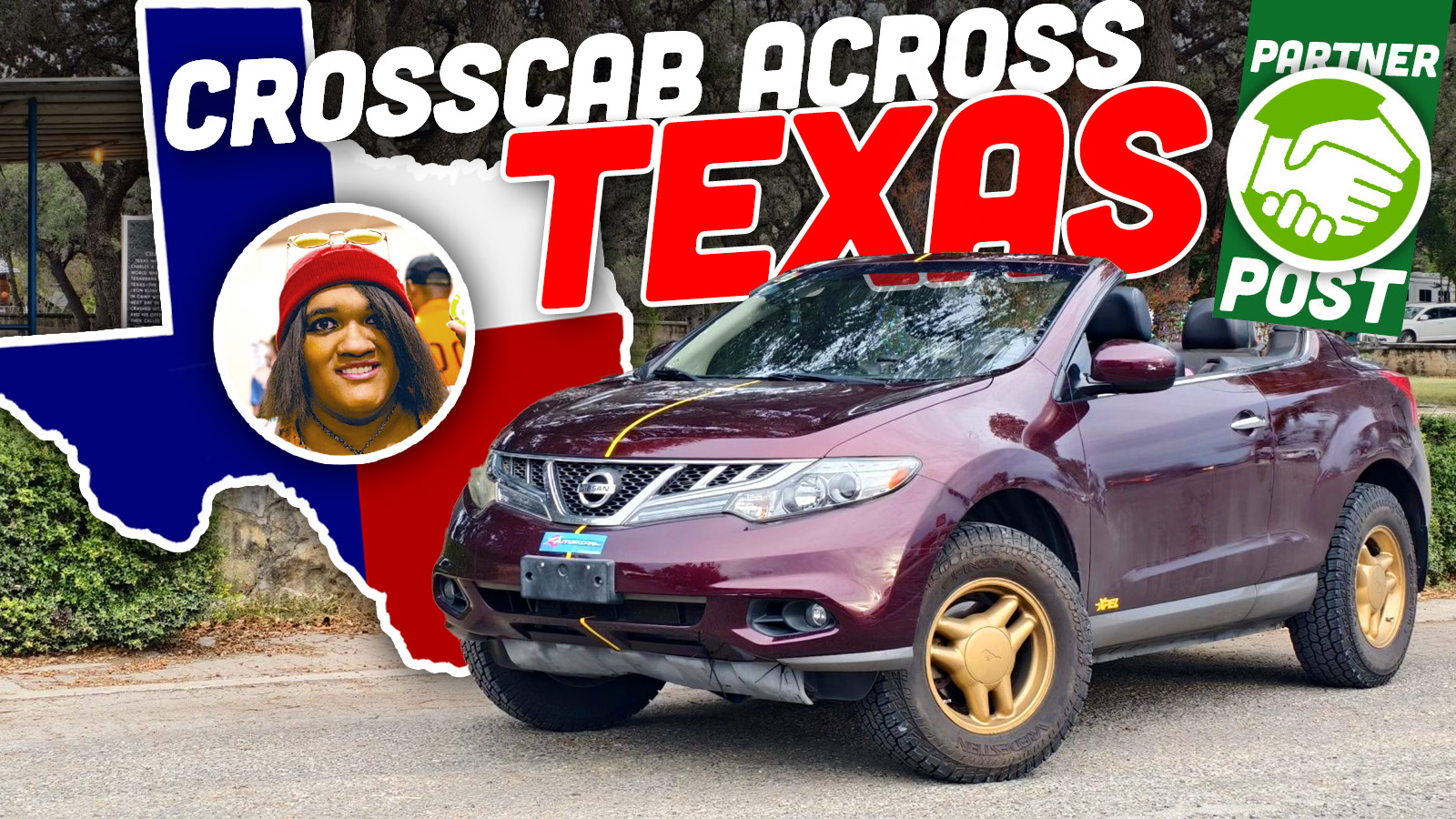
Learning history isn’t always fun or particularly engaging. A textbook is sometimes as great a method to educate yourself as it is a way to induce sleep. But I found perhaps one of the best ways to learn about America and its states, and it’s through a road trip. Last month, I drove more than 2,000 miles across Texas. But this trip wasn’t entirely random. I took part in the Lone Star/No-Start Lemons Rally, an event where a bunch of weird people intentionally drive old and broken cars across a whole state to have fun and discover a shocking amount of history that they might not have learned otherwise.
It was one of the longest single road trips I have ever taken. I flew out to Los Angeles, California, where I met the Autopian’s Nissan Murano CrossCabriolet for the first time. I then drove 4,050 miles across most of America. The CrossCab battled Los Angeles traffic, went rock crawling in Sedona, Arizona, cannonballed through New Mexico, explored Texas, and then raced north to Illinois. The Texas section alone was a touch over half of the mileage. I drove 2,070 miles around the Lone Star State, and, wildly, the drive wasn’t as random as it would sound.


One of my car enthusiast dreams has been to get involved in the 24 Hours of Lemons. I already off-road crapcan cars in the Gambler 500, so an endurance race in garbage cars is near to my heart. 24 hours of racing is hard on any car, let alone a pile of junk. A 24 Hours of Lemons is a race where just finishing at all is basically an accomplishment. But Lemons isn’t just about racing total buckets, as the series also has what it calls the Lemons Rally.
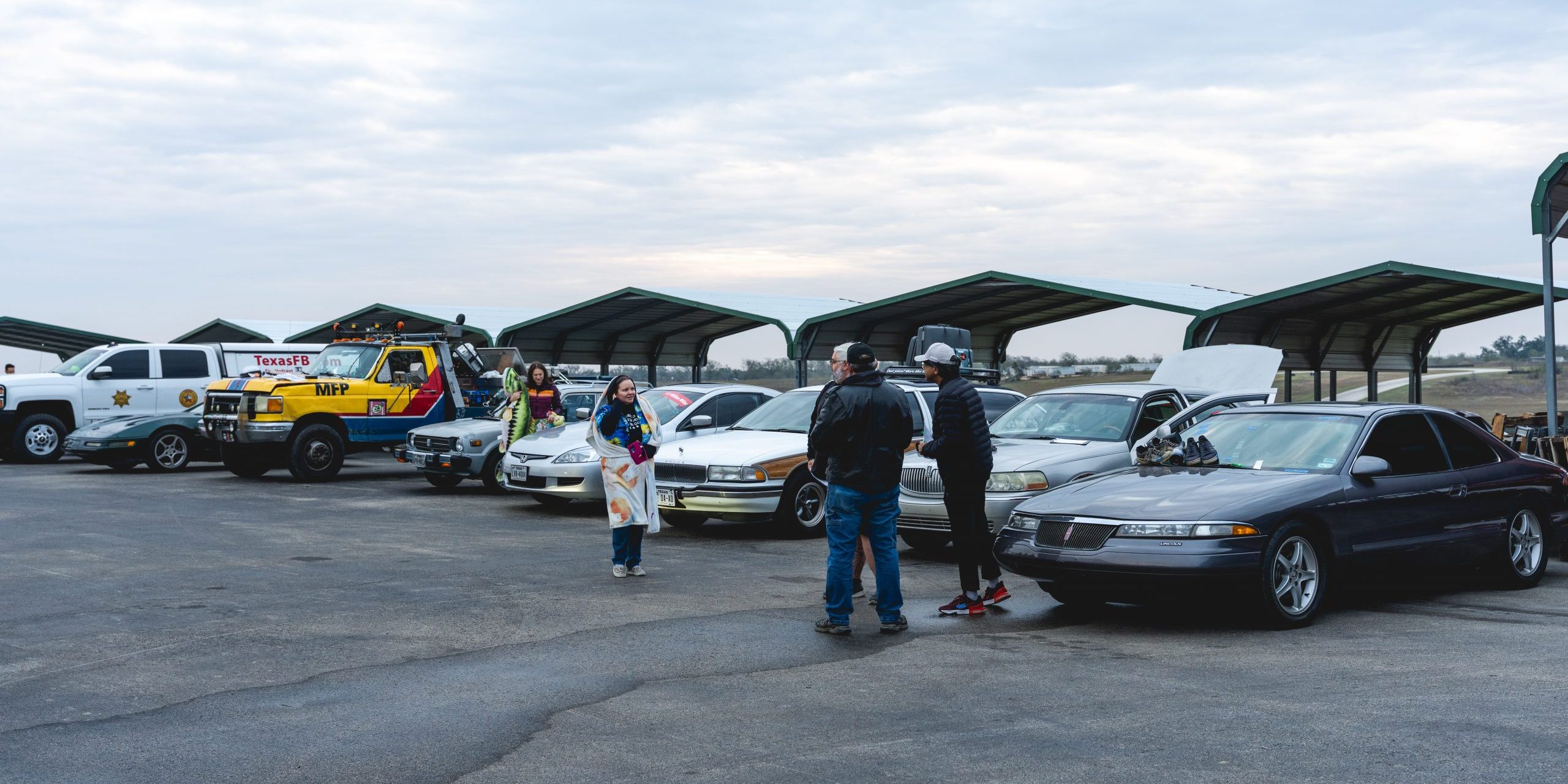
On the surface, a Lemons Rally sounds similar to a Gambler 500. You gather up a bunch of weird people, put them into cheap cars, and then drive across a region, hitting up checkpoints along the way. At first, I thought the main difference between a Gambler and a Lemons Rally is that a Gambler 500 is designed to be as much off-road as possible. Instead, what I learned is that the events are entirely different, totally awesome experiences.
A Lemons Rally is a road trip featuring trashy, but road-legal cars. But it’s way more than that. The checkpoints aren’t just random places to drive. The vast majority of stops are miniature educational experiences. Some are small and cute, like a giant cutout of Matthew McConaughey in his birth town or the so-called “Spinach Capital of the World.” Other times, you learn some deep local or national history that you almost would have never come across on your own.

Our excellent videographer Griffin and I arrived at the start point of the Lone Star Lemons Rally bright and early on Friday, December 5. We had already been on the road for four days by that point, and had driven 1,980 miles. I had no idea what to expect. I thought that, like a Gambler 500, maybe we’d drive something like 500 miles, or maybe 1,000 miles at the most. Oh my, I wasn’t prepared for the madness.
One of the silliest parts of our morning was finding out that we brought one of the most normal cars. Most drivers rolled up to the start point in something vintage, unreliable, or cobbled together from five other cars. We saw a Honda Odyssey wearing the front end of a Pontiac Aztek, a Plymouth Valiant wagon with mini backyard furniture and a flamethrower on its roof, one of the cheapest running and driving Corvette C1s in America, and even an old Ford Crown Victoria Police Interceptor filled with guys wearing very convincing orange jumpsuits labeled “D.O.C.” on their backs.
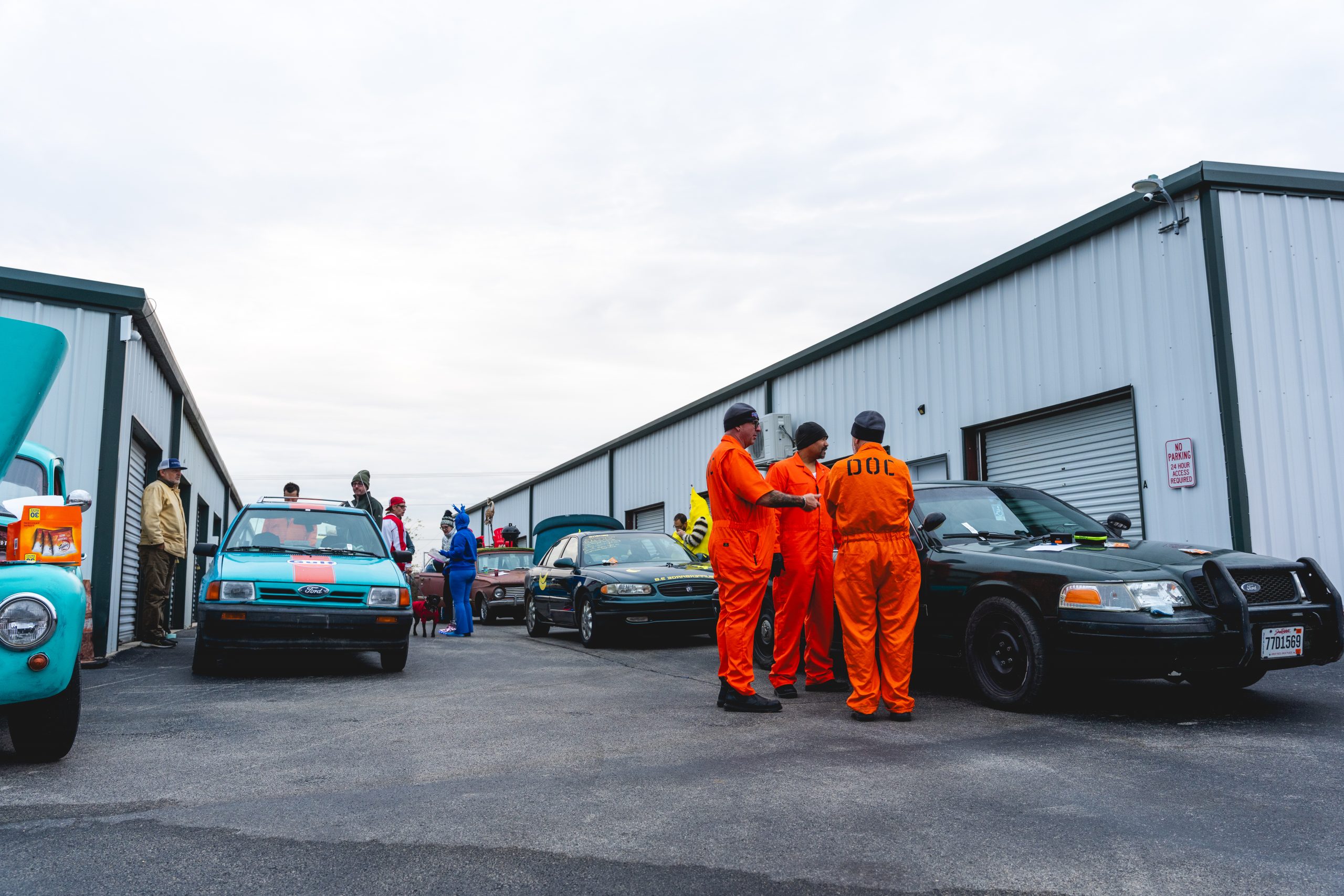
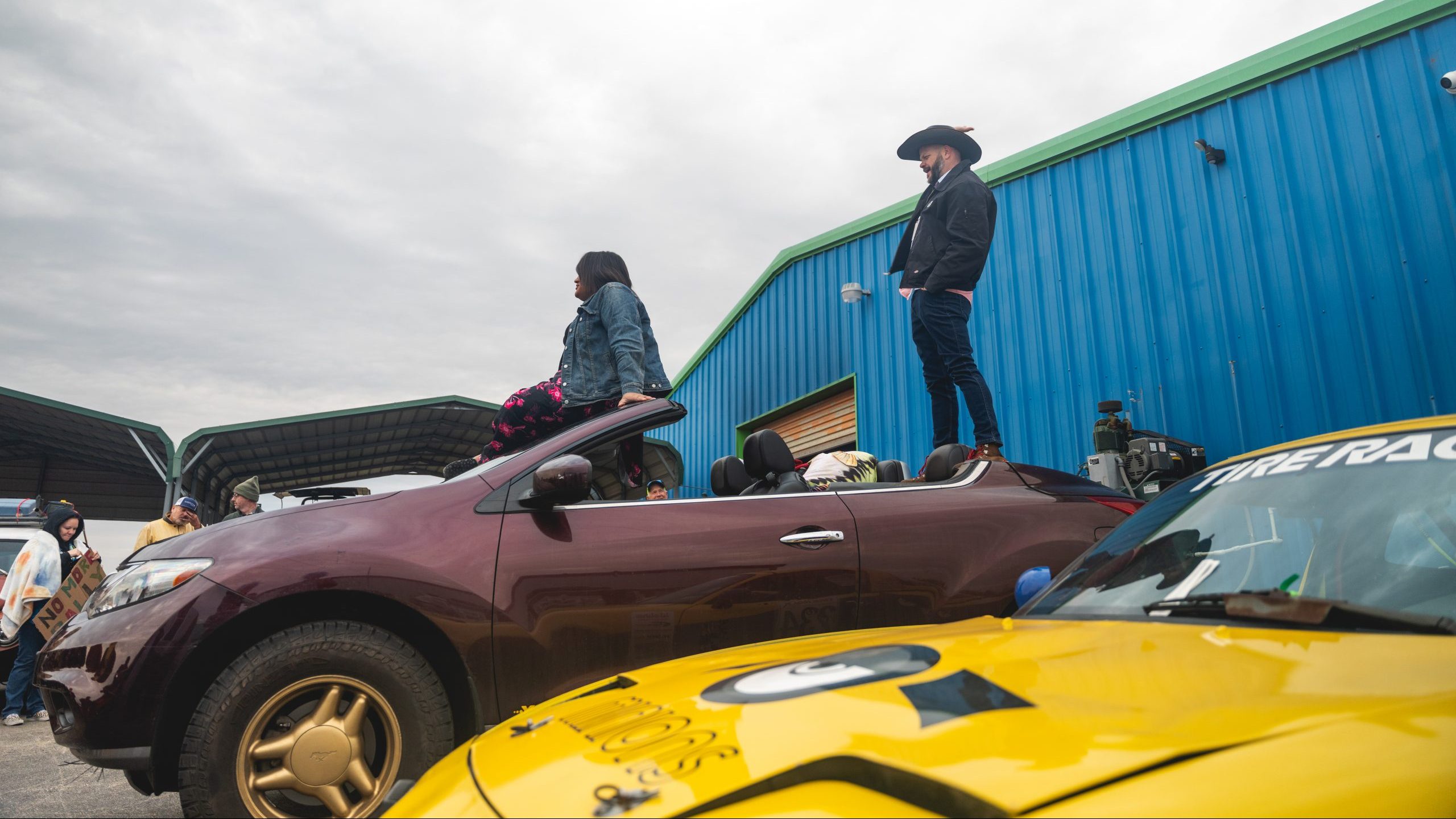
The CrossCab is normally a strange car, but it looked comparatively pedestrian in this group. The only cars that were more “normal” than us were a rental Tesla Model 3, a stock Ford Mustang convertible, and a Lincoln Mark VIII. Everything else was crazy cranked up to 11. Even cars that looked fairly regular, like the BMW E39 wagon, had some sort of story to tell. In the BMW’s case, the darn thing was completely totaled twice, with the second time being submerged during a hurricane.
The CrossCab would also be one of the most reliable cars of the weekend. We passed by countless people wrenching on the side of the road, and heard stories of shadetree hacks guys did to get their cars back into the rally. Us? The CrossCab never gave us an issue outside of abysmal fuel economy and a whole lot of twerking thanks to a failing wheel bearing.
I cannot cover every single stop on this trip. Not only did we not hit every checkpoint, but writing about every one would balloon this post to 10,000 words. So, I want to write about some awesome highlights that demonstrate what I mean by the educational aspect of the Lemons Rally.
We left San Marcos bright and early in the morning. One of the rules of the Lemons Rally was that once we retracted our convertible top, we could not put it back up for the remainder of the rally unless we were parked at the overnight halt. If we broke the rule, we’d lose all of our points. I intended to follow the rule to the letter. So, when we left San Marcos on that brisk morning, we turned up the heat and rolled up the windows. The CrossCab was surprisingly good at keeping the cabin warm with the top down.
Lots Of Learning

Our first stop was the Old Tunnel State Park, which Texas Parks and Wildlife describes as:
Old Tunnel State Park’s namesake—the railroad tunnel—symbolizes persistence and resourcefulness. When European settlers moved into this area in the mid-1800s, they needed a reliable way to connect nearby Fredericksburg to San Antonio. The Big Hill stood in the way. Since trains weren’t quite powerful enough to climb this ridge, the rail line needed a tunnel. But the cost of breaching the Big Hill thwarted their plans. By 1913, locals raised enough money to build the tunnel.
Workers bored 920 feet through solid limestone—that’s the length of two and a half football fields! Around 100 workers, probably local laborers of German descent, dug out most of the tunnel by hand. During its construction, the tunnel became a popular tourist attraction, much like it is today. The San Antonio, Fredericksburg, and Northern Railway used the tunnel until 1941. Despite its popularity with local residents, the rail line was never profitable. It was deemed unessential to the World War II effort and was dismantled, so the ties and rails could be used for other things.
Once people abandoned the tunnel, new residents moved in: bats. Old Tunnel State Park is the smallest state park in Texas at 16.1 acres.

We never got to see the old tunnel. However, what we did see was a breathtaking view of the Texas Hill Country. I’ve been to Texas countless times in my life and, prior to this trip, I had no idea that Texas had rolling hills like this. If you told me that this was Appalachia, I would have believed you.
From here, we drove to a dam with a lot of birds, and a road where the sign was punched into a tree. We also stopped by the Riding River Ranch, a place for folks to get away and go for a swim, a hike, fishing, or wheeling. The big revelation here was the discovery that Texas has some unexpectedly epic driving roads. You can read my story about that by clicking here.

As our day continued, we got back into learning some history. One of those stops was this plaque right here, seemingly in the middle of nowhere in Camp Wood. Lindbergh landed in Camp Wood on the way to California. He then crashed into a store. Apparently, Lindbergh made so many friends that nobody cared that they didn’t even accept payment for the mangled store. Camp Wood loves Lindbergh so much that there’s a tiny monument to him.
The wild thing about this is that Camp Wood looks like any other American small town. Yet, apparently, it has a thing for Charles Lindbergh to this day. I wonder how many people drive by this plaque every single day without noticing it?
Not The Real Alamo

Our biggest stop of the day was a place called the Alamo Village, which is north of Brackettville. This isn’t the actual Alamo, of course, but ruins of a tourist attraction and film set. From the Texas State Historical Association:
This replica of an old Texas town was first a set for a Western movie on the battle of the Alamo, but it remained a tourist attraction for almost fifty years. The idea for the complex was developed by James Tullis (Happy) Shahan after he was elected mayor of Brackettville in 1950. The town’s economy had been ailing since the army deactivated Fort Clark in 1946. Shahan persuaded Paramount Studios to film Arrowhead at Brackettville in 1951. Two other movies followed before John Wayne filmed The Alamo on Shahan’s ranch near Brackettville—The Last Command (1955) and Five Bold Women (1959).
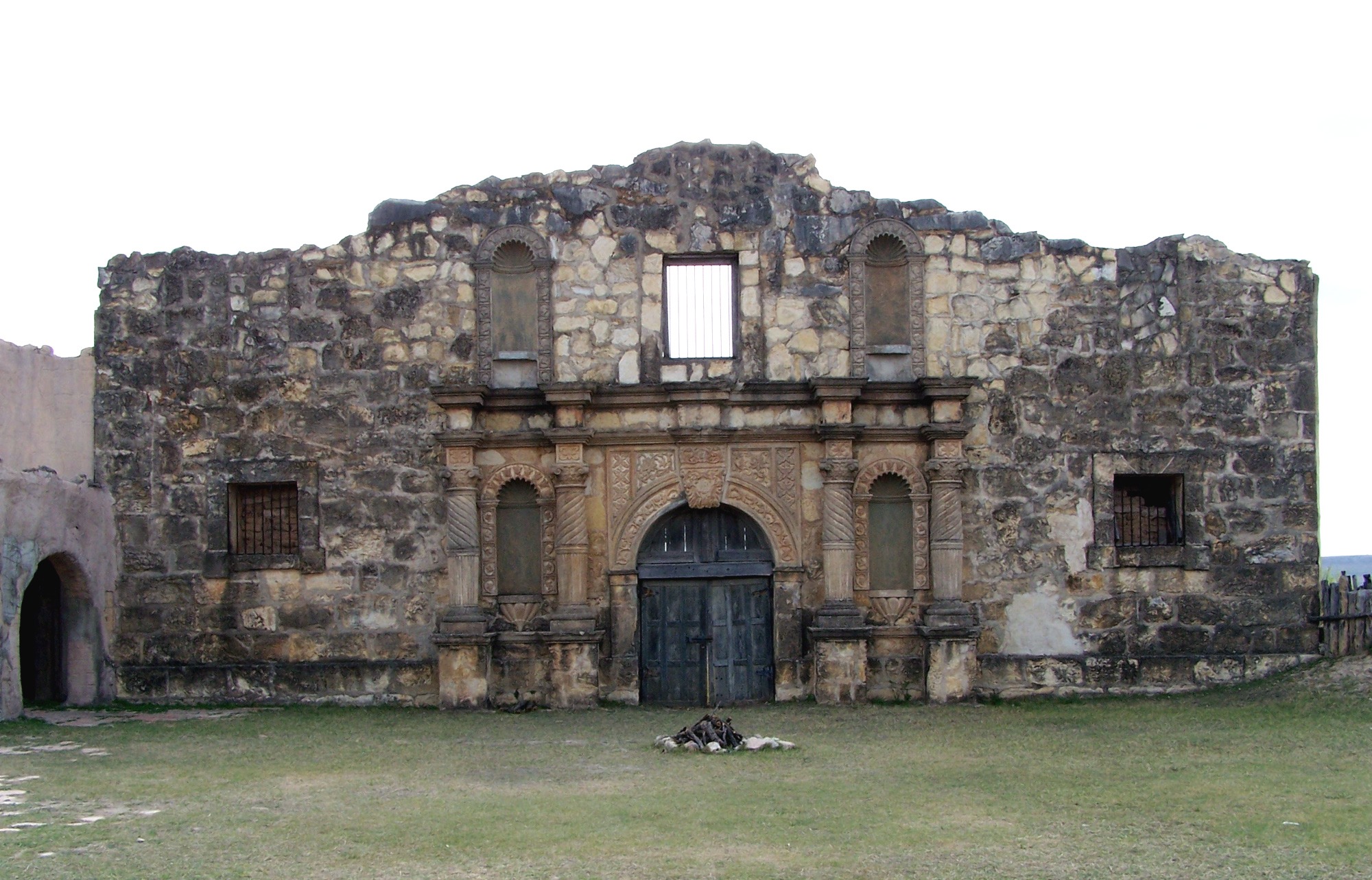
From December 1957 to September 1959, when the filming of The Alamo was begun, the Batjac Company preproduction crew supervised a $12 million building program that involved up to 400 workmen at one time. The set was a two-pronged undertaking: an 1836 facsimile of the Alamo and the pueblo of San Antonio de Béxar. Artisans from Mexico made adobe bricks as they were made three centuries ago. More than a million bricks were used to construct 200,000 square feet of permanent buildings in pursuit of verisimilitude. Veteran art director Alfred Ybarra based the Alamo replica on careful research that included obtaining plans sent to Spain by the Catholic priests who built the mission. There were no “false front” streets. Electrical and telephone wiring was concealed in more than ten miles of underground casing. Other modern infrastructure included fourteen miles of road, a 4,000-foot airstrip, and six water wells.

After production of The Alamo, Shahan acquired the set, which housed a cantina and restaurant, a trading post, an Indian store, a church, a jail, a blacksmith shop, museums of western artifacts, and a gallery of celebrities who performed on the dusty streets of this little village. Alamo Village was filled with antique tools and vehicles. A herd of longhorn cattle contributed to the Old West atmosphere. The set was used for several other films in need of an Alamo replica, namely Viva Max (1969), The Alamo: Thirteen Days to Glory (1987), and Alamo: The Price of Freedom (1988), and proved useful for a number of Western movies, such as Bandolero! (1968), Barbarosa (1982), Lonesome Dove (1989), and Streets of Laredo (1995). The set was also used in documentaries, music videos, commercials, and television shows. Nevertheless, Alamo Village operated primarily as a tourist attraction. From Memorial Day to Labor Day live entertainers were hired to perform country music, Western melodramas, and stage shoot-outs. Horseback and stagecoach rides were available. The activity of the summer months culminated in the Labor Day Horse Races, which drew the largest annual crowds to Alamo Village. All of the buildings and facilities were open to the public year-round.
Alamo Village shuttered in 2010, then briefly reopened in 2018 just to close again. It was entirely inaccessible during our visit. One reminder of the property is the gate, which still bears some signage from its old life.
Even The Quick Stops Were Fun
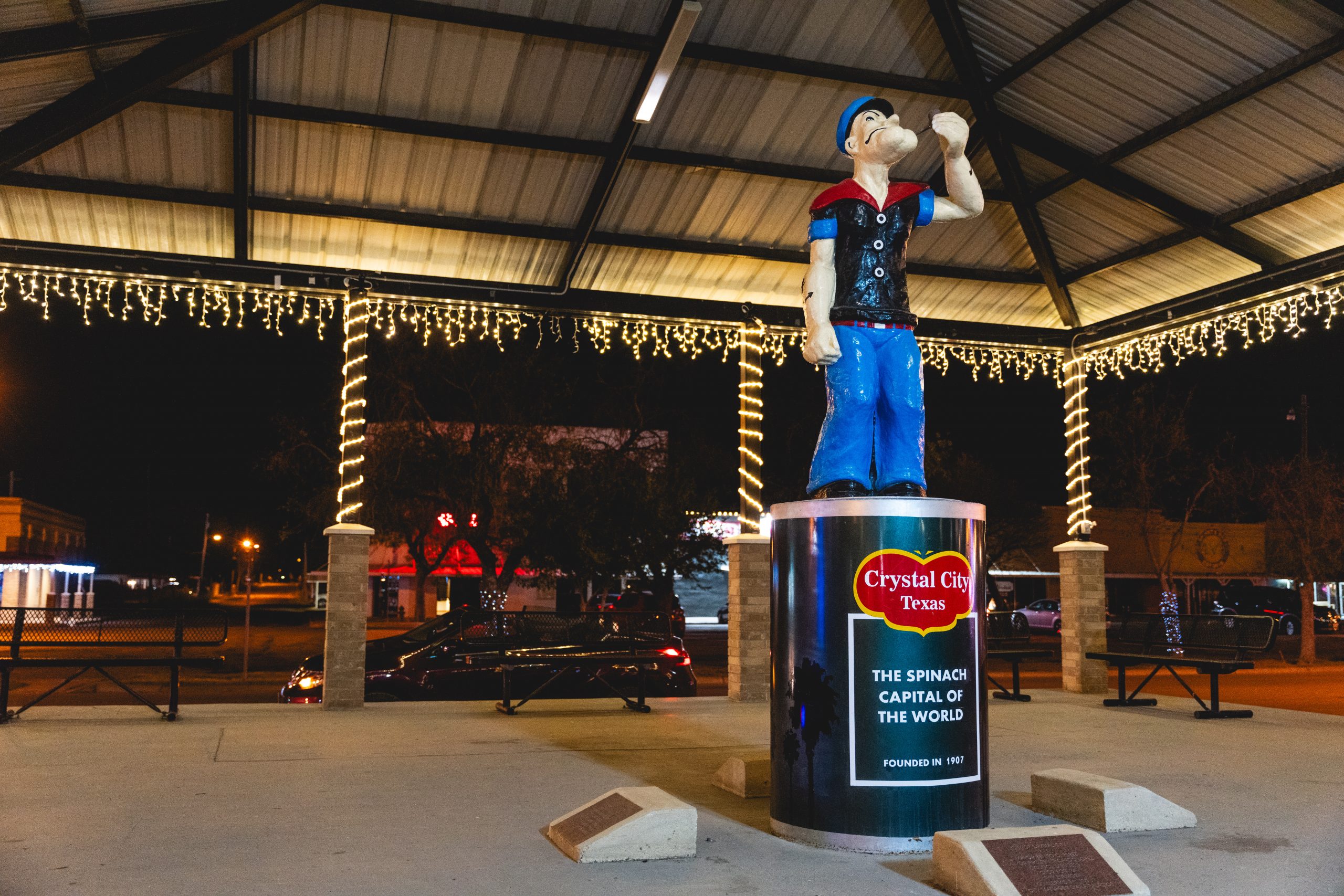
As the day turned into night, the history never stopped. We drove through Crystal City, an area that claims to be the “Spinach Capital of the World” due to the city’s insane spinach production in the 1930s. Amusingly, more than one town wants to claim to be the capital of spinach, and the other main competition is Alma, Arkansas.
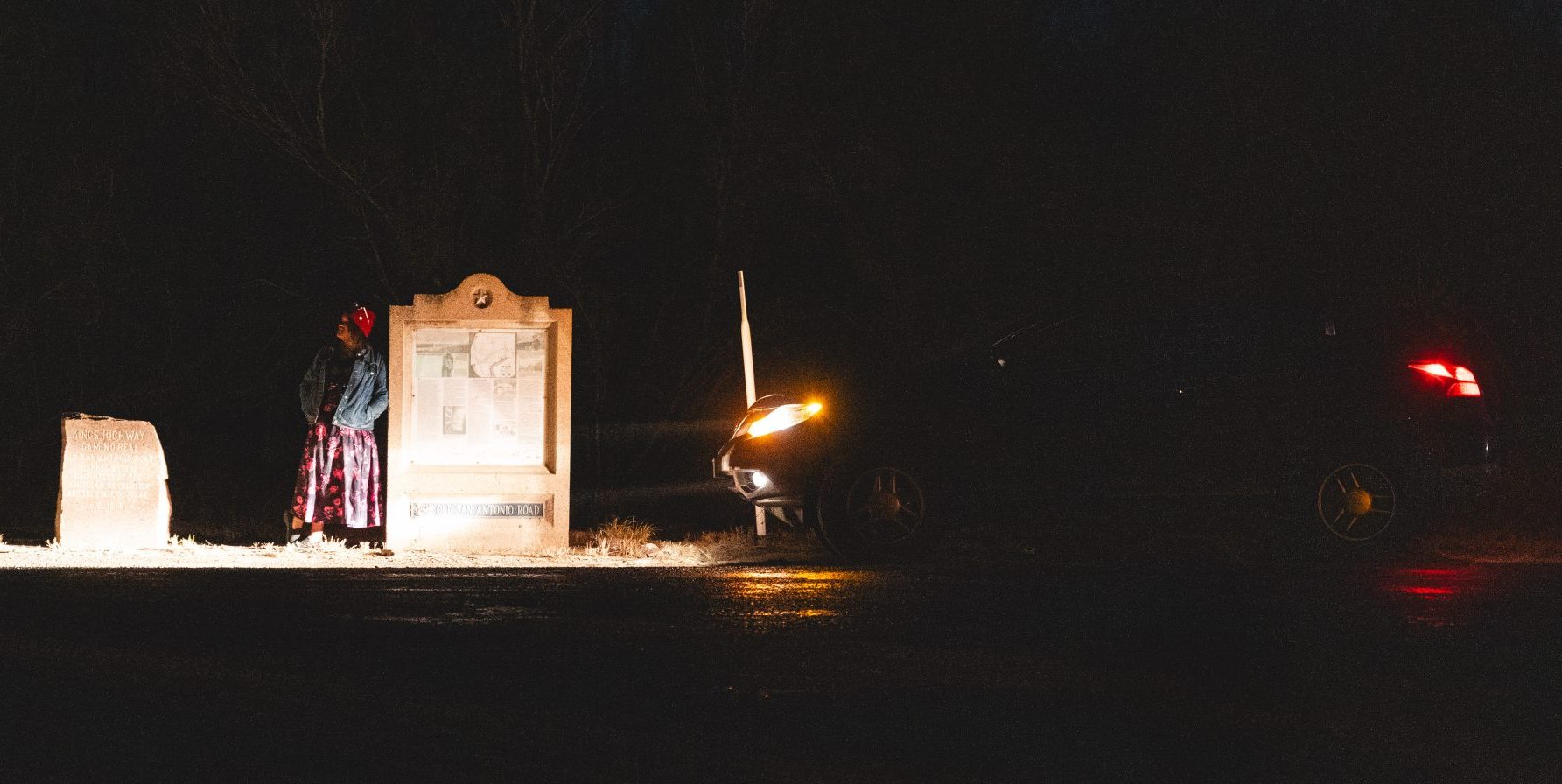
We also stopped by this sign on the Old San Antonio Road, where a faded slate told the story of how it was originally branches of trails that linked Native American settlements, but would later be used by Spanish explorer Alonso de León in 1690 in his quest to establish a mission in East Texas. The network of trails was also once a vital link between East Texas and Mexico City. The Texas State Historical Association says that the road stretches some 540 miles through Texas and another 48 miles in Louisiana.
Our day ended in Laredo, itself a city chock-full of history. While there, we stayed at the historic Rialto Hotel.

This building was constructed in 1925 and lived much of its life as the Sames Moore Building, a reference to the Moore and Sames families that owned several businesses in the area. For decades, the building was home to doctors, accountants, attorneys, and anyone else who needed office space. In 2005, the building was converted into a hotel, and retains a lot of its original elements as sweet easter eggs about its past.
The History Was Non-Stop
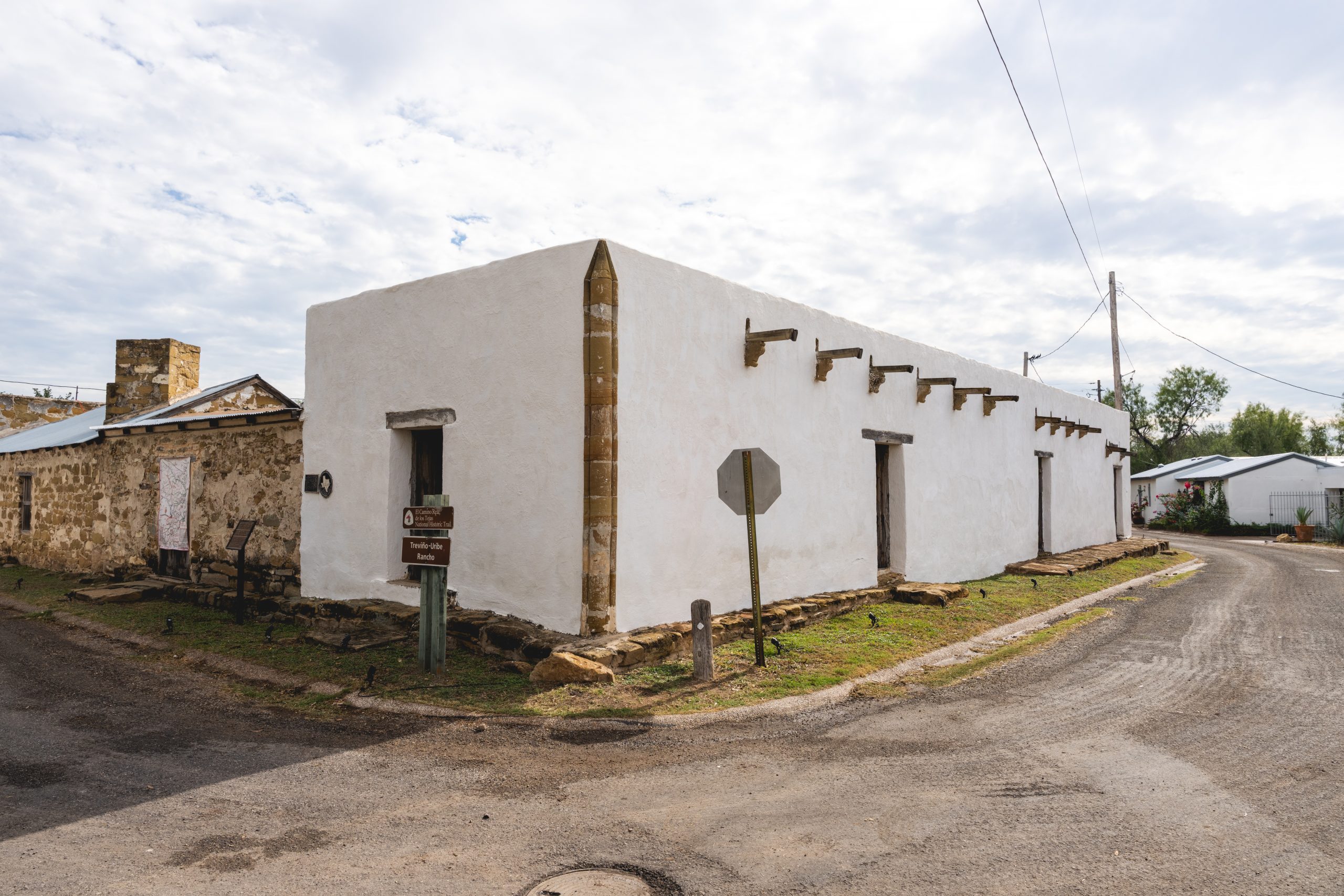
The second day of the rally laid the history on full. We departed the Rialto and drove to the river on the U.S.-Mexico border. Then we drove off to the Treviño-Uribe Rancho, a fort that will drop your jaw to the floor and keep it there. From the National Park Service:
This national historic landmark was settled in 1830 by former residents of Revilla (now Nuevo Guerrero, Tamaulipas) under the leadership of Jesús Treviño. The site was in the southwest corner of the original Hacienda de Dolores, a grant made in 1750 by Col. José de Escandón to José Vázquez Borrego, and was named for the patron saint of Guerrero, Saint Ignatius Loyola. In 1830 Treviño built a sandstone home, known as Fort Treviño, 100 by 140 feet. José Villareal placed a sundial at the home in 1851; the timepiece has become a tourist attraction. San Ygnacio became a center of trade by the mid-1800s, and the town was the scene of several border skirmishes throughout the years.
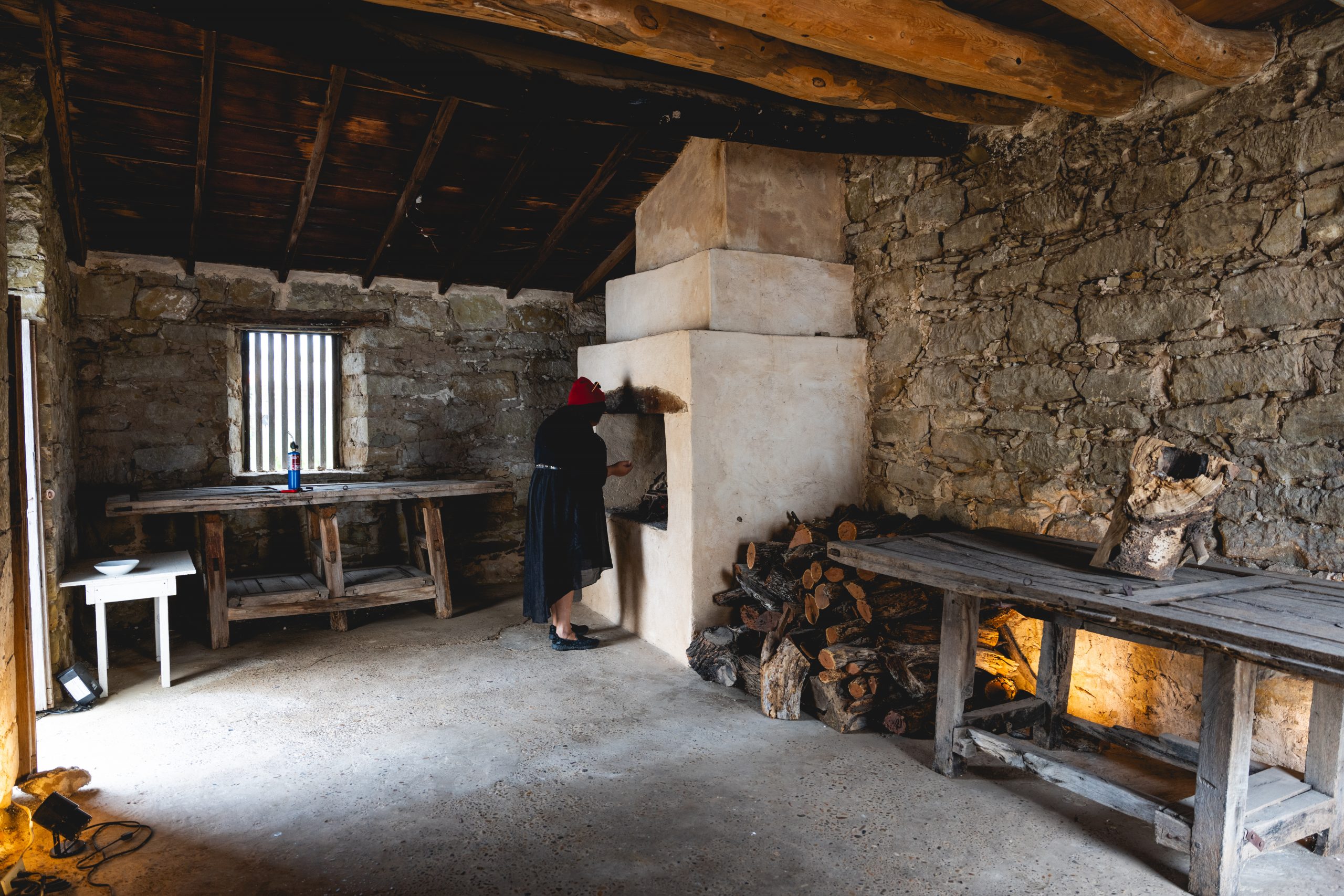
Like many frontier buildings of its era, the fort is fortified by strong walls that protect a courtyard within. Its walls have no windows, only small gunports through which those inside the fort could fire at attackers outside. The fort sits on a small bluff above the Rio Grande, and the lush vegetation and plentiful birdsong creates an almost tropical feeling.

It was at the fort where we found a group of rally participants fixing the Valiant. As it turned out, the classic car cooked its front wheel bearing, and it had to be fixed right away. Everyone banded together and kept spirits high by turning a wrench or two, telling a joke, and generally being awesome to each other. To these people, the triumph of a roadside repair might have been greater than hitting checkpoints.
We ended up losing a couple of hours or so to fixing the Valiant. Yet, nobody really cared. They just crossed off checkpoints they could no longer reach and hit the road. Griffin and I decided to join the group because the vibes were that good. In that moment in time, nobody cared about politics, nobody judged you, and the world was just your cars, the open road, and fun people. On the day before, we drove solo. Convoying with other Lemons drivers made things so much better that acquiring checkpoints no longer mattered.
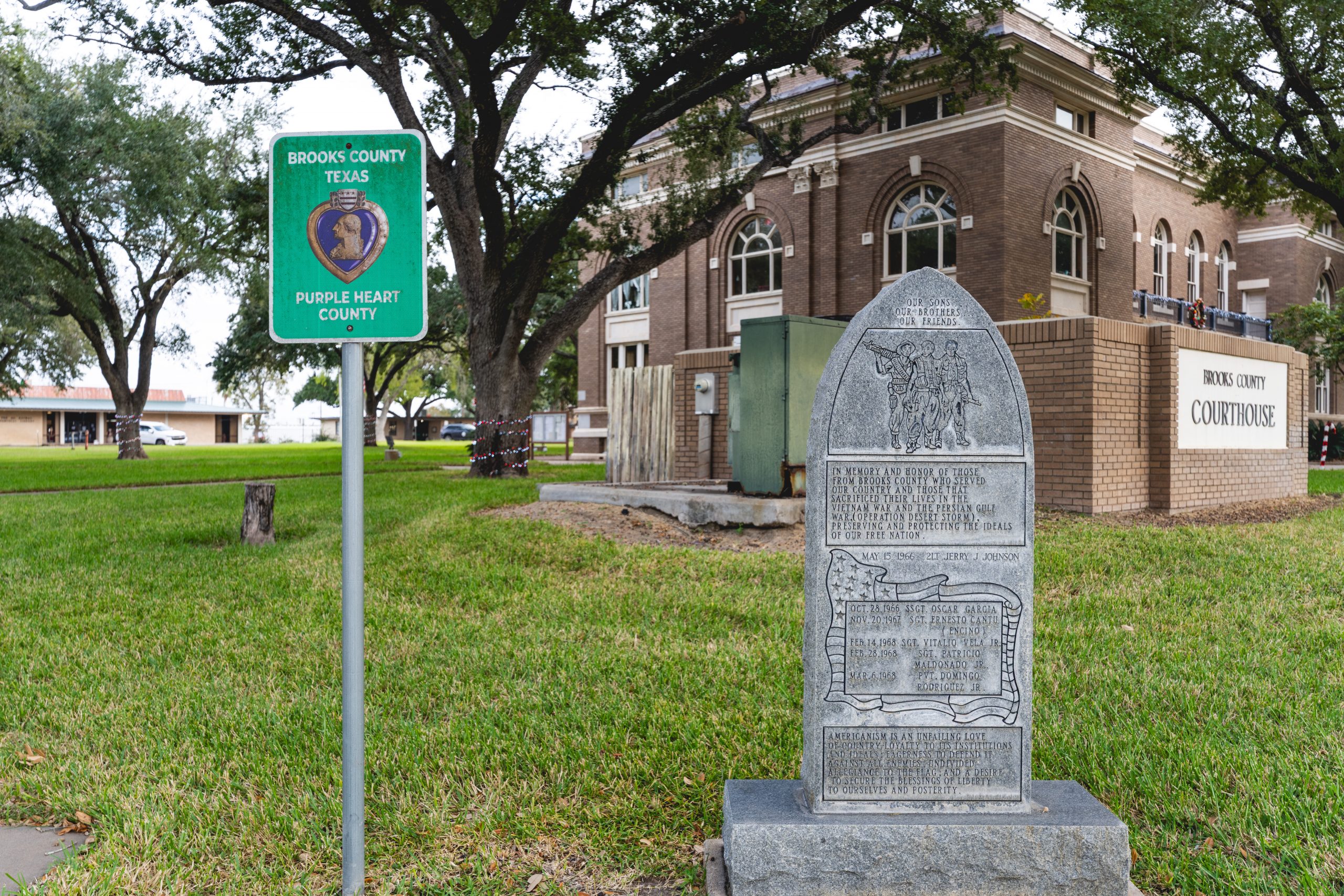
Due to the truncated nature of the day, we missed a lot, but still saw some fascinating landmarks. One was the Brooks County Courthouse. The courthouse was built in 1913 and 1914, and is named after James Abijah Brooks, a former Texas Ranger who had a reputation for solving disputes with guns rather than words. Later, he would become a judge. If that’s not the most Texas thing I’ve ever heard, I’m not sure what is.

Later, the group would find itself in the middle of a random park, where we found this McDonnell Douglas A-4 Skyhawk “City of Kingsville.” This aircraft was placed on this plinth back in 1989 to honor those in Kleberg County who served and everyone who trained at Naval Air Station Kingsville since it opened in 1942.

What was notable about this aircraft was its astoundingly poor condition. The airframe was riddled with holes and heavy corrosion. It was in such bad shape that the cables that secured it to the ground were no longer attached to anything. If you pulled gently on one of these cables, the whole airframe jiggled. I fear one decent windy storm would probably take it down, which is sad.
We ended our day with stops at the USS Lexington, the Selena Memorial Statue, and, finally, our hotel right on the coast of Corpus Christi. Some folks who got an earlier start to their day managed to drive their hoopties on the dunes on Padre Island. Sadly, as much as I would have loved to do that in the CrossCab, we did not have any time. Granted, I don’t think I cared all that much, because I got to party through the night with fellow car nut Stef Schrader and some Lemons guys.
One Last Run

The final day consisted of a drive back to San Marcos, where we started. Like the other days, there were a lot of small and tiny stops, such as a resort where Elvis went tubing once, what was supposedly the world’s largest peanut, and a gigantic skull.
I had two highlights from the final day. One was the ruins of the Saint Dominic Church in D’Hanis. Here’s its story, via the Austin Chronicle:
Between 1843 and 1847, Henri Castro brought 485 families and 457 single men to Texas. Most were French and German from Alsace. Of the four villages the immigrants founded, D’Hanis, named for the colonization company’s Antwerp manager, was the last in 1847.
A priest came from Castroville to minister to the 29 families who made up the settlement. The grand church was finished in 1854 with an extension added in 1869 that included a towering wood steeple.
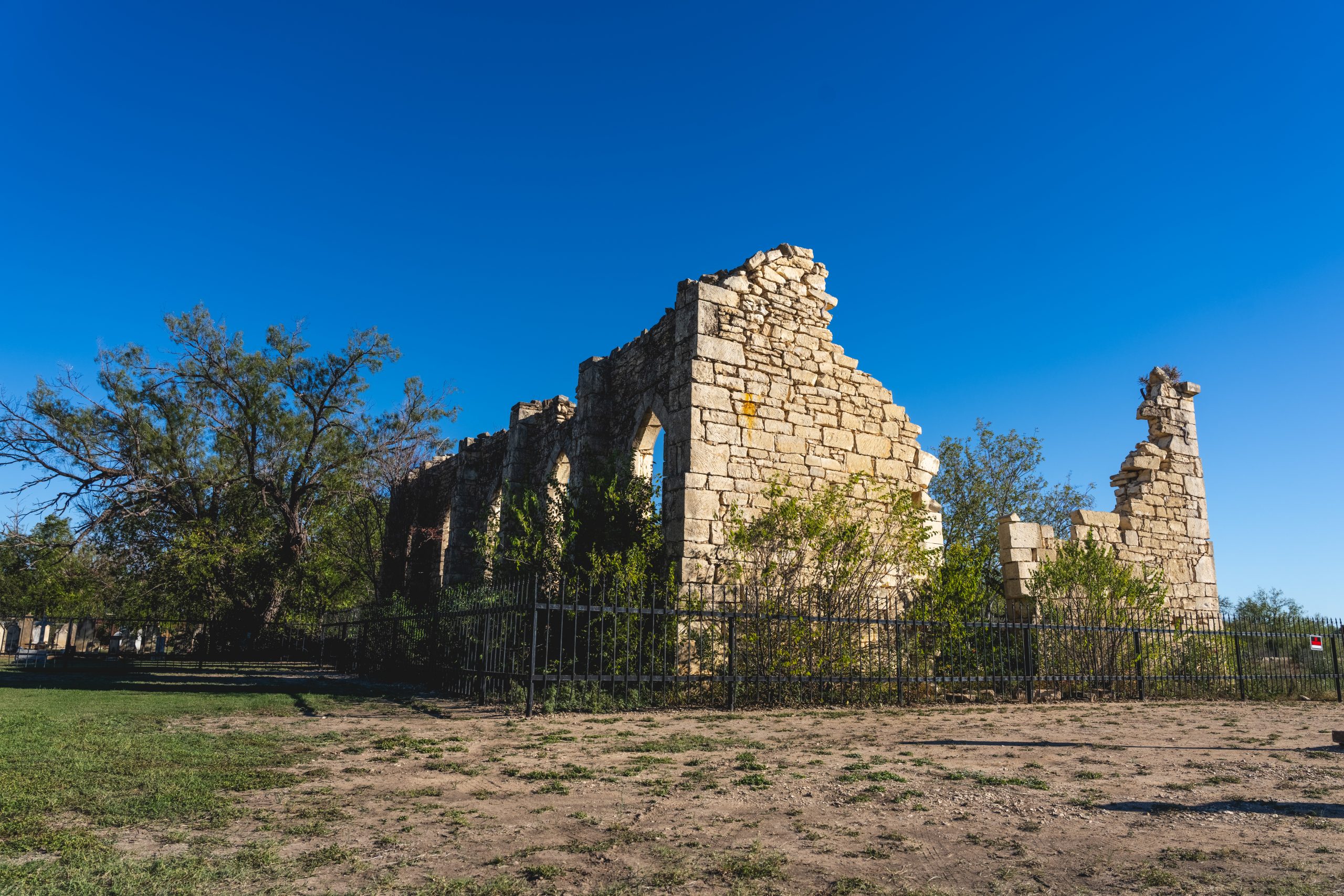
It all came tumbling down in 1912 when the stone and timber church caught fire. By then, most of the residents had moved 1.5 miles west to be closer to the railroad at New D’Hanis, where they built a new church.
What was fascinating is that the old incarnation of D’Hanis eventually featured European-style buildings, reflecting the origins of its residents. Sadly, the church ruins are just about the only surviving piece of history from this period. The cemetery is another fascinating bit. It was used until a diphtheria epidemic swept through the area in 1893. This graveyard still holds the remains of the German settlers, and if you look closely, you’ll notice that many of the headstones have inscriptions in German.
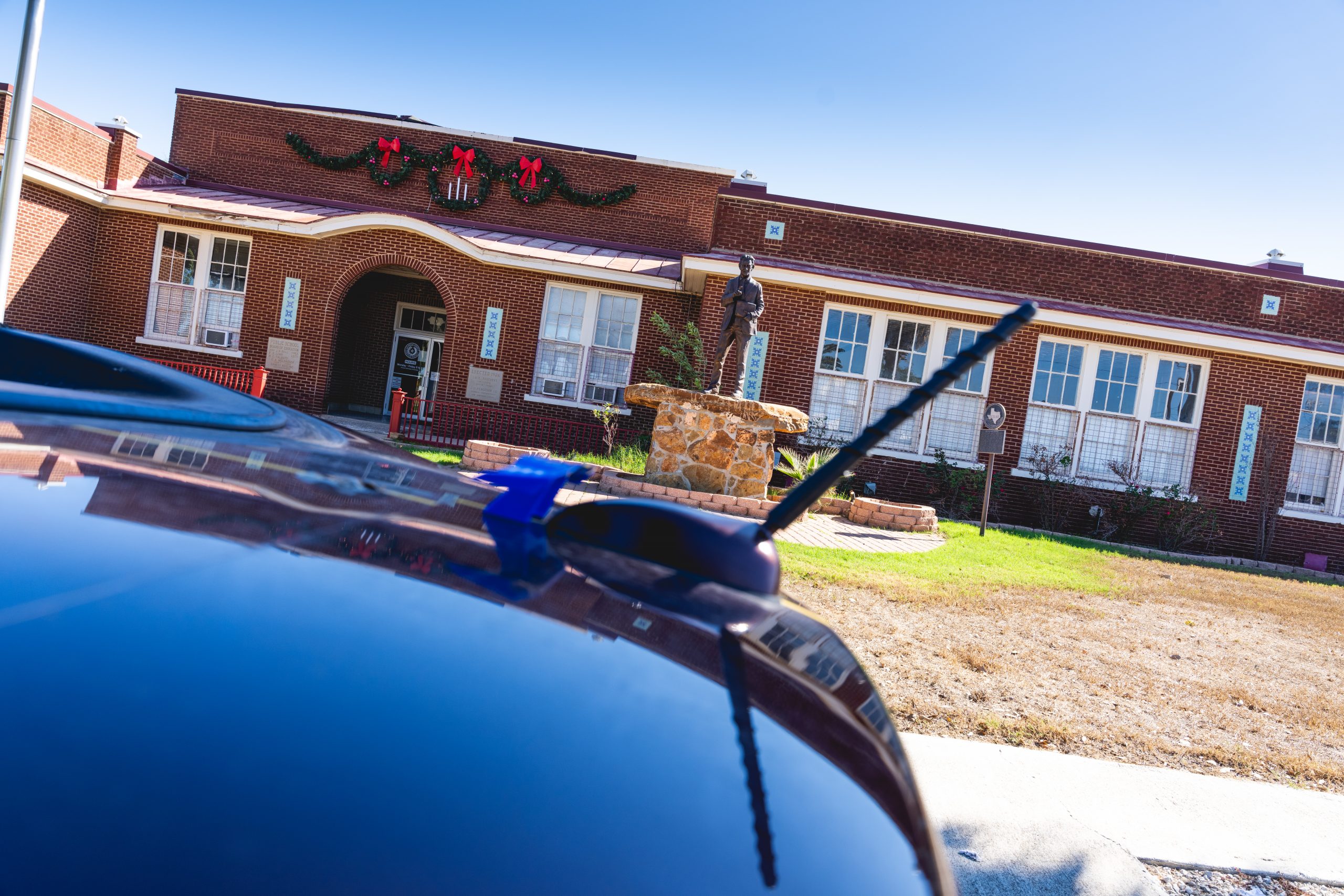
Finally, we have the Welhausen School. Its stake in the soil of history is being the place where a 20-year-old Lyndon B. Johnson taught children beginning in 1928. At the time, the school was only two years old.
In remarks dated 1966, LBJ noted that the school didn’t have a lunchroom or school buses. The school couldn’t even afford to buy playground equipment or volleyballs. LBJ said he cared about the health and education of the students and spent much of his income on equipment and textbooks. He even moonlighted as the school’s janitor.
Cars, History, And Wonderful People

When all was said and done, I felt like I had learned more about Texas in a single weekend than I had in years through Wikipedia and random internet searches. This wasn’t just a road trip, but an educational journey. It’s like one of those kid shows where an animated character travels to some part of the world. But this was real, and our crappy cars were the vehicles to get us to that education.
The people made it even better. I got to see so many creative cars and had the privilege of meeting the glorious people who owned them. Everyone had a great story to tell about how they ended up in Texas and why they went with whatever their theme was. There was a couple who challenged themselves to drive through rural Texas in a rental Tesla, the fake convicts, the Nixie tube-obsessed Volvo brothers, and even a guy who bought a broken classic Corvette without any idea how to fix it. All of these people were colorful, awesome, and brought a smile to my face.

Oh, and those Tesla people? They had to leave the hotels absurdly early to hit the checkpoints, but by golly, they hit most of the checkpoints. They somehow found charging in even the most remote places. The overall winner was a pair of fellas dressed like Mario and Luigi who somehow got every single checkpoint despite spending some considerable time on the side of the road with a broken Fiat.
Somehow, the Autopian got an award, too. We didn’t win anything based on checkpoints, theming, or any real silliness. Instead, we sort of embraced Lemons culture with open arms. We never closed the roof, even when it rained, and we were kind to everyone. Perhaps it was a refreshing change from the apparent auto journalist stereotype of being a massive jerk to everyone and acting entitled. Either way, my reward was some Flarp! Noise Putty, which I took with pride.

I’m also now addicted to the Lemons Rally. I’m already planning my return this year, and I want to commit even harder. I want to bring a crappier car, give the car some real theming, and try to hit more checkpoints.
If you’re interested in a Lemons Rally, I highly recommend doing it. There are Lemons Rally events all over America, and I hear that all of them are epic. Admittedly, you might cringe at the $500 entry fee, but after running the Lone Star rally, I get it. Lemons organizers go through some incredible work to put these rallies together. It’s not easy to find all of this history!
If you swing the entry fee, you’ll have an experience you’ll never forget. Who knows, maybe you’ll end up driving 2,000 miles across a state and learn facts and history that you never knew were possible.




Yes ha ha ha ha ha YES!!! This one had really good stops, and I liked the swing through south Texas for a change.
Come east and do the Oppo Rally, too! It’s June 27, IIRC. Similar deal, but typically one day and a little more chaotic.
Such a cool adventure. I really miss America.
The Mark VIII was such a nice looking car.
Was it any good as a car?
They are good highway cruisers, cool interiors for their time, decent performance from a 32 valve V8. Downside is problematic air suspension, mediocre 90’s Ford build quality, and I think it is hard to find some parts for them now.
The Big Peanut!
“ A pair of fellas dressed like Mario and Luigi who somehow got every single checkpoint despite spending some considerable time on the side of the road with a broken Fiat”
I gotta meet these guys.
That looks like a really, really good time!
Someday.
I hope you were respectful, as some of them may be my ancestors.
That was a really cool graveyard. I spent some time looking through it and it definitely looks like folks still drop in and look after things. I love that.
Awesome experience! As I’ve mentioned before I’ve been heavily involved in the 24 Hours of Lemons, both as a racer and on staff, but I’ve yet to do a rally and I really want to. Several of my friends have, and I know rally master Jeff. I was hoping this would be my year to do it, especially as the CA event will be their 10th anniversary, but this year’s PTO is being monopolized by a trip to Japan. I know, boo-hoo.
There’s apparently a discounted entry fee, details to be determined, for anyone who runs the tenth anniversary rally in the same vehicle as the inaugural rally. I may have to do this if I can decide whether to try again with the vehicle I attempted to run at first or with the vehicle I actually used for days two through five. I’ve still got both. Both currently run. Currently.
Can either be outfitted to tow the other? Seems like that would cover your bases and get you some creativity points, but they may bill you for two cars?
They both have trailer hitches but I imagine the ’70 International 1200D would have an easier time towing the ’76 Volvo 66 GL than the other way around. Still, it was the Volvo that failed ten years ago…
do it, do it, do it
I think I’m out for the 10th anniversary run, but I have to do Oregon Trail on principle. Wouldn’t be the first time someone in this family took that route, heh.
Fair warning: Of my six Lemons Rallies so far I’ve managed to leave home, complete the rally, and arrive home all in the same vehicle only twice.
Clearly, you need to bring an even LESS reliable car!
But that would mean I’d need to get yet another… Oh, I’m liking this idea.
Yes, ha ha ha ha HA HA HA HA HA YES!!!!!
I’m going to assume that Honda with an Aztek from end came from Minnesota, there can’t possibly be more than one. If so, the owner lives across the street from good friends of mine and I’ve seen this van. I can’t believe you left out the part about a how it has been modified in to a rolling, functional game of Operation.
What city is it in?
Minneapolis
I’ll have to keep an eye peeled.
Upon further review of the Lemons Rally Instagram page, it appears that it is the same van, but it is no longer Operation themed.
Lemon the bus or Jason’s RV.
I vote for Jason’s Beetle. We’ve got to get it running in time for
MoabLemons!I think deep down, Jason isn’t fixing the Beetle so it doesn’t get stolen again.
🙁
I’d choose the 2CV. Since Jason is actively working on it, it might be ready in time.
I know, but I’ve been to read about the Beetle being repaired for a while now.
The 2CV is even easier to fix with a rock by the side of the road.