Inside a warehouse building in the Chatsworth neighborhood of Los Angeles is a portable factory the likes of which I have never seen. The factory, owned by 7-year-old startup Machina Labs, consists of a number of “Robocraftsman” cells, which Machina refers to as “factories in a box.” Here’s how they work.
Machina — which has worked in the defense industry but is now branching out into the original inspiration for the business, cars — invited a bunch of journalists to one of its facilities in LA to demonstrate what it considers a valuable manufacturing method for “mid-volume” automotive body panels. High-volume panels are made via stamping; low-volume one-off panels can be hand made. But what about medium-volume projects for which justifying the tooling for stamping doesn’t quite make sense, but hand-making panels would be too challenging?
image: Machina Labs
That’s the “white space” Machina sees itself filling.
Machina refers to its manufacturing method as flexible (it can be used to make a variety of products for a variety of clients), distributed (the machine can be moved easily), and automated (it’s done by a computer and not a human).
image: Machina Labs
The method behind it is foldable “Robocraftsman” like these:
image: David Tracy
A Robocraftsman — which folds up and ships in two 9.5-foot tall ISO 668 containers, weighing a total of 80,000 to 110,000 pounds — features two robotic arms, one on each side of the sheetmetal being worked.
That sheetmetal — which can range from 0.5 mm to 9mm thick and can be various materials (usually steel or aluminum) — is hydraulically fastened in a vertical orientation in a clamping window located between two mechanical arms. Those arms feature a “warhead” at their ends, with one arm applying pressure and the other supporting that pressure on the back end to “work” the material into the desired shape:
image: David Tracyimage: David Tracy
The machines receive their information from a proprietary software that Machina calls “Architect.” This is effectively a “slicer” akin to what you’d see in 3-D printing software, with Machina describing how it creates instructions for the two robotic arms:
The first [stage] is uploading a mesh. The next step after that is then turning it into a series of slices. Our robots are going to go through this and layer by layer do one slice at a time and just progress through until they make the final shape. And so this step on here, which we call path planning, is taking those slices and decomposing it into a set of instructions for the first robot and a set of instructions with a pinch force for the second robot.
Image: Machina
The process of the two warhead-equipped robotic arms forming the sheetmetal is what Machina calls “RoboForming,” and like stamping, it’s a cold working process that plastically deforms metal at low temperatures relative to the material’s recrystallization temperature (in this case, it’s done at room temperature). Machina describes the technology’s dimensional, material, and surface finish limitations, writing:
RoboForming™ is a cold working process by which a sheet metal feedstock is incrementally formed into the desired geometry using AI and robotics for highly predictable, consistent results.
Today, RoboCraftsman™ enables the production of parts up to 12 ft (3.7 m) long and 5 ft (1.5 m) deep, and can shape structural sheet up to 1/4″ (6.35 mm) thick with sub-millimeter precision.
Achievable surface finish is 125 µin (3.2 µm) Ra or lower.
Within the Machina’s elastic factory, post-processing (e.g., additional forming passes, trimming, heat treat, polishing, or finishing) can be applied as required based on product application requirements.
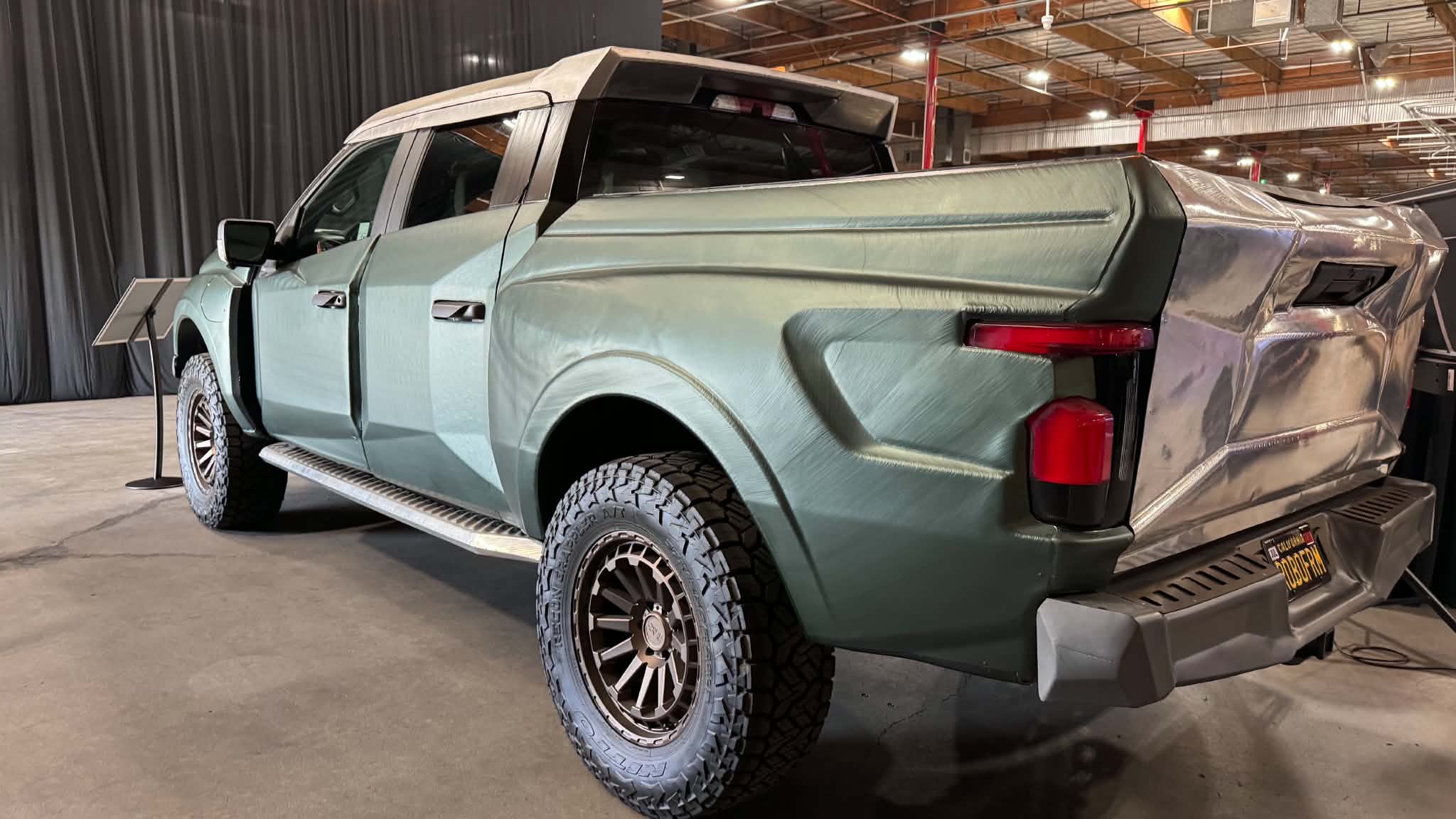
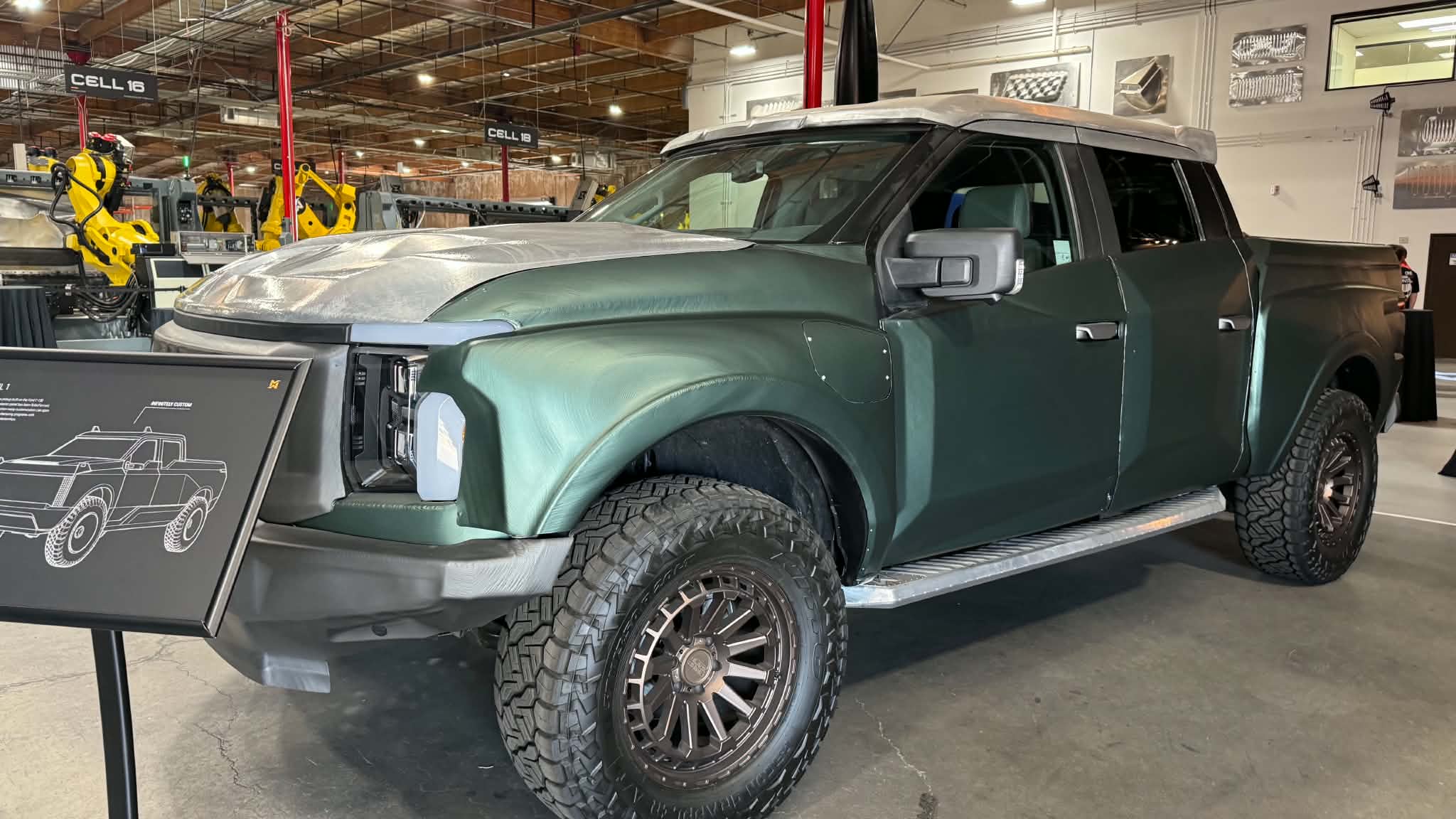
Surface finish is one of the first things I was curious about, since Machina Labs’ first vehicle project was an F-150, and the panels on it clearly needed extra refinement:
image: David Tracyimage: David Tracy
Machina Labs’ big announcement ahead of the LA Auto Show was its second vehicle project, a Toyota Tacoma designed by design consultancy Callum Designs; it’s apparent the team at Machina has made a lot of progress since that F-150:
image: David Tracyimage: David Tracyimage: David Tracy
As you can see, the new aluminum fenders are wide and aggressive (25 mm wider per side), fitting bigger tires without requiring a lift, trimming, or bolt-on plastic/fiberglass fender flares. It’s quite clean, even on the inside, which has been painted black:
Image: David Tracy
Machina Labs’ arms each feature over 50 sensors, measuring, among many things, the real-time forces the warheads are imparting on the sheetmetal as well as the shape that material is taking (via optical sensors). From Machina:
It transforms CAD files into robot tool paths and uses sensors to interpret force and torque being applied as well as optical scans measuring deformation to incrementally manipulate sheet metal to form parts. The process creates a digital twin as the part takes shape, and a digital thread captures all relevant process characterization and part qualification information. This digital record then travels with each piece produced for full documentation.
These sensors allow the arms to re-work forms after the first pass in order to get the forms into tolerance. Here you can see some initial passes of some Tacoma bedside panels:
image: David Tracyimage: David Tracyimage: David Tracy
As you can tell, the surface finish isn’t perfect, and in fact, even the bedsides on the truck Machina debuted for the LA Auto Show required some post-processing. In total, Machina told journalists, the part was able to go from initial design to what you see there in 2.5 weeks, with about a week of that being post-processing (refining the surface finish, painting, etc.). Had Machina used a traditional stamping method, the company told us, this would have taken at least 2.5 months — probably close to six.
“Stamping can’t accommodate high mix, high volume,” CEO Edward Mehr told journalists, mentioning that a key value of this tech is the time savings.
I asked Machina if post-processing (sanding, grinding, etc.) would become part of each Robocraftsman’s skillset, as the company had mentioned that the Robocraftsman cells were already capable of “loading, forming, scanning, trimming, and drilling in a single workflow” and that welding and heat treating were part of the plans moving forward. They didn’t confirm either way, since Machina says surface finish has improved so much and likely will continue to improve significantly in the future.
“We’re at 8 out of 10 right now,” a Machina Labs rep told me about the product that comes from its unique manufacturing process — specifically referring to the surface finish.
Image: Machina Labs
In addition to panel forming, Machina’s Robocraftsman cells can do what’s called “striking,” which involves imprinting shapes and logos into sheetmetal. Here’s an example of it on the Tacoma’s tailgate, whose skin they received as a standalone panel from Toyota before striking it and then hemming it onto the tailgate structure.
Here you can see the process flow for striking:
You can see striking in action in this video I shot at Machina’s facility:
Mehr told journalists he sees three main applications of his Robocraftsman cells in the automotive space:
Limited Edition vehicles
Prototyping and preproduction
Full-rate production — for example, restomod vehicles like modernized Broncos
Image: Machina Labs
At an estimated $1 million per Robocraftsman cell, it’ll be interesting if boutique restomod shops — which seem to be popping up more and more every year at Pebble Beach and Goodwood — take Machina up on this tech in order to offer a variety of unique body panels in just a matter of weeks instead of months. That’s the automotive space where I think this machinery is most likely to find a home.