

“Tepid Start? And where’s Jason?” Yes, sorry, but owing to travel snafus getting back from Monterey Car Week, Jason will be joining us too late in the day for what could reasonably be called a Cold Start, so I’m filling in. You could sound less disappointed, jeez.
I think his name was Roy. The passing of some fifty years has dulled my memory, but Roy lived at the outskirts of the radius from my home that I was allowed to travel as a 7- or 8-year-old. My leash was shorter than other kids’ my age in the neighborhood, but still shockingly long by today’s standards – long enough that I could make it the half-mile or so to Roy’s place, a tiny rented farmhouse that Roy seemed to live in by himself, as I never saw his parents. Roy was “the poor kid,” but I always envied his wealth in hand-me-down toys, fantastic things from the late sixties, including a Remco Lost In Space robot and a car that could be set loose on the kitchen table but never fall off thanks to a clever mechanism that I studied with fascination.


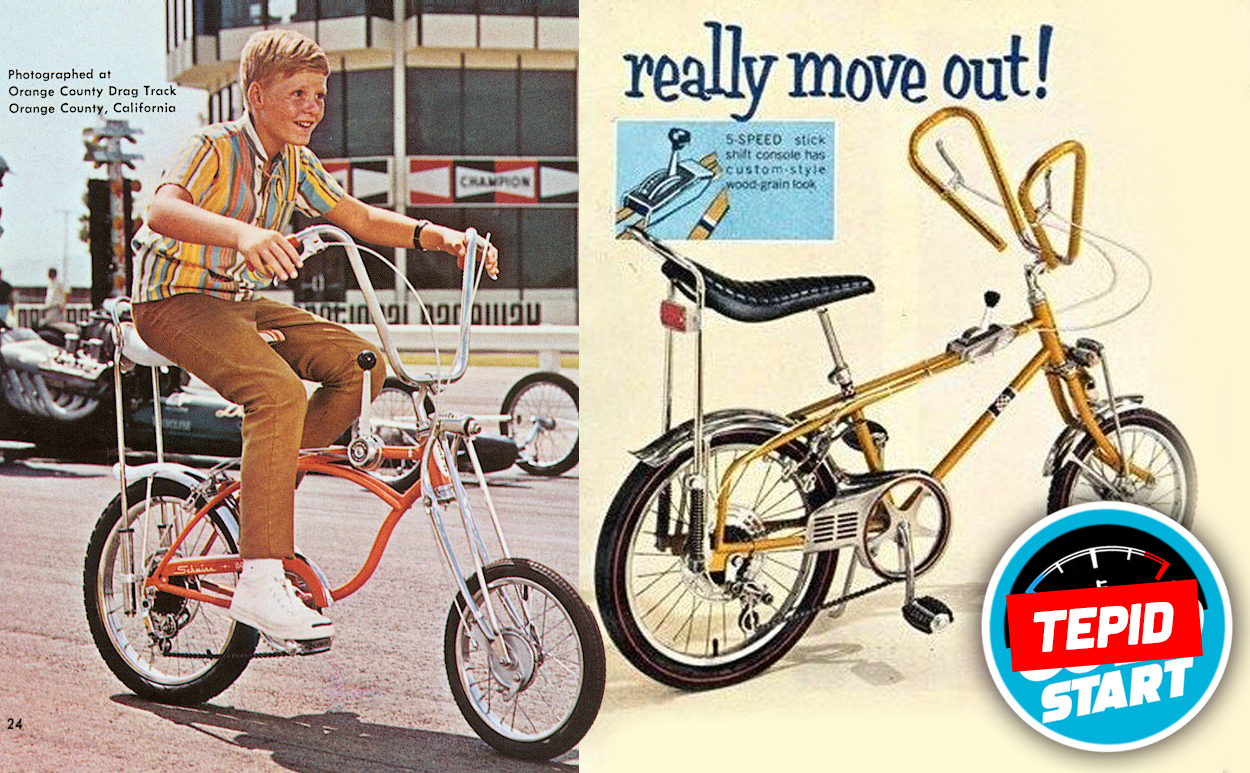
Most alluring, though, was Roy’s bicycle. Something I had never seen in real life before, but remembered vividly from a bicycle safety pamphlet: a Schwinn Orange Krate procured from a yard sale. Even before I saw the confirming lettering on the chain guard, I knew it was a Krate. Sixteen-inch front wheel with drum brake; springer fork; shock-absorber struts supporting a banana seat; fat, square-shouldered slick rear tire beneath a bobbed fender; ape-hanger bars; and the pièce de résistance, a towering five-speed shifter.

At this point, circa 1975, I was on the sole BMX bike in the neighborhood, a conversion my Dad had assembled for me after I was blown away by the motocross bicycles I saw in “Petersen’s Complete Guide To The Bicycle,” which was designed to capture readers interested in joining the ten-speed boom but had a chapter on the nascent So-Cal BMX scene that enthralled me. But I still had a deep affection for what we called “chopper bikes,” and though I would discover they were fairly miserable to actually ride, their car- and motorcycle-like features were serious stuff and catnip for my imagination, especially as things I had merely seen in pictures, never in person. Until Roy’s Krate.
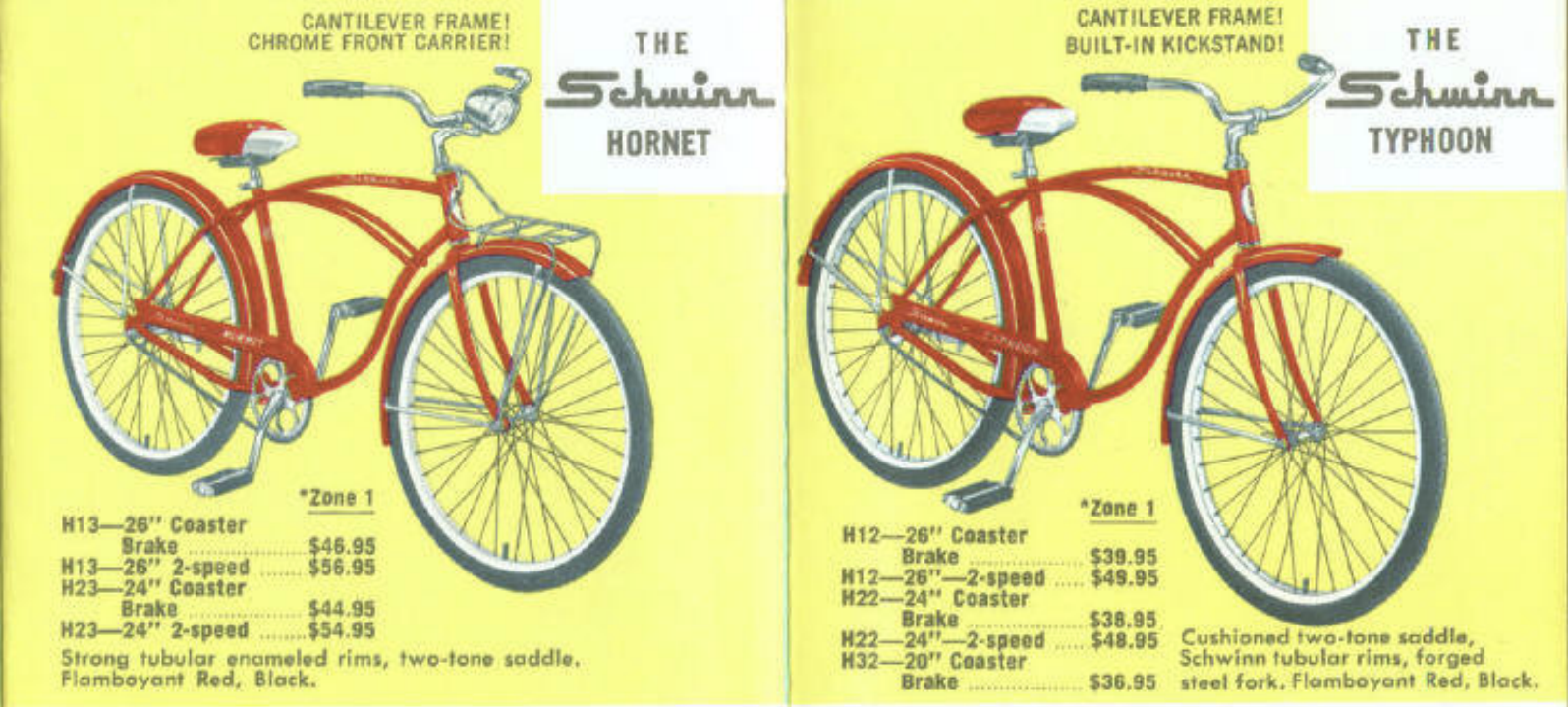
Up until 1963, balloon-tired bikes were the most common bicycles you’d see, under both adults and children. “Middleweights” like the Schwinn Hornet and Typhoon were bread-and-butter models, and similar-looking but less ruggedly built bikes were offered by scores of brands.
That all changed with the 1964 Schwinn lineup, which marked the debut of the Sting-Ray, “the bicycle with the sports car look,” as the catalog proclaimed.
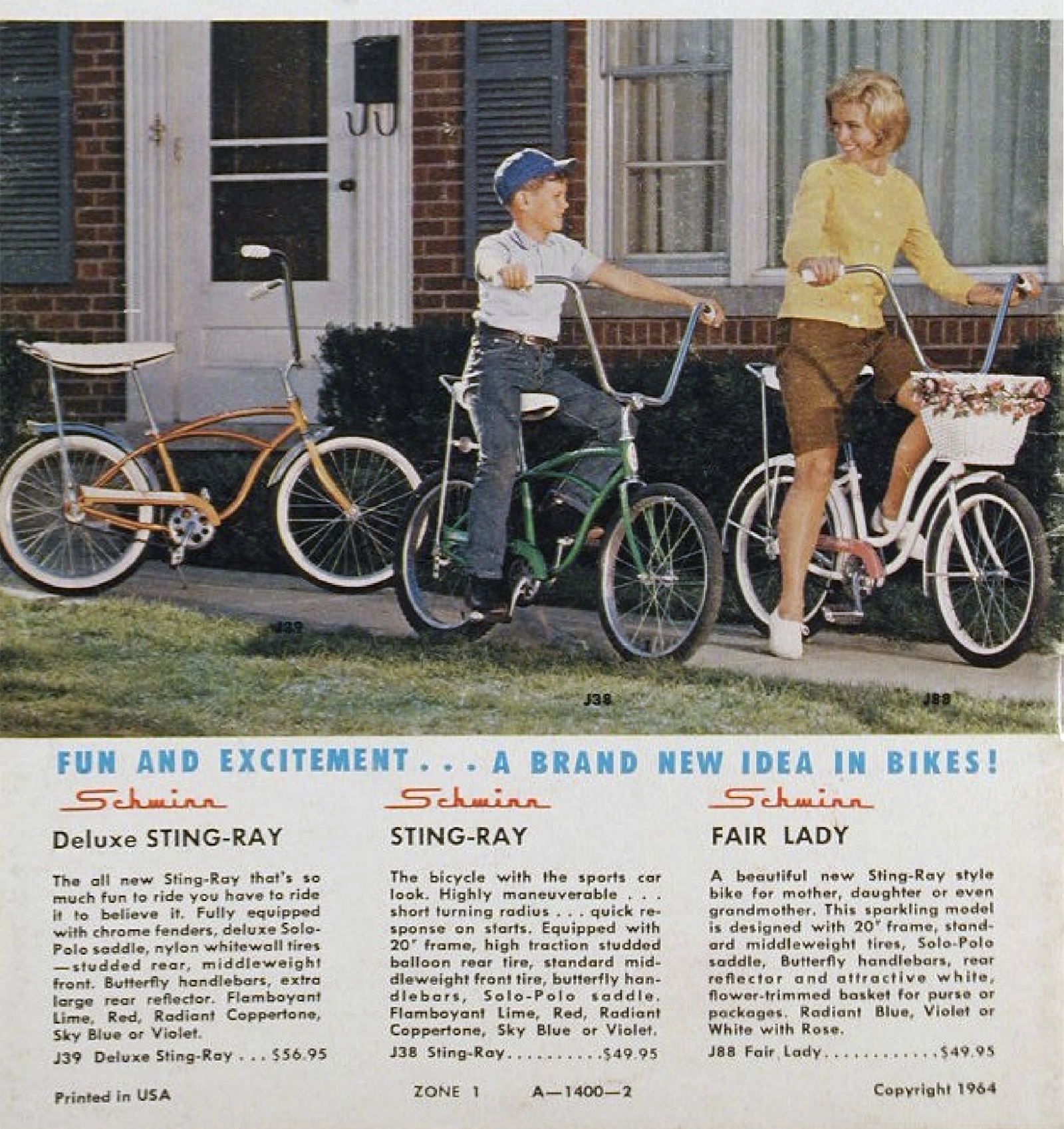
As Schwinn tells it,
Schwinn introduced the original Sting-Ray in 1963 after the company realized kids in California had been customizing their bikes to look like motorcycles. Bikes were fitted with 20-inch wheels, elongated seats, rear “sissy bars,” and ape hanger handlebars.
It didn’t take long for Schwinn to develop a similar style. Al Fritz, Schwinn’s director of research and development, recommended the Sting-Ray as a way to replicate the style California kids were looking for. The Sting-Ray quickly became the bestselling bike in Schwinn’s history.
These kids’ bikes featured a coaster brake on the large back wheel and wide-stance handlebars that were perfect for popping big wheelies. The connection of the bike’s name with the (at the time) new Corvette helped solidify the connection between the bicycle and glorified automobiles of the sixties. Before long, the Sting-Ray was synonymous with suburban youth in the 1960s.
All true! The Sting-Ray would go on to become the standard for BMX conversions until the first dedicated purpose-built bikes from Webco, Redline, BMW Products (Mongoose) and others appeared. But in between the launch of the Sting-Ray and the late 70s – early 80s BMX boom, muscle bikes were what kids dreamed of.
The Krate series was the ultimate example of the form, both in quality and technical ambition (and cost), leaving other brands to lean heavily on style. Top-tube-mounted stick shifters were de rigueur, and designers went wild with frame shapes and handlebar bends. Clearly, it wasn’t just the seats that were bananas.
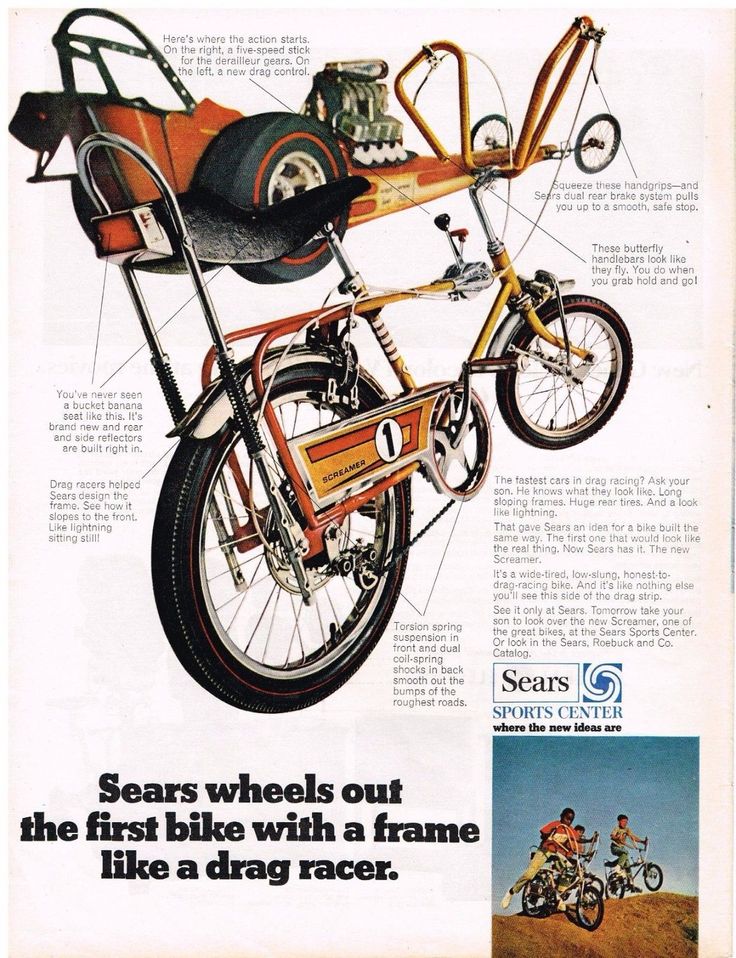
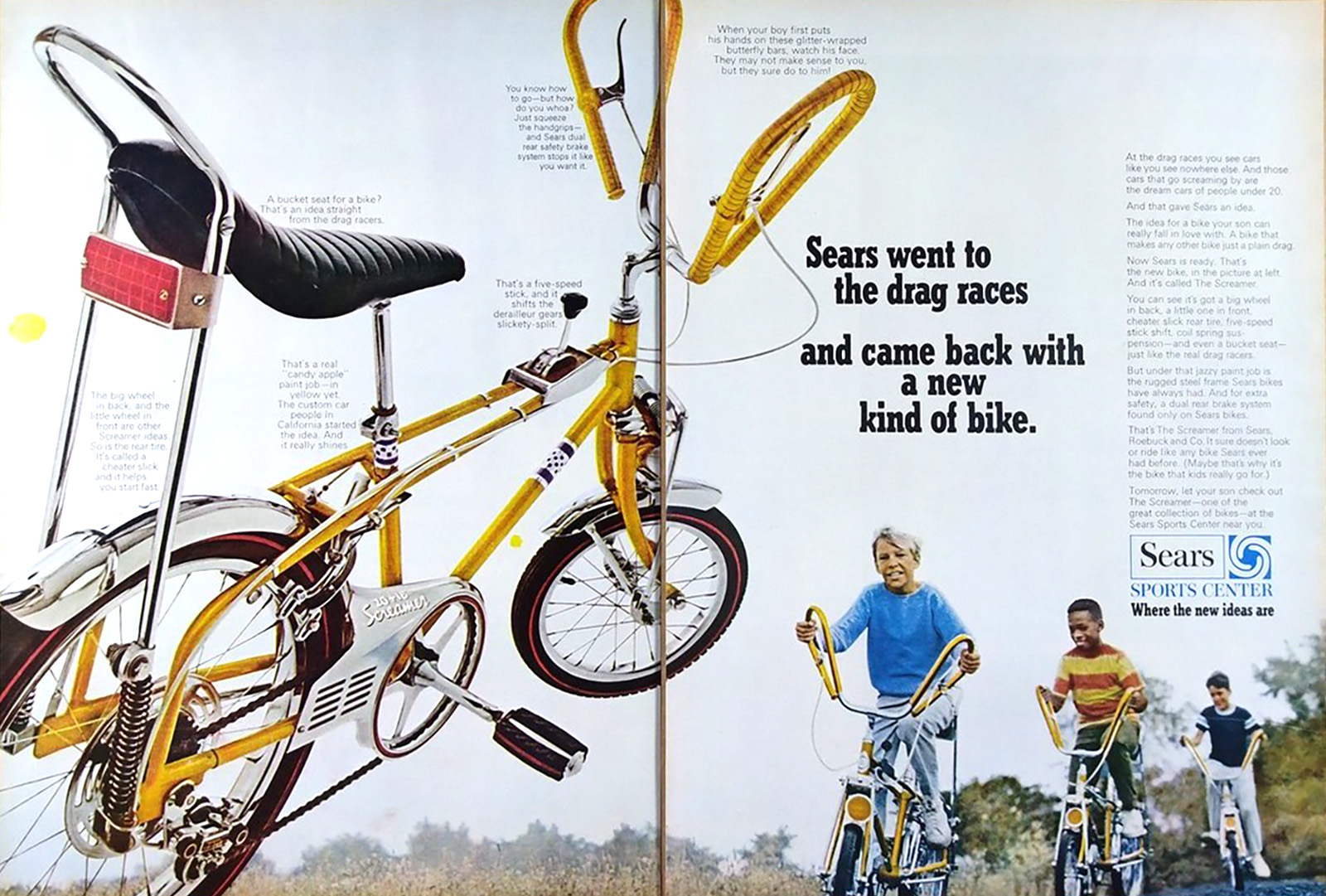
Sears threw the kitchen sink at its Screamer lineup, including some of the 1970s worst handlebars. Just look at the kids in the corner, doing their best. The upside-down brake levers operated dual rear brakes, because somehow twice the rear stopping power will make up for the lack of a front brake, I guess.
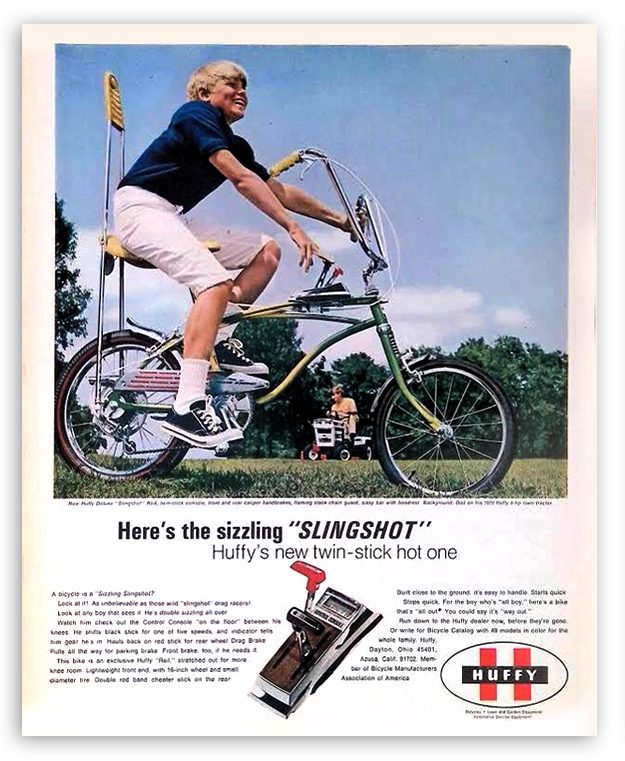
Huffy’s Slingshot offered not one but two shifters to wreck kids’ privates, an all-too common occurrence that ended the short reign of the bicycle stick shifter.
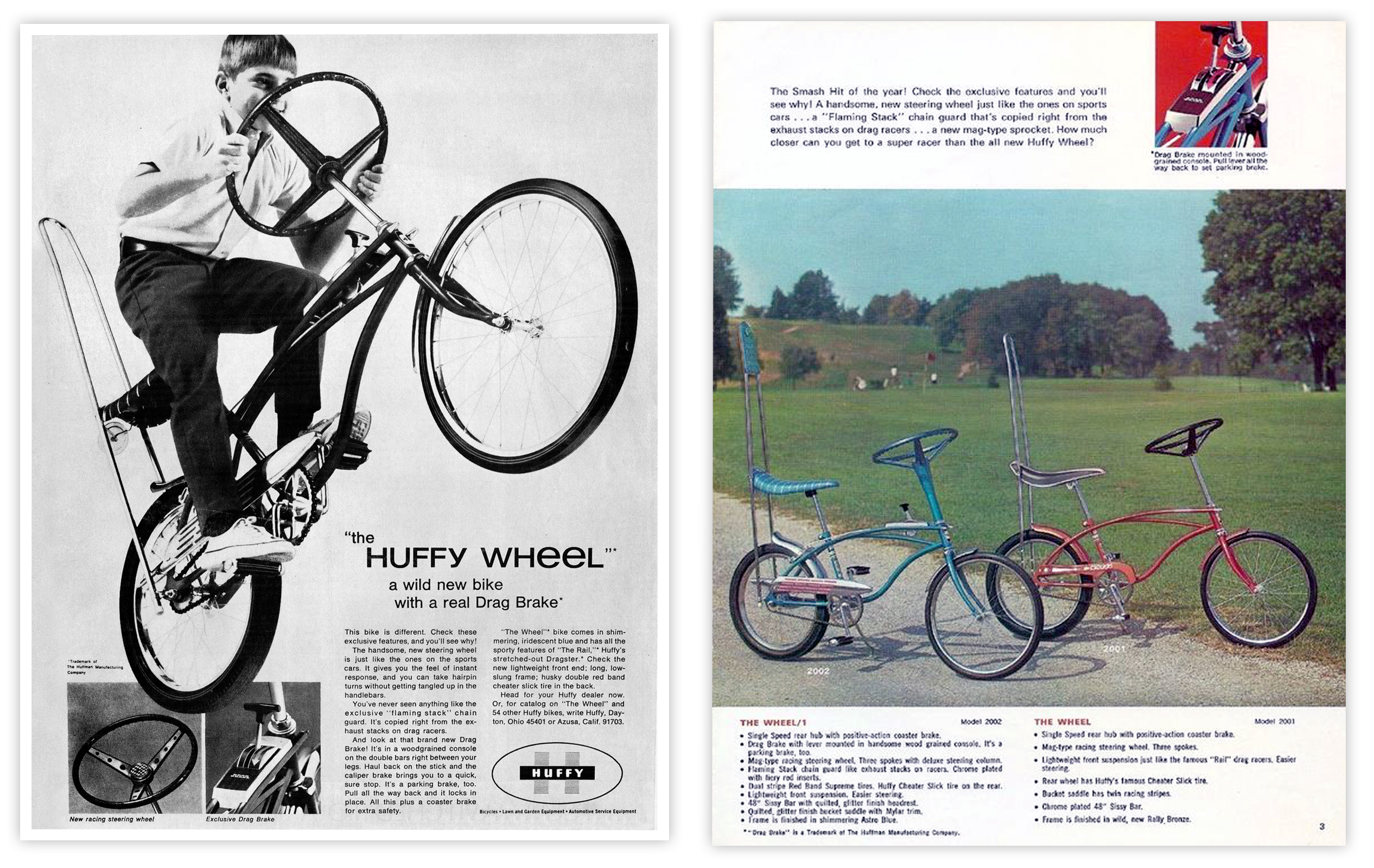
Huffy went harder than anyone for car-ness with The Wheel, which, as you can see, replaced the handlebar with a straight-up steering wheel. I imagine these were absolutely awful to ride, with the perfect combination of no good position for your hands and ample opportunity for smashing your knees. That sissy bar though …
Motorcycle themes were also rampant, of course, what with bicycles being two-wheeled and all. Mattel’s V-RROOM line featured a noise-making “engine.”

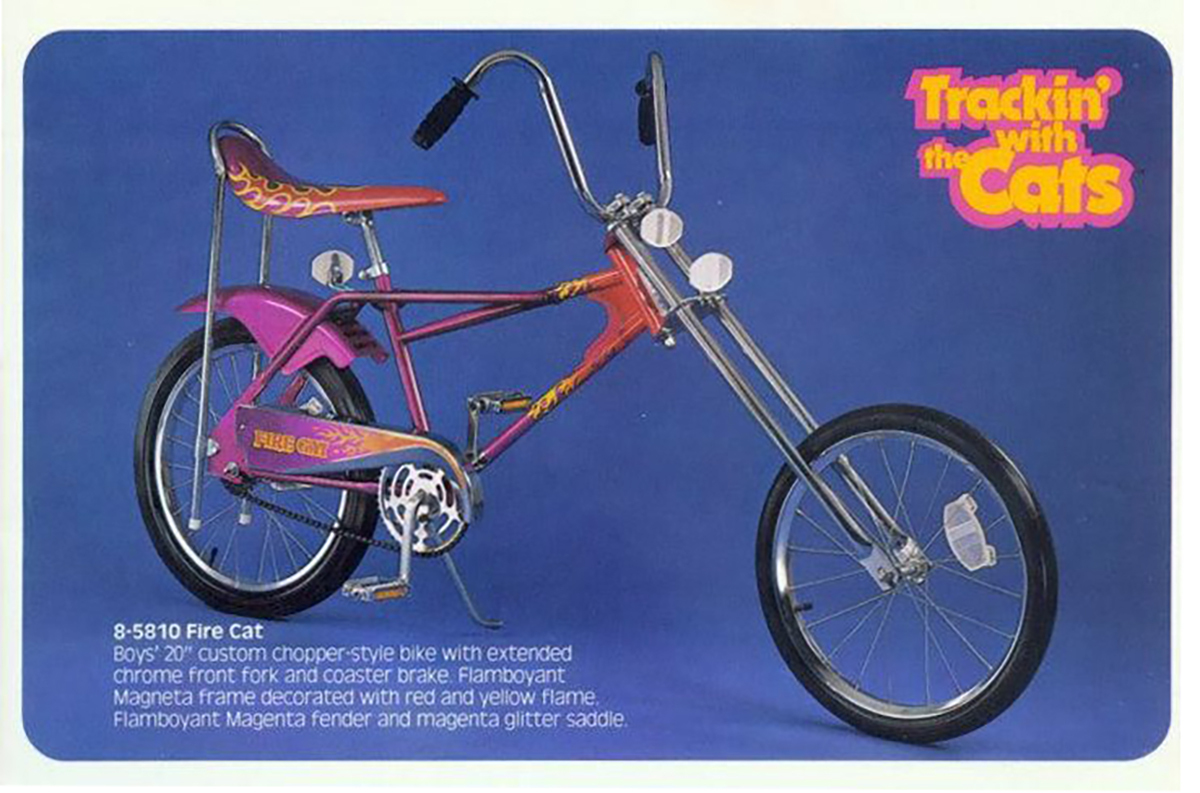
A few brands offered truly chopperized bicycles, and perhaps none were as committed to the bit as Murray. Sears also sold a version of the Cat series, with and without a simulated peanut tank. Unfortunately, the thrill of riding these things was inversely proportional to the thrill of looking at them, which is to say they were terrible.
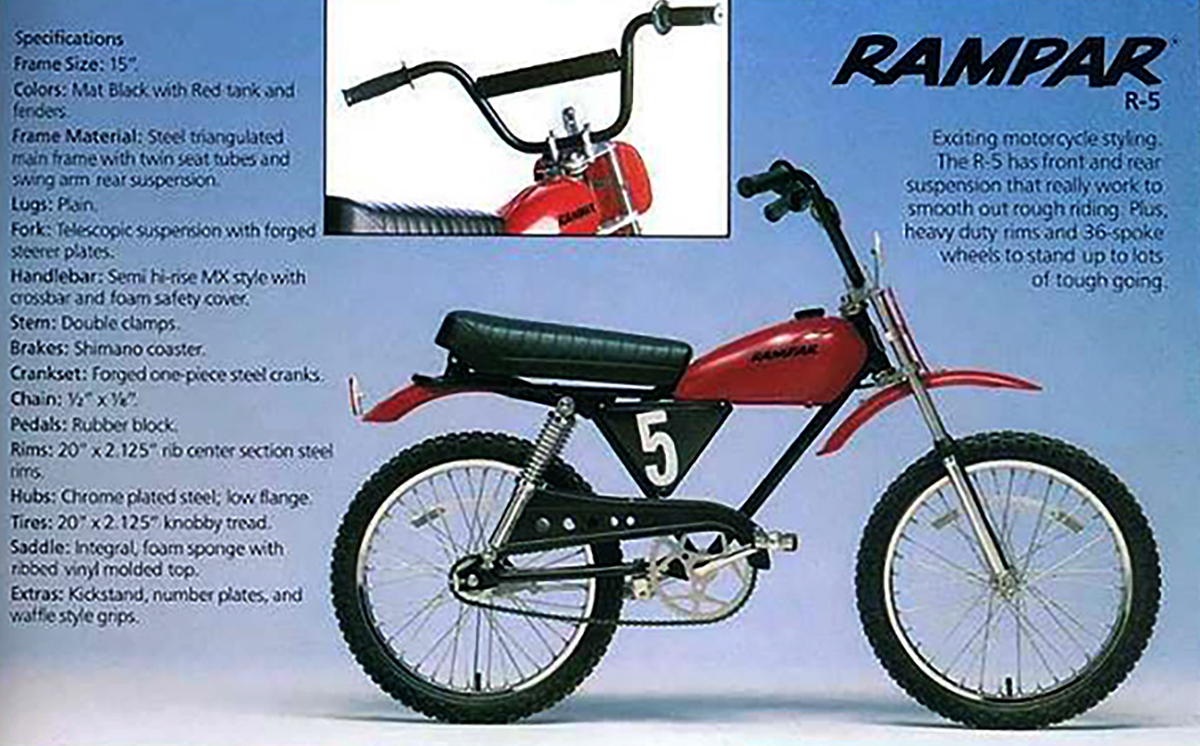
Through the mid 70s to the dawn of the eighties, muscle bikes faded as motocross styles ascended. Some of the earliest bikes, such as the Rampar R-5, could be mistaken for a minibike minus an engine. The functional telescoping shocks and swingarm rear suspension sapped pedaling power (and weighed a ton), but man, you could really jump these things.
Even motorcycle makers got in on the game, with Kawasaki and Yamaha producing fully suspended bikes and even sponsoring riders and races.

Kawasaki was way ahead of its time with an aluminum frame, way before Cannondale and Klein.

And look, here’s Bob “Hurricane” Hannah extolling the virtues of the Yamaha Moto-Bike. Pretty sure Bob’s nickname was derived from the hairdryer he relied on for his Farrah Fawcett look.
And for the full motocross bike experience, be sure to install R-R-R-Raw Power:
Did you have a muscle bike? Were you a BMX kid? Did you rock a R-R-Raw Power? See you in the comments. Cold Start returns tomorrow, with 100% real Jason!
Top graphic images: Schwinn; Sears


Cool, we did something like that from junkyard bicycle parts in our early teens. Like a frame with a big rear wheel, two forks stacked on each other with some drilling, additional spare axis and chain sprocket. Front wheel from a different bicycle, half the size of the rear one, longer steering shaft to simulate monkey grabs. Huge mud flaps cut from truck tubes. Good times!
I so So SO wanted an Apple Crate and got one for my 10th birthday (1970). I always loved how it looked, but over the next year I learned the hard way that it was one of the slowest bikes in the neighborhood. Regular ol’ Sting Ray was the way to go.
I wanted one of the crate bikes but ended up with a used Murray Stingray knock-off. It had a rear slick, the chrome fenders, banana seat and ape hangar handle bars. I later got a sissy bar off a garbage picked bike. this was circa 197
A neighborhood kid had The Wheel. It was awful to ride. And I had a 3 speed Schwinn green stick shift bike stolen out of our garage.
My first bike was a Stingray. My friends and I loved working on our bikes, so I gradually replaced everything on it with BMX parts to the point where the only things original were the frame and forks. Then I saved up and bought a Redline Proline II.
I only ever had a series of hand-me-down bikes, often cobbled together from whatever we could scrounge. My best friend had a red Huffy Monoshock and man was that thing cool.
Wow, that Monoshock is something.. definitely the way rear bike suspensions went.
I was kind of sandwiched in between the decline of the muscle/chopper bikes and the rise of BMX bikes. And where I lived in semi-rural Michigan, a lot of kids had gas-powered trail bikes and small motocross bikes for off-roading as soon as they were old enough and could handle them… which was pretty early back then. So BMX bikes were mainly for kids still too little for powered rides, and for on-road use to get to friends’ houses and such, most of us used very conventional bikes.
That kind of changed in the early 80’s when mountain bikes started taking off. I was quick to make the jump to a classic long-frame, high-clearance Schwinn High Sierra — which I still have to this day. It has a lot of BMX design in its DNA, just up-sized. And the beefy aluminum castings used on the heavy-duty shifters and brakes evoked some of the mechanical look of the accessories on the old chopper bikes, but without just aping them and being functionally necessary for rougher use.
My dad actually had a Huffy Wheel when he was a kid. Apparently once you get over the initial coordination reset, it wasn’t that bad.
Love this article!! I recall Schwinn reissued the Krate bikes in the late 90’s for a nostalgic shot in the arm. I worked at Eberhardts Schwinn in Tempe while in college and we had a couple on display. I mostly sold Mesas and Frontiers to the students though. More biketopia content is most welcome!!
I had a friend that had something along the lines of the Rampar. It looked the part, maybe it really was a converted old dirt bike, but it weighed a ton. Mine was a banana seat street bike (Schwinn?) that I mistreated on the trails anyway.
That Rampar must have been a pig… so much extra metal
they were the end of the era for me. I got a Schwinn Pixie for my first bike, but by the time my cheapo dad bought me a larger bike, the BMX craze was fully in effect. So, although my older cousins made some pretty radical choppers from multiple hand me down banana seat bikes, I was way more into Mongoose, Haro and Redline, and of course the slow riding tricks versus attempting to outrun a Schwinn World Sport 12 Speed on the pavement. Though I did get one of those at one point and then found the world of real Muscle Bikes. AKA the Yamaha V-Max.
The rich kid in our neighborhood had a Grape Krate. My Dad wouldn’t let me have a Stingray because of communism. Schwinn American for me. Super sturdy bike that couldn’t be stopped.
…there was never a Grape Krate in-era. It was probably either a multi-speed regular Stingray, or a purple Fastback, the one with skinny “lightweight” tires. Or a bike from a different brand. The only Grape Krates Schwinn ever made were limited-edition reproduction bicycles, starting in the late ’90s.
I still have the Sting-Ray that Santa left in my living room Christmas morning, 1977. I had a freind bring it back to service a couple years ago. It’s fun to bring it out once in a while for a ride down the block.
Just saying, my Sting-Ray was the shit back in grade school. Or at least it was until Brad showed up one day with a brand new Mongoose BMX’er. The first time he let me ride it, I knew the reign of the Sting-Ray was over. That thing felt like it was half the weight of my Sting-Ray, and would jump so much further.
I revived the Pixie from the barn for my daughter, then found a Huffy Desert rose, which was kind of the weird transition form banana bikes to BMX. it has plastic BMX fenders and knobby tires out back, but clearly Banana everything else. She rode that for a long time, then found out about E-Bikes and that is her mainstay these days
In Primary (Elementary) school our groundskeeper would ride around the school on a Sears Screamer exactly like the one shown above, complete with the butterfly handlebars and chain cover with the No 1 proudly shown.
I can vividly remember (this was the mid 80’s and I was all of 5) seeing him struggle to peddle up a slight incline, struggling with a rake and shovel under one arm, while attempting steer with the other in the hope of avoiding scores of students fresh off the buses.
He ended up adapting a ride on mower trailer to tow behind the Screamer, complete with matching paint job! Those were the days!!
Busy day today so late to the comment party but yeah I’m down with all that starting early 70s with a Pixie then Sears Stingray knockoff and being jealous of the older kids with crate bikes – I remember chain link steering wheels nobody could control. on through the years fixing those bikes at a Schwinn dealer in the 80s and other bicycle experiences over the decades.
Anyway, loved the article and the comments – long story short I’m down for more biketopicyclian content!
Holy Grail:
Schwinn Mini-Twinn with high-rise handlebars and dual banana seats!
My ride from age 6 to 12 and my brother still has it stashed away! (I’m 63!)
I had to Google this, had never heard of it. Apparently that’s quite a rare piece, that was prescient to have kept it!
Closest thing to those Krates in our neighborhood (late 70s / early 80s) was one friend that had a newer Schwinn Stingray that was much more “standard”–single speed / coaster brake, in maroon metal flake.
Me, I had some off-brand knockoff (JCPenney, maybe?) in purple with a white banana seat. Could still leave great skid marks, though, and I had a V-RRoom, too!
I did have a friend with an off brand, Huffy maybe, it had a square rear tire like a drag slick and the seat supports in back had shocks down by the wheel in back. it was interesting if nothing else.
I’m BMX era, but muscle bikes were still fairly common, if not well regarded partly because they were old and not cool. For me, I never liked the look and they were terrible to ride in every way (HEAVY, poor steering, uncomfortable, inefficient to pedal, and couldn’t do BMX or freestyle stuff). I’d like to at least be able to say that the suicide shifters on my ACME rocket bike’s body were inspired by muscle bikes, but it was more that they were reminiscent of cartoony throttles.