

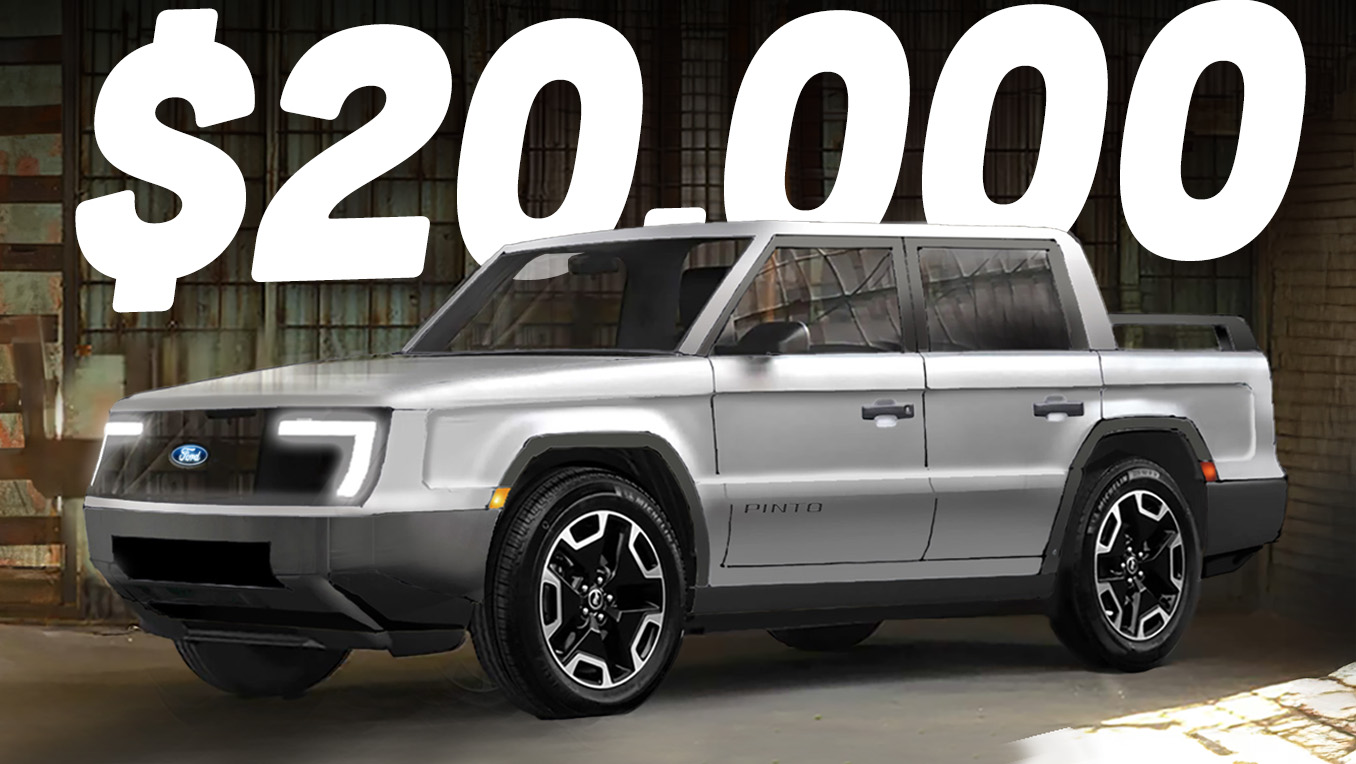
Ford’s upcoming “Universal Car Platform” promises to give customers far more budget-friendly autos, reportedly starting with a sub-$30,000 EV pickup truck. But when pushed, Ford spokespeople claim the pickup isn’t really going to be a “pickup truck” in the traditional sense at all.
If it’s not a pickup, what is it? Do people really want an electric pickup anyway? How is “under $30,000” really budget-friendly? After thinking about this for the last few weeks, I have ideas for what Ford’s “Universal Car Platform” entries could look like, and how Ford could deliver the fun and affordable new vehicle many are looking for.


We’ve gotten a taste of a few “affordable” new-style pickups that have resonated with buyers. Ford’s Maverick unibody pickup exploded on the market at the magic “sub $20,000” price point back in 2022, but has quickly risen in cost to the point that now it’s essentially a near-$30,000 proposition once you add a few options. It’s still a good value, but not the how-do-they-do-it deal that fired up car buyers initially.
So Cheap, You Could Buy Two!

Recently, the Jeff Bezos-backed Slate truck appeared to attract those same bargain pickup truck hunters with a bare-bones EV that was supposedly going to start at – you guessed it – around $20,000. Since the press launch, tax credit issues and such have started to push the price up to the point where the Slate is starting to look a lot like a too-good-to-be-true misfire.

Honestly, I’m not surprised that a startup would have a hard time creating the super-cheap vehicle that the public seems to be clamoring for. To make such a car will likely take a sea change, and it’s no wonder that Ford is talking about reinventing the assembly line to do it: the very thing that Henry Ford made over a hundred years ago to make cars affordable to the masses in the first place.
Ford is understandably vague about how this will work, showing an image of subassemblies coming together to form the finished car instead of the traditional Henry Ford straight line:
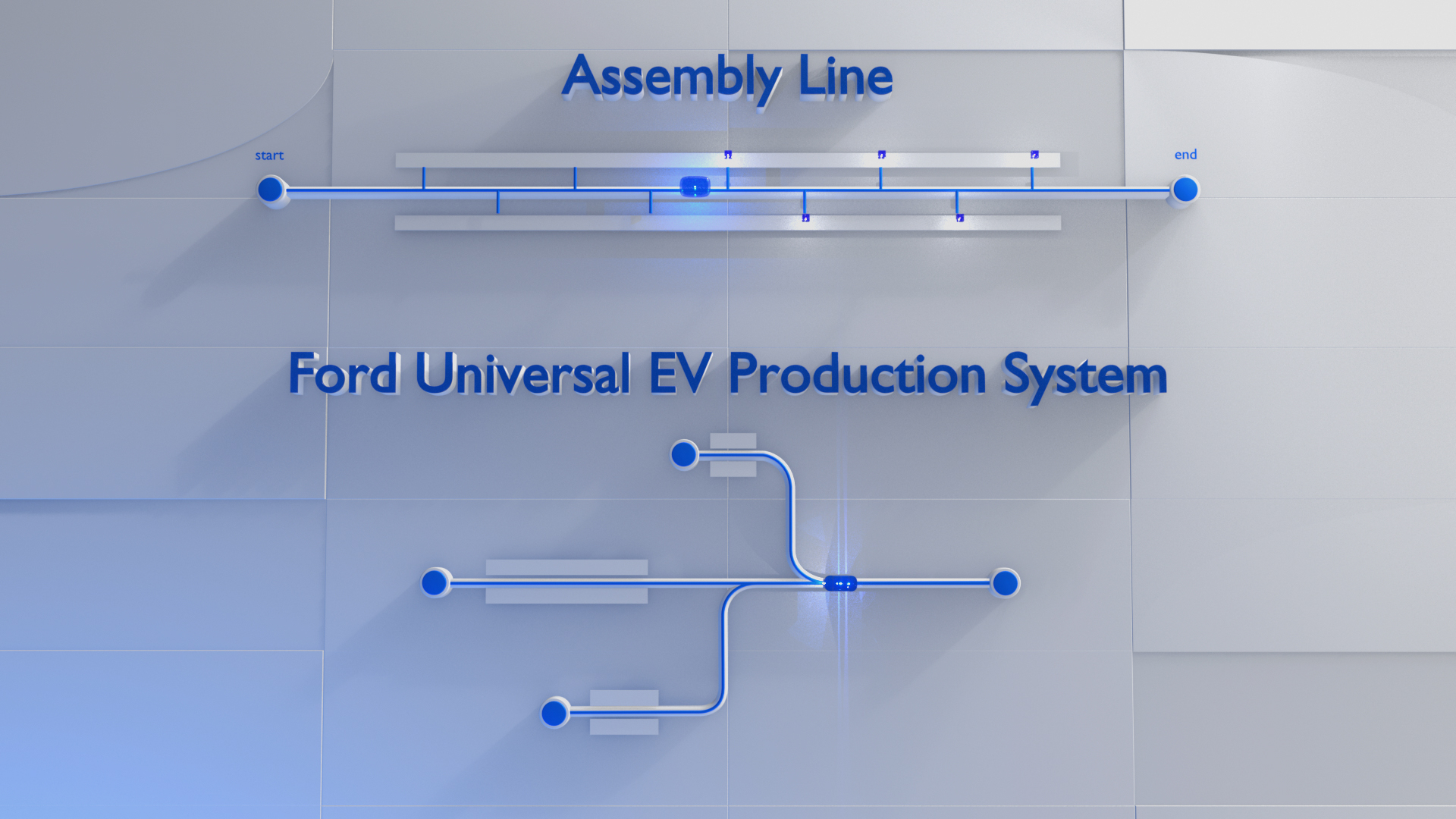
We’ve seen patent drawings from Ford that show front and rear units that bolt to a central module with batteries; it’s essentially a Lego system of making cars.
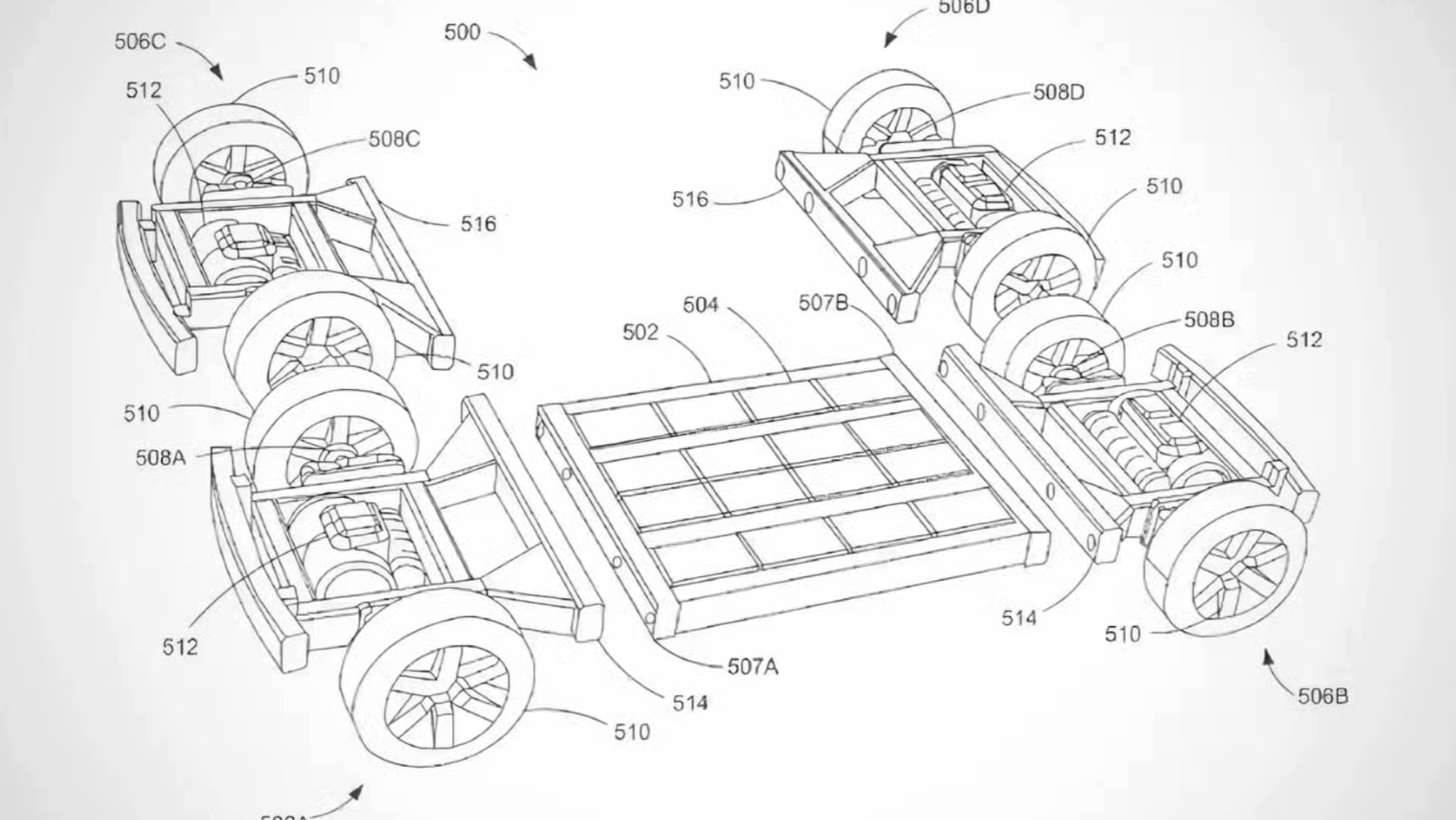
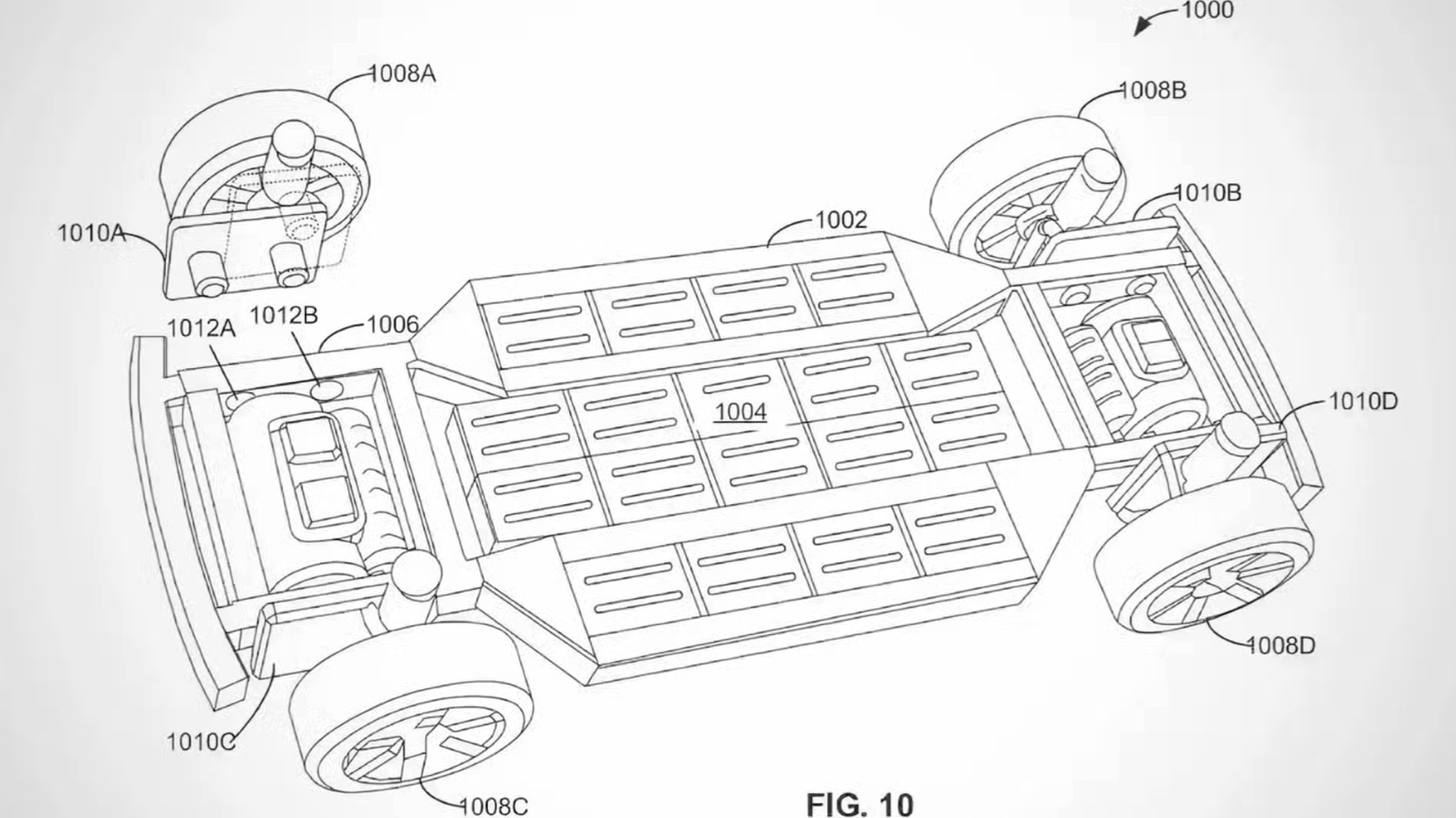
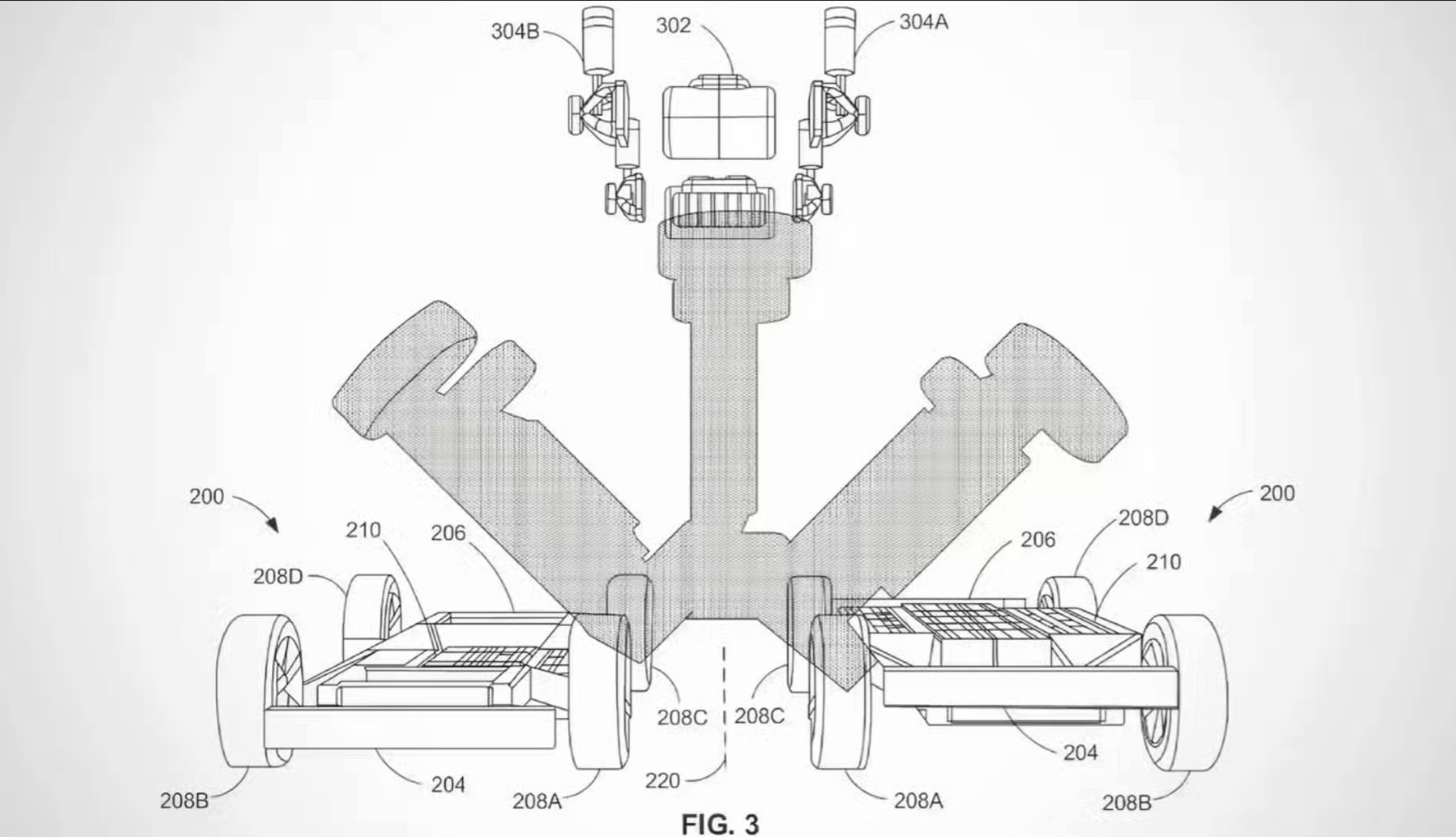
Tesla has shown what appears to be a very similar system with its “gigacast” parts – large, one-piece stampings that reduce labor costs. It seems that both Ford and Tesla are also using adjustable frame rails to connect these components like Lego pieces, which helps alleviate my fears of rusted bolts connecting the front motor module in place giving way and the entire nose of your ten-year-old car driving off across an intersection while you stay sitting at the light.
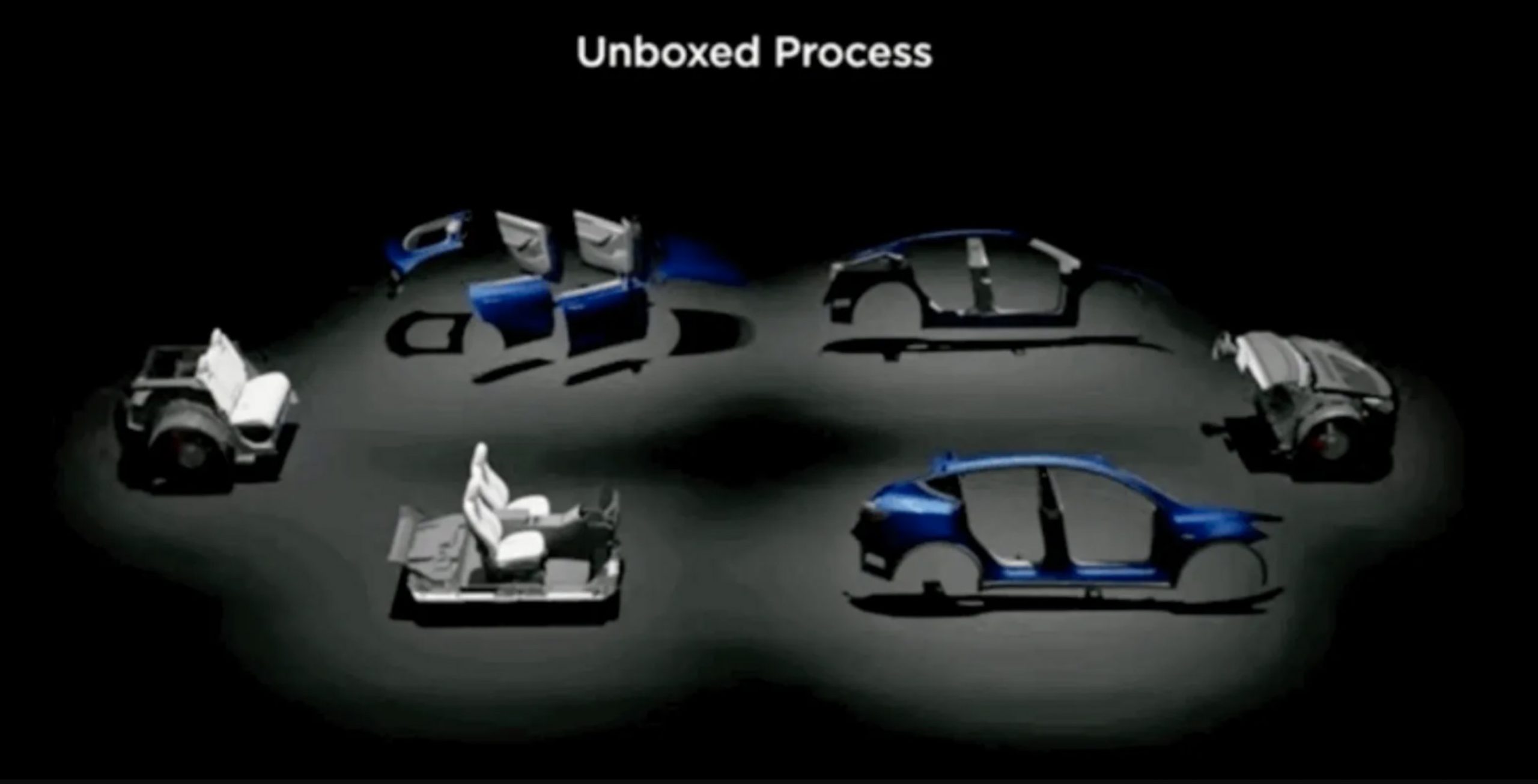
Such a system would take the whole modular thing to a new level, as we quoted from Ford a little while back:
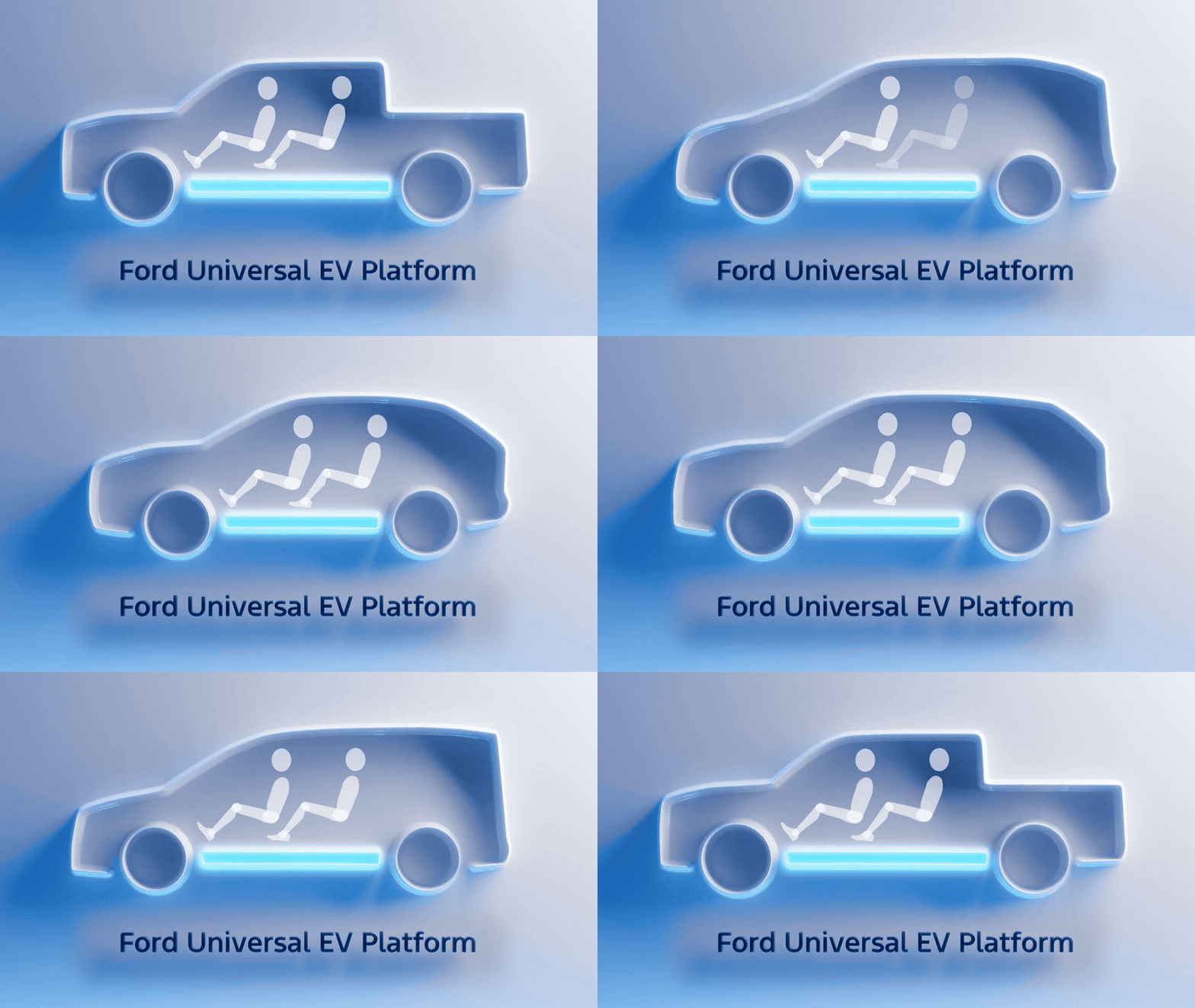
The platform reduces parts by 20% versus a typical vehicle, with 25% fewer fasteners, 40% fewer workstations dock-to-dock in the plant and 15% faster assembly time. Lower cost of ownership over five years than a three-year-old used Tesla Model Y.
Ford is also showing animations that indicate the mechanical components would be used to make a wide variety of different vehicles. Pickup trucks, SUVs and vans would all be possible with the same mechanical components.
This is a more advanced version of what is not even close to being a new idea, of course, as Lee Iacocca proved around four decades ago with a capital letter K:

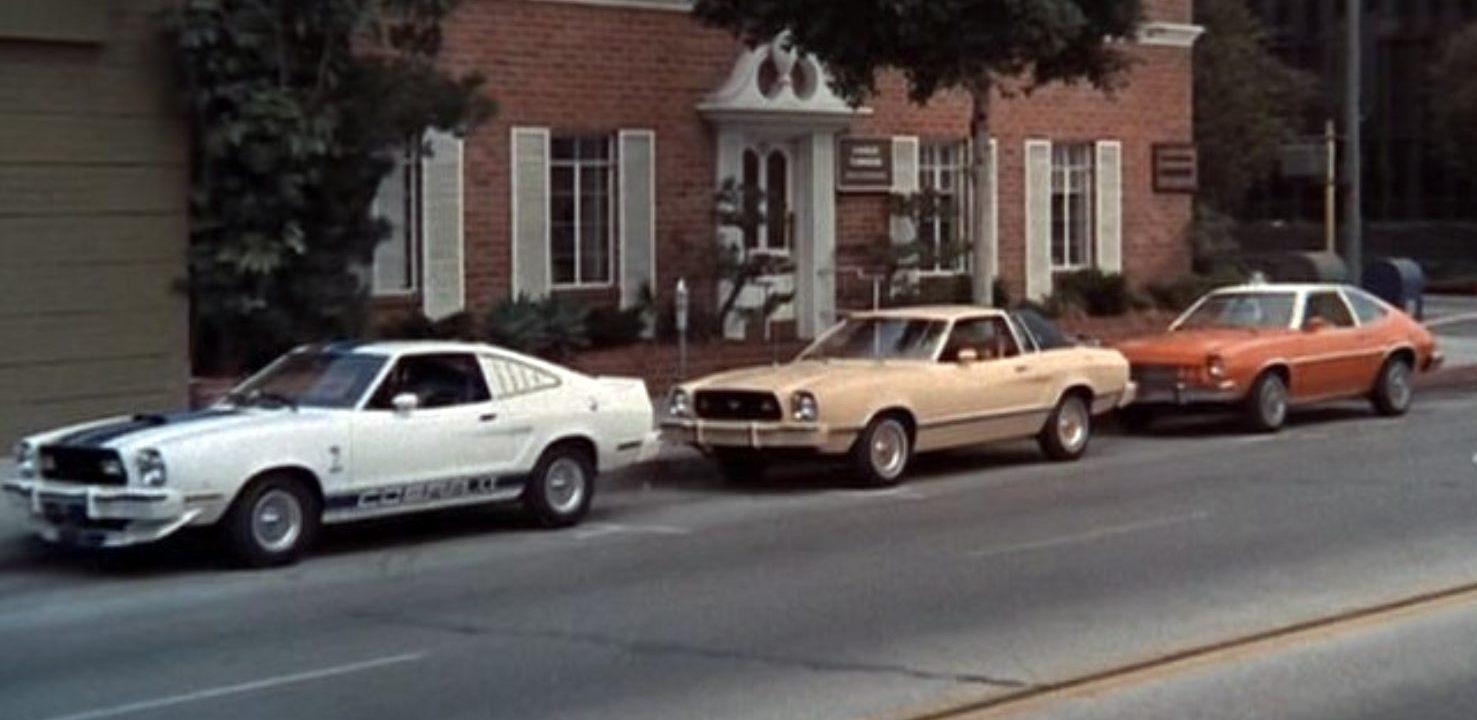
Indeed, Ford did the same things as well, such as these identical-under-the-skin cars being made to fit the very disparate personalities of Charlie’s lovely Angels.
There have been plenty of renderings shown on various websites of what this “compact EV pickup” might look like; our own Adrian Clarke did his own cool rendition of something that was a bit like a more aerodynamic and simplified Maverick. Still, to really save money, I think Ford should start with a collection of vehicles that share the vast majority of body parts, too.
Also, I believe that Ford needs to push this idea even further than the purely electric platform they’re proposing. This “$30,000 EV” isn’t something that’s in as great a demand today as we thought it might be five years ago, and the F-150 Lighting has shown the appetite for EV pickups is about the same as that for haggis outside of Scotland. If the first Maverick and the Slate have proved anything, it’s that people want a $20,000 new vehicle, full stop. Also, the impending death of Nissan’s last sub-$20,000 car in America indicates that even the cheapest buyers seem to want something other than a subcompact four-door sedan. With today’s fastback styling, the utility level of most modern sedans is pretty pathetic, and the near-vertical trunk lid opening of the Versa proves this.

I’m not sure how Ford could hit this very low price point, but I’ve got a few ideas. We’ll also have to explore what this “not really a pickup” body style even looks like. Let’s get started on Project Pinto. Yes, that’s the name.
Like A Real-Life LEGO Car
First of all, there’s a misconception that making a “stripped down” version of a car with crank windows and no radio will be the answer to the ultra-cheap car. That’s usually not the case today; you’ll certainly never chop thousands out of the price of a product by doing that. You see, a wind-up handle mechanism doesn’t really cost any less than an electric motor, and electronics likely cost the same whether they receive FM radio or not. In fact, it might cost the company more since they’ll need to make two separate window mechanisms and a special non-radio-receiving head unit to offer as options instead of just making them all the same. As Adrian has alluded to in earlier posts, the way to build an economical car is fewer parts, and parts that are shared with other vehicles in your lineup.
Here’s what I have in mind for Project Pinto. First, we’ll want the Pinto to be a smaller car than the Maverick; I’m thinking more like the length of that Slate and the similar-sized Bronco Sport like below:
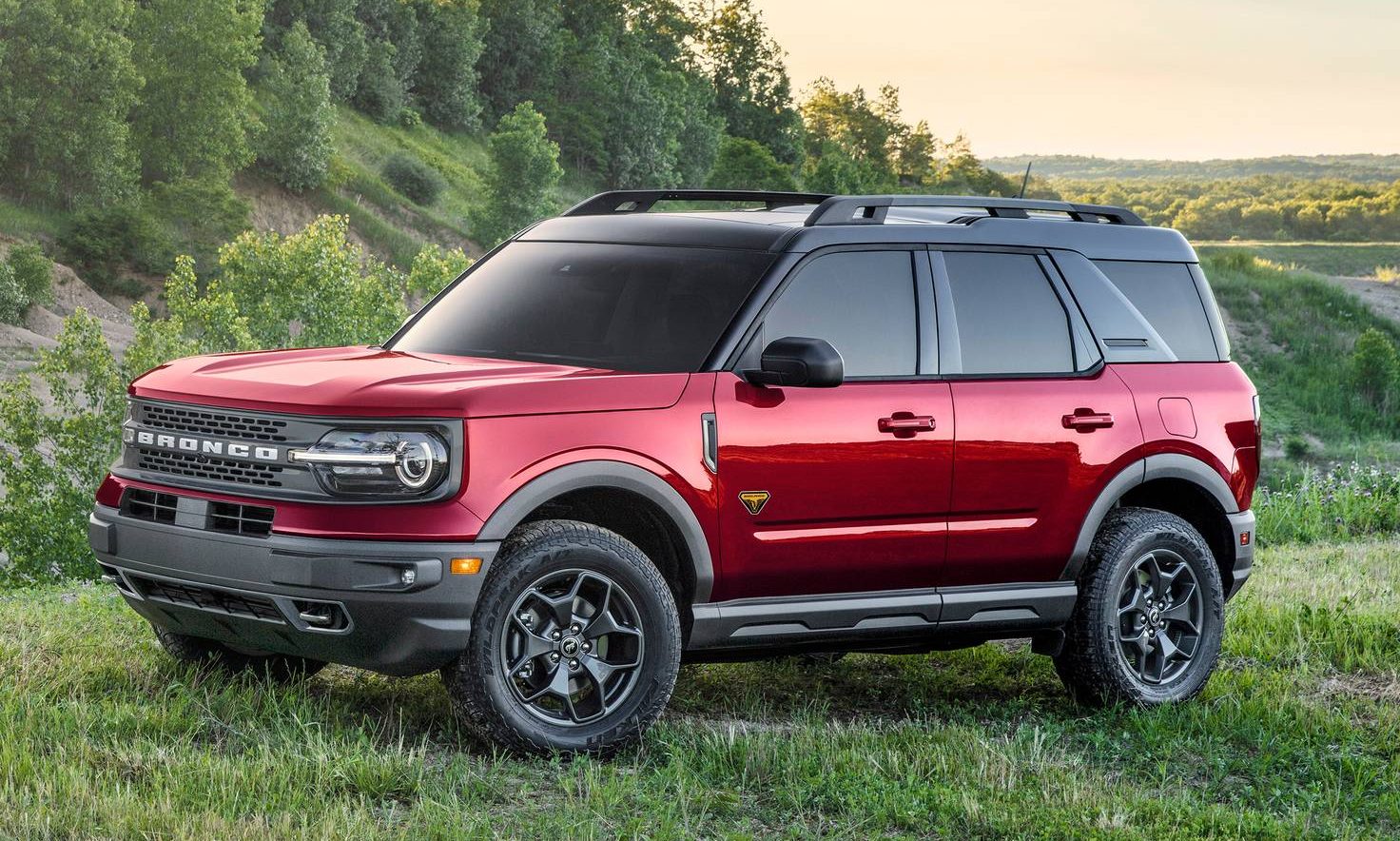
Ford has called this upcoming “EV pickup” a “midsize,” but that’s a rather big vehicle, especially if low overall cost is the main goal. I think a cheap car should be small for economy of materials; at the very least, it needs to be a size down from the Maverick for logical progression of price point. Ford claims a midsized EV can exist in the same space as the hybrid Maverick, but why muddy the waters?
We could build the front, center, and back of the Pinto separately as Ford intends, but I’m not sure about the whole EV-only thing. Let’s let the buyer choose; the front and back modules could offer options. Maybe we’d start with a gasoline-powered 2.0-liter four up front with an automatic for the cheapest version; maybe 160 horsepower or so? Ford is claiming the new Universal Car will be as fast as an Ecoboost Mustang. My question is, why? A Mustang is supposed to be fast, but an economical car just needs to be “peppy” with “good pickup.” That two liter will be plenty quick for an entry-level pickup (as much as it pains me to say it, there’s no point in spending money we’re trying to save to develop a manual transmission version that a hundred people would buy).
Next up could be an EV version with batteries in the floor section and an electric motor either up front, front and back, or with the gas engine up front and the electric motor in back for a hybrid setup. Jason would probably want two liter fours front and back as an option, but we’ll just let that one go.
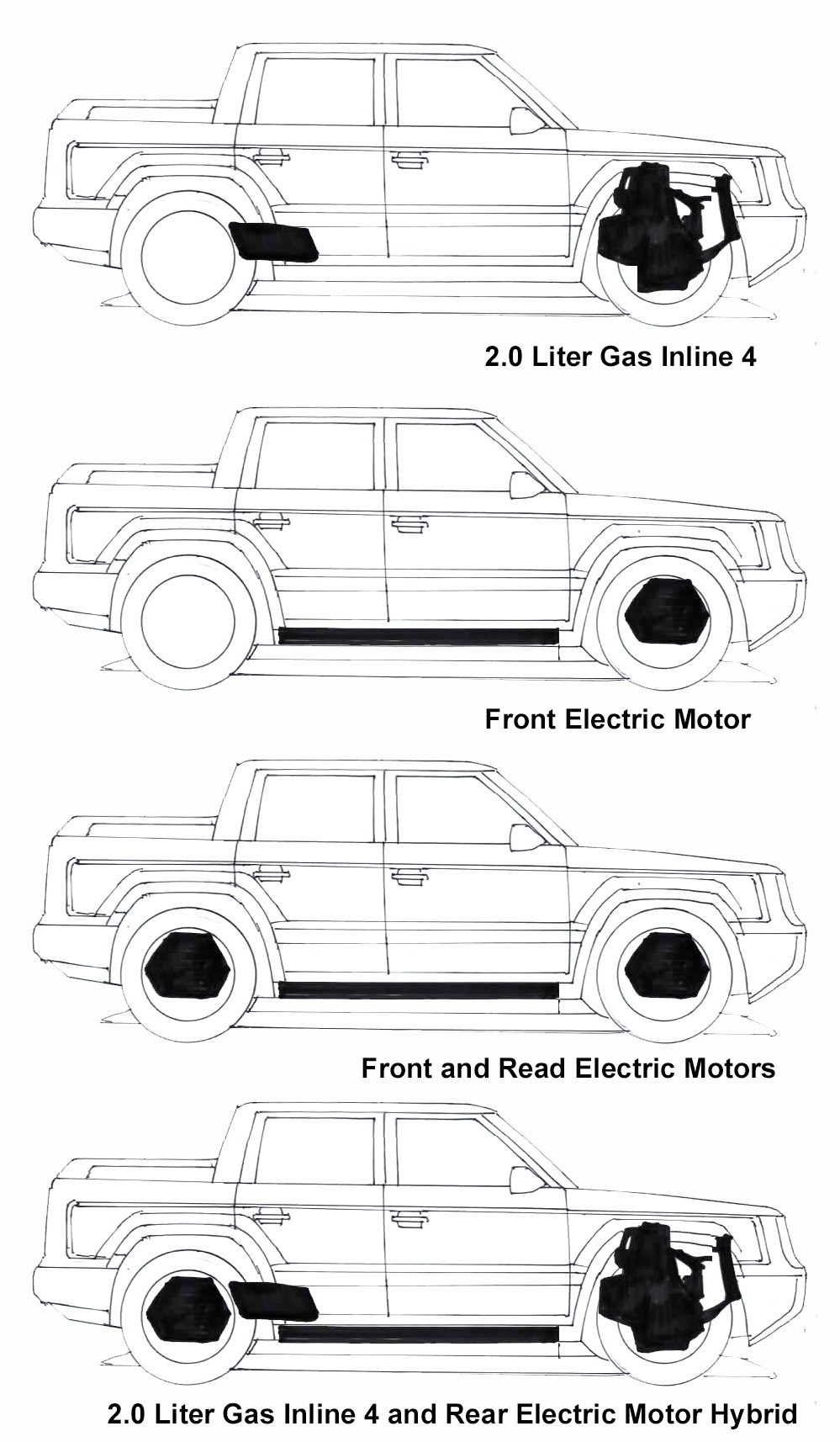
Also, I’d want cars to share as many parts as possible, not just under the skin. That means the front doors, entire front clip, and dash will be common, and only the overall framework would change to make the different body styles. Still, what body styles are we talking about?
Well, to start with, what is this “not necessarily pickup” thing that Ford says will kick off the program? For that, I figured this bargain basement thing would indeed have a cargo bed, but it would be so short that it would almost be the size of a sedan trunk. This isn’t a new concept; Jason wrote about examples of this from overseas over half a century ago:

That’s the inspiration for our car/truck, which we’ll call a “utility.” The bed would be covered and weatherproof, but you could take off the cover to accommodate tall items. You could fold down the tailgate and put a “fence” around it to get a larger cargo bed, or with an optional “midgate” open, you might carry items that are surprisingly long. This new kind of “sedan truck” we’d call a “utility” could look a bit odd, but Ford might provide rails along the cargo bed to “normalize” the look of the Pinto. These would, of course, be optional, but the salesperson would tell the customer that “they’d only add a few cents to your monthly payment.” What you’d have then is a “sedan” without the stigma of “small sedan,” and with far more utility.
Not your scene? There would be a Pinto SUV, of course, with the rear cargo bed enclosed. Need more room? No problem; a larger center floor and roof section would allow for a longer wheelbase compact pickup, not much smaller than the Maverick, but again with the same doors and front end. You’ve already guessed the next part: we can enclose the long wheelbase pickup to make a larger Pinto SUV that would be just long enough to allow for a little third row.

Now we have a full Lego kit of parts where you can build a series of products that could fit the shopping list of almost any sub-$30,000 car buyer. The last question is, what would it look like?
This Pinto Will Be Fire
It’s sort of odd that the Ford Maverick and the proposed Slate seem to be well received in today’s world of ultra-swoopy-looking cars with so many creases and cuts in the bodywork that I sometimes wonder if they’ve just been in a fender-bender (sorry, Hyundai). Simpler isn’t always better, but somehow this clean aesthetic cuts through the overly-trendy overstyled visual language on many cars today that will look hopelessly dated in five years (again, sorry Hyundai).
The only glimpse (and I really mean glimpse) of Ford’s upcoming Universal Car appears to show a painfully simple and featureless fascia, so it seems like the clean direction of the Maverick is the way this new product will go as well.
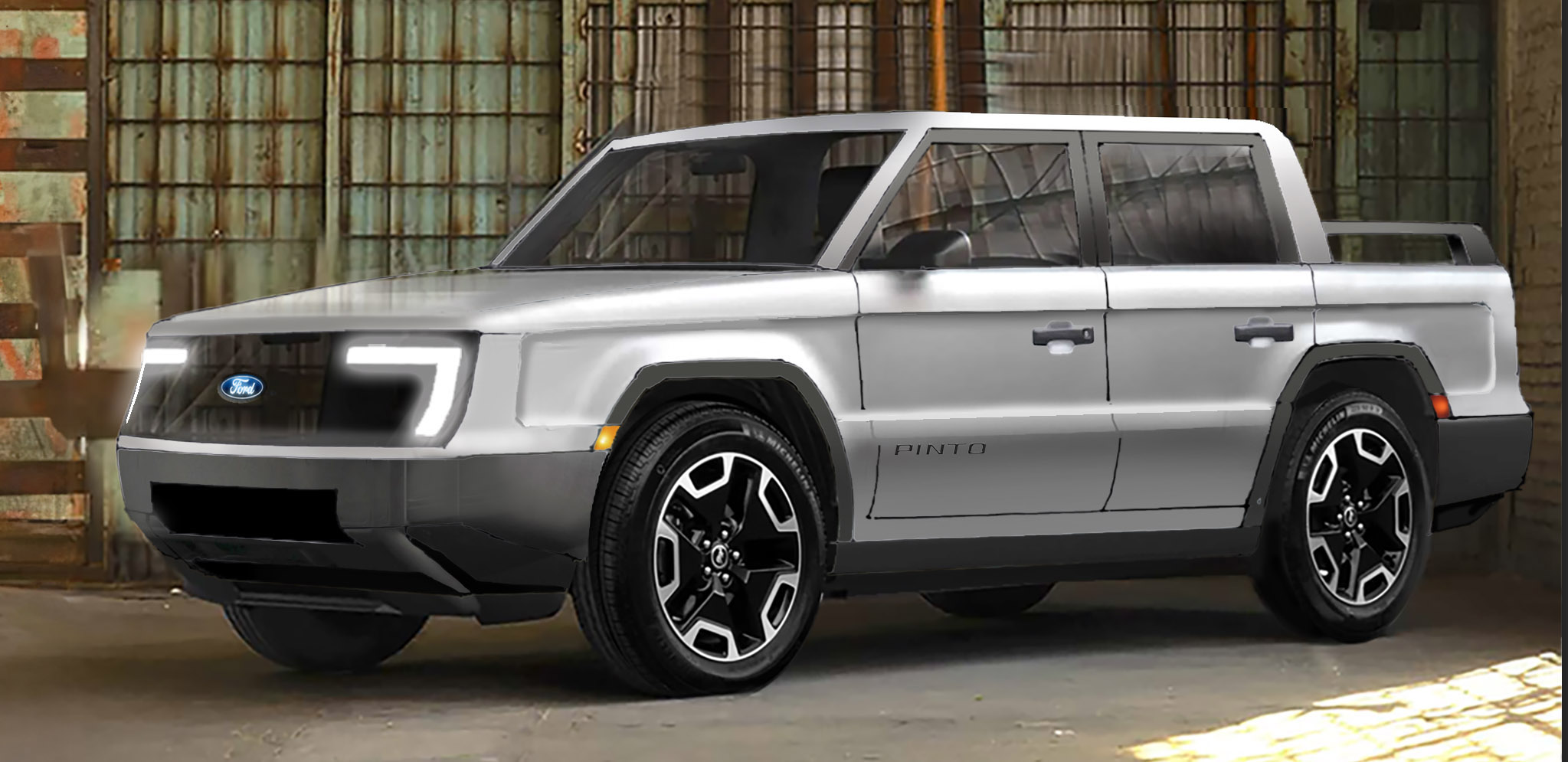
Extrapolating as best we can on that tinny snippet, I’ve come up with an extremely clean and functional-looking design for the new Pinto with single-piece stamped doors and as few body panels as possible. Here’s the animation:

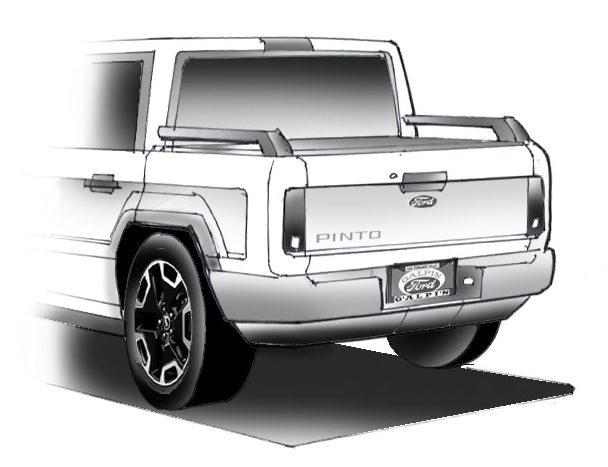
This is the least-expensive version- the “utility” with the short covered “bed”. The optional rails at least make it look less like an oddly proportioned sedan and more like a poor man’s Lamborghini LM002:
There’s a recessed area going down the side of the Pinto to break up the mass just a bit, but it will serve another function as well. In the comments of a recent post I did on the Mustang II Cobra, a reader named CivoLee had an interesting point:
You laugh, but I think the sea of grayscale that the modern automotive landscape has become would benefit from some appearance packages.
I’m not laughing. Well, I kind of am, but in a good way. That’s a great idea CivoLee has to bring some individuality and fun to your car. With different wheels and graphic inserts into that recessed area on the side, your Pinto could transform into whatever you want it to be. A rainbow stripe “Free Spirit” model would be a necessity, and I wouldn’t mind one with a contrasting color insert to mimic the old Bronco II. You can be damn sure that I’ll offer a woodgrain-side-paneled version. Honestly, you could get any celebrity or influencer to come up with a package or do a print-on-demand thing for your own graphics. The graphics would be vinyl, but that recessed area might also be a locator for magnetic graphics you could add, like seasonal “holiday” images of Christmas tree balls or dreidels and such.
Here’s the page from the proposed Ford Pinto website with personalities like Sydney Sweeney and Joanne Gaines:
 Sydney Sweeney via Ford; Joanna Gaines via Magnolia
Silly? Sure is, but you could spend a hundred grand on a grey SUV that just blends into the crowd. With the Pinto, you could stand out for very minimal cash, and the second owner could change it up just as easily for maximum, personalized fun. Not your thing? You could still get a grey one with steelies for your conservative tastes. Yes, before you say it, I will reluctantly agree that dealers might not make a mint in profit on a cheap car, but they sure as hell could make money on the customization.
In back, the Pinto would have another recessed area in the tailgate for graphics like on the sides. With the vertical taillights, the Pinto looks very similar to the Slate’s back end, but since the Slate’s rear seems to be a copy of old Ford Broncos, it doesn’t look like anyone is going to be doing a lawsuit standoff any time soon. I’m imagining a solid rear cabin wall and window as standard on the base model, with a drop-down midgate as an option. Also optional would be a rear backlight with a sliding opening or the ability to remove the rear glass entirely to give you a full midgate opening for larger cargo. Or, you could drive with the rear glass out, the side windows down, and the optional sunroof open for a near-convertible feel.
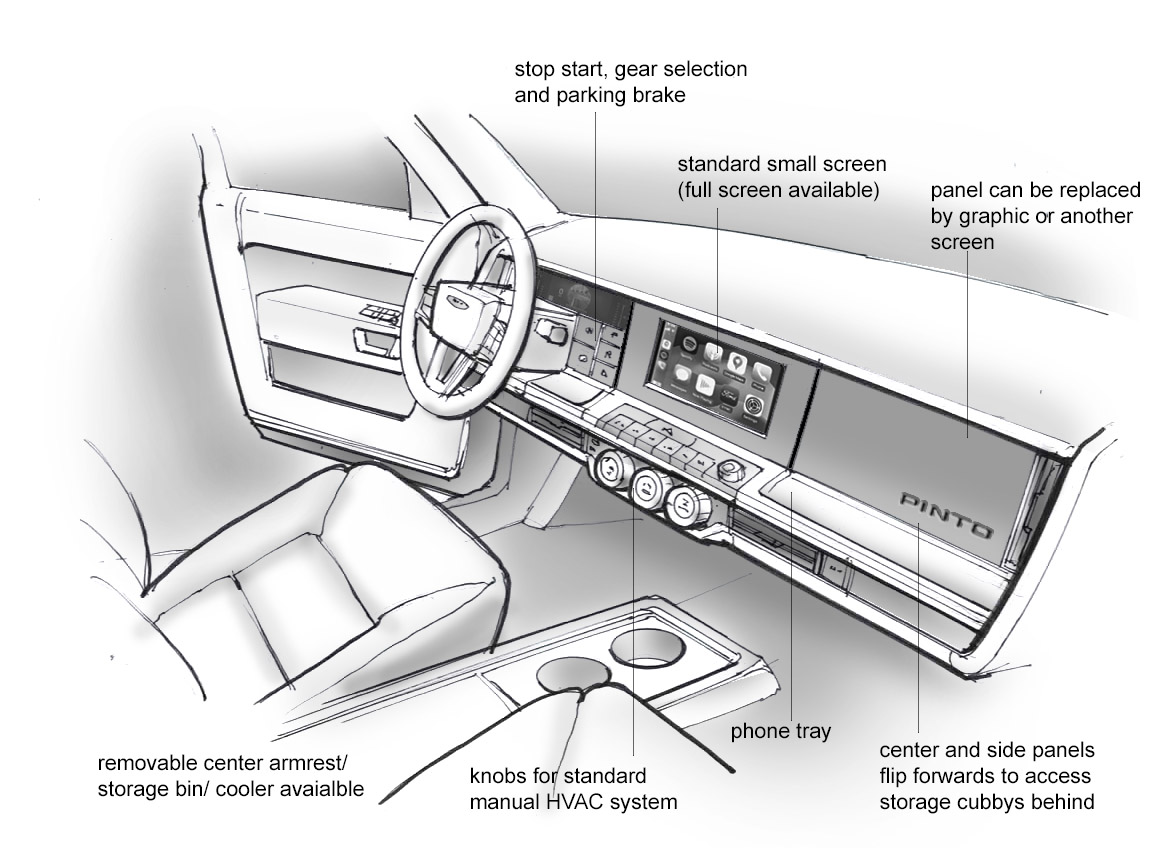
Inside, every Pinto would have power windows, locks, and air conditioning since it would be cheaper to just make them all the same instead of investing in multiple door mechanical systems. Besides, I don’t care what “the internet” says: nobody (other than maybe Jason) really wants a bare-bones hair-shirt penalty box of a car any more than they want a brown diesel “analog” manual station wagon that many car site wags canonize. Well, at least not enough people to make it worth tooling up for.
The standard Pinto model has knobs for the climate control and a very small center screen (legally, you need it for the backup camera anyway) you see below, but that could be upgraded to a screen filling the whole space with touch screen HVAC. The panel in front of the passenger is blank but could be replaced by a graphic (woodgrain, carbon fiber, a picture of your kids) or another video screen. Both center and passenger side rectangles flip down to access the hidden storage cubbies behind.
No center console or armrest is standard, but you could add one; even a storage bin or cooler or something that could be removed from the car (maybe electrically heated and cooler from the 12V power plug in the dash). You could probably double the cost of the base Pinto, but that’s possible with the likes of a Porsche Cayenne as well, and it’ll look like pretty much the same car inside. An entire industry of aftermarket parts would likely spring up if the new Pinto becomes as ubiquitous as the original Pinto.
Comfort, economy, decent performance, and handling all at a very reasonable price; not to mention the ability to personally trick it out as easily as adding a custom case to your cell phone. People are telling us what they want in an affordable car; why not give it to them instead of some mid-sized EV they don’t?
Pinto, Maverick- Is A Granada Revival Next?
If you were old enough to remember your parents’ awful rides from the malaise era, you’d agree that today there are no longer any truly “bad” cars. However, there are plenty of forgettable cars that lack both personality and utility, and you need to pay through the nose to buy them. Lee Iacocca’s almost-final words of advice to car companies in a nearly final interview were to “make small cars that people want to buy”. More importantly, we need to make them affordable. If his ghost is alive in Glass House at Dearborn, he’s probably still saying that, and we should listen.
What would be next for Pinto? Maybe a van body for the modular chassis? A two-door pickup? We could do this all day, as long as you don’t want a low-profile sports car or sedan, which would be a fool’s errand for Ford to go after anyway. You can’t be all things to all people, but the Pinto would certainly try.


I was just reading the article about the Citroen Oli concept linked from the ELO coverage. Maybe Citroen is really the company weird enough to bring us this utility vehicle? Seems like they were on the right track in 2022.
This endeavor will be Ford’s new folly. Sub $30k won’t happen, regardless of how the assembly line is configured.
despite the hype and mis information online, a Mustang 2 was not a Pinto in drag. I wish that lie would die already. If you want to see long lost variations in trim levels and colors, check out the 1980 Ford Pinto brochure. pretty amazing.
Umm… Not totally true. The M2 was based on shared Pinto platform hard points and some floor structure and suspension design from its design origin.
La vie moderne de Pinto!
Sorry but every time I read “Pinto” my soul had to shudder.
And this is from a guy who’s owned 4 Pintos, and parents also owned them.
I just find the name game redundant, especially since the original Pinto had a lot of PR issues, as well as being well known death traps in accidents.
I am all for FORD trying to offer a low cost entry.
And I will seriously look at them when they become reality.
All the same, I can see FORD screwing this up quickly and the MSRP rising like the sun in the east….YMMV
I haven’t read this yet, but I will and respond accordingly. But I agree 100% with the sentiment expressed in the title and have said as much elsewhere on the site. Just moments ago, after reading about Ford’s tie-up with Renault, I fantasized that Ford might just have the good sense to replicate a Twingo assembly line stateside, and sell the resulting car in a single color/trim/spec for $20K… directly to buyers somehow, avoiding the $10K markups that dealers would cripple the car with, rendering it a sales failure.
A decent, usable $20K EV with a bit of style and personality is what would sell, assuming that it was a good car first, and an EV second. Not everyone does long-distance travel on interstates, not everyone needs a third row of seats, or four-wheel-drive, or all-terrain tires for trips to Walmart, etc… This reality is tempered by the fact that potential buyers are always going to compare a vehicle’s price with what else could be bought for the same money, whether that other thing is useful or necessary for their needs, or not.
A $20K Twingo fits the bill. Can a modest profit be eeked out at that MSRP? I’d like to think so, but that could just be my ignorance talking (yet again).
Ford, DO IT! And I tell you what: I’ll also buy one of those Twingo plushies with the car (in the same color please) so there’s another $25. of profit for ya. 😉
Platform engineering makes a lot of sense. Design a flexible utilitarian framework for mobility, and use it for damn near everything.
On the other hand, cheap cars don’t make any money! Toyota, Ford, GM, VW, everyone work as hard as they possibly can to NOT sell cars at low price points. Why? Because, again, there is no money in cheap cars!
Entry level cars are dead, dead, dead. The new entry level car is a USED car.
Also (and I hate to break it to all of you) that Slate pickup will NEVER sell for a nickel less that $35K. Let that dream die.
We usually agree.
But cheap cars do make money.
It’s the level of profit that you are maybe referring to?
Granted it’s not the same as the profit on say an F-150.
Very few companies actually produce anything that does not make a profit, however small it may be…
Entry level cars are not dead to me, or untold millions of others.
They also lead to bigger profits as buyers may end up selecting something more upscale than they originally intended.
But agree on the Scout thing, will probably MSRP at 30K or above before all is said and done.
They should make 2-door pickup too. I thought I wanted a Maverick but I looked at one in person and the bed is so short it’s almost a square. Coming from an F-150 that wouldn’t work for everything I need.
Yeah, it needs a 6′ bed, at least. 6.5 would be better.
Yeah Ford should totally make a bunch of 80s Jeep Cherokees and 2000s Ford Flexes.
The fact is that there is still a vanishingly small number of $30k EVs and those all look weird or have some severe limitations. None of them look or feel like cars. When lease deals on Honda’s Ultium rebadges made them affordable, people leased them in droves.
I think Tesla would sell many more Model 3s if Elon wasn’t a Nazi, but those cars are also weird and compromised, with a super high floor and just like shitty materials and UX.
Make an electric RAV 4 that costs what a regular one costs and feels the same to use, and who’s buying a gasser?
I love everything about this except one: the wheel and tire package is too big! Overall less diameter and definitely less wheel, please. I want a slightly nicer ride and will not be off-roading this thing.
15 inch steelies it is for you, sir.
That’d be fine with me.
If only wages kept pace with inflation and our corporate overlords weren’t so gung ho on shedding jobs from the economy (as is also demonstrated by Ford’s production model in this article) we wouldn’t be having this discussion. There are actually more people who need jobs on the planet, not fewer.
Median household wages have exceeded inflation.
https://fred.stlouisfed.org/series/MEHOINUSA672N
maybe in your world. Others are not feeling it.
That is the reality of the median. Of course not every household has wages exceeding inflation.
That doesn’t change the reality that the average household income in the USA is outpacing inflation
I guess we need a flaming tailgate graphic if it’s going to be a Pinto. There, I said it.
Part of me is interested in something like this, the rest sold the crossover and dailies a Fiat 500 with an old and cheap F150 for moving big stuff.
As for the brown diesel manual wagon, I was playing with the Mazda UK configurator in 2015 and built and priced a Mazda5 diesel with a manual and brown paint, unfortunately this paragon was not available in the US so our actual Mazda5 was white with automatic.
It’s simpler than this: just take the Chevrolet Bolt, make it have a 3-seat bench and column shifter, make it a single cab and put a pickup bed on it and bam: the car that would absolutely dominate the American landscape within a few years.
Ford Aspire (does the peggle guy jump) TWO!
But…it hasn’t. If anything, “under $27,500” to “around 25,000” (as people now seem to consistently interpret “mid-twenties”) is a reduction in price with the loss of a Federal incentive. And, while I’ve seen some suggestions on the unofficial Slate Forum that they’ve found themselves in need of extra Round C money, that doesn’t provide an “and such” beyond the tax credit issue. Singular?
As a Slate fan, this article (rather unavoidably, given its premise) boils my blood a bit, and I might go over some (respectful) counterpoints based on my own understanding of a few things…depending on how much actual work I get done today.
Same, I hope to hear what you have to say!
Only two months or so late
Alright, two months (according to the comment UX; can we not be like YouTube, and bring back the actual date things were posted instead of “1 year” etc.?) later and I’m cleaning out tabs.
As I said before, “tax credit issues” is one issue, and the projected price of the Slate has not actually increased.
Vague complaints about the Slate “getting more expensive” aren’t based in fact, nor are the emerging complaints that Slate announced their trucks “years ago” and it’s been repeatedly delayed; it hasn’t even been a year yet.
Apparently, we should hear a more “final” price around June.
Slate’s business model does away with factors that make cars by legacy automakers “more expensive than expected”. Aside from direct sales, the “Blank Slate” pitch is that you don’t have to buy-up to a higher trim upfront to avoid FOMO on specific features.
The $20K Maverick was allegedly hard to find in dealerships and marked up, and more importantly, had charming omissions like a separate set of switches and an ECU flag to deny cruise control to base models. The disrespect! “People don’t buy base models” because that is, to varying degrees, the goal. They are the “small” in the “small, medium, large soda” range.
So, you could buy a cheap car, but you specifically shouldn’t want to. If you happen to realize at the dealership that you could afford something nicer…well, that’s your choice as a consumer, right?
We all love EA-style “player choice”. At least, more than we like Stellantis-style “surprise mechanics”.
Yes, people generally like cars that aren’t ancient, abandoned concepts with no hype. It doesn’t mean that people don’t want commuters that aren’t small and not-SUVs; though I much prefer lift/hatchbacks to overly-traditional “sedans”.
I assume this isn’t shade at Slate, and more at people who think cars superficially similar to the Slate would be cheaper (which is like saying replacing the OLED on an Apple Watch with an e-paper screen would give it the low cost and battery life of a Pebble smartwatch). “No radio” would be more “no elaborate infotainment suite”, though, and the entire tech-heavy ideology on modern cars absolutely makes them more expensive.
Unless automakers are just being cruel by putting smaller screens on the “low trims” despite the larger screens “basically costing nothing” and being duplicate parts, of course.
I thought (and agreed) that duplicate parts were bad. All of the complexity of an internal combustion engine and relevant transmission in front is a lot of extra parts.
The appearance packages thing.
So, notable issue that comes up in the example images: the actual paint of the car would still be a limitation. Dark blue, two-tone white and blue, a third shade of blue, silver, and white. That can’t be easily changed.
Also, it seems like the partial wrap in the images actually fails where Slate claims to have succeeded, as the wheel arches add the relatively complex shapes that I understand to be a challenge of wrapping.
Overall, it comes across like an imitation of Slate that doesn’t actually capture the benefits they claim like ease of repair, dent resistance, ease of wrapping, cheap/fast customization, or elimination of paint as a production (and repair) challenge/cost. It goes halfway and gets the worst of both worlds.
I assume this isn’t shade at SlateOkay, then. This seems like a fine time to note that the Slate Truck has power locks and A/C standard.
Not true, as the Slate has that in the digital instrument cluster, leaving the dash free for whatever you want to put there (if anything).
Why make a modular car if you’re just going to effectively make slight variations on ONE CAR anyways? Isn’t the point of part-sharing that we can get more variety without redundant part development?
It’s not like the main “cabin” would be reusable across every concept you’ve mentioned, since a longer pickup bed (without making the whole thing decidedly not “mid-sized”) would require a shortened cabin that ends before leaving the wheelbase. A two-door cabin that’s otherwise identical would either have gigantic doors, big inaccessible walls behind the doors, or make the entire thing awkwardly short (and probably unstable when loaded heavily).
If you’re going to talk about all these wild ideas, at least extend the ambition to offer the things people want and can’t get. The self-rejection of the car enthusiast who doesn’t even care to see enthusiast cars exist is depressing.
All I see here is “meeting in the middle” between a Slate and a Maverick and getting something without the advantages of either. A hybrid, of sorts.
Great writeup, you made a ton of good points. Two months or not, it was worth the wait!
There will never be a “truck” sitting in your driveway that only cost you $20,000.00. Never, ever. Clickbait.
Counterpoint: Inflation. I was comparing generations of the Leaf recently and found that, at least for EVs, some progress has been made.
Checking again now (inflation data may be less accurate due to some federal data shenanigans for October), the 2nd gen Leaf’s 2017 starting MSRP of around $30,900 would be $40,950 now. 30k today would be around 22k in 2017.
I can’t say it’s an entirely useful point of reference, especially since the issue with inflation is that everyone (with notable exceptions) has fallen behind inflation with limited increase to wages and significant increases to cost-of-living.
As far as automakers are interested in making a car at that price point (and with all the dealerships and nonsense fees), you’re probably still right.
Never say never.
Also you don’t have enough qualifiers. A brand-new modern body-on-frame pickup truck meeting all federal and state requirements is highly unlikely to ever cost less than $20,000 USD unless the value of the dollar changes drastically, yes.
Never, ever.
I like your dashboard.
But I fear it’s too complex, as are the various body styles and drive variants.
It would be very nice in a small RWD EV sedan/wagon about the size/shape of of the Ford O21C Concept.
But the dash in that concept is more appropriate for that price point.
Because if you want a $20,000 vehicle – simpler and fewer options/features are more realistic, not more.
At least not at first.
Yes, to a good, reliable and safe non-flashy long-wheelbase all-wheel drive utility/wagon, please.
Bishop – I liked the article and the thoughts you shared with us, but hell no to your chosen name, maybe chosen to spark more comments?
Courier would make more sense and be less loaded with negative baggage.
Got you to comment, didn’t it? Anyway, glad you liked the article!
Hope you get brownie points or some type of bonus when you have more comments on your articles…
I agree, “Pinto” – while, yes, available for a proper redemption especially for a reputation it didn’t justifiably earn – just has too much baggage with it.
There’s so many other possible names to choose from, both old and new.
-Courier is good as you said, especially with the intent to be versatile and carry stuff.
-Flex is right there, of course.
-Supposedly the Escape isn’t long for this world, so it could be easily used.
-Excursion is good but should be saved for a possible Super Duty-based SUV (I hope) again – no, the Expedition Max doesn’t properly fill that role.
-Fairlane might be a bit too upper-crust for a more basic model like this, but it’s better than alphanumeric Boggle, or something like “EcoSport”.
-Lucid is doing fine with names like Air and Gravity, there’s nothing saying Ford couldn’t use any number of nouns if they wanted.
This is nothing new. Anyone who played with remote control cars in the last 40 years knows that you can have a simple chassis with electric drive and steering, and slap a large variety of different bodies on the top. I’m glad these dinosaur auto makers finally got a clue that the R/C car people have known forever.
This idea is not complete without a Pinto Cruising Wagon.
Long WB panel truck variant, complete with porthole, please!
As I said in the post, print on demand baby! Cover up the rear quarter windows NOW
Finish it off with some Cragar 5-slots and a rake!
This appears to borrow some of the concept behind Ford’s Model U idea in the early 2000s. I thought it had legs then; I think it has legs now. And with the runaway success of the Maverick and Bronco Sport, not to mention the whelming sea of succesful competition in the compact- and medium SUV/CUV space, Ford might be still able to find a market even as everyone else is pushing their wares. Car prices are going up and up; a de-contented vehicle bringing the basics – and note today even “the basics” is what we called “nicely optioned” in the 80s – and not much frippery would find a market. I’d certainly be interested. I’m sure that lots of people would be.
But not if they call it a Pinto.
It’s a male enhancement product is all they’re saying.
It’s just a pick up truck in the literal sense.
This was the promise of the electric skateboard chassis that nobody has taken advantage of yet, I mean GM had it’s concept in 2002, going by my perception of time that was more than a year ago.
Tesla is the closest now with their latest…project…using full drive by wire, at least here in Freedom land, several Chinese makes are also doing it.
But instead of skateboard Ford(and Tesla) are doing modular, probably for safety reasons, the skateboard is basically what body on frame was and frames don’t crumple so good.
People also punch down on Slate but I think a lot skip over that they are looking to do only about 100,000 units a year, a majority of that could just be fleets, and then in the used market people get the Slate for less than $20k and buy the accessories they want to make it look less fleetlike. A lot of states are making up for EV incentives too so they may still go for near $20k in like California, and at that price fleets are probably look really hard at them.
Ford kind of did this model with the Lightning Pro, only for Fleets, but fleets are buying in bulk and not going crazy on personalization, and they sell for less than $50k for a full size truck EV, the consumer one starts at $5k more. I doubt there are any for that price on dealer lots, but just shows what they can save on a standard build outs.
I guess to sum up, good thoughts but I don’t see them going this way. The styling seems a little off for the ‘bed’ part too, maybe the cab is too tall or the front too long, the Maverick has good proportions but the above is a little too Envoy XUV.
My first car was 1971 Toyota Corolla that I purchased used. New it cost $2,100 and it put out 67hp, on 12inch tires, with no power accessories and no safety features besides seatbelts. Inflation would price that Corolla at $16,800 in today’s money according to Google. Today you can’t get a car without AC, power steering, mix of high strength and generic steel so that you might actually survive an accident, airbags, seatbelt pre-tensioners, rear camera, far more power, an automatic transmission, ABS, etc. All those features make that car about 10x better than that 1971 Corolla. There is no way that anyone would buy a modern car as terrible as a 1971 Corolla for $16,800 today. A $20,000 car today is just not going to happen. Not enough people are willing to buy a new car without at least a few basic safety and convience features and to make a $20,000 new car it would have to be a tiny defeatured death trap.
It would still have to pass modern day crash standards at a minimum. The comparison between adjusted inflation costs in one hand-picked model isn’t that relevant (car loans were also shorter term at higher rates and cars tended to need to be replaced more frequently, so they were more expensive than the simple inflation number implies). Many modern equivalents of cars from 50 years ago are not much more than they were then when adjusted for inflation (or at least that was true a/o a few years ago), yet they exceed modern crash standards, are more capable, corrosion-resistant, and offer all kinds of standard former luxury items and once unimaginable crap on even low end stuff. Granted, those aren’t bottom-barrel cars and building to such a low price requires some innovative ideas (as addressed in the article), but they indicate how manufacturing has changed quite a lot. I think one of the bigger challenges is doing this in the helter-skelter tariff environment. This would require a lot of careful planning for it to succeed and unpredictable costs for materials and components along with potentially greater variability in quality that can follow could sink this.
Component/platform sharing, while highly efficient, has one big downside. A single bad component can affect many models. I hope Ford, of all companies, recalls that…
I see what you did there. Take your like!