

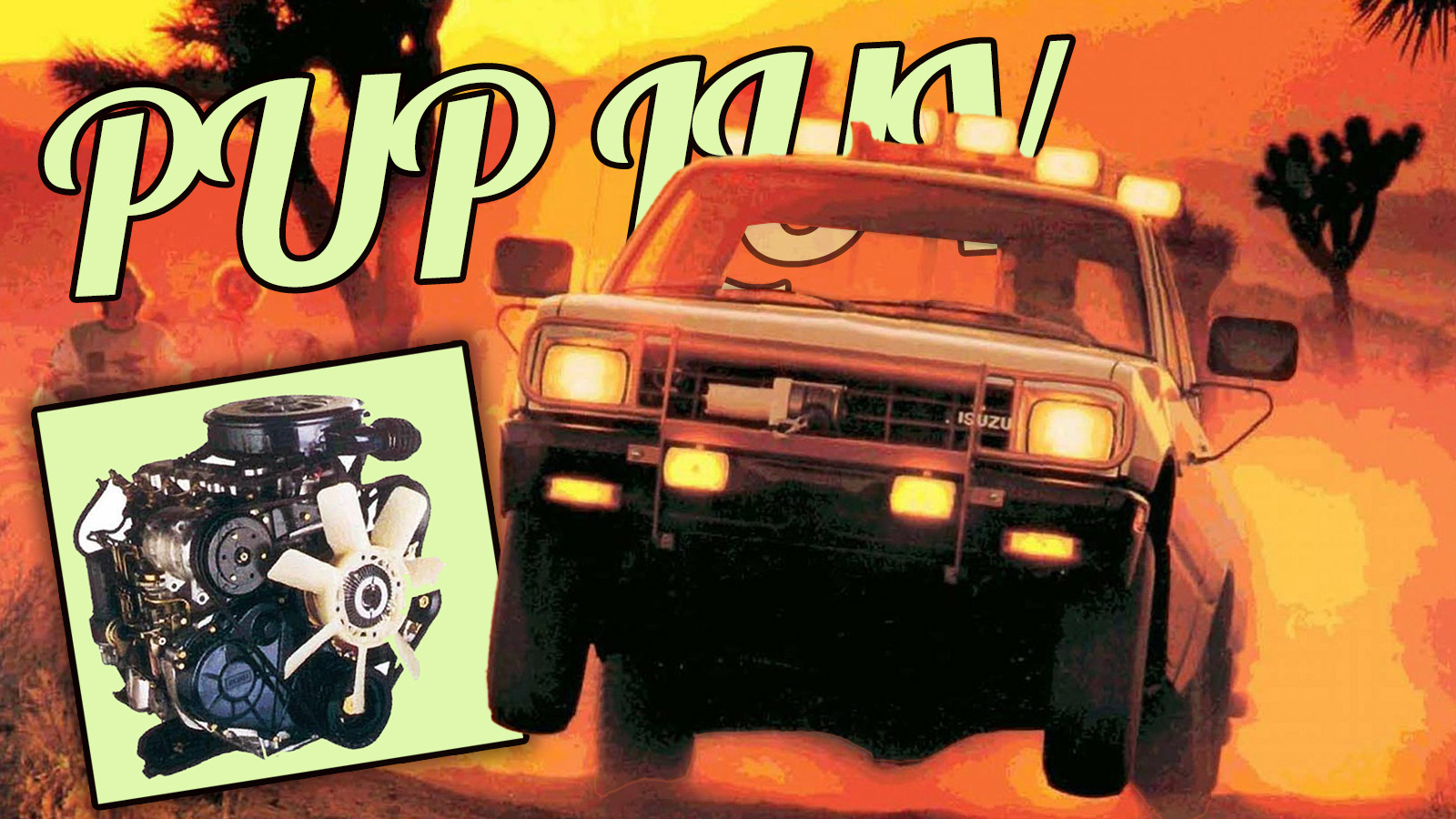
The modern pickup truck is an incredible feat of engineering. Today’s trucks can haul inconceivable loads while being almost as comfortable as a luxury car. But, aside from the likes of the Ford Maverick or similar, most trucks aren’t particularly fuel-efficient. Back in the 1980s, Isuzu sold a truck in America that got fuel economy so good that, technically, it beat pretty much any truck on the road today. This is the Isuzu P’UP, a truck that got a whopping 44 mpg on the highway with a diesel engine and a manual transmission.
The diesel truck of today is a different beast than it was four decades ago. Modern trucks are built to run impressive power numbers right from the factory. Anyone with enough cash in the bank can walk into a Ford dealership and drive out in an F-450 that’s capable of hauling a small nation with its 1,200 lb-ft of torque and 40,000-pound tow rating.


It was a different story in the 1970s and the 1980s. The diesel pickup truck engines of those days usually made well under 200 horsepower, and the compact diesel engines often had power numbers in the double digits. In those days, a diesel passenger vehicle was not purchased for its raw power, but for its fuel economy. The gasoline engines of the era couldn’t hold a candle to how little fuel diesels sipped. The rise of the diesel in the 1970s made sense given the conditions of the period, which suffered through multiple gas crises and fuel price instability. Diesel was a cheaper fuel, and diesel engines got better fuel economy.

This era was also ripe for the ascension of the compact pickup truck. Datsun and Toyota both entered small trucks into the American market in the 1950s, and then continued to cultivate their presence in America in the 1960s. By the early 1970s, tiny imported trucks were becoming exceedingly popular, but dealers of domestic brands had nothing that they could directly compare with. So, the Big Three responded by partnering up with Japanese brands and just slapping American badges on Japanese mini-trucks. The Mazda B series would get a Blue Oval and a new Courier nameplate. The Mitsubishi Triton would become the Dodge D-50, and General Motors? It would turn to Isuzu.
The house of Joe Isuzu would build extremely thrifty trucks for the American market, including the Chevrolet LUV and the Isuzu P’UP. These trucks were so economical that, based on the EPA testing of the day, the P’UP got an impressive 44 mpg on the highway. Even by today’s standards, these old, simple, and durable trucks got better fuel economy than most pickups you’ll find in a dealership.
Isuzu’s Rescue

Isuzu came to America later than the likes of Datsun, Toyota, Mazda, and Honda. Going into the early 1970s, Isuzu was in dire shape. It launched new models, but trailed far behind Toyota and Nissan in Japan, which controlled a total of 56.4 percent of the Japanese market. The New York Times noted that, of the 5,289,157 vehicles built in Japan in 1970, only 2.8 percent of them were Isuzus. The brand’s hold of truck sales in Japan was a little better, as Isuzu had 5.8 percent of that market. Isuzu ranked dead last in size for Japanese automakers and sixth for Japanese truck manufacturers.
Either way, this wasn’t sustainable, and Isuzu started shopping around for interest from another firm. At first, Isuzu kept its interest in Japan, seeking some sort of deal between Fuji Heavy Industries, Mitsubishi, or Toyota. Much of this was due to the fact that, until 1971, the Japanese government didn’t allow foreign investment into Japanese companies. Once that restriction was lifted, General Motors came in to scoop up 34.2 percent of Isuzu. Meanwhile, Chrysler got 35 percent of Mitsubishi, and Ford took a slice of Toyo Kogyo Company, Ltd. (Mazda).

Under the particulars of the deal, Isuzu would get to export cars to America. But the twist was that they’d have the badge of a General Motors brand on them.
This led to some really weird vehicles. In 1970, General Motors sought to create a world car platform for a car that could be sold in as many markets as possible with minimal changes. The T-car program engaged GM’s partners in America, Brazil, Germany, and Japan to develop a front engine, rear wheel drive unibody vehicle that would initially launch as the 1973 Chevrolet Chevette for GM Brazil. Then came the Chevrolet Chevette for America, the Pontiac T1000 for America, and the Saehan Bird for South Korea. Isuzu got the T-car as the Bellett Gemini. Bizarrely, the Isuzu flavor of the T-car was then sent to America as the Buick Opel. So Americans had many chances to experience slightly different variations of the same thing.
Small Truck LUV

GM’s answer to mini-truck madness was to slap a new badge on an Isuzu. In 1972, the Chevrolet LUV (Light Utility Vehicle) landed in America. This truck was little more than an Isuzu Faster with an American face. The Faster, launched in 1972, was derived from the Isuzu Florian sedan, featuring that car’s front clip and doors.
The LUV featured an Americanized face plus a 1.8-liter four-cylinder engine good for 75 horses and 88 lb-ft of twist. The little truck also had a four-speed manual transmission, a 102.4-inch wheelbase, and a 1,400-pound payload. It was a hard-working, basic truck that got good fuel economy. General Motors, like the rest of the American automakers that slapped their own names on Japanese trucks, even found a clever way around the infamous “Chicken Tax” 25 percent import duty. By shipping the LUV to America without a bed, it was considered a chassis cab, and thus subject to only a four percent duty. The truck would then be mated with its bed after clearing through Customs.

Something that was pretty heartwarming about the LUV was that it was treated as a legitimate member of the Chevrolet truck family. It was marketed as a rough and tough half-ton truck for businesses and individuals who wanted a real truck, but just didn’t want it big or thirsty. Chevy depicted LUVs working on farms, at construction sites, and hauling dirt bikes. In 1979, Chevy even started marketing a lightly lifted and ruggedized 4×4 model. Chevrolet sold 20,000 LUVs in the truck’s first year of sales, and sales peaked at more than 100,000 units in 1979.
By 1978, the LUV’s 1.8-liter mill saw a power increase to 80 horsepower and 95 lb-ft of torque. A diesel wasn’t available, but with contemporary EPA ratings of 24 mpg city and 34 mpg highway, the LUV was plenty thrifty. Sure, “highway” in this case meant the ol’ “double nickel” of 55 mph, but there are still a lot of trucks that couldn’t do that good today, even at the same speed.
If you wanted some diesel with your LUV, you had to wait for the second-generation model to land on American shores.
Round Two

The second-generation Faster had a more modern look. Chevy said that the 1981 LUV got an aerodynamic design and a bed that was redesigned to have its tie-down hooks on the inner wall of the box. Fresh additions for the 1981 year included side window defoggers, a combination turn signal, headlight, and wiper stalk, and a locking glovebox. The cab was said to be bigger inside with more legroom and shoulder room.
Under the hood, the LUV sported a 1.8-liter four with a cast aluminum head, a cast aluminum block, and the ability to burn unleaded gas. Power remained the same as the outgoing truck with 80 ponies in the stable and 95 lb-ft of torque. The LUV also had a 7.5-foot box, up to a 1,680-pound payload, and rode on an independent torsion bar suspension up front, plus leaf springs in the rear.

The part-time 4×4 model also made a return, and Chevy boasted 7.5 inches of ground clearance, an undercarriage with driveline components tucked into the body, steel skid plates, and a two-speed transfer case. MPG figures for 1981 were 36 mpg highway with a manual transmission and a far worse 28 mpg highway with an automatic transmission. The 4×4 model thankfully came with a manual as its only option, and scored 31 mpg highway in EPA testing.
The new Chevy LUV, also referred to as the LUV Series 11, was marketed with a diesel engine. This baby mill was a 2.2-liter naturally-aspirated engine that had all of 58 horses and 93 lb-ft of torque to its name. Chevrolet advertised fuel economy as high as 44 mpg with this diesel engine and a five-speed manual.
Isuzu’s Little P’UP

Something a bit weird also happened with the new LUV. Sales crashed as Chevy buyers largely rejected the LUV’s new looks. Meanwhile, Isuzu decided to try its hand at marketing its vehicles under its own badge in America. The Isuzu Faster that formed the basis of the Chevy LUV was also turned into the Isuzu P’UP (short for Pickup), which went on sale in 1981. This meant that the Faster was on sale in America under two different brands at the same time. At the time, the P’UP had a price of $6,117, depending on options. That’s $22,868 in today’s money.
These trucks were the same underneath, featuring the same structure, the same engines, the same transmissions, and the same fuel economy ratings. Really, the differences between them, at least in 1981 and 1982, were superficial. The LUV would bow out of the market in 1982, replaced by the Chevrolet S-10, which had been in production since 1981. Technically, the S-10 was still at least partly Isuzu because, thanks to a technology-sharing agreement, the S-10’s base engine, diesel engine, and one manual option came from Isuzu. This meant that, in the 1980s, Isuzu had its hands on a few diesel trucks in America, and only a couple of them were badged as Isuzus. This list included the P’UP, the Trooper II, the Chevrolet LUV, and the Chevrolet S-10.
Popular Mechanics ran a gauntlet of tests for all of the mini-trucks on the market in 1982. The list included the Ford Ranger, Subaru BRAT, Volkswagen Pickup, Dodge Rampage, Datsun King Cab, Dodge Ram 50, Mazda B2000, Toyota Pickup SR-5, Chevrolet S-10, Isuzu P’UP, and Jeep Scrambler. Of that lineup, the P’UP was the second-slowest truck, taking 20.28 seconds to complete a quarter mile at 65.98 mph. The slowest was the Ford Ranger at 20.76 seconds at 64 78 mph, but only the automatic version. The manual Ford Ranger dusted the P’UP.

The P’UP was the third slowest through the slalom, beating only the Jeep Scrambler and Subaru BRAT. Popular Mechanics attributed the P’UP’s terrible handling to its bias-ply tires. However, the publication also said that the ride was “uncomfortable,” plus “strained and bouncy” with “unpredictable handling.” The P’UP made up ground by having middle-of-the-pack brakes, and excelled in practicality and fuel economy. Only the Volkswagen beat the P’UP’s gas mileage.
On paper, the LUV and the P’UP were the leaders in fuel-efficient body-on-frame trucks in America. The Nissan 720 truck also had a diesel engine, but brochures mentioned only 39 mpg at best. However, the EPA said not so fast. In 1981, the EPA ran America’s cars through a simulation of what it believed to be real-world driving. The undisputed champion of pickups was the Volkswagen Rabbit Diesel, which scored an impressive 38 mpg average in the real-world test against its 48 mpg highway advertised rating. For whatever reason, the makers of body-on-frame compact trucks ignored the hare from Wolfsburg.

If you excluded the Volkswagen and focused only on body-on-frame trucks, the king of diesel in 1981 was the Nissan 720. Here’s what I wrote before:
If you go back to the EPA’s 1981 simulation, which included tons of idling and other wasteful driving, you’ll find that the Nissan 720 scored 33 mpg during the test, just a few numbers shy of the VW’s 38 mpg average. The closest runner-ups were the Isuzu P’up/Chevy LUV diesels, which got 32 mpg. The closest gasser was the Mazda B2000 at 27 mpg and a reproduction Ford Model A truck at 28 mpg.
Nissan was proud to advertise this fact and called itself “King of the Diesels.” Of course, this was based only on the technicality that Nissan ignored the existence of the Rabbit as a real truck.
The P’UP Rides On
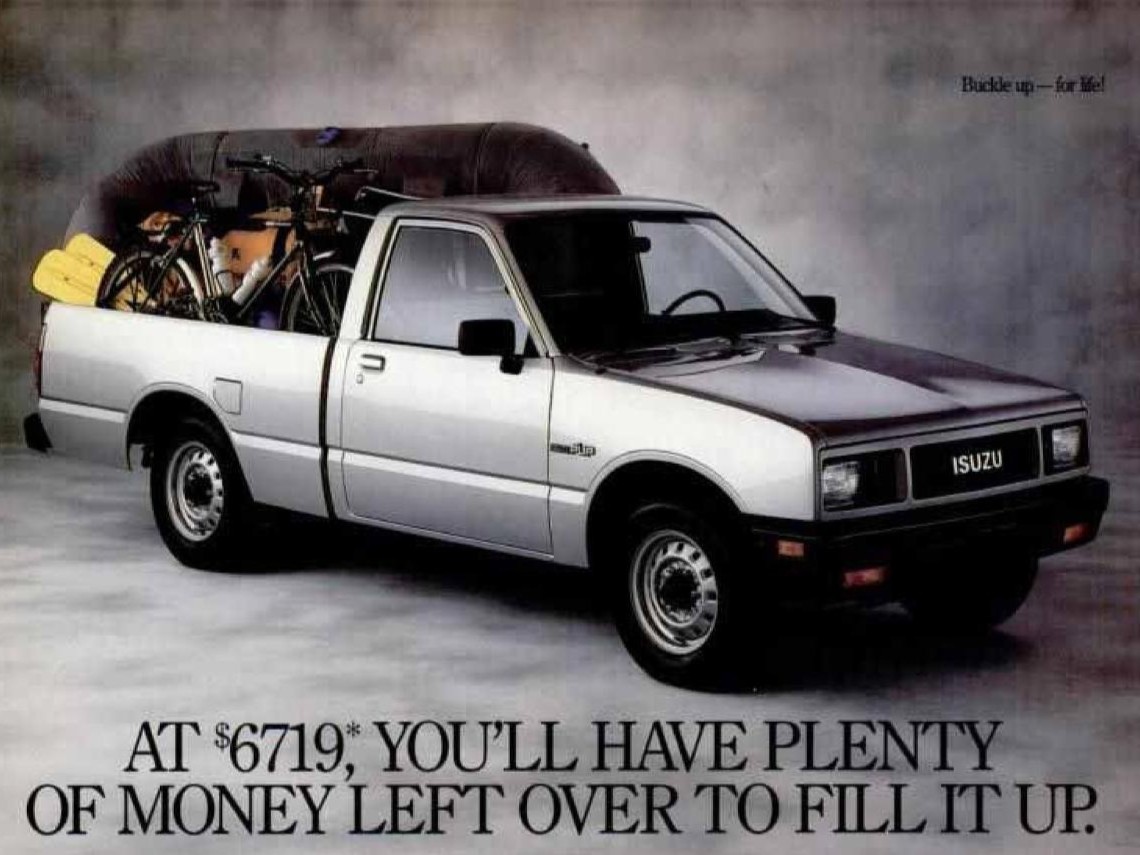
Isuzu kept selling and improving the P’UP long after General Motors gave up on the LUV. In 1985, the P’UP got a facelift, which added a new 1.95-liter four, which was good for 82 horsepower and 101 lb-ft of torque. The diesel engine, meanwhile, saw its output increase slightly to 62.8 HP and 96 lb-ft of torque. The marketing also seemed to get a little closer to reality as Isuzu marketed the diesel as getting 38 mpg at best, down from the high of 44 mpg only a couple of years earlier.
The P’UP would get weirder still in the latter part of the 1980s with the introduction of the extended “Spacecab” model. A turbocharged diesel would also become available, adding a bit of spice in the form of 80 HP. There was also a 2.3-liter four, which brought 96 HP and 123 lb-ft of torque to the table.
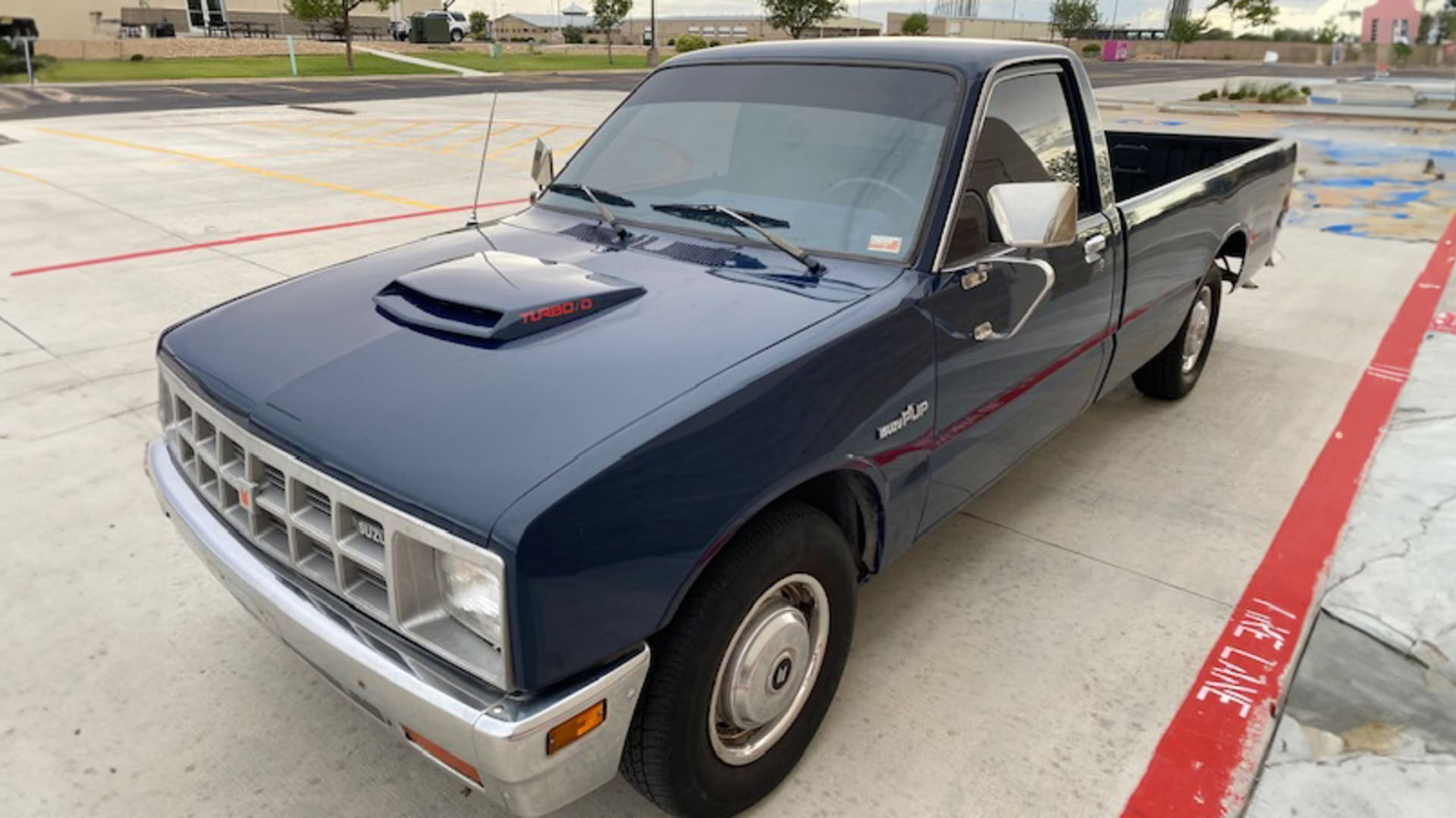
By 1988, the P’UP’s story came to an end. Isuzu’s new and shiny truck dropped the cute P’UP name for “Pickup.” The Pickup ditched the diesel engine and also holds the distinction of being the last new vehicle available with a carburetor. Yep, the 1994 Isuzu Pickup with the 2.3-liter four was the last holdout with a carb!
You can sort of look at the P’UP through modern lenses. In 2008, the EPA revised its fuel economy testing methods to better reflect real-world driving. This was the biggest change to EPA fuel economy testing since 1984. The result was that many vehicles saw their highway fuel economy numbers fall. For example, the original Honda Insight was rated for 70 mpg highway at its launch, but after the EPA’s revisions, its rating was retroactively dropped to 61 mpg. What’s neat about this is that the EPA maintains a catalog of models going back to 1984 with revised numbers.
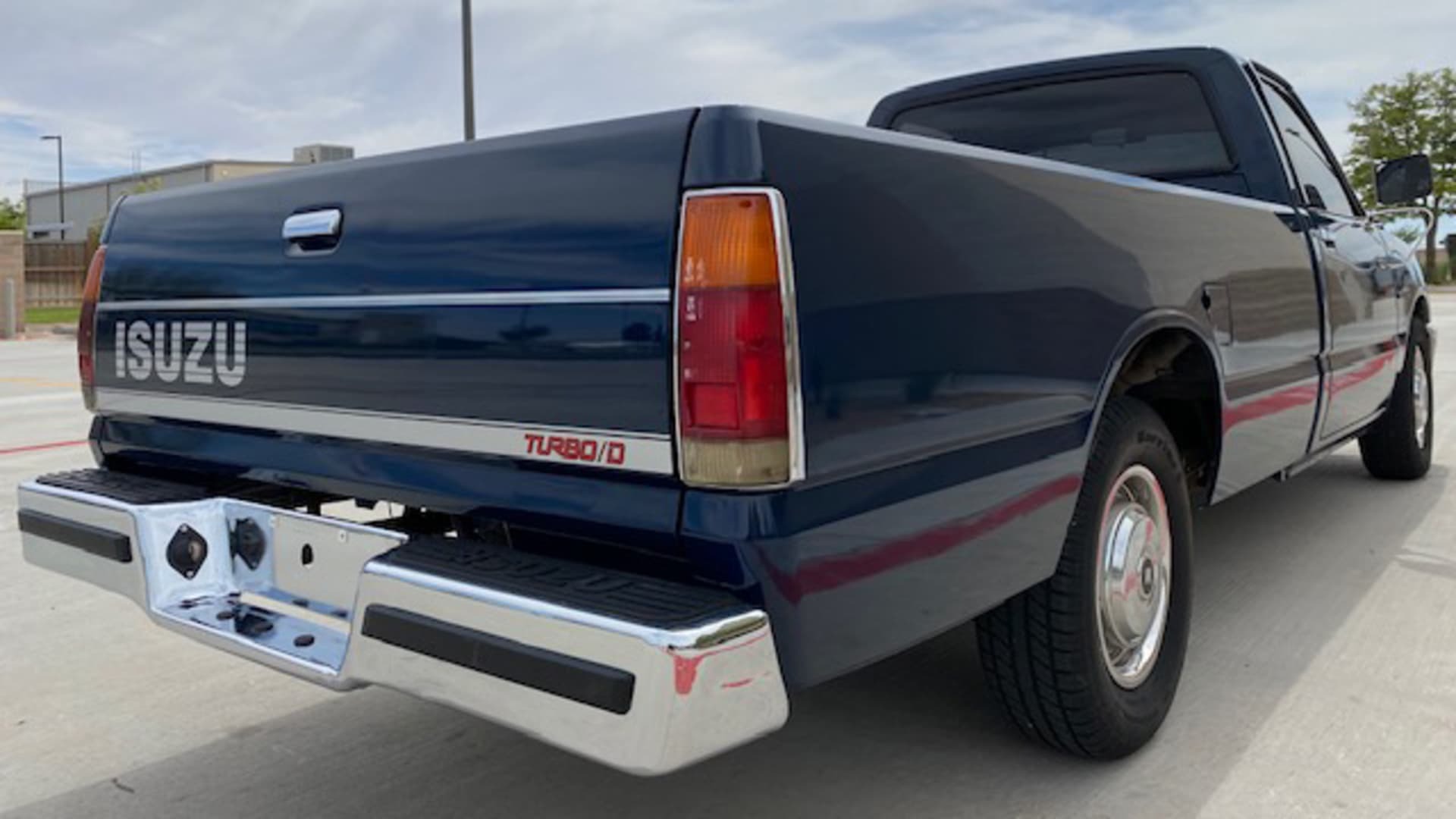
The P’UP? In 1985, the EPA said the 2.2-liter diesel with a four-speed manual transmission and rear-wheel-drive got 38 mpg on the highway. Today, the EPA says it’ll be closer to 35 mpg. This seems to reflect what modern P’UP owners get with their trucks, as they seem to get roughly 30 to 40 mpg, with some really careful drivers claiming as high as 50 mpg.
That means, with some exceptions, the Isuzu P’UP diesel, like the Nissan 720 diesel, gets better fuel economy than most trucks today. What is better? The Ford Maverick easily beats up the P’UP, and you might be able to match the P’UP with a Hyundai Santa Cruz if you’re careful. I’ve also been able to get in the upper-20 mpg range in a regular cab Ford F-150 5.0 V8, but that required being really easy on the go pedal. Otherwise, there’s nothing that really comes close.
History Is Fun
Of course, fuel economy is only a single metric. Today’s trucks are far more powerful, more comfortable, safer, and more feature-packed. Also, the average P’UP is over 40 years old now, and it’s getting exceedingly difficult to find one that hasn’t been returned to the Earth yet.

Still, it’s fun to think that, back in the 1980s, small, fuel-efficient trucks were everywhere and were sold by so many automakers. Now, you can count the number of trucks that get above 30 mpg on a single finger. But it’s also not all bad, because nowadays you can also buy a competent all-electric truck.
If you’re lucky to find one of these trucks in decent shape, it’s unlikely you’ll pay a lot for one. One gas-powered P’UP sold on Bring a Trailer for $4,300 in 2023. A diesel rolled across the auction block at Cars & Bids in 2023 for $6,000. A basically showroom condition Chevrolet LUV went for $12,000 on Cars & Bids that same year. I bet you wouldn’t even pay that much on a platform like Facebook Marketplace.
Little diesel trucks like these are firmly a thing of the past. It’s unlikely they will come back, and if they did, a modern equivalent won’t be as cute or tiny. So, I like to look at stories as the Isuzu P’UP, as a fascinating artifact of the past. These were very much trucks of their era, built for a time when saving money was paramount for many car buyers. At the very least, it does seem like there is a sort of mini-truck revolution happening in America with the Maverick, the Slate, and maybe Ford’s new $30,000 truck, so the fun isn’t over yet.
Top photo: Isuzu


I used to have a ’91 Rover Metro with a 1.4 diesel. It was SLOW AS HELL, but got a consistent 55-60mpg, even in the city. Absolutely ridiculous car that would never pass modern safety standards, but at least it was cheap to drive.
Yeah, but none of the modern ones will give you and everyone around you lung cancer, so I’m going to call that one a win for progress anyway. My understanding is that modern diesels can do ridiculous fuel economy too if you emissions-delete them, but even an amateur hypermiler like me doesn’t think that’s a good tradeoff.
That is very true! I’d rather have a Maverick than a P’UP. 🙂
Yep! The art of a well crafted headline. Gotta click on that just to make sure everyone knows that of course today’s lower figures aren’t just because we somehow are dumber now than we were 30 years ago! (talking to myself here, but also, as a person who is becoming increasingly aware that I’m spending too much time on this site, the intentionality of the drawing in is also something I’m feeling funny about).
I’ve complained about that repeatedly. The clickbait headlines have been bad lately, even on some legitimately interesting articles. I assume it must be juicing their metrics, but it is very disappointing.
Thanks for confirming I’m not the only one here!
I understand that The Autopian already has me, and is trying to get those unique visitors to engage.
But it’s still annoying!
And I’ve banned myself from reading any more DT articles because they engage in this throughout the article, positing various stances and mechanical work choices that are just questionable enough to make us “real mechanics” want to yell at the screen.
I don’t know.
But anyway, keep up the good work, Autopian team.
Had an ’86 Spacecab gasser in high school. Was a fun little truck, great mileage, easy to work on. Extended cab was large enough for…activities.
Always liked these, and while not exactly common, you would see them around the New York area in the 1980s from time to time. Isuzu also had the Impulse, with those great wheels with the squares cut out.
I’ve been watching a lot of videos about diesel Mercedes: the W123 and some W124 mostly. Both the naturally aspirated ones (which could probably give the diesel P’up a run for slowest vehicle) and the later turbo ones too. There seems to be some consensus that parts for all W123 models have been getting much scarcer over the past several years, with a commensurate increase in price if and when you find what you need. Which isn’t suprising I suppose: those cars are mostly 50 years old, and nice ones routinely sell for tens of thousands of dollars. As long as you’re not in a rush to get somewhere, those cars are stylish, durable, and mechanically simple (except for HVAC and those power accessories operated by vacuum, but that’s only in upper trim models generally… opt for manual windows, locks, etc… and you won’t have to worry about it). I never had a W123 myself sadly, but have driven a few, and always liked them too.
I drove a VW TDI (turbo diesel) for 23 years and loved the drivetrain. Even though it was an automatic, and a heavy car for its size, getting 44-45 MPG on the highway was easy (55 for manuals was common). City MPG for my automatic was merely 30 MPG, which of course I long for now that I sometimes get under 10 MPG around town in my 240 (hopefully, that’ll improve to maybe 15 MPG now that the timing’s been adjusted).
I dunno why, but I’ve been jonesing badly for an older Mercedes, despite my bad experience with their CLK, which was the only car I got new and turned out to be super unreliable. But something older than that, like a W124, should be more reliable, excepting the issues due to age (hoses, belts, bushings). Hopefully, I’ll be able to resist the urge to get a W124 (a wagon would be my first choice of course).
My impression: Mercedes W123/124 roughly equal Volvo 240/B5 vehicles.
Isuzu built, and still builds good stuff.
But the P’up ain’t it. It’s great outside of the US, where you’re winding down narrow gravel or dirt roads and never going faster than 50.
Isuzu really hit its stride in the 90’s, when you could buy Isuzu products under Honda, Acura, GM, or Isuzu labels. And the Duramax (largely designed and built with Isuzu engineering know-how) still kick ass.
But man, everything Isuzu built in the 80’s offered double-digit horsepower and terrifying freeway experiences. I had an original Trooper II and loved it for its dead-simple durability, but Isuzu always veered heavily toward the “utility” part of SUV and less towards “sport.”
Imagine marketing a truck called the P’UP in 2026… Ford has a Lobo, but most 4×4 I see look more like Cujo. LUV vs angry eyes Jeep.
These things were slow, utterly terrible rustbuckets. And I say that as someone who actually LIKES old diesels when they were bolted into something good. Reliable as a nail until the tinworms won the battle, but nothing at all to be nostalgic for.
And anyone who thinks that modern trucks are “almost like luxury cars” to drive obviously has never been in an actual luxury car. Because they don’t, at all. And I say that as someone who drives his neighbor’s full-zoot $80K++ GMC Sierra Denali on the regular. It’s a truck with a bunch of tinsel draped on it, but it’s still a $40K work truck (that should be a $30K work truck) under all the tinsel. The Rams with air suspension ride a little better, but not much.
I drove one of these once. I CANNOT Over-state just how AWFUL it really was. It was my friend’s Pu’p and good gawd… I thought we were gonna’ die trying to get it up to freeway speed and keep in mind this was in the mid-90’s when most cars were still pretty shitty in terms of acceleration. There is only one other thing I’ve driven that was so anemic. It was a Chevy Aveo. But even it was like a damned rocket ship compared to the pup.
Just here to say that first gen LUV is a pretty good looking truck!
I’m surprised that the 2nd LUV, which looked like a small Chevrolet, didn’t get any love.
I live in South Africa and, back in the early 2000s I drove a 1990 Isuzu KB250 with a naturally aspirated 2.5-liter diesel engine. I would easily get 31 mpg on the highway.
I had a coworker at my old department that commuted in a pup diesel. He was so excited to tell me that he was getting 35 mpg until I pointed out the fact that my jeep liberty CRD was getting between 39 and 43 for the same drive at the same times. I offered to carpool but he didn’t want to because he smoked like a chimney and my jeep had never been smoked in.
As for modern trucks, my wife is consistently getting between 26 and 29 mpg in her ecodiesel ram. The thing has the worst turbo lag of anything I’ve ever driven but she likes it and it gets her good economy on the 160 miles per day she drives it.
I would like to see small trucks come back.
It’s okay if they’re not diesels, that’s fine. But smaller trucks would be a win. Ford and Hyundai are laughing all the way to the bank with the successful results of their experiments, let’s see how many more like that – or even smaller, like the P’UP – we can move instead of overwrought, overpowered, underutilized gargantuans.
“Yep, the 1994 Isuzu Pickup with the 2.3-liter four was the last holdout with a carb!”
That may have been – but it wasn’t available in the US. By then it was related to Mexico and Latin America only for the North American market.
When I returned from Japan and got a job selling cars at the San Francisco Autocenter in June 1993-Jan 1994, the P’UP was gone (tho people still occasionally came in asking for them)
There are guys putting industrial diesels in older rangers and other more recent small trucks. They see 50mpg regularly I’ve heard some say 80 or 90mpg. They aren’t the fastest thing to 0-60 but even a 20 year old industrial engine originally rated at maybe 40 to 50hp that was running a reefer with a $120 turbo added and probably some pump and injector mods and a 20 year old maybe slightly more aero certainly heavier chassis. If someone can do that in their garage with with alot people would consider junk why can’t the established automakers make something similar. Even if you go automotive grade VW had those little 1.0 tdi in Europe. There are tons of small displacement Japanese diesels. Put one a little truck and go.
I love the old factory diesel mini trucks but they can be a bit tin box rattle traps with almost no power. But most didn’t even have a turbo and of course very outdated injection systems. Both have come such a long way in the 40+ years since they were made.
Robot Cantina on YouTube I’d experimenting with a normally aspirated vw diesel in an old s10 right now if you like ridiculously underpowered engines making real cars move and trying to play with them for best performance. I find them entertaining.
I’ve watched some of that and his other projects. I wish he went for something more modern than like an 85 vw diesel. He is basically making a rabbit truck. He will probably turbo it or some other forced induction at some point but still he still had to make a bell housing adapter. Might as well go straight to the industrial diesel out a reefer of apu while they are cheap and pluntiful.
He did a 3 cyl industrial in one of his first gen insights that he has played with for years. I think it was a kubota but I’m not 100% certain. He also said that he used the ancient vw because that’s what he had and yes he’ll add forced induction but eventually he plans on doing a more modern one too. He re engines everything multiple times so it’ll likely happen over the next year or so.
Bringing back smaller trucks would create a social shock in some of this country’s men. They would require many years of therapy, not being able to deal with what they perceive as being emasculated.
Truth. Do your own survey. The average F150 driver is taller than the average F250 driver
The average F-450 driver needs to take a running start to get into the cab
That’s funny because it’s absolutely true.
Not to mention that the big 3 American car companies would weep. They’ve spent decades pitching about how macho their bigger more expensive trucks are. If their buyers ever saw behind the curtain, that giant profit model would come crashing down.
I don’t necessarily buy into this. Sure, I see the fragile-masculinity bro-culture trucks too but I see that as a relatively small minority of shallow-thinking trend-followers. That sort has always been around. But when I’m out in my Ram 50 I hear one statement from observers more than any other: “I wish they still made trucks like this.”
Guys…. have any of you ever actually driven a mini truck from this era? Especially a diesel one? Yes they get double the fuel mileage, but a modern diesel pickup makes TEN TIMES the power. Look I also wish that smaller more fuel efficient pickups were available, but these things were pretty useless for all but hauling grass clippings, and did not do so in a safe manner. This isn’t some secret forgotten technology, it’s low horsepower, poor emissions controls, and sheet metal made of kleenex and scotch tape. I’m in a region that doesn’t rust, and I’ve seen ONE LUV in the past few years that only had one hole through it.
I have pretty much only ever driven a mini truck from that era, or its predecessors or successors, and hauled an honest 1/2T in them many many times. We also have an old F250 for when we want to haul a ton or two while towing a few tons.
What do I need TEN TIMES the power and more length and width for?
well you just said you have an F250 for when you need to haul more serious loads. My first vehicle was a 1991 Toyota Pickup. I miss that truck more than anything, but it got pretty terrible fuel mileage for its capabilities. Now I own an old K2500 for when I need to use a truck, and a car for when I commute. I think people who are buying ONE vehicle, and feel the need for a pickup (whether justified or not) are going to buy the most capable vehicle for the money they have. A modern half ton vs. the mid size pickups don’t really pencil out. The half ton is nearly always a better buy than a midsize, if just comparing figures.
Horses for courses. I don’t commute, and when I did I took a motorcycle or the bus. I use my mini truck for car stuff and hauling motorcycles/parts/lumber/tools/firewood. The high load floor and low MPG on the F250 makes it only useful a few times a month.
Yeah my 3/4 ton is relegated to a few times a month duty as well. Motorcycle gets hauled on the back of my Tracker, and my Volt can take a shockingly huge amount of junk in the hatch!
Dad had a 1980 Ford Courier XLT 5 speed.
It hauled all kinds of landscaping stuff – manure, mulch, bushes and trees, as well as appliances, TV’s, furniture, bicycles, etc.
It also hauled him to work every day and me to school & activities occasionally.
Sure it was light and tinny – but it wasn’t much more tinny than the ’73 F100 Custom it replaced.
Back then, being smaller and easier to drive and park, easier on fuel, cheap to insure, and low priced were major plusses.
I find it bizarre how we got away from that – it’s not like people were less active, men were less masculine, or families had fewer kids.
Not even Countaches or Berlinetta Boxers had 10X the hp of these rugged little trucks – yet today you can get the same power as a 1980 Countach in an E450 sedan, or a Stellantis Dodge Charger. So what?
And yeah, I suppose pretty much any @50 year old car or truck would have some rust. Just because it’s in a rust-free area now doesn’t mean it hasn’t spent time in rust-world – or simply been parked outside for the past half-decade.
Again – So what?
Come on, you gotta admit Toyotas and Isuzus of that era are ESPECIALLY dissolvable in rain. My point wasn’t that “trucks are better because they make 10x the power”, just that they make 10x the HP, while getting about half the mileage. Still an incredible engineering feat. Do I think modern 3/4 tons need to make 1000 ft/lbs? No, but it does seem to be what the average buyer wants.
Isuzu was sold at local Buick dealer. Prior to Isuzu the dealer sold Opel alongside Buick. My uncle being a Buick man purchased a diesel 4×4 Isuzu in 85. I drove that truck a LOT. Mainly on trips to get firewood at area sawmill. Scrap wood was free, the work was hard labor for me and the truck. That little truck was slow, economical and very capable. I owned a 78 Courier with long bed while in college and I’ll tell you that even though it was gas engine, the diesel Isuzu was far superior. So yes I have experience with this era of compact trucks. I’d eagerly purchase a modern day version. Recently I spent time working in Aruba. Assigned a Mitsubishi Triton diesel I was impressed with performance and drivability. I’d buy one. It was more utility oriented and lacked the carlike attributes of the Maverick hybrid my wife drives so I’d say it would be my truck and my wife would keep her Maverick.
I mean you sort of can, a USDM colorado is only a couple of inches wider than a current generation Triton. They were also available in diesel! But it seems nobody bought them, which I think is a shame.
I’ve got one (Colorado diesel). It’s a ZR2, so it’s down on the MPG compared to the more street specs, but if I keep it around 60-65mph I’ll average 25-28mpg. Even better if I keep it on the country road two-laners, I’ve managed 30+mpg a few times.
That’s pretty impressive, they aren’t exactly little trucks either. Offroady bits always kill MPG’s, my Tracker hasn’t seen better than 19 since tires and lift.
Yeah, my Xterra with a lift and 33’s got ~17mpg no matter what. With the cost of diesel it’s not really saving me any money, but it’s nice getting ~500 miles to a tank instead of ~250.
17 ain’t too bad considering the size and power increase over my 4 cylinder Tracker. I’m running 32’s, with a 5 speed. My BIL has a V6 grand vitara with a similar lift, poor bastard can’t get over 15!
I had a 2wd (gas) Nissan 720 that carried 200-lb me and 1500 pounds of paving stones about 20 miles from a quarry to my home. Yes, the rear suspension was nearly on the bump stops. It managed to get up to 60 on the freeway in what seemed like a reasonable amount of time, but the steering felt light and a little spooky at speed, so I got off the freeway and took surface streets the rest of the way.
No apparent damage.
Heh, I think we’ve all done that with minitrucks. I loaded at least a yard of gravel in my old 91 Toyota P/U. Drove pretty good, but that rear was loooow. Probably not safe.
I would love a new version of my old 82 Toyota sr-5 4×4 with the comfy bucket seats, and 7ft box. Nostalgia is a hell of a drug.
I’d probably like a clean ’82 over what Toyota might do these days. The styling at least.
Yes in 82 Truck makers were not trying to sculpt trucks into masculine gender affirming care.
I think that headline is wrong and you meant cars. Even then, diesel Isuzus and Nissans got mileage close to gas subcompacts (Civic, 210, etc.). Compact pickups were completely viable as utilitarian fuel-efficent “commuter cars.”