


The modern pickup truck is an incredible feat of engineering. Today’s trucks can haul inconceivable loads while being almost as comfortable as a luxury car. But, aside from the likes of the Ford Maverick or similar, most trucks aren’t particularly fuel-efficient. Back in the 1980s, Isuzu sold a truck in America that got fuel economy so good that, technically, it beat pretty much any truck on the road today. This is the Isuzu P’UP, a truck that got a whopping 44 mpg on the highway with a diesel engine and a manual transmission.
The diesel truck of today is a different beast than it was four decades ago. Modern trucks are built to run impressive power numbers right from the factory. Anyone with enough cash in the bank can walk into a Ford dealership and drive out in an F-450 that’s capable of hauling a small nation with its 1,200 lb-ft of torque and 40,000-pound tow rating.


It was a different story in the 1970s and the 1980s. The diesel pickup truck engines of those days usually made well under 200 horsepower, and the compact diesel engines often had power numbers in the double digits. In those days, a diesel passenger vehicle was not purchased for its raw power, but for its fuel economy. The gasoline engines of the era couldn’t hold a candle to how little fuel diesels sipped. The rise of the diesel in the 1970s made sense given the conditions of the period, which suffered through multiple gas crises and fuel price instability. Diesel was a cheaper fuel, and diesel engines got better fuel economy.

This era was also ripe for the ascension of the compact pickup truck. Datsun and Toyota both entered small trucks into the American market in the 1950s, and then continued to cultivate their presence in America in the 1960s. By the early 1970s, tiny imported trucks were becoming exceedingly popular, but dealers of domestic brands had nothing that they could directly compare with. So, the Big Three responded by partnering up with Japanese brands and just slapping American badges on Japanese mini-trucks. The Mazda B series would get a Blue Oval and a new Courier nameplate. The Mitsubishi Triton would become the Dodge D-50, and General Motors? It would turn to Isuzu.
The house of Joe Isuzu would build extremely thrifty trucks for the American market, including the Chevrolet LUV and the Isuzu P’UP. These trucks were so economical that, based on the EPA testing of the day, the P’UP got an impressive 44 mpg on the highway. Even by today’s standards, these old, simple, and durable trucks got better fuel economy than most pickups you’ll find in a dealership.
Isuzu’s Rescue

Isuzu came to America later than the likes of Datsun, Toyota, Mazda, and Honda. Going into the early 1970s, Isuzu was in dire shape. It launched new models, but trailed far behind Toyota and Nissan in Japan, which controlled a total of 56.4 percent of the Japanese market. The New York Times noted that, of the 5,289,157 vehicles built in Japan in 1970, only 2.8 percent of them were Isuzus. The brand’s hold of truck sales in Japan was a little better, as Isuzu had 5.8 percent of that market. Isuzu ranked dead last in size for Japanese automakers and sixth for Japanese truck manufacturers.
Either way, this wasn’t sustainable, and Isuzu started shopping around for interest from another firm. At first, Isuzu kept its interest in Japan, seeking some sort of deal between Fuji Heavy Industries, Mitsubishi, or Toyota. Much of this was due to the fact that, until 1971, the Japanese government didn’t allow foreign investment into Japanese companies. Once that restriction was lifted, General Motors came in to scoop up 34.2 percent of Isuzu. Meanwhile, Chrysler got 35 percent of Mitsubishi, and Ford took a slice of Toyo Kogyo Company, Ltd. (Mazda).

Under the particulars of the deal, Isuzu would get to export cars to America. But the twist was that they’d have the badge of a General Motors brand on them.
This led to some really weird vehicles. In 1970, General Motors sought to create a world car platform for a car that could be sold in as many markets as possible with minimal changes. The T-car program engaged GM’s partners in America, Brazil, Germany, and Japan to develop a front engine, rear wheel drive unibody vehicle that would initially launch as the 1973 Chevrolet Chevette for GM Brazil. Then came the Chevrolet Chevette for America, the Pontiac T1000 for America, and the Saehan Bird for South Korea. Isuzu got the T-car as the Bellett Gemini. Bizarrely, the Isuzu flavor of the T-car was then sent to America as the Buick Opel. So Americans had many chances to experience slightly different variations of the same thing.
Small Truck LUV

GM’s answer to mini-truck madness was to slap a new badge on an Isuzu. In 1972, the Chevrolet LUV (Light Utility Vehicle) landed in America. This truck was little more than an Isuzu Faster with an American face. The Faster, launched in 1972, was derived from the Isuzu Florian sedan, featuring that car’s front clip and doors.
The LUV featured an Americanized face plus a 1.8-liter four-cylinder engine good for 75 horses and 88 lb-ft of twist. The little truck also had a four-speed manual transmission, a 102.4-inch wheelbase, and a 1,400-pound payload. It was a hard-working, basic truck that got good fuel economy. General Motors, like the rest of the American automakers that slapped their own names on Japanese trucks, even found a clever way around the infamous “Chicken Tax” 25 percent import duty. By shipping the LUV to America without a bed, it was considered a chassis cab, and thus subject to only a four percent duty. The truck would then be mated with its bed after clearing through Customs.

Something that was pretty heartwarming about the LUV was that it was treated as a legitimate member of the Chevrolet truck family. It was marketed as a rough and tough half-ton truck for businesses and individuals who wanted a real truck, but just didn’t want it big or thirsty. Chevy depicted LUVs working on farms, at construction sites, and hauling dirt bikes. In 1979, Chevy even started marketing a lightly lifted and ruggedized 4×4 model. Chevrolet sold 20,000 LUVs in the truck’s first year of sales, and sales peaked at more than 100,000 units in 1979.
By 1978, the LUV’s 1.8-liter mill saw a power increase to 80 horsepower and 95 lb-ft of torque. A diesel wasn’t available, but with contemporary EPA ratings of 24 mpg city and 34 mpg highway, the LUV was plenty thrifty. Sure, “highway” in this case meant the ol’ “double nickel” of 55 mph, but there are still a lot of trucks that couldn’t do that good today, even at the same speed.
If you wanted some diesel with your LUV, you had to wait for the second-generation model to land on American shores.
Round Two

The second-generation Faster had a more modern look. Chevy said that the 1981 LUV got an aerodynamic design and a bed that was redesigned to have its tie-down hooks on the inner wall of the box. Fresh additions for the 1981 year included side window defoggers, a combination turn signal, headlight, and wiper stalk, and a locking glovebox. The cab was said to be bigger inside with more legroom and shoulder room.
Under the hood, the LUV sported a 1.8-liter four with a cast aluminum head, a cast aluminum block, and the ability to burn unleaded gas. Power remained the same as the outgoing truck with 80 ponies in the stable and 95 lb-ft of torque. The LUV also had a 7.5-foot box, up to a 1,680-pound payload, and rode on an independent torsion bar suspension up front, plus leaf springs in the rear.

The part-time 4×4 model also made a return, and Chevy boasted 7.5 inches of ground clearance, an undercarriage with driveline components tucked into the body, steel skid plates, and a two-speed transfer case. MPG figures for 1981 were 36 mpg highway with a manual transmission and a far worse 28 mpg highway with an automatic transmission. The 4×4 model thankfully came with a manual as its only option, and scored 31 mpg highway in EPA testing.
The new Chevy LUV, also referred to as the LUV Series 11, was marketed with a diesel engine. This baby mill was a 2.2-liter naturally-aspirated engine that had all of 58 horses and 93 lb-ft of torque to its name. Chevrolet advertised fuel economy as high as 44 mpg with this diesel engine and a five-speed manual.
Isuzu’s Little P’UP

Something a bit weird also happened with the new LUV. Sales crashed as Chevy buyers largely rejected the LUV’s new looks. Meanwhile, Isuzu decided to try its hand at marketing its vehicles under its own badge in America. The Isuzu Faster that formed the basis of the Chevy LUV was also turned into the Isuzu P’UP (short for Pickup), which went on sale in 1981. This meant that the Faster was on sale in America under two different brands at the same time. At the time, the P’UP had a price of $6,117, depending on options. That’s $22,868 in today’s money.
These trucks were the same underneath, featuring the same structure, the same engines, the same transmissions, and the same fuel economy ratings. Really, the differences between them, at least in 1981 and 1982, were superficial. The LUV would bow out of the market in 1982, replaced by the Chevrolet S-10, which had been in production since 1981. Technically, the S-10 was still at least partly Isuzu because, thanks to a technology-sharing agreement, the S-10’s base engine, diesel engine, and one manual option came from Isuzu. This meant that, in the 1980s, Isuzu had its hands on a few diesel trucks in America, and only a couple of them were badged as Isuzus. This list included the P’UP, the Trooper II, the Chevrolet LUV, and the Chevrolet S-10.
Popular Mechanics ran a gauntlet of tests for all of the mini-trucks on the market in 1982. The list included the Ford Ranger, Subaru BRAT, Volkswagen Pickup, Dodge Rampage, Datsun King Cab, Dodge Ram 50, Mazda B2000, Toyota Pickup SR-5, Chevrolet S-10, Isuzu P’UP, and Jeep Scrambler. Of that lineup, the P’UP was the second-slowest truck, taking 20.28 seconds to complete a quarter mile at 65.98 mph. The slowest was the Ford Ranger at 20.76 seconds at 64 78 mph, but only the automatic version. The manual Ford Ranger dusted the P’UP.

The P’UP was the third slowest through the slalom, beating only the Jeep Scrambler and Subaru BRAT. Popular Mechanics attributed the P’UP’s terrible handling to its bias-ply tires. However, the publication also said that the ride was “uncomfortable,” plus “strained and bouncy” with “unpredictable handling.” The P’UP made up ground by having middle-of-the-pack brakes, and excelled in practicality and fuel economy. Only the Volkswagen beat the P’UP’s gas mileage.
On paper, the LUV and the P’UP were the leaders in fuel-efficient body-on-frame trucks in America. The Nissan 720 truck also had a diesel engine, but brochures mentioned only 39 mpg at best. However, the EPA said not so fast. In 1981, the EPA ran America’s cars through a simulation of what it believed to be real-world driving. The undisputed champion of pickups was the Volkswagen Rabbit Diesel, which scored an impressive 38 mpg average in the real-world test against its 48 mpg highway advertised rating. For whatever reason, the makers of body-on-frame compact trucks ignored the hare from Wolfsburg.

If you excluded the Volkswagen and focused only on body-on-frame trucks, the king of diesel in 1981 was the Nissan 720. Here’s what I wrote before:
If you go back to the EPA’s 1981 simulation, which included tons of idling and other wasteful driving, you’ll find that the Nissan 720 scored 33 mpg during the test, just a few numbers shy of the VW’s 38 mpg average. The closest runner-ups were the Isuzu P’up/Chevy LUV diesels, which got 32 mpg. The closest gasser was the Mazda B2000 at 27 mpg and a reproduction Ford Model A truck at 28 mpg.
Nissan was proud to advertise this fact and called itself “King of the Diesels.” Of course, this was based only on the technicality that Nissan ignored the existence of the Rabbit as a real truck.
The P’UP Rides On
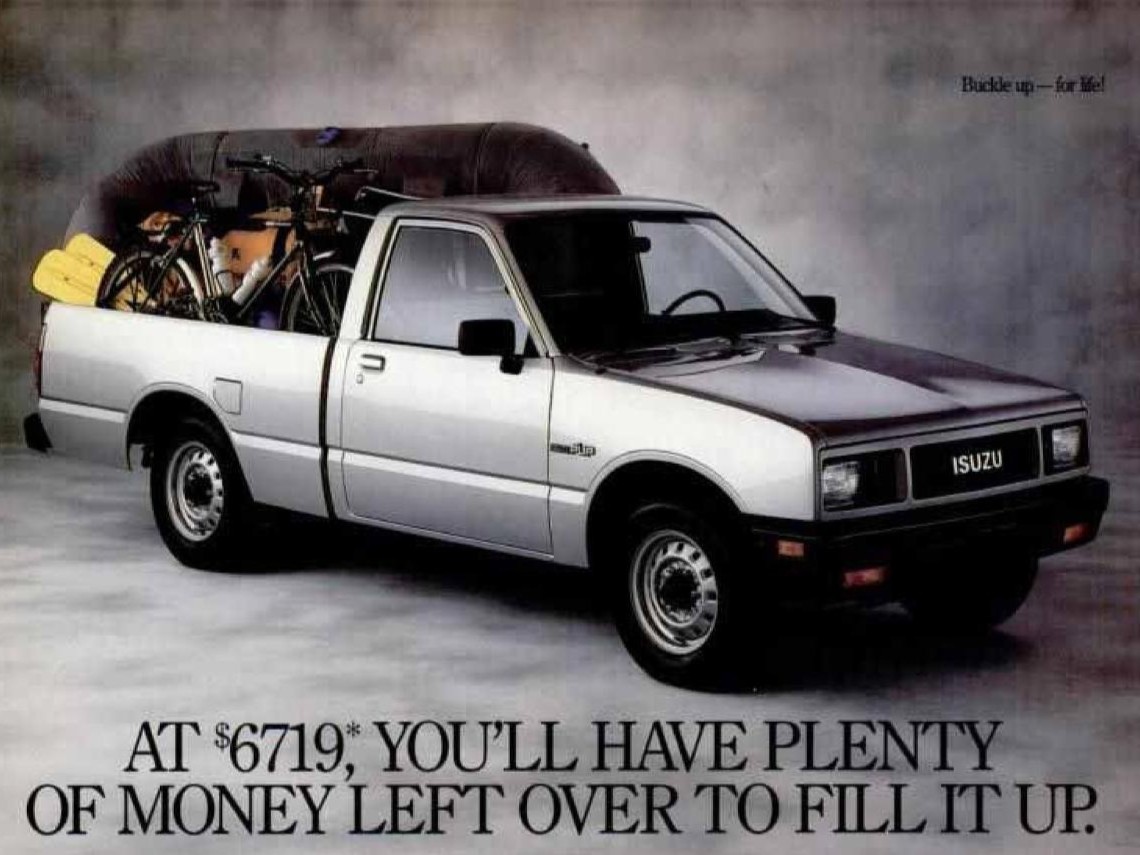
Isuzu kept selling and improving the P’UP long after General Motors gave up on the LUV. In 1985, the P’UP got a facelift, which added a new 1.95-liter four, which was good for 82 horsepower and 101 lb-ft of torque. The diesel engine, meanwhile, saw its output increase slightly to 62.8 HP and 96 lb-ft of torque. The marketing also seemed to get a little closer to reality as Isuzu marketed the diesel as getting 38 mpg at best, down from the high of 44 mpg only a couple of years earlier.
The P’UP would get weirder still in the latter part of the 1980s with the introduction of the extended “Spacecab” model. A turbocharged diesel would also become available, adding a bit of spice in the form of 80 HP. There was also a 2.3-liter four, which brought 96 HP and 123 lb-ft of torque to the table.
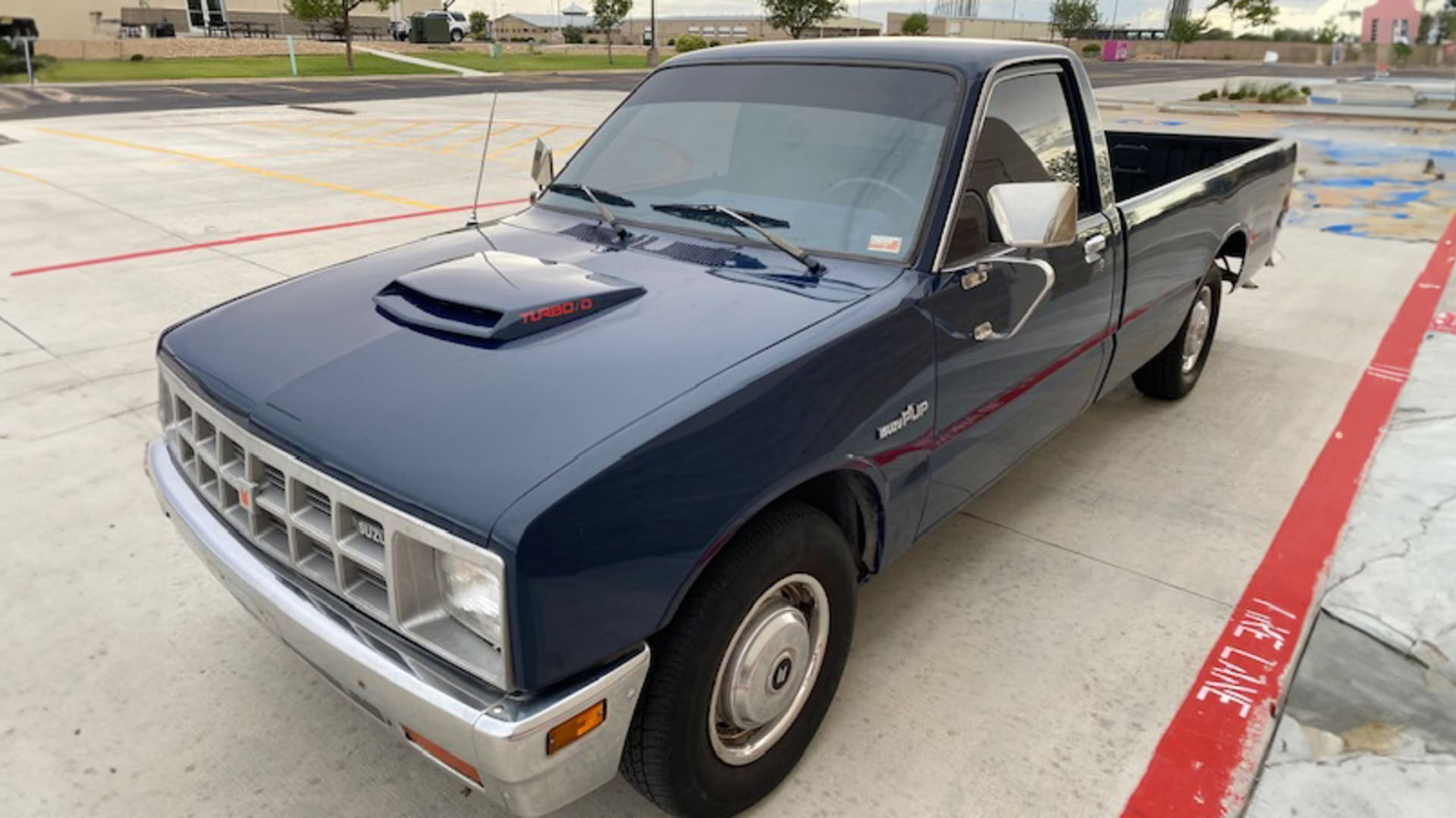
By 1988, the P’UP’s story came to an end. Isuzu’s new and shiny truck dropped the cute P’UP name for “Pickup.” The Pickup ditched the diesel engine and also holds the distinction of being the last new vehicle available with a carburetor. Yep, the 1994 Isuzu Pickup with the 2.3-liter four was the last holdout with a carb!
You can sort of look at the P’UP through modern lenses. In 2008, the EPA revised its fuel economy testing methods to better reflect real-world driving. This was the biggest change to EPA fuel economy testing since 1984. The result was that many vehicles saw their highway fuel economy numbers fall. For example, the original Honda Insight was rated for 70 mpg highway at its launch, but after the EPA’s revisions, its rating was retroactively dropped to 61 mpg. What’s neat about this is that the EPA maintains a catalog of models going back to 1984 with revised numbers.
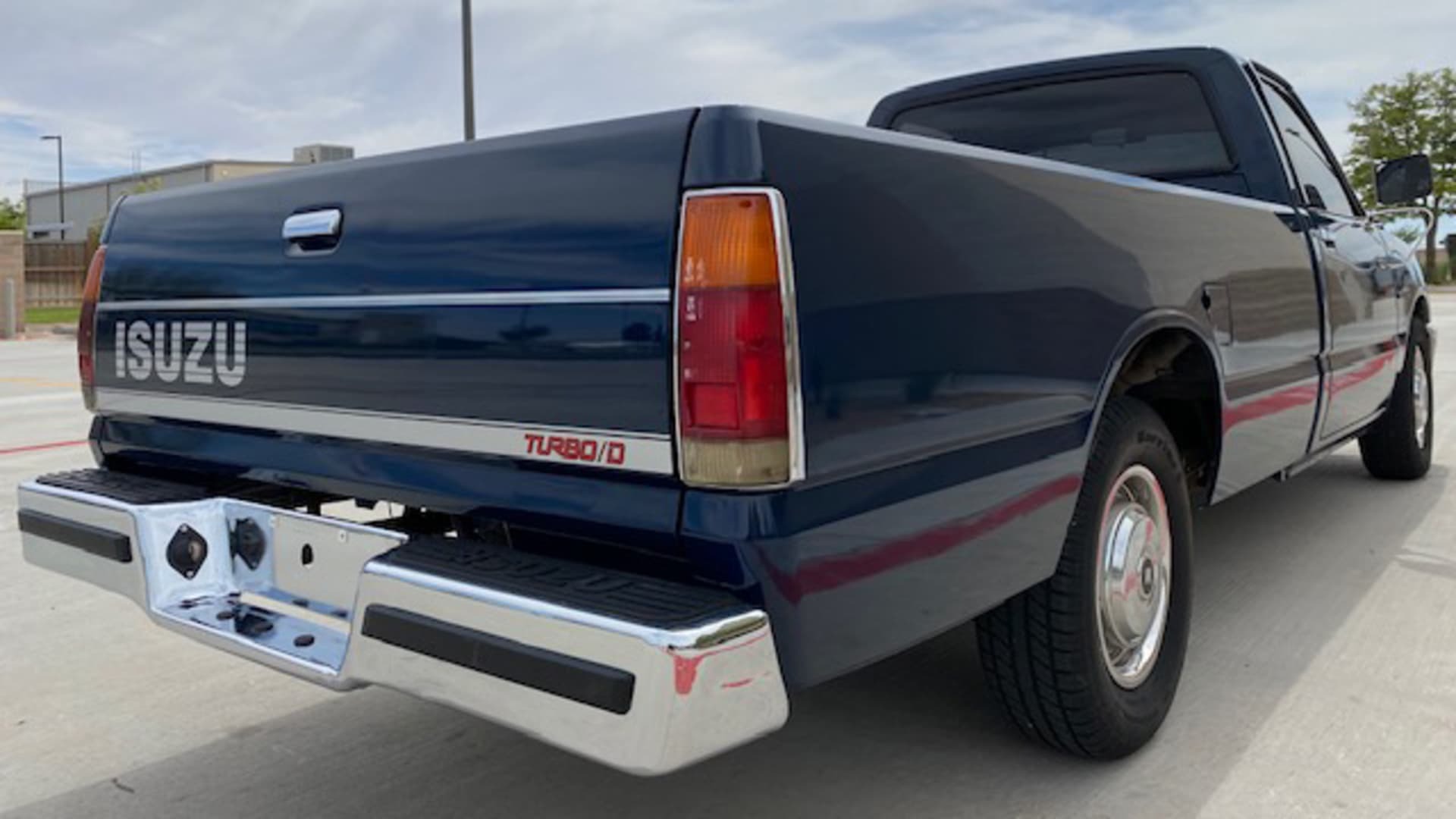
The P’UP? In 1985, the EPA said the 2.2-liter diesel with a four-speed manual transmission and rear-wheel-drive got 38 mpg on the highway. Today, the EPA says it’ll be closer to 35 mpg. This seems to reflect what modern P’UP owners get with their trucks, as they seem to get roughly 30 to 40 mpg, with some really careful drivers claiming as high as 50 mpg.
That means, with some exceptions, the Isuzu P’UP diesel, like the Nissan 720 diesel, gets better fuel economy than most trucks today. What is better? The Ford Maverick easily beats up the P’UP, and you might be able to match the P’UP with a Hyundai Santa Cruz if you’re careful. I’ve also been able to get in the upper-20 mpg range in a regular cab Ford F-150 5.0 V8, but that required being really easy on the go pedal. Otherwise, there’s nothing that really comes close.
History Is Fun
Of course, fuel economy is only a single metric. Today’s trucks are far more powerful, more comfortable, safer, and more feature-packed. Also, the average P’UP is over 40 years old now, and it’s getting exceedingly difficult to find one that hasn’t been returned to the Earth yet.

Still, it’s fun to think that, back in the 1980s, small, fuel-efficient trucks were everywhere and were sold by so many automakers. Now, you can count the number of trucks that get above 30 mpg on a single finger. But it’s also not all bad, because nowadays you can also buy a competent all-electric truck.
If you’re lucky to find one of these trucks in decent shape, it’s unlikely you’ll pay a lot for one. One gas-powered P’UP sold on Bring a Trailer for $4,300 in 2023. A diesel rolled across the auction block at Cars & Bids in 2023 for $6,000. A basically showroom condition Chevrolet LUV went for $12,000 on Cars & Bids that same year. I bet you wouldn’t even pay that much on a platform like Facebook Marketplace.
Little diesel trucks like these are firmly a thing of the past. It’s unlikely they will come back, and if they did, a modern equivalent won’t be as cute or tiny. So, I like to look at stories as the Isuzu P’UP, as a fascinating artifact of the past. These were very much trucks of their era, built for a time when saving money was paramount for many car buyers. At the very least, it does seem like there is a sort of mini-truck revolution happening in America with the Maverick, the Slate, and maybe Ford’s new $30,000 truck, so the fun isn’t over yet.
Top photo: Isuzu


Of course it got better mileage. Trucks back then were more sensibly sized, not the overcompensation for a physical shortcoming or political statement vehicles they are today.
You’re 100% right of course Frank, but sadly, the general/buying public isn’t particularly self-aware.
Mercedes, since you quoted your own past article for this one, how about some details on this intriguing sentence: The closest gasser was the Mazda B2000 at 27 mpg and a reproduction Ford Model A truck at 28 mpg. Now, i want to see a model A pickup from 1981
Yes, what is this reproduction Ford Model A truck you speak of? Inquiring Minds Want to Know(R)!
Its called a Shay and used a pinto engine.
Thanks! That’s a half hour rabbit hole!
Sadly, the EPA had no further description of this truck! I will have to track it down one day.
I saw one of these on a vintage episode of The Price Is Right once! Beyond that, I have no further information.
Its called a Shay and used a pinto engine.
New small trucks aren’t as small as the old ones. I understand there are crash regulations and you’d likely survive a crash these days, but I miss really small trucks and vehicles.
Crash test regulations are relative. If as a manufacturer, they take the cheap route of simply making their vehicles really big and heavy and not doing any engineering into actual safety, all they’ve done is put the smaller vehicles on the road at risk.
No, they are pretty specific. And it’s a lot more difficult to do with a much lighter vehicle. One that doesn’t use exotic materials anyway.
It doesn’t change the reality that auto manufacturers do indeed, simply use more mass in place of any safety innovation. All you need to do is open your eyes and look around. This is the path they’ve taken.
Exactly. The Smart car and Mercedes A-class are both examples of safe small vehicles. But they would still get punted like a ping-pong ball if hit by a 7000lb Rivian.
There’s no reason why we can’t have something corolla or civic sized with a bed but that risks killing the “biggest truck I can buy until they make something bigger” marketing that the American auto manufacturers have been pushing for the last 30-35 years
I didn’t drink the American truck Kool-Aid. I like 90’s small pickups. I blame Back 2 The Future with the black Toyota and the KC Daylighters.
Amen brother, I miss my S-10 everyday. The maverick was interesting but it’s way bigger than I thought it was going to be.
Hmm, I wonder why we can’t replicate 40 year old tech….or is it we aren’t allowed?
Funny how we ignored that little nugget for the entire 50k words here.
You mean, puking out copious amounts of nasty stuff into the air is bad?
You can’t write an article glorifying the era, and motor, and then pretend it just disappeared randomly with no cause. Especially since Mercedes is so thorough in her reporting and mentions the EPA quite a bit.
Your response doesn’t address the issue of leaving out pertinent information to the article. But it surely will get you some cool internet points.
The knuckle dragging crowd will never let it go. I’m completely ok with the strides we’ve made in cleaning up the air.
Why make small truck that only gives $100 in profit when you can make big truck with $10,000 in profit?
GMC 1500 Sierra Denali Ultimates are nearly $100k and F-150 Platinums get that high too. Why open up a fuel efficient, super utility oriented market that would kill your golden goose?
Fords developing a 20k truck supposedly and did bring the Mav to market. Your ignoring the actual point of my comment. For better or worse (most obviously think for the better) we are no longer allowed to produce those types of simple cheap things anymore, and especially not diesel engines. It has nothing to do with Ford or GM.
There’s small trucks in other markets that do exactly what this truck did made by manufacturers that sell and make vehicles here in the US. Why not bring them over here?
Toyota could easily modify their Hilux Champ for the US market as a cheap, utility oriented truck and build them here but that would start easing the market away from the larger and more profitable Tacomas and Tundras.
The Maverick was supposed to be the $20k truck and it isn’t. Ford and GM make cheap small trucks too for other markets. They make small diesels that hit EU regulations and HEV and PHEV drive trains that are equally efficient.
The modern version of this Isuzu is being made and you’re absolutely correct that we aren’t allowed to have it but it is absolutely the auto manufacturers making this decision. Full size pickup trucks are just too profitable to risk any damage to that market.
These were sold as the Bedford KBD here in Portugal from the second gen onwards (first gen was badged Isuzu for some time; post-facelift 2nd gen were sold as the Bedford Brava, but are often referred to as KBD). You still see them fairly often, almost always still actively being the workhorses they are meant to be. Great little pick-ups.
One of my highschool friends had the long bed series 2 diesel one, sold with a Bedford badge over here. Great car! Would like one, or the Toyota or Nissan equivalent 🙂
I knew this was a Mercedes article based on the length. Can’t wait to read it, but would appreciate some shorter articles for the weekend for us who actually work them fully
A mechanic I know once let me drive his diesel manual Isuzu PUP to run an errand. It was already 30 years old at the time.
It was slow and awkward to drive, but I didn’t care. It’s not a sports car. It was a refreshingly simple, adequate, no-bullshit git ‘er done truck.
If I ever needed to own a truck, I’d have begged him to sell it to me. It matched my sensibilities as far as trucks go, and this particular truck did truck stuff exactly as I liked: at minimal expense with minimal hassle.
If I owned a car company, I’d build a modern equivalent with a 4-cylinder Isuzu 4JJ as standard and an EV option(RWD for the diesel, AWD using hub motors for the EV). It would be Ute-shaped with a low roofline(body shape like a slightly-scaled up/elongated Lotus Europa for low drag but a truck bed where the Europa’s engine would have been), have a bed that can fit a stack of 8’x4’ sheets of plywood with the lid up, single cab, have roll-up windows, no power steering, buttons for everything, the only screen would be a cheap and replaceable backup camera you could swap with a cheap unit at a car parts store, there’d be a retractable bed cover(for aerodynamics when the bed isn’t loaded high with cargo), everything would be designed to be easily fixed/serviced, and I’d be targeting a weight of around 2,500 lbs. It would be a low vehicle with Miata-like height, but with a ground clearance around 7″, and engineered to carry at least 1,000 lbs of stuff in the bed.
I bet a basic-bitch 55+ mpg @ 70 mph diesel pickup truck matching my description is possible for under $25k today. As an EV option, the same truck would be about as efficient as a Tesla Model 3 or maybe even a little better at highway speeds. And it would be a perfect choice for contractors and fleet vehicles where a basic work truck is needed.
When you make one, let me know where to send the deposit to buy one. I’ve had 3 small trucks and they were perfect for everyday use. The last one was 2wd, crank windows, manual transmission, no A/C, no tach, no frills. It worked every time I needed it to, with no exceptions. The thing only weighed a few hundred pounds more then my NC Miata. RIP 2002 Tacoma 2.4l regular cab 2wd. Now clean ones sell for 5 figures! The secret is out.
I had a ’93 Mazda B-2200 short bed bought used and that thing was great. Even though it was antiquated and still had a carb.
I had a 88 B-2200, and a 91 Isuzu Pickup 4×4. The reason the older ones got better fuel economy was they were smaller and lighter than modern trucks, and had minimal safety components or convenience options that modern car buyers want.
“Badge engineering” continues at Isuzu, Chevy and Hino (Toyota) are currently selling poorly disguised Isuzu cabovers. Still a damn good work truck, too!
Not just at Isuzu, most of the Japanese cabover trucks (from kei class all the way up to semi tractors) are shared across multiple brands that you wouldn’t necessarily expect to get along.
Back in the 80s when I ran I-94 in western Wisconsin a diesel P’up passed me every morning on a newspaper run from Madison to northwest Wisconsin. Last I talked to the driver it had covered over 400,000 miles and was still going strong.
” I’ve also been able to get in the upper-20 mpg range in a regular cab Ford F-150 5.0 V8, but that required being really easy on the go pedal.”
I haven’t forgotten about that from your FP700 article. Asked Huibert Mees to weigh in on it, still waiting. I’m not doubting you, and understand the engine control unit is maxing efficiency in a low/no load situation, but still bothered. Where are the 50-70mpg aero shooting brakes with 250-300hp.!?!As for li’ll p’ups, good ones were always just as pricey as full size in used.
“The T-car program engaged GM’s partners…to develop a front engine, front wheel drive unibody vehicle that would initially launch as the 1973 Chevrolet Chevette for GM Brazil.”
Um, no. The T-cars were all RWD. It’s the weekend, so I’ll give Miss Mercedes a free pass.
Oh no! I’ve sent a correction for that. I may or may not have written this at 10 pm on a Friday night.
Just noting that I continually remain astounded that the Isuzu Piazza/Impulse was a T-platform car. I think it’s one of the best car designs in automotive history.
My daily driver 96 Isuzu Trooper shares one stat with the PU’P and has one that is very different. Unfortunately, they are the 0-60 time and fuel economy, in that order.
Great article! One note – the T platform was RWD, as this very drifty Chevette HSR rally video shows. With commentary by the peerless Murray Walker!
https://www.youtube.com/watch?v=DGm9PoMRyQ4
“Now, you can count the number of trucks that get above 30 mpg on a single finger. But it’s also not all bad, because nowadays you can also buy a competent all-electric truck.“ Except that all of the “competent” electric trucks get WAY better than 30 mpg. Hummer builds one with 1160 hp that gets 48 MPGe. Rivian builds one with 1025 hp that gets 67 MPGe. Chevy builds one with 760 hp that gets 68 MPGe. Tesla builds one with 834 hp that gets 79 MPGe. Tesla even builds a semi that gets 22 MPGe and goes 0-60 in 20 seconds when loaded to the legal maximum of 82,000 pounds. Fast enough to beat the ‘82 P’UP in the quarter mile despite a 79,400 pound weight disadvantage. And you can’t smell any of them coming or going.
I had a 1981. Diesel. The fuel economy was pretty good. Added a separate Racor fuel filter / water separator partly because the OEM filters were quite expensive. Helped with maintenance costs quite a bit,
Started out Canary Yellow. Faded quite a bit. I don’t remember it as a real noisy or harsh riding truck. Nor do I recall it having a lot of engine vibration.
Mine was a real beater at the end of its life. The grill was replaced with chicken wire and one headlight was a bolt on tractor light as a result of a deer jumping in front of me.
The frame rusted up towards the rear spring attachment point. The floor had rusted out and was replaced with 3/4 inch plywood. The bench seat was replaced with a pair from an Audi.
When it became obvious that it was a matter of when, not if, the frame was going to fail, I finally took it to a fire department training and we flipped it on the roof and practiced cutting the cab off. Then we lit it on fire a bunch of times and drowned it in foam.
It was about 25 years old. A truly excellent truck for the era.
I’m interested in the mention of that Chicken-tax avoiding loophole of shipping and installing the beds separately. That seems like a really easy thing to do, that lots of manufacturers could do. Did anyone else ever try that? If not, why not?
It wasn’t brought into the US as a Chassis Cab it was brought in as an incomplete vehicle which is how it avoided the chicken tax since the final assembly point was now the US. Until that loophole was eliminated that was how the mini trucks were brought into the US. I highly suspect that is why when Toyota decided their little truck needed a real name they chose Tacoma which was the final assembly point for most of the Toyota trucks brought into the US. The beds were made in CA, shipped north on specially built trailers, and installed on the vehicles that entered at the Port of Tacoma. Some trucks did come in as complete vehicles so when you needed a new tail gate for example you needed to know if your particular vehicle had a US or Japanese made bed. That is also why you saw some Toyota beds that rusted much faster than the cab as the US built beds were more rust prone for whatever reason.
While they eventually did declare that they were chassis cabs and not incomplete trucks that didn’t completely close that loop hole. For many years Sprinters bound for the US drove off the assembly line and back into a shop where the engine and transmission were removed, put on a carrier and secured in the cargo area of the van. That way they qualified as CKD, (Complete Knock Down) kits and the final assembly point was considered to the the US.
The Brat made it to the US thanks to those jump seats in the bed which made it a passenger vehicle for import tax purposes. At the time by definition a vehicle with 4 or more seating positions was considered a passenger vehicle while one with 3 or less and a cargo area was considered a Truck.
That stuck around for a lot longer and was how the Transit Connect was imported to the US w/o being subject to the Chicken Tax. They drove off the line in Turkey with a 2 passenger bench seat in the back and glass on either side. At the port in the US the rear seats and belts were removed and recycled while the glass panel(s) were replaced with steel. The closure of that loophole is why the Transit Connect was discontinued in the US.
Interesting stuff, thanks!
Toyota et al…
Had a diesel brown one with stripes in 96. Had it about 6 months then the frame broke in half behind the cab from rust. Shook like a bed that used quarters in a cheap Motel.
Joe Isuzu truck commercial (as best recalled).
“The Isuzu Pickup, the lowest price truck in America. At only six dollars you can save enough money to buy 600,000 bananas. Why, I saved enough money to buy this island.”
Lots of experience with these, both flavors.
Early LUVs were cramped penalty boxes. Literally.
Never could make myself buy one.
By the late 80s and 90s these became decent trucks.
The gas models were not bad and seemed well put together.
The diesels were a real experience in NVH life. The diesel at idle was like the whole truck was a 4 wheeled popcorn popper. Good luck with placing your drink on the dash and expecting it not to hop off into your lap. The vibrations were nuts at idle.
The diesels also had their interiors “loosen up” dramatically within a year vs the gas models.
Fuel mileage be damned, there were a lot better choices back then if a small truck was required. YMMV
Back in the mid to late ’70s, possibly early 80’s, Playboy magazine did a photo shoot consisting of several pictures of a naked couple making love in the bed of a Luv, with the pictures taken from an overpass on a major highway. The fun part is seeing the vehicle in the adjacent lane using it’s brake lights as the driver attempted to get a better look at the action. That’s how I remember the LUV!
My 1995 Chevrolet S-10 2WD regular-cab 5-speed could eke out 30 mpg on the highway if I drove it no faster than 62 mph. It got 25 mpg in the city. Sadly, it succumbed to rust in 2015.
My 2010 GMC Canyon 2WD regular-cab 5-speed only gets at best 25 mpg on the highway if I keep it below 65 mph. It gets 20 mpg in the city.
I’m hoping to get 5 more years out of my current truck before something collapses on it.
It’s too bad nobody builds an inexpensive small 2WD regular-cab 5 (or 6) speed manual truck anymore. I’m looking at getting a Slate to replace my truck once my truck rusts into oblivion.
I actually had one back in the 90s, an 84′ Isuzu P’up diesel longbed, had to replace the transmission so swapped in a 5 speed instead of the 4 speed that failed in it.
Slow doesn’t really capture the vibe of these, like there was a long uphill grade on a divided 4 lane 55mph road I had to go up to get to the main town, at the top of that hill you’d be lucky to still be making 40mph, that was unloaded. Now it’ll do 40mph all day long, but maintaining highway speeds was asking alot of the 62hp(when new).
Also, this was mainly a southern truck, in Virginia, and the frame was already rotting to pieces in only about 10 years and way less than 6 digit mileage. The body panels were fairly tin foily too, I remember getting run off the track on a narrow gravel road and denting the fender a bit, there in the ditch I bent it back into place with ease, then drove on my merry way.
It was a neat little truck but cheap is the main theme, solid engine though.
I miss all of the little 70s and 80s trucks!
Utility and efficiency, and minimum waste.
Vote for the topshot you like better!
Simply comment with a 0 (for the top topshot) or a 1 (for the bottom topshot).
Make me scroll all the way up there on a Mercedes Streeter article… 1
Dang it, Hardigree! lol I fixed it. 🙂
😀