

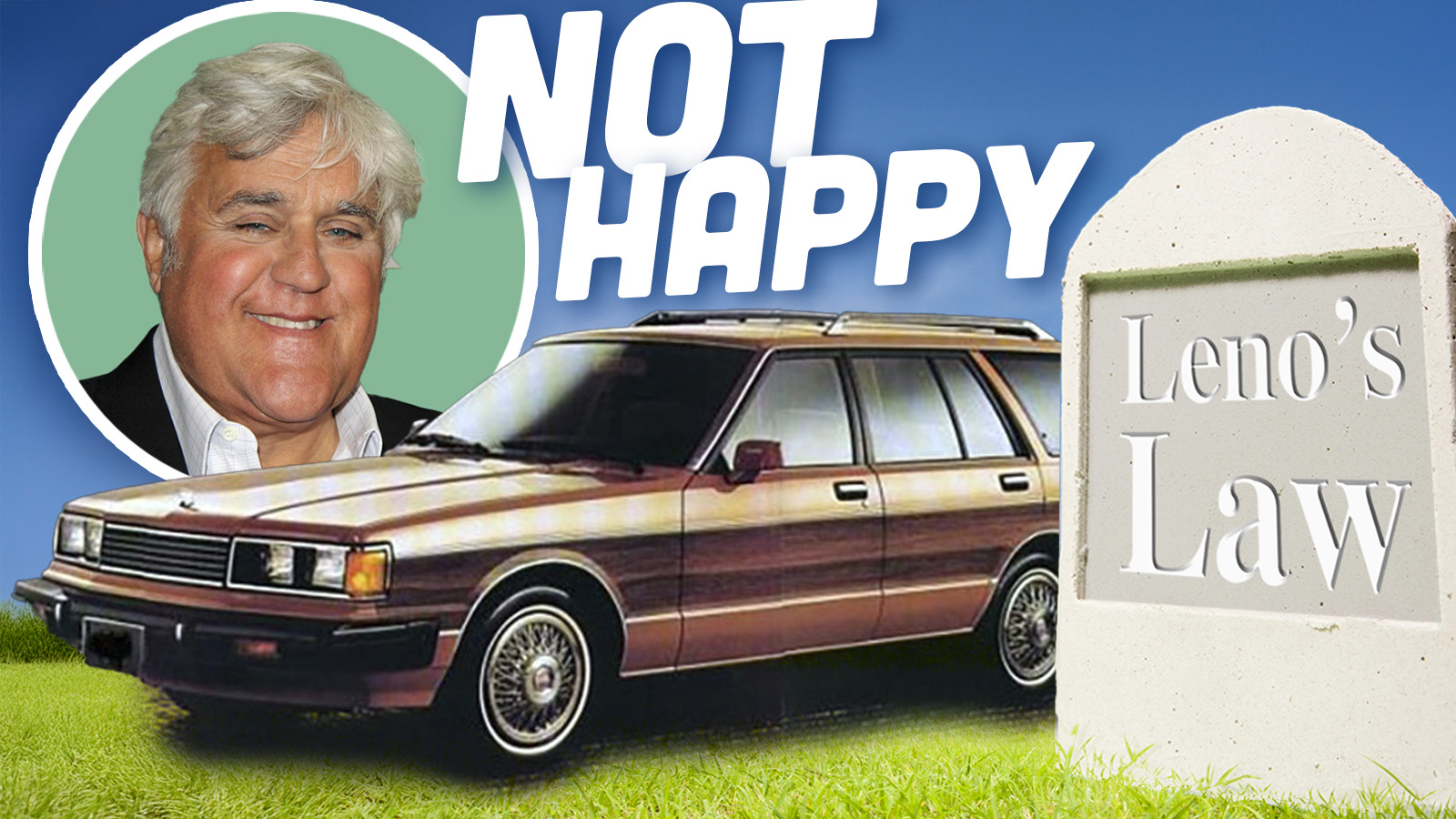
California is the car capital of the world. Perfect year-round weather and some truly spectacular roads mean enthusiasts flock in droves. But the Golden State is also regulatory hell on earth for classic car owners. Smog laws require all road-going vehicles built after 1976 to pass strict emissions tests, which can be overly costly and time-consuming, as our own David Tracy has dealt with firsthand. Senate Bill 712, also known as “Leno’s Law,” was supposed to fix that. Except it won’t. Because it’s dead.
The bill, which would’ve eliminated Smog checks for vehicles 35 years or older, died in California’s Assembly Appropriations Committee, a group of 11 assembly members that vote on whether bills reach the State’s full assembly for a vote. The news comes just four months after the proposal passed California’s Senate Transportation Committee with bipartisan support.


State Senator Shannon Grove, a republican representing Bakersfield who authored the bill, was understandably disheartened by the law’s failure to reach the assembly. From her website:
I am deeply disappointed that once again, the California state legislature did not prioritize California’s Classic car culture and the enthusiasts who were relying on this measure to pass. Leno’s Law would have simply allowed for a few additional classic car model years to receive a full smog exemption—a much-needed update on an antiquated law. Sadly, today California said no to helping preserve these rolling pieces of history and let down classic car clubs across the state from low riders, to hot rods and every American classic in between. Leno’s Law was not just about the cars, it was about the enthusiasts behind the wheel.
News of the bill’s demise came even as lawmakers sought to water down its effectiveness in an effort to keep it alive. They slapped on an amendment in June requiring vehicles to be registered with historic plates, and later, narrowed qualifying cars to those built between 1981 and 1986. But those efforts proved futile.
Senate Bill 712 had tons of support from the car community and beyond, not only from Jay Leno himself, but also from the Specialty Equipment Market Association (SEMA), which sought to have the law passed as a “practical solution for collector vehicle owners, allowing them to enjoy their passion without the burden of unnecessary regulations,” according to CEO Mike Spagnola. But health and climate change activists opposed its passing. Will Barrett, assistant vice president of the American Lung Association, told The Mercury News his organization was happy the bill died in the committee.
We’re pleased it’s not moving forward. From a public health perspective, this is a good outcome. It represented a step back from clean air protections. One of the things we really need to be on guard for is these bills that weaken the existing tools we have.
It’s true that Leno’s Law would’ve ultimately allowed more emissions into the atmosphere. The state’s Bureau of Automotive Repair told The Mercury News it expected to receive 17,500 requests every year for smog check exemptions had the bill passed. But the environmental impact would’ve likely been negligible. As my colleague Thomas Hundal pointed out back in March, the vehicles qualifying for an exemption are antiques registered as collector cars, which usually come with specific insurance that restricts usage and mileage. So it’s not like the law would be opening up a swath of highly polluting vehicles to everyday commuter use.
Alas, none of that matters anymore. With Leno’s Law dead, Californians will continue to suffer under the thumb of the State’s Smog Check laws for the foreseeable future. And with the State cracking down on out-of-state registrations—including well-known methods through Montana—vintage car owners have little to no recourse.
Top graphic images: depositphotos.com


I was in line for a tailpipe smog check back when that was the norm in Colorado. Ahead of me was a – I forget exactly but – a 1963 Plymouth. Nice condition. Guy said it was one of a few factory built drag cars he and friends pulled out of a field and restored. Apparently it came with the appropriate big block race tuned motor. For purposes of the smog check though they swapped in a 318, then put back the original motor once passed.
Of course, that’s what you get for stupidly, blindly, gullibly voting Democratic politicians again and again. They have done a splendid job of ruining California…
The governor that removed the rolling 30-year exemption was republican…
Something that always gets me is people’s need to win absolutely. I’m an environmentalist – I care deeply about climate change and about air and water pollution. How do I square that with being a car enthusiast? Easy: there aren’t enough of us to matter. 95% of the population will drive whatever box is available to them, and if you make public transit easy and cheap, they’d use that instead. As for the rest of us? It genuinely would not make a difference if every car enthusiast on the planet ran a V12 Dino burner until the day they died. I get that the vice president of the American Lung Association is by nature an absolutist, but this bill has genuinely zero affect on actual experienced air pollution in any real sense. Go after the shipping industry if you want to make an actual difference.
Elsewhere in the comments is data that shows that pre-2004 vehicles account for 73% of NOx emissions. If that is true, then while I don’t necessarily disagree with you, it’s gonna be a hard sell to the average person to allow more vehicles on the road which account for a high percentage of emissions.
The same person who presented that data also stated that CA is heavily going after the shipping industry already and forcing ships to use shore power or other cleaner methods of power when in port, and that ships have been required to use low sulphur diesel for years now.
Anecdotally, an acquaintance of mine was super excited about Leno’s Law because it would allow him to put his dad’s ’70s Trans Am back on the road. A car that was taken off the road because it wouldn’t pass smog previously. I’m positive there would be a lot more cases like this, and that’s one of the main counterarguments to the bill.
As my dad always says, 74% of statistics are made up. Seriously, I’m sure that is a real figure, but where did that data come from, and how is it relevant to this conversation?
Restrictions on diesel emissions have gotten exponentially tighter over the last 20-30 years, and diesels are notoriously bad emitters of NOx (though they certainly aren’t alone), and diesels make up a large percentage of highway vehicles. However they’re a tiny fraction of the enthusiast population that Leno’s Law is aimed at.
Also, that number of “pre-2004 vehicles” on the road is going to keep getting smaller, whether the law would’ve been passed or not, meaning that the percentage of NOx emissions created by that group of vehicles will decrease over time.
Again, I don’t necessarily disagree, and as the owner of a 1985 car which just passed CA smog check 2 weeks ago I have more of a dog in this fight than most people here.
But the 2 primary reasons why the bill was shelved were cost to implement and impact on air quality. TBH I didn’t look in detail at what they’re using as their evidence, but here is the study that someone else in the comments posted: https://www.ucs.org/resources/cleaner-cars-cleaner-air
Again, I’m not fact checking this, but if it’s true, it’s hard to convince the average person (many of whom can’t wrap their heads around an ’80s or ’90s car being a “classic) that a special exemption should be carved out.
Hoo boy. I dropped a bunch of comments on this in the morning, then spent the day with my family before attending my mother in law’s funeral, and now that I’m back home I see 14 replies. Personal record!
I have my mother in law’s funeral to attend next week; I am sorry for your loss.
Californians experience far more air pollution from their wildfires than they do from classic motor vehicles . . .
Californians experience far more air pollution from (insert here) than they do from classic motor vehicles. FTFY.
Human farts, cow farts, grape cultivation, wildfires, foreign pollution, shipping ports, air travel, tourism, list goes on.
California is the car capital of the world? Not likely. That’s like labeling Alexandria as the library capital of the world. Decades have passed since California was anything remotely like a car capital. California truly makes the term parkway correct.
*extends chin* “Did you see this? Did you hear about this?”
Next thing you know they’ll repeal Letterman’s Law, which prohibits shaving during a writer’s strike.
Hi-Oh!
if the japanese can do it all and still pass smog/inspections yearly, i’m sure californians can come up with something. aka the out of state license plate.
They’re trying to make sure you can’t plate vehicles out of state if you’re a resident.
I am curious on how exactly they’re doing that. It is completely legal and above bar for non-residents to register a vehicle in my state, and the relevant government websites even tell you how to do it! It’s a perfectly normal, valid registration, so how can California just say that it doesn’t count?
They can make it illegal to be a CA resident AND register vehicle out of state to evade taxes or inspection. It’s pretty obvious to a cop when you’re driving a car that’s either incredibly expensive, or visibly wouldn’t pass CA inspection, and you hand them a CA driver’s license with a CA home address.
From the above linked article:
That’s straightforward enough, but I have to wonder if that would conflict with something like interstate commerce laws, for example. On paper at least, my state could sue the state of California for lost revenue from people no longer being able to register their vehicles, despite my state still allowing them to.
I’m not a lawyer, interstate commerce laws are weird, and there may be other possible legal challenges to this.
No. Eliminate the out of state work around and get rid of the idiot politicians in California
I live in Oregon, and it’s annoying to go to DEQ and get checked every two years, but at the same time it’s nice to not have (quite so many) complete piles of crap driving around.
Does the whole state do that shit or just the Portland area? Otherwise, yo can move to Washington 😛
Doesn’t Oregon go earlier than 76 as well? I think Colorado and Delaware do, for example.
I don’t know about the rules for classics in Oregon, or if Portland is different than the rest of the state (I don’t live in Portland). But I grew up in the Seattle area, and I moved to Oregon on purpose (by way of Alaska).
It’s Portland and strangely enough, Medford. The rest of the state has no DEQ. And all it is on most vehicles is an OBDII readiness check, so I question how much value it adds in reality.
It’s more than just Portland, because I live west of Hillsboro (and so outside what I’d consider the metro area) and I still have to do it. Well, I guess I don’t have to go in, because my car is new enough, but normally I’d have to. Medford is a little surprising, I agree.
It’s just the greater Portland Metro area. I live about 30 min from Portland and am just barely outside the boundary. I mostly drive my EV though, so it’s kind of a moot point, but nice not to have to deal with it on my old Jeep (which still has all its emissions devices, though I’m not sure it would pass a very rigorous check anymore).
I suppose I should just accept the fact that I live in what’s considered a suburb of Portland, regardless of what the map makes it look like.
Yeah as mentioned it’s the greater Portland Metro area which like or not, includes Hillsboro.
Just move out of blue states
I like it here. DEQ alone would be a stupid reason to move.
Seriously, I laugh at people who suggest the solution is to just move to another friggin state. I don’t know about you but there are a lot more reasons than just a hobby that make me choose to live in the state I do. Must be nice to just pick up your whole life and move because your toys aren’t easy to play with.
The same people who tell you to move to another state are most likely the same to tell you to move out of the country if you have even the slightest criticism of it.
Why? It’d be far cheaper to just buy a CARB compliant car. Hell California might be the ONLY place you’ll find that car in any form anyway.
I mean that doesn’t really work. Texas is pretty red and there are still yearly smog checks for every metro area, and until this year it was everywhere.
It’s only 11 counties. I had to go late last month and get one.
Yeah, I live in one of those 11. Mine was done in June.
If I had a nickel for every time I heard “just move to another state bro” for whatever reason…
People have families, friends, jobs, favorite hamburger stands, and so much more that they aren’t just going to ‘up and leave because of one dumb law. Stay where you want to stay, and do whatever you can to make a difference there.
Classic cars only need to meet the emission standards for their model year, not the year the test is being performed. If it’s had an engine transplant the emissions standard to be met is for the newer of the chassis or engine. As long as the CA OEM spec smog gear is working properly and the car is in proper tune it should be fine. Is that really too much to ask?
For some people, asking anything is asking too much.
A few smog checks ago I watched a young man pull into the test only STAR facility with an early 80’s Chevy pickup. The truck was ruǹning so poorly I had to go outside else gag on the stench of unburned HCs (with no doubt a hefty chaser of deadly CO). He insisted on having the check done despite the advice of the shop owner. No surprise, it failed and it has since become my touchstone for why smog laws are so needed.
If a vehicle fails you can get 30 days extension that you are still road legal
Whenever I visit places that don’t have such tests, I see at least one absolute POS driving around that’s so bad I feel like my car is getting some disease even being next to it.
It’s not but you might…
They don’t only have to meed the standards, they have to meet it with the original equipment. Cars that were sold without catalytic converters (e.g. a first-gen RX-7) cannot fit one to pass the test, despite it making them both more efficient and cleaner than the stock setup.
This is what I’ve found on the matter:
“For a used direct import vehicle more than two years old upon date of entry through 1975 year model and not equipped to meet federal or California emission standards to be registered in California, the applicant must certify to one of the following exemptions on a REG 256F:
When they acquired the vehicle they were a resident of, or on active military duty in, another state for at least one year where the vehicle was last registered. The vehicle must have been certified under a U.S. Environmental Protection Agency Certificate of Conformity and issued an approval letter from the U.S. Department of Transportation.”
https://www.dmv.ca.gov/portal/handbook/vehicle-industry-registration-procedures-manual-2/nonresident-vehicles/california-noncertified-direct-import-vehicle-exemptions/
The “and not equipped” indicates to me a California resident can indeed retrofit the appropriate emissions equipment as long as it new and has the correct specs (e.g. EO#). I could be wrong though.
The problem is that the emissions equipment tends to be unavailable. If the law was that the car had to pass an emissions test, that would be a piece of cake.
The problem is that the hardware has to be the same as originally installed on the car, or if using a newer engine, has to be the same as installed on the car the engine was from. Recent engines want everything on the network to be there otherwise, the ECU goes into passive-aggressive mode.
The stuff the CARB wants to see is the stuff that salvage yards either routinely throw away, or, recently all the serial numbers have to match.
So, you can install a new engine, but you neen a box containing the dashboard and the ignition switch and some other stuff.
Making a post-1975 engine pass smog with an aftermarket ECU and 3 way cat would be too easy.
“The problem is that the hardware has to be the same as originally installed on the car, or if using a newer engine, has to be the same as installed on the car the engine was from.”
Do inspection stations check this, or do they just hook up the check to the tailpipe?
They absolutely do check. I hear that tidying up the messy engine compartment of 1980s American cars with a few wire ties can make it fail.
I gather that there is a picture they compare the engine compartment to.
Ever tried to get an old jalopy with a higher mileage engine to pass smog? It can get quite expensive.
My newest car is a 2010 so yes, I have. And yet they still pass. It probably helped that the older one had its cat stolen before its last test and insurance paid for a brand new OEM cat and sensors. But it was fine before that.
Still the only time I’ve had a car fail in about 30 years was when the inspector noticed the intake flex hose was ripped. That cost about $20 and 10 minutes of easy DIY to replace.
CA smog check is a piece of cake for 2000 and newer. The cars we’re talking about have to go on the dyno. It can take weeks for the local smog check place to get the dyno fixed (all smog dynos are over 20 years old now and are broken most of the time). Combine the dyno age with the fact that your local smog check place probably sees 3 cars per month max that require the dyno, so he doesn’t realize it’s broken when you show up and you have a cluster f of a time getting a smog check. And you need carb certified cats (that might not exist for your car – there’s only one source for my 92 civic – Magnaflow and it’s over $1k), etc, etc. As everyone has said, if smog check was just about having compliant emissions it would be easy. The regulations are intentionally written to get old / classic cars off the road (preferably scrapped) and get everyone into electric cars (or better yet, public transportation)
“there’s only one source for my 92 civic – Magnaflow and it’s over $1k), etc, etc.”
If you don’t mind a bit of welding Autozone has that CARB executive order D-193-150 1992 Civic cat for $562:
https://www.autozone.com/emission-control-and-exhaust/catalytic-converter-efn/p/magnaflow-carb-catalytic-converter-3322304/1166175_0_0?searchText=Catalytic+converter
Some shopping around might find it for less.
You should only need one catalytic converter for the rest of that car’s lifetime. As auto repair costs go that’s unfortunate but not nearly as bad as it gets. That’s barely even the cost of a fender bender.
“The regulations are intentionally written to get old / classic cars off the road (preferably scrapped) and get everyone into electric cars (or better yet, public transportation)”
I can see the hope of government being you scrap your old (relative) deathtrap for a newer, safer, more energy efficient car. Maybe that car is even electrified. But public transportation?
I very much doubt anyone seriously considers public transit as a viable alternative to owning a car in California for all but a lucky few especially for anyone living outside an urban area, triple so for rural folks.
Lucky you.
In the late 90s I drove an ’86 model year vehicle. On what ended up being the final time I needed to have it smogged, it failed the test, so I took it to a mechanic for repairs. Repeat twice more and, after more than $600 invested (not to mention an inordinate amount of frustration and irritation), it failed a fourth time. I was finally given a smog repair waiver and allowed to renew my plates.
I wasn’t doing this because I liked that car (I didn’t), or because I didn’t care about the environment. It was the car I had, and at the time I couldn’t afford to take the hit from selling a car that wouldn’t pass smog. Thankfully that changed prior to my next license renewal, or I would probably would have gone through the same mess again.
It wasn’t luck to make low insurance costs, high expected reliability and wide parts availability high priorities in my purchase criteria.
I’ve seen a lot of people claiming CA made the standards tighter on old cars. I’ve owned the same 1985 Ford since 2001 and have smog check records going back to 2003 and the standards have not changed a bit. Just got it smogged on Saturday, and nothing has changed in 22 years.
Thanks for clarifying that. Here I was thinking people would be forced to “upgrade” their classic cars to meet modern standards, which seemed absurd.
It’s actually illegal to upgrade and meet modern standards. Or upgrade and lower the emissions for that matter. You have to make whatever loony one year only unibtanium equipment was stock work.
If some previous owner in another state tossed the original air cleaner housing , or the original exhaust manifold with the rusted out air injectors, well it sucks to be you.
All they had to do was put a limit of say 3K miles on the amount of annual miles driven. Proof could be done by requiring an inspection of the odometer annually, either at a state station or by the cars insurer. This would have lessened the impact of any increase in emissions.
A guy who grew up in CA said that the smog in LA is now the worse it has ever been and I am a bit skeptical that it is worse now than in the mid 20th century. How is the smog there?
As someone who lived in eastern LA for most of the 1970s and has lived throughout the state since I can say the closest thing I’ve experienced to a bad smog day from 1970s LA is being downwind from a serious wildfire. The times I’ve been to LA since are nowhere near as nasty as any of that. So I’d say that “guy who grew up in CA said that the smog in LA is now the worse it has ever been” had better have some convincing data to back his claim up.
The San Joaquin Valley, where I have lived for 70 years, with a 35-year gap in NYC, was fine in the 60s, but is just awful now. Back to NY in 6 months!
Not a surprise. There’s a hell of a lot more people living in the valley now and probably a lot more agriculture tilling up dust.
Plus fires.
The agricultural impact is less, actually, a lot less, you don’t have as much ag burning, and there are some emissions restrictions on farm equipment. It’s the greatly increased population that has actually covered a lot of farmland. I think less tillage, plowing costs money.
Of course, there are a lot of assholes burning stuff at night, so no one will see the smoke.
I was thinking more about the dust kicked up from bone dry, droughty fields.
That gets left alone, nobody tills that. Of course it can catch fire.
Livermore National Labs was doing a controlled burn at site 300 where they test the chemical explosives in nuclear weapons, last year, and ended up burning 14,168 acres of dry grass. It came to about 3 miles away. It may be draught most of the year but one rainstorm can grow a lot of grass.
Then you get an occasional flash flood too. Or earthquake. Also the hotspot of valley fever. It’s one dam thing after another here.
I’m familiar with the Livermore area. Sure the hills are untilled but east of Mountain House Rd and 580 it’s furrow central.
Also IIRC there was a MASSIVE pile of tires in that area which caught fire a few decades ago and was just left to burn because it was too big to put out. I kind of remember seeing the fire from the air.
Ah, I may have found it:
https://www.sfgate.com/bayarea/article/After-2-Years-Smoking-Tires-Close-to-3236405.php
Although I kind of remember the year being 2003 so maybe there was more than one fire.
Yes, about six miles from where I am sitting now. And yes more than one fire, the 2003 fire was further south and bigger. . I was in Brooklyn at the time, but it was pretty smoky when I came to visit , and when it got windy you could see the flames.
In Brooklyn I was living about 3 blocks from the Gowanus Superfund site, the heart of the industrial revolution in the 19th century, where there were coal gas factories, tanneries, lead shot towers, the India Ink, factory the first can factory and the first cardboard box factory, and something that put tons of mercury into the soil. They are cleaning that up and putting high rise apartment buildings in on the canal. This is the second time they tried cleaning it up they built a pumping plant and a tunnel to flush out the canal, but of course, a whale swam into the tunnel, plugged it up and died, wrecking the machinery. Then something happened that distracted everyone, possibly WWII, and nothing happened. They started working on it again in the 1990s. Then there was Hurricane Katrina, but now things looking great with shiny new buildings. Of course, they were 20 feet underwater in toxic waste a few years ago so I won’t move there
Meanwhile, a mile due west from our farm in Tracy is the Defense Logistics Agency. AKA the Duartermaster’s Depot, where during the Vietnam War they would receive helicopters from Vietnam, wash them off, drain the agent orange, contaminated fuel and spoiled munitions into a big pit, and set whatever didn’t drain into the aquifer on fire. So that’s a big superfund site too. I think they would set helicopters on fire and practice fighting fires too.
So if it’s not one thing it’s another.
Indeed. In LA I lived a few miles from the biggest lead recycler in the country. They got into trouble numerous times for emissions which was probably a good chunk of that smog I remember although there was plenty of leaded gas being burned too.
Then we moved to San Jose next to the gold rush era Almaden mercury mines, IBM, Fairchild, UTC and a bunch of other producers of toxins. What used to be the Valley of Hearts Delight is now the Valley of Silicon. Lots of super fund sites up here too.
It is better in LA proper now than in the mid 1990s. I have photo evidence.
As someone who first visited LA in the 90s and again more recently, it’s night and day. The improvement was drastic. And even the 90s weren’t nearly as bad as the worst of it in the 70s.
For all CARB is a massive pain in the ass, it’s very hard to argue with the results.
LA was much improved by the mid 1980s. I lived in Newhall and was in downtown LA a lot, and it was vastly improved compared to to 15 years before.
Doesn’t California have, or used to have an exemption on engines under 819cc? (50 cubic inches)
That would also include all kei cars, since kei cars are limited to 660cc.
They have or had a few interesting exemptions, such as 819cc, 2-cylinder engines, and even 2-strokes used to be exempt at some point.
I agree with a rolling exemption. It used to be 30 years, or even 35 would be fine. Or if they don’t want a complete rolling exemption, make the test visual-only for cars over a certain age.
Did Letterman become a state senator just to spite Leno? LOL
On the bright side, people in other states have access to some cool rust-free cars, as people can sell them to someone out-of-state that doesn’t have to deal with that shit 😛
The visual part is the killer. Finding a 50 year old one year only air cleaner hose is harder than it sounds.
You realize that everyone hates us, right? This will never happen. To John and Jane Q. Public we’re all Kevin with the straight piped mustang hitting donuts in the church parking lot at 11:30pm or Chad rolling coal down the main drag in a brodozer or Braden with the burble tuned BMW scaring their dog. That unpopularity coupled with the environmental concern (real or otherwise) means coming down on our side isn’t going to be popular at the ballot box.
Sadly this is true and is probably one of the most dissapointing things I find about being a car enthusiast. Additionally soundbites claiming a candidate voted to make air quality worse, which would certainly be true but the amount to which it would be worse is unclear, would certainly be more damaging than passing this would be helpful for any given politician.
Yep. But the problem is many people *are* actually Kevins and Chads and Bradens based on the entitled attitudes I’ve seen.
If only they would go after the coal rollers. I drive a Prius, and they take offense at being passed, so all of a sudden there’s this guy blowing black smoke at 95mph. Then they drop down to 80, and the next time I pass they do it all over again.
I used to have an old diesel Mercedes (inspection exempt btw) that was a little smokey, but it was old and performed just like when it was new.
These guys don’t have that excuse.
I like diesels. I live in a red state. I resent coal rolling with a passion. It is the dumbest, most “antisocial” driving behavior there is.
It’s not even that they’re defeating the emissions equipment on their vehicle that gets me, because I understand that that equipment often defeats the rest of the vehicle. It’s the unwarranted middle-finger to other people who are minding their own business. It’s literally saying “I hate that you breathe”. And they go out of their way to do so.
There are plenty of people like that in blue states too.
I have always liked diesels too, growing up on a farm and all that.
Thing is that complaining about having to add fluid as though the fuel and oil were free is really dumb. Modern Diesel engines just like modern gasoline engines are vastly better in every measurable way, except maybe longevity. Maybe. I suspect a modern Diesel engine or gas engines that made 50 horsepower per liter would outlast an old engine with the same performance.
But these idiots aren’t making more power, the smoke proves that they are constrained by the air they are pumping not the fuel.
The other thing is what fragile egos they have when they get passed by Prius.
Yeah, I never really understood whining about DEF either. Sure, it’s another maintenance item to keep track of, but is it really that big of a deal? It really is just like filling up with fuel, and there are no long-term implications of DEF and the SCR system that it enables. That said, it probably didn’t help the optics that it was introduced around the same time as other, more problematic changes.
Longevity is the kicker. You are correct, modern diesels are objectively better than those from say 50 years ago, much the same as gasoline engines. The problem is that they (well, both the engines and the fuel) still don’t burn efficiently enough to keep soot to a minimum. Now that soot will cause damage regardless, as it is abrasive, however, newer engines have EGR systems, which pump the exhaust (including the soot) back into the combustion chamber to go again, creating even more soot. You’re basically injecting super fine (fine enough that it will slip past the piston rings and through most oil filters), abrasive sand into your engine. Even better, you can combine the EGR with your PCV system, which means mixing oil & oil vapor into the soot to create sludge. I don’t think I have to explain why that’s bad.
Now, remember how I said that modern diesels are objectively better engines? That comes through tighter gaps & tolerances, higher operating pressures, lighter construction where practical, and various improvements to timing, fuel injection, ignition, etc (again, similar to gasoline engines). But all of that means they’re less tolerant of being filled with crud, and they’re now making even more crud than they were before. Think of it a bit like a direct injection gas engine, with how they build up carbon on the back of the valves, but in basically the entire engine.
There’s more to the picture, but that’s the one thing that’s literally, physically killing modern diesels. And between how all of the various laws are written, the expectations of consumers for power and fuel consumption, and what’s currently available for fuel and emissions control tech, manufacturers have no choice but to make their engines this way. There’s stuff on the horizon to fix this, but for now we really are stuck.
Yes, everything you say is true.
Isn’t the soot supposed to burn as fuel with EGR if there is enough oxygen, ie the engine isn’t running rich?
We used to buy Chevron Delo 30weight in 42 gallon barrels, 2 or three at a time. We also had a Caterpillar mechanic replace the pistons and bearings in the (quite literally) field. Well he brought a little tent, so maybe it wasn’t technically outdoors, but it was in a field. The Mercedes diesels got treated in a more dignified manner, including the dreaded E service. Old Diesels lasted forever as long as as you were fine with low power and a ship of theseus definition of “forever”
Also, for all the reasons you list, modifying a diesel engine to use extra fuel just makes all those problems worse.
If you’re running a diesel engine, and treating it like a gasoline engine it’s not going to last very long either.
People that keep complaining about modern diesel engines think they are entitled to their cake and want to eat it and their neighbor’s cake too.
It’s pretty much the same as smoking and complaining about medical costs.
Wasn’t there a technique developed at one time to separate and capture the soot, sort of like a hurricane air filter? For that matter, it would not be terribly difficult to separate and remove the sludge from the oil using the same principles of centrifugal force. They would both be sort of bulky, but Americans love bulk so it’s a win win solution.
Maybe you could burn a little bit of it, but it’d be like trying to burn the ashes from a fireplace, it’s mostly just carbon, not a lot of hydrogen or other combustibles left (well, unless of course you’re otherwise running very rich). The main point of running EGR when the engine is leaner is because lean mixtures burn hotter, which promotes the bonding of nitrogen and oxygen to make NOx. Pumping the exhaust back in displaces some of the intake air, effectively enriching the oxygen-fuel ratio without actually adding more fuel.
You know, I hadn’t thought of using a cyclonic filter in the exhaust before. Seems pretty clever, though you’d think someone in industry would’ve thought of that by now, considering how often they use cyclonic intake air filters, so maybe there’s a problem we’re not seeing.
In theory, yes, you could remove sludge from the oil with a centrifugal separator. The problem is that the sludge would first have to get there. A bit like cholesterol, once it sticks to a wall, it just stays there and builds up until it clogs. So you may prolong the life of your oil system, but it won’t help with any that’s stuck on the valves and in the EGR and PCV, and possibly even in the exhaust and turbos.
Rudolf Diesel’s original engine eas designed to win on coal dust, not that different from soot,
Soot and ash are completely different, ash is the non carbon minerals in wood after the carbon has burned. Soot is pure carbon, and can be an explosive when mixed with air, much like flour or sugar dust.
Modern oils have lots of detergents in them designed to keep impurities in suspension, the problem with using a centrifugal separation system is whether carbon had a sufficiently different weight compared to the oil.
Probably someone reading this knows but I don’t.
I must’ve had a brain cramp when I wrote that last reply. I know what coal is, it’s carbon, and it burns, so why on Earth did I think soot wouldn’t? Anyway…
My knowledge of motor oil is also limited, but you don’t have to have detergents in your oil. While having a slew of additives is expected these days, motor oil used to pretty much just be straight, refined oil. If you could develop an additive package that keeps crud from sticking together and building up, but without bonding it to the oil, then that would be ideal. However I don’t know if there’s really a way to do that.
The general name for something that keeps crud from sticking together and building up is a detergent or a surfactant.
Unfortunately, preventing it from sticking together means emulsifying it in the oil. But as anyone who has run a cream separator knows ( everyone here has done that to make butter, right? ) un-emulsifying something isn’t that hard.
Modern motor oils make modern engines possible. They even may old designs last much longer.
Removing crud from oil beyond basic filtering doesn’t really fit into anyone’s business model, but I think it would be possible. Cost effective? I have no idea.
I’m not disappointed the bill didn’t pass, but we do need to remember this is about licensing cars for the road. There are all sorts of arses stinkin’ the place up on racetracks and in the desert with no emissions equipment what so ever. I doubt there is anyway to regulate that pollution and waste, and even more unlikely to educate the perpetrators, but it is possible to try and ban these events and discourage sponsorship and endorsement. But, but freedumb!
In terms of of greenhouse gasses, the race cars’s share is a drop in the bucket compared to the spectators’s cars. And nearly nothing compared to driving to a stadium to watch people play with balls.
The joke about California emissions testing is the emissions equipment on a 70’s or early 80’s car is pretty rudimentary. So a visual test to determine if it’s all stock doesn’t take into account that you could modify your car to be more efficient, with lower tailpipe emissions than was possible in the late 70’s but not look stock. I don’t mind emissions laws, I do mind ignorant people writing stupid laws.
Yup. My first experience with emission testing was when I moved to CA in 1991 and bought an old F100 with a 300-6. It ran fine, passed the emissions part with flying colors but failed due to a non-functional EGR and incorrect timing.
I paid to have the EGR fixed and timing corrected. The truck ran worse, emissions were markedly hight but was still under the limits so it passed. I got the truck home, put the timing back where it was and plugged the EGR.
What percentage of people do you think would do that?
What percentage of people are driving 30 yo cars? See, that was the point of changing the law. These aren’t cars that are out driving 12-15,000 miles a year. Most of these are now collector cars. Yeah, even crappy 80’s cars have found an audience.
So, to answer your question, probably a very high percentage of owners of a 30 yo car will modify it to run better with lower emissions than when it was new. Especially if none of the emissions parts are still available.
It would be easy to design a self training closed loop electronic fuel injection and catalytic converter system to retrofit to old cars if the law allowed it. You could even retain the carbs as throttle bodies for a stock appearance. That’s essentially what the megasquirt people are doing. It would probably be cheaper than rebuilding the old carbs on a lot of cars or keeping a 40 year old fuel injection system system working.
I think that laws saying that an engine can’t pollute are great. I think that regulations saying that keeping up appearances with broken technology is more important than actually not polluting fare stupid and actually cause harm.
Yup, and that was the point of the now-dead law. Basically, it’s not about reducing emissions, it’s a few nannies ideas that old cars are bad and should be eliminated.
can somebody help with math?
example, the driver has 2002 Camry for example. 2.2 inline 4.
the driver does 25000 miles per year for example.
should he/she spend on a new 2026 Camry or continue driving an 2002? nothing is wrong with it and will regular maintenance it will be road road legal (emission aside) for another 10 years.
what does it take pollution wise o make a new replacement car and how many miles later will initial shit invested pollution be offset by lower emission?
Math is the easy part, the difficulty would be in finding the numbers to perform it with…
it says new ICE cars take about 10metric tons of CO2 to produce and numbers range vastly…
You’ve committed a cardinal sin when talking emissions. You can’t include everything involved in actually making a car, it’s only the energy source. If you include manufacturing emissions you want to keep a bunch old gas guzzling clunkers on the roads that will wreck the air, use all the oil, and you’re not being green.
You have to buy new car and make stonk line go up. /s
Real talk, you would need to find the tailpipe emissions from the old car per mile, compare that with the tailpipe emissions from the new car, and add the entire emissions footprint of the new car. That last number is shockingly hard to find, for purely innocent reasons I assume.
Part of the problem is where do you stop counting. For example, when building the factory, does the emissions of making the clothing for the families of the construction workers count? Is economic activity a good thing or a bad thing.
Just getting anyone to agree where to stop counting is the problem.
You wouldn’t need to get that far down the rabbit hole to show where the crossover point of a newer, more efficient car is worth the resources/emissions vs the old. 10mpg vs 20 is pretty clear. 20 vs 30, still rather easy. 30 vs 40 is the tipping point from what I’ve read. The mileage required to actually come out ahead is frequently more than the new car can do as manufactured.
It’s probably going to depend a lot on how you’re weighting the different types of pollutants. Overall energy and CO2? Might be better off with the older car. NOx, hydrocarbons, and CO? Probably relatively few miles even for a 2002, but definitely not many miles at all for something from the 1976-1995 or so. Jump to EV instead of a Camry, especially in a state like CA that doesn’t get much power from coal, and the payback period gets very short.
A blanket smog exemption for 35 yo cars was way too broad to begin with. What they should have done, is to just slightly tweak the existing law, and just make 35yo cars exempt from the visual inspection (visual inspection = no modifications allowed). There is such an exemption on the books currently, but it requires a visit with the smog referee and the language of the law is confusing. If they would just clarify the law to just cover all 35 year old cars and not require a visit to the smog referee, that would be a worthwhile change and I see no reason for any clean air advocates to object to it.
That would defeat the real purpose of the bill though – which is to allow people with old cars to tune however they want. That is the reason SEMA is on board.
I don’t think people should be allowed to tune their old car however they want. With modern fuel injection and turbo/supercharging , you should be able to make your ’76-’86 car much faster and much cleaner. There is no reason why a modified car should be failing smog.
You can already do that today with CARB approved parts, engine swaps to a newer model year engine, or a CARB compliant crate engine.
Problem is there really aren’t that many CARB compliant parts. That process is also expensive and tedious.
Depends on if you have a 1985 Mustang or a 1985 Fiesta.
Or a 1980 TR7
I had a car with a rebuilt engine that was in every way compliant, with all of the stuff that was on the original engine, except the serial number indicated that it was originally installed in a truck. The bare block had been taken to a machine shop and rebuilt to specifications, but it still had that serial number, and I couldn’t get the car registered in California.
Had you started with a car block for a car you would be fine.
Yes, but I put the engine in the car when I was living in New York, and figured a 307 short block was a 307 short block.
The difference between what you think is reality, and actual reality, is massive. The process is the punishment.
Ask LTDScott how it works in California. Follow the rules and you can mod a car.
SEMA members would be the ones selling the retrofit equipment to pass emissions and make more power at the same time. Why would they be against that?
Supposedly, actually getting that referee appointment is impossible. Someone was able to get an appointment after contacting a state senator, but even then they had to wait months. I think it was even someone on this site that mentioned that, but I don’t remember who.
I heard this from Mike Frankovich.
Those Vettes they gave to astronauts? Illegal to drive in California. FFS.
The obvious rule should be that vehicles must be compliant with the regulations in effect at time of manufacturing. Anything else seems like an ex post facto punishment. I’m all for clean air, but not at this cost.
What makes them illegal? Just curious.
If they can’t pass emissions. Unless I’m misunderstanding the law? Which is indeed possible because I been stuck on the phone with my mom half the day and losing my mind because of it.
Ah, I see. ANY car that can’t pass the smog testing can’t be registered/have its registration renewed, regardless of age (as far as I know). I thought you meant those astronaut ‘vettes were unregisterable for some specific reason. If they pass smog (or can be tweaked to do so) then they can be registered.
The one time my ’95 Miata didn’t pass smog, it cost several hundred dollars worth of labor and misc. parts (plugs, etc…) to get it to do so. Testing time is coming around again soon for that car, so we’ll see what happens… apparently, not driving it much doesn’t help.
Okay, I gotta hear why, cause that sounds made up.
Yes, I did sort of make it up based on my understanding of the facts. If I’m incorrect, I apologize.
There have been some strange restrictions here so I wouldnt have been all that surprised. I was expecting some variation of “if you bring in an out of state car to California they make you put all the smog stuff on it” statement which has never been true.
Although they used to charge a $300 “smog impact fee” when initially registering an out of state vehicle here. It was supposedly to discourage higher polluting out of state cars being brought in and to even the playing field for Californians who had to buy more expensive versions of the same car everyone else got.
Eventually it was found unconstitutional and the state had to give refunds.
The astronaut Corvettes would be legal since they were built before 1976. Anything pre ’76 is exempt from smog inspection.
And if they were post 1976, then they could still be legal if the met the emissions regs that a 1976 vehicle needed to meet. they are not saying a 1976 car needs to meet current 2025 emissions regs. So that means if you own a 1976 vette you have to keep it completely stock with all emissions devices functional that it had when it was new. This does mean you will have a slow vette though….
You can keep it stock or….
Or go electric.
Did that in 2016. Today I have an electric for the majority of our miles and a gas and diesel for specific tasks.
Ain’t nobody got time for that.
“Ain’t nobody got time for that”
Sure you do!:
https://macsmotorcitygarage.com/video-converting-a-vw-beetle-to-electric-power-in-one-day/
Part of me thinks it would be funny to change my original comment just so people are confused. Instead, I’ll accept my shame for comments like yours, because this is exactly what I love about this place.
Wouldn’t work anyway. Comments are unchangable after 15 minutes or when someone posts a reply.
The time limit was fixed to a much longer term by popular request. I for one almost always find an error in one of my posts, but almost never within 15 minutes due a life of constant interruptions.
But I’ve clearly never tried to change a post after a reply because, as I said that would indeed be bogus.
That is how it works today. Cars are only required to meet the emission regulation of the year they were manufactured. A 1980 car has to meet 1980 emission regulations.
“Those Vettes they gave to astronauts? Illegal to drive in California. FFS.”
Not true. According to this the astronaut Corvette program ended in 1971:
https://www.slashgear.com/899611/the-reason-why-so-many-nasa-astronauts-drove-corvettes/
So those pre 1975 Corvettes are fine:
“Exemptions from Smog Checks
There are a few exemptions to the smog check requirement:
Gasoline-powered vehicles from model year 1975 or older”
https://woodlandbuzz.com/2024/07/01/everything-you-need-to-know-about-smogging-vehicles-in-california/
And even if they did need smogging they only need to meet CA emissions for their model year, not the current year. And even if the failed THAT miserably that wouldn’t mean they could not be driven in the state, only that they can’t be registered in California until the emissions are fixed.
I swear to God. It’s answers like this that tempt me to troll. I won’t, but it sure is tempting. But it sure makes being to very wrong an absolute delight.
Thanks CB!
Of course!
It’s like that joke about asking a question on Reddit, post the wrong answer and someone will immediately correct you!
Sometimes it feel like they have a time machine they respond so fast. Like, how?
There is always someone waiting to be correct on the internet.
It’s not all surprising. It’s just a matter of how much tax payers dollars the ruling elite in California will spend to try to stop the current EPA from enforcing their new policies and trying to keep their waivers. In the end it will probably just be another circle of choas. Hopefully they won’t try to regulate ev conversions but they are getting financial gains from regulations so undoubtedly they will find something to regulate tax and annoy people with unless people stand up to them.
If you only you knew how to write coherent English to match your smugness.
Until Schwarzenegger took office it was a rolling 30 year timeframe for the SMOG laws in California. I think the biggest issue was when they included the collector car insurance piece. It was absolutely unnecessary. The number of cars this was going to impact was very small. They could roll it back to the 30 year rolling exemption pretty easy. The real issue for cars that age is not going to be SMOG abatement but that parts just aren’t there for most of them.
I am an EV proponent and for some pretty restrictive Smog Rules, because I have watched the air literally get cleaner and have responded to oil spills throughout California, and efficiency rules for newer cars but I think there was room for this. One of the biggest issues for these older cars is that people do not have the equipment to even test ODB 1 vehicles anymore.
There are non-ODB2 smog test stations in SoCal, though they’re not as common (and usually pricier) than those that limit themselves to ODB2 cars. I think the CARB website has a downloadable list, though I don’t know how current it’s kept since older guys (with legacy test stations) retire from time to time. My fave testing place (for ’96 and later ODB2 cars) actually owns the older, non-ODB2 testing equipment, but doesn’t use it because of the associated costs involved in being certified to do so.
The shop I worked at stopped doing them due to the cost of keeping the dyno up and certified vs the income. To be honest, I wasnt mad as I kind of hated doing them – they took 2-3 times as long as a plug and play OBDII car that you only had to plug in and do a visual vs checking timing and running an EVAP functional test
This is probably the biggest piece that people don’t see. If they are closing all the test stations then it does make it really hard to verify emissions on the cars post 1976 and pre-OBD2, which yes it basically forces these cars off the roads. Now, most american cars made in the 1970s to early-mid 80s probably should be off the road but this also means some really cool japanese cars and the few american gems in this time frame are screwed.
Yeah. This is getting to be a serious issue on the ground. Last time I called 5 different places. 3 of them claimed their dyno rollers were broken. The 4th one had a dyno, but the mechanic could not drive a stick shift car(!!). The 5th one charges $80 a pop but we have no choice but to pay that.
This was a problem the last time I had my 1986 Volvo 740 turbo tested in NYC 15 years ago. After 4 days of trying to complete the test, they had to get an actual race car driver to test it on the dyno. The problem was that it had a manual transmission, and the driving cycle was right at the shift point, and using the clutch would bork the test.
Also NY would not let the same car take the test twice in a 24 hour period.
I was happy to pay $85 on Saturday for a dyno smog on my manual trans car because the dude knows his stuff.
Around here, $80 for a non-OBD2 smog test would be a reasonable price (LA).
PS: I used google and duckduckgo to try and find an online list for SoCal test stations that still do pre-’96 cars, just to post for any local Autopians, but maybe I haven’t had enough coffee, because I couldn’t find a working site/list in a reasonable period of time.
I did start with the CA DMV itself, but as I’ve experienced in the past with them, the gerbil that powers their server must be napping.
BAR has a shop location finder but it does not seem to have a filter for just pre-’96 cars.
A lot of people complain about the regulatory morass that is Illinois and for a lot of stuff it’s right on, but I feel like auto emissions is one of the places where they got it right. Anything before OBDII is exempt; anything registered with antique or extended-use antique, and a bunch of other stuff, too. And for us it’s little more than and OBDII scan for those that do need testing. It’s mostly just a matter of filling out the right paperwork.
This was the system we had in Ontario before the current right-wing government scrapped the system altogether.
This type of system works in our part of the continent because almost no one is daily driving pre-OBDII cars. Most of them have been killed by rust at this point. Also, we don’t have temperature inversions trapping smog in.
Neither of the above apply to California, so they absolutely do need to regulate pre-OBDII cars. Collector cars should get a pass because they are subject to mileage restrictions, but daily drivers should be emissions-tested.
Delaware and a few other states also have emissions testing back to even older years than California requires! I think Delaware goes back to teh 60s 🙁
YIKES.
I guess I’m one of the few dailying a pre-OBDII car, though only by one year!
Also, I know political rankings are pretty subjective and vague, but I’d call Ontario’s current government a lot more centrist to center-right. After all, we’ve had several new further-right parties popping up provincially recently to try to take advantage of that “gap in the market.”
Your username checks out!
That is true, but I think that is only if you compare the OPC to the insanity that is happening in other parts of the world. None of these parties trying to outflank them on the right are a serious threat to them, at least not yet.
Yeah, I’d agree those other parties would have a long way to go to become relevant.
I do think it’s valuable to compare our political parties to the different governmental systems in the world. We in the West can get really worked up about how amazing our preferred parties are, and how horrible the others are, but I think it gives some good perspective to realize that our big rival parties are really (in my opinion) extremely close to each other, when placed on a spectrum that contains all the world governments, given all the dictators and warlords out there.
I had a 1993 Subaru Legacy wagon that was our DD for several years I got early in the pandemic, and it finally gave up the ghost this spring. Its replacement is a 2018 Sonic, and so next year is our first go-round with the IL DOT. Not bad considering we’ve been in the city since 2017.
I would agree mostly on this, having lived in Chicago and now MI. I think some level of checks or validation so your vehicle does not smell like an old bus really does help air quality. Here in MI we have absolutely nothing, not an issue usually but sometimes man oh man it’s bad… I would also be game for an annual inspection, not like an MOT in the UK or anything, just have tires tread above wear bars, working lights, not dragging your bumper along (eg Big Altima Energy)…
Back to CA Lenos Law, you would think for old classic vehicles perhaps they could have an annual miles cap, few thousand miles a year or something. I’ve been to LA numerous times and at least in most parts of it, traffic is just awful. Tho Angeles highway, or out of town, some pretty fun curvy roads… Like where smoking tires does the “big number” which is what north of 100MPH
Too much abuse nationwide of the ‘antique’ vehicle status classification.
Get rid of it nationwide.
Here in IL, antique status also means you can’t drive it half the year (assuming you actually get cited for it…), though extended antique–which I have on my Fiero, not that it matters from an emissions point of view–extends the available driving season to 9 months. Dunno if that’s the case everywhere, but there are actual drawbacks to it here. Again, assuming it’s enforced.
I’m sorry to hear that ‘Leno’s Law’ didn’t pass, but not surprised since my impression was that despite support from various groups, the odds were slim.
Generally, I’m in favor of emission controls, environmental protection measures, etc… and I try to live my own life in at least a semi-sustainable fashion: I’ve had a roof full of solar panels on my home that have provided 100%+ of my power needs for over 25 years.
However, I like old cars too, with my three current rides ranging in age from 21 to 36 years of age. Had Leno’s Law passed, my NA Miata would have been potentially exempt from smog testing which I would have really appreciated, since the work required to get it to pass smog last time wasn’t cheap. I drive it maybe 1,000 miles a year, so even if unsmogged, the impact from its emissions would have been modest. 🙁
How does Will Barrett, assistant vice president of the American Lung Association, feel about bad fire policy that is exponentially worse for pollution that what a few classic cars emit.
Also, this is more about saving on registration costs. we have to register cars every year at the cost of a couple hundred each year. A lot of classic cars are already over the 1975 rule and don’t require tests anyway
Come to Indiana… we don’t smog check ANY cars (unless you live in Lake or Porter counties). That F-350 Powerstroke? Yeah, just cut the cat off and run it as rich as you want. Given the current politicial climate of Indiana, it wouldn’t surprise me if one of the local yokel statehousers decides to submit a bill to re-legalize leaded gas. You laugh.
Or come to Michigan! No counties that have emissions checks or any checks. If we didnt have so many trees it would be brutal. Coal rollers, and cars with cat deletes are common, along with insanely unsafe cars (though I have some sympathy as its normally due to that being the only car they could afford). I am actively making sure to keep cats on my current project car even though it is largely going to be a track car.