

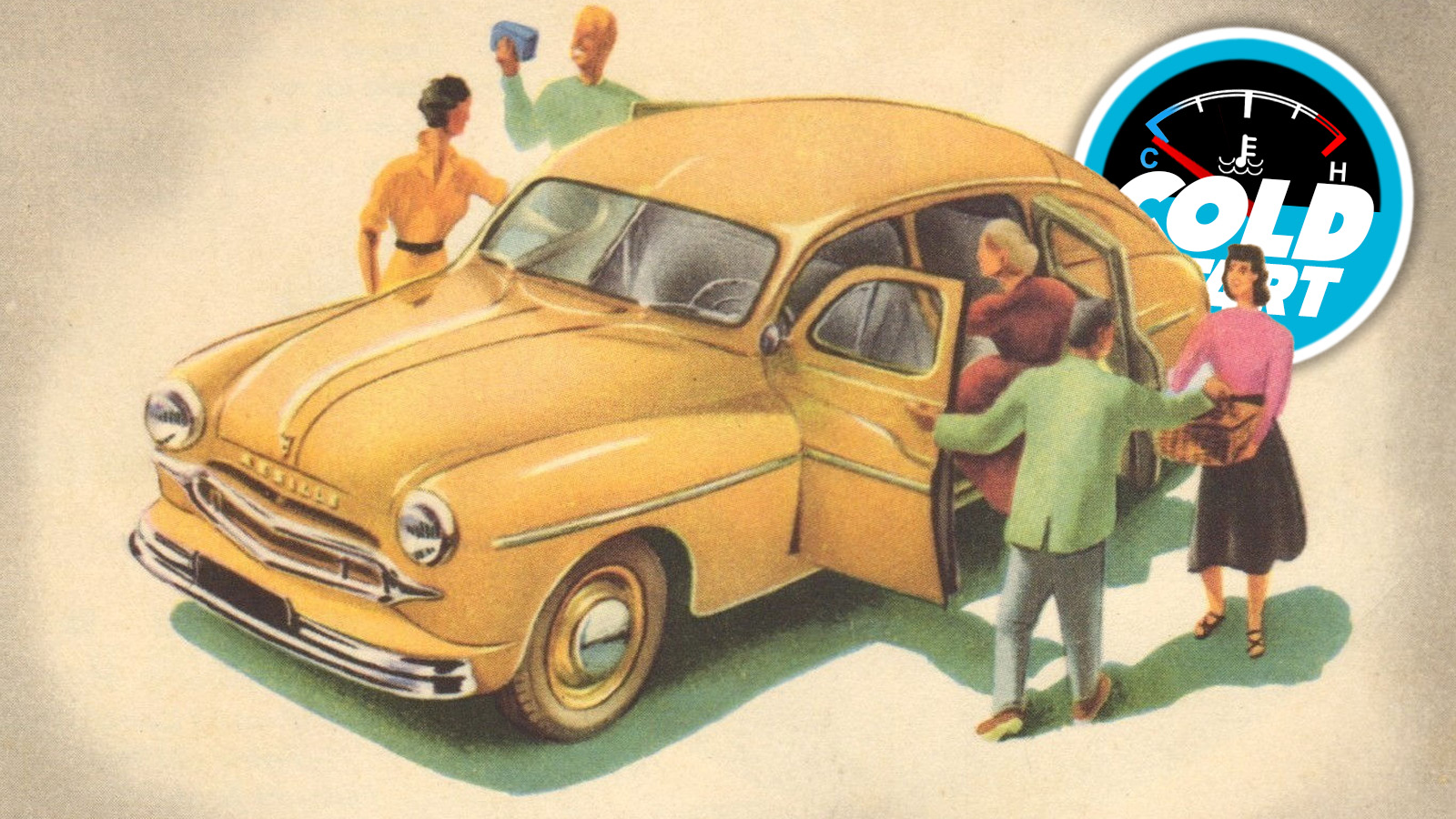
You know what bit of modern slang I really like? The use of the word “coded.” Like when people say something is, “[some noun]-coded” meaning that it has the feel of whatever the reference was. Like I have a shirt that is Boy Scout-coded or this ancient temple is very Cheesecake Factory-coded or whatever. You know what I mean.
Anyway, this 1952 French Ford brochure for a car called the Abeille (that means “bee” in French) is very early postwar children’s book-coded, illustration-wise. The style of these illustrations feels a little less like the typical car brochure illustrations of the era and more like, say, a Curious George book.


There’s just something about how the car is rendered, the slightly modified (lightly cutified?) proportions, the shading style and texture, just all of it feels sort of happily storybook-coded.
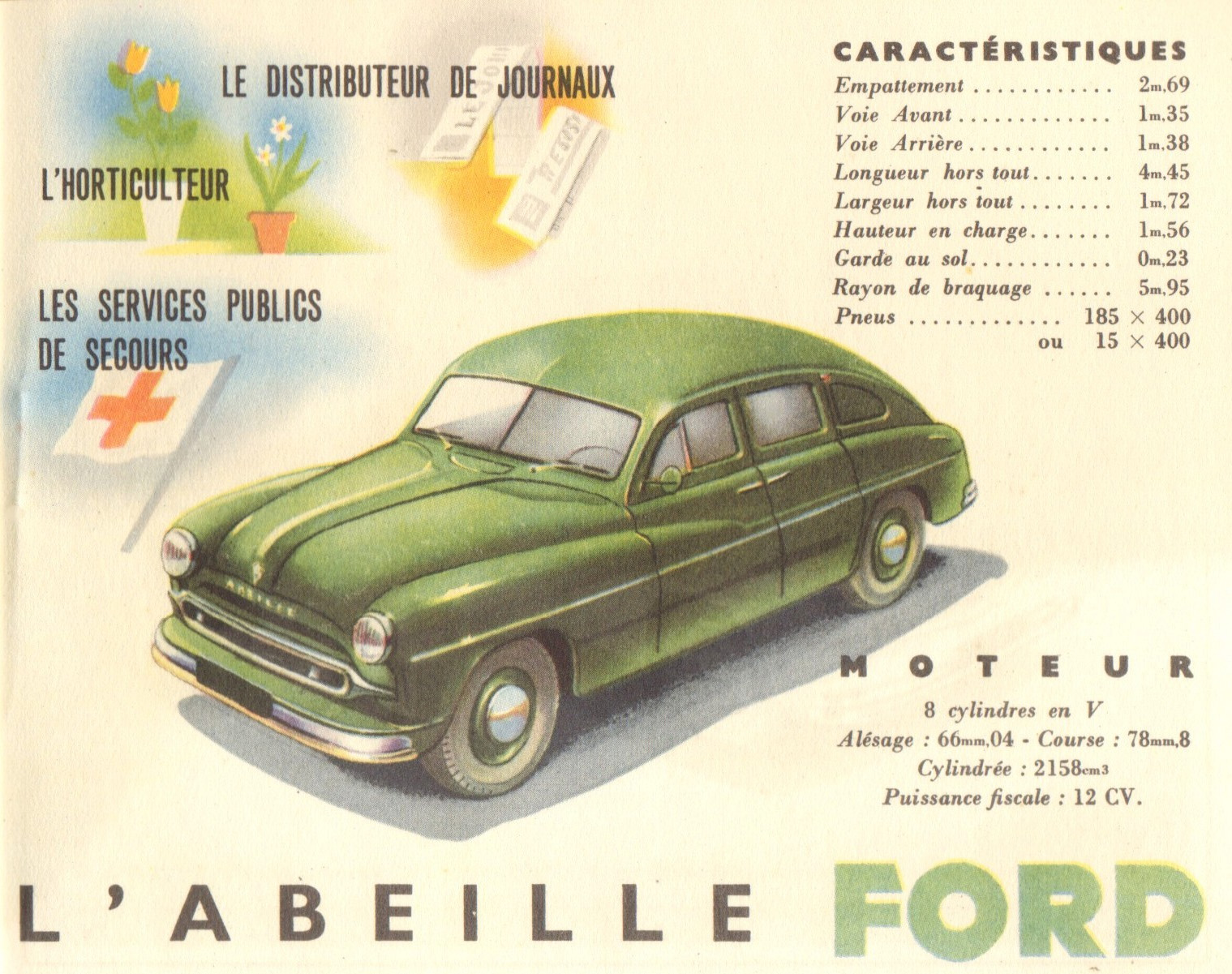
The car itself is kind of fascinating, too: it’s a commercial version of the French Ford Vedette, which started life as a plan for a smaller, lighter Ford for the postwar American market. In the end it was decided that Ford would sell bigger cars to Americans, and this “light Ford” was sent off to France, where it became the Vedette. These things had a 2.2-liter V8 engine! What a tiny V8!
The Abille was the commercial version of the Vedette, and had some interesting modifications. Most of the chrome was gone, replaced with painted trim, and the rear side windows were covered with body-colored panels, but from the inside, and the glass remained, which is really weird. Lots of carmakers had commercial versions that blocked out the rear side windows to make a more van-like body, but they almost always replaced the glass with sheetmetal. This is strange.
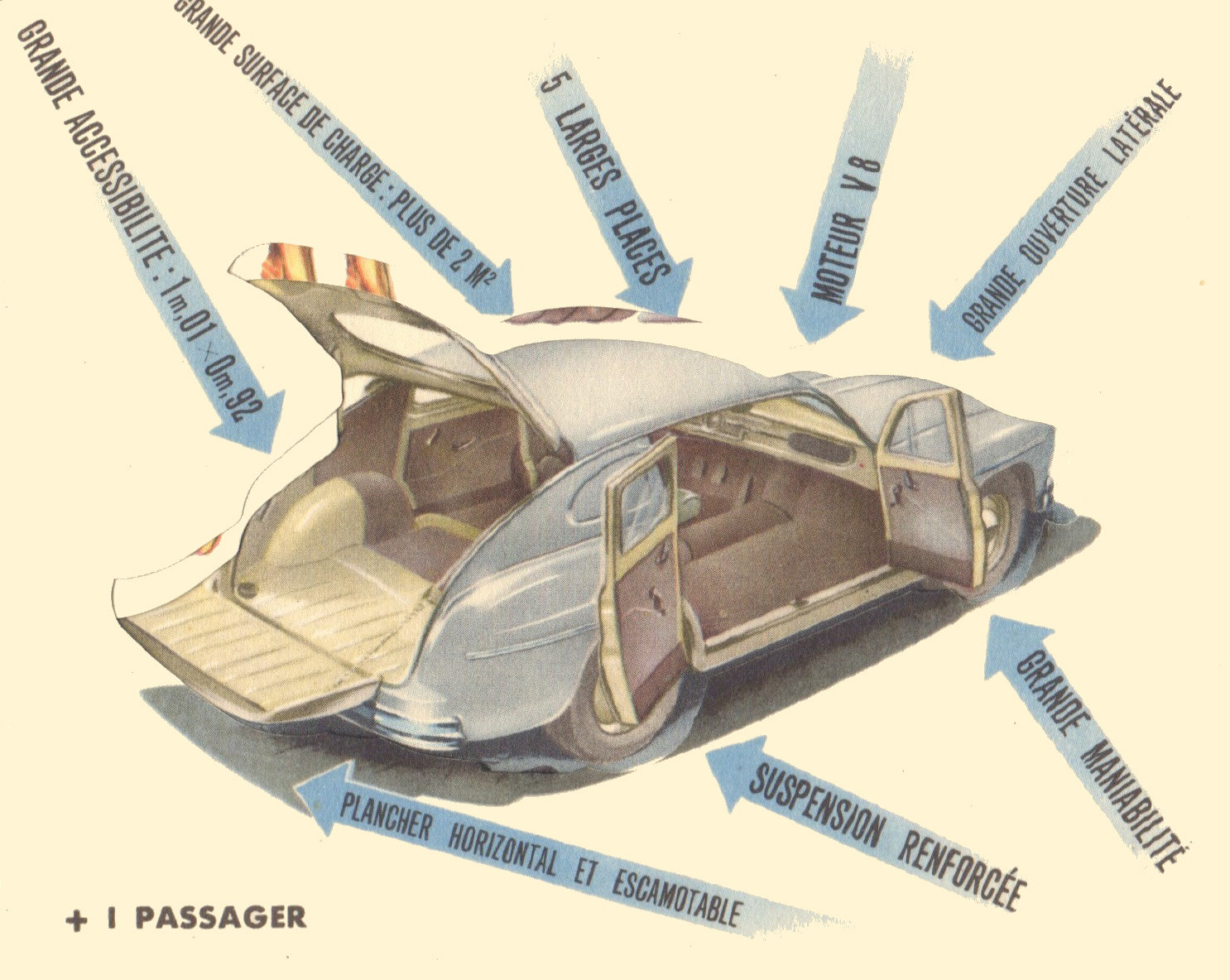
But here’s what really makes the Abille cool: that tailgate/hatchback setup. While this could be fitted with seating for five, in full utility mode it was just one seat and a crapload of room, accessible via the side doors, which opened with no B-pillar (reverse-opening rear doors made for a huge access area) and the combination hatch/tailgate at the rear provided great cargo access.
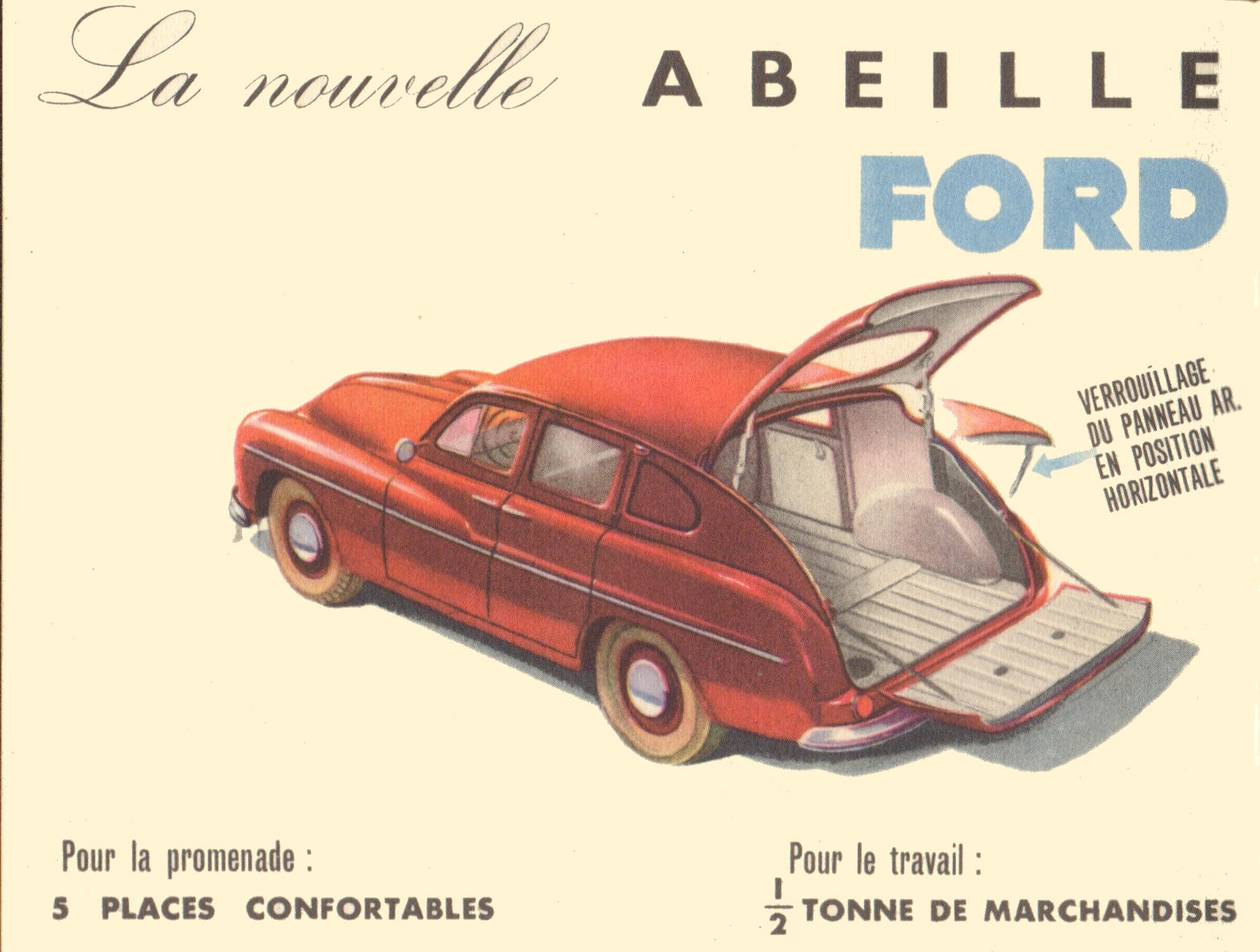
You could hold half a ton in this thing! Or that’s what it says, at least.
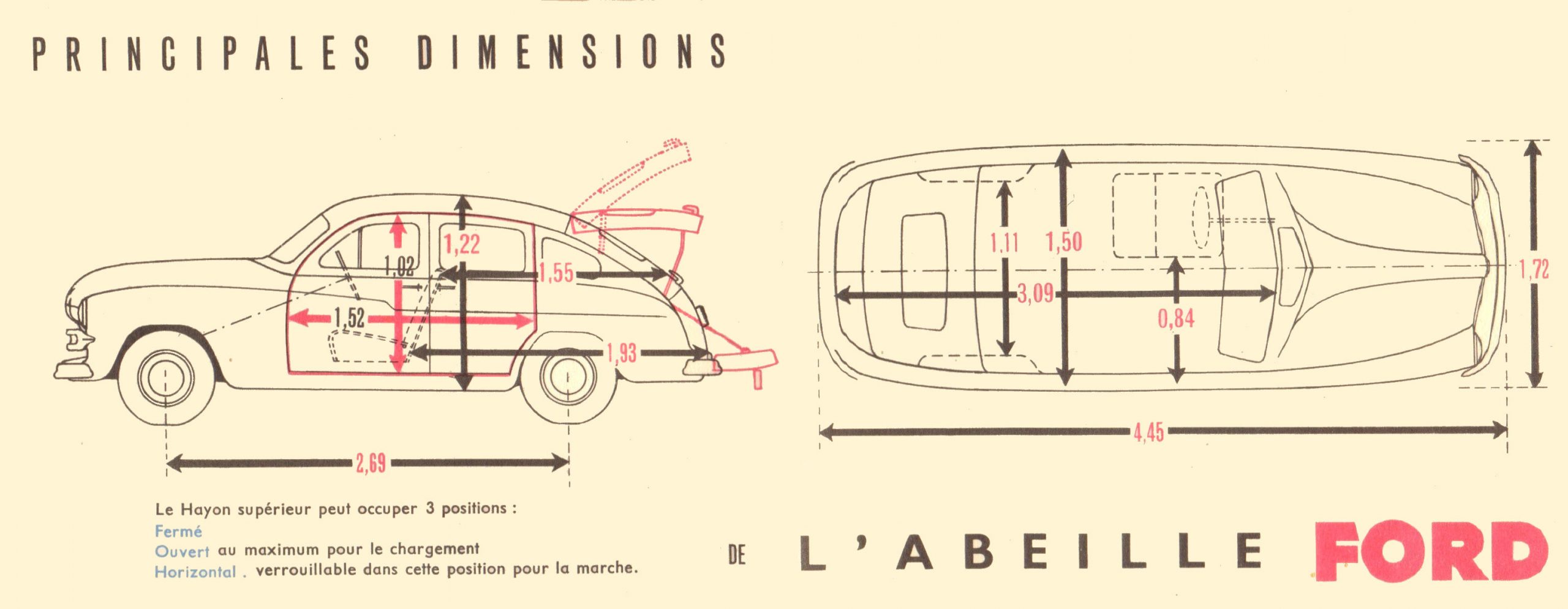
With the front passenger seat gone, the load area is about as long as a pickup truck, too. And note how the tailgate can be locked into that horizontal position, in case you need to let something really big hang out the back on the tailgate.
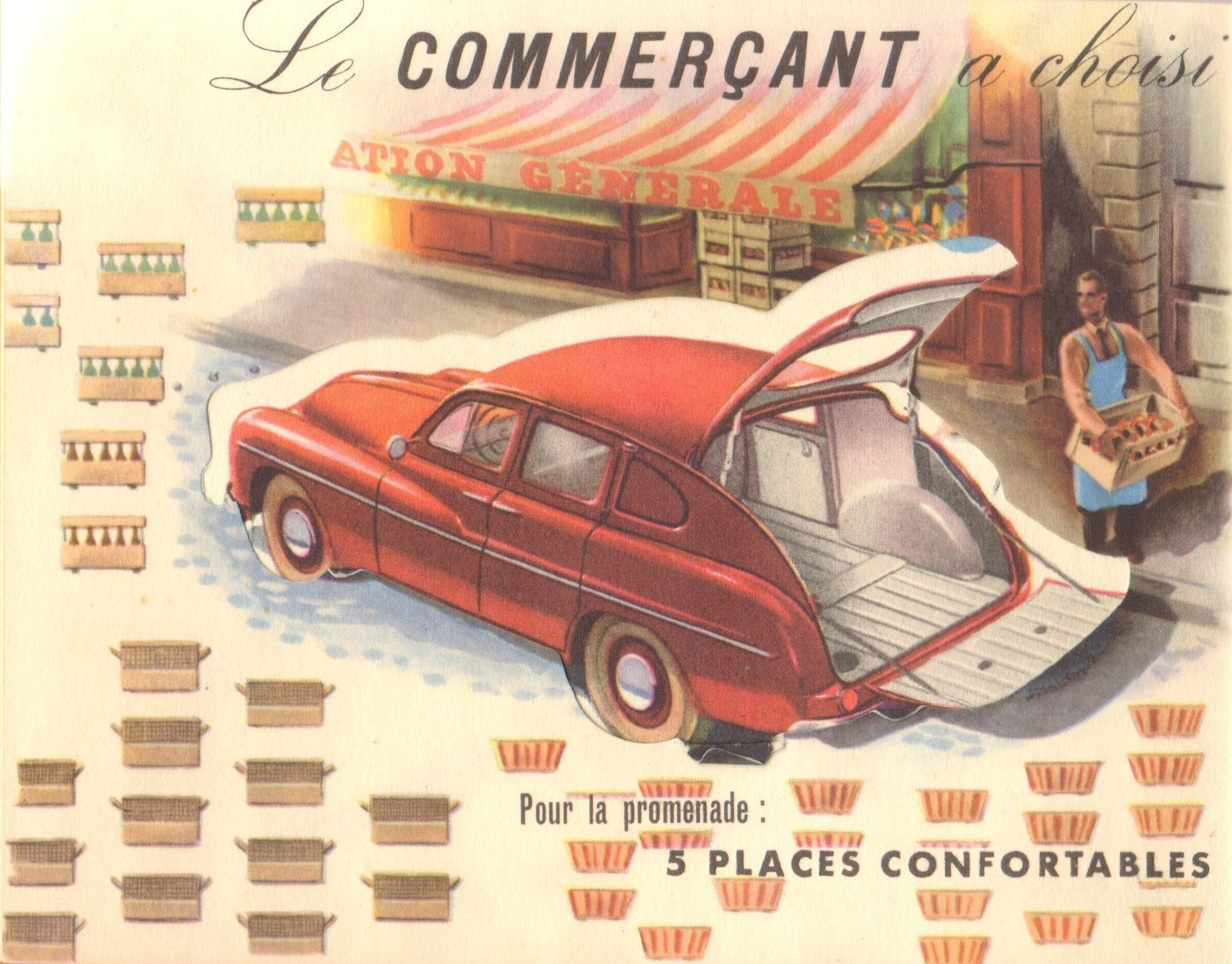
Look at these lovely illustrations, though! This brochure is fun because the car is seen through a cutout in the center, and the surrounding background changes. I love how part of the illustration is a naturalistic environment, and then the rest are repeating images – almost icon-like – of objects that can be crammed into the car.
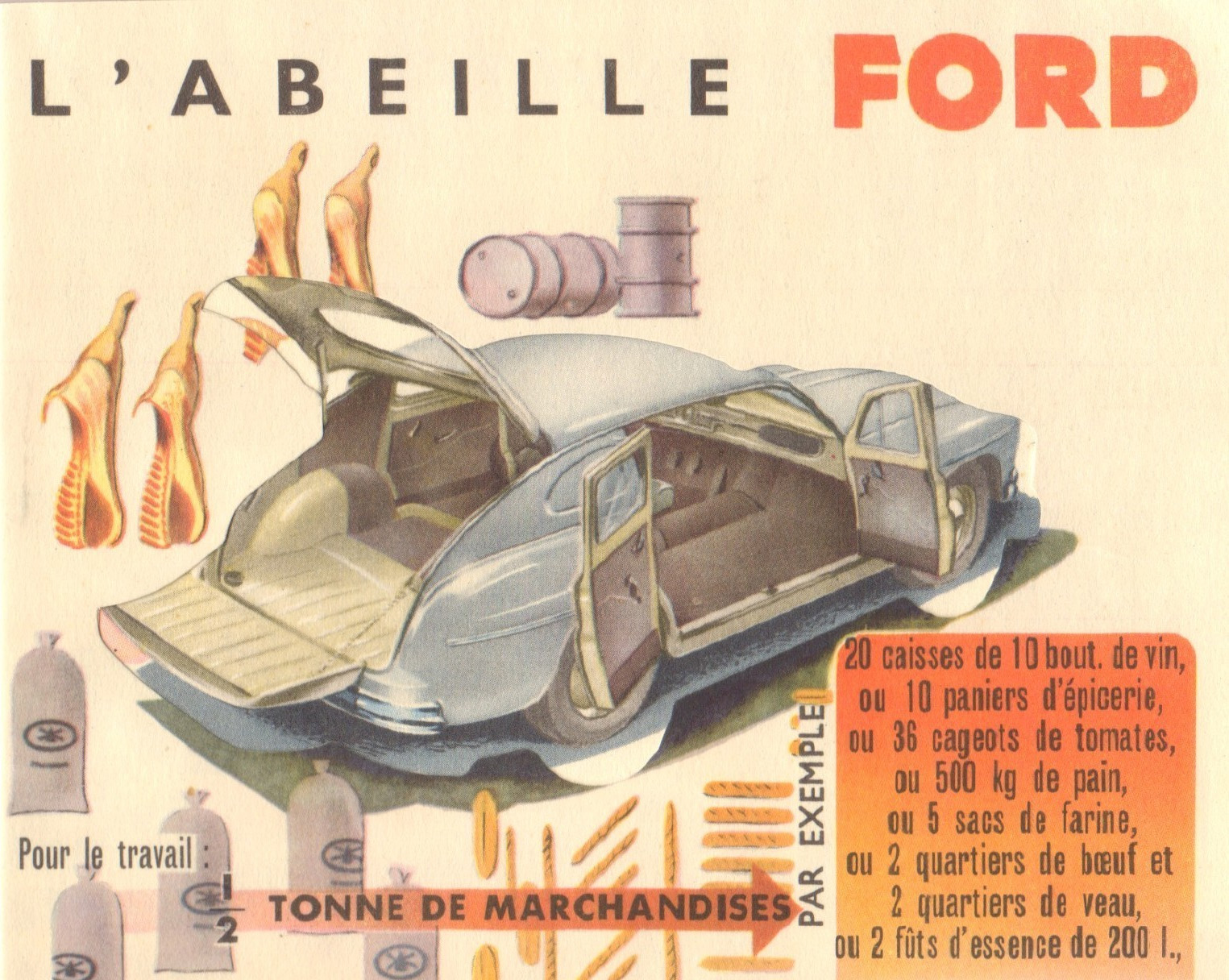
On the right side pages, we have a different view of the Abille, again seen through a cutout, but on this side it’s just the objects and no background, like these hunks of butcher meat, sacks of grain, baguettes, and, yes, oil drums.
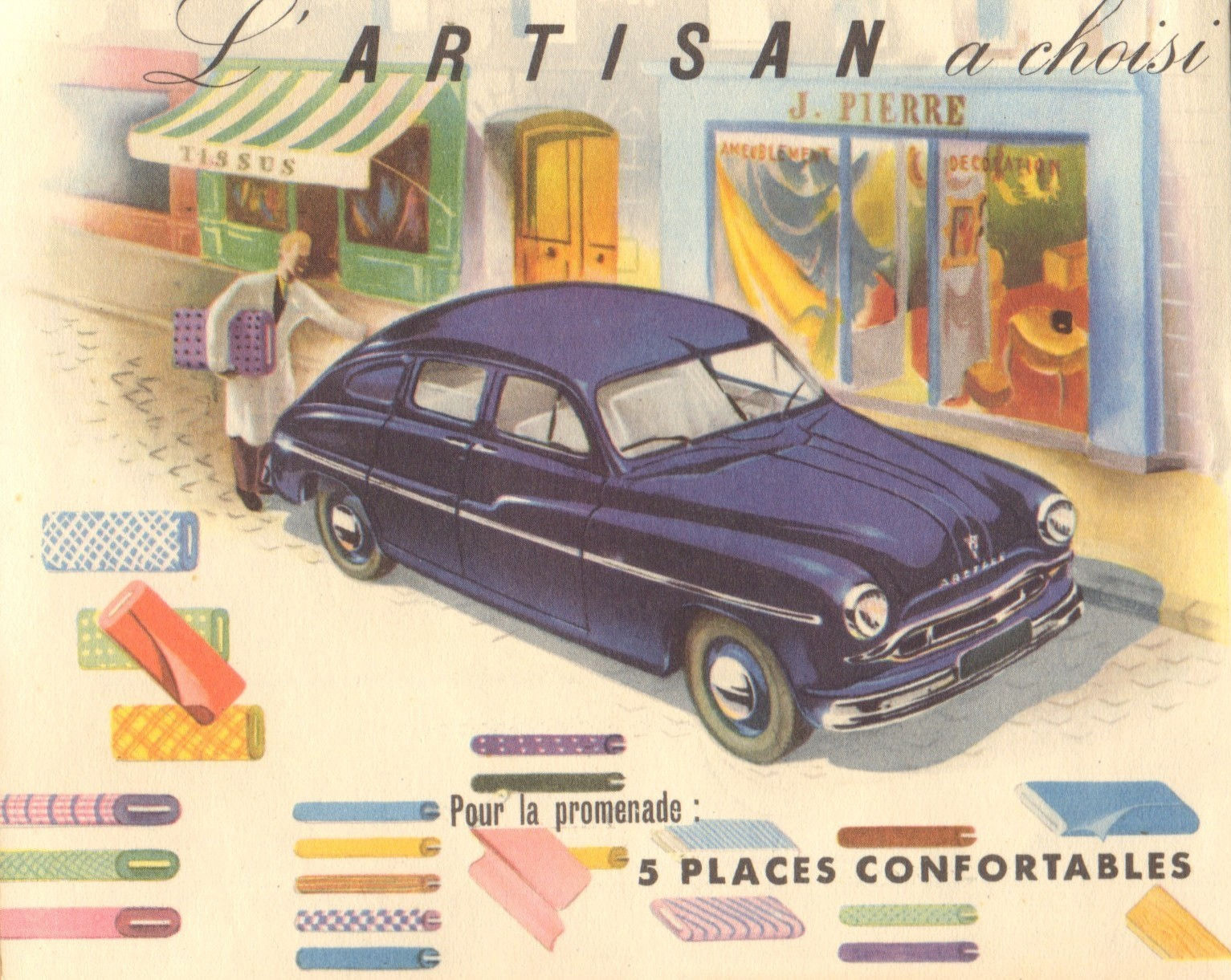
This car is an exception, as it’s not one of the cutout pages, so we see it with doors and hatch closed. The Vedette/Abille were tidy-looking little fastbacks, maybe getting a bit dated by 1952, but still handsome in an understated way. Also, I love all these fabric colors and patterns.
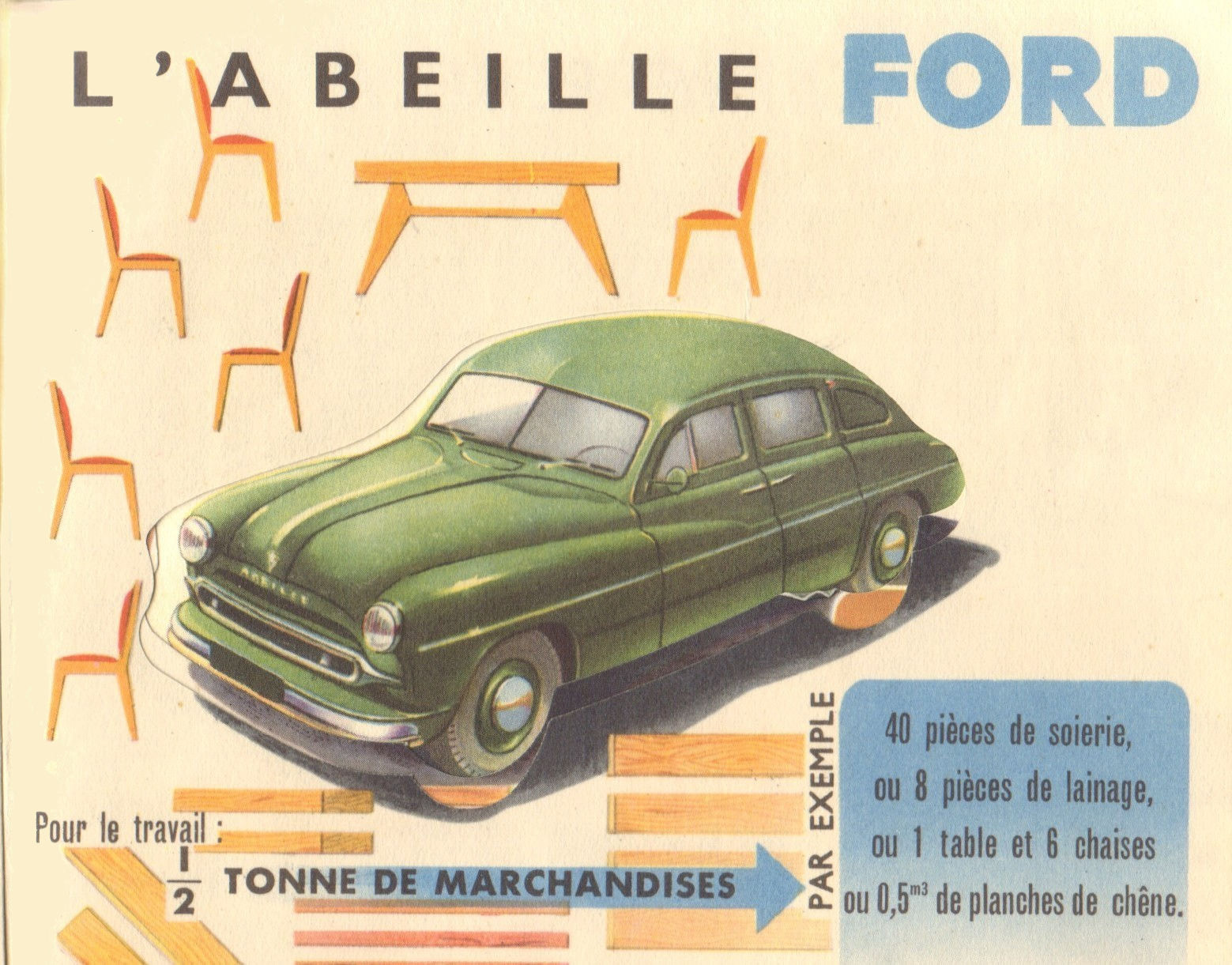
Look at these fantastic tables and chairs! That’s some hardcore midcentury furniture porn, right there.
I don’t think utility versions of cars tended to get saved and preserved like their more posh siblings, and that’s a shame. Often they’re the most interesting version of a car!




Google the Frazer Vagabond.
Quite a phoned-in-coded way of making a commercial vehicle, almost like they knew they were going to merge with Simca soon, so why bother.
– But cute car, I hope they sold some 🙂
“I don’t think utility versions of cars tended to get saved and preserved like their more posh siblings, and that’s a shame. Often they’re the most interesting version of a car!”
The grass is always greener on the other foot. You’re a chicken eating its own egg. You can please some of the people all of the time, but you can’t get blood from an aphorism.
What I mean to say is, it wouldn’t matter what kind of cars got preserved, there would always be cars we wish had been preserved. Even if half the posh cars got preserved, and half the slob cars, someone would cry about the other halfs.
It’s not a shame, it’s a reality.
You can lead a horse to water, but you can’t make a silk purse out of a pig in a poke.
What I mean to say is, you can urge people to miss certain cars, but some cars just aren’t worth missing.
????
Man I feel like DT upon reading a modern reference. What is coded, it wasn’t explained here, and what is TBQ I asked before but didn’t see a response
I want a modern version of this, or maybe this now! 2.2 v8!
I have needs!
Which came first? Torch came upon a website called Furniture Porn and just had to use it.
Or Torch wanted to use the phrase Furniture Porn and went looking to see if there was a website.
Third option; he misspelled his favorite kind of porn..
It was a site already taken where you can buy furniture used on a porn site. Make sure you get pictures and a certificate of authorization as well as proof it has been cleaned and disinfected. That is why I wouldn’t by Pamela Anderson’s Airstream Tramper Trailer when it was for sale in Laughlin Nevada. It was there because no one in Vegas ever heard of her
Maybe the window panels could be taken out for those that didn’t care to hide their cargo?
With a V-8-60 under the hood and a body originally designed to be a new compact American Ford (the “big Ford” to accompany it ended up being the ’49 Mercury and the final ’49 Ford was an in-between size) it had a development story similar to the first Holden, also a smaller postwar Chevy packed off to an overseas subsidiary late in the development process.
Long story short, too small for postwar America and just right for postwar Australia ended up being too big for postwar France.
This makes me think about children’s books with awesome vehicle illustrations. From Cars and Trucks and Things That Go, Big Joe’s Trailer Truck, and the works of Virginia Lee Burton (Katy and the Big Snow, Mike Mulligan and His Steam Shovel, etc.)
Mike Mulligan was a favorite, but I always felt sorry for Mary Anne at the end.
All of the books you’ve mentioned were key childhood memories (especially Big Joe, as my dad drove tractor-trailers at the time).
Cars and Trucks and Things that Go is still one of my favorite books…and I think almost every car-nerd started out with this book.
Same! I was obsessed with “big rigs” and the Big Joe book, my parents even found tractor trailer wallpaper to do my room in, haha.
You just brought back this memory of wallpaper was a repeating motif of construction equipment in pale blue…
“Wait, so they’re just walling her in there?”
Like the Cask of Amontillado.
Yeah, somehow generating steam vs. digging holes just doesn’t seem to be a fair trade…
But she got to generate steam that kept the town hall warm for over 100 years… long enough for the city council to approve a string of data centers to be built on pristine farm land nearby. So that’s an accomplishment.
Maybe she and Katy should connect and Katy should do some Killdozer kinda work on some of those data-centers…just sayin’
I bet there was a special version for fish, especially snails. Then it would have to be called the Abeille S. The people would say L’Abeille S Allez! Or in English, look at that S Car Go!
It was also probably shaped like a fish too. Which is awfully convenient since fish are naturally aereodynamic.
In the first illustration it looks like they drew hobbit-sized people next to the car to make it appear larger than it actually is. If so, I applaud the clever if highly dishonest presentation.
Like getting Dustin Hoffman in a commercial to sell a small car 😉
Shortly after that car, France went into a panic about all the lost taxes due to people getting company cars in lieu of higher wages.
So the rules were tightened and company cars, had to have two seats.
Something which remains to this day.
Rules were lifted slightly to allow cars with seats for presidents of companies, but even there an amazing number find it is better to buy their own cars, even if they have a company chauffer.
The large hatchback has always been a French thing — even now the Berlingo car with the lifting hatchback, has one large enough to keep a family of four out of the rain.
I would really like an R16 again, damn that was a good car,I have a thing about French big cars. The Peugeot 604 was a Jaguar XJ competitor.
Interesting:
It’s giving 1951 Kaiser Traveler from the tailgate –
1949 Mercury from the fender line which terminates in the driver’s door –
And 1950’s French Watercolor Impressionism from the illustration style.
That red one was saying Volvo Duett in front, SAAB 900 in the back to me.
Must be the Ytterbium poisoning.