


I don’t pretend to understand why I get interested in certain car details. I just accept it, like a force of nature, like the blowing of the wind or peeing yourself just a little bit when you taste something with a lot of paprika. It’s just one of those things one has to accept. And that’s why I accept that I’m going to talk to you about some car detail so minor it may make you a little dizzy, or perhaps pee yourself a bit, like you tasted some paprika.
The detail I want to discuss is dashboard turn signal indicator lamps; specifically, cars that make the bold choice to just have one of them.


It’s not particularly common for this to happen, and in Our Modern Age, it’s just about extinct. But from the era when flashing turn signals became common – say, the 1950s – up until, oh, maybe the late 1980s, there were always some percentage of carmakers that decided having two blinking green lights on the dashboard was just a ridiculous extravagance, and really, one is just fine.
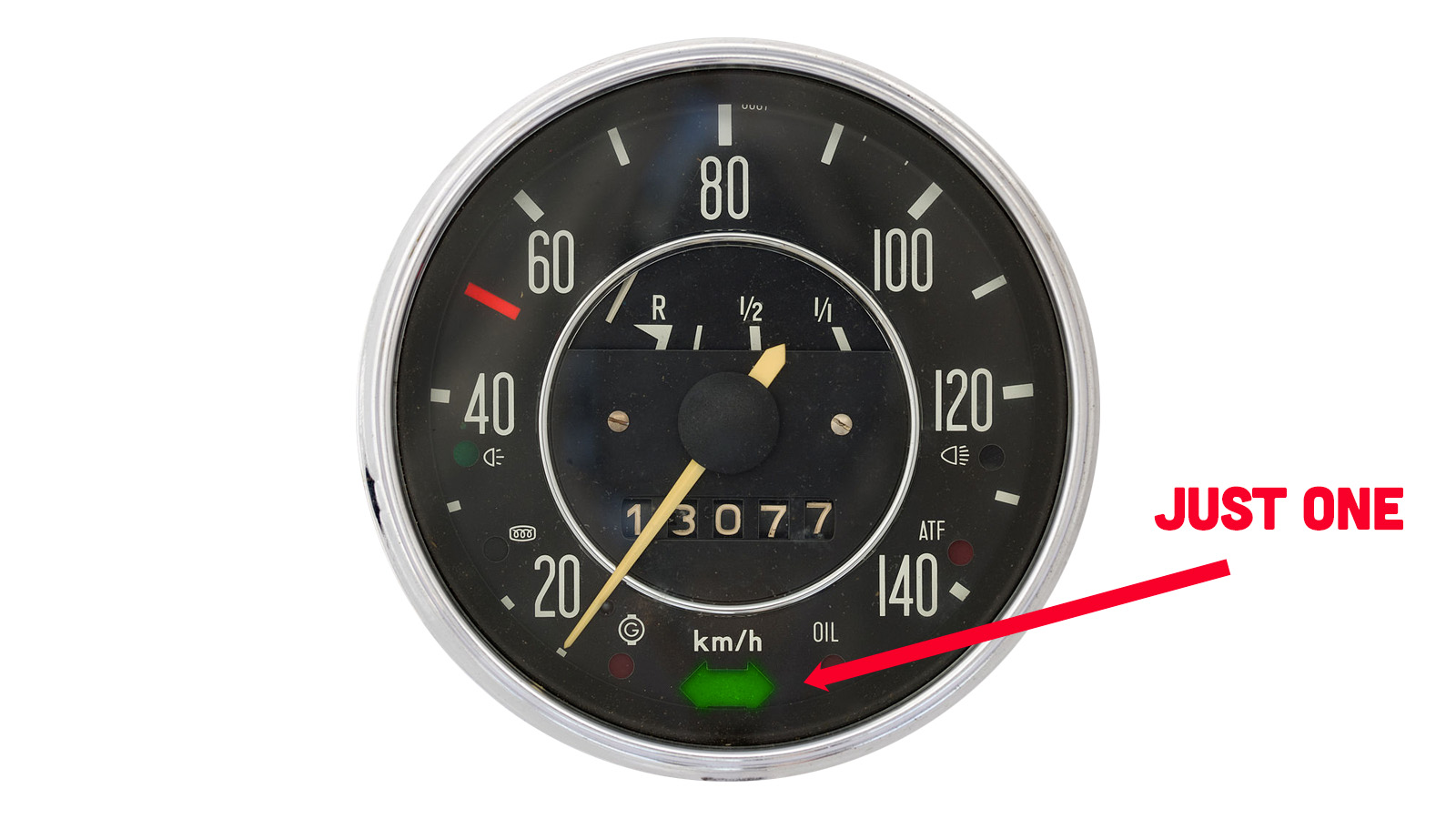
I first became aware of this because my first cars were Volkswagen Beetles, and Beetles only ever, throughout their entire 65-year production run, had one dashboard turn indicator lamp.

That even goes for the Super Beetle, which, despite getting such decadent trappings of luxury like that fake wood on the swankiest trims, only had the normal one dash turn light.

For whatever reason, Volkswagen was maybe the largest carmaker that was a dedicated proponent of the just-one-dash-turn-light concept, continuing the practice well into the liquid-cooled era, as you can see above.
It’s strange, right? I thought perhaps that maybe it was strictly a cost-cutting thing, and that sort of holds up, as my Yugo only sported one lamp, too:

…but I’ve been in some cheap cars that did manage to find enough pennies for two dash indictor lights, like this one that even makes sure the lights are in little arrow shapes:

… and even my Nissan Pao, a stylish car but by no means an expensive car, manages a pair of these lights:

I suppose the question is really does it actually matter? Is having just one blinking green light to let you know your turn signal is on so much worse than having two?

I mean, it tells you that your signal is on, and you know which way you pushed that lever. You can see the lever, and if it’s higher you know it’s right, and if it’s low, it’s left. If you want to turn it off and you somehow forgot which way you pushed it, you’ll feel that and figure it out when you touch the lever pretty quickly.

But then again, it is kind of nice to see the two separate arrows. That bit of reinforcement when you’re waiting to turn is somehow strangely reassuring. It is more information, and I can’t deny that. And more information is better, right? But then again, I’ve driven one-light cars plenty, and I can’t say it’s ever caused an issue.

In fact, the only issue I’ve ever had with this is in my Citroën 2CV, which has no dashboard turn indicator tell-tale lights. As in zero. I know it was possible to have one on some configurations – I think one of those oddly leather-patterned plugs is filling a hole where it would live.
Having no reminder that your signal is on sucks, especially in a loud car like the 2CV. I end up driving with a signal still on all the time, like the old man I am, but I don’t have to advertise that to everyone, right? I do think I’ll wire up a dash turn indicator light at some point, because you really do need at least one. Plus, Citroën gave a flashing light for the hazard lights already – it would have killed them to make that flash when your normal signals were on, too? I guess there’s probably a law that requires the hazards to have their own lamp, to avoid confusion. Still!

The fancier DS did get two separate lights, (up top, flanking the fuel and temperature gauges) which means Citroën is one of the few carmakers to offer a 200% jump in dash turn indicators from the low end of their lineup to the top. They should have used that in ads!
I’m curious what all of you fellow Autopians think – do you find that one indicator is enough? Or do you demand two separate indicators, like some kind of sultan? Tell me!


In some cars I’ve been in, you just watch for the rhythmic, metronome-like back-and-forth jumping of the voltage gauge whenever the turn signal is on
I need at least 3 5/8th lights.
My first car was an 86 cutlass with two signal lights, spaced luxuriously wide on either side of the sweeping speedometer. When I changed to a 1992 Jetta with the single light, I thought it was a funny Bauhaus minimalist novelty at first, and I got used to it quickly. When I then changed to a Volvo V40 I don’t remember thinking the doubled number of signal lights was dramatically improving my life.
Even my tractor has separate indicators, but if I use the turn signal, all the other lights go out. Instead of trying to figure out why, I just stick with hand signals.
I’ve never had a one-arrow car but I’ve had a center-dash-pod Toyota Yaris where the hardest thing to get used to about the whole center pod was the left turn signal lighting a green arrow indicator off to the right.
I’ve owned a few cars with only a single signal light indicator on the dash (Mini, Beetle and 66 Mercury F100); it’s fine. Trivia: on classic Minis with the round gauge pod, there is usually just one dash light for turn signals. There are a pair of amber lights on either side that you would think are turn signal indicators but are actually oil pressure lights. In most markets, that is. On late-70s Canadian market Minis, those amber lights were used for left and right turn signals. The single green light used for the signal indicator everywhere else was used for the rear defrost indicator. These are all unmarked, of course.
Well, thank you! This solves the mystery of why the fancy new Smiths electronic speedometer for my old Mini has only one signal light indicator while the old one had two. The old speedometer was from a Canadian Mini!
Jeez Jason, it wouldn’t take much to tidy up the 2CV’s metal dash. Throw some turtle wax on there or something man. One lamp is fine – I hear the clicker way before seeing the dash light.
In your 2CV you have to channel your inner motorcycle rider, and just press the signal cancel button like you have OCD.
Even two turn signal indicators are far too plebeian for me. I prefer at least four, as on Chrysler products from the late 1960s and 1970s (the little orange lights on the fenders), or six, as on many Cadillacs on into the 1990s (two on the fenders, two more above the back window for viewing via the rearview mirror).
You can add my 1964 Triumph TR4 as well as the 1978 Scirocco, 1983 Jetta, 1987 Quantum Synchro, and 1989 Golf to the list of single turn signal vehicles. The 2001 Allroad and 2012 Golf TDi were the first cars we had that were so decadent as to indicate which signal was on.
Ah but Citroën refused right up to the 1990s and the XM, to have self-cancelling indicators.
Apparently one of the bosses decided having self-cancelling indicators would make drivers lazy and end life as we know it.
I learnt how to drive in a DS, and even now I find myself moving to cancel the indicators, even though they stopped clicking long ago…
When you think about it self cancelling indicators are a luxury. And other drivers will always kindly tell you when the indicators are left on.
My Fulvia has a single turn indicator light and it’s never been an issue. Feels in keeping with the spirit of the car.
And when I had my 2CV I just used hand signals, since I figured nobody would notice the small, low-mounted 6V lamps anyway.
I was amazed to see the single indicator in my buddy’s XR4Ti.
For the 2CV, you should wire it to the cluster illumination circuit, so the whole thing blinks at you.
My brother’s Land Rover would blink the dome light when he indicated left, but that was the result of a previous owner’s frame repairs, AKA “just Land Rover things”.
(He eventually solved it by running a separate ground wire to the rear left light pod.)
I didn’t realize this was so commonplace. The only cars I encountered with this “feature” are BMW-era MINI Coopers.
And it wasn’t just inexpensive cars. My 1987 928 S4 has only one indicator, in spite of being the most expensive car Porsche sold at the time.
Two indicators is better in one instance – if a light is out and the indicator doesn’t blink, but just lights up, you know which turn signal is burnt out. But other than that it’s not a big deal.
That’s smart – thank you. I knew there might be a good reason for two but couldn’t think of it!
My ’73 TR6 has just one round lamp to indicate the turn signal is on, and it’s fine to me.
’86 Jetta GLI – one light. Found it annoying.
I can’t recall any US-made cars with a single turn signal indicator since at least the 50s or 60s. Motorcycles, certainly. Some old clamp-around-the-steering-column turn signal units found on trucks sometimes used a single light in the unit — although most of those tend to use two in a stacked configuration where each light corresponds to the up/down position of the lever.
Single turn signal indicators always seemed to be more of a thing on European vehicles. The original VW Golf/Rabbit comes to mind, with its simple little utilitarian LEDs. Land Rover used a single indicator in the original Range Rover and Discovery 1 clear into the 90s… I don’t think this changed until the P38A Range Rover and Discovery II came along.
Interestingly, the Range Rover and Disco had a second single turn signal indicator for a trailer. It flashes once as a test when you turn on a turn signal without a trailer hooked up, and then with a trailer connected, it flashes alongside the main turn signal light in sync, unless there’s a problem with the trailer turn signals.
My Elise only had one, but oddly it was just that it only had one light that was connected to both signals. When I had to change my gauge cluster to a digital one a couple years ago it correctly shows which side is turned on.
Indeed – my 2CB does have a single indicator light. It is also in a terrible location which means unless I move my head to look for it, I won’t see it. Pair that with non-cancelling indicators and (as Torch noted) engine noise louder than the relay, and… I leave my signal on sometimes.
However, unlike Jason’s 2CV, mine does not have hazard flashers, or at at least won’t until I take the time to wire in the switch unit that a friend brought me back from the EU.
My 86 2CV has the same dash as Jason’s. Turn signal light is the one on the left of the speedo. The two lights on the right side are headlights and high beams.
My 1963 Ford F100 only has one, bit only because the one for the right indicator seems to be burned out.
My 1966 Mercury M100 only had one on the right side that blinked with left and right signals. What you would think was an signal indicator on the left side was the high-beam indicator.
One is fine and it is better than just a shift up light instead of a tachometer.
My 1980 Spitfire just had one light and I don’t know if it was a feature or if it was just Lucas things, but if you indicated a right turn it would flash and if you indicated a left turn it would flash once than stop flashing.
What am I talking about. It had to be a Lucas thing.
Bizarre side note – Back in 1999 I changed my 1968 Olds over from an automatic to a 4-speed manual and did the swap correctly, including getting the correct steering column and gauges. Here’s the weird part: The automatic speedometer (which I had to change out because it had the PRNDL indicator on it) had directional triangles for the turn signal lights and the manual speedometer had a pair of rectangles. I think this was mainly because the manual speedo had more space to make bigger lights, but it also seemed really unnecessary.
One is plenty for me. Fun fact is that until recently, one lamp was common on motorcycles, to help economize on space. My Suzuki has a row of colored lamps (below the analog gauges), with a green bulb for the indicators.
My Pacific Coast had two AND the ultimate decadence of a FUEL GAUGE!!!
My X1/9 has only one turn signal light and I have never turned opposite of the intended direction in 145,000 miles.