

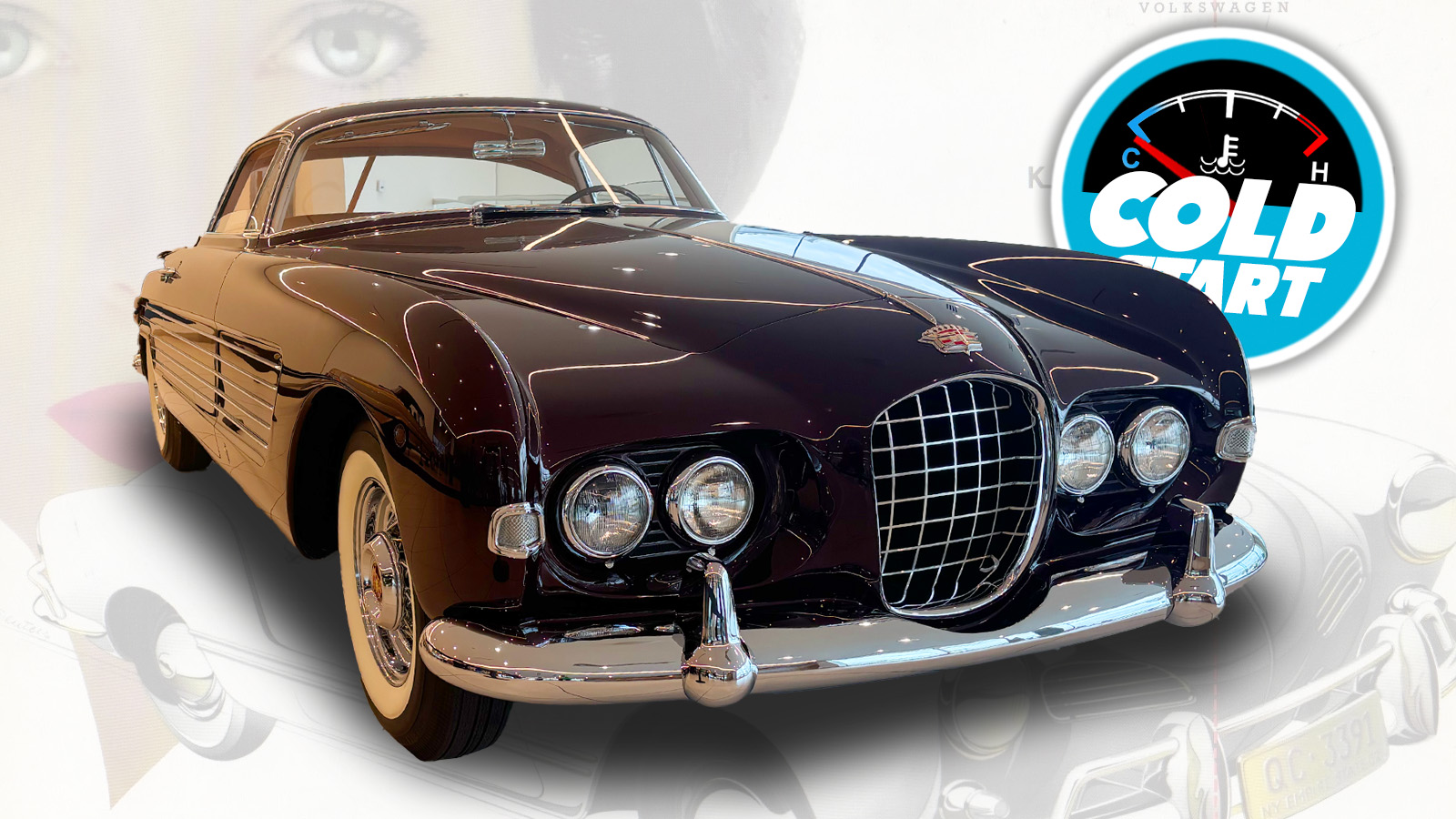
At the Galpin Car Show this past weekend, among the many incredible cars there, there was one that really stuck with me: the one up top there, a Cadillac re-bodied by Ghia and owned by actress Rita Hayworth. The car was a gift from her then husband, Prince Aly Kahn, who got her the car because he’d been getting his royal rocks off with other women, and Rita had enough of that. So, in a desperate attempt to win her back, the Prince bought the car right off the stand at the 1953 Paris Auto Salon.
It’s such a beautiful car, the gambit would probably have worked on me. Though, to be fair, I’m probably not the Prince’s type.


Anyway, this Ghia-Cadillac was loaned to be shown at the Galpin Car Show by the Petersen Museum, and seeing it in person was a powerful experience. This is a car with more presence than all of Hanukkah (that phrasing only works if you read it aloud, so please do so) and it’s just a strikingly lovely machine.
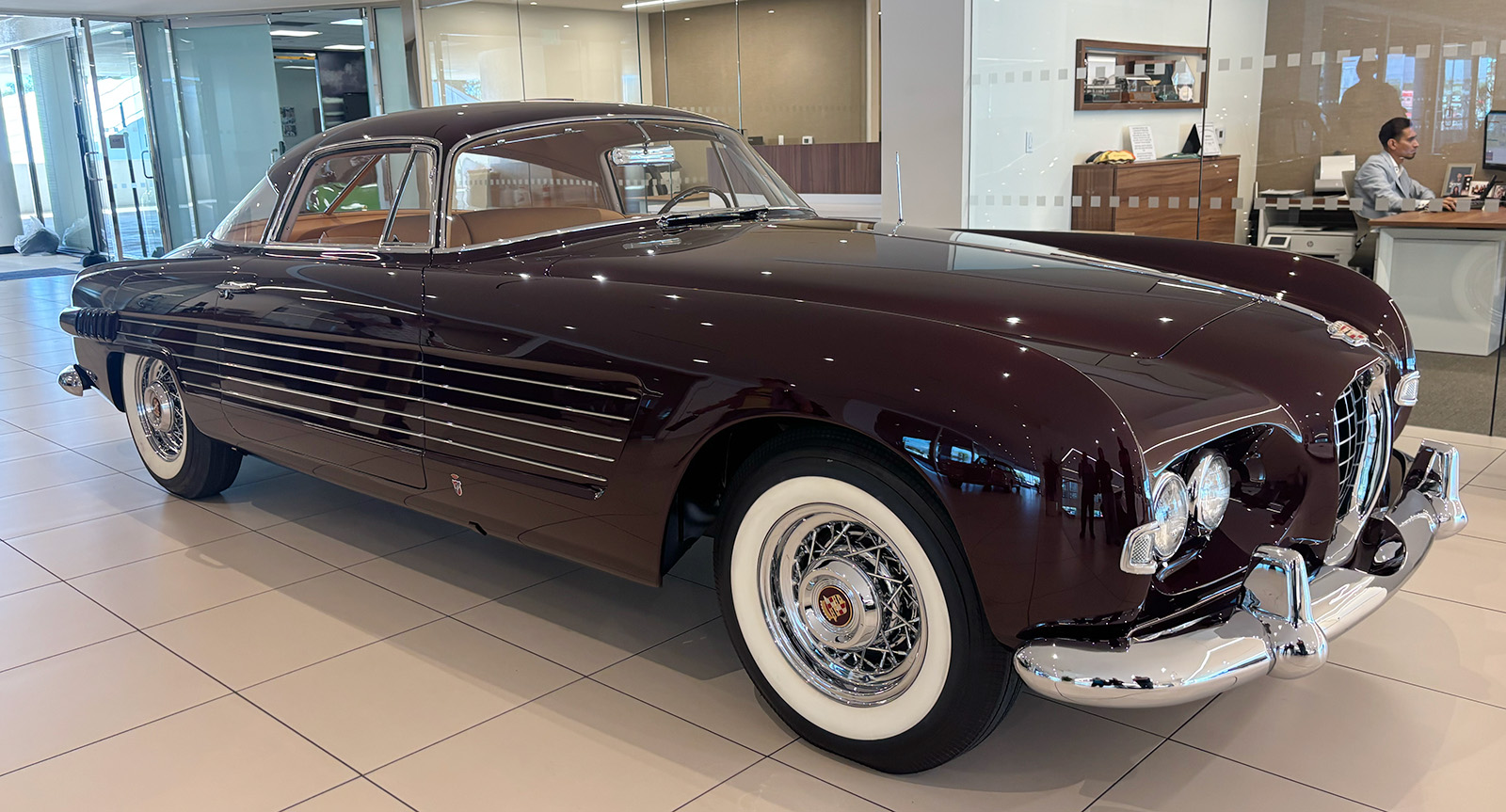
Seeing it also made me think of the other early 1950s Ghia designs, especially the ones made for Chrysler, and, of course, the Volkswagen Karmann-Ghia. All of these cars, when considered together, feel like a phases of a singular design concept, being tweaked and played with in various ways, all different but all seemingly based on a shared set of aesthetic concepts, with only one version, perhaps the least likely one, making it to mass-production.
The Midcentury Ghia Coupé look, as I’m deciding to call it, cleverly, has a number of shared characteristics:
• Proportions: Classic long hood/short rear deck
• Greenhouse: Small, very curved, usually with a window graphic that combines front and rear side windows and curves downward to the rear dramatically
• Design Vocabulary: Rounded forms, minimal harsh angles save for slacks-like creases in fenderlines. Some forms almost border on bulbous, but skirt the line
• Character lines/beltline: Most have a front fender line that glides back in a long sweep; rear fender line starts low and then kicks up dramatically to form a rounder rear fender
• Front Fascia/Grille: Most have a tall, shield-like grille that doesn’t extend far to the sides
… there’s probably more, but I think these are key characteristics. Let’s look at some profiles:
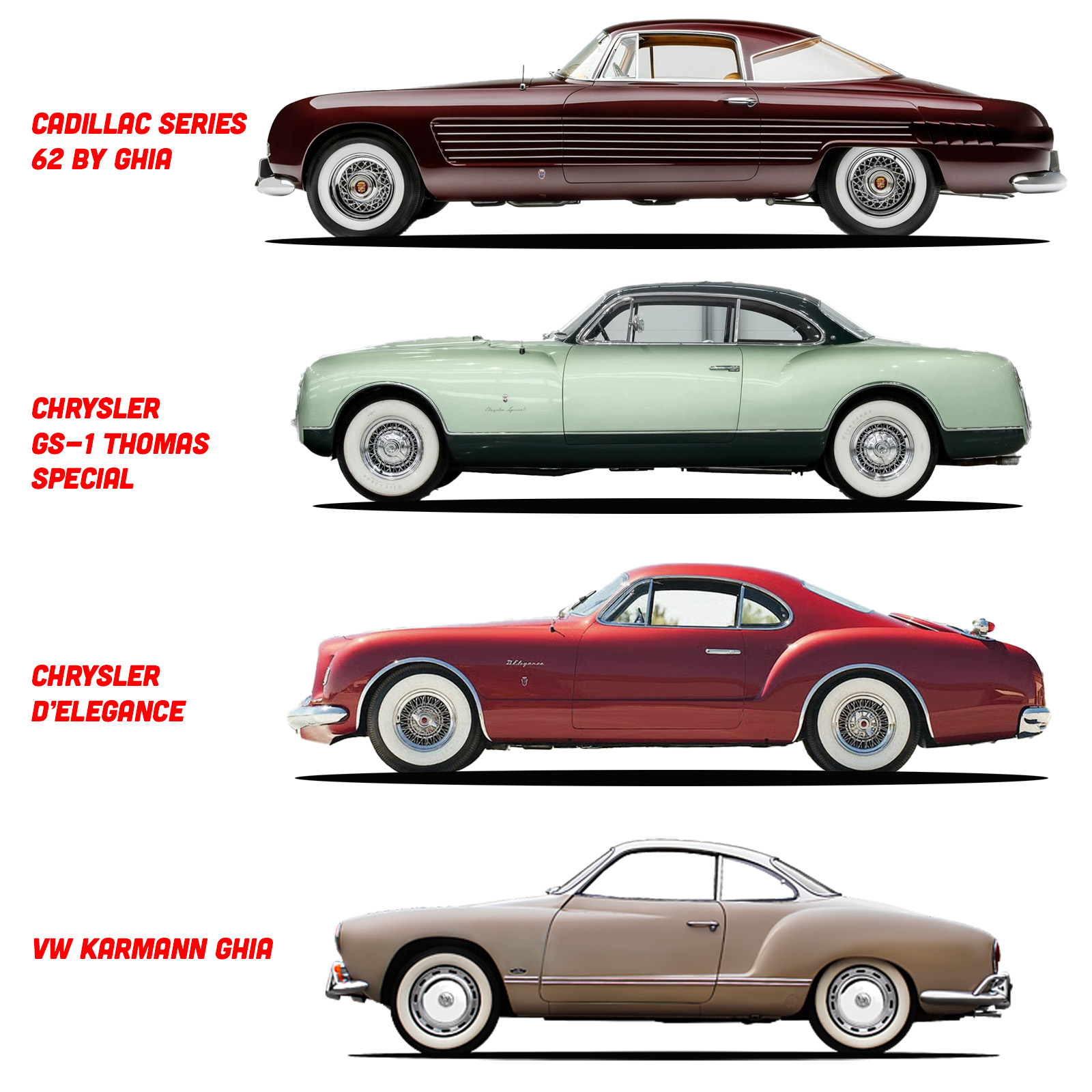
While the sizes of the vehicles do vary a lot, it just shows how flexible this design language is. The two Chryslers and the VW are closest, I think, with very similar fender lines and minimal body detailing. The Cadillac differs the most, with more chrome side ornamentation and a different fender line concept, but it still definitely feels part of this series.
The Cadillac has the most divergent greenhouse as well, though the proportions are generally retained. Perhaps the most dramatic similarities of greenhousen are in the Ghia-designed Fiat 8V Supersonic and the Karmann-Ghia:

Those greenhouses are just about identical. The Fiats were built (all 15 or so) in 1953, and the Karmann-Ghia was first released in 1955. I know a lot of times people like to suggest that the Karmann-Ghia was a re-worked Chrysler D’Elegance, and while I think that’s generally true, really it was a mix of all of these Ghia early ’50s coupé designs.
Let’s take a look at some front ends:
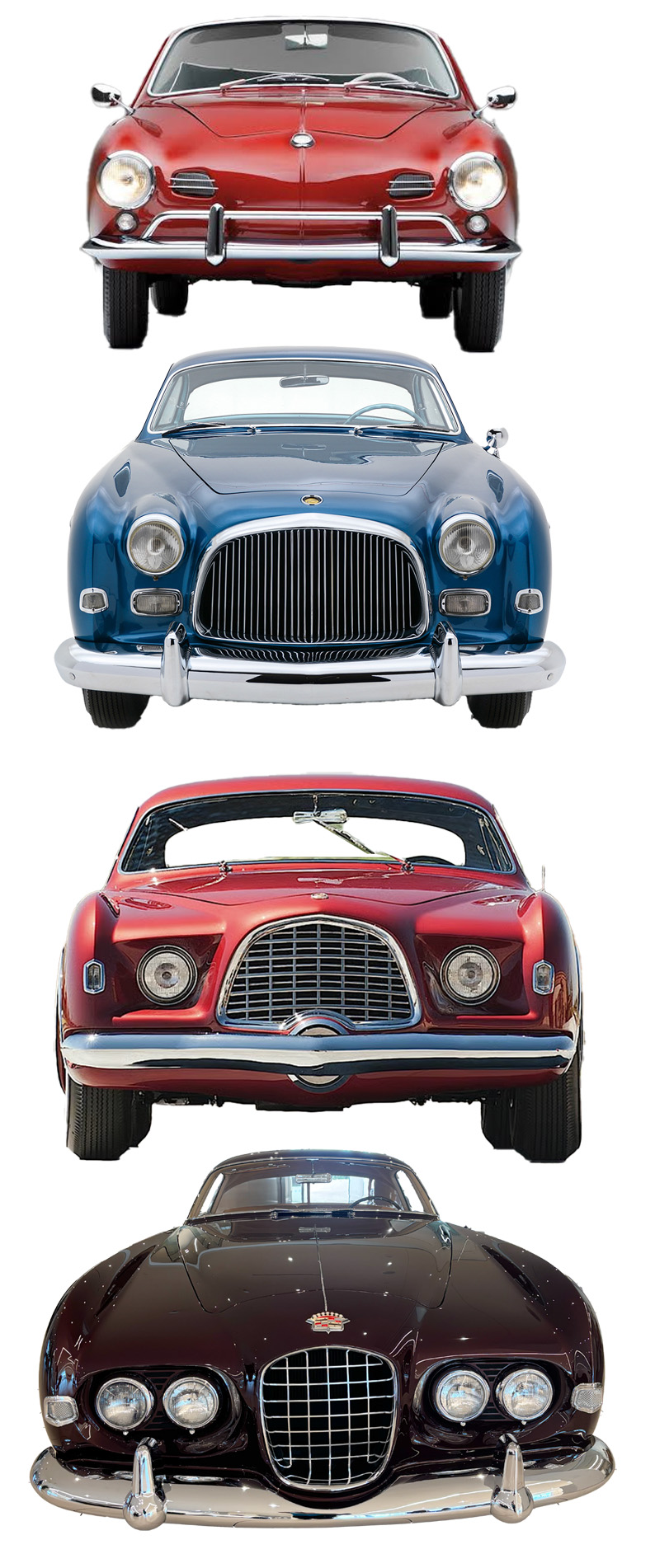
Ghia liked that sort of central, somewhat upright-oriented grille for these cars; they played with a lot of variants and headlight number and orientations, sometimes insetting the lights into little alcoves in the body, sometimes putting them into pods that flowed into the main body.
The biggest divergent design here was the Karmann-Ghia, which, being a rear-engined, air-cooled car, had no need for a large radiator grille. The VW had a pair of fresh air inlet nostrils instead, making for a face that differed the most from its Ghia-designed siblings.
All of these Ghia cars, taken as a set, may be one of the loveliest expressions of a general design concept, spread across multiple cars, in all of automotive history. I think I like them so much because when you look at these cars together, you really get the sense of a designer exploring and trying variations to find just the right combination of elements and details.
No two of these cars are exactly alike, of course, but you can’t ignore the sibling traits. It’s sort of funny that the only one of these to make it to production was likely the humblest expression of the idea; before Volkswagen adapted the design to the Beetle chassis, these were all extremely high-end cars, the kinds of things you, a prince, might give to your wife to try and help her forget your philandering. The Karmann-Ghia had the beauty of these elevated driving machines, but was actually accessible to people who had no royal titles at all.
Early ’50s Ghia really was magic.
Top graphic image: Jason Torchinsky


…save for the creases, like slacks, in front fenderlines.
With the possible exception of the Centurian, 50’s GM didn’t come close to these beauties.
My first actual purchase of a car was a KG. It was crsp and I loved it. Convertible slow rusty crsp. I still get teary when I see another Kg on the street
I have a feeling these are not that far from the influence of the pre-Ghia Cisitalia coupes. Definitely an Italian period look.
If the manner of your birth lacked a manor, you just need a car, man.
I had a better one about the prince’s life crumbled like a crumpet for failing to resist the…But I vowed to never post that.
Despite being a 4-door, I think the Facel-Vega is in this vein.
EDIT – I was actually picturing the Facel-Vega coupes – the sedan looks a lot different.
Although most were convertibles, there were a few Dual-Ghia coupes made, which definately fit into this continuity, they were also based on a series of thee Dodge Firearrow show cars (the last one of which was a coupe) and a production-ready version called the Firebomb (which went back to a convertible, and which was cancelled at a fairly late stage)
Lack of design range
I had never seen the Ghia-caddy before, and wow… that may be the most beautiful car ever made.
It’d be even better with hideaway headlights to make a more streamlined front face.
I can’t read anything about a Ghia design without hearing my grandmother’s voice talking about her “Geeeyah” in a tone most people reserve for precious pets. She owned two Karmann Ghias – one baby blue, one green, both with white tops – in the 60s. My sister inherited the green one and drove it into the early 80s before it finally died on a bridge.
Interestingly, Aly Khan knew Orson Welles as a child in London then married Rita Hayworth after she and Welles divorced. A notorious roué, Khan was passed over to succeed his father as Imam of the Ismailis in large part because of his playboy reputation. It was only the second time in 1300 years that descent was circumvented. Three years later Khan died as the result of injuries suffered in a car accident. By then, he and Hayworth were divorced, during which process she supposedly turned down $1 million to raise their daughter as a Muslim. Generally speaking, not a great guy, but he had good taste in women and cars.
I appreciate the flowing lines and such, but the faces of the bottom two in the front face comparison pic both remind me of the car from the movie The Car. Maybe it’s the inset headlights in a space that’s larger than the lights.
I see the same thing. I have to wonder if George Barris was inspired by the look when he was designing the movie car.
Its why this custom you guys made an article about (shame you didn’t) looks so good:
https://www.theautopian.com/this-gorgeous-karmann-ghia-is-really-a-mercedes-benz-slk/
I want that!
I’m a major fan of the Fiat 8V Supersonic. 0.23 Cd value, and coupled with a small frontal area, makes it more slippery than anything currently on the market today. And it’s well over a half century old.
My first car was a 1971 Karmann-Ghia. No functioning heat, nor radio, but still probably my favorite car.
My first car was a 1964 Comet Caliente. No functioning heat, no radio, no seat belts, no mirrors. I had to work on it every week to keep it running. Definitely my favorite car.
My cousin had one with the clutchless manual. My wife really wants one of those once I told her about it.
If I remember correctly, the Karmann-Ghia was originally named the Ghia-Karmann. That makes more sense, as the designer is more important than the coachbuilder.
That’s certainly what car designers/stylists think.
But how many car designers would we know if no one ever actually built the car?
You can engineer and build a car without getting a designer/stylist involved. Many of them are hideous, obvs, but I happen to know that the Lotus Type 119c had every exterior surface dictated by engineering.
The 119d was designed by a designer. You won’t find any pictures of it as it wasn’t built.
Two takeaways:
1: It makes sense to me that a design house working within a certain era probably would have a certain signature art style. This isn’t strictly the case as many artists can shift between wildly different styles and techniques, but this article does a great job of exploring Ghia’s style within the ’50s. That comparison between the Fiat and VW greenhouses really brought it home.
2: Not only was that Hannukah pun a slow burn but a groaner. I’m simultaneously annoyed and impressed.
Beautiful car.
The M-B 300SL is somewhere in this range too, although not a Ghia design of course.
https://www.topgear.com/sites/default/files/2024/04/434_HILTON_MERC_GULLWING_F34.jpg
Hot damn!! Another walk off for Torch! Great read, better visuals. Good day sir
Given how many classic-aping kit cars came to live on Beetle platforms, the Karmann-Ghia just seems like VW beating them all to the punch.
One of my favorite concept cars, the Chrysler Chronos from 1998, leans heavily into this aesthetic.
https://en.wikipedia.org/wiki/Chrysler_Chronos
Maybe it’s just familiarity but I think it’s a classic example of your theory of constraints bringing out the best in designs, but to me the VWKG is the best proportioned of the lot because it has the biggest greenhouse; it simply can’t have a pimple-small one because it’s a small car and as a production model it had to meet acceptable standards of passenger room.