

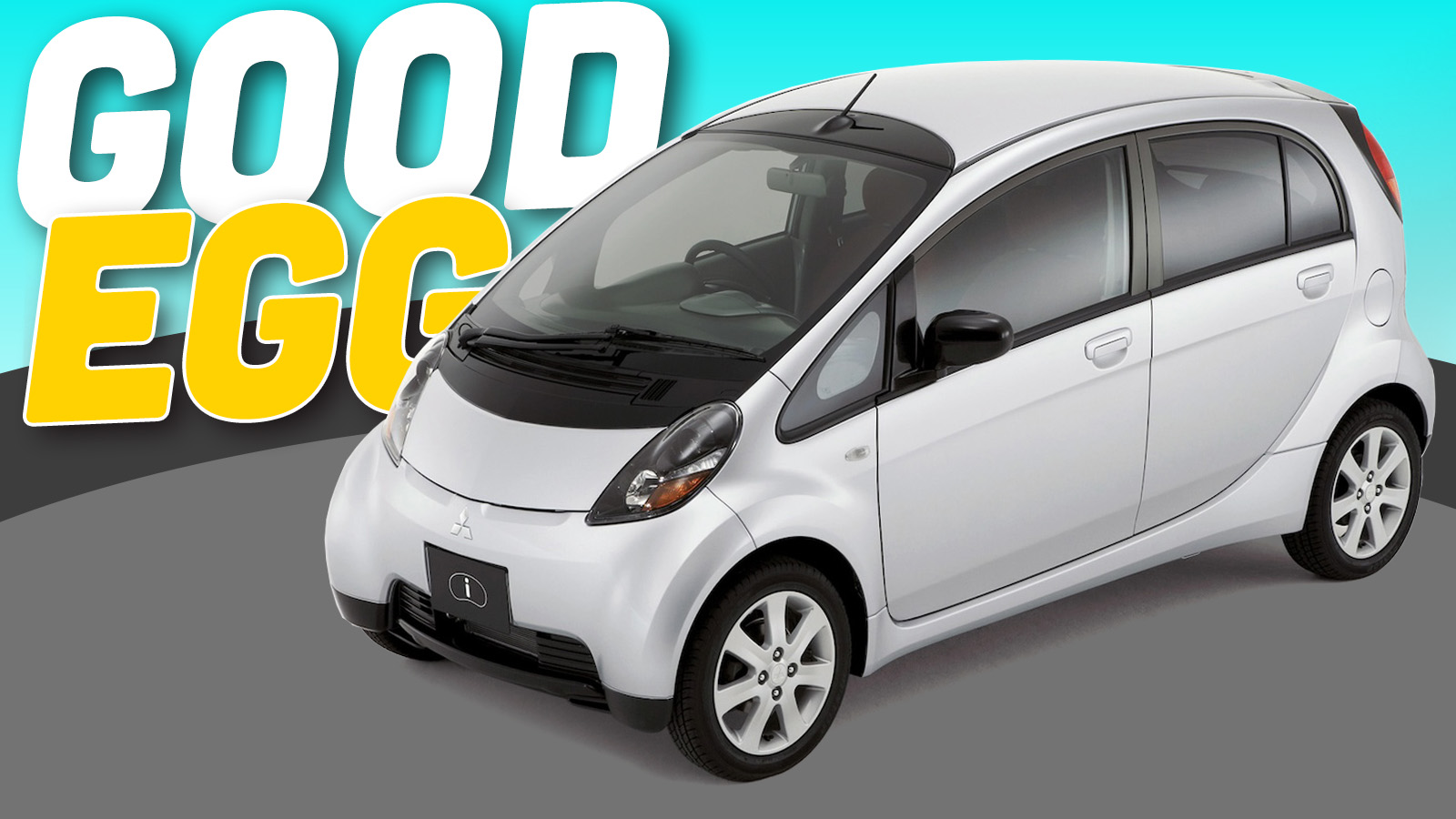
Back in the early 2000s, the Mitsubishi Motors Corporation laid an egg. Because Mitsubishi Motors makes cars, it gave the egg four wheels, one in each rounded corner. The Mitsubishi i, as it was called, was shown in concept form at the 2003 Frankfurt Motor Show, and the production version followed three years later.
Most customers around the world know the egg-shaped little Mitsu as the i-MiEV, MiEV being short for Mitsubishi Innovative Electric Vehicle. It was sold globally, and PSA Peugeot Citroën (which grew up to form Stellantis) also sold badge-engineered versions as the Peugeot iOn and Citroën C-Zero. While it only utilized a tiny 16 kWh battery and a 63-horsepower electric motor, it was an important step in widespread EV adoption that continues today.


Tiny EV, Big Price Tag

In 2010, there weren’t that many other EVs you could drive on a public highway without holding everybody back; the i-MiEV did 80mph and its EPA certified range was 62 miles. Not great, not terrible, and it’s best to keep in mind it’s a very small car with a pocket sized battery.
They were never going to be strong sellers in the States, and between 2012 and 2017 Mitsubishi sold some 2100 units before ceasing sales. Most of those were sold in 2013, which was a particularly good year with 1029 sold thanks to pricing changes, but in 2017 only six cars changed hands.

New, American market i-MiEVs retailed for $22,995 at their cheapest as prices were dropped by $6000 in 2013, with a touch screen navigation package available for an extra $2000. With all applicable grants, you could get a late-model i-MiEV for as cheap as $12,995 in California.
The same car was priced at over 40k Euros here, which coincidentally was about the same as a new Leaf cost in 2012. That is a lot, but EV sales had to start from somewhere. A largely comparable car, the Chinese-built but Romanian-badged, Renault-based Dacia Spring costs $16k in Europe today. We don’t get it here in Finland, because they don’t make a version that’s suitable for the Nordic winter climate. They sell the same cars in the Baltic states with largely similar winter.
Mitsubishi Built It In Turbo AWD Specification Too Because Japan

However, the i-MiEV is only a part of the story. Mitsubishi didn’t put all of its eggs in the same basket, but also produced gasoline versions of the same car, with a three-cylinder, turbocharged, intercooled MIVEC DOHC motor under the trunk floor. In 2006, the Mitsubishi i went on sale in Japan, followed by select Asian markets, and interestingly also the United Kingdom in 2007. UK market versions cost £9000 new, which seems like a screaming deal compared to the EV versions.
In Japan, it won a dozen awards in its first year, a welcome boost to a company mired in the early-2000s vehicle defect and recall scandal in Japan.
Reviews of the time note Mitsubishi planned to sell 300 i:s in the UK in 2007, which sounds like a bold number for a very narrow car originally intended for Japanese city streets, with 57 horsepower and inherent susceptibility to crosswinds. There are currently two gasoline-powered, European market Mitsubishi i:s for sale on the British AutoTrader, both for less than £2000. Sadly they seem to have developed a bit of rust.
Unlike the EV version, all of these were right-hand-drive, but importantly they were also offered with all-wheel-drive in Japan. That transforms the entire proposition.
How many four-door passenger cars with all-wheel-drive and rear mid-mounted turbocharged engines do you know?
We can leave out the Volkswagen T3 DoKa, as that’s a truckified van. The Tata Nano looks largely the same as the Mitsu, but never got AWD, or turbos. Tatras of course relied on a rear-engined layout, but the air-cooled V8s were never turbocharged and all-wheel-drive was a bridge too far for the Czech manufacturer.
In their infinite wisdom, Mitsubishi engineers and product planners thought that customers could need to do most of their driving in town, but still take the same car to the mountains in the weekend, through snowy roads. The rear wheel drive version has a good amount of weight on the rear axle (45/55 weight distribution for the EV), but for negotiating mountain passes, albeit with just 660cc of displacement on tap, you have to go AWD.
Weight-wise, there isn’t much difference between the EV and the ICE powered models: the EV weighs some 2400 lbs and the turbo model just under 2000 lbs. The battery just isn’t that large to weigh that much.

Most Japanese manufacturers have offered 4×4 versions of their tiny home-market, kei-class vans and trucks, so Mitsubishi’s engineering department likely had less trouble delivering power to the front wheels from the rear of the car than developing an EV version in the same bodyshell.
Conversely, Mitsubishi also developed a Minicab MiEV out of the i-MiEV drivetrain, simply dropping a kei van body on top of the egg-car platform.
The original Japanese commercials for the car show the design pitch. What you have is simply a rounded passenger cell with wheels, dedicating most of the floorpan to passenger space. A variety of colours were offered, so you could get your tiny egg in metallic pink as well as other fancy pastel colours.
All i:s are automatic to make things simple and to fit the target market, but imagine what a manual version would feel like. At the very least, it would be faster than the automatic, which takes 15.5 seconds to reach 60mph.
Should You Buy the Gasoline One Or The Electric Version?

Mitsubishi also displayed a really cool-looking “Sport Air” coupe concept in 2007. It weirdly looks a lot like a Messerschmitt to me. A delivery van version was touted, too, and because this was the early 2000s, there are a bunch of photos of police liveried i-MiEVs likely vinyled up for publicity.
What about the electric versions, then? Well, they’re pretty much the cheapest electric-powered and road-registered anything you can currently buy. Over here, you’d pay two grand at their cheapest for a road-legal one (presumably registered new in neighbouring Estonia, where several blue ones were in municipal use), and I’m sure they aren’t that much more expensive in the States, either. A Citroën-badged 2020 model, one of the last ones made and actually European-built (at the Stellantis Vigo plant in Spain) instead of Japanese, costs 5500 euros at a used car chain dealer in Finland.
Given that they are some of the oldest “modern-day” EVs you can buy, and the batteries on them will have degraded to a certain extent, you cannot feasibly use the cheapest ones for much beyond getting groceries nearby, or for a short commute – it beats walking. They did come with DC rapid charging capability in addition to AC charging, but because we’re talking about an early EV from a Japanese brand, the fast charging standard is CHAdeMO, and good luck making it from one fast charger to another. If you do, it’ll charge at 50kW, which will at least juice up the tiny battery quickly.
The i-MiEV online community is still active globally, and it’s probably one of the best sources for any information regarding used models, troubleshooting, and upgrades.

Rich Rebuilds bought one on a recent YouTube video, and it seems the only use case for this particular car is burnouts. Instant electric torque, even on a weedy car like this, means it’ll light the rears neatly. In the video, Rich and Tavarish claim their car has 35% SOH left compared to a new battery, and that it’s good for 21 miles of range. I get range anxiety just from watching the video.
But compare these to similarly aged Nissan Leafs, and at least the Mitsubishis are rear-wheel drive. You could slide around a parking lot for a while.
Back to the cool AWD ones. On Goo-Net, the Japanese website I most commonly use to browse weird and wonderful cars that are surprisingly cheap until you factor in any associated costs, there are nearly 200 i:s for sale, with ten percent of those being the AWD version.
The same Mitsubishi engine also went into the Smart ForTwo, which means the powerplant also made it into some American market cars. Feasibly, were you to import one of your own, you could source some of the powertrain parts without having to order everything from Japan.
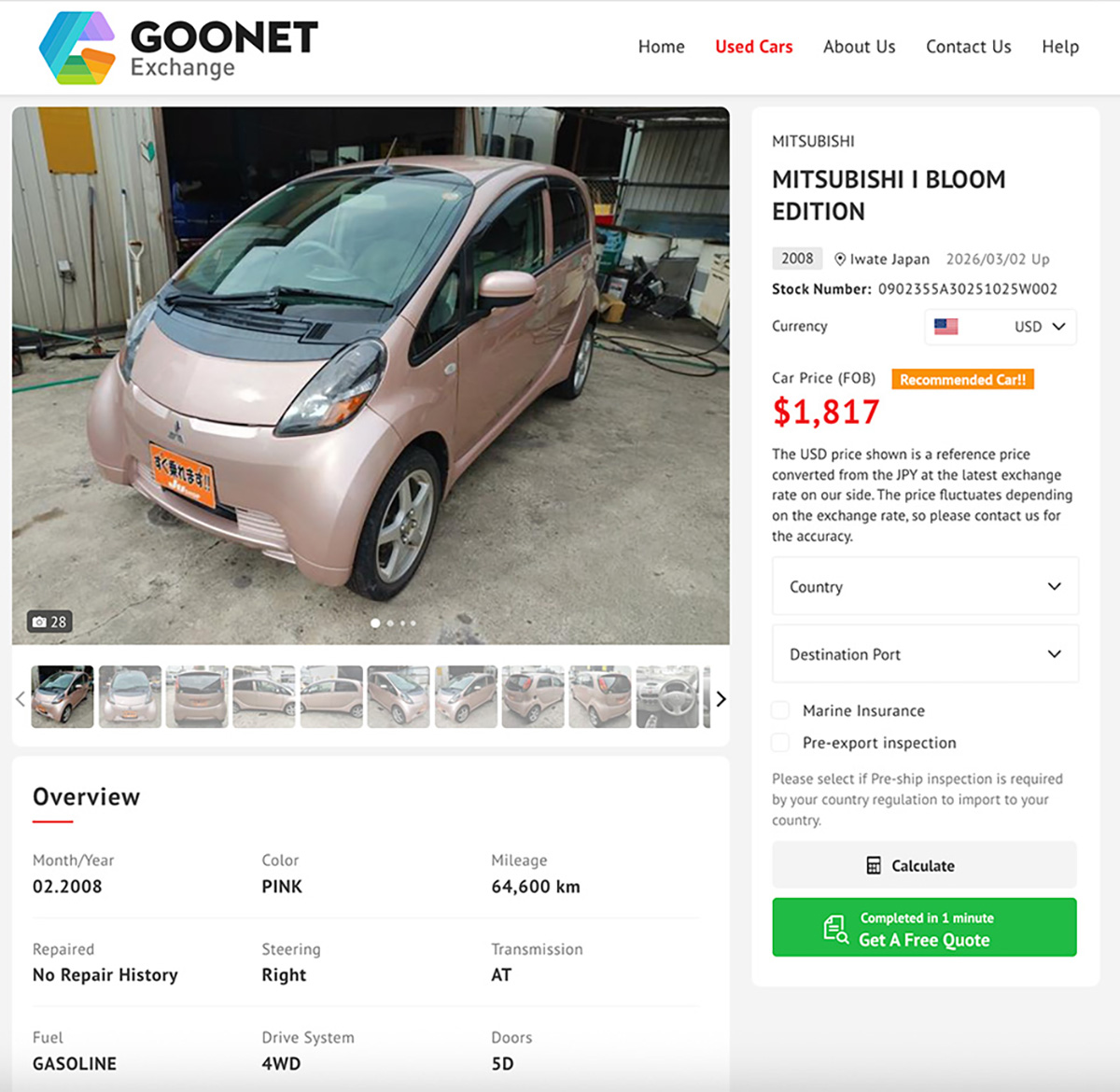
Both the electric Mitsubishi i-MiEV and its gasoline-powered siblings will remain weird and wonderful footnotes in automotive history, one for being one of the first modern-era EVs that were publicly available to customers to buy instead of being limited to fleet use or short-term leases, and the other for its idiosyncratic configuration.
It’s hard to say whether either of these eggs is all that desirable, but their out-and-out oddity will make them stand out. Make mine over easy.
Photos: Mitsubishi Motors unless otherwise noted


so basically a porsche 911 c4s
Too bad there isn’t one with a two-tome black/yellow paintjob; you could add it to “It’s all the same to us.”
I’ve almost bought an i-miev so many times both new and used but it just never makes sense. Especially because leafs and cheap and pluntiful with cheap easy to source batteries. The i-miev never had that. I was offered a new one for about $15k in maybe 2014 or 2015. It still didn’t make a ton of sense. That’s what I paid for a brand new delivery mile leaf last year. With a lot more features and at least 3x the range but probably closer to 4. Such a neat little kei car though. I always thought they looked better then 1st gen leaf. But the 2nd gen came along and looks quite decent.
The rich rebuilds video was quite funny. Especially going to the Mitsubishi dealer with everything but Mitsubishis.
Someone in my random small town in the Midwest has an iMiev with some sort of graphics package. Makes me smile every time I see it.
Apparently normal,IL had the largest number of them in the us because of the Mitsubishi now rivian plant there. Might have originated there as I don’t think many are left around there.
Pronounced in German, it roughly translates into “egg stinks”. Maybe that’s one of the reasons it nevertheless really caught on there.
A friend worked for a Mitsubishi partner when these were being sold new in the US. His company had an incentive program where he could lease one for a year for only $1. The only feedback he provided for his one year of ownership was “I overpaid”. Yikes.
Weird, JDM car – check
Has Smart association – check
I think I know what Mercedes is gonna try to import at some point.
Plus, it can do 80mph, has AWD, and gets great gas mileage!
Wait, Sheryl isn’t looking for a car anymore, is she?
I would have bought one if they sold them in the US (the ICE version with AWD) provided someone made snow tires for them.
A guy who works at a mechanic shop near me has three i-MiEVs. He buys the occasional fourth as a parts car every year or two to keep the good ones running. I know it’s a rare car here in the States, so it’s cool to see a collection of them in my neighborhood.
I daily drove one in Boston last winter and charged it by running an extension cable from my flat across the sidewalk to the curb. It was a blast in the snow as long as I didn’t need to go any farther north than Arlington (or closer if I didn’t have a full charge).
I remember seeing an i-Miev at the auto show, and thinking, ok, it’s a Nissan Leaf but like a Smart, only weirder. I don’t think I’ve ever seen one on the street.
One of my neighbors still drives an i-MiEV! Makes me smile every time that it’s still going.
Would like an i:K. I’ve no idea if you could build one from a Smart drivetrain and a MiEV, though…
Is it just me, or does this bear a strong resemblance to the Tata Nano posted below?
I kept refreshing thinking there hadn’t been a new article since the Nano one
Glad you linked to the Rich Rebuilds video. I watched that one on Sunday morning and was gritting my teeth as they tried to find a charger in the middle of nowhere Florida.
These were in Gran Turismo 5 and 6. Tune them and watch them tear ass