

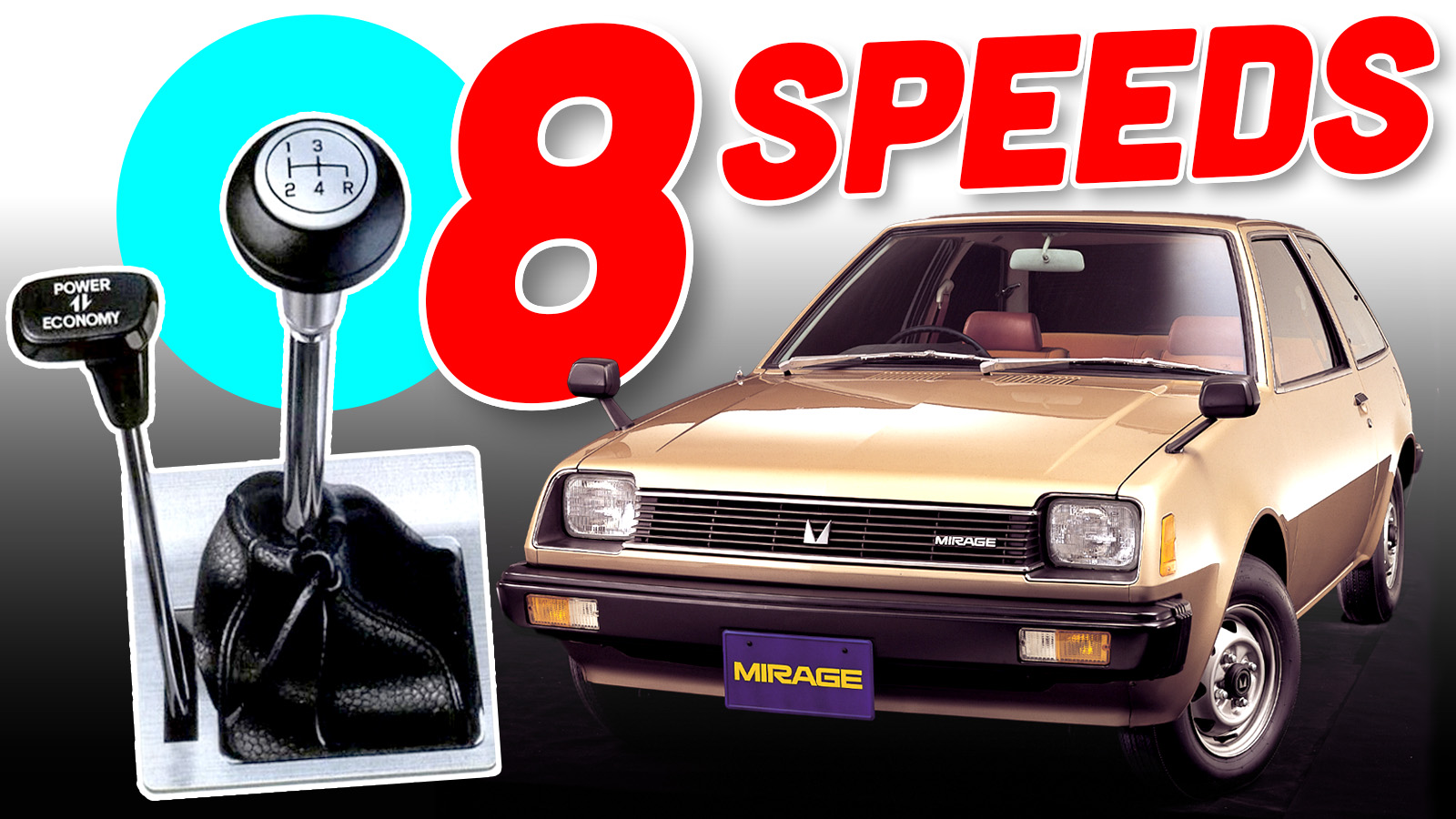
The oil crises of the 1970s undoubtedly reshaped the direction of automotive history. The demand for more fuel-efficient vehicles spiked, bringing a deluge of smaller engines and cars to the market. The crisis also accelerated a host of automotive innovations, like front-wheel drive, turbochargers, and the use of diesel in vehicles other than gigantic trucks.
It’s fun to think about what would’ve happened to the car industry had oil prices never spiked back in ’73 or ’79. We’d probably still be driving around in absolutely humongous, V8-powered land yacht Cadillacs that got 7 mpg. Sadly, we’ll never know for sure.


I’d argue the most interesting piece of tech to emerge from the energy crisis of the ’70s came from Mitsubishi. Known as the Twin-Stick, it was a second gear selector placed next to the shifter in the center console, responsible for controlling a two-speed transfer case between the four-speed manual and the engine. It only came to be thanks to Mitsubishi’s strange drivetrain arrangement.
The Wonders Of Front-Wheel Drive Engineering
By 1978, the shock from OAPEC’s oil embargo had sent waves throughout the industry, with manufacturers scrambling to pivot to more efficient offerings. Front-wheel drive layouts, a rarity in vehicles before the crisis, were becoming mainstream due to their more efficient packaging and better economy figures.
Mitsubishi wasn’t going to be left behind. That year, it revealed its first-generation Mirage hatchback to do battle with the collection of other “two-box” front-wheel drive hatchbacks entering the market. Like those cars, it used a transverse layout. But instead of putting the gearbox at one end of the engine, like you’d normally see in a transverse layout, engineers did something peculiar: They put the gearbox under the engine.

Finding documentation on why Mitsubishi went in this direction is tricky. While front-drive had been around for decades at this point, the layout had yet to be perfected, with manufacturers coming up with different packaging solutions that suited their needs best. Having the gearbox underneath the engine meant a narrower engine-transmission package, allowing designers to squeeze the most out of the Mirage’s footprint. Such a compact drivetrain setup likely made the car’s assembly easier, too.
[Editor’s Note: I just want to note that the first really significantly successful transverse FWD car, the Mini, had its transmission under the engine as well. So this wasn’t exactly unheard of. – JT]
The Twin-Stick Is Born, Thanks To An Icy Carburetor
Originally, Mitsubishi engineers had no plans to incorporate the twin-stick (known originally as the Super Shift transmission) into the Mirage. The car was going to get a four-speed manual, putting it slightly behind the competition, which had mostly switched to five-speeds. But a discovery in prototype testing would reveal a unique possibility. From World Cars 1979:
This neat dual-range transmission with an alternative pair of transfer gears was a product of logical development work. The design criteria specified the use of the company’s Orion SOHC inline 4-cylinder engine. Placed in the Mirage prototype shell, it had a forward-facing carburetor and quickly ran into icing problems. Turn around the engine, then you would have to change the direction of the revolution.
Here, engineers could’ve simply installed an idler gear between the engine and the transmission to reverse the direction of travel and call it a day. Instead, they went the extra mile:
Chief engineer Kisuna and his designers and engineers came up with a clever solution. Insert a transfer gear train, give it two alternative ratios, and they could kill two birds with a single stone. And the cost consideration was about the same as if they had developed a brand new 5-speed gearbox. Everybody else had a 5-speed box, but not a twin lever, 8-speed one.
Here’s How The Twin-Stick Worked
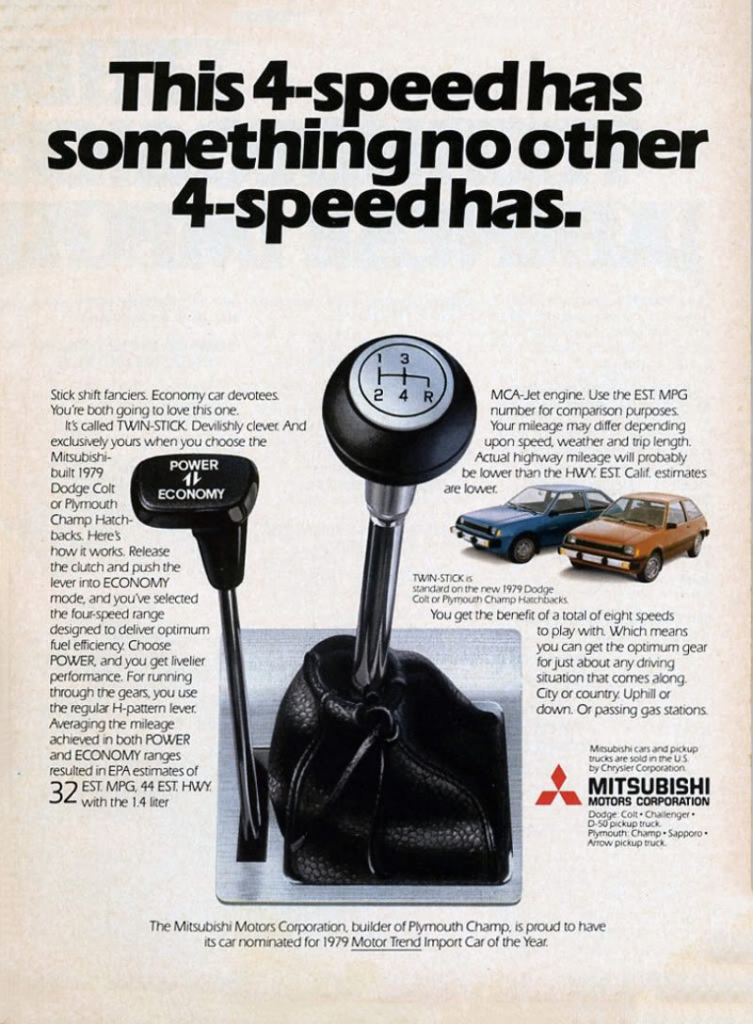
If you know anything about how two-speed transfer cases work on off-road-ready trucks and SUVs, understanding the Twin-Stick should be easy. In the center console of the first-generation Mirage is a normal four-speed shifter, with an H pattern for gears one through four, and reverse hanging down and to the right. Next to that shifter is another shifter with only two possible positions, showing markings for “Power” and “Economy.”

Leave that second knob in Economy, and the four-speed would act like any other four-speed manual transmission. It’d be as if Mitsubishi never installed a twin-stick in the car. You could theoretically go your entire life behind the wheel of a Twin-Stick-equipped car without ever using the second stick, and you wouldn’t notice a huge difference in gearing between it and any other four-speed car of the time.
The magic behind the Twin-Stick lies in that Power position. The second stick acts as a selector to switch between high and low range for the transmission. The Economy position is effectively the “high” range in this scenario, while the Power position is the “low” range. Though unlike an off-road low range gearing, which is often too low to be used on the road, the Twin-Stick’s low range is still high enough to be used on highways. The difference between each gear in Power and Economy modes was just a few hundred rpm.
This meant that, effectively, drivers had eight forward gears to choose from: Four in the Economy position and four in the Power position. The second stick can even be shifted while the car is moving, allowing drivers the ability to shuffle between whichever gear they need at the time without having to come to a stop. Watching it in action is trippy:
Because the Twin-Stick transfer case is simply a ratio modifier between the engine and the transmission input shaft, it even worked in reverse. That means Twin-Stick-equipped cars effectively have two reverse gears to choose from. You know, for when you have to leave your driveway extra-quickly to make it to that too-good-to-be-true Facebook Marketplace deal.
The Twin-Stick Cars And Their Legacy
In addition to the Mirage, the Twin-Stick also made its way to other Mitsubishis, including the Colt, the Cordia, the Tredia, and the Chariot. Most people in America know of the Twin-Stick through its availability in the fourth-generation Dodge Colt, which was just rebadged Mirage sold in North America.

Undoubtedly, the coolest car to be available with the Twin-Shift setup is the Dodge Colt GTS Turbo. It was around for just one year, towards the end of that generation’s production cycle. You got an updated honeycomb grille fascia, a front air dam, side skirts, front and rear sway bars, and sticker tires. Under the hood is a turbocharged version of the available 1.6-liter inline-four, making 102 horsepower and 122 pound-feet of torque—a big step up from the 72 horsepower and 85 pound-feet.
That might not sound like much, but thanks to a curb weight of under 2,000 pounds, according to Automobile Catalog, the Colt Turbo wasn’t a slouch by prime Malaise-era standards. It was able to sprint to 60 mph in 9.4 seconds in the Power setting, or 9.7 seconds in the Economy setting, according to testing done in-period by Motor Week:
The Twin-Stick survived until 1990, when it exited production alongside the Tredia and Cordia. Mitsubishi never officially gave a reason for dropping the Twin-Stick, though with the use of more traditional five-speed manuals on the rise and the growing popularity of torque converter automatics, it’s easy to see why the more complex Twin-Stick was cast aside—for most people, having to worry about shifting two separate selectors was probably just too much work. Plus, while switching to the Power setting might’ve felt like you were unlocking more speed, instrumented testing like Motor Week’s showed the numbers weren’t all that different.
Still, the Twin-Shift was a defining moment in the metamorphosis of the industry, showing the lengths manufacturers were willing to go to stand out. With most Colts having gone the way of the great junkyard in the sky, they’re now a rarity. If you have one, cherish it.
Top graphic images: Dodge / Mitsubishi




Had a twin-stick set-up exactly like this (but in rear-wheel drive) in a 1964 Rambler Ambassador 990H. 327ci V-8 with a torque tube drive shaft. Really interesting car.
Wow this brings back good memories. I had a couple of these Colts back in the day. The Turbo was truly a hoot to drive! My saving grace with the Turbo turned out to be those skinny-ish 13″ tires. They were relatively cheap to replace, which was good. That car was fun to do smoke outs in and I was hell on tires. It would freak some people out seeing the front wheels do a burn out! I really miss that little rocket! The twin stick was more about power delivery on the Turbo, on the normally aspirated twin stick Colt I had the twin sticks were more about fuel economy. Great cars.
It was just a traditional OD transmission. I don’t know why they had to come up with a new name for something most car buyers at that time were familiar with.
Not really, “over drive” in relation to cars was marketing speak for a high 5th gear (over 1:1). Some Honda motorcycles had true OD and large trucks, that is actual gear “splitters” high/low.
I’m talking about the 2 speed overdrive transmission used by MG, Triumph, Jaguar, Volvo, Jeep and various pickup trucks throughout the 60’s – 70’s.
lol I looked up the MG: The overdrive unit was engaged by a toggle switch on the dashboard or by pulling the wiper lever towards the driver. Because of course!
These seem to be actual “overdrives” where the Mitsu, is two full sets, 8 gear ratios. The MG/Triumph was locked so only 3rd and 4th (later only 4th, basically cheating 5th) With Jeep and what I read Volvo, being final drive overdrive units.
My folks had a Plymouth with that setup. I recall them liking it quite a bit. But when it was wrecked, they replaced it with a Honda hatch.