

You all remember Emily Velasco, right? She’s written for us a few times about all kinds of interesting stuff, and she’s an artist/maker who builds e-bikes and all sorts of fascinating things. More importantly for me, though, is that when she sees cool cars around her, she will almost always take pictures of them for me so I can write about them, which is much appreciated. She saw a car she wanted to take a picture of for me recently, but there was one catch this time: that car was in a dream.
Here’s what she told me, verbatim:


“So last night I had a dream that I was in a coffee shop with a friend and I saw a crazy little old car towing a crazy little trailer outside and I ran out there to get a photo of it for you”
I like that even in dreams, she knows it’s important to get pictures of weird cars for me. Unfortunately, she was too late to get the picture in the dream, and even if she did, I probably couldn’t have used it because it’s really hard to download pictures from dream-phones to reality-phones still, at least without expensive software.
However, drawing cars you see in dreams is free if you have the ability, and thankfully Emily does! She sent me this drawing of the car:
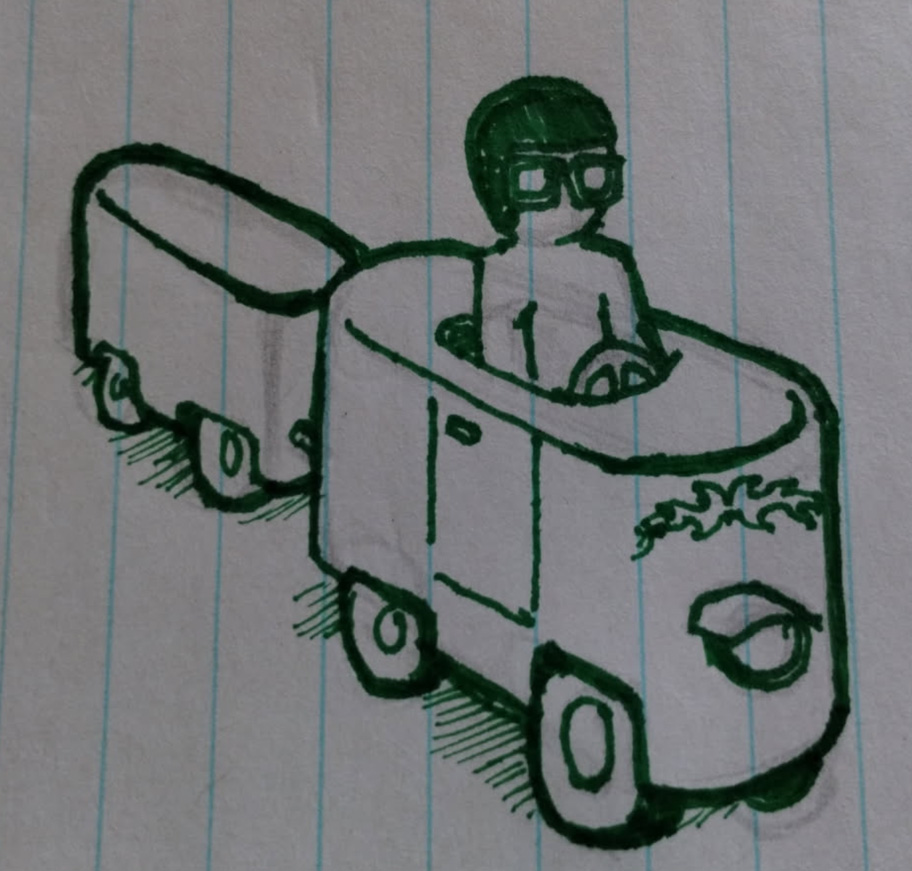
She said it was a sort of maroon-ish enamel-type finish with brass detailing. A quick sketch not being enough, she then sent me a color version:

And I gotta admit, this is exactly the sort of car I’d want a picture of if someone sees it, dream or otherwise. The strange, simple basic design, the oddly ornate brass detailing, the diminutive size, that trailer – there’s nothing about this I don’t like.
I was pretty thrilled by it all, and asked Emily if she thought it had a name. She said “It would be called the Lloyd Motors Lilliputian or something,” and while that’s a good name, there’s was already a German carmmaker named Lloyd out there, and this doesn’t really seem like something they’d make.
I found myself thinking about this car more and more. It doesn’t seem German, but it does seem European, post-WWII Europe, maybe French, or something close to French, but a little more unexpected. Belgian! Okay, in the alternate universe where this exists, let’s say it’s Belgian, so let’s translate Emily’s name idea into Belgian French. Lloyd means “gray-haired” in Welsh, so in Belgian French that would be cheveux gris, and I like “Lilliputian” so let’s just translate that to French, too. I think we’ll simplify cheveux gris into Chevgris, giving us this:
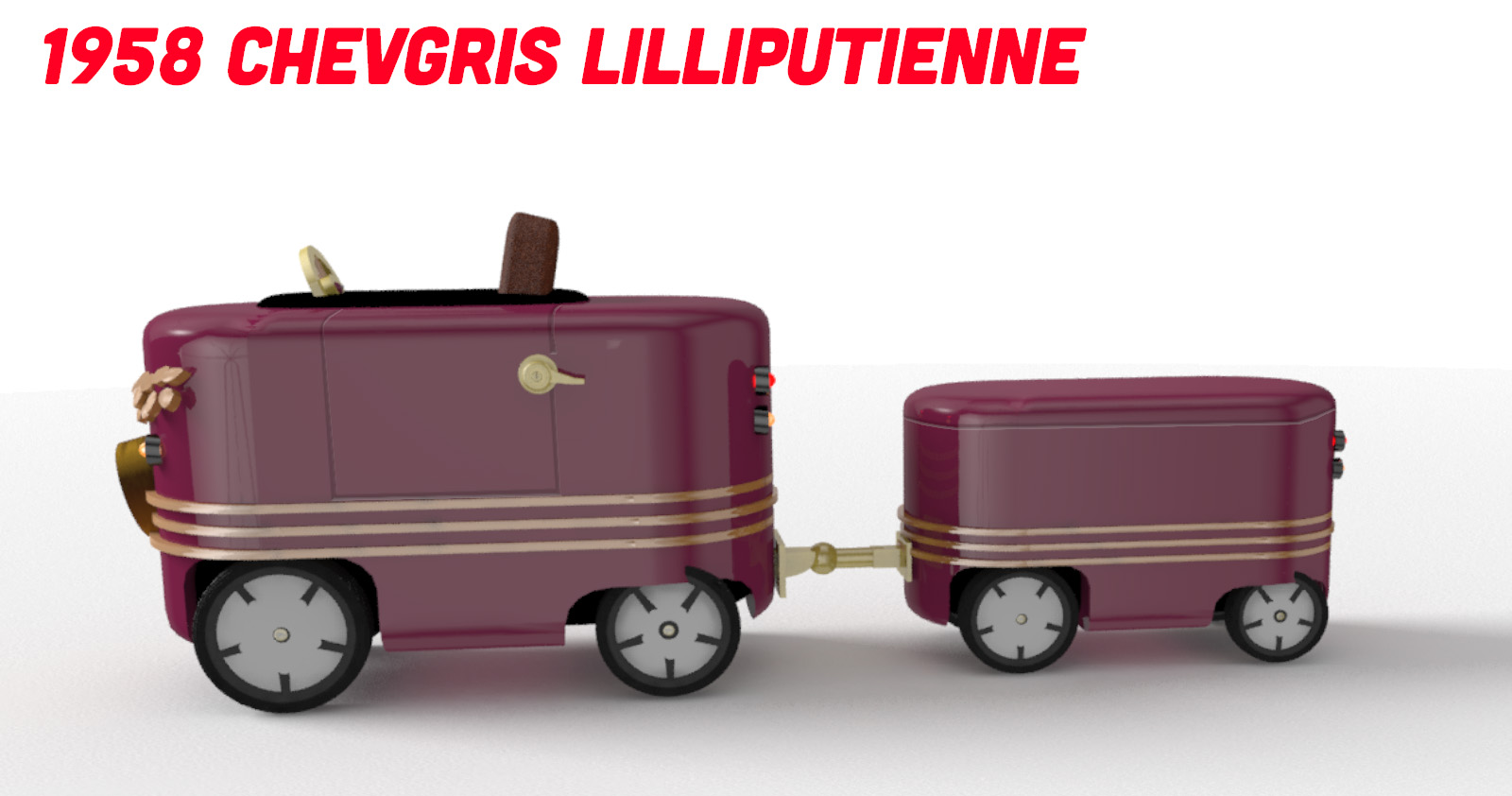
I just picked 1958 because I figured they started making these after the war, around, oh, 1952, and kept it up until, let’s say 1960. The Chevgris was designed to be a more stylish and upmarket alternative to most microcars, and used some really idiosyncratic engineering, primarily because of a deal the founder of the company, Jules Savonfromage, had with his brother-in-law who owned a huge number of rail freight cars across Europe: Jules could ship his cars anywhere, for free, but the cars had to be able to fit in whatever random spaces were available in the freight cars.
As a result, Savonfromage designed a car that was very narrow and able to be crammed into the most unlikely of spots. Also, by separating the main car from extra cargo or people-carrying capability but being able to add that via the included trailer, he could be even more flexible about where his vehicles could cram into packed boxcars.
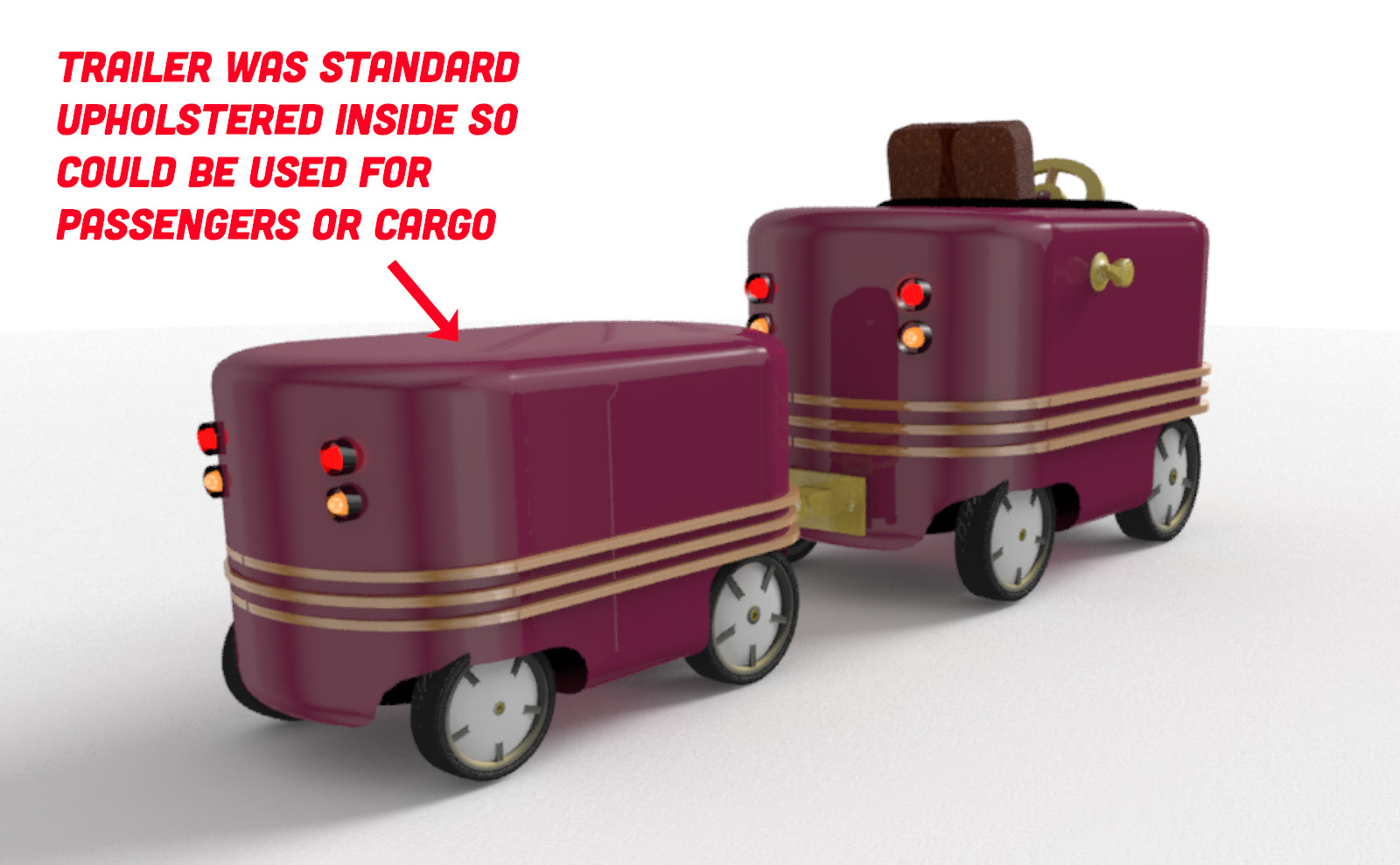
The trailer was upholstered and padded inside so up to three people could ride in it with the lid removed, or it could be used to haul a good bit of cargo with the lid on. The main car had a small luggage well behind the seat, but was really only suitable to carry one person.
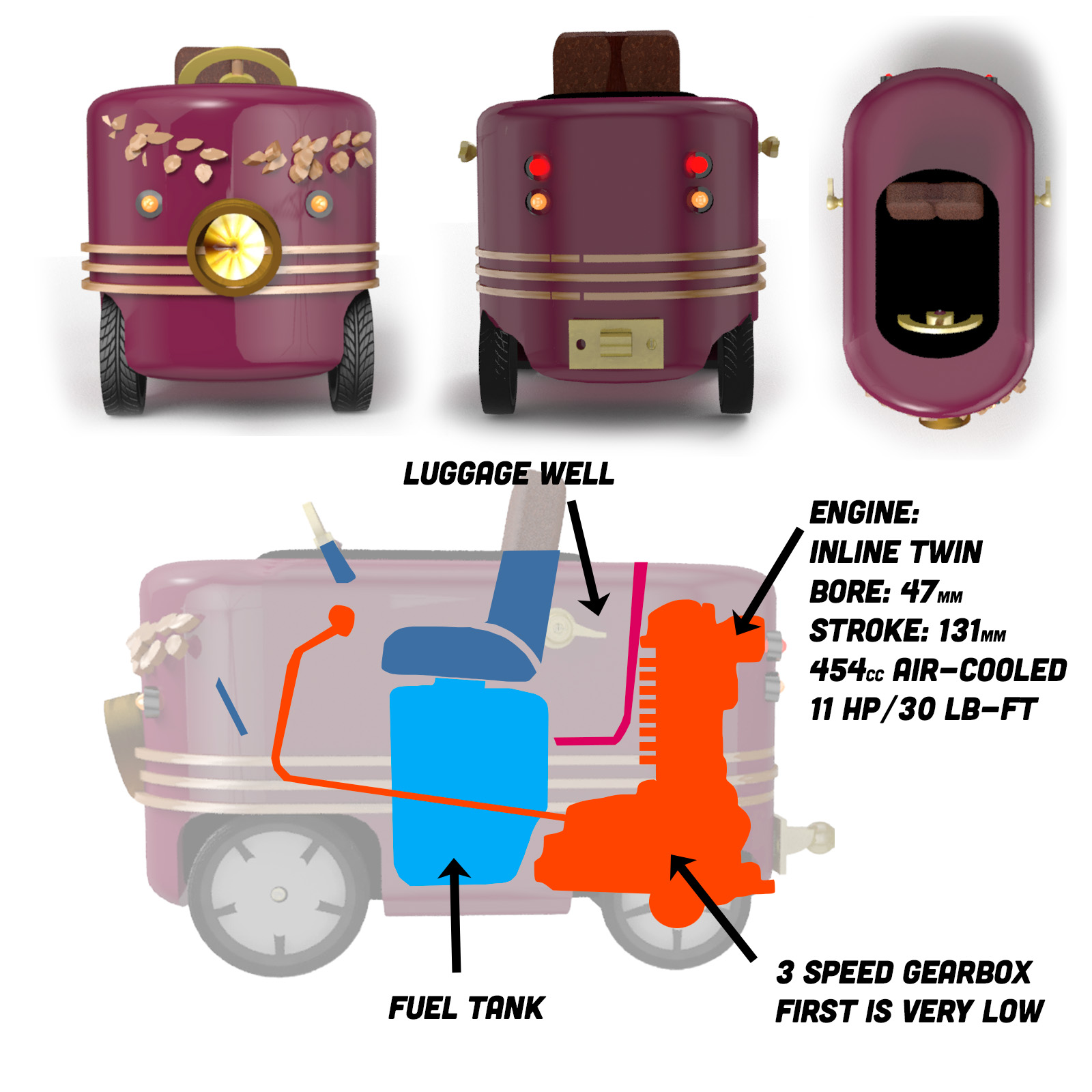
To engineer such a small and strangely proportioned car, a lot of odd engineering decisions were made. The engine was designed to fit into a very tall, narrow space, leading to the strange piston design of a very small bore and a very long stroke: it was a 454cc engine, but with only a tiny 47mm bore and a stroke of 131mm. The result was pretty low horsepower (only 11) but surprisingly good torque (30 foot-pounds) which gave the Lilliputienne unexpectedly good acceleration.
No windshield or roof was provided, but the car did come with the leathern helmet and goggles seen in Emily’s drawing, as well as a sort of tonneau cover with a head-hole that would be used in the rain.
The Lilliputienne was never built in huge numbers, but was fairly well-known across Belgium and Europe, and was famous as the only car that Belgian cartoonist Hergé, creator of the famous Tintin comic series, refused to ever draw or include in his works, as the result of a childhood fight with Savonfromage over a merguez sausage.
What a fascinating little car! I can’t believe I never heard about this thing before. I guess I need to spend more time on the Internet that connects to whatever Emily is dreaming about.


Oh, these things are closely related to the darker side of our history. This is why they don’t show up anymore in official media. But since they were built specifically for those kind of circumstances, they were build extremely durable. So you can sometimes still see them, chugging around on their slow, long stroke engines at places where they still have their liquified coal fuel.
And also,
This reminds me of the special, narrow vehicles they drive around on Hong Kong islands. Complete with the wacky wheel choices.
https://en.wikipedia.org/wiki/Village_vehicle
You guys should definitely do an article on these some day.
“Jules Savonfromage” killed me.
Anyone else getting GM Futurliner?
Even in whimsy Jason has some period correct engineering. A lot of British cars,from the 30s and 40s had small bore long stroke engins because the taxable horsepower was lower than a larger bore.
Style wise this immediately looked like a baggage tug to me, with the brass ornamentation and nice paint being added to a normally utilitarian vehicle for some special purpose. I think either a circus or carnival support vehicle or a baggage hauler for a luxury passenger service. I could see these trundling around large markets or factories as a smaller Scammell Scarab
Reminds me of something driven in the Eyebeam strip.
It does look like it would be a successful island car.
This is what Minions drove all over the Ardennes.
My June 1952 copy of Popular MicroCars says the first prototypes were built in the lates 20’s as a farmers car. The trailer could hold ice but was designed for a future addition of a coal gas heater to keep products warm. The onset of the Great Depression prevented the building of a factory but the designers did build some tooling. During WW2 they hid the tooling and prototypes in several barns across the countryside. After WW2, it took several years to get the car into production but by then the 2CV was a juggernaut in the farm car scene. They added seats and upholstery in the trailer to market as a city car, but the lack of a roof really hurt the car. My later copies of this fine magazine don’t mention the car again so why production stopped is a mystery.