

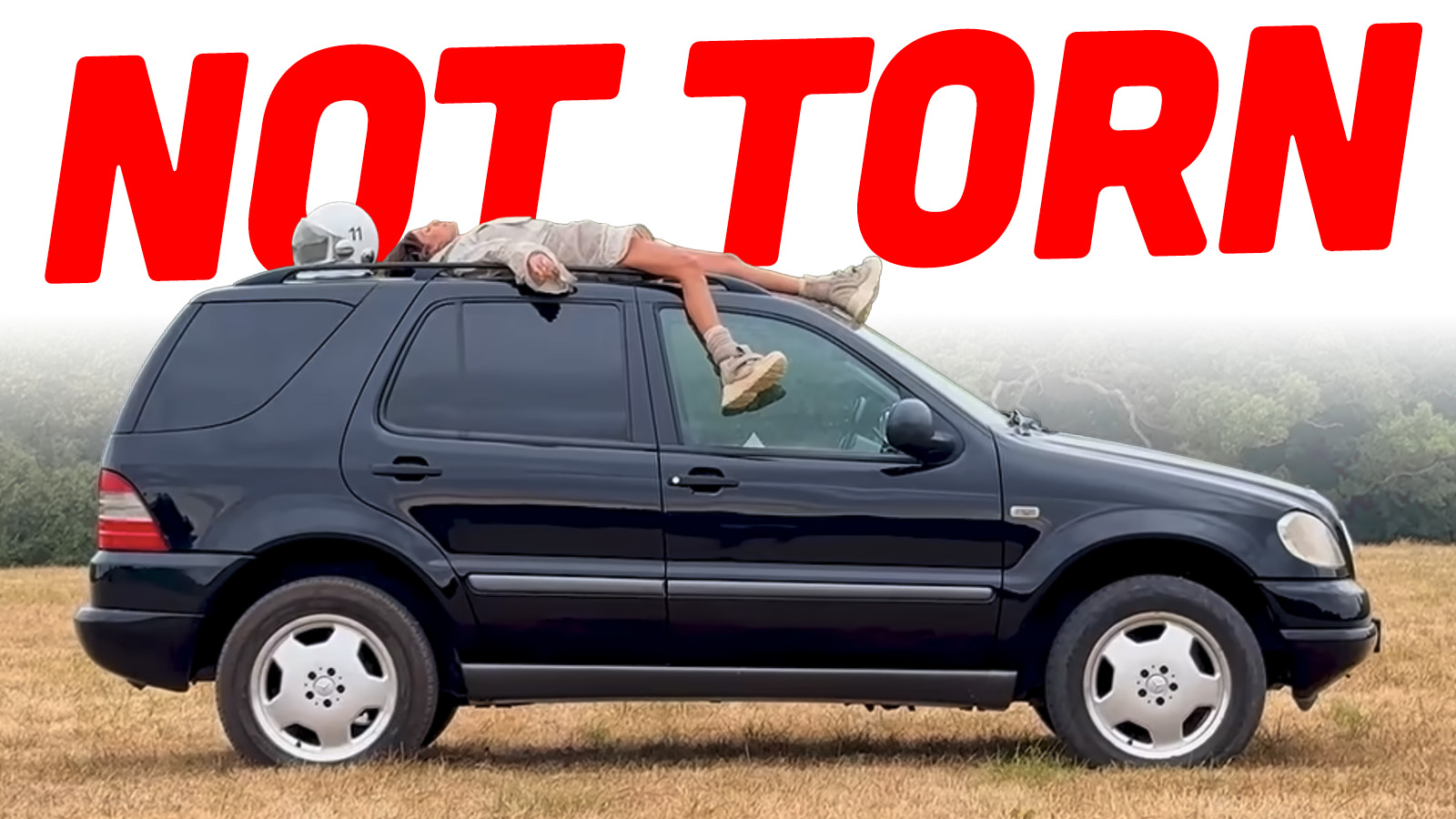
Back in the late 1990s, one of the vehicles creating the most buzz and attention was Mercedes-Benz’s new M-Class SUV. Mercedes-Benz had only really been making one other sport utility vehicle, and that was the venerable and blocky G-Class introduced in 1979. While the G-Class was selling well, Mercedes-Benz felt like the approaching turn of the millennium could mean the old bus needed a successor. The M-Class was launched in early 1997 to great anticipation.
Around the same time, the Australian actress Natalie Imbruglia signed a record deal with the Bertelsmann Music Group or BMG. Her first single, Torn, was inescapable on late 1990s daytime radio and MTV heavy rotation, and 1998 turned out to be an extremely successful year for her. Having relocated to London in the mid-1990s, she treated herself to a brand new Mercedes-Benz ML 320 in black as her debut album proved to be a million-seller. What’s more, her latest music video shows the same exact car.


Imagine It’s 1998
(Click here if you can’t play the video embed)
Looking back, from nearly 30 years in the future, it’s almost difficult to grasp how big a deal the new Mercedes SUV must’ve been, especially as the manufacturer underestimated the demand for it. Magazine tests of the time mention year-long wait lists for the M-Class, even if they also note the discrepancy between the car’s badge and the actual perceivable quality.
The drivetrains in these body-on-frame SUVs were usually 1990s Mercedes-Benz, with the ML 320 V6 the most common choice at launch, but you could also pick the ML 270 CDI diesel and, a model year later, the V8-engined ML 430 became available, and another year later the hot rod version, the ML 55 AMG with its flared wheelarches and an AMG-crafted engine.

The thing is, with the M-Class, the drivetrain was the solid stuff. Everything around it was flimsier, in tune with Mercedes’ strive to make more profitable cars by cutting costs. The tide had turned around the W202 C-Class and W210 E-Class: sure, the engines were great, but combined with 1990s water-based paints, the rot set in both figuratively and literally. 1990s-2000s Mercedes-Benzes are some of the rustiest cars you see on the road today, and rust belt M-Classes will have rotten wheel arches and doors like any other salty truck.
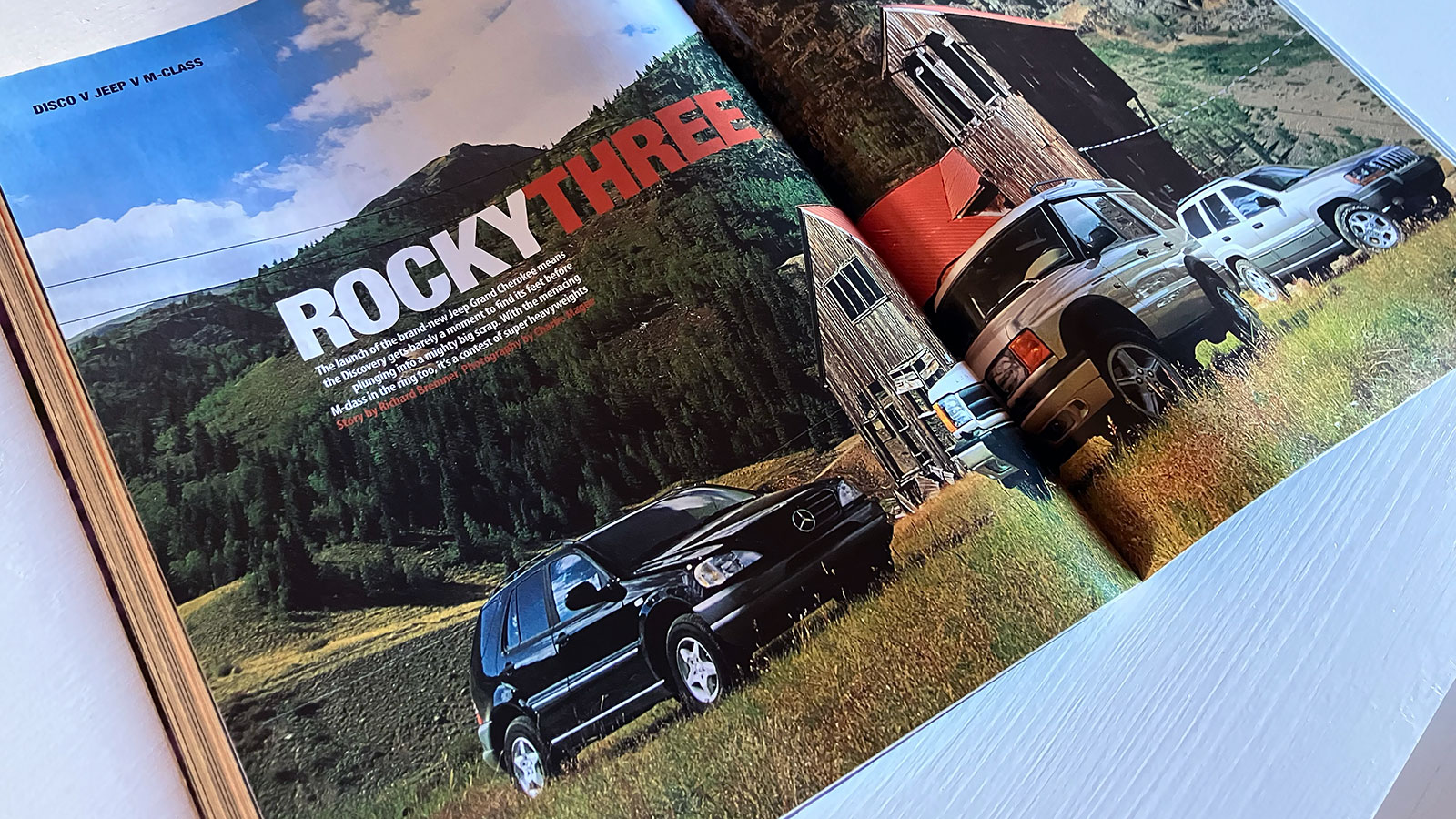
In its November 1998 issue, CAR Magazine compared the ML 320 to the Land Rover Discovery 4.0 V8 and the Jeep Grand Cherokee Laredo with the 4.7-liter V8. While the Mercedes was outgunned in displacement, it’s wasn’t the least powerful (the Disco is), and the magazine proclaimed the ML’s drivetrain the best of the three, with a smooth-shifting transmission. In addition, it was said to handle the best, have the best packaging, and the best fuel economy, but was “seriously compromised by its cheapskate interior” (and even called “amazingly poor” in a photo caption). CAR continued, “If on-road ability is what you want and you can live with the interior, go for the Merc.” Otherwise, they recommended the Land Rover over the Mercedes, and declared the Grand Cherokee the best all-rounder.
The DaimlerChrysler merger had been a reality for just six months when the magazine issue came out, and I presume it must’ve been well read at both Daimler and Chrysler. And yes, the car was initially called the M-Class even if the badges say “ML”; BMW claimed the M for itself.
You Could Get It With A Manual Transmission
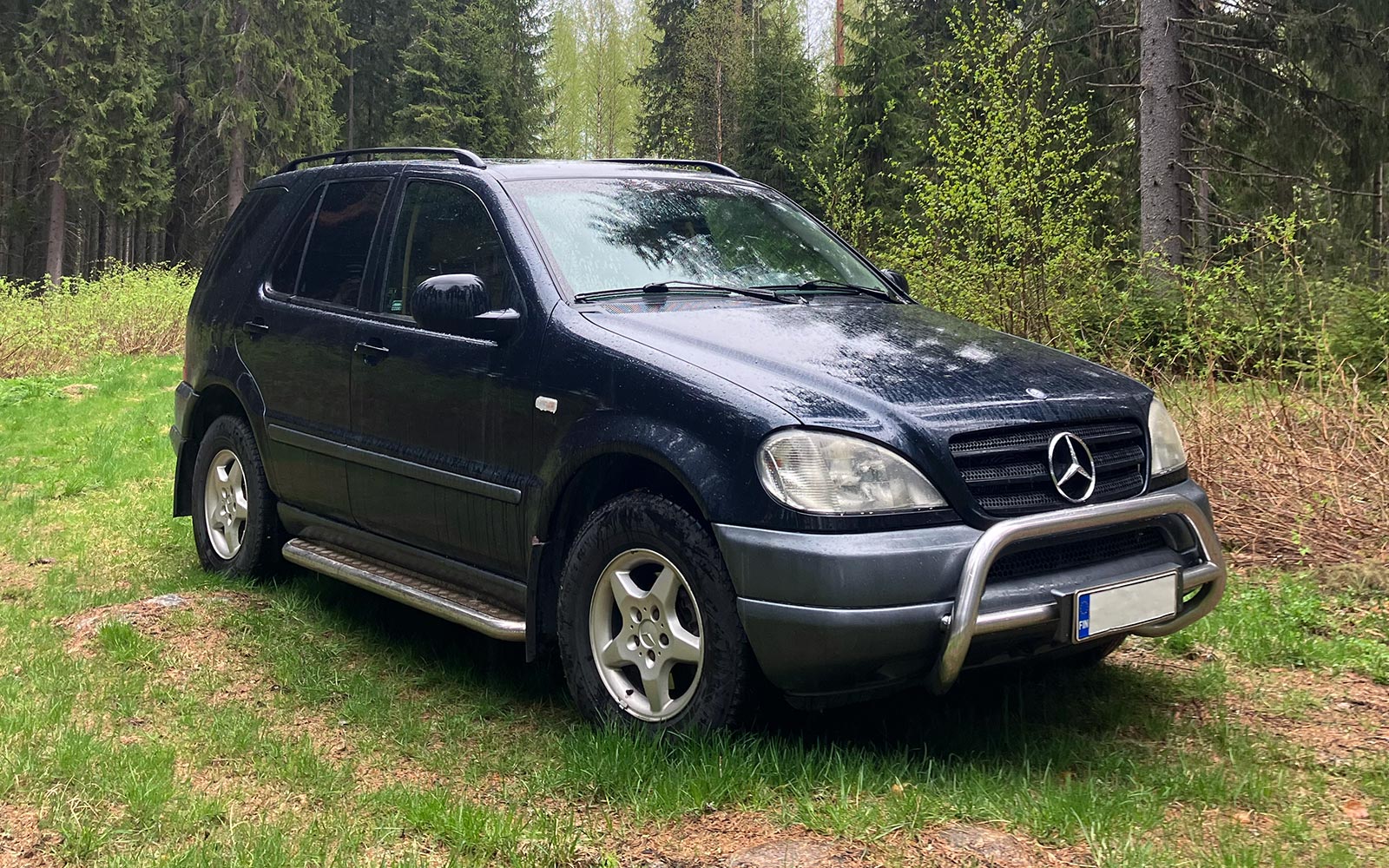
My dad drives a 1998 ML 230, the relatively rare base version with the 2.3-liter, 150-horsepower M111 four-cylinder, which I didn’t yet even mention above and which wasn’t sold in all markets. It’s about a third too little for the car, since it reaches 50 mph ponderously and does nothing after that. It was built with a 5-speed manual gearshift, but it currently has a 4-speed. This is because the fifth gear initially started making a terrible chafing sound and then exited through the gearbox drain plug when it was opened.
Since my dad bought it mainly to drive between the summer cottage and the forest nearby, this is not really an issue, but longer stints on the road without a fifth gear are a bit rough, since it’s not exactly a quiet vehicle to begin with.
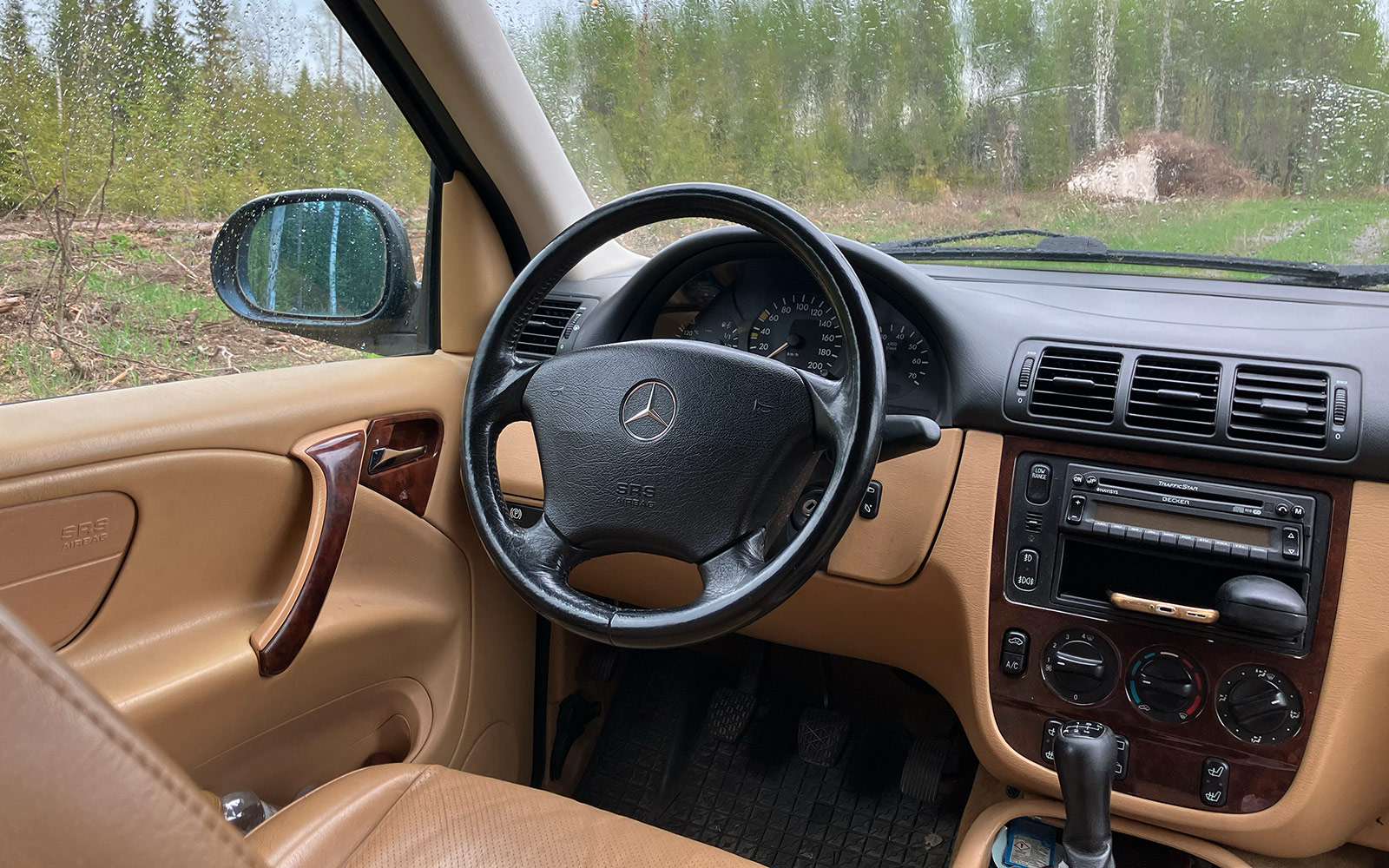
At least it’s not as rusty as they often tend to be, and most everything else works fine, including the sunroof, and the beige leather is in fine nick. Slamming the doors doesn’t produce the sort of Solid German Bank Vault sound you’d usually associate with Mercedes-Benz vehicles, but rather a hollow slap, and the door cards are some of the creakiest I’ve ever encountered.
I like the car in an ironic way, because it’s quite turrible, but it’s also a 1990s youngtimer classic. A friend, back in the day, used to think the M-Class shared actual parts with the Chrysler Voyager because of the way it looked inside out, and I can’t blame him. Not all ML-Classes were built in Alabama, as Magna-Steyr assembled them from 1999 to 2002 at the same plant that also later built the Chrysler 300C for the European market, among other cars.
“We Spared No Expense”

The one reason why the W163 generation M-Class can be cool is its starring role in Jurassic Park 2: Genetic Boogaloo. I mean, The Lost World. In 1996, before the cars were launched, Mercedes-Benz provided the filmmakers with pre-production cars to use in the dinosaur theme park movie.
Since the original 1993 Jurassic Park film featured Ford Explorers and the M-Class was Mercedes realizing the potential within premium SUVs beyond the old Geländerwagen, it only makes sense that these would feature in the film. As Jurassic Park sequels come, the movie is far from being the worst, but the M-Class has never looked better than in The Lost World – partially due to all the cool stuff that’s bolted onto it for movie magic.

The W163 received a facelift soon enough to address some of the quality issues and to lose the grey bumpers that are painted despite looking unpainted, and the later interiors really are better. The first generation soldiered on til 2005, when it was replaced by the W164, which arguably was neater built. Mercedes also never replaced the G-Class with the ML, as the classic looks kept selling and the old truck received updates after updates. Plans included replacing it with the large GL-Class, but that didn’t kill off the G either, and the W463 generation was so heavily revised in 2018 that only the headlamp washers, the door handles, and the spare wheel cover were carryover – yet it kept the internal chassis code.
These days, you can pick up first- and second-generation M-Classes for a few thousand, but no usable old G-Class is available for anything close to that. In fact, the W163 is one of the cheaper 4×4 trucks for sale on the market here: Suzuki Jimnys easily cost more, as do Lada Nivas. And those are even unibody.

Yet, after all this, I completely understand Natalie Imbruglia’s choice of holding onto her ML 320. Since it represents the beginning of her career as a recording artist, when she really broke through, it’s absolutely worth keeping around even if it must have needed a thing or two to stay on the road all these years. It looks great in the video, especially with the chunky monoblock wheels, and I applaud her for cherishing it. As she says in her Facebook post about the music video for “Beautiful Love”:
Also … some intel! The merc in the video that I wake up on is the first car I ever bought brand new, it was in 1998 and I’m so attached to it I can’t let it go!
Just imagine walking into a Mercedes-Benz dealership in London and ordering the newest, hottest thing on the showroom floor as your first new car. No wonder she’s keeping it for as long as possible.
Top graphic image: Natalie Imbruglia/Landgirl


My dad was a Mercedes tech right when these came out. Apparently the factory was a bit of a comedy of errors and they definitely made changes every year chasing those early gremlins.
As fate would have it though, near 20 years later he would buy one as a daily. The early issues with the M112 got cleared up and the engines have been cherry for the I think 200k miles hes put on them.
For the original price, the interior is almost comedic. But as something to do light actual off roading its really endeared itself and I dont know what we would replace it with pound per dollar now
I was a skeptic for so long but I can see why multiple people kept these things on the road for as long as they did. I can only hope the upcoming baby G shares its roots
For some reason, I thought BMW beat M-B to this market segment with the X5, but it appears the ML got there first. I had no idea the ML’s interior was so lacking quality. Thanks for the article.
Of course I’ve heard Natalie’s name for many years, though regretfully, I can’t name a single song of hers.
Regardless, I am always crazy about folks who just keep driving their cars: potentially, it demonstrates maturity, and integrity, and thrift, all of which I consider to be very positive attributes. So: major kudos to Natalie. 🙂
Aesthetically, I really like the smaller scale and simple lines of those first-gen MLs, and of course, hers looks great with those AMG Monoblocks. However, the early six-cylinder late ’90s Benzes like her ML were awful during their initial ownership. I bought the CLK (with the same Monoblocks) and it was back to Calabasas Mercedes Benz for service with a dashboard full of warning lights many times the first year (seven, to be precise). There, I’d sit drinking mediocre complimentary coffee with a whole damn bunch of new E-Class, ML, CLK, etc… owners, everyone suffering the same indignity as me. 🙁 I’m not kidding: consistently, the service waiting area was so full that customers were jockeying for chairs.
I expect that the multitude of problems common to the 3.2 liter drivetrain and electronics were eventually resolved, but not before inflicting a whole lot of pain on Mercedes Benz owners during the late 1990s. Such as myself. That silver CLK was the only new car that I’ve ever owned, and the most expensive of my dozen+ cars by far.
A neighbor of mine has the diesel version of this first-gen ML and predictably, I really lust for it. 😉
Those first year M112 certainly had some growing pains. But strangely enough theyve become one of the more bulletproof engines with time.
Where the M104s will konk out with headgasket issues around 150k, outside of the odd coil pack ive seen several of those 3.2 v6 go beyond 300k without serious thought and 10k oil changes.
These are truly stupid-reliable. My aunt and uncle bought one these new back in 99 or 00. They drove it for about a decade before it exchanged hands between both of my slightly younger cousins. Both of my cousins aren’t the type to treat vehicles particularly well, and that thing took the abuse. They STILL have it 26 years later, parked next to their pole barn, and my uncle uses it as a beater fishing gear hauler. Mercs used to be built like tanks.
Funnily enough, the Grand Cherokee and M-Class would finally merge platforms for what was the Grand Cherokee’s fourth generation (WK2, 2011-2021) and the M-Class’ third (W166, 2012-2019, GLE-Class for 2016+). This was after the DaimlerChrysler merger expired, but had clearly been developed during that time. It is unclear whether the Daimler-Benz or the Chrysler side led development of this platform, but there are some philosophy choices like the seat shape and the battery being under the passenger seat (along with the general solidity of it) that would suggest it was Daimler-Benz.
The WK2 and W166 are also fantastic cars. Either one would be on my list for an inexpensive mid-aughts 4×4, although if a two-speed transfer case is important to you, you’re likelier to find it on the Jeep; it was rare on the Benz.
The Durango is still using this platform.
These were a very big deal when they came out, I hopped on the bandwagon and bought my wife an early ML-320. The interior seemed nicer than her 1991 Protege’s and didn’t really mind that we had one of the comparatively rare “non-leather” interiors (since she had never had leather seats in her life and currently enjoys the marine-grade vinyl seats in her 2023 Bronco Badlands). She enjoyed driving the ML-320, and for a short time anyway, was the envy of her friends. All the needed warranty work showed me it was best to cut our losses and sell before the warranty expired. We did tow a racecar once or twice and spent some time on the fireroads in the mountains north of Phoenix, AZ.
the Lexus RX-300 was not as good on the fire roads (and was unibody) but did just about everything else better.
Still, at least we can remember that, for awhile anyway, we owned a “real” Mercedes SUV (with full frame and transfer case)
My father bought one of these in 97. He was very proud of his ML320, which then had a deer run into at full sprint while stopped at a light when it had 65 miles on it and had to stay at the dealer for over a month because they didn’t have parts. The buck dished in the front quarter-panel, driver headlight, the driver door, rear driver door, mirror, and the antlers dented and thrashed the roof as he tried to run through/over the car. I’ve never seen my dad so mad since.
It was also the first car I drove, years later, the first car that I was in for a major accident (i was not driving), and the first car I rear-ended someone in. My father held onto it for a very very long time, and frankly, I do miss it, particularly the little flip down cupholders.
My uncles called it “the minivan” (they both drove Tahoe/Suburbans) to his absolute fury, but that 320 outlasted multiple iterations of both of their vehicles.
Mercedes-Benz initially wanted to call it M-Class (a.k.a. Star Trek‘s terminology for the liveable planets). BMW objected, citing the similarity to its M trims and models, because Mercedes-Benz didn’t ask nicely if it could have permission to use M. So, it was renamed as ML-Class. Nobody knows exactly what L in ML stands for since ML-Class is neither lightweight (Leicht) nor long (Lang) wheelbased.
Nissan did ask BMW nicely and was allowed to use M for certain Infiniti models: M30, M35, M37, M45, and M56 from (1990 onward).
One of the executives responsible for ML-Class admitted that Mercedes-Benz could have spent at least $500 per unit for better quality from the beginning. Day late, dollar short…
The first two (and half of the third) generations were officially called M-Class though. They just couldn’t use ‘M (number)’ for the badging.
The L apparently stood for Luxury.
https://web.archive.org/web/20120605105502/http://www.topgear.com.ph/features/feature-articles/is-it-m-class-or-ml-class
That doesn’t appear to explain why Mercedes-Benz chose L for GLA, GLB, GLC, GLE, and GLS when certain models weren’t luxuriously appointed as in Europe and certain international markets.
I’ve seen several automotive media sources state that the “L” in Mercedes-Benz “ML” stands for “Luxury,” reportedly based on an explanation given by a Mercedes-Benz employee who might not be authorised to give out the official explanation. However, I have not found any official Mercedes-Benz publication confirming that interpretation. Then, the “journalistic slop” when the different medias published the article without verifying the sources.
Mercedes-Benz has described the “L” in later combinations such as CLS and CLA as a linking letter (“Verbindungsbuchstabe”), rather than “Luxury.” Likewise, when Mercedes-Benz introduced the CL-Class, I have not found an official source explaining “CL” as “Coupé Luxury” or any other expansion.
Unless the original employee statement can be documented as an official Mercedes-Benz explanation, I would therefore regard “L = Luxury” as a reported interpretation rather than an officially established meaning.
I think it was just a fairly loose interpretation.
Back then in the late 90s/early 2000s, Mercedes cars with ‘L’ like the CL and SL were large coupes/roadsters. Mercedes wanted to have their SUV simply be called the M-Class but as reported were thwarted by BMW. The ML badging was just to circumvent around that but the series was still officially called M-Class.
Later on Mercedes shifted their naming conventions again. ‘CL’ names were for four-door coupes (CLS and CLA), while they decided to use ‘GL’ names for SUVs. In these instances the L doesn’t stand for anything.
So the ML was really just an aberration in badging.
Large, but Loose.