

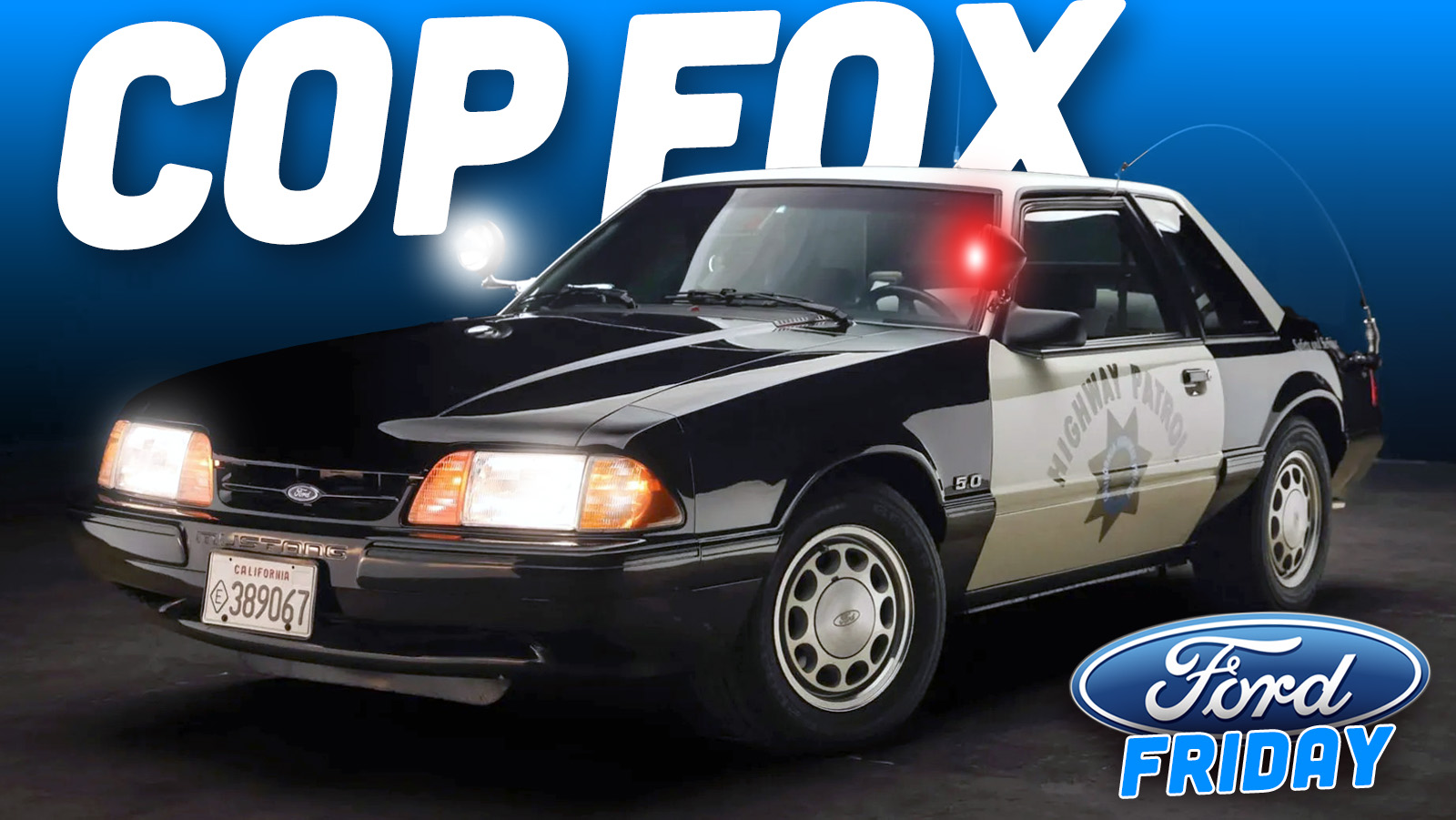
Many of us enjoy a good police pursuit when it’s confined to a movie, TV, or phone screen, and the peril to Ponch and John or TJ Hooker or Detective Lieutenant Mike Stone and Inspector Steve Keller (Streets of San Francisco, stay with me) is entirely imaginary. But in the real world, no one wants to be part of a police chase – whether cops or bad guys, or regular folks just trying to get from A to B amongst the action.
After numerous high-speed wrecks and the litigation surrounding them, many places have banned police chases for anything other than rare scenarios where pursuit is truly essential. The feeling today is you can’t outrun radio, and the equivalent of SCMODS (State County Municipal Data System) from The Blues Brothers exists everywhere in the country now. If you’ve done wrong, you can’t really get very far, so why risk life and limb and lawsuit?


That’s today. But up until the end of the last century, pursuit was an expected part of police work, and by the late seventies, it was obvious to most that the typical full-sized American police car was no match for even run-of-the-mill sports machines. The solution was to create some of the most interesting police cruisers ever made by putting muscle and pony cars into police duty, including the Ford Mustang. How did the five-oh version of one of our favorite Fords come into being, and how did it compare to the civilian model? Let’s get into it.
Not A Very Bitchin’ Camaro
Surprisingly, many of the police cars from days of yore could achieve rather high top speeds. Some of the big 440-powered Mopar sedans could reach 140 miles an hour, and the ubiquitous Ford Panther-body Crown Victoria was often limited to 129 miles an hour. However, acceleration to get to such lofty speed was not even remotely close to matching Porsches or Corvettes of the day. Also, having owned a 1983 and then a 1988 Panther body for a sum total of about 150,000 miles, I would very much not recommend driving one at those speeds (and after one hard stop from around 70 miles an hour, the brake pedal becomes a footrest).
No, by the late seventies, most law enforcement professionals knew that a different tool was needed to keep up with scofflaws. The first ones to experiment with the fight-fire-with-fire approach were none other than Ponch and John’s California Highway Patrol (cue the disco theme song). However, their test vehicles were not from Dearborn: the CHP purchased 12 modified 1979 Chevy Camaro Z28s complete with heavy-duty components from Police 9C1 Novas.

Decked out as cop cars, these police Camaros looked painfully cool and were assigned to Redding, Bakersfield, El Centro, and West Los Angeles districts for the test. Despite getting an exemption from the California Air Resources Board, the 350 V8s in the Z28s made just 170 horsepower. The test didn’t go particularly well; reportedly, nine of the twelve cars blew their engines with no more than 26,000 miles on them.

This particular example is a replica, as are apparently all of the ones you’ll see today. Even the CHP had this particular “tribute” shown here in their possession to display, as no originals appear to still exist.
Supposedly, issues with the main bearing caps and camshafts on the CHP Z28s were resolved, but the damage appeared to have been done. You can guess who was there to take advantage of the situation.
The 5.0 For The Five-Oh
The Highway Patrol took bids from GM and Ford in 1981 for this new type of cruiser, and the Camaro’s archenemy won the prize. Surprisingly, it wasn’t even close. The accounts I’ve found don’t say if the Camaro police car proposal was a second-generation car or the soon-to-be-introduced 1982 third generation, but the per-car price GM entered was reportedly $11,445. Ford presented a 302-powered notchback version of the Fairmont-based Mustang that they’d debuted two years before, for a mere $6,868 per car. Road tests were favorable, and Dearborn received an order for 400 police Mustangs, dubbed “SSP” for Special Service Package.

While almost all SSPs were notchbacks, the CHP received four to six hatchback models as well; reportedly, the CHiPs didn’t like the hatch cargo area versus a trunk and even claimed chassis flex could pop that tailgate!
Note that these were not, in effect, full-on “police cars.”In fact, an entry from an SSP manual states that these Mustangs were for “limited highway traffic law enforcement service,” meaning the typical standards for law enforcement cars (especially the passenger and cargo space) were intentionally not met.

The 1982 Mustang SSP featured a 157-horsepower engine that was mated to either a manual or automatic transmission, though the stick shift obviously proved to be a bit of a hassle for officers who needed to use the radio or other police gear with a free hand. Among the changes to the police Fox Mustang included:
- Engine oil cooler
- Silicone radiator hoses and aircraft-style clamps
- Auto transmission fluid cooler
- 130 and 135 amp internally and externally regulated heavy duty alternators
- Two-piece VASCAR speedometer cable
- Certified calibrated speedometer 0-140 mph (1982-early 1989) and 0-160 mph (late 1989–1993)
- Non-operational courtesy lights (safety feature)
- Relocated rear deck release
- Single key locking doors/trunk
- Reinforced floor pans
- Full size spare tire

Equipment in terms of comfort and convenience items was as limited as you’d expect in a police vehicle, which kept weight down. Despite some rumors and misinformation, the engines in SSPs never produced more power than the stock Mustang GTs.

Note: If you’re wondering why the example in the images above has a “GL” on the trunk lid, that’s because this was reportedly the prototype 1982 car, later used as a training vehicle in the Emergency Vehicle Operation Course (EVOC). With nearly 100,000 hard miles, I bet it has some stories.

The outside was stark black-and-white, with black steelies topped in dog dish chrome caps. Those police Z28s looked slick, but they also seemed a lot like something confiscated from a drug dealer; you might have a hard time taking one seriously as a cop car. On the other hand, the boxy Fox Mustang’s upright appearance had a rather menacing I’m-here-to-work appearance that seemed perfect for the job.
Fleet Fuelie Fox
California’s SSP fleet worked so well that soon, jurisdictions across the country were ordering Mustangs for their motor pool. Each state chose different equipment levels in their orders, like New York, which asked for power windows, and some that even installed roll cages. A few locales requested unmarked ‘Stangs, but regardless of how stealth some municipalities might have wanted these things to be, Ford taking the opportunity to advertise how the original Pony Car was the choice of the Law across the United States likely had those wary of police double-checking any Mustangs they encountered.


All of the upgrades that the Fox Mustang GT (and later LX 5.0) received found their way onto the SSP. Most notable was the addition of fuel injection and the five-speed manual ‘box for the rare stick examples, and later models sported the upgraded 5.0 under the hood with 225 horsepower.


The later cars traded the steel rims for the GT aluminum wheels, but there was an odd twist. On the 1986 to 1990 SSP models, these ten-hole wheels were powder-coated black, except for the caps. What that meant is if you wanted your Mustang to look like an “unmarked” car, you needed to select the option of “blackout treatment delete.” After 1990, SSPs reverted to all aluminum-finish wheels, and the SSP continued rather unchanged up until 1993 with rather minimal changes, becoming a rather regular sight on roads and remaining in demand with police forces.


Um, Can I Return This?
Not every municipality that ordered SSPs ultimately wanted them. You know how you’ll order something on Amazon and change your mind about an hour later? Well, the Oregon State Police apparently did the same thing with their request for 34 SSPs from Ford. However, it was too late to cancel it. The ordering dealer wasn’t sure what to do with these soon-to-arrive Mustangs, and found that noted tuner Steve Saleen was willing to work some magic on 14 of them.
Saleen did his usual upgrades with ground effects, rear spoiler, and suspension modifications, and the cars were resold through the original dealership. At first blush, I would think that the typical Saleen visual treatment on a notchback ‘Stang might be ill-advised, but the end result looks as good, if not better than the hatch; I don’t doubt that it’s more structurally sound.
The Vic Claims The Ultimate Victory
In total, around 15,000 SSP Mustangs had been delivered across the country; many were decommissioned or disposed of, though some treasured examples remain as prized members of the fleet as display or DARE cars. Once a choice of racers because of the beefed-up chassis, the collectability of Fox bodies in general means that you’ll see more restorations than competition cars today.
What killed the SSP program after a decade? Ford had no interest in making a police version of the all-new SN95 Mustang in 1994, and with the introduction of Corvette-powered Caprice police cars that same year, it sort of made such compact cruisers obsolete. That still didn’t stop Chevy from making a new police package for the Camaro, starting with a third-generation model in 1991 and continuing on to the fourth generation. The B4C package was a mix of parts from the Z28 and the 1LE included the LT1 V8 through 1997 and the LS1 V8 from 1998 to 2002. Unlike the Mustang SSP, the B4C Camaro never found more than around 200 buyers in each year it was built, except for the 700 ordered in 2002, the fourth-generation Camaro’s last year.

The story wasn’t over, though. Chevy had already dropped the Caprice in the mid-nineties, so what V8-powered car continued on as the choice of American police officers? You guessed it: the Ford Crown Victoria on the same damn 1979 Panther chassis, a large cruiser that the SSP Mustang was supposed to supplant as a pursuit car back in 1982 – yet the Crown Vic lived on for another thirty years and two decades more than the SSP. Funny how some things come full circle, isn’t it?
Top graphic image: Bring a Trailer



My uncle was a cop for fairly big and very well funded police department he was in with the motor pool guys and later became the main motor pool cop. They would always give him one the random test vehicles they had ordered or been loaned as a take home. I remember him having several of those fox SSPs and 3rd gen cameos for a few weeks of testing he said they were both fast and preferred the mustang for handling and felt it had better preformance but when he got the 4th gen Camero he was really impressed. Somehow that got him a c4 Corvette to test after having a Caprice he recmmended they buy all caprice they bought a few of being mainly a Ford department. That situation happened again when they brought out the caprice again and Ford killed the crown Vic. He recommended the caprice and they bought some for detectives but tons of Taurus for patrol that he hated and most of the cops hated because they basically had to lay someone they were taking to jail on their side as the cage took up all the foot room in the back. So they would normally end up calling for a wagon and it took them extra time waiting around.
Seems a bad idea and an expensive proposal to keep switching vehicles. Between accumulating necessary parts for many different vehicles you need different training on the different vehicles. Seems well funded means let’s not worry about taxpayers dollars.
Most of their fleet was panther platform until they couldn’t get them anymore then Taurus. The county had a fleet with all the big 3 vehicles and then some when you add in public works fire and school. The county garages worked on all the stuff. Plus there were multiple dealers around that stocked most of the parts. There were also some independent shops they used to spill stuff over to. I thought it was funny they weren’t allowed to get chargers because the sheriff thought they were too aggressive. But the sheriff had a few I’m not sure why. I would rather them buy cars then tanks. Some of these departments with no money buy tanks and that’s just bad bad idea. They had some command units and they bought swat a few of those German or Swiss urban tactical vehicles with the pole on front to breech.
I can’t even imagine how much uniform-shitting would be involved in taking an old full-size Mopar to 140 mph! Even with the requisite cop shocks and cop tires, I bet that would be an adventure, to say the least.
I used to regularly drive 100-110mph on rural interstates in my families stock 1970 and 1976 Chrysler New Yorkers. I wouldn’t want to slalom them, but in a straight line or sweeping curve their sheer size and weight gave them a decent stability. They tended to rock slightly from side to side, but they would track straight as an arrow.
The best of the big mopars did 176 mph out of the box, and in the southeast were often modified.
The police packages had heavy anti sway bars and so on.
Keep in mind they only had to out handle what they were chasing.
Late night pursuits outside the suburbs often hit top speeds, but it’s an area where NASCAR and drag parts are still developed.
I would not want to drive anything that big at those speeds myself.
What year were those 176 mph mopars? I don’t think they were doing that in NASCAR let alone an overweight police cruiser even in the 20 teen years.
I remember the Michigan State Police having Mustangs in “full dress” blue livery, complete with the classic and even-then anachronistic illuminated Lucite “STOP” sign on the hood and the big “gumball machine” rotating light on top. They also had unmarked ones (usually silver) particularly for the drug enforcement task force. The marked ones were staggered throughout the fleet and were expected to be called whenever there was a serious accident or incident some distance away that needed police assistance ASAP. Michigan has a lot of road milage to cover, and a rather thinly-spread state police presence, so it made sense. The Mustangs had speed and handling, which made them a little safer for purpose.
Both versions parked in my next-door neighbor’s driveway in the 80s — He was a MSP Trooper, who worked his way up into the drug task force and eventually undercover work. (And was a heck of a nice guy as well, contrary to the image the police in so many places have accumulated.) Although not really a “car guy”, he liked the Mustangs; with proper training and driven responsibly at speed, they were safe and useful for first-response scenarios where getting there fast mattered. Rural Michigan is pretty spread-out and until EMS services become more ubiquitous, it was possible that a Trooper might be the first on the scene to deliver first aid. The Mustangs were helpful to that end.
The Michigan State Police station in my home town has some Mustangs for traffic enforcement on I-75. Ours were blue with the sign on the hood but no gumball light on the top. That made them dangerous because the normal state police cars where so noticeable with that giant light on top.
My brother got nabbed by one is his Camaro. Flying down the left lane and didn’t notice the Mustang in the right lane was a police car until he was almost past it – way too late.
The trend lately is fake “marked cars” that have invisible decals that aren’t visible until you’re feet away.
Which really isn’t a concern to me anymore. My days of speeding everywhere and topping out every motorcycle I owned are in the past.
It’s objectionable just on safety grounds though.
There’s a long history of crimes committed using fake police cars.
Besides visible police have a distinct effect on crime.
That’s why blue running lights are being adopted many places.
I live in the country now, but outside a growing town.
Traffic is heavy enough there is really no place to drive hard, unless maybe late at night.
Even trying to get through traffic has no advantage.
Accelerating onto the highway or up hills is about as exciting as I can do around here.
Excessive torque is still fun.
Did you ever ride the Honda inline six?
My late neighbor and buddy had 2 brothers and a lifelong friend in the CHP. They usually drove whatever “Klingon battle cruiser” was in the rotation in the time period. When the SSP Mustangs were in the fleet, they were used for high speed pursuit on I-5 and Hwy 99. According to the family, they acquired a reputation for being easy to snap-roll at pursuit speeds.
Last winter, I was binge watching TJ Hooker, and I noticed in the background of a scene where Heather Locklear and William Shatner are outside of a diner talking with somone. In the background there is a tow truck that is towing the Dukes of Hazzard General Lee behind it.
These shows were all filmed at the same time in the same area, so it makes sense.
It’s funny (or sloppy?) how that somehow made it into the show, not caught by the editors
As a avid partisan of that era of tv, I love the sheer amount of cars that jump and/or explode on the slightest provocation. Crash into another car? Well, you won’t simply come a smashed halt, you’ll careen over the top, possibly twisting while doing so.
Oh yeah, absolutely. I’m with you.
By the time that stuff was on reruns in the late 80s, I was fully addicted as a child and soon after really started to appreciate vintage “jiggle TV“ as well.
They built them pretty damn well back in the day… And the cars too!
One of my favorite now-that-I-notice-it things from that era, along the lines of series-inappropriate cars in the background, is angry/threatening guard dogs.
Sure, they’re seemingly barking, growling, or even attacking, but look closely and their tails are happily wagging away.
Oh my gosh, it’s like you’re in my brain because I was actually thinking that earlier.
That along with seeing the same handful of cars in multiple different scenes where there would be no logical reason for those vehicles to be near the cars in the chase, scene, etc.
Another good one is how shows like especially the A-Team.
They were firing high-powered Mini-14 fully automatic rifles at the bad guys and they would flip over and explode but the bad guys would just get out and be more or less OK – just shaken up.
Growing up having the opportunity to shoot that very same weapon at an outdoor rifle range into all sorts of objects, including cars, often times the bullets would slice through everything.
Dogs can wag their tail and charge you.
One day commuting, I was a in a group of traffic that was moving quite fast, there was a slower car in the right lane just before a curve and the group just blew by them. After the curve there was a RCMP Mustang on the shoulder. The cop turns on his lights and pulls out – and pulls over the slower car which everyone had just passed. Much like a sick gazelle being taken down by a lion. I felt bad for the guy who got caught.
The current CHP commissioner lived not far from me when he was a patrol officer and would bring home a test car every now and again. He had one of these for a while: https://www.jalopnik.com/how-the-california-highway-patrol-swapped-crown-vics-fo-5959429/
My best friend’s ex’s parents have a former MD State Police foxbody. I think they found it down south somewhere and brought it back home to be restored. Very cool car, those the B4C Camaros are my personal preference.
Johnny Law is still rocking Mustangs in 2025. Here in the South, state smokeys and some county mounties have them. And those things are FAST, so I was told by a friend.
The B4C Camaro is very UNIQUE. Sure, parts will be hard to find (and they had their own problems), but it had enough power that most criminals FEARED THEM.
Ford had a chance to make the SN95 Mustangs with a police package. They didn’t.
As for the Camaros blowing their engines, I think that has more to do with the unreliable emissions equipment (and less quality) on them. Also, Chevrolet tried again with the generation of Camaro AFTER that- those did have their own issues too.
My dad bought one of the four hatchbacks from the CHP sales lot in Torrance when they sold it. It had the certified 140 mph speedometer and a stick shift. He street raced many an E30 BMW in the ’80s where it routinely saw triple digit speeds (with me in the passenger seat and there was no seat belt law at the time). Unfortunately it burned to the ground on the side of the freeway
Man, I love the notchback Fox-body Mustang. It’s the plainest-looking Pony Car ever, perfect for a sleeper.
Ponch and *Jon*. That’s Officer Jonathan Baker, CHP to you, bucko.
And not a single mention of Ponch’s Firebird, seemingly always the victim of some sort of maltreatment that kept it from cruising in its amazing 70s glory.
Alabama State Troopers had the AMC Javelins in the 1970s. They remained in service until around 1979. You were a fool if you tried to outrun those guys.
They also used the Mustangs in 1987. They lasted for about two jears before the state dumped them.
Ah memories. I grew up in suburban Richmond, VA. It was a part of town full of spoiled high schoolers who drove too fast and cops who had nothing better to do than hunt for them. I wasn’t a bad kid/major speeder, but I drove a bright red 1990 Mustang GT. The local police had a few unmarked Mustangs and they got 4th Gen Camaros as soon as they could. The unmarked cars were pretty silly because they were still very obvious.
Often I would get followed by a police car for no reason – just waiting for me to do something. I’m sure it was disappointing when I just kept doing the speed limit and using my turn signals, but that was suburban Richmond for ya.
The specs of the police Mustangs weren’t a secret back then and I always thought it was a little surprising they didn’t do much to squeeze more power out of it, but you probably weren’t going to outrun one of those cars.
Never stopped me from getting pulled over in my 1972 AMC AMX, on the way to school, for, get this, having the sticker on my license plate installed in correctly.
Wow, are you sure you didn’t grow up in my smallish hometown in middle TN? Cops had nothing to do except hassle teens. My driving record greatly improved once I left town.
These are probably a little faster than the Volvos Barrington had back in those days.
Not a problem. All the other cars in Barrington were Volvos and diesel Benzes at the time.
This is mostly true, but also a lot of Porsches and BMWs. And Jaguars. Right next door to the quik-lube I worked at was a Beck-Arnley import parts store.
Cop ‘Stangs were just very, very cool.
Oddly enough, the Maine State Police 20 years ago had a decent fleet of Mustangs in assorted colors, replaced a few Camaros they had previously – probably about the time they switched from GM to Ford for their entire fleet. But they were easy to spot because despite being completely unmarked and devoid of obvious cop lights and antennas (didn’t even have cop license plates), they had a level of tint that would instantly get you pulled over for a roadside conversation on any other car. Dark windows on a Mustang or Camaro was instant caution in those days.
There was one of these that haunted I-79 in northwestern PA back in the early 90’s – unmarked, navy blue, tinted windows. You never even saw it until the lights fired up.
The RCMP had some of these in BC, I passed one in the dark one night in my diesel Jetta. He lit me up and asked if I knew how fast I was going, as my speedometer didn’t work I truthfully admitted nope, the ticket wasn’t much but I felt pretty stupid.
Going fast enough to get a ticket in a die-smell Jetta is pretty impressive.
And it was an NA one- drove it in LA once it was ummm fun
Diesel badge was the ultimate anti theft device in LA.
Was hard to find diesel in service stations I go 1000km on the highway on a tank but filled up anytime I got below half as I didn’t know where I could full up
I am surprised at that.
The problem I run into is affordable gas or diesel in California.
I really regret not buying a tiny Izusu diesel car, that got incredible mileage.
A lot of people traveling west from here buy extra fuel heading west, to add once we hit high prices. My factory tank is good for about 700 miles on the truck.
I’m actually watching Corner Gas tonight!
I remember when these started to hit the government auctions and were being picked up by regular folks. They were fairly hot commodities right away, since people who like Mustangs were well aware of what was on offer. I also believe it was the ex-HP Mustangs that started to make the coupe body style a bit cooler. Previously, they had been viewed as a bit old-fashioned, and the hatchback style was the one to have.
The cops told Ford to take the Fox and kick rocks.
Seeing that CHP Camaro reminded me of the story of the Camaro that became a legend in the Bosnia war:
https://greasegunburgers.tumblr.com/post/175988677779/im-going-to-start-rattling-cages-until-all-the
Another article:
Bosnian War Hero’s Custom Bullet Proof 1979 Camaro
Now that is seriously cool.
*looks at topshot*
Cop tires, cop suspension: Cop Fox
Fix the cigarette lighter
My first experience with a CHP Mustang was in 1989, ‘flying’ down the 15 towards San Diego. I notice a tan vehicle coming up hard in the fast lane. I keep my eye on it as it rapidly closes the distance. I was two lanes over to the right, with enough traffic moving faster than me. When he finally passed me at Warp 9, I noted the CHP emblem on the door. In addition to the black and whites, they ran tan/beige and some all white cars.
Oh, back in the day there was an R&T article discussing some of the drivers had to be taught how to drive a manual, as they never had before in life.
Similar experience here – except we were flying northbound off the Grapevine up I-5 in my buddy’s Fiero 2M4 in 1988. He wasn’t about to waste the momentum of coming off the pass – and he was nabbed by a CHP ‘Stang.
So he gave me the wheel and I continued the drive back to base in Monterey – when we suddenly saw a plane circling overhead while heading west on that flat stretch of 46 – and sure enough there was another CHP lying in wait for me.
That was the first and only double-ticket road trip I’ve ever done!
Huh, I didn’t know that CHP used anything other than black/white or all white cars (at least until this year with the Durangos), but apparently they did have a small number of them in the factory colors in that era.
https://www.reddit.com/r/PoliceVehicles/comments/1e2rdtz/california_highway_patrol_plainwrapper_commercial/
I remember having a chp Mustang in the fast lane doing 140mph pass next to me on the 210 freeway in the early ’90s more than once. Man, was it shocking when it went by at that speed
When I was a teen, there was a SC State Trooper in an unmarked, black Fox body Mustang. He somehow got the NC (yes, NC and not SC) vanity tag GOTCHA. He became well known in the Myrtle Beach area by the locals as he would frequently nail speeding tourists.
In my home town there was one with “300 HP” on the plate. That seemed optimistic until I realized that was the “h”ighway “p”atrol’s unit number
That is just super, super sneaky. Maine’s hot cop cars just had regular plates instead of the usual State Police plates that the cruisers had.
I think Fox Bear is the accepted terminology for this gumball machine.
That’s a 10-4, Good Buddy.
I was always tickled by the cop with the radar gun: a Kojak with a Kodak.
The correct CB lingo:
“A bear riding a horse”