

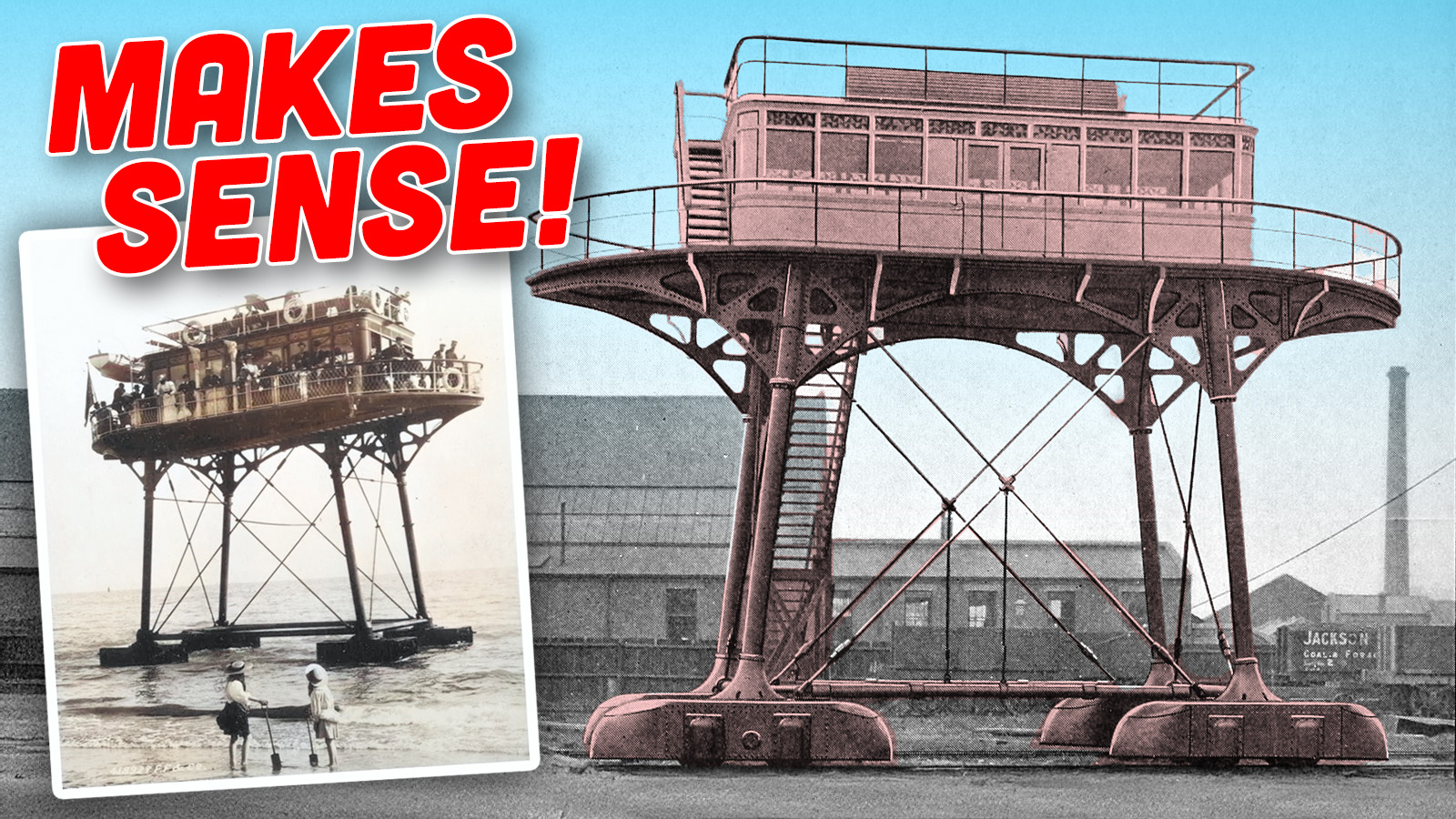
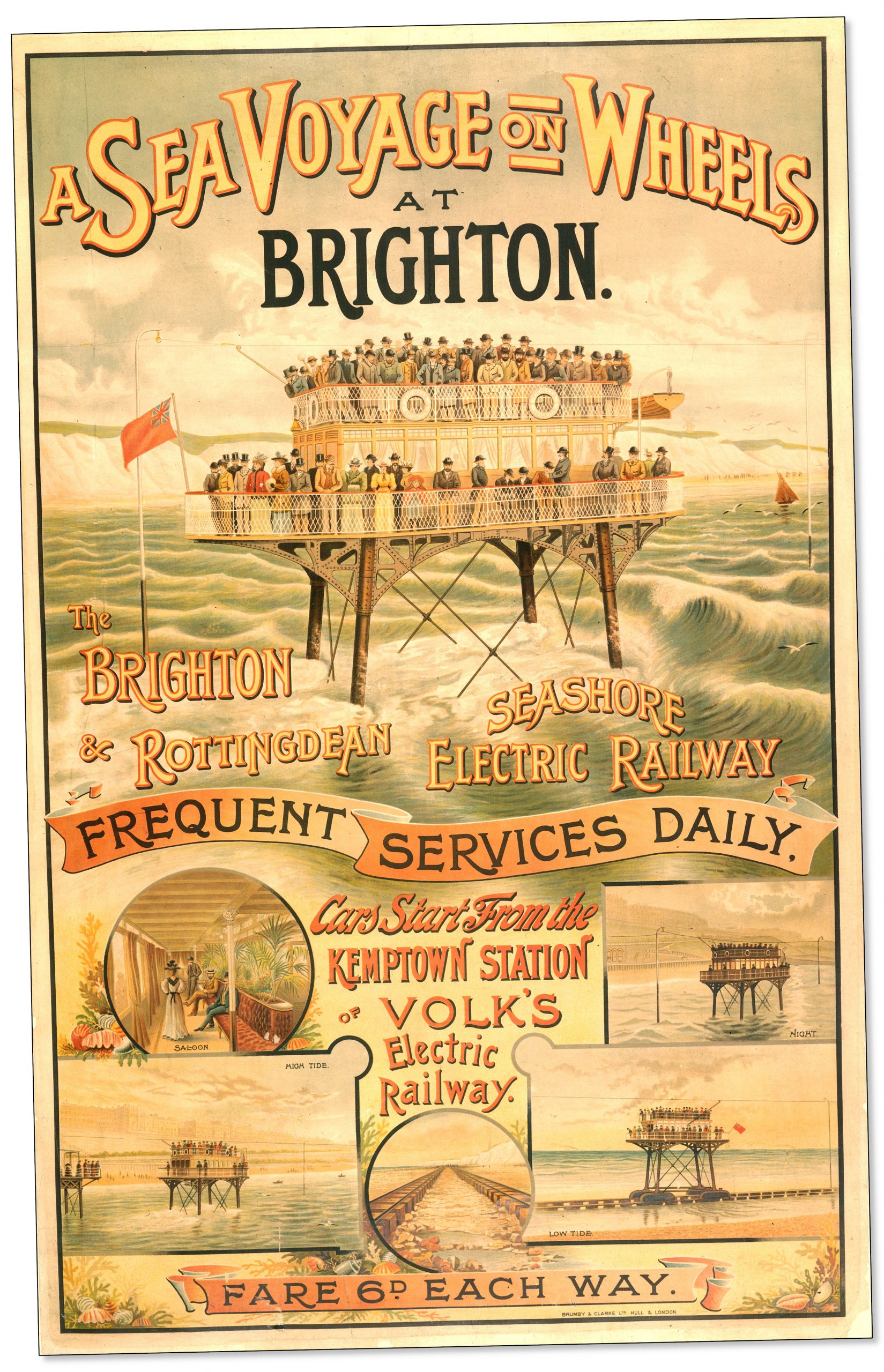
Traveling between two points along a coast probably isn’t something that many people have to think much about. Today, you’ll find lots of options like trains, ferries, or roads. But not every solution has been so straightforward. Back in 1896, the Brighton and Rottingdean Seashore Electric Railway provided service between two points 2.8 miles apart. But it didn’t use a boat or have a train meander a coastline. Instead, the man behind the project, Magnus Volk, invented a bizarre train that rode on stilts above water. But it was more than a train, given its lifeboat, life rings, and a sea captain at the helm. This is what happened to one of the weirdest vehicles that technically counted as a train.
This train, which was given the nickname the “Daddy Long-Legs,” was the work of British-German pioneer inventor and eccentric Magnus Volk. On the surface, Volk’s train solved a pretty simple problem. The jagged and high cliffs along the coastline of Brighton, England, were unsuitable for a rail line. Trains can climb only so steeply, and changing the geography to permit the construction of a rail line is costly and time-consuming. Instead of carving his way through the rock to build a rail line, Volk took a more creative path. What if the train ran on rails through the surf, bypassing the rugged terrain entirely?


That was only one of the ideas behind the Brighton and Rottingdean Seashore Electric Railway. On paper, this 2.8-mile railway was supposed to be a bunch of vehicles and objects all in one. The train was like a boat that you couldn’t get seasick on, and in a way, it was also sort of like a moving pier. But the whole experiment didn’t last particularly long, and there hasn’t been a train quite like it ever since.

A Railway Pioneer
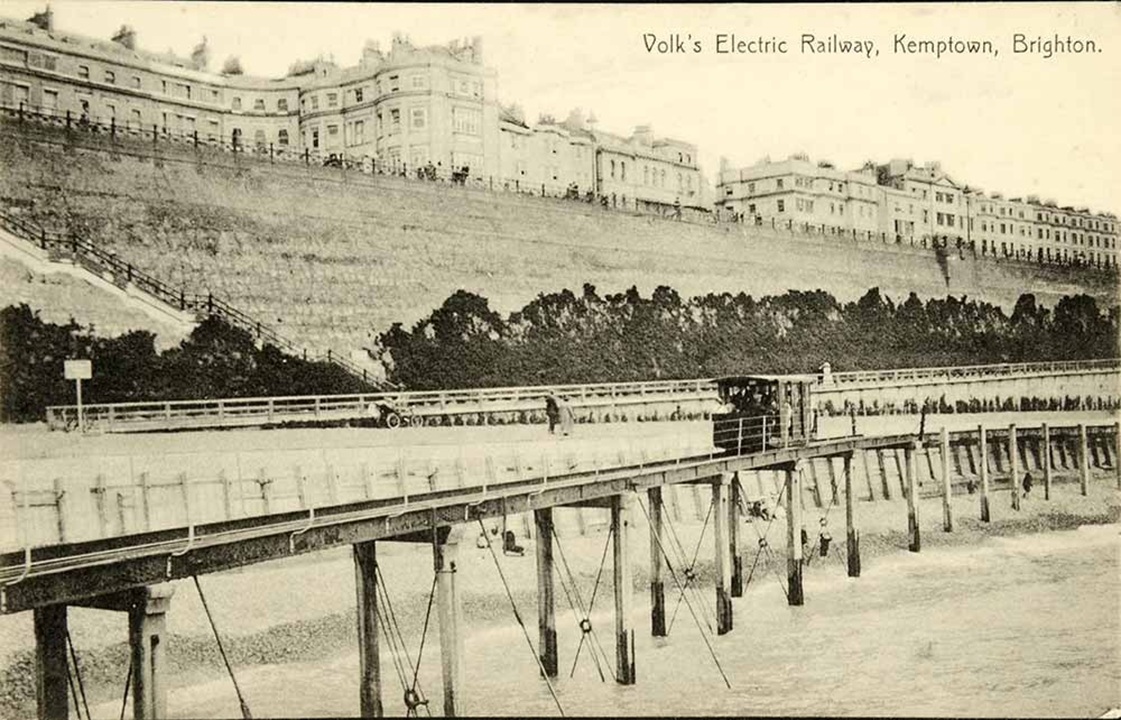
Magnus Volk is not a name that is uttered often on this side of the Atlantic, but in the United Kingdom, he was a visionary in his day. Volk was born in 1851 in Brighton to a German clockmaker. Just over three decades later, Volk would have his name on one of the first electric train lines in the world. Amazingly, that line, known as the Volk’s Electric Railway, is still in operation today. It holds the distinction of being the oldest operational electric railway in the world. But how does someone even get to this point? In 1937, following Volk’s passing, Meccano Magazine published his biography:
Mr. Volk was only 14 years old when his father died, but the boy took over the clockmaking business. Then he began to make toy telegraph instruments, and became sufficiently prosperous to employ 20 workpeople. Later he added electric bells and shocking coils to his range, and it was soon after this that he became interested in electric lighting. This led to his appointment as electrical engineer to the Corporation of Brighton, and in 1883 he lighted the Royal Pavilion estate electrically. This installation was then the largest of its kind in the country. A large chandelier in the Dome of the Pavilion was wired for 200 lamps, which had carbon filaments, and the 200 gas fittings in it were retained for possible use in emergency. This made Mr. Volk’s work more difficult, for his insulating materials had to be capable of withstanding the heat of the gas flames.

In the meantime he had begun to plan the electric railway that was to make him famous. He had made an electric motor for a London firm, which had not accepted it, and with this, a small Siemens dynamo and a 2 h.p. gas engine he carried out some experiments that suggested the great idea to him. He asked the Brighton Corporation for permission to build an experimental line along the sea front, and when this was granted he set to work. His track, of 2 ft. gauge, was made of flat bottomed rails spiked to longitudinal sleepers, with shingle packing, and his first car was a crude one with four wheels. The gas engine and dynamo were installed in a tiny power station under an arch in the roadway opposite the Aquarium. Current was generated at about 50 volts, and was conducted to the motor by means of the wheels. The line was laid and the equipment prepared in the astonishingly short time of 18 days. The track ran from the Aquarium to the Chain Pier, so that it was only about a quarter of a mile in length, and it was opened on 3rd August, 1883. The greatest interest was taken in the event, for there had been many gloomy predictions that it would prove to be a complete failure, and probably many of those in the crowd that assembled for the opening hoped to see something sensational. In this they were disappointed, however, for the car started without a hitch as soon as power was switched on by the Mayor of Brighton, who drove it on this occasion, Mr. Volk acting as conductor.
From that time the line was very popular, in spite of the forebodings of a few obstinate people who saw in it the latest invention of the Devil. About a thousand passengers enjoyed the novelty of a trip on it on August Bank Holiday of that year, when the railway was in operation for 11 hrs. and the little car ran about 50 miles at its regular speed of 6 m.p.h. From then until the end of the year about 300,000 passengers were carried, and the enterprise was so successful that the period for which permission to operate it had been given was extended, and the line was lengthened to Paston Place, and subsequently to Black Rock. Then followed a great struggle. Violent storms wrecked the line four times during one summer, and sleepers, boards and other equipment disappeared from time to time, removed possibly by cabmen, boatmen, and hay and corn dealers who thought the railway threatened their livelihood. Mr Volk fought pluckily against misfortunes of all kinds, however, and he received so much support locally that he was able to keep his line open and to retain complete control of it. On one occasion a stranger offered to provide him with capital without any legal agreement, and on another a local newspaper raised a fund by subscription to enable the whole line to be repaired.
As the New York Times wrote, it was true that Volk was such a wizard with electricity that his inventions were denounced as the “work of the devil.” But that never stopped him. In addition to building one of Britain’s first electric railroads, he also built a three-wheeled electric car in 1887, another electric car for Sultan Abdul Hamid of Turkey in 1888, and he even invented an egg cup for men whose arms had been amputated.
Volk has also been credited with experiments involving fire-alarm systems and bringing electricity into houses. However, Volk is remembered best for the railway from 1883 that you can still ride today.
A Tall And Awkward Railcar
As Meccano Magazine writes, one of the limitations of Volk’s railway was that it was susceptible to being overtaken by crashing waves from the sea. But Volk kept pushing forward. That was until Volk saw a challenge that his rail line couldn’t beat, at least not at first. Volk wanted to extend his train east from Paston Place and Banjo Groyne (a groyne is a kind of wall in a body of water to reduce erosion) to Rottingdean. It was a distance of about three miles as the crow flies or about four miles by land.
There are two versions of the story as to why Volk made a train on stilts. The often-reported story is that the foreshore between the two points was covered in water for most of the day, so taking a typical train through it would be unfeasible. However, the more traditional path would have the train tackling cliffs and rugged terrain along the coastline. Volk would determine that the easier path was to make the train operate over the water rather than try to carve a railway through the cliffs.
The alternative version of the story, as told by Volk, is that building a train that rolled above the sea would afford visitors the unique opportunity to see the coast, take in the fresh sea air, and experience a short sea voyage without seasickness.
Whatever the reason, Volk’s idea didn’t consist of making a train roll across a bridge, as would be the likely solution today. Instead, he built the train itself to run along the shore and under the water, regardless of where the tide was. Volk says that parliamentary powers for the new line’s execution were granted in the summer of 1893 and that construction started in June 1894. Apparently, additional licensing from the Board of Trade, the Crown, and the Corporation of Brighton was required. Volk then describes how the line was built, via Cassier’s Magazine:
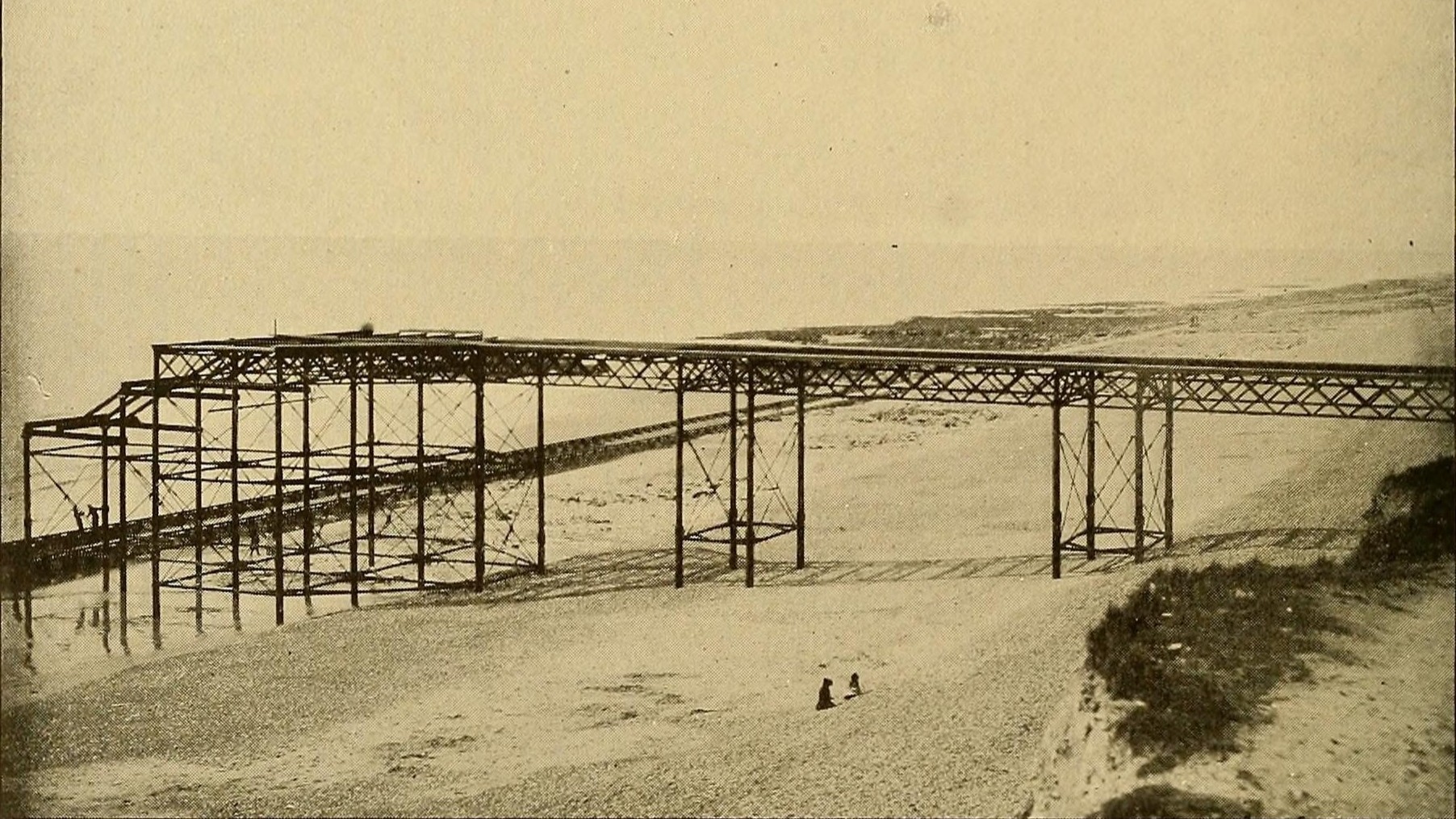
The line commences at the eastern end of the Brighton Electric Railway and extends a distance of three miles to the village of Rottingdean, a favourite summer resort. There a small iron pier has been erected for the cars to run alongside the pier being available also for steamer traffic and promenading. At the Brighton end of the line an iron jetty has been erected and a building containing commodious waiting-rooms and offices was built on it.
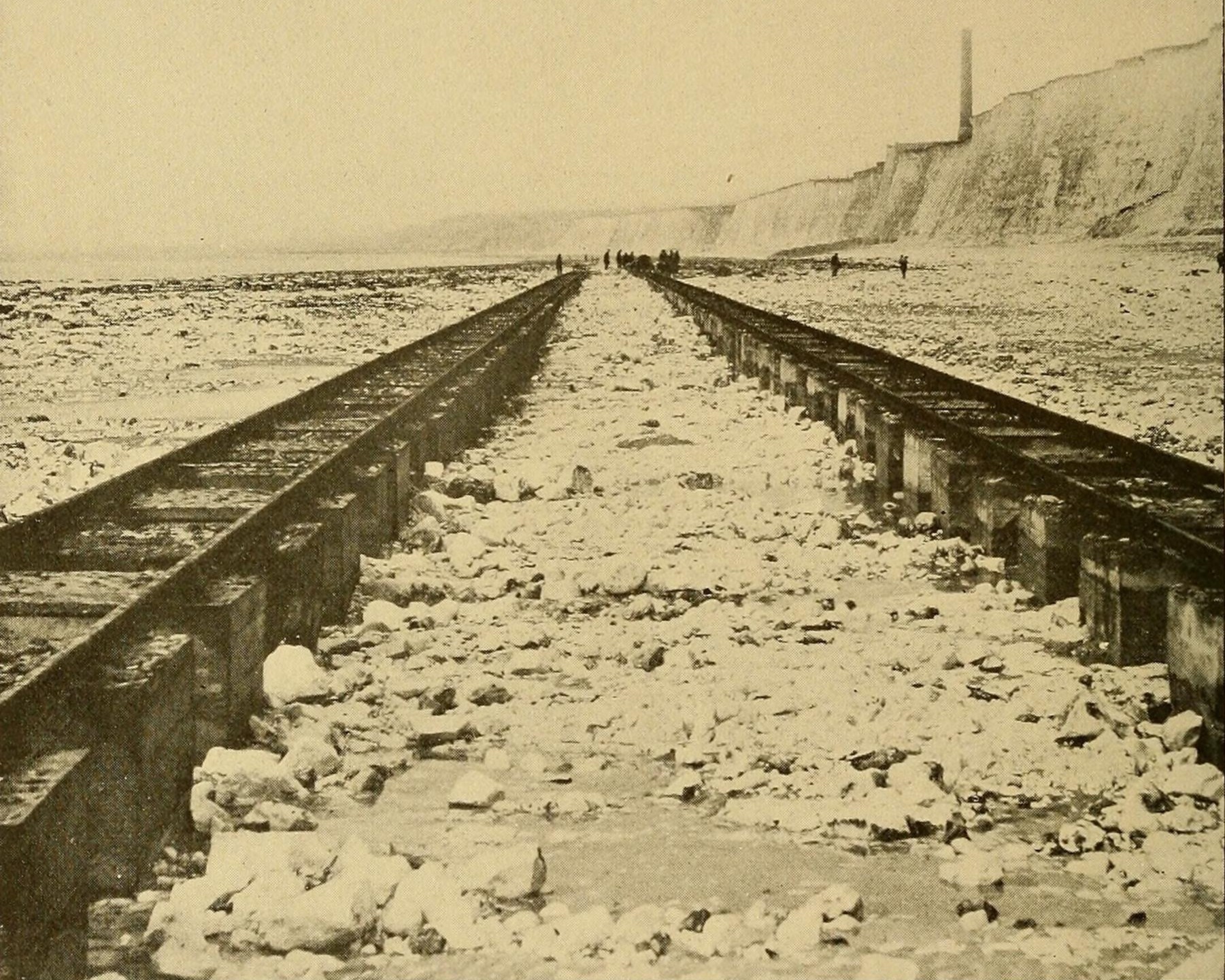
The coast is bold along practically the whole distance, with chalk cliffs varying from 60 to 120 feet in height, and as the rails are laid a considerable distance from the shore, a fine view of the coast is obtained. The rails rest on concrete blocks, made in situ, about three feet apart, mortised into the sound rock, the height of the block varying with the irregularities of the shore. A shifting sand of very moderate depth covers the rock in places, but the rails were laid sufficiently high to prevent any trouble from accumulations on them. The steepest gradient is one to 300, and the radius of curves, 40 chains (2640 ft.).
The line consists of four rails (54 lbs. per yard) laid as two tracks of 2 feet 8.5 inches gauge, spaced 18 feet between the outer rails, thus giving an effective gauge of 18 feet, this being rendered necessary to give the required stability to the cars. The rails are secured by steel clips and bolts, the latter being embedded in concrete. Oak blocks, through which the bolts pass, are placed between the rails and the concrete blocks. Tie rods are also used every 10 feet on the straight, and every 5 feet on the curves, and heavy angle fishplates are used for the rail joints, the rail being in 30-ft. lengths.
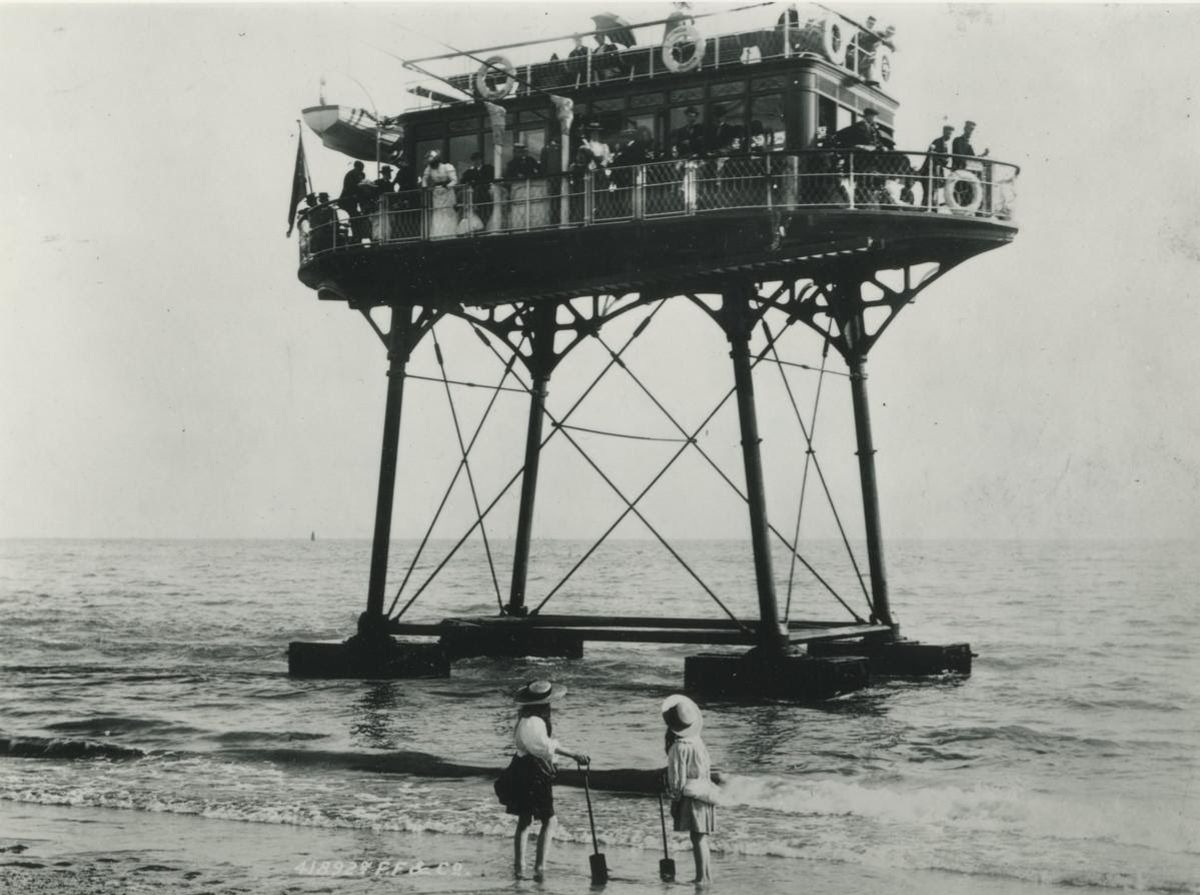
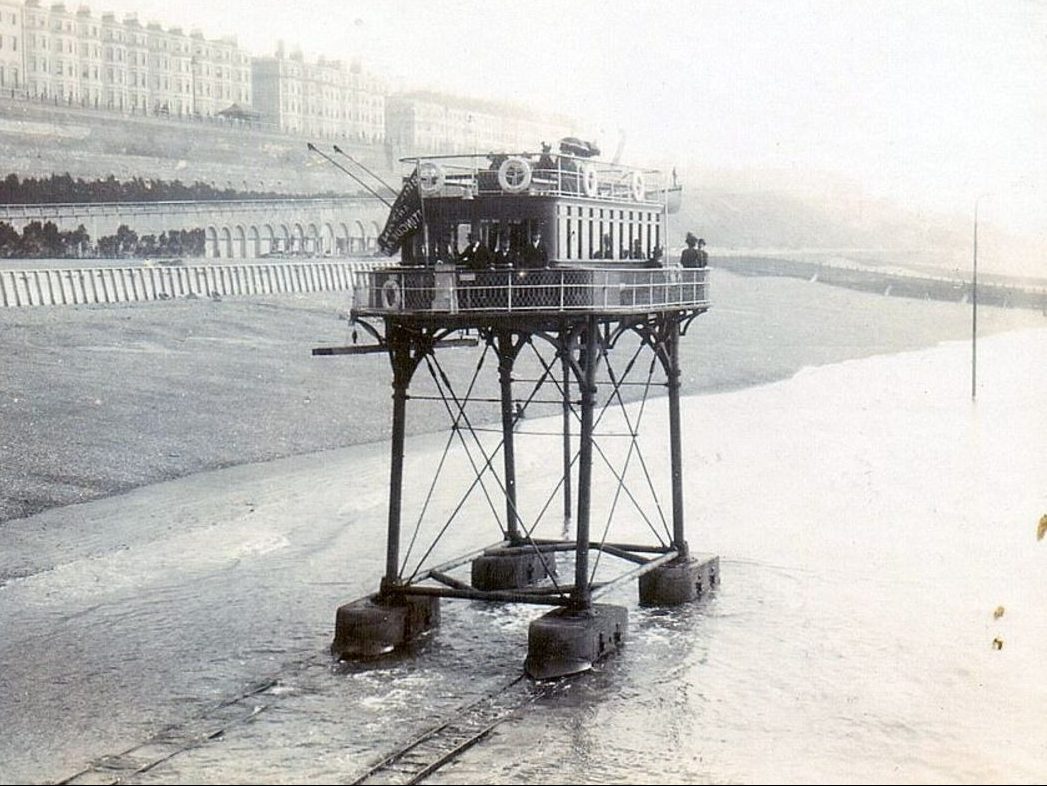
At low tide, the concrete foundations and the tracks are visible. It was possible for people on the beach to run under or alongside the train as it rolled down the track. At high tide, Volk said, the blocks and tracks were submerged under 15 feet of water from the English Channel. Volk noted that the track system survived multiple strong storms during the 1894 and 1895 seasons without any permanent damage and without any accumulation of seaweed or other debris.
The other part of the equation was the railcar, which Volk also described:
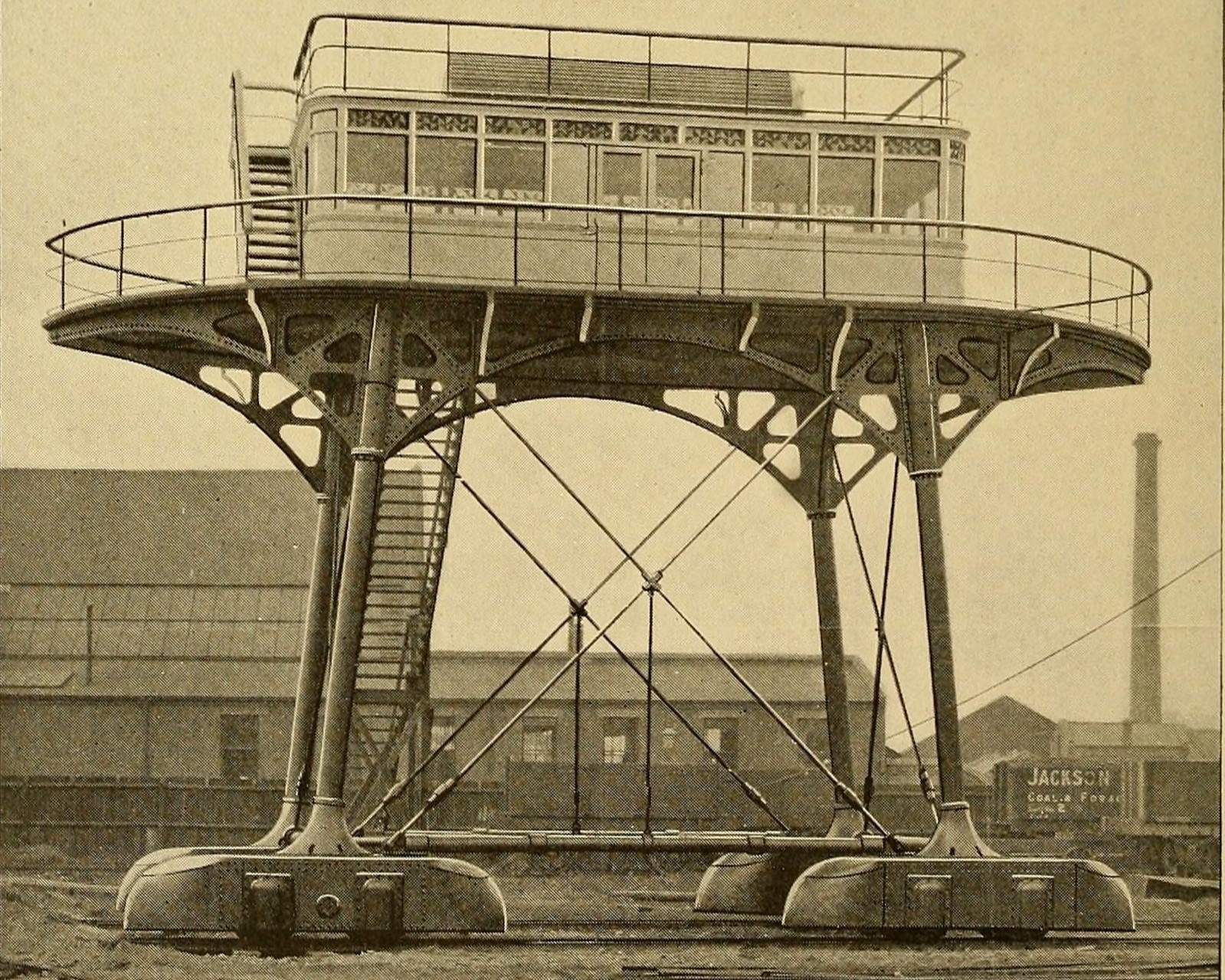
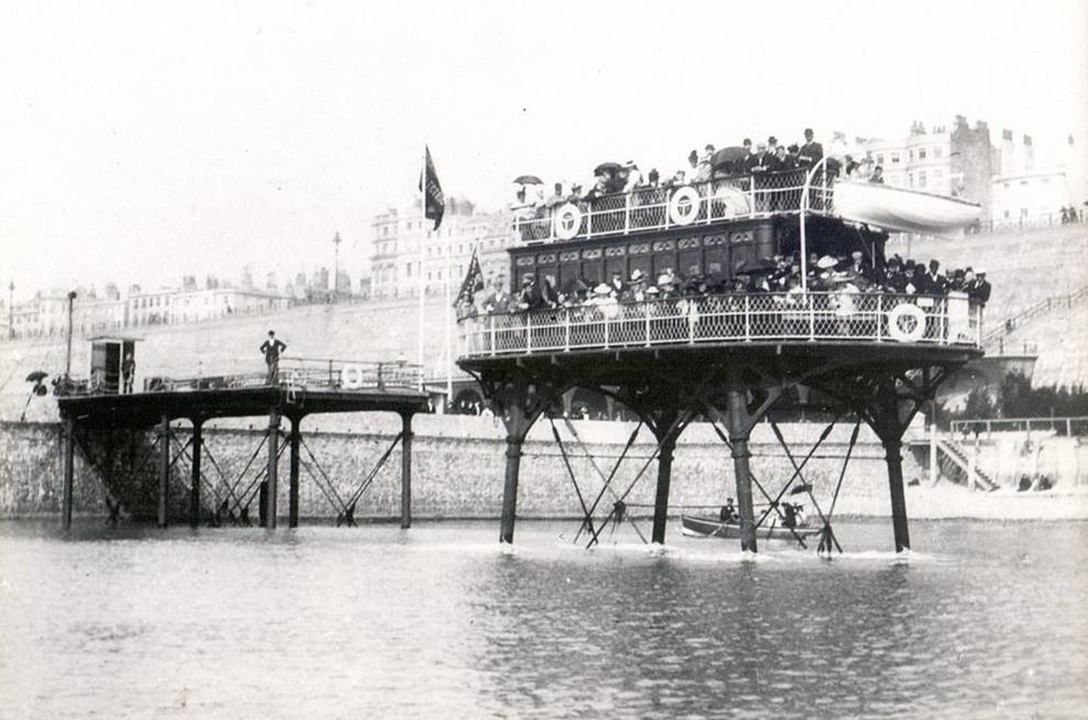
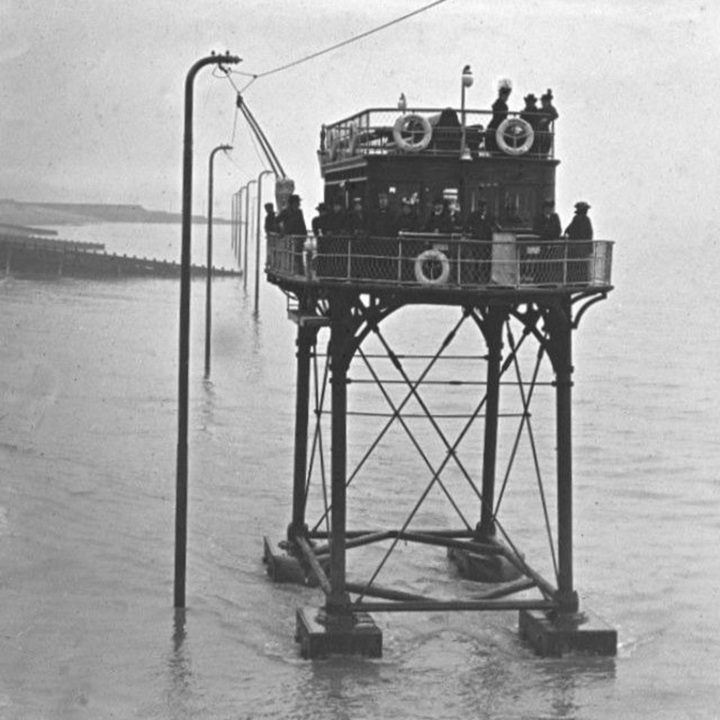
The car, which was built by the Gloucester Railway Carriage Company, is a structure on 16 wheels, each 33 inches in diameter, carrying the passengers at a height of 24 feet above the level of the rails. The four main legs are tubes of drawn steel 11 inches in diameter. At the bottom of each leg is placed a bogie truck, having four wheels, the outside of the bogie being shaped like an inverted double-ended boat to facilitate its passage through the water, and also to remove any obstructions from the rails. The four bogies are firmly held together by steel tubular struts. The wheel base is about 28 feet and with the already mentioned effective gauge of 18 feet, gives great stability.
The tops of the main legs are firmly built into lattice girder work carrying the deck, and the whole structure is firmly secured by cross ties. It is of greath strength, although offering but a small surface to the force of the waves. The main deck appurtenances and erections are carried out exactly as if for a steam yacht, and measure 50 feet in length and 22 feet in width. The railings round the deck are of iron with a wooden top rail and wire netting. An ample supply of seats, with reversible backs, is provided to enable passengers to face the direction in which the car is going.
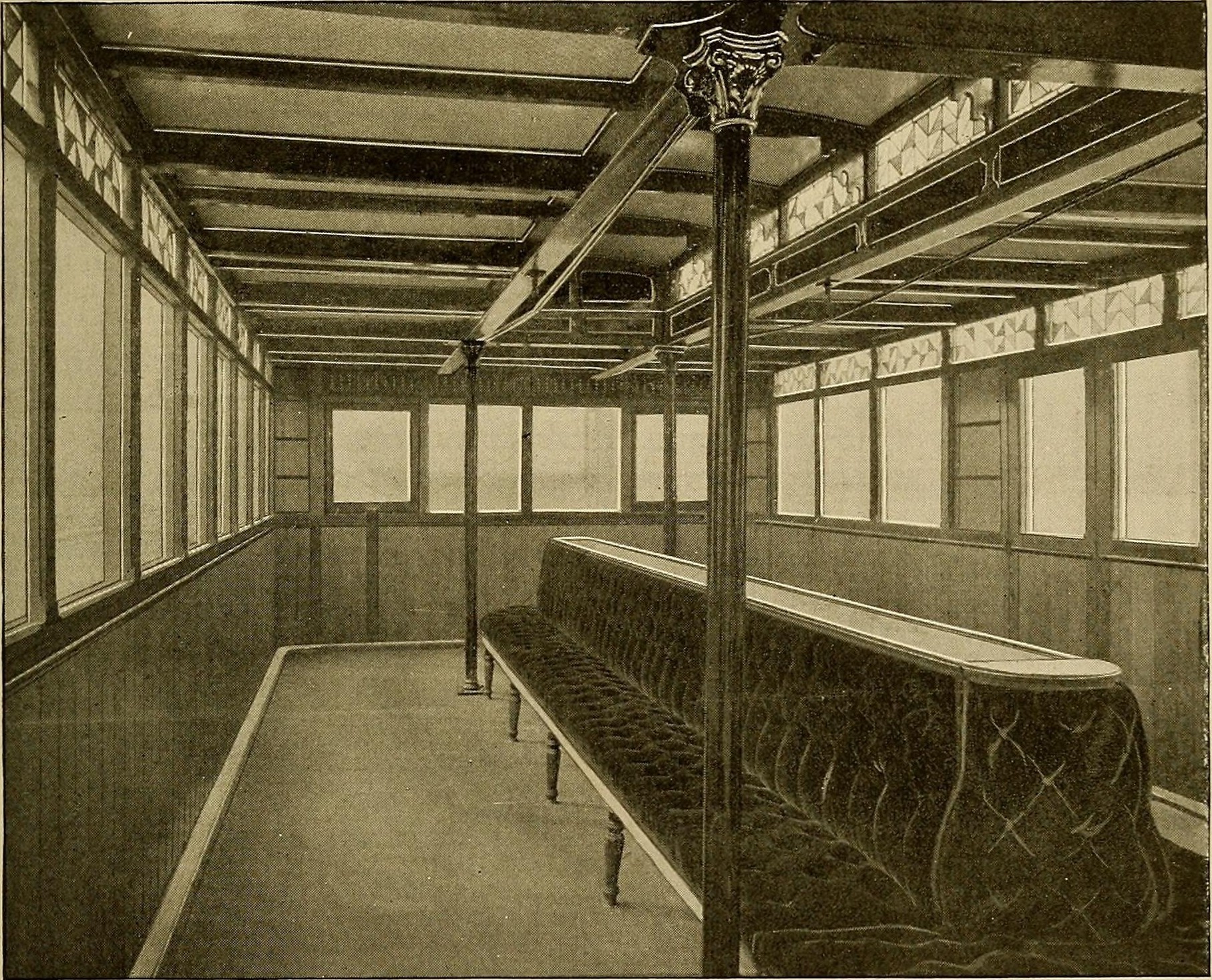
The centre space of the deck is occupied by the saloon, a structure 12 feet wide by 25 feet long, provided with plate glass windows all round and a large central ottoman, fitted with a box between the backs in which are placed palms and flowers. The centre of the ceiling is occupied by a stained glass dome and the interior decorations are carried out in a simple but effective manner. The roof of the saloon is railed round and forms a promenade deck, seats being placed over the glass dome and over the centre of the saloon. On the lower deck is placed the controlling apparatus for driving and stopping the cars. The total accommodation is for 100 to 150 passengers. As the journey is short and will be undertaken more for the sea air than for quickly making the trip, the speed is kept between six and eight miles an hour.
Volk continued that the railcar, which weighed 50 U.S. tons, was powered by General Electric 800 type 30 HP electric motors placed above one leg on both sides. A shaft travels down to the bevel gearing, which turns the wheels at the base. The train did have brakes, which were actuated by rods contained in the remaining two legs that did not have the motors in them. The trucks at the bottoms of the legs contained a total of 16 wheels and were shaped like inverted boats in an effort to plow debris out of the way of the railcar.
500 volts of power came from tall trolley-style poles placed beside the tracks. Power was generated for the car at the Rottingdean-side of the rail line by a 110-horsepower William Sissons and Co. steam engine running a 50 kW General Electric four-pole generator.
Engineering of the rail system was handled by Volk and Mr. St. Geo. Moore. Funding came from Mr. Edward Overall Bleacky, Mr. J. J. Clark, J. P., and Mr. R. L. Pope, J. P. Some other reports said that the four tubular legs of the railcar each had a 25 HP motor. I’ve also seen period reports saying that the machine had only two 25 HP motors. So, the railcar had anywhere between 50 HP and 100 HP, depending on who you asked back then. Apparently, Volk had also considered powering the railcar using the era’s batteries, but that plan did not work out.
The Sea Voyage on Wheels
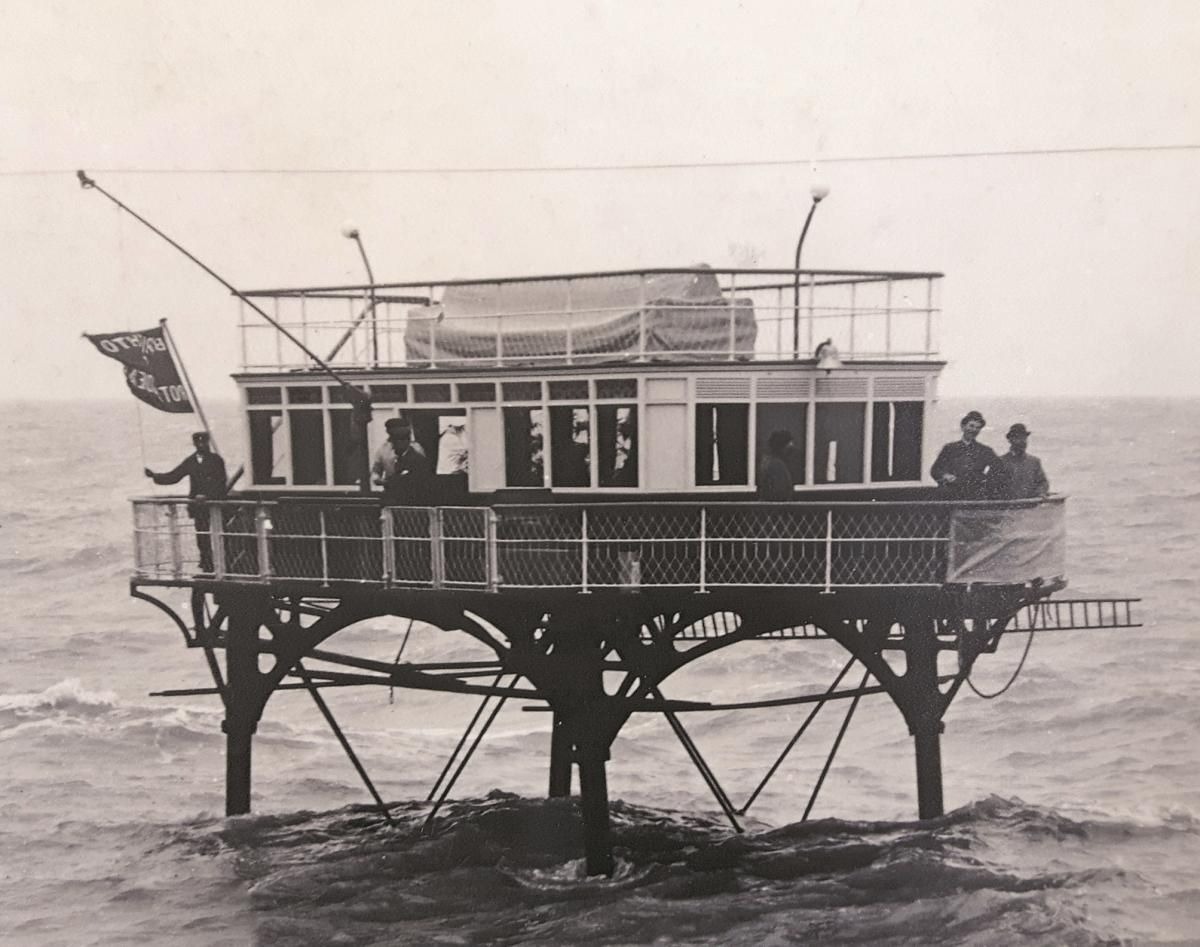
When the line was finished in 1896, the railcar was christened the Pioneer. Scientific American reported that the construction of the tracks, the railcar, and the piers cost about the equivalent of $150,000 back then. The Brighton and Rottingdean Seashore Electric Railway opened on November 28, 1896, and it was a strange curiosity. Since the railcar went out over the sea, it had to be commanded by a sea captain. It also had a lifeboat and life rings. When it went “to sea,” it even flew a flag like a ship.
To drive the railcar, the operator had to climb to the upper promenade deck, where they were presented with the same General Electric controllers that would be found in a streetcar. Volk’s promise of creating a tourist attraction rang true, and the Pioneer became a bit of a destination. Soon enough, it earned the nickname of “Daddy Long-Legs.”
On December 4, 1896, the whole operation nearly came crashing down, literally, when the line was stricken by a strong storm. The gales were so powerful that the Pioneer even toppled over. The building at Paston Place was devastated, three poles were damaged, and a portion of the track was destroyed in one place. Reportedly, Volk spent more than the equivalent of $20,000 to rebuild the rail line and the Pioneer, which was nearly damaged beyond salvaging. In doing so, the Pioneer’s legs were stretched by two feet to further keep it out of harm’s way. The line reopened on July 20, 1897, and by the end of the year, the railway had moved 44,282 passengers along the 2.8-mile route.
Issues plagued the railway almost from the very beginning, however. As the Volk’s Electric Railway Association writes, the railcar was severely underpowered and ran at only walking pace at high tide. After the turn of 1900, two new concrete groynes built east of the railway caused scouring of the seabed and damaged the track bed. Volk had to close the line in July and August 1900 to enact repairs.
While all of this happened, Volk never made back nearly enough money to pay for the line’s construction costs or its repair costs. But then, worse news was to come. In September 1900, the government alerted Volk to its intention to build a beach protection barrier that would go right through the Seashore Electric Railway’s right-of-way. This was a problem for Volk as he would need to move the line into deeper water to avoid the new barrier. However, he just didn’t have the funds to move the line and reengineer the railcar for deeper water.
By January 1901, the government cut up the right-of-way for the barrier, forcing Volk to shut down the line. Volk attempted to raise money to build an over-water viaduct, but this failed. Ultimately, the track, the railcar, and the structures would be scrapped. Amazingly, the concrete beds were not torn down and are still visible today. The Brighton and Rottingdean Seashore Electric Railway was never replaced, but the Volk’s Electric Railway was extended to the beach later on.
The Sea Railway Legacy

While the Brighton and Rottingdean Seashore Electric Railway came to a sad end, it wasn’t really the end of the concept of a train that rides in water. Some water rides at theme parks use a simpler concept of having a train that’s sort of like a boat that rides on submerged rails. In the 1930s, there were also the Dutch “veerwagens,” ferries that were actually self-propelled railcars riding on submerged rails. However, in the case of the Netherlands, the veerwagens were less tourist attractions and more tools for farmers.
Additionally, there was also a single-track railway in St. Malo, France, that used a submerged track. This railway lasted between 1873 and 1923, too. Volk even noted the existence of the railway in France, but said that his was better because the one in France was pulled by a cable rather than being self-propelled.

So, Volk’s work wasn’t entirely a dead-end. The concept of a train with an underwater track might not be mainstream, but it has been used in some niches. Volk’s other rail line still operates today, which is something that no older rail line could say because they don’t even exist anymore.
All of that aside, the Brighton and Rottingdean Seashore Electric Railway was just a fascinating engineering project. Instead of carving his way through the cliffs, Volk baked up a crazy idea to carry a train above the ocean. Then, he somehow pulled it off. Sure, making a gigantic railcar-boat-pier thing didn’t really make money, but I bet it must have been amazing to see.
Top graphic image: Magnus Volk






Mercedes this was a fascinating article but I’m pretty sure you aren’t allowed to call them faerries anymore.
on a related note: see Polish Elblag Canal where boats are loaded onto cable carriage cars and pulled to travel between different water levels (it’s inclined planes, apparently) . Metal AF as well.
What a magically fantastic device!!
Great article 🙂
I mean, as entertainment, I’d absolutely ride one today. Sounds like it was more bad luck than anything else that doomed it.
Yeah, in the right location – sheltered beach without obstructions – this sort of thing would work as a tourist attraction today. Maybe someplace warm where it could run year-round to maximize revenue
Victorians, man. Metal AF
As a fan of the B&O (World’s first railroad in 1827, and continues as part of CSX) I would like to point out Volk’s is the oldest ELECTRIC railroad
Oh drat. One missed word makes a huge difference. I tried to be careful in qualifying the railroad as one of the earliest electric railroads, and then completely messed it up with that sentence. Fixed it! Thank you for your eagle eyes.
this is fantastic! something out of a steampunk video game or something!
Ah, the original Volk’s Wagon.
Fascinating story, Mercedes. Thank you for enlightening us about something I had never heard of. Amazing ingenuity and interesting engineering.
The amount of opium and other such substances consumed in Victorian England by these people must have been astounding. So many crazy weird who thinks of that things they built. This is up there. Sort of like that Canadian loch train that I think was just a bigger version of what they were using in England or Scotland at the time. Or that other crazy 4 story loch machine they still use in the lochs I think in Scotland. That thing reminds me of cartoon one of the airport moving lounges you see at iad and used to at a few other airports.
Cocaine probably played a role in this
Machine capability and access had fairly recently exploded and there were no established ways of doing things, no industry standards, and few restrictions in regards to safety or the environment. Nobody yet knew what they weren’t supposed to do, as little had been done before. On top of that, you had World Expositions and the greater dissemination of print information for people to find inspiration or collaboration. You can see wild ideas in the history of most things around during the end of the 19th and early 20th century, be it firearms, bicycles, automobiles, naval vessels, aircraft, or just about anything else. It’s an absolutely fascinating period of history from a mechanical evolution perspective or to anyone interested in ideas, be they crazy, ingenious dead ends, or way ahead of their time.
So where did the electricity come from to power the motors? Was it on the Pioneer?
110 horsepower steam engine running a 50kw 4-pole General Electric generator.
I suspect I’ll have a few tabs open later trying to get my head around a 4-pole generator
I actually saw this last night watching season 8 episode 1 of Poirot. The wife and I were both saying WTH is that thing.
Neat, that’s some attention to detail!
Figured I’d go back and find out what the episode was in case anyone wanted to see on in action
This feels and looks like something right out of Studio Ghibli film.
Volk’s Moving Castle
With such an incredibly high center of gravity, I’d be very wary of riding on it whether it’s on land or sea.
Did it though? Without knowing the mass of the wheel trucks the CoG could be pretty low, even fully loaded.
I’m sure the railroad trucks (or whatever they’re called) are heavy AF, but still I’d be surprised if riders didn’t get a bit seasick.
I forget the mechanism, it’s just the boat rocking that does it, so yeah.. also I’d be surprised if this didn’t sway some amount.
This gives me an idea for a Burning Man art car…
Ya know…
A ‘trolley’ on stilts with an upturned canoe over the wheels at each corner….
Lots & lots of triangles for torsional rigidity.
Do it!
Cool.
That’s so dumb. I love it.
The Pioneer has to be one of the craziest vehicle I have never heard of.
Thank you for another great post!
Reminds me of the old “submarines” at Disneyland, of which the upper parts were always out of the water.
Disneyland reopened the Submarine Voyage ride with a Finding Nemo theme almost 20 years ago.
Very cool. Another cool thing are the RNLI motor lifeboat tractors, that drive the rescue boats out into the surf to launch them in areas that are unfeasible for a slipway or harbor.
West Edmonton Mall used to have an attraction that had submarines that ran on rails! I remember riding them as a kid. The subs would cruise past underwater scenes including some with exotic sea creatures in tanks. It was pretty cool. https://youtu.be/RU5pTZpWYEc?si=YN6g8zRBjdUN0UtE
Rode those when I lived out west. The rollercoaster was fun too.
Disneyland had the same thing called Submarine Voyage, opened in 1959.
The original Submarine Voyage closed in 1998 but was reopened with a Finding Nemo theme in 2007.
It is strangely poetic that his venture was underwater both literally and financially.
What a great story, Mercedes! Thanks for yet another well written article.
Holy Hubris, Batman. Things were sure different before we had safety and environmental regulations.
Interesting that you say that. Because today with all the jet skis and rental boats it’s much safer and environmentally friendly?
What did you think I meant? Things in the past were terrible before environmental and safety regulations. I have no idea what you are talking about.
I mean in this specific instance. It was environmental, compared to the personal gas or diesel boats around Brighton (or any average beach) today, and probably safer than giving the keys to a jet ski to a vacationer. I mean in general your statement is 100% correct, but guys like Volk who played around with electricity and electric conveyance were swept aside for more coal and oil use. I don’t really see anything inherently unsafe or environmentally impactful about this, except for the steam engine producing the electricity, which, unsurprisingly hasn’t changed as a method of electric power production 125 years later…
Magnus Volk: Behold! My greatest invention! It’s a train! It’s a Boat! It’s a Pier! I call it… The PierTraBoat!
British Official: Maybe we just go with “Brighton and Rottingdean Seashore Electric Railway”
Volk: Doesn’t have the same ring to it, but I’ll see if it grows on me.
“We’re from the government and we are here to help you!”
I spent a summer working at a pub and club in Brighton, and I saw a lot of rails but no pier trains.
I hope the creators of “Transformers” have a dedication to Mr. Volk in at least one of their cartoons or movies. Or perhaps Volktron is a direct name check.