

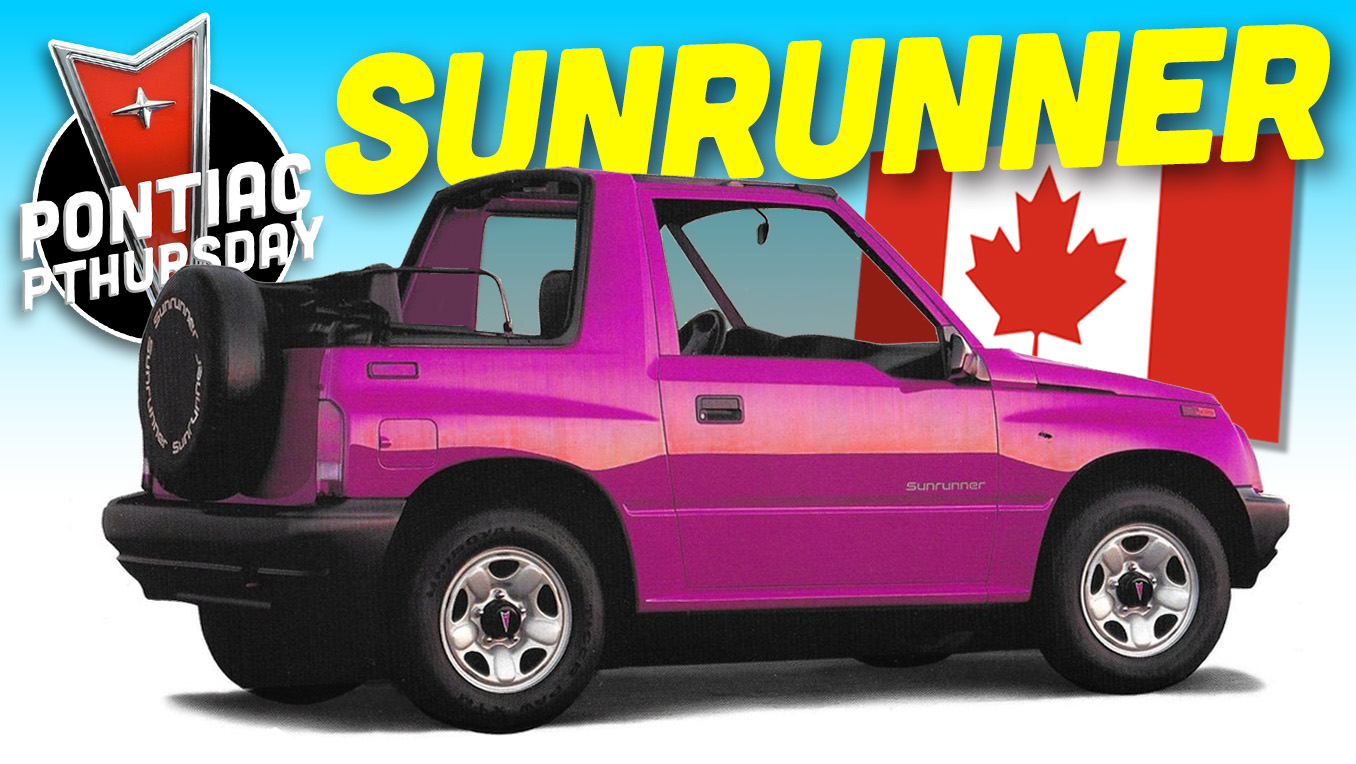
We have a lot to thank Canadians for. From maple syrup to poutine to even our own German-car wrenching wordsmith Thomas Hundal, our neighbors up north are responsible for some great things we enjoy here in the Lower 48.
Over thirty years ago, the province of Ontario helped us avoid the infamous Chicken Tax by assembling a very fun and capable little mock-Wrangler off-roader and importing it here. In their own country, however, they sold this particular product as the only ‘light truck’ ever to have a Pontiac badge on it. Meet the Pontiac Sunrunner.


Great Sales, Uh, Turnover
In North America, the Sunrunner story starts in the mid-eighties when a company best known for two-wheeled recreation vehicles decided to sell one with four tires in the US. Introduced for the 1986 model year, Suzuki’s Samurai was the brand’s legendary Jimny sport utility made up for the American market and offered in both hard top and convertible body styles.
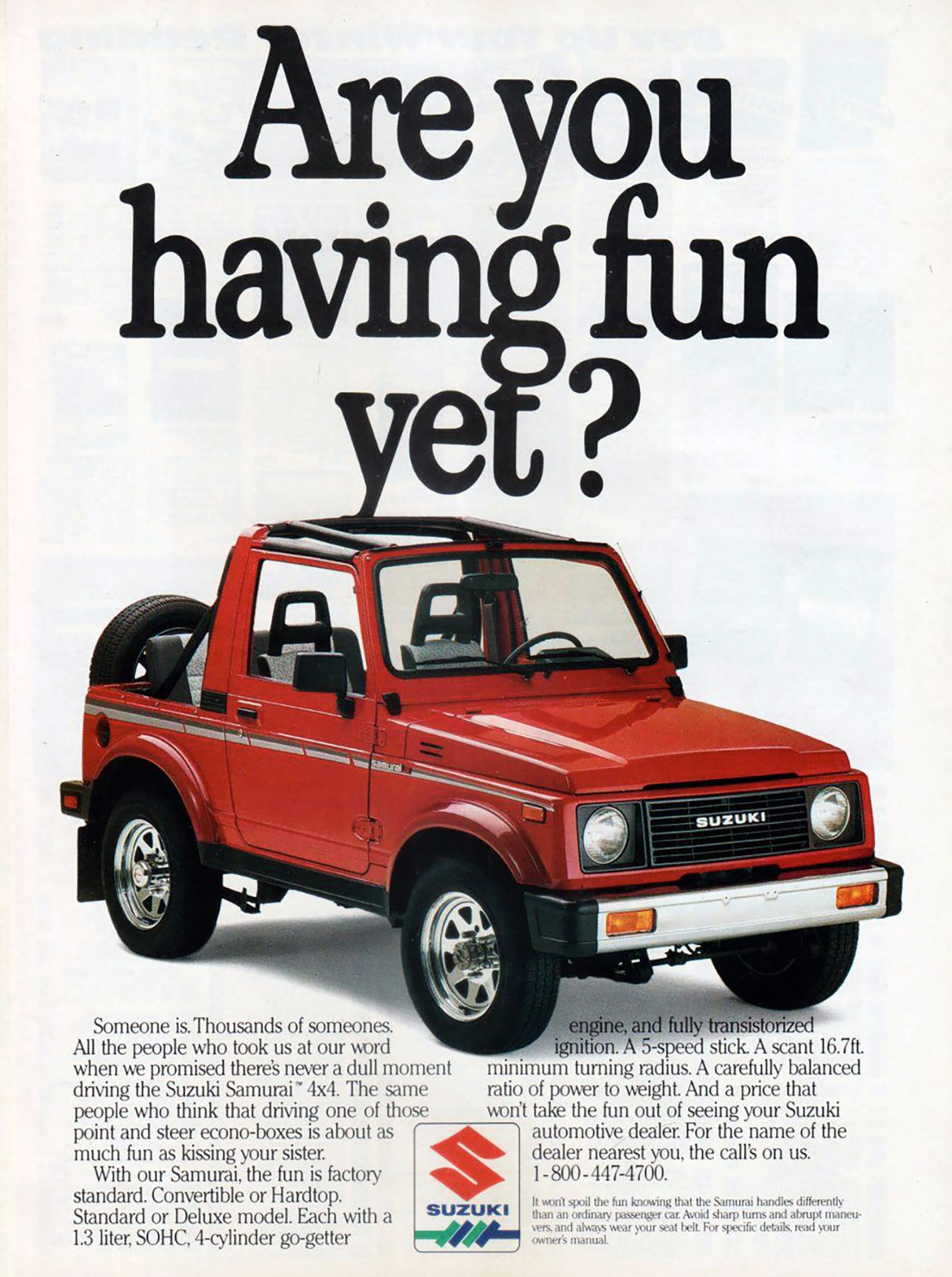
Priced at a mere $6200, it quickly outsold the Wrangler YJ, and Suzuki moved nearly twice as many Samurais as the Jeep, which was priced $2,000 more than the Suzuki.
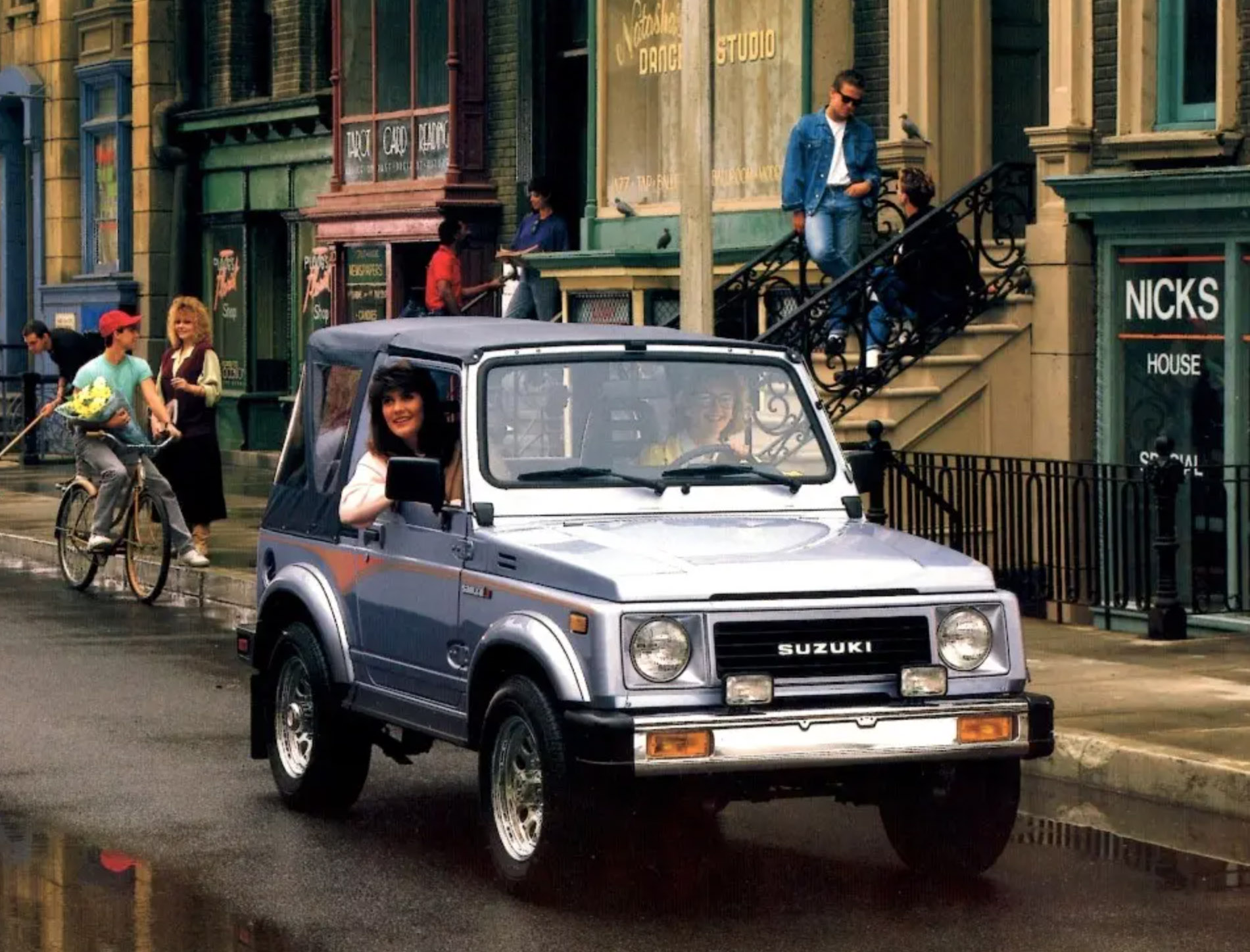
The ad campaign was great at promoting what was almost third-world transportation as a first-world plaything. It was high fun, high value, and, unfortunately, high center of gravity. Consumer Reports felt it could too easily be steered into a rollover, which earned a NOT ACCEPTABLE rating from CR, though the NHTSA tests did not find it significantly worse than many other SUVs. Suzuki sued the magazine and later settled, but at that point, the damage was done. At least the one Jack White bought fairly recently is a hardtop to protect him if he tries to replicate the Consumer Reports “test”.
[Ed Note: It was later found that the Suzuki Samurai actually didn’t roll any easier than other SUVs of the day. The Samurai even vastly outsold icons like Jeep, but that all changed after the CR report.]

Despite the early market success, Suzuki was going to run out of buyers fast with so agricultural an offering. The solution was a vehicle that would end up wearing so many different brand badges, that they may as well have been magnetic.
The Sidekick’s Sidekicks
A more car-like SUV would be needed by Suzuki to increase its share in the market that was then in its infancy before growing into the monster it is today. There would be challenges, though. The 25 percent so-called “Chicken Tax” on imported trucks meant that something domestically made would be the most cost-effective solution, so a joint venture called CAMI (Canadian Automobile Manufacturing Inc.) was created with Suzuki and GM of Canada to build this new, more streetable SUV in Ingersol, Ontario as well as Japan.
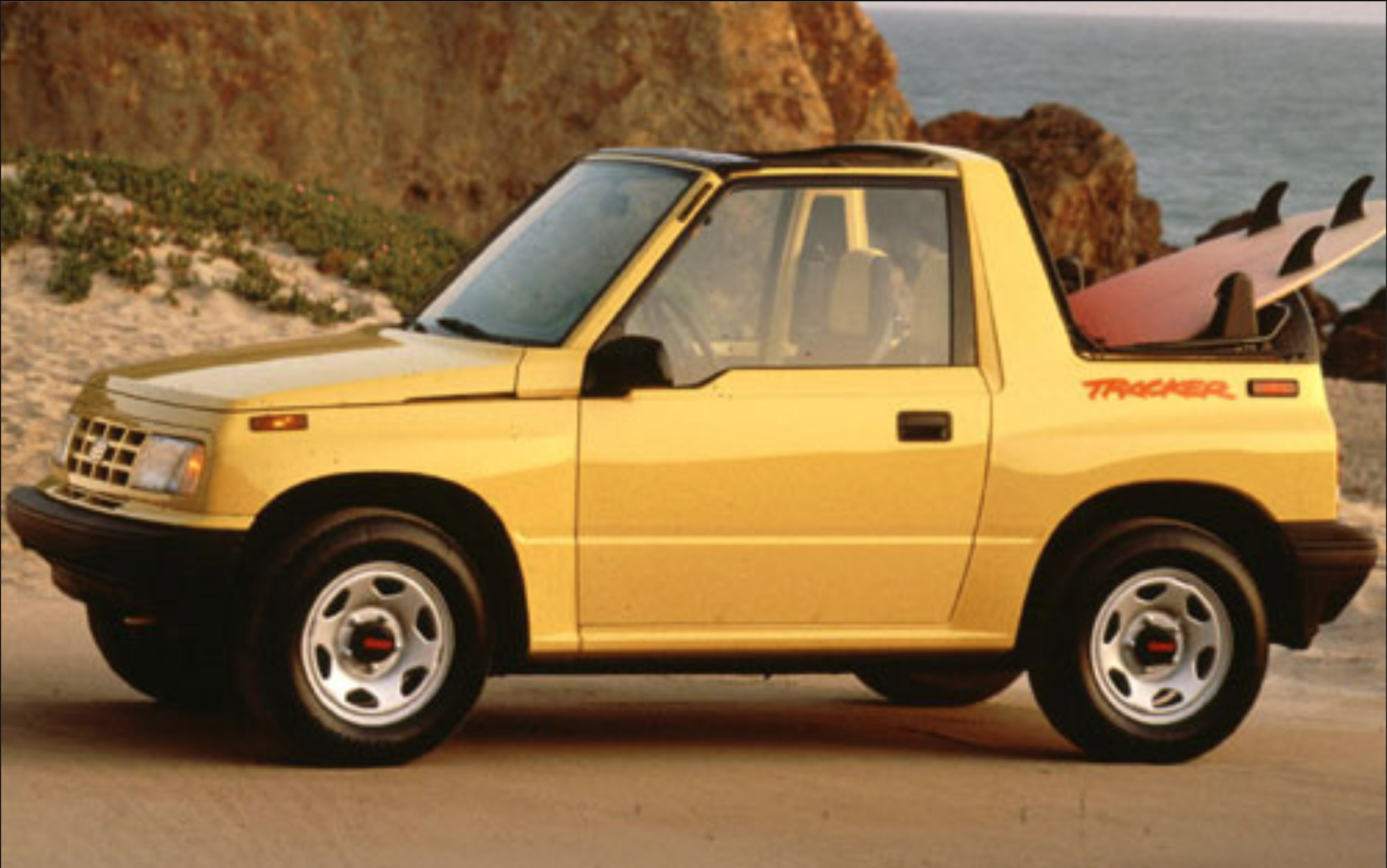
This new mini SUV was launched as a 1989 model called the Sidekick at Suzuki dealers and the Tracker under the new “Geo” brand of captive imports in the US. Some teething issues with the new factory meant that nearly all of the 1989 and early 1990s were actually built in the Japanese Suzuki factory and imported to North America.

Of course, Canada did not yet have a “Geo” brand, so how were they going to sell it in the country that actually built it? Well, that’s where things go strange. In Canada, General Motors has had a bizarre history of selling “captive imports.”
From the fifties up through the early seventies, GM sold British-built Vauxhalls as Envoys and later as Firenzas; cars that turned out to be so bad that owners held protest parades that Jason wrote about a little while back.

Later on in the eighties, GM came up with “Passport” dealers to sell a selection of Isuzu cars and trucks, plus a Daewoo-built Opel that we got in America as the unloved Pontiac LeMans, which was called the Passport Optima in Canada.
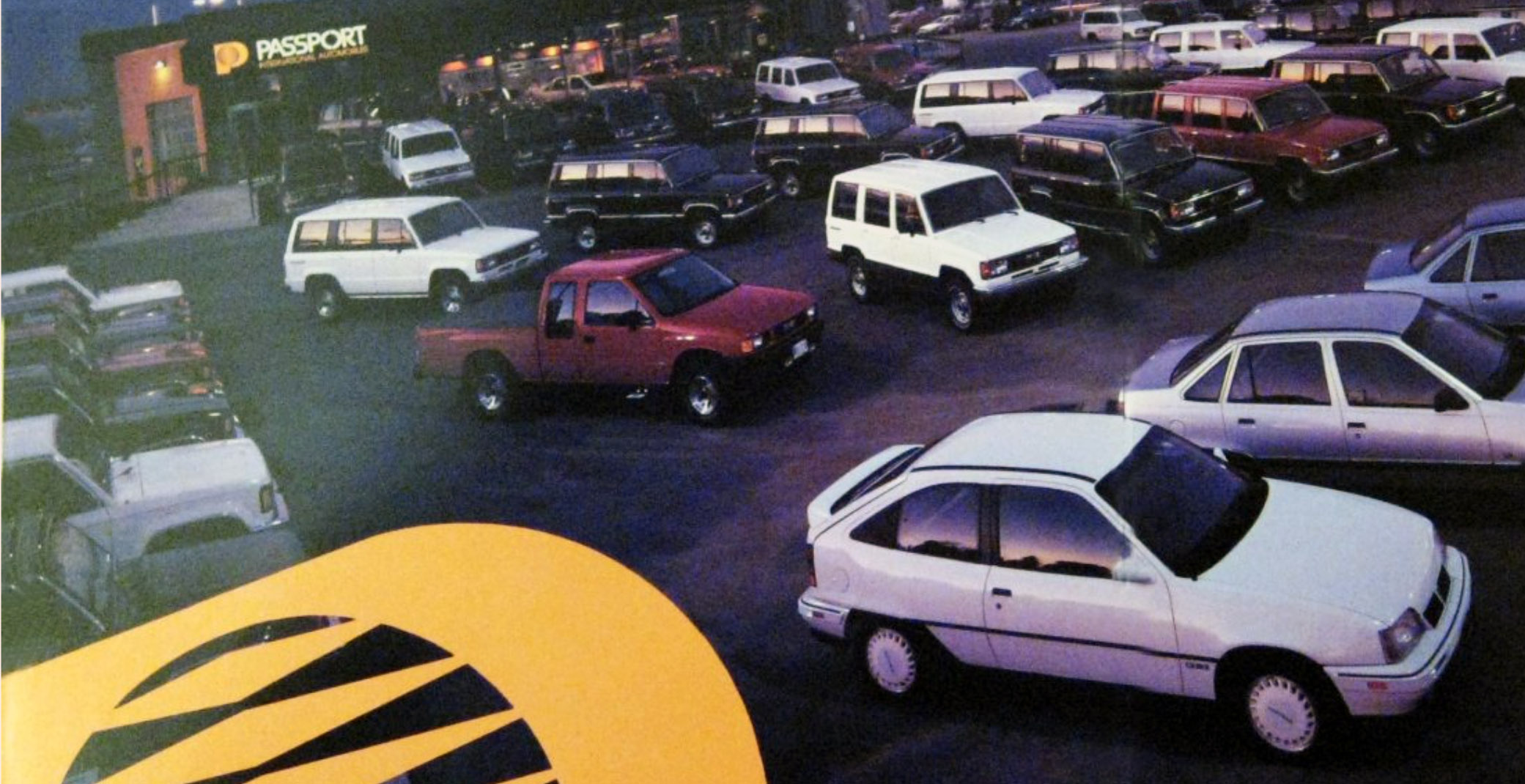
Initially, the Tracker was sold with a Chevy bowtie at Canadian Chevrolet-Oldsmobile-Cadillac dealers and as an identical product at Pontiac-Buick-GMC dealers. Suzuki- and Isuzu-branded “captive imports” had sold well at the Chevy stores, so GM decided to match the States and sell them under the Geo brand in Canada for 1992. This left the Pontiac-Buick-GMC dealers wanting their own versions of these products, leading The General to come up with the “Asuna” brand. This has to be the most phonetically contrived names ever thought up, complete with Motley Crue-style umlauts. Asuna also sold that awful Daewoo Opel and the Sunfire, which was a rebadged Isuzu Impulse twin of the Geo Storm:
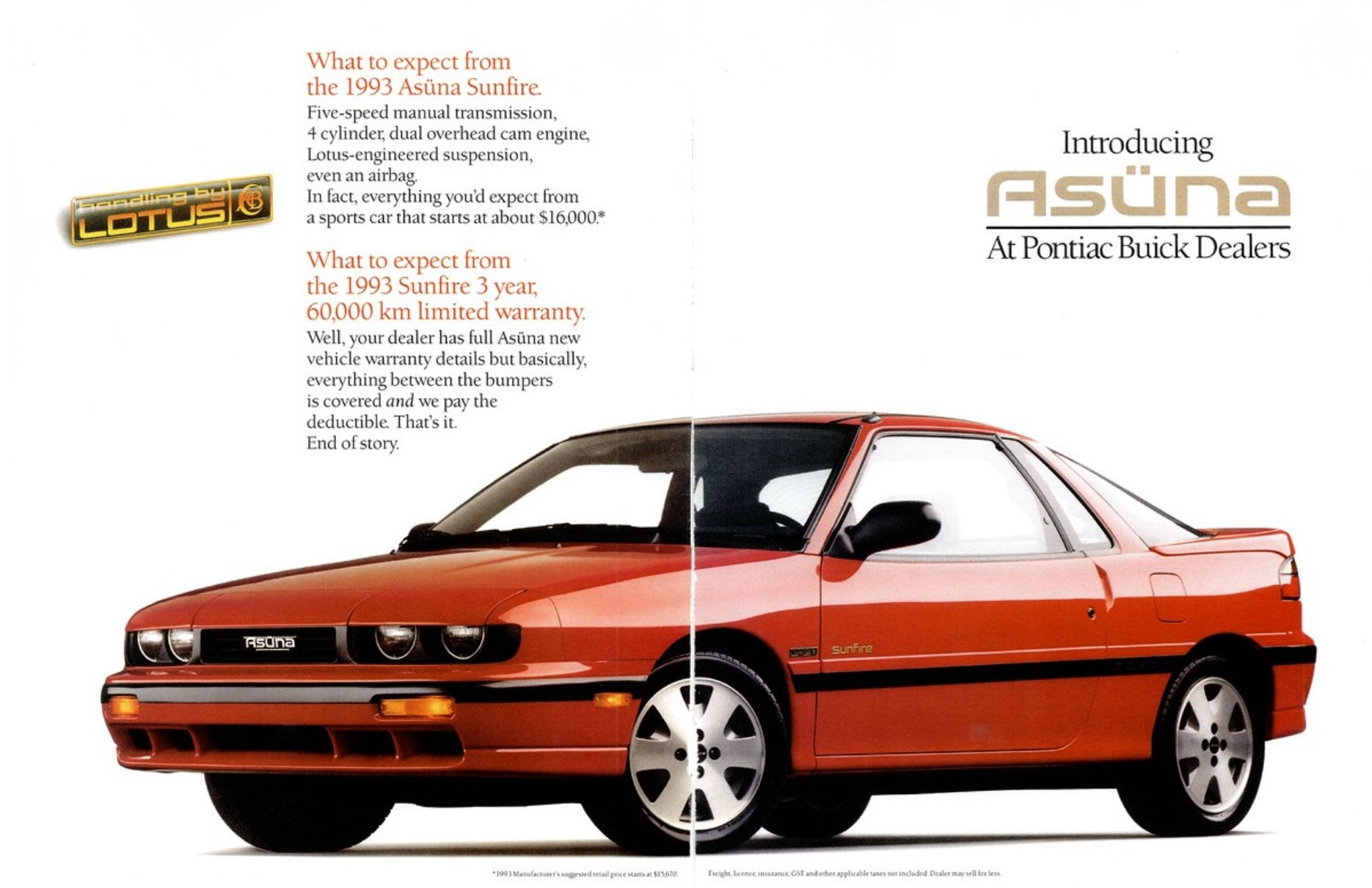
Asuna received the former-GMC Tracker and called it the Sunrunner. You can see that they got a relatively well-equipped version compared to some of the stripped-down Geo variants. Look at that dopey Asuna logo.

As expected, this sort of stupid-sounding brand only lasted for two model years in Canada; the Daewoo Opel and the Storm clone were unceremoniously dropped, while the Sunrunner now became the only Pontiac light truck ever sold.

This newly christened and groundbreaking Pontiac sure looked like fun. Still, what was it like to drive?
You Hear The Thunder, The Call Of (No) Road
The so-called Sunrunner was a cute, modern-looking thing that gave the appearance of a very car-like product with an interior that wasn’t exactly lavish but still more livable than a YJ Wrangler.

One might assume from this that it was underpinned by the mechanicals of a small sedan. Those appearances were deceiving; under its skin, the Sunrunner was a body-on-frame light truck with a very capable four-wheel-drive system featuring a hi-low transfer case (a rear drive version was also offered). Unlike the outgoing Samurai with Wrangler-like live axles on leaf springs front and back, the Sunrunner came with independent front suspension and a live axle only in back, all on coil springs.

That ruggedness was and still is admired by off-roaders, as you can see from these antics here with non-Pontiac versions:
Despite the coil springs and no live axle up front, on the streets and highways the Tracker gave a pretty good impersonation of a truck. The ride wasn’t spectacular; if you’re cross-shopping an old RAV4 and think that this Geo product will be comparable, forget it.
The 1.6 liter SOHC four produced 80 horsepower to start out with, mated to a five speed or three speed automatic; later models got a rocket ship-like 95 BHP and even an extra gear on the optional slushbox. Look, the thing has a low range for a reason.

I can’t find production figures, but the Pontiac Sunrunner lasted surprisingly long under one brand name for a Canadian GM product; from the 1994 model year all the way through 1998. The four door bodystyle that the other Suzuki variants received was never sold as a Pontiac; also, based on the brochures I’ve seen the steel hardtop model of Sunrunner ceased to exist after around the 1995 model year. Hey, it’s a Sunrunner, dammit! Give it a soft top, right?
No, The Aztek Was Not A Truck
When the second-generation Tracker debuted for 1999, no Sunrunner version was offered. That makes the Sunrunner the last and only Pontiac light truck. Some commercial vehicles were offered in the late twenties, but they were simply car based. The various El Camino clones (like the one based on the G8 near the end of Pontiac’s life) were just one offs; the Montana simply a minivan dressed up like a mock SUV. The Aztek? Don’t get us started.

I’ve only seen one Sunrunner for sale; this non-running but clean looking example for an asking price of $2500. Trackers and Sidekicks are hard enough to find, so I’d imagine the Pontiac version is thin on the ground.
Was the Sunrunner just a badge engineered bodge or a real Pontiac? Well, if so, you could call any number of platform-sharing GM products that wore the Pontiac logo the same thing. The Sunrunner was undeniably an amusing, capable and machine that could be quite a thrill to drive with the top down on a beach or on some muddy back trail. If that’s not Pontiac excitement, what is?
Pontiac Points: 64/100
Verdict: The WalMart BMW brand make a Dollar General Land Rover that was almost as capable, and a lot more reliable.
Top graphic image: General Motors


Man one of these to go along with my Fiero would create a pretty cool Pontiac garage.
GM really made a hash of their brand names. Whoever came up with Asuna should have been tarred and feathered, and run out of town on a rail.
Whoever decided to take a Japanese name and add an umlaut should also share this fate.
Anybody that knows the joys of just having fun with something simple, small, and cheap knows what a gem these things are to own. In my mind, it sits on the Mt Rushmore of things that anyone can afford, but are rarely appreciated for just how great they are. Looked over because of their small size and simplicity, so many never get to understand that greatness can come from the humblest of places.
Nothing fancy. No frills. No pretenses, no status symbol. Just wholesome, cheap, fun.
The Doritos Loco Taco. The Ruger 10/22. The Honda Recon 250.
The Geo Tracker.
Suzuki Vitara in the UK, I remember the Fatboy version with fender flares and twisted three spoke deep dish alloys was very cool.
So the Sunrunner was eating the Jeep Wrangler for lunch and they user CR to attack it for being prone to rollover? Isn’t that like having Roseanne attacking Whoopi and attacking her for being bat shit crazy?
Ah! It’s my moment to shine!
So first of all, as the article mentioned, this car was sold with six different names in Canada: Chevrolet Tracker, GMC Tracker, Geo Tracker, Asuna Sunrunner, Pontiac Sunrunner, and Suzuki Sidekick!
My first (two) cars were a 1996 Pontiac Sunrunner (16 valve, 2-door, removable fiberglass roof, 4×4, 5-speed), and a 1997 Suzuki Sidekick (4-door, 4×4, automatic) that I bought for $700 from a zoo, when I was 16! My dad and I spent two long days driving ~4 hours and back to Peterborough, ON, to pick them up, one at a time.
The Pontiac was definitely the one to fix up, and the Suzuki was to be the parts car. According to the seller, the Pontiac only needed a new fuel tank and a camshaft position sensor to get running again. I spent a good bit of time that summer cleaning the cars out, removing the gas tank from the Pontiac, and realizing that the 4-door Suzuki’s gas tank was larger, and wouldn’t fit the Pontiac. At some point, a more mechanical family friend took a look at them, and essentially told me that I’d never get it on the road. I guess the body mounts were rusted out, and the amount of rust repair you’d need to do to get it through an Ontario safety would be prohibitive. I could have, and maybe should have, put some money into a new fuel tank, and gotten it running as a bush buggy at least, but I guess I was discouraged enough that I didn’t want to throw any money at something I wouldn’t be getting on the road. In the end, I sold both the Sunrunner and the Sidekick for the same $700 that I got them for, and moved on from the Trackkickrunner life.
Perhaps ironically, the Pontiac Sunrunner was missing its grille, so I don’t think there were actually any Pontiac badges on it at all! I think there were some stickers, and I believe the steering wheel said Sunrunner, but I guess I was missing the most unique element!
Of course, then a couple years later I bought my ’95 Geo Tracker, and then proceeded to spend good money re-buying rims for my winter tires, and a hardtop, and other parts, that I would have had if I’d held on to the parts cars!
A life goal, that I don’t expect to put any effort into completing, is to have owned all six of those Canadian-market badge versions for this car. I’m already halfway there with Suzuki, Pontiac, and Geo, but the other three are all also pretty rare!
Dang, there’s a thought! I should head down to the local junkyard and pick up Chevrolet, GMC, and Pontiac badges, dig up my Geo and Suzuki ones, and 3D print an Asuna one. Then I can put all six on my grille, and then 3D print a Sunrunner badge to go with my Tracker and Sidekick badges on the door. Make it a Chevrolet/GMC/Pontiac/Geo/Suzuki/Asuna Tracker/Sidekick/Sunrunner!
Isn’t that 3 names and 6 brands?
Yeah, I suppose! Six make/model combinations
I knew you were going to show up, but I’m surprised there was no mention of the Suzuki Vitara, which was the most common name. It really was the car of many names, Wikipedia lists 12 including the Mazda Proceed Levante.
I think we need a Mazda Monday feature since Toyo Kogyo has weird JDM model names and some interesting technical diversions.
Yeah, Vitara is probably the most correct name internationally, but the first generation was never given that badge in Canada, so I didn’t mention it
This is awesome. Keep us posted.
I am sure these are fun off-road, and they certainly were cheap, but having spent a day in one 30 years ago on a LONG road trip to go onsite in Northern Maine, to borrow a phrase from Car Magazine “they turn tarmac into dirt”. Absolutely horrible thing to cover any distance longer than to the corner store in.
When I was 17 I drove one (96 tracker 2 dr 5 speed) from Steubenville Ohio to Ocean City MD and back with nothing but coffee stained Map-quest papers and a Neal McCoy CD.
It was an ADVENTURE
I bet. Northern Maine and back was certainly one. It was seriously cold and windy that day too. Those things didn’t like crosswinds much.
I don’t miss the days of flying to random places in the country then needing to find a hardware store in the middle of a cornfield with nothing but some printouts from DeLorme’s mapping software. I got my first TomTom One and thought I had died and gone to heaven as a road warrior.
This article reminded me that I owned one of the very last North American Chevrolet Trackers built with a 5-speed. I bought it in 2004, but it was a 2003 model. It was built in Canada. The build date was September of 2003. They started building the 2004 models in August, and the sales manager at the stealership said they received my Tracker in October, a few weeks after the ’04s started coming in. But it was titled as a 2003 model due to the manual transmission and the 4-cylinder. (The final Tracker from Canada was built on January 27th, 2004)
All 2004 Trackers were indeed all V6 automatics, according to the following brochure:
https://xr793.com/wp-content/uploads/2021/11/2004-Chevrolet-Tracker-Spec-Sheet.pdf
I no longer have that Tracker, as it rusted quite badly by the time it was only 9 years old. I even had to replace the oil pan because it rusted all the way through and started leaking. In 2012 I replaced it with a 2003 GMC Envoy, which still looks and runs great, although it only gets 10-12 mpg.
My biggest quibble I’ve always had with the Asuna brand is that they could have called this thing the Matata, and had the tagline be ‘It Means No Worries, For the Rest of Your Days’.
Ya know… Asuna Matata,y’all 😉
Out. Get out. lol
* Oot. Get oot.
A Jimney is an absolute hoot to drive. How can you not smile in a tiny stick shift 4×4 with a softtop?
Asuna was so short lived, the paragraph introducing it in my ’93 auto show guide starts with describing it as GM’s new brand, and ends the paragraph with the note that GM would be discontinuing it at the end of the year.
Although up here, a 2WD Sunrunner was about the same cost as the cheapest Jeep YJ (which came standard with 4WD). If you wanted to be extra thrifty, the Lada Niva was about $2k cheaper than either.
A Lada Niva is a car I would love to own someday, but I don’t think it has the advantage over my Tracker in really any category except the weird factor of being Soviet. And having a steel roof, if you consider that a perk?
Oh, no advantage except it was cheaper 35 years ago. Although, we got the incredibly rare Niva soft top as well!
Referring to Jack White, and rollover protection. The soft top is generally thought to be safer in rollover, because they had a proper roll bar installed from factory, at least here in the states. The hardtop is fairly tin toppy and basically crushes like a soda can if you tip it since there’s no real reinforcement.
Now it makes me wonder if there are outfitters who would do an aftermarket rollcage inside a hardtop Sammy
I grew up 90 minutes south of Montreal and regularly saw these Pontiac-badged captive imports – but I never saw a Sunrunner. Ratty DRL-equipped Fireflys and Tempests with mismatched tail lights (one Tempest, one Corsica replete with bowtie) sure. But never one of these.
Perhaps it was because Quebec was quite possibly the worst possible place for a convertible trucklet.
However – GM Canada (Pontiac specifically) has an entire volume of these cars for future installments of Pontiac Pthursday.
Me too. What I remember from the ’90s/early ’00s was for the longest time whenever I went into Canada, whether for a few hours or a long weekend, I would see exactly one Lada. No more, no less and never the same one twice.
This score is an insult to this small car.
Agreed!
There are rednecks all over the South the mid west hording Samurai’s trackers and sun runners. When they find one for sale they run and get it. Some have gotten in to kei trucks and other 4×4. But they really like to drive on the left. It’s truly fascinating they will go just about anywhere. Guys working in gas in wv pretty much drive them exclusively because it’s just the only thing that can get them where they need to go and still be road legal. The jimney needs to be back in the us.
It seems like everyone who owns any of these cars owns, like, three or more of them! I only have one, but if I was settled down on some land, I’m sure I’d pick up a parts car or two!
Indeed, the only way they sell one if they already have a better one lined up. I bought one off a guy I know because he kept pestering me about how I needed one. He already had a much better one lined up and sold me his roughest running one. He has several parts rigs stashed away. They fit pretty well in a conex too. It can be a pretty tight fit but a lot of guys can sneak in the door if you have it parked close on the passenger side.
My Geo Tracker was the best car I’ve ever owned. Basic, simple, reliable, FUN!!! Drove it for 14 years and the only issue was rust. Once I could see the road from the inside I had to replace it, but I miss it dearly.
We daily drove ours (89 kick 5spd 4wd) for over 20 years. Mainly got rid of it when the rear seat belt mounts rusted out, so no longer safe to haul the kiddos around in.
My wife is still disappointed that no one sells a modern version these days (has to have a removeable top). It would go anywhere, anytime.
I had a 4 door Sidekick in college. It was an auto, unfortunately, but man was it fun to tool around in and take on the many miles of dirt roads and trails in the area. My friend had given me a big subwoofer in a box that I just chucked in the cargo compartment. I needed 12V power for it and the rear defroster was broken, so I just stole that wire and used it, giving me on-demand bass by pushing the defrost button.
I sold it when I got married since we were moving cross country and my wife’s Mazda3 didn’t strain to hit 65 while the tops of the doors flapped in the wind. There’s one in my area that looks just like mine now, and I’m always tempted to go knock on the door to see what they’d take for it.
I’ve got a two-door, which I believe came with a soft top (with no defroster!) from the factory. I later installed a fiberglass hard top, which had a built-in defroster, and was very pleased to discover that my defroster button worked, and had wires already run to the right area! It’s like the factory had planned for my eventual upgrade, 29 years later!
I would like to offer a correction. The Samurai did NOT have a tip over problem. There is evidence that Consumer Reports took issue with the Samurai for some reason and very deliberately skewed the rollover test. They pushed the Samurai harder and harder until they got a rollover, then presented that as though they had done the normal test. Suzuki sued, and though they settled out of court, CR has come out and said they “never intended to state or imply that the Samurai easily rolls over in routine driving conditions”. NHTSA data shows that the rollover frequency of Samurai is the same as the same years of S10 Blazers.
A samurai was one of the 3 roll over accidents I have been in. IT was the only one we rolled back up right and drove away from.
Please remind me not to get into a vehicle with you. Or maybe you’re the norm for Autopians and I’m the outlier with no rollover experience.
I had a bad year in highschool. One bad roll over, one in the Suzuki, and one in a Jeep. Both Suzuki and Jeep were in ditches in farm fields screwing around with 4x4s.
Thanks for beating me to the punch, I really wish stories that include this non-trivial bullshit would call it out for what it was. As a former Samurai as a first car owner, I can confirm that if they were prone to roll over; I certainly would have rolled mine.
It was, IMHO, motorsports manufacturers like Polaris, Can-Am and others that bribed CR to manufacture that rollover risk to scare buyers away. Potentially also the Big Three. Though the Sidekick/Samurai wasn’t THAT much smaller than a two door Blazer/Bronco II at the time.
Somebody had a major hardon for killing off small, affordable trucklets in the NA market, that much is obvious.
We rode to HS a few times with a girl that had a Samurai, four of us in that little thing. All I could think of is this chick is gonna send us, because that CR reporting was all over the place back then around the early 90s
I thought the Samurai was kinda cool when it came out. Same with the Geo Tracker ,even if my red-neck NC Navy friend scoffed at “fuel efficient 4WD”.
I guess there are a hundred ways to define the word “truck”, but Pontiac sold Sedan Deliveries from about 1949-1958 and by my definition, they’re trucks.
They are to me, too. But the Sunrunner was, for some reason, classified as a light truck by the NHTSA
NHTSA’s definitions for a light truck are so generous that the PT Cruiser, HHR, and Matrix/Vibe twins are also classified as light trucks.
Light truck was down to flat loading area or removable seats if I remember right. So small wagons and suvs that had a flat floor design all counted to bring down truck fleet efficiency average.
There ya go right there! The Vibe was a light truck!!
Why would the NHTSA classify the Sunrunner as anything? It wasn’t sold in the states! (j/k, I assume you meant the Tracker/Sidekick)
I’d love to drive into Cars and Coffee in a Pontiac Sunrunner.
Me too. With a few boxes of Timbits in the trunk
Indeed, can use the Timbits to draw people over to your “Geo Tracker”, and watch their faces when they see the Pontiac emblem!
I’m STILL salty that the deal I made last fall on a Pontiac Sunrunner fell through.
I’ll own one, one day…
Well at least that prevented rust from occurring.
In some parallell universe, the Samurai was definitely sold as the Pontiac Suntumbler or Suntoppler or perhaps Pontiac Capsize.
I think the Sunfire was a rebadged Isuzu Impulse, rather than its mechanical (but differently styled) twin the Geo Storm.
Came to say this. The Storm had a unique front fascia, whereas the Sunfire is visually identical to the Impulse. I always preferred that nose to the Storm’s.
I think I read somewhere that for every Impulse that Isuzu managed to sell in the US, Geo moved 30 Storms. This despite the fact that the Impulse could be had as an AWD turbo RS. How’s that for the power of marketing, branding and dealer networks?
A turbo AWD RS version of (basically) a Geo Storm? Damn I’d like to see/drive one of those.
They were rare even when new.
Yeah, sorry about that. I’ll clarify it; also apparently Asuna got the cool shooting brake version.
The Pontiac versions of non-Pontiac cars Canada got but we didn’t always intrigue me. A little. Until I realize that badge aside there’s nothing much different. Would still be fun to import one and make people do a double take.
The whole Pontiac Canada thing was definitely interesting, and more a quirk of how GM was set up there.
In Canada, many dealerships paired Chevrolet/Oldsmobile/Cadillac together, and then Pontiac/Buick/GMC together. Only…Chevrolet’s sales volume could outsell everybody else combined. And because dealer networks were thinner, GM Canada needed each dealer to have a broader lineup at multiple price points. So rather than letting Chevrolet dominate, GM Canada decided to even out the score and let Pontiac extend to selling lower-end cars, as well. That allowed Chevrolet-level cars to be sold at Pontiac dealerships, rather than needing to have Chevrolet dealers in those same areas. And that gave GM a fuller reach at all price levels.
As far as building them in Canada, keep in mind that this practice began back when GM was more or less a collection of interconnected but distinct companies, with a mixture of common and unique engineering. Before the 1965 Auto Pact, Canada and the US had tariffs and a more-segmented auto industry, so Chrysler, Ford and GM often built Canada-specific variants of cars at Canadian plants rather than shipping them north from the US. It was cheaper that way.
The reasons those Canadian-built Pontiacs were Chevrolet-based was because GM Canada already had Chevrolet manufacturing infrastructure up there. Building the Pontiac cars in Canada and having them actually use Pontiac engines and frames would have required more unique tooling, more parts complexity and more cost…for a smaller market. So GM Canada instead took the (often-smaller) Chevrolet underpinnings and adapted Pontiac styling to fit them.