

We have a lot to thank Canadians for. From maple syrup to poutine to even our own German-car wrenching wordsmith Thomas Hundal, our neighbors up north are responsible for some great things we enjoy here in the Lower 48.
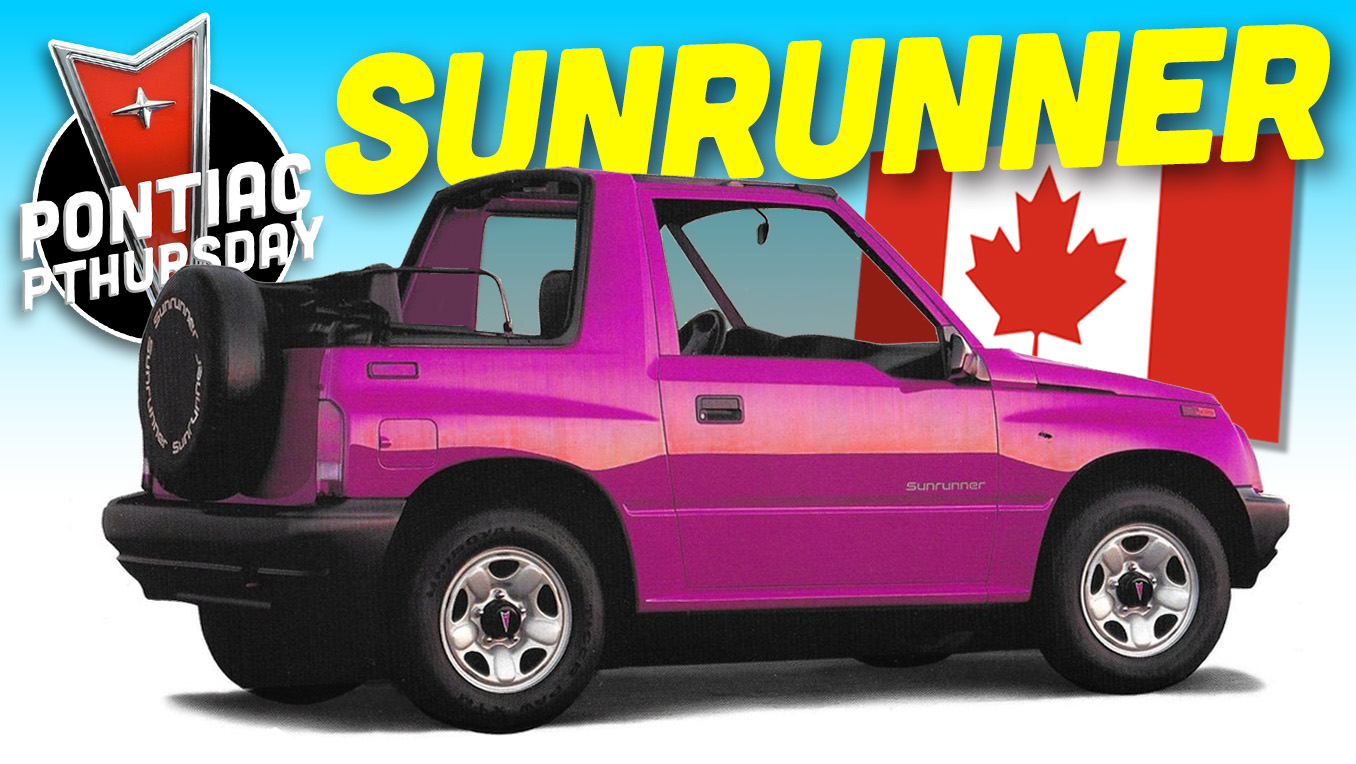
Over thirty years ago, the province of Ontario helped us avoid the infamous Chicken Tax by assembling a very fun and capable little mock-Wrangler off-roader and importing it here. In their own country, however, they sold this particular product as the only ‘light truck’ ever to have a Pontiac badge on it. Meet the Pontiac Sunrunner.


Great Sales, Uh, Turnover
In North America, the Sunrunner story starts in the mid-eighties when a company best known for two-wheeled recreation vehicles decided to sell one with four tires in the US. Introduced for the 1986 model year, Suzuki’s Samurai was the brand’s legendary Jimny sport utility made up for the American market and offered in both hard top and convertible body styles.
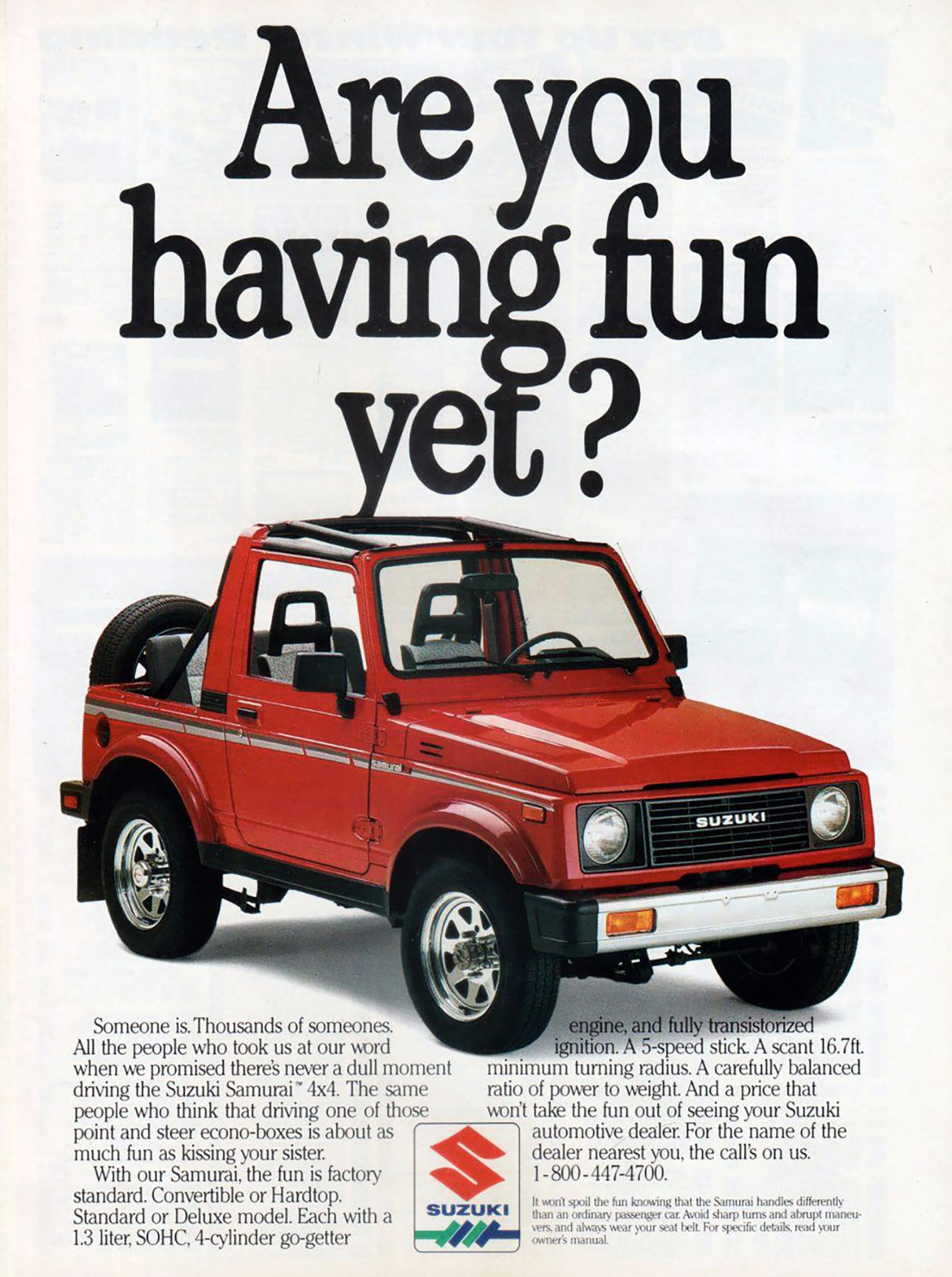
Priced at a mere $6200, it quickly outsold the Wrangler YJ, and Suzuki moved nearly twice as many Samurais as the Jeep, which was priced $2,000 more than the Suzuki.
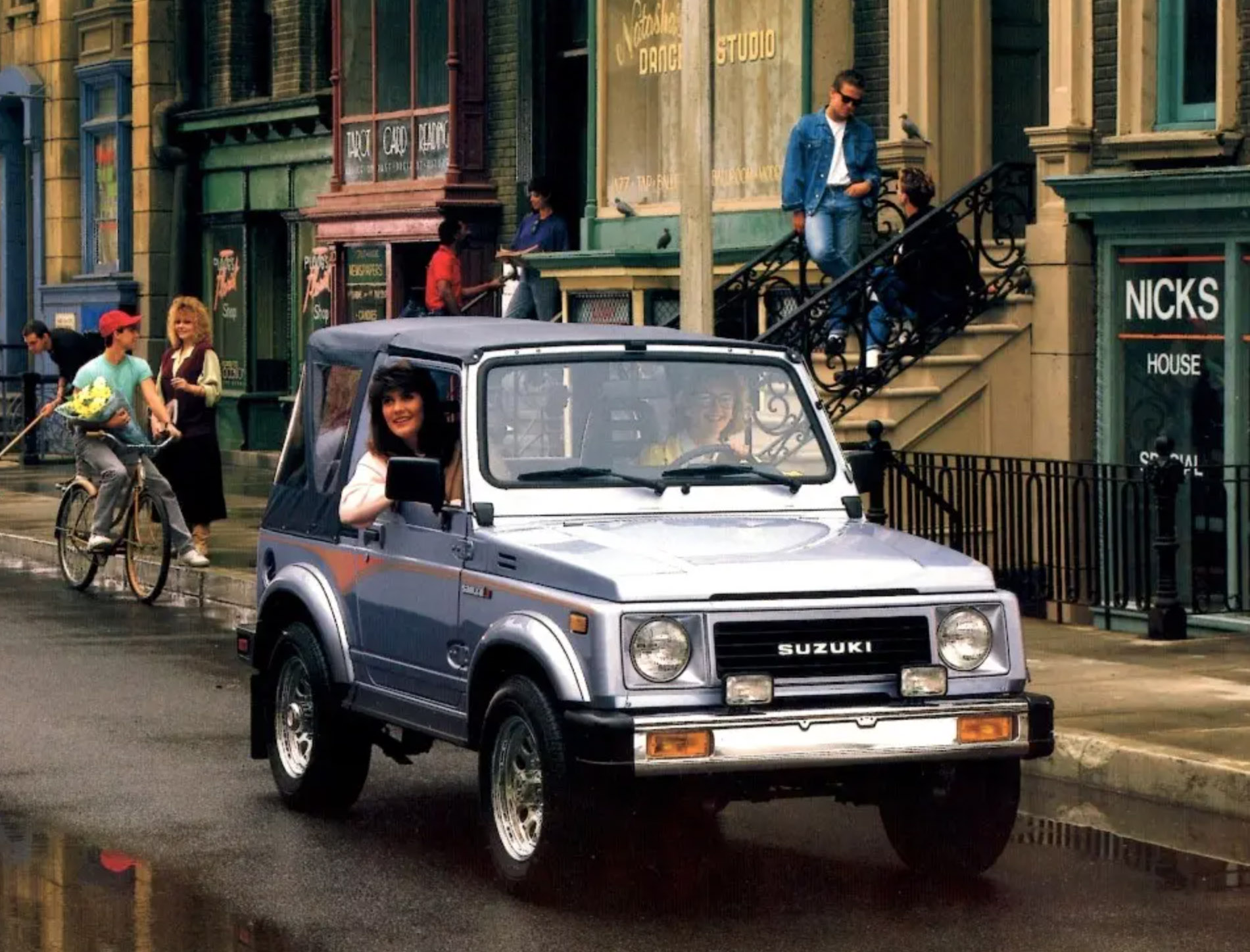
The ad campaign was great at promoting what was almost third-world transportation as a first-world plaything. It was high fun, high value, and, unfortunately, high center of gravity. Consumer Reports felt it could too easily be steered into a rollover, which earned a NOT ACCEPTABLE rating from CR, though the NHTSA tests did not find it significantly worse than many other SUVs. Suzuki sued the magazine and later settled, but at that point, the damage was done. At least the one Jack White bought fairly recently is a hardtop to protect him if he tries to replicate the Consumer Reports “test”.
[Ed Note: It was later found that the Suzuki Samurai actually didn’t roll any easier than other SUVs of the day. The Samurai even vastly outsold icons like Jeep, but that all changed after the CR report.]

Despite the early market success, Suzuki was going to run out of buyers fast with so agricultural an offering. The solution was a vehicle that would end up wearing so many different brand badges, that they may as well have been magnetic.
The Sidekick’s Sidekicks
A more car-like SUV would be needed by Suzuki to increase its share in the market that was then in its infancy before growing into the monster it is today. There would be challenges, though. The 25 percent so-called “Chicken Tax” on imported trucks meant that something domestically made would be the most cost-effective solution, so a joint venture called CAMI (Canadian Automobile Manufacturing Inc.) was created with Suzuki and GM of Canada to build this new, more streetable SUV in Ingersol, Ontario as well as Japan.
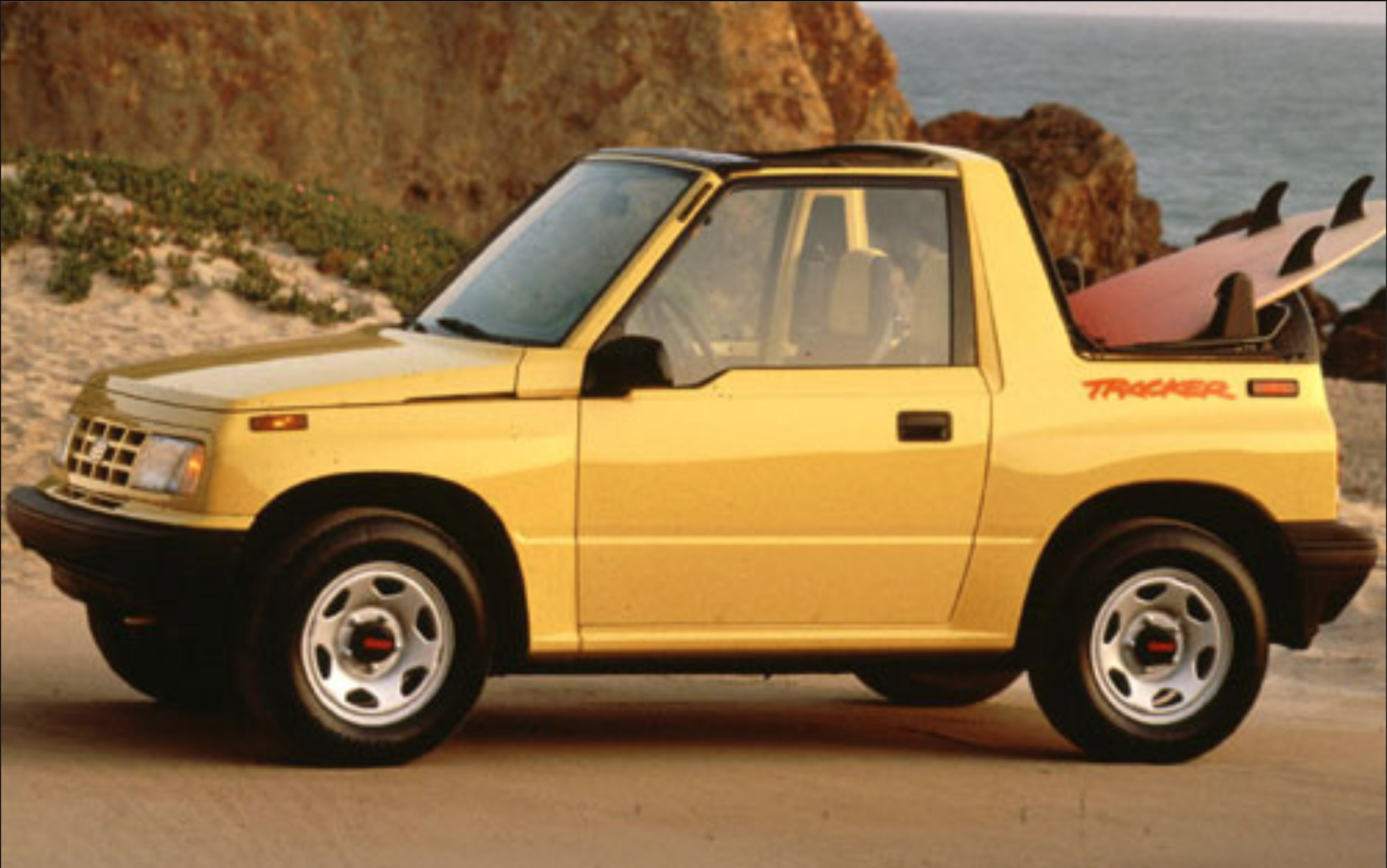
This new mini SUV was launched as a 1989 model called the Sidekick at Suzuki dealers and the Tracker under the new “Geo” brand of captive imports in the US. Some teething issues with the new factory meant that nearly all of the 1989 and early 1990s were actually built in the Japanese Suzuki factory and imported to North America.

Of course, Canada did not yet have a “Geo” brand, so how were they going to sell it in the country that actually built it? Well, that’s where things go strange. In Canada, General Motors has had a bizarre history of selling “captive imports.”
From the fifties up through the early seventies, GM sold British-built Vauxhalls as Envoys and later as Firenzas; cars that turned out to be so bad that owners held protest parades that Jason wrote about a little while back.

Later on in the eighties, GM came up with “Passport” dealers to sell a selection of Isuzu cars and trucks, plus a Daewoo-built Opel that we got in America as the unloved Pontiac LeMans, which was called the Passport Optima in Canada.
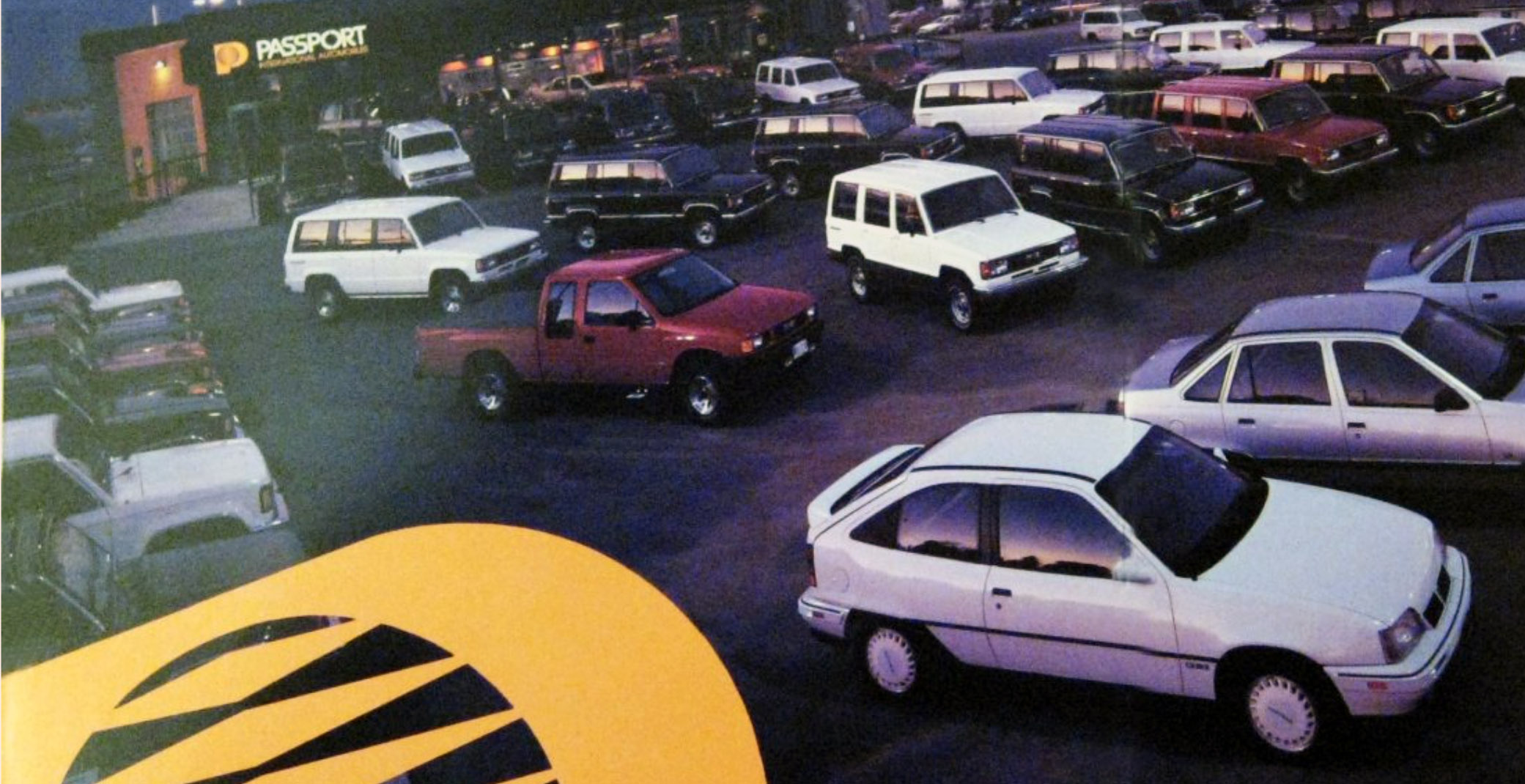
Initially, the Tracker was sold with a Chevy bowtie at Canadian Chevrolet-Oldsmobile-Cadillac dealers and as an identical product at Pontiac-Buick-GMC dealers. Suzuki- and Isuzu-branded “captive imports” had sold well at the Chevy stores, so GM decided to match the States and sell them under the Geo brand in Canada for 1992. This left the Pontiac-Buick-GMC dealers wanting their own versions of these products, leading The General to come up with the “Asuna” brand. This has to be the most phonetically contrived names ever thought up, complete with Motley Crue-style umlauts. Asuna also sold that awful Daewoo Opel and the Sunfire, which was a rebadged Isuzu Impulse twin of the Geo Storm:
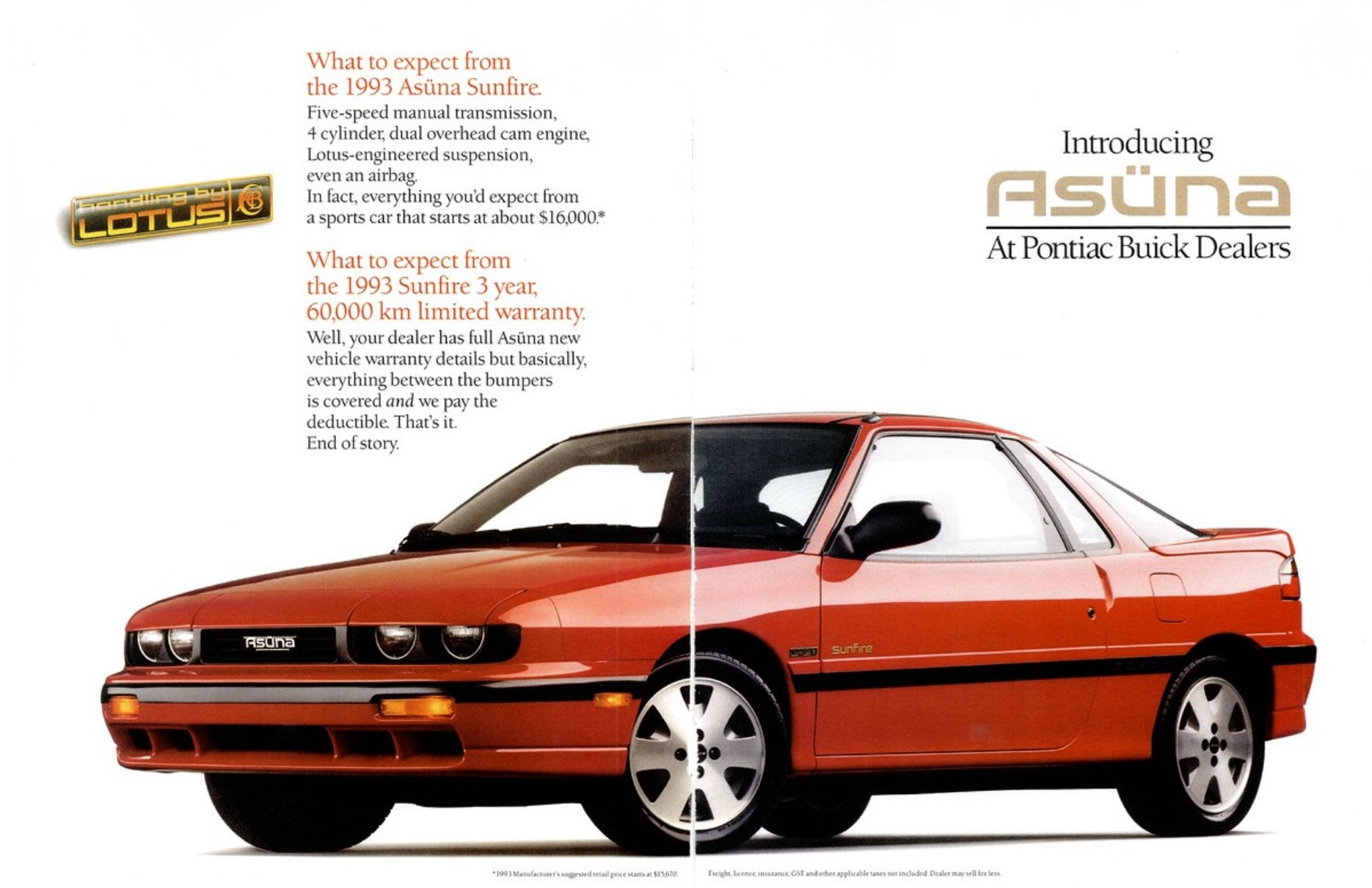
Asuna received the former-GMC Tracker and called it the Sunrunner. You can see that they got a relatively well-equipped version compared to some of the stripped-down Geo variants. Look at that dopey Asuna logo.

As expected, this sort of stupid-sounding brand only lasted for two model years in Canada; the Daewoo Opel and the Storm clone were unceremoniously dropped, while the Sunrunner now became the only Pontiac light truck ever sold.

This newly christened and groundbreaking Pontiac sure looked like fun. Still, what was it like to drive?
You Hear The Thunder, The Call Of (No) Road
The so-called Sunrunner was a cute, modern-looking thing that gave the appearance of a very car-like product with an interior that wasn’t exactly lavish but still more livable than a YJ Wrangler.

One might assume from this that it was underpinned by the mechanicals of a small sedan. Those appearances were deceiving; under its skin, the Sunrunner was a body-on-frame light truck with a very capable four-wheel-drive system featuring a hi-low transfer case (a rear drive version was also offered). Unlike the outgoing Samurai with Wrangler-like live axles on leaf springs front and back, the Sunrunner came with independent front suspension and a live axle only in back, all on coil springs.

That ruggedness was and still is admired by off-roaders, as you can see from these antics here with non-Pontiac versions:
Despite the coil springs and no live axle up front, on the streets and highways the Tracker gave a pretty good impersonation of a truck. The ride wasn’t spectacular; if you’re cross-shopping an old RAV4 and think that this Geo product will be comparable, forget it.
The 1.6 liter SOHC four produced 80 horsepower to start out with, mated to a five speed or three speed automatic; later models got a rocket ship-like 95 BHP and even an extra gear on the optional slushbox. Look, the thing has a low range for a reason.

I can’t find production figures, but the Pontiac Sunrunner lasted surprisingly long under one brand name for a Canadian GM product; from the 1994 model year all the way through 1998. The four door bodystyle that the other Suzuki variants received was never sold as a Pontiac; also, based on the brochures I’ve seen the steel hardtop model of Sunrunner ceased to exist after around the 1995 model year. Hey, it’s a Sunrunner, dammit! Give it a soft top, right?
No, The Aztek Was Not A Truck
When the second-generation Tracker debuted for 1999, no Sunrunner version was offered. That makes the Sunrunner the last and only Pontiac light truck. Some commercial vehicles were offered in the late twenties, but they were simply car based. The various El Camino clones (like the one based on the G8 near the end of Pontiac’s life) were just one offs; the Montana simply a minivan dressed up like a mock SUV. The Aztek? Don’t get us started.

I’ve only seen one Sunrunner for sale; this non-running but clean looking example for an asking price of $2500. Trackers and Sidekicks are hard enough to find, so I’d imagine the Pontiac version is thin on the ground.
Was the Sunrunner just a badge engineered bodge or a real Pontiac? Well, if so, you could call any number of platform-sharing GM products that wore the Pontiac logo the same thing. The Sunrunner was undeniably an amusing, capable and machine that could be quite a thrill to drive with the top down on a beach or on some muddy back trail. If that’s not Pontiac excitement, what is?
Pontiac Points: 64/100
Verdict: The WalMart BMW brand make a Dollar General Land Rover that was almost as capable, and a lot more reliable.
Top graphic image: General Motors



I’ve got a friend here that really wants a tin top Tracker like those Sunrunners, it’s a shame they were mostly northern only. All the transplants I see down here are all nearly rusted to death.
Ok. Geo, Pontiac, Suzuki Trackers aside, I had no idea that Canada got The Impulse with the actual full Impulse body. Nice! I’ll take mine with a turbo and AWD. I dont know about up there but finding an Impulse like that in the states ir probably rarer than a Rarri F50. And I like the styling more than the Storm.
I have an original Isuzu passport brochure here at home in really good shape that I scanned several years back! 😀
https://drive.google.com/file/d/1gk_WJ37lzrwOgE4suCmZ92NmSg0UE9m_/view?usp=sharing
That generation of the Suzuki Vitara (the rest-of-the-world branding) was a decent little thing. Droney gearbox and a rather bouncy ride, but fine.
That was a neat little car! My mom drove a Geo Tracker from 1990 to 1997; she and dad sold it shortly after they bought the Grand Cherokee. The only issue I remember with it is that Mom was terrified of driving it in heavy rain.