


For decades, countless Americans have dreamed of being able to connect between cities at a lightning pace without having to board a plane. Unless you live in the Northeast, true high-speed rail probably remains a dream for you. But we didn’t get to where we are today without trying. In the 1960s, the New York Central Railroad experimented with the idea of sending a train down existing rails at speeds not seen before in America. Its testbed was the M-497, a wild railcar that was normally self-propelled by a diesel engine, but had a pair of General Electric J47-GE-19 turbojets from a Convair B-36 Peacemaker on its roof. This train would set a record, but also didn’t usher in the future some hoped for.
This story comes from a dark period in passenger railroading history. As the National Railroad Museum explains in its exhibits, rail travel experienced a squeeze during the Great Depression as passenger volume plummeted. World War II was a sort of blessing for the railroads as there became a need to transport people, vehicles, and materials across America. Helping even further was the fact that Americans faced wartime restrictions on driving.


After the war, Americans returned home not to ride the train, but to spend their money on a shiny new automobile. America had a growing network of roads, and cars offered a kind of freedom of travel that no train could match. Later, the Interstate Highway System would help cement the car as the primary transportation of choice for an increasing number of Americans.
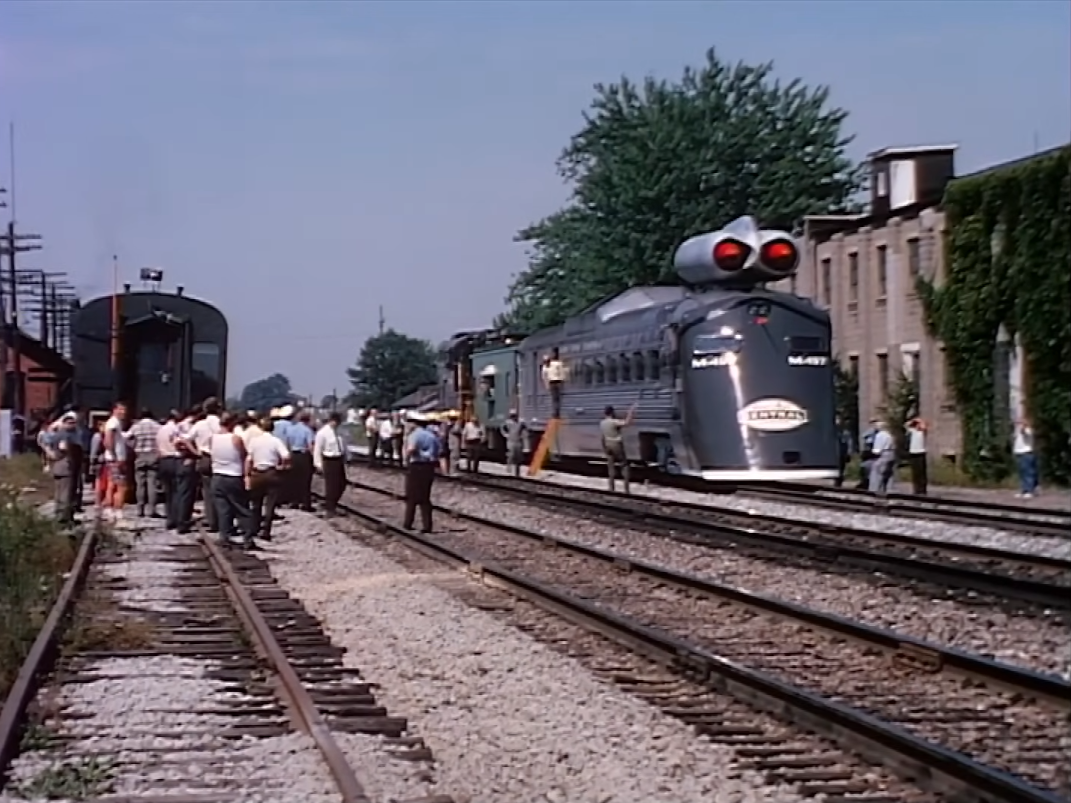
The car wasn’t the train’s only adversary, as trains also had to compete with intercity buses and planes that were only getting faster by the year. It wasn’t long before the idea of riding a train somewhere seemed so antiquated. Popular Mechanics wrote in 1955 that railroads were losing $700 million per year on passenger rail, losses that were only barely made up for by freight rail. As passenger volumes bled, railroads threw countless ideas at the wall to see which could convince people to park their cars and fall back in love with the rails.
This era saw streamliners painted in bold colors and filled with all of the luxuries you could ask for on the rails. None of this worked, and passenger volumes continued to decline. This marked the beginning of the end of the era of private passenger railroads. Conditions reached an emergency in the 1960s, when falling passenger volumes were combined with the United States Post Office Department diverting mail from passenger trains and onto more freight trains, trucks, and planes.
The collapse of private passenger service would eventually lead to the creation of Amtrak. However, the railroads didn’t go down without a fight. In the 1960s, the New York Central Railroad had an idea. What if trains were crazy fast?
Birth Of A Crazy Train
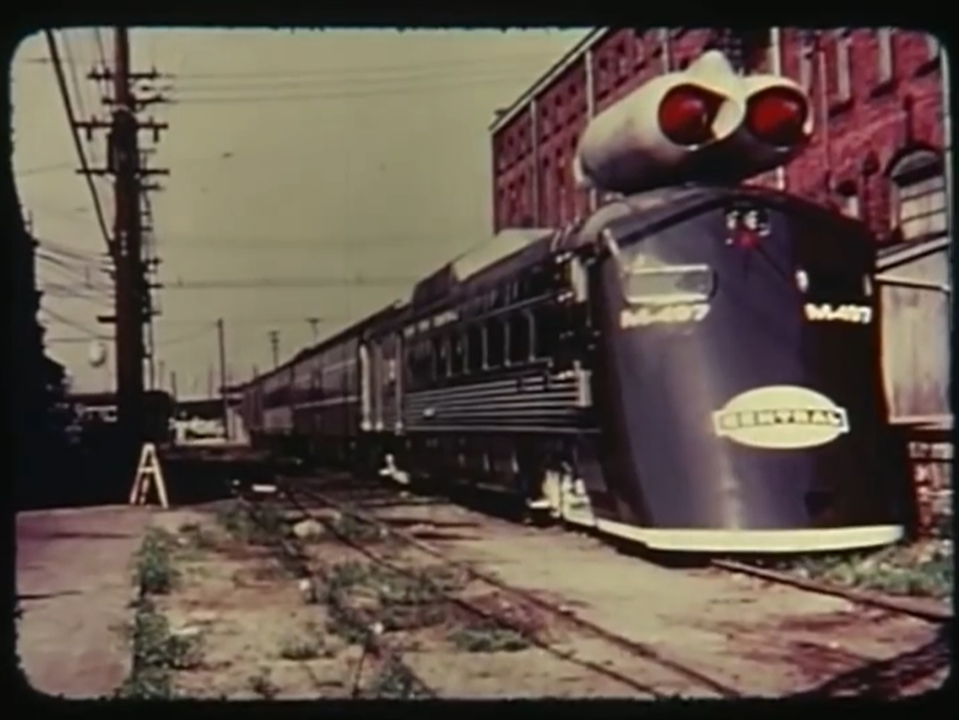
This story starts in 1958 with the appointment of Alfred E. Perlman as president of the New York Central Railroad. Perlman, who had prior experience in engineering and as an executive of the Denver and Rio Grande Western Railroad, was put in charge of a railroad that was derailing fast.
One of Perlman’s curiosities was the New York Central’s Technical Research Center, one of the only research labs in America that worked on nothing but trains. Perlman was an engineer at heart and supported the railroad’s research and skunkworks division. Under his lead, as the book “The Flight of the M-497” by Hank Morris and Donald C. Wetzel explains, the Tech Center would perform outlandish experiments. One was using floatation bags to protect fragile cargo, including nuclear reactors and guided missiles. Another experiment involved using plastic explosives at switches and diamonds to harden the steel. His mission for the lab, per the book, was to use science to improve materials, engine performance, and the railroad’s equipment to make trains faster, safer, and more economical to run.
(Above, a video from the NYC Railroad about the turbojet railcar. Click here if you don’t see it.)
In 1965, the skunkworks at the technical center came up with a wild idea. The NYC had a past of building seriously fast trains, and researchers had what was probably the road’s craziest idea for speed yet. What if they made a train faster by bolting a Rolls-Royce Dart turboprop engine from a Vickers Viscount onto a locomotive? The locomotive they had in mind was a GM EMD F-unit diesel-electric locomotive. Reportedly, James J. Wright, then Director of the Technical Research Center, modified the idea by switching the turboprop for a turbojet engine, then submitted it to Perlman, saying that it could be done for $30,000. Sadly, the idea initially went nowhere.
That was until a little over a year later, when Wright got a call from Perlman. Perlman didn’t just approve of making a jet-powered train, but the tech center was to be given a blank check to spend however much was necessary to build it. The only catch was that the jet-powered train had to be started and finished within the next 30 days.
(Above, a film from Emery Gulash showing the railcar in motion. Click here if you don’t see it.)
What changed? As Chuck Crouse wrote in Trains magazine in 1988, the U.S. Department of Commerce was looking for a way to improve commutes in the crowded Northeast Corridor. Research had shown that highways were inefficient as they depended on the judgment of thousands of individual drivers. Trains had a higher flow rate at getting people to their destinations than a highway. High-speed rail could get people to where they needed to go faster than they could ever achieve on a highway. The government reached out to Perlman, and Perlman wrote down what he remembered from that conversation in a letter to Chuck Crouse. From Trains magazine:
“I was approached by the Secretary of Commerce Office to meet the high-speed runs that were being publicized by the Japanese Tokaido Line and the Pennsylvania. I told them that we had all the technology necessary, but that since we were losing over $100 million on our passenger business and the Japanese Tokaido Line was losing hundreds of millions of dollars, and the Pennsylvania losses were greater than ours — and furthermore that I know of no railroad passenger service in the world that was being operated at a profit — I felt that we would be jeopardizing our entire railroad operations should we put more money into this type of travel. They were told that in my desk was a file from our research center in Cleveland saying that for $30,000 they could equip one of our Budd RDC cars, which were then running between New York and Poughkeepsie, with equipment which could get them up to a speed of 170 miles per hour. The people in Washington were skeptical, so I authorized our technical center to spend that amount of money, which went principally for two second-hand jet engines which were placed on the roof of the car and a certain amount of streamlining for the rear end of the car.”
The blank check meant that the engineers charged with building this train would be well compensated, too. During the building of the train, the workers were reportedly paid double – double and a half for overtime. Donald C. Wetzel was a part of this team, and according to the book, he has quite a resume. Not only was he an engineer, but he also drove trains, was a commercial pilot, a bomber pilot, a boater, a motorcyclist, and an inventor. Wetzel invented the pulsating locomotive ditch lights that remain in use on American railroads today.
The M-497
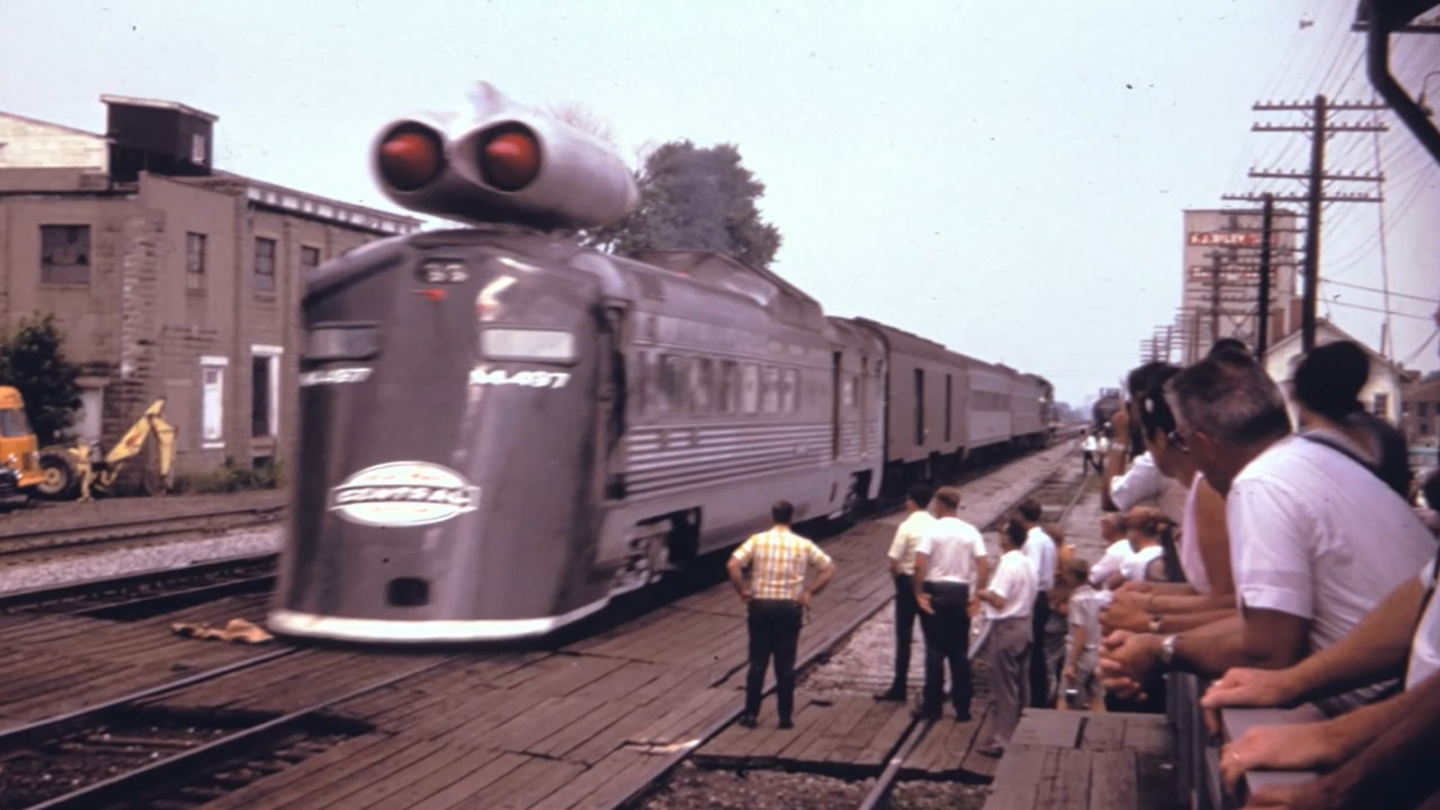
To achieve their mission for the budget they pitched to Perlman, the shop acquired a 13-year-old Budd RDC-3, No. M-497 from the NYC. The Budd Rail Diesel Car is a railcar that doesn’t need a locomotive because it has its own powertrain. From Railfan & Railroad Magazine:
After the end of World War II, the Budd company returned to the railcar business, preparing to re-equip the nation’s railroads with modern, lightweight, streamlined trains. The postwar economy was a prosperous time for many, but America’s railroads were already seeing a dramatic 43 percent drop in passenger traffic from 1944 to 1948. While railroads attempted to win back customers by introducing flashy new streamliners, Budd once again turned to the development of a low-cost, self-propelled vehicle.
Based on a standard 85-foot passenger car, the most important feature of the RDC was the motors mounted beneath the car to maximize space for revenue. Deciding against electric traction, two diesel engines employed a torque converter to bring power to the axles. Ease of maintenance was a huge selling point, as the diesel assemblies could be repaired or replaced without heavy cranes or a service pit. Horsepower-to-weight ratio was such that acceleration would rival that of comparable electric traction cars. The controls were designed for ease of use, and allowed for cars to be operated singly or as multiple-unit. Welded trucks and disc brakes were further contributions to the car’s modern design.

The Budd RDC is an example of a diesel-hydraulic railcar, a system where the diesel prime mover doesn’t power electric motors, but transmits power through a torque converter and transmission. NYC No. M-497 was an RDC-3, which meant that it was a self-propelled railcar with a baggage compartment, a railway post office, and 12 rows of two by two seating.
No. M-497 was, like other early RDCs, powered by a pair of 1.8-liter Detroit Diesel 6-110 straight-sixes rated for 275 HP each. These engines propelled the mostly stainless steel 117,900-pound railcars through an Allison torque converter, short drive shafts, and Spicer transmissions. In 1956, the RDCs would get an update, which would see power rise to 300 HP each.
Jet Power
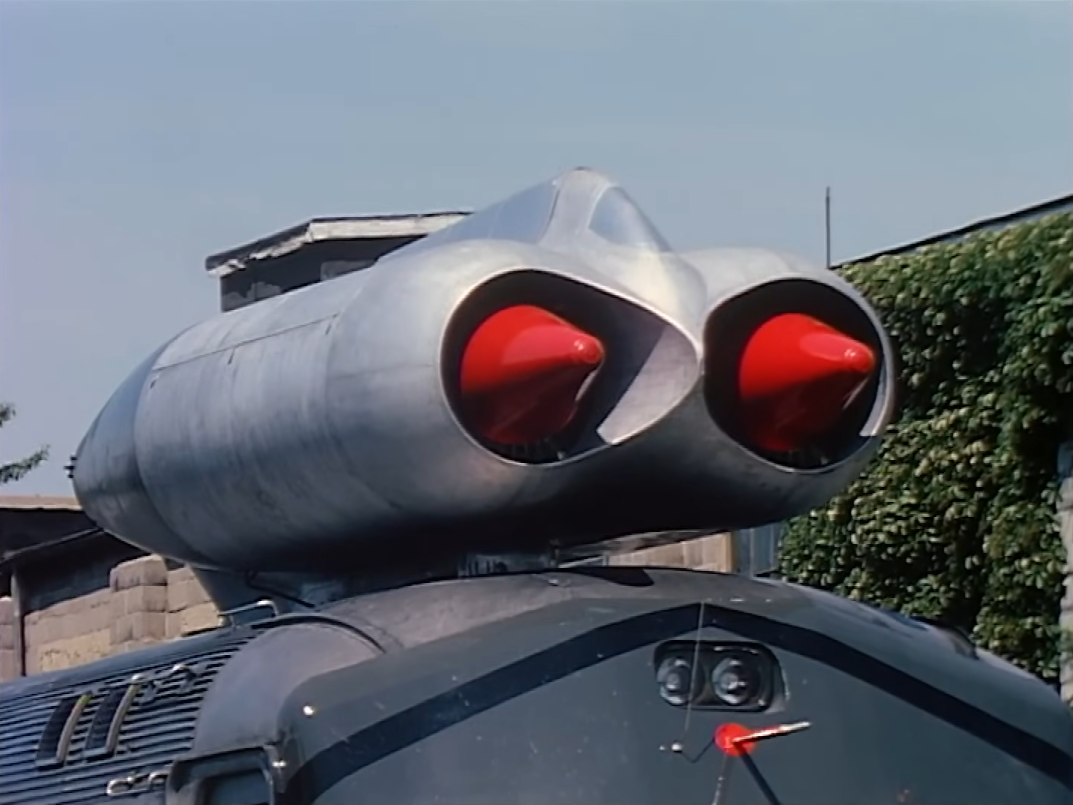
The NYC Railroad crew found an entire military surplus engine pod from a Convair B-36D Peacemaker bomber for $5,000. Inside that engine pod was a pair of General Electric J47-GE-19 turbojet engines, which were good for 5,200 pounds of thrust each. The NYC believed that using these jet engines was the quickest way to get over 10,000 HP.
These engines made the B-36D and later variants a rather ridiculous aircraft. In addition to having four J47 turbojets, these bombers also sported six Pratt & Whitney R-4360 Wasp Major 25-cylinder radial engines, making 3,000 HP or more each. USAF says the turbojets were used during takeoff and for extra speed during bombing runs, but the radials otherwise did most of the work. Yes, the B-36 was such a flying tank that some versions had 10 engines!

The use of turbojets on the rails wasn’t that crazy. Railroads all around the world, including U.S. roads, have used jet engines to clear snow off tracks. What was weird was using the thrust of these engines to propel a train. Of course, the M-497 wouldn’t be the only jet-powered train in history, but all of them were oddballs compared to the standard ways that trains work.
Anyway, M-497, which entered service in 1953, was one of NYC’s first three RDC-3s and spent its early years on the rails serving branch lines in Detroit before moving to New York. Now, it was getting towed to the New York Central Railroad’s Cleveland Technical Center, Inc. in Collinwood, Ohio. Most of the budget was spent on acquiring the turbojets. Next came the challenge of bolting a bomber’s turbojet pod to a railcar.

The engine pod was affixed to the railcar by flipping it over and attaching it to the roof. The engine was further rotated five degrees to help push the locomotive onto the rails. Underneath, some rows of seats were removed so a supporting structure could be installed in their place. The railway post office compartment was used to hold the massive fuel tank to feed the two turbojets, which were converted to burn diesel. Other changes to the railcar include the disconnection of the hydraulic transmission and swapping the railcar’s tapered wheel treads with cylindrical treads. Hydraulic damping was also added to limit vertical oscillations.
To aid in this speed quest, Donald C. Wetzel’s wife, Ruth, who was a commercial artist, designed a sheet metal aerodynamic nose to go on the power end of the coach. Aerodynamic skirts were also added. Originally, Donald, who was the main designer for the jet-powered M-497, wanted to place the engine at the rear of the railcar. However, Ruth thought that the engine would look way better up front. She was right. Reportedly, her design was tested and validated in a wind tunnel, too. With the engines, fairings, and equipment added, the jet-powered M-497 weighed 139,000 pounds.
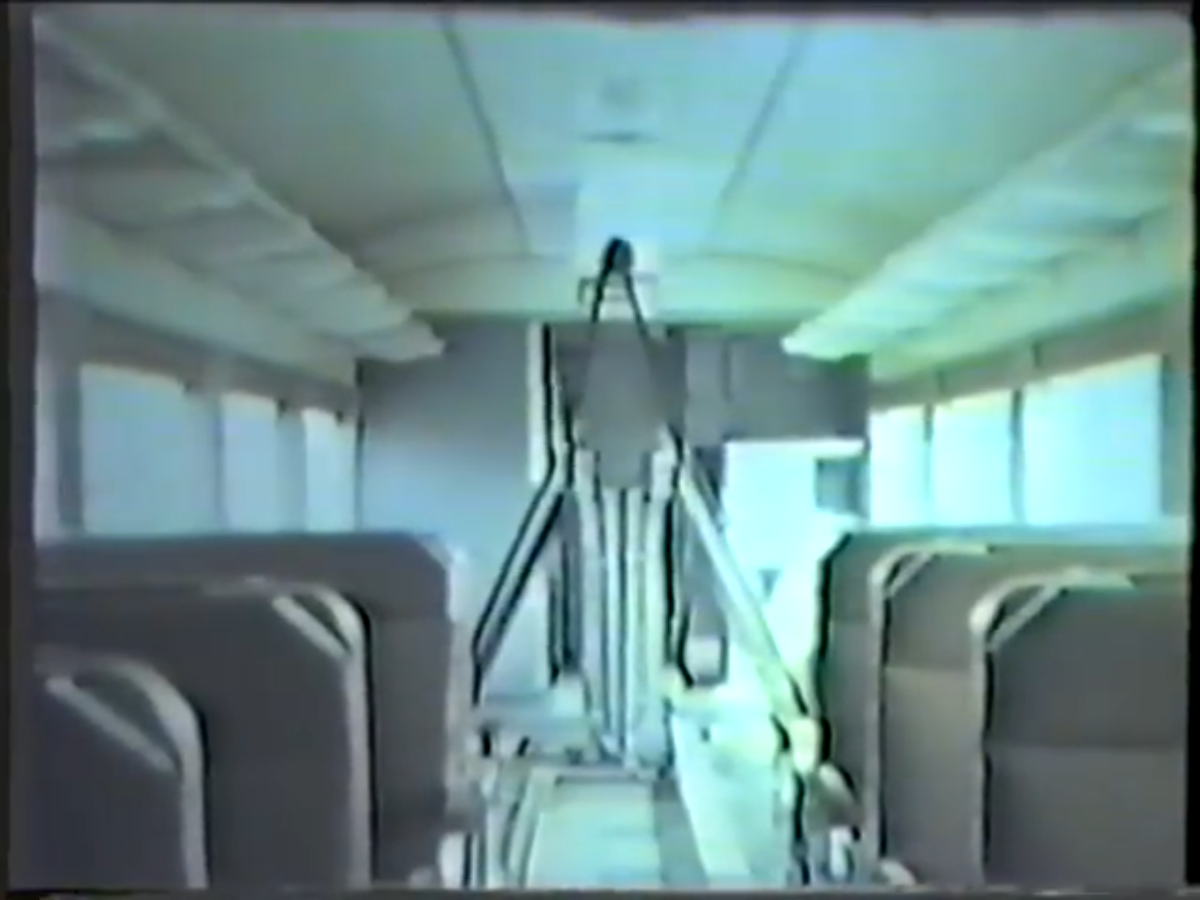
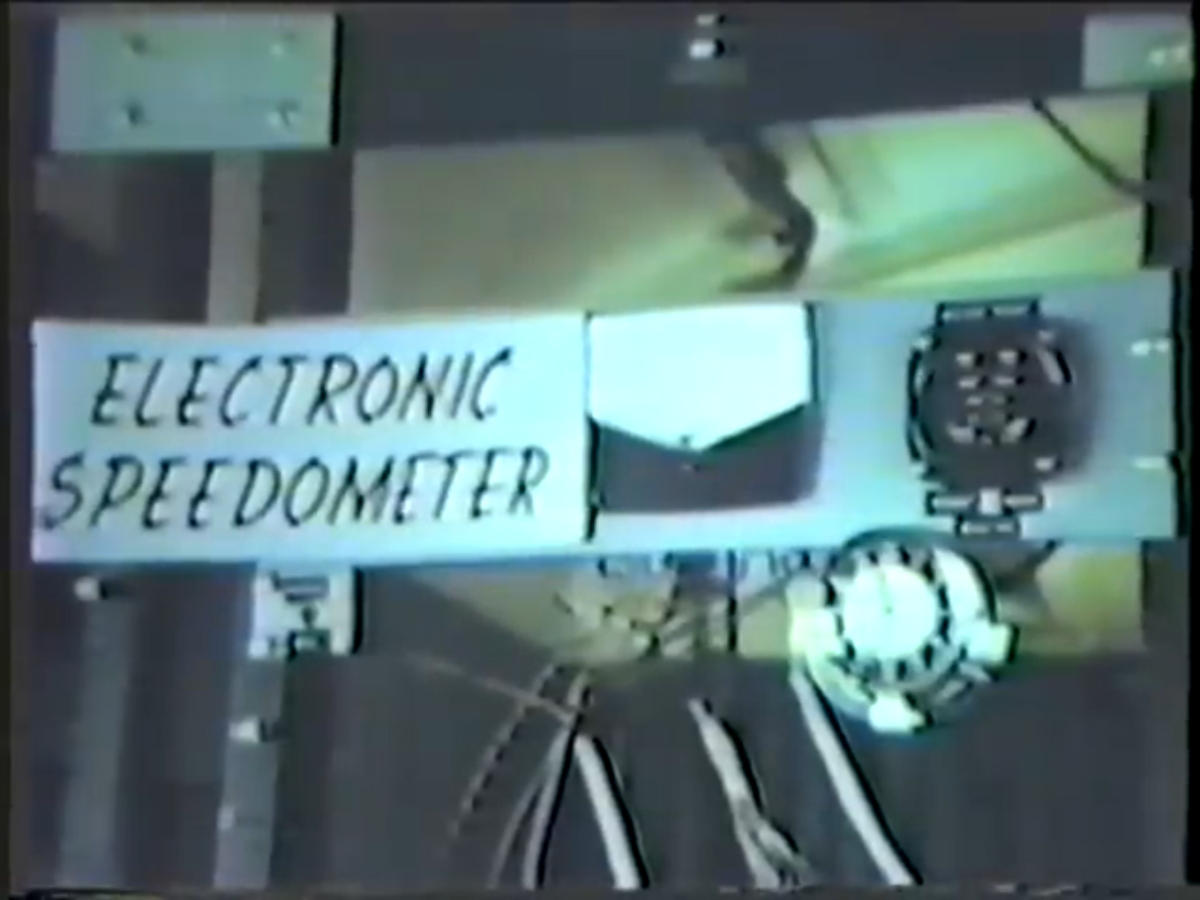
Since this train was designed to be a rolling laboratory, the railcar had to be loaded down with dozens of measuring devices. The New York Central said that it installed more than 50 instruments in the baggage compartment, which included devices to measure speed, stress, bearing temperatures, and ride characteristics. Some data was reported directly onto oscillographs, while others were saved onto magnetic tape. Remote-controlled cameras monitored the wheels, while four of the instruments alone were just for measuring speed. Two digital devices, one mechanical device, and one air device measured speed.
A normal Budd RDC was designed to go around 85 mph. This one? The NYC wanted it to go 200 mph. But speed wasn’t all of it. Part of the mission was to go fast, yes. The engineers loved the idea of making the fastest train. But there was also supposed to be some practical research, too, including finding out how America’s existing rails could handle trains blasting down the track at 170 mph or higher.
The team did not change the M-497’s brakes. When the railcar needed to slow down, the engineer at the helm would let aerodynamic braking slow the railcar down to about 120 mph. Then, the Budd’s standard brakes would be applied. Once the railcar slowed to 50 mph, the brakes were released, cooled down, and then applied again.
The final touch was a pair of gunslit-style windows on the aero fairing for the engineers to look through. As “The Flight of the M-497” notes, these windows were actually number boards from EMD F-units, which is amazing.
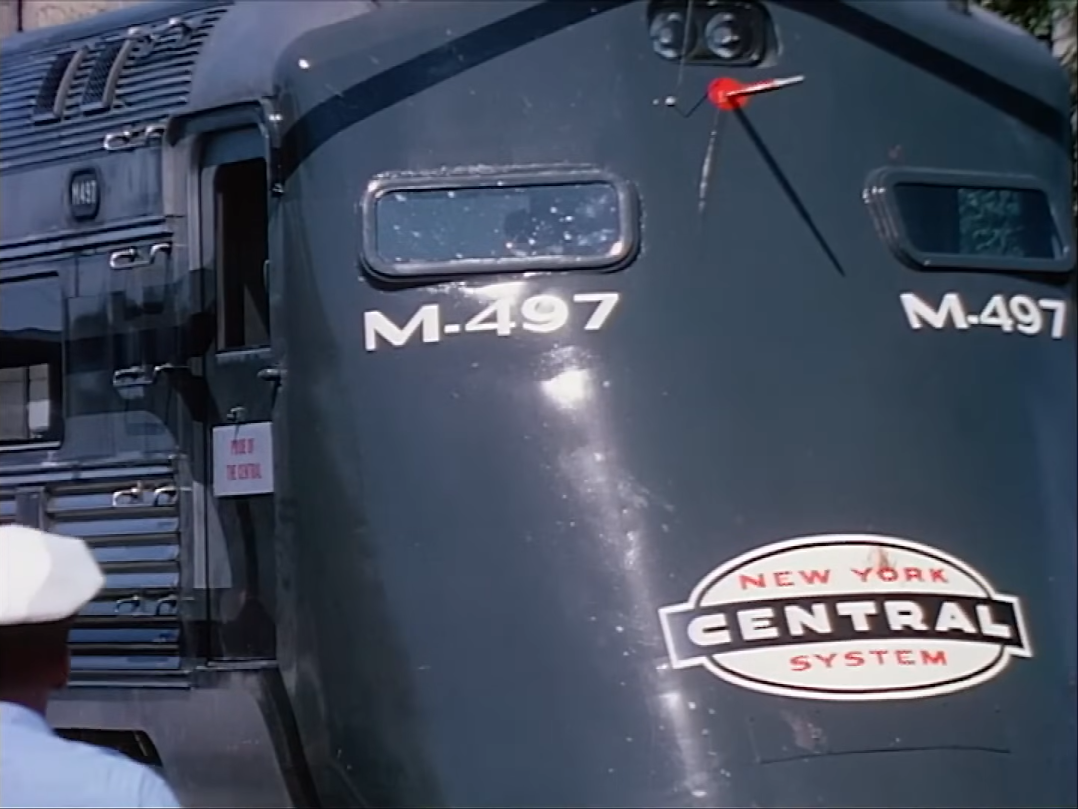
The NYC shop crew completed the M-497 jet train with a futuristic silver, black, and gray paint scheme. It’s noted that one magazine called the M-497 the “Black Beetle” and the name stuck in the press, even though the NYC officially named the train “Pride of the Central.” As Railfan & Railroad Magazine writes, Donald Wetzel actually hated that the magazines of the day called it the Black Beetle.
All-in, the NYC told the press that the project cost between $30,000 and $35,000. The true cost is unknown. Not that it really mattered, because what the engineers achieved was incredible.
‘Flying’ The Jet Train

When it came time to test the M-497, there was only one engineer the NYC could choose to command it, and it was the man who designed it, Donald Wetzel. He was in a unique position at that time. When Wetzel joined the NYC in 1950, he would become one of the last engineers trained in running steam locomotives. But in addition to being a mechanical engineer, plus knowing how to run steam locomotives, electric locomotives, and diesel locomotives, Wetzel was also a pilot trained in jet aircraft. Wetzel was the NYC’s first and only jet engineer. He even flew the railroad’s North American B-25
A series of four tests was conducted on July 23 and July 24, 1966. The train was towed to a 68.49-mile section of track between Butler, Indiana, and Air Line Junction, Ohio. Of this stretch, the tests happened in a 24-mile sector. This track was standard 39-foot sections of bolted 127-pound per yard rail. A four-mile section was made of continuous welded rail. In this case, the rail was 26 years old and had been pounded by freight trains through all that time. So, it was a typical track, which is what the railroad wanted. At roughly three-quarters through the 21-mile run between Butler, Indiana, and Stryker, Ohio, a 300-foot section of track was equipped with spring-loaded microswitches to be used to measure the train’s speed.

To prepare for the tests, railroad workers stood at every grade crossing to make sure there weren’t people or vehicles in the way, and a Beechcraft D18 Twin Beech was hired to fly 1,500 feet above ground level at 160 mph to 170 mph ahead of the train to monitor the track for hazards. The pilot in the Twin Beech communicated through an FAA Unicom radio frequency to everyone on the train, who wore flight helmets with radios. An EMD GP7 diesel-electric locomotive towed the M-497 backward since the railcar had no way to propel itself in reverse.

Wetzel and the team discovered that the jet-powered railcar had some quirks. On the very first test of the railcar, some of the jet blast from the engines was fed through the radiators for the railcar’s diesel engines. The engines had to run in order to build air pressure for the brakes. Unfortunately for the jet railcar, the hump on the roof of a Budd RDC contained the exhausts, radiators, and intakes for the diesel engines. Unsurprisingly, the hot jet blast overheated the diesels, causing them to shut down. This meant that there was no way to replenish the air tanks. From that point forward, the over-temperature shut-down relay was blocked closed so that overheating the engines didn’t result in their shutdown. Blast deflectors were also added to the dome.
During one test, it was found that someone had left a sheet of plywood on the track. M-497 was running so fast that Wetzel couldn’t stop in time. So he braced and hoped for the best. Apparently, the M-497 obliterated the plywood and kept going as if nothing had happened. During another test, one of the engines failed to start, so Wetzel sent the railcar down the track with one engine. Once the train moved fast enough, the other engine kicked into life with a giant fireball. As Trains magazine notes, the engines suffered from one flame-out on Saturday and two more on Sunday.
On that first run on Saturday, the Budd No. M-497 officially hit 140 mph. On the second run, it crossed through the traps at 183.85 mph, setting a new record for the fastest train in America. Wetzel claimed that he actually hit 196 mph, and the record was set while the railcar was slowing down. The railcar itself had a specially modified speedometer capable of reading up to 240 mph.
Sunday’s two runs were slower, with speeds ranging between 90 mph and 144 mph. But this didn’t really matter. Not only did Wetzel and crew make records and history, but Perlman had achieved exactly what he was looking to do. This train raced down an existing track at over 183 mph. He proved, at least for this 21-mile section of track, that high-speed trains could run on conventional track.

However, Budd No. M-497 was always an experiment. It was always just the quickest and cheapest way to build a 200 mph locomotive. That’s why it was sort of cobbled together with jet engines that cooked the onboard diesel engines, had front windows that were really number boards, and even still required the diesel engines to run just to power the brakes. The NYC did not expect to put jet-powered trains in revenue service.
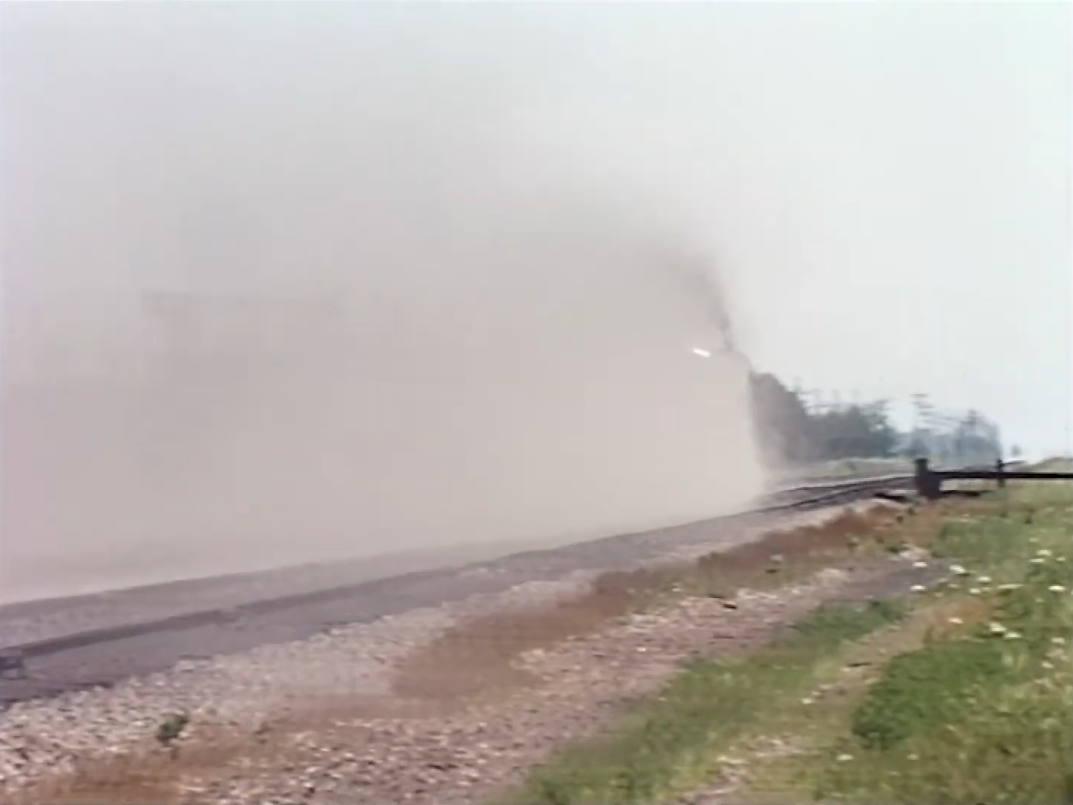
Nor would it have even really been practical to. The turbojet engines were reportedly heard from miles away and the jet blast kicked up rocks and clouds of ballast dust. While there was no shortage of people who were amazed at the sight of a jet-powered train, others saw it as nothing more than a pointless publicity stunt. The fact that the test track was perfectly straight didn’t help with the critics.
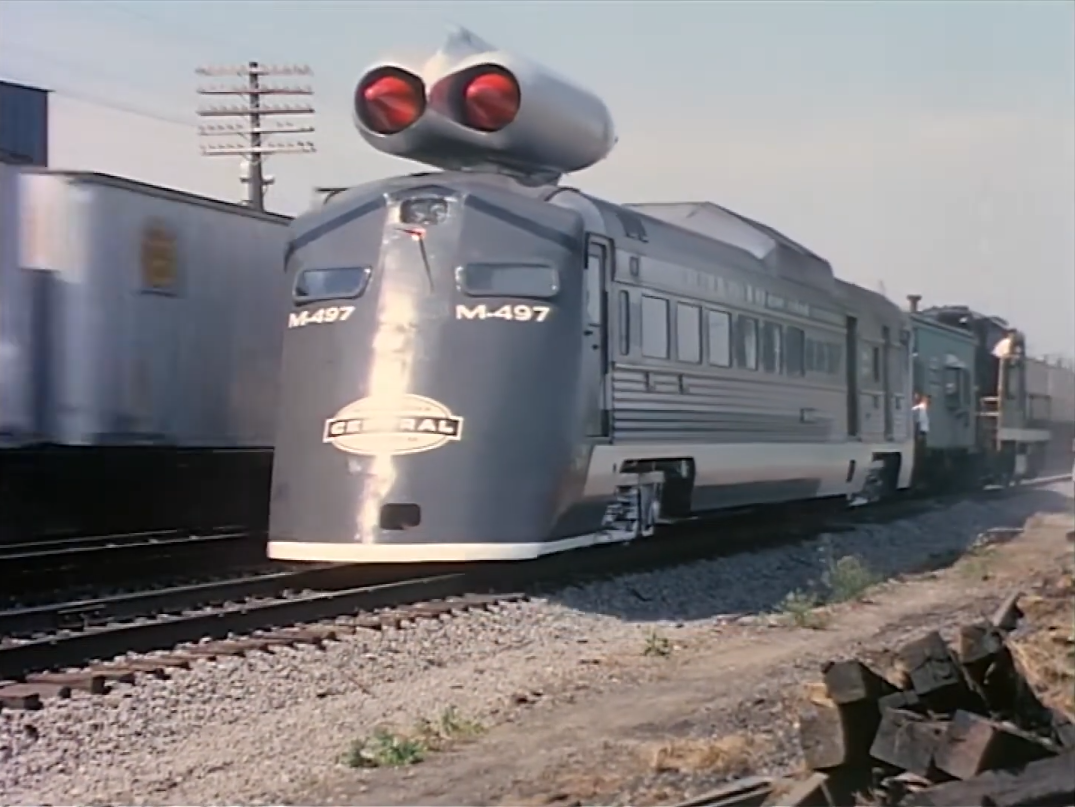
The M-497 didn’t even get to keep its jet engines for very long. The railcar was paraded around for marketing, but by 1967, the jet engines were removed, and the railcar was put back into service on diesel engines for commuter service out of Harmon, New York.
In 1968, the Pennsylvania Railroad, the New York Central Railroad, and the New York, New Haven and Hartford Railroad merged to become the Penn Central Transportation Company. M-497 served its new railroad dutifully until 1977, when the Consolidated Rail Corporation took it out of service. The railcar would then be scrapped by the Metropolitan Transportation Authority in 1984.
The Jet Train’s Legacy

The program wasn’t entirely pointless. The turbojet engines that were removed from M-497 would be mounted onto the X29493 experimental snow blower. Unfortunately, the engines proved too powerful for that job as they not only cleared snow and ice, but fired gravel from the road beds of railyards, too.
Ultimately, the data gathered by the NYC was largely ignored, too. The federal government instead looked into projects involving the Budd Metroliner and the failed UAC TurboTrain gas turbine train project. Nowadays, there’s the Acela, but even that can’t beat what the M-497 did.
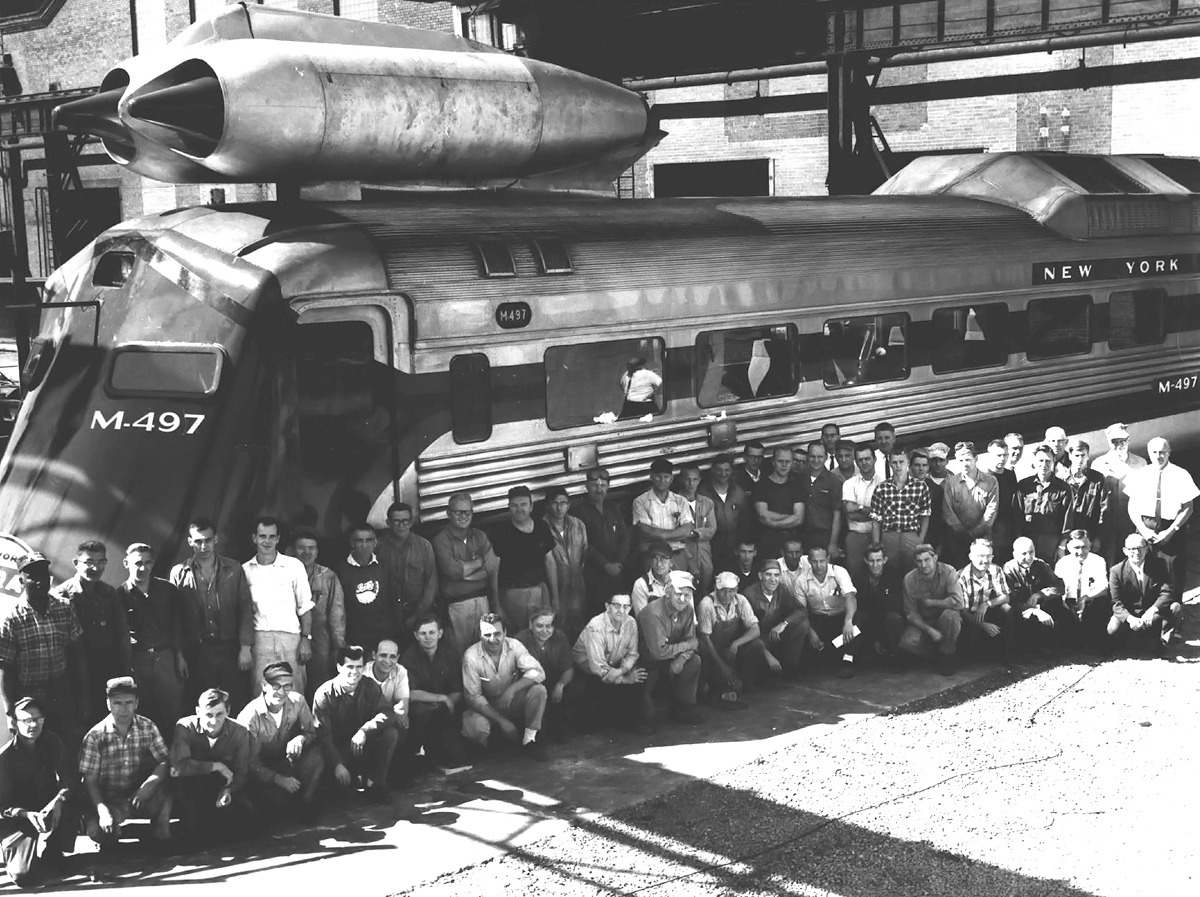
The turbojet M-497 sits in a weird place in history. The Garrett AiResearch Linear Induction Motor Research Vehicle (LIMRV) broke the record set by the M-497 when it hit 255.7 mph in August 1974 under turbojet power. Of course, the French TGV is even faster than that at 320.3 mph. The current fastest trains in the world are maglevs. Weirdly, the Guinness Book of World Records currently lists the M-497 as the fastest jet-powered train of all-time. Technically, the LIMRV was faster, so it’s unclear what distinction Guinness is making. I suppose one distinction is that the M-497 ran on an existing freight track while the LIMRV ran on a test track.
I feel like I’m underselling just how cool Donald Wetzel was. I mean, he was an inventor, an engineer, and could drive, ride, or pilot more vehicles than most people will ever see or touch. He was the kind of man who could be the engineer on a freight train one day, and then fly a bomber another day. Alfred Perlman believed passenger trains worked their best when running routes that were 300 miles or less. He would pass in 1983, and Wetzel would pass in 2019. Both men would become railroad legends for their impressive careers.
The M-497 that was built in 30 days was an insane creation. This was a train cobbled together using surplus engines from a bomber and ran to insane speeds. It was never practical and was never going into service, but it is one of those things of wonder. Wetzel was able to say that he was one of the only people on Earth to have driven a jet-powered train, and all of those spectators got to see a once-in-a-lifetime event. So, the M-497 might have been sort of pointless, but I bet it was a lot of fun, 5,200 pounds of thrust of fun, to be exact.
Top graphic image: Emery Gulash




Just a technical note – the Detroit 6-110 had a displacement of 1.8L *per cylinder*, not total, so each of the Detroit units displaced 10.8L.
I find it amazing they did this in a month. The pace of change was incredibly quick back then. Makes me think of WWII. Propellers to jets in 6 years.
I have the Lionel O Gauge version of this. Includes jet sounds. Solid model.
Man, this is exactly the kind of content I want to see. Excellent article, just when I think I’ve seen it all! BAM! New insane vehicle. 10/10 no notes.
Holy air pollution, Batman. My lungs hurt just watching that video.
Really makes you appreciate that we actually care about the environment today!