


There is always something magical about a great concept car. Engineers and designers come together to make a vision of what could be. Concepts capture the hearts and minds of enthusiasts, and sometimes, automakers are brave enough to put them into production. Many concept cars disappear shortly after their time in the spotlight, and they rarely fall into the hands of the Average Joe. That was the case for this Ford Probe IV concept car. Once an optimistic idea for the future, the car disappeared. Now, it’s back, and amazingly, it’s for sale on Facebook, of all places.
You might think that most concept cars get to live a cushy life. Talented people put tons of work into making a concept car real. Then, their hard work gets to be seen by potentially millions of people. It would be a fair assumption to think that concepts get to retire to some great hall where automakers preserve history.


Sadly, the reality is that a lot of concepts are sometimes left outside to rot or are sent to the crusher. It was only last year when car enthusiasts spotted some of General Motors’ famous concepts headed to the crusher. A few years before that, there were some Nissan concepts that were in a sorry state and headed for the great auto show in the sky.
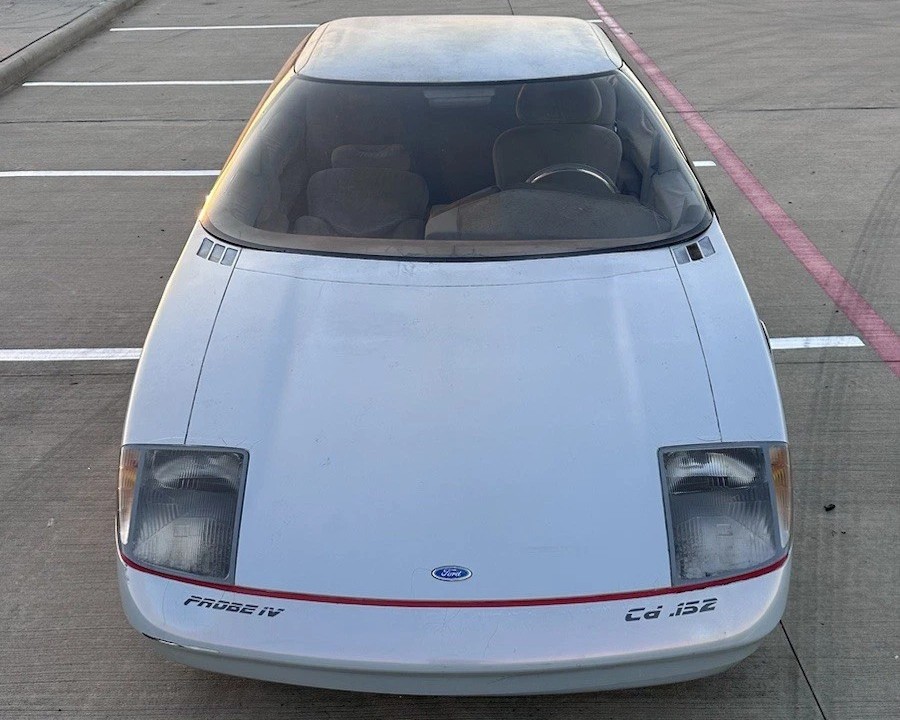
Some concept cars manage to leave the houses of their automakers, but also don’t get crushed. These cars fall into the hands of private collectors and museums. One of those concepts is this Ford Probe IV, which was originally found by the folks at Ford Authority. This is a concept car that you can buy right now! But there’s a catch.
Going All-In On Aero
Ford built a series of five Probe-branded concepts, and they were originally born in the influential period that changed the trajectory of car history. Yep, we’re going back to the 1970s, the time when the auto industry was effectively turned upside down. The decade was pockmarked with multiple oil crises, skyrocketing oil prices, and economic unease on top of a greater effort to protect vehicle passengers and also reduce emissions. Cars downsized, horsepower figures plummeted, and car design got funky. The horsepower wars of the 1960s turned into a race to build vehicles that sipped the least amount of fuel. Automakers also had to be concerned with the Corporate Average Fuel Economy standards that were introduced by the Gerald Ford administration.
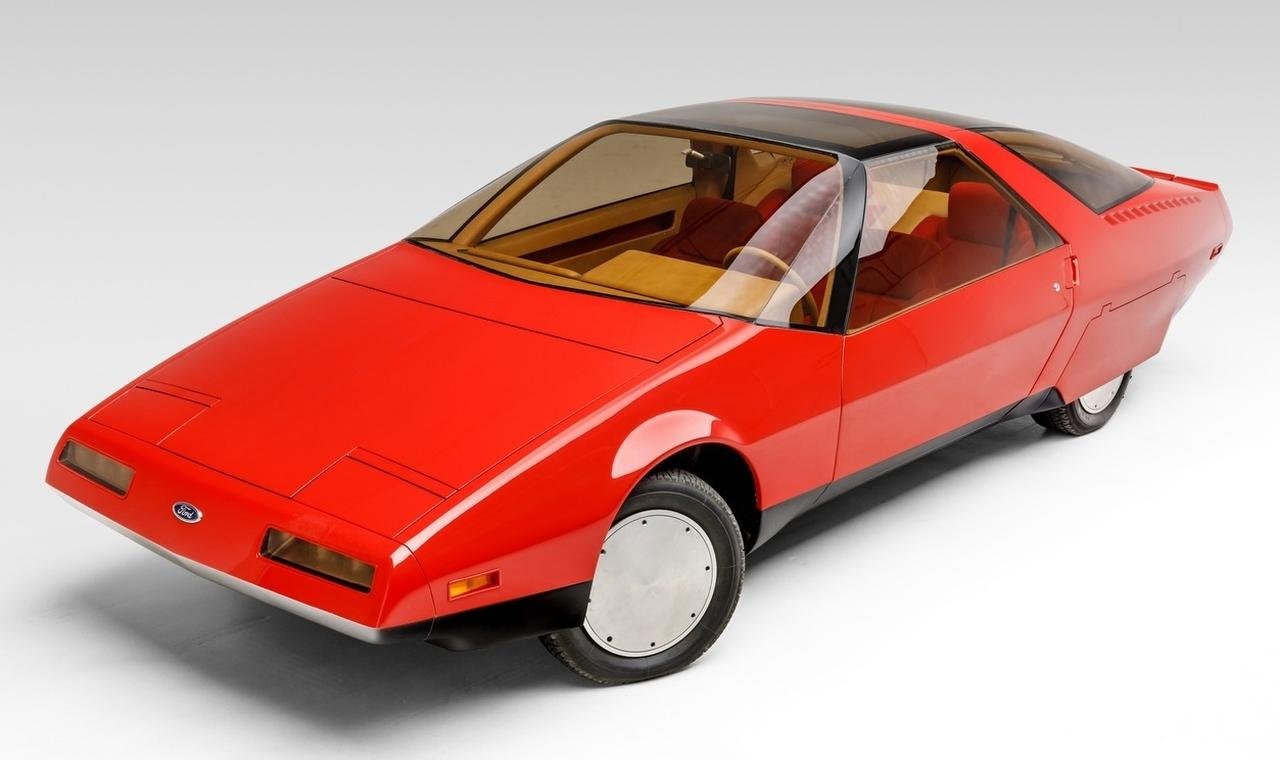
The problem was that Ford, like other automakers, discovered that transitioning from the gas guzzlers of the early 1970s to more efficient vehicles was not going to be easy. Automakers had entire lineups of boxy, inefficient cars. Instead of reinventing the car, the automakers decided to make them slick.
As Ford Authority writes, Ford became obsessed with the idea that the cars of the future would be super slippery and thus need only a small four-cylinder engine to move with gusto. Ford would team up with Carrozzeria Ghia to create the Probe I, which made its debut at the Frankfurt Motor Show in September 1979. This car was based on a Fox Body Mustang and, at the time, MotorWeek said it was the slickest car to ever wear a Blue Oval. This was thanks to extensive aerodynamics research and wind tunnel testing done by Ford and researchers at the University of Maryland.
The result was that the car, which was functional, had a drag coefficient of 0.25. That was incredible, given that, at the time, the Mustang the Probe I was based on had a drag coefficient of 0.39. To put this into perspective, a 2010 Toyota Prius is just as clean through the air as this concept car from 1979.
Of course, the future wasn’t just slippery, as Ford also baked in some typical concept car accoutrements. The Probe I had a retractable instrument panel and even a credit card “key” that could be used to start the car and to pay for gas and tolls. Sadly, the Probe I was lost in a fire last year. You can read our coverage of that by clicking here.

Our secret designer, the Bishop, details the next couple of Probe concepts:
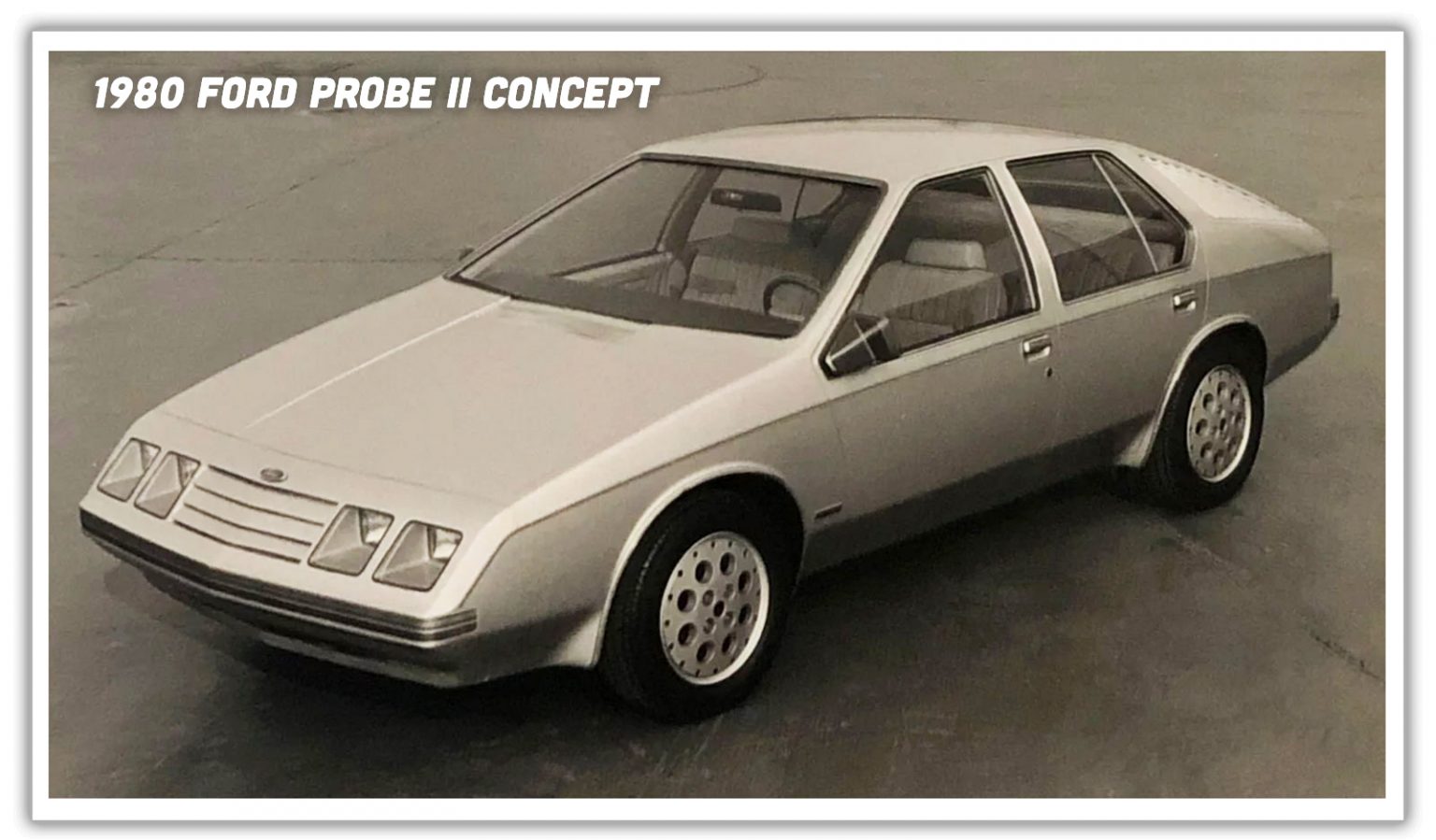
In the real history of Ford, the Probe I went into mothballs while they continued to pump out new versions of low-drag Ghia-built concepts. The Probe II came next, and it was a rather disappointing semi-productionized version of the Probe I.
Next up was the Probe III, the only Probe to ultimately be transformed into a production car, namely the European market Ford Sierra (sold here briefly as the Merkur XR4Ti).
Slicing Through The Air Like A Jet
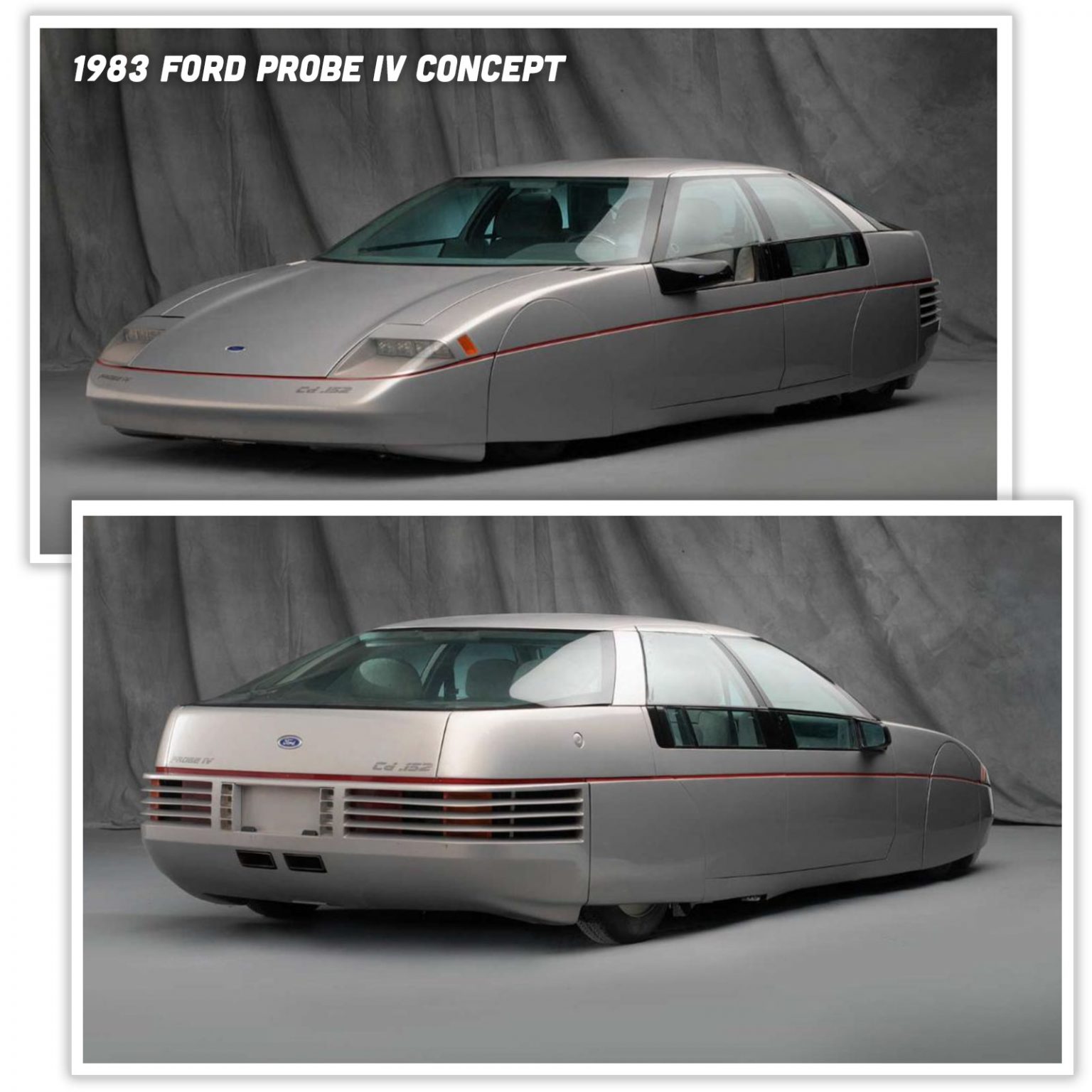
The Probe concepts returned to madness in 1983 when Ford built a pair of concept cars that it dubbed the Probe IV. Ghia was around to help build this one, too, and by this time, research in aerodynamics had allowed Ford to achieve something incredible. Here is what Christie’s says about the Probe IV:
Probe IV advanced the state of aerodynamic art at Ford to a new level, going to great lengths to make its surfaces as smooth as possible and present the minimum frontal area. A low ride height minimized undercar airflow and the Probe IV went to the extent of creating a speed sensitive ride height and attitude system. Probe IV could assume a pronounced nose-down attitude at speed. In fact, the back of Probe IV could rise six inches while at the same time the nose dropped four inches at high speed, improving its stability and air penetration. The front air dam was also electrically controlled, compensating for attitude changes and driver controllable to compensate for rough surfaces.

Headlights were under plastic covers. Side windows were flush in their frames with small power operated panels at the bottom for ventilation and paying tolls. The radiator and air conditioning compressor were located at the rear in order to eliminate a high drag radiator opening in the front (or nose). A full belly pan smoothed the limited undercar airflow that the air dam and attitude control let through and the tires were specially-developed for Probe IV, skinny P155/75R-16 LDC Goodyear tires that even had a low drag tread pattern. Even the identification and emblems were flush with the Probe IV surface. The only interruption to exterior air flow were the outside mirrors, which were in faired-in and sharply swept back enclosures. Mechanical innovations were required to meet Probe IV requirements including a highly sophisticated short MacPherson strut front suspension. Its front engine, rear drive chassis was powered by a 1.6 liter 4-cylinder turbocharged engine which was canted 70 degrees to the side to lower the hood.
One of Probe IV’s most distinctive features are its fully-skirted wheels and tires which utilize membranes between the outer covers and the body. The membranes flex when the front wheels are turned and allow Probe IV to be driven normally, but drastically reduce wheel well turbulence and resulting aero drag. The occupants of Probe IV sit in specially designed grey velour “sling” style seats designed to provide lumbar and thigh support in a semi-reclining position which saves 1½ inches in roof height. Instruments are placed directly in front of the driver with other controls in elaborate black panels with white legends on each side of the wheel. The top of the single-spoke steering wheel is transparent. The transmission shifter and additional controls are placed on the center console.

Perhaps the wildest part about the Probe IV was its drag coefficient of just 0.152. This is often reported to be the same as an F-16 fighter jet. Probe IV chassis 002 is currently owned by Scott Grundfor and Kathleen Redmond, the pair who also owned the poor Probe I that burned to the ground. Chassis 002 is functional, sporting a turbocharged 1.6-liter inline four rated at 122 horsepower. Given the ridiculous aero, that would theoretically be enough ponies for both some speed and for great fuel economy. If you want to see that car, it’s currently on loan with the Petersen.
The Probe IV is a properly funky car, with a single-spoke steering wheel, buttons all over the place, and velour seats. Sharp observers might note that there’s more detail in chassis 002 than in the typical concept car. It has a physical parking brake, seat belts, and what appears to be a real HVAC control panel.
This Probe IV
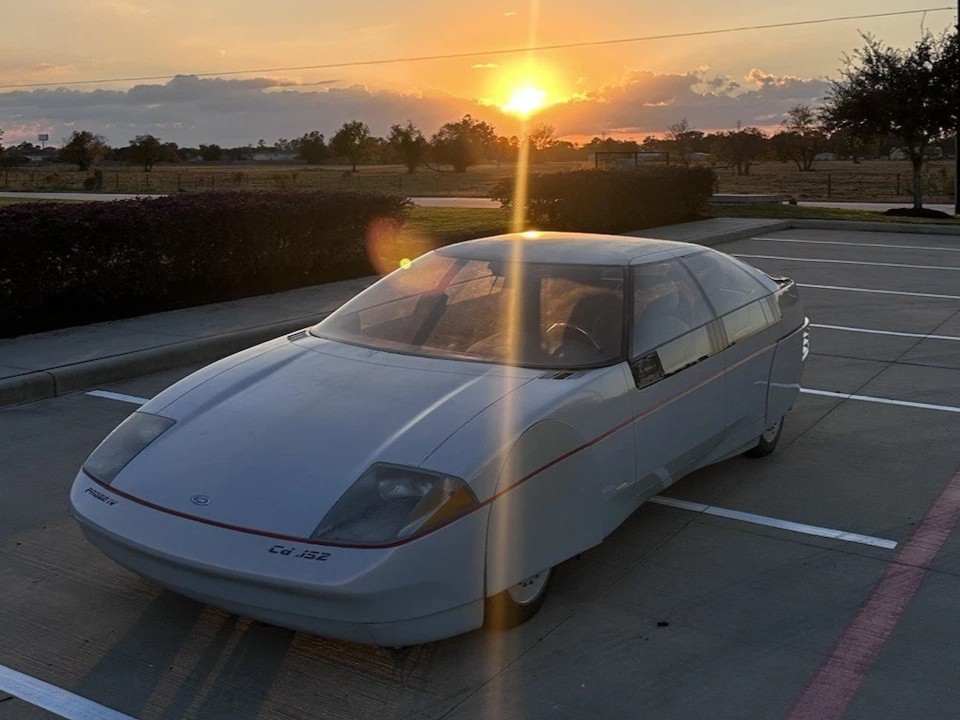
You have also likely noticed by now that I’ve been talking about chassis 002. Yes, there is a chassis 001, and you’re looking right at it. Chassis 001 was sold with chassis 002 in 2002 in an auction by Christie’s. Probe IV chassis 001 sold for $11,750 in that auction, while chassis 002 sold for $48,175. Chassis 002 would sell again in 2022 for $125,000.
Allegedly, it wasn’t exactly known what happened with chassis 001 in the years since the auction. According to the seller today, Alejandro, this concept car was acquired by Houston-based car dealer magnate and former Houston Auto Show chairman, Tony Gullo. Tony passed in 2024, and his family liquidated his over 300-example car collection. That’s how Alejandro got the concept. He told me that he found it while buying a different car. Who doesn’t want to own a concept car? Of course, he had to pick it up.
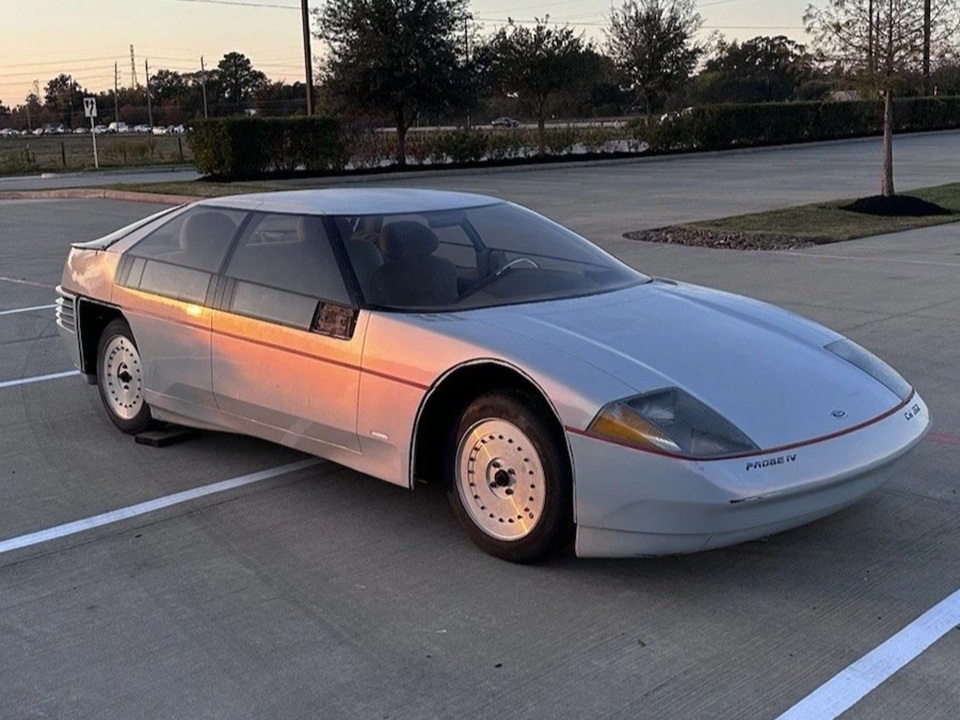
Probe IV chassis 001 is a very different car from chassis 002, in that it’s not really a car at all. The vehicle is built on a wooden frame that supports steel subframes front and rear. Those subframes don’t support any running gear at all. Instead, they just hold the rolling and steerable wheels.
Check out the chassis:

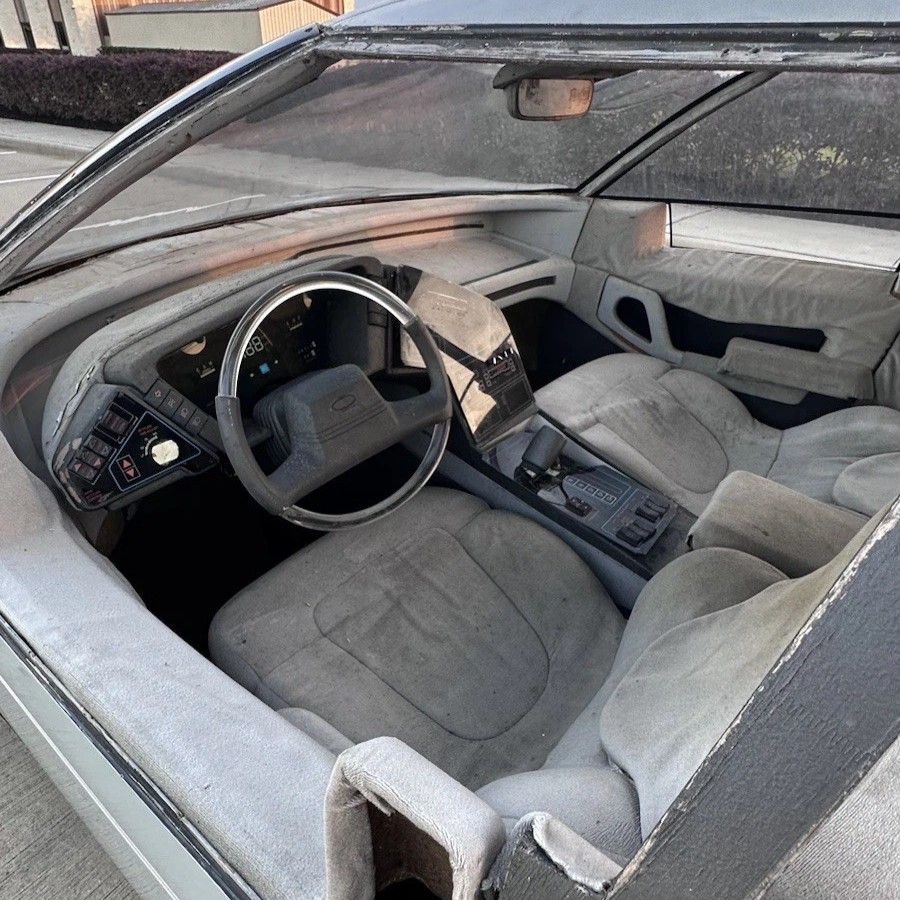
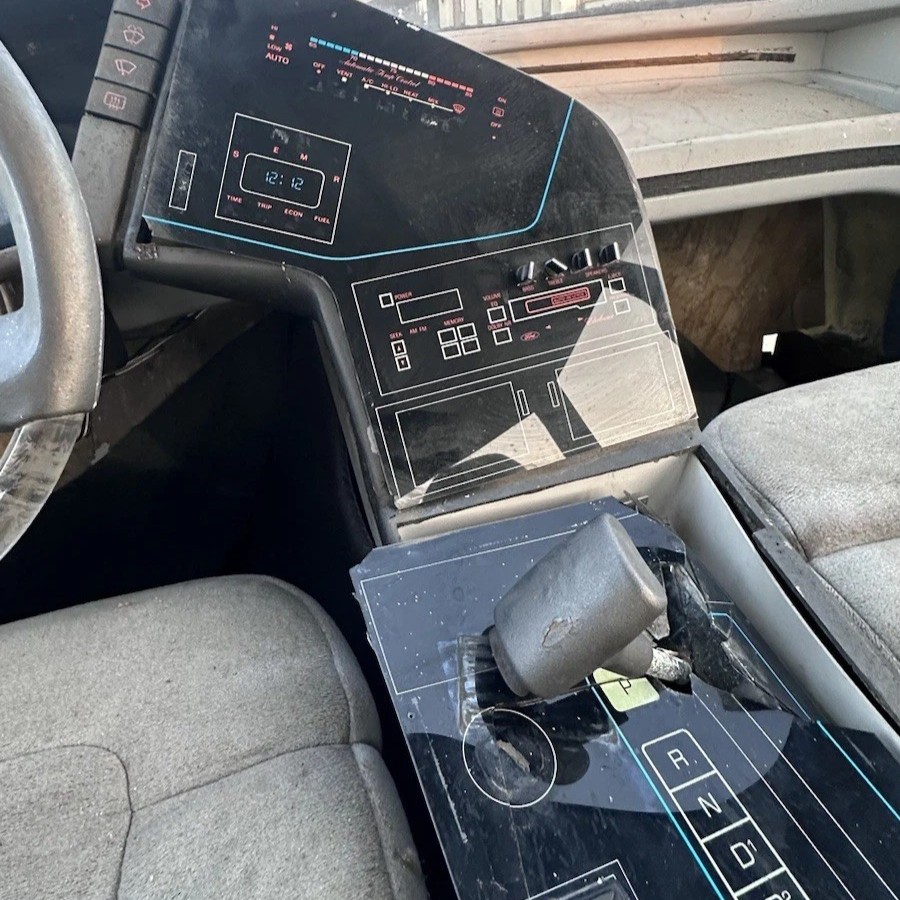
The body of chassis 001 is fiberglass, and it’s one big slab of composite. The doors and trunk do not open. But if you were to peer inside, you’ll see that the concept car has a full interior, sort of. The seats are real, but you’ll quickly notice huge differences between the functional concept car and the non-functional version. There are no seatbelts, all of the buttons on the dashboard are fake, and the gear shifter is fake, too. It’s a pretty shocking contrast compared to the functional Probe IV concept.
The interior of chassis 001 looks like a low-poly rendering of the functional chassis.
Alejandro notes some additional quirks:
Construction & Features
– Composite fiber body mounted on a wood structural chassis with steel subframes for wheel assemblies.
– Manual-adjustable front and rear suspension for testing purposes.
– Active front splitter, electrically actuated.
– Front and rear lighting assemblies wired, including center console lighting (non-tested).
– Unique two-piece wheels with custom tires made specifically for the Probe IV.
– Tires hold air but have leaking valve stems.
– Fully realized interior, closely matching Chassis 002.
– Display-only vehicle (no engine or functional steering).
– Wheels can be manually positioned for loading or display.
Apparently, this chassis was used for aero development and wind tunnel testing.
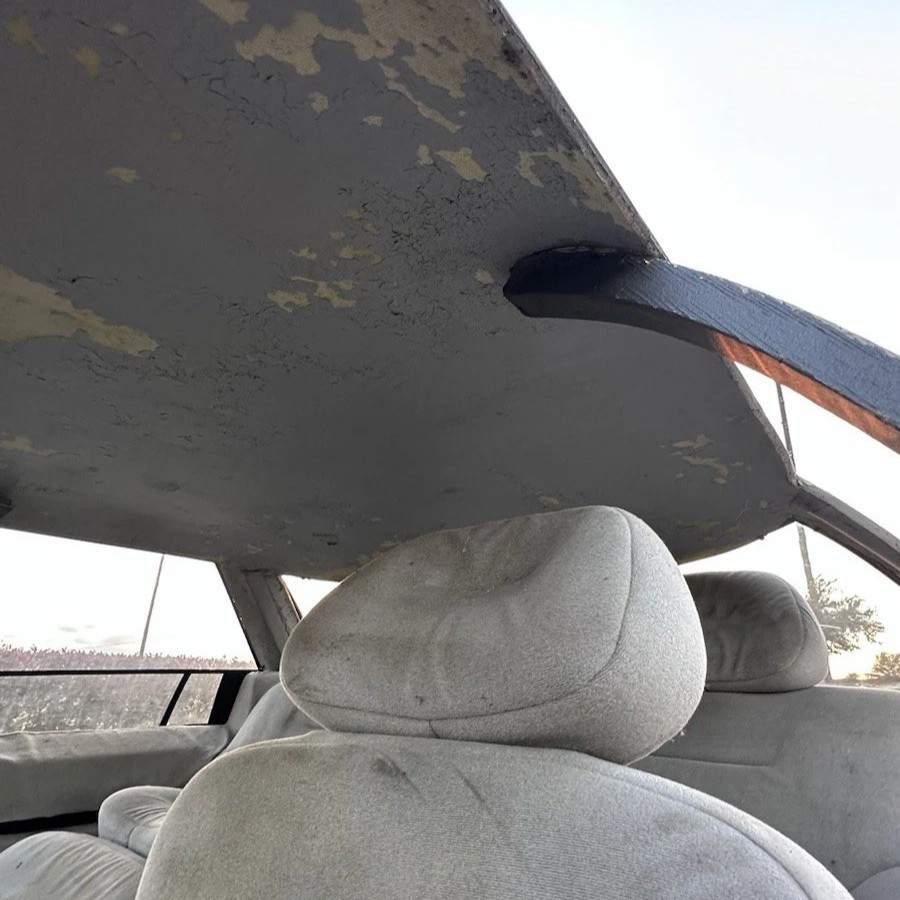
It’s noted that the concept has deteriorated a bit. In the 2002 auction, the listing said “condition is poor” and that the paint was failing. Today, Alejandro says that the rear portion of the vehicle’s roof has somewhat collapsed, the fake center console is broken, the side mirrors are gone, the right front wheel cover is gone, the left front wheel cover doesn’t stay on, and everything looks pretty dingy. In other words, it sounds like the concept has aged terribly.
That Belongs In A Museum
It’s also hard to figure out what one would even do with this concept. In theory, you could make it a real car, but that would require cutting the doors to make them functional, giving the vehicle a real frame and powertrain, giving it a real interior, and then convincing a regulatory body to slap license plates on it.
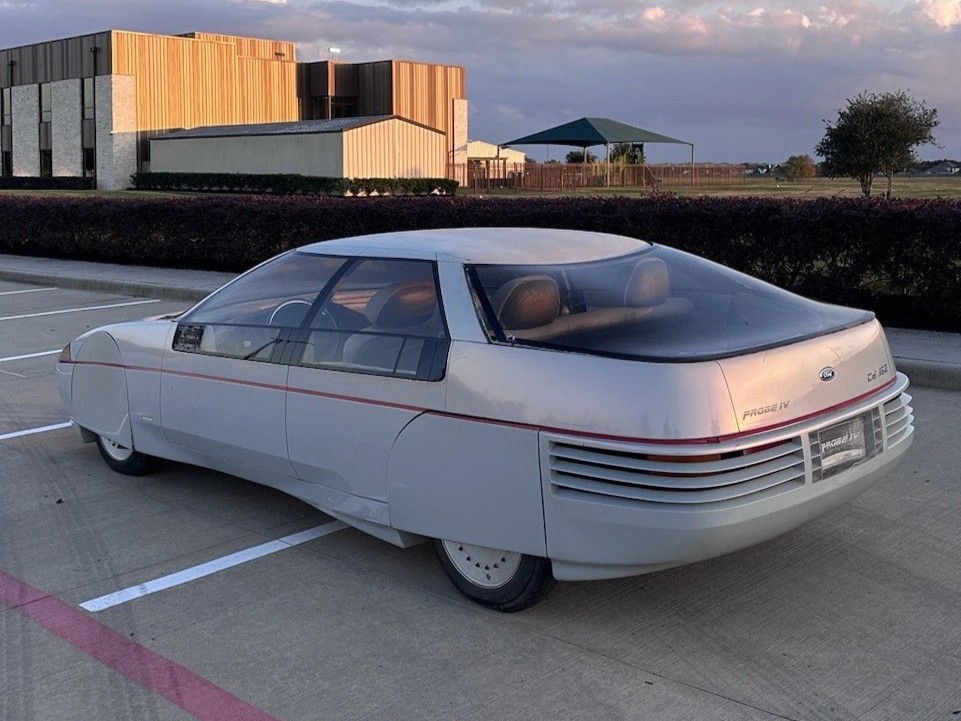
Realistically, this is more or less a rolling sculpture that some enthusiast or museum will probably put on display somewhere. It’s a shame that you can’t even sit in it. If you’re still interested, Alejandro, who is based in Spring, Texas, is taking offers. He recently tried selling it on eBay, where nobody bought it for the asking price of $30,000.
While this isn’t really a real car and its practicality is zilch, I still find it exciting. This Probe IV is a concept car that’s for sale on Facebook! That alone is such a weird statement that has me with a stupid smile. I love how people can just find weird things like this and then one day sell it like you would a $3,000 beater. What will you do with this? Maybe hop onto Facebook, shoot an offer, and find out. At the very least, maybe you’ll get to save a concept car from the crusher.
(Topshot image graphics: Ford, Alejandro)





I am so intrigued by the flexible wheel well covers.
They look solid, and even have the body belt line. I’m trying to imagine what this would look like in operation, and I can’t picture it.
It’s such a weird solution and I have so many questions. What material did they use and how did they expect the wheel not to wear through it?
That is definitely not a one spoke steering wheel, it’s the basic 2 spoke style that most malaise era cars came equipped with.
Just a note/reminder, chassis 002, the functional one, was featured in the movie “2010: The Year We Make Contact” (1984).
Those tire membranes would have been a TON of fun in the winter
“Don’t drive trank. Low-res scuzzball!”
Saw these pics a few days ago and assumed this thing was AI. We are doomed.
If it was near me, I’d be over there immediately to document it and maybe see if it can be grafted onto a chassis.
I like dumb cars that suck the life out of my soul and the money out of my wallet.
The Probe IV went so hard on aerodynamics that it moved the radiator and HVAC condenser to the back of the car, pulling in air at the hips abaft the rear wheels, and exhausting the air at the very stern to help fill the pressure wake. Genius design.
Cool, but standard mid-engine solution, except the engine stayed in the front here.
Front-engine with a mid-engine cooling layout likely didn’t catch on because of the extra space required.
That, and they didn’t build it as a production model. It’s a solution to a problem that doesn’t exist unless you’re specifically seeking to give the car a lower nose.
Watch this space. If ICE ultra-aerodynamic cars become a thing, this might come back around.
I would love to see 80s style wedge profiles come back, although pedestrian safety standards might have something to say about it.
Quick, someone tell DeMuro!
Thhhhhiiiissssss is …..
Compare this with the production Probe, and the broad themes are there. Especially in the greenhouse.
And the rear straked (?) taillights.
I still miss the production Probe. Much better sportcoupe execution compared to GM’s and Chrysler’s offerings at the time.
In what world is this thing worth $30,000 instead of sending directly to the crusher? A $3,000 car with $27,000 of refurbishment, maybe. Imagine getting parts or anything for this. At the end of the day, you’d still have a completely nonfunctional car.
I mean, it’s literally a sculpture. There aren’t “parts” available for this because it’s not a real vehicle. You’d have to build something from scratch for it to sit on…
And you can’t send it to the crusher, because its mostly wood and plastic, very little metal
Ford sure used to have some really good imagination and built some amazing concept cars. These days, however, it’s nothing but F-150’s and forgettable SUV’s with the occasional Mustang thrown in for good measure.
Sadly neither Ford or GM are auto companies any more. They are truck / SUV companies.
In Ford’s case a truck company that also happens to sell exactly 1 car in the ice Mustang
In GMs case a truck company that happens to sell a few cars in the corvette and a couple Cadillacs
One of Probe IV’s most distinctive features are its fully-skirted wheels and tires which utilize membranes between the outer covers and the body. The membranes flex when the front wheels are turned…
Hard to believe that fully skirted wheel membranes never caught on.
Nash had fully skirted wheels in the 50s with old fashioned sheet metal. More for style than economy, though, the 600 got the same 30mpg highway with or without the skirts
Yep. It’s the idea of some flexible membrane that is utterly bizarre IMHO
It broke my heart when one of the original Probe concepts caught fire in the transport truck. I still wish cars looked like it did. It would have been a perfect thunderbird for the future.
Now that Ford’s made it clear it’s going to focus on protected market trucks and niche stuff, I wonder if we might see a futuristic T-bird at some point soon, a look-at-me styling exercise that it’ll sell to the Cybertruck crowd.
No doubt the big 3 pickup truck brands have had plenty of legislative assistance over the decades. But they also protect the full size truck market by offering extensive configurations for business or personal use, and they will gladly build to order even if the quantity is 1.
Their only competitor, the Toyota Tundra, offers neither of those things and their former competitor, the Nissan Titan, also offered neither of those things.
Because of protectionist measures in both cases… the entire USM is akin to the JDM and K-cars.
And in both cases this limits the buying options for the local populace and decreases the world wide potential competitivness of the very companies that are being protected in their respective domestic markets only.
Meanwhile, I can’t get anybody except scammers to pay attention to the old Panasonic projector I’m trying to move on FB Marketplace
Post an 83 Pontiac T1000 with 24k original miles and watch the listing blow up!
Good cars get sent to the crusher but this hunk of junk doesn’t. The world is unfair.
I thought I misread your comment at first but I agree. It’d be one thing if the car was functional, but with it being haphazard under the skin, nonfunctional and in bad shape, I don’t see the point in keeping this around.
Yeah absolutely, I don’t want to see functional cars, or even cars that could be repaired to functionality, crushed.
I think one of these was featured in Demolition Man and Back 2 the Future II
Demolition Man used all GM concepts, there were a couple Probes in BTTF II, but they were modified production models
Thanks brotha!
Flashbacks. That woman screams the 80s. Very cool.
It wasn’t worth much when Ford auctioned it off.
Expecting over 2.5x more via Facebook is silly.
That dashboard and console remind me of the cardboard “electronics” that furniture stores of the same era used as props.
Or Star Wars (the best, the original) consoles. I’m sure they were just as cheap.
Lady, I love your 80’s-tastic outfit but please get your dirty shoe off the paint!
Its only a model
‘Tis a silly car
If I had the workspace, I’d be looking to make molds of this thing so that some body panels could be slapped onto some econobox. The fact that we can’t buy entry-level EVs with drag like this 25+ years ago is a testament to how far behind the auto industry actually is regarding the aero of its collective vehicle lineup. With the CdA value of this car, you wouldn’t need more than 30 kWh for an EV to get 200 miles range at 70 mph in good weather, or maybe just get 60+ mpg highway with a non-hybrid 4-cylinder or 40 mpg with a big V8.
True, build it to maximum efficiency, not these tall boxes on wheels that go for transportation these days.
I’d also do my due diligence to minimize the amount of things needed to be removed for servicing/repairs, and publish a procedure guide. Mechanics need to know how to work on them, dammit!
There are things more important than CdA value. Comparing drag values of an unfeasible concept car is nonsensical (if we can even accept they’re true to the full-scale model), creating a sensible production car always comes with a bunch of compromises. Mostly practical but also artistic and aesthetic.
Many of the current “aesthetic” trends add lots of drag and are frequently derided as ugly, yet cars come with these unnecessary “compromises” anyway so as not to hurt some CEO’s ego and preserve the planned obsolescence paradigm that has been a hallmark of the auto industry since General Motors pioneered that paradigm a century ago.
There’s absolutely nothing practical about expensive/fragile rubberband tires, oversized wheels, grilles that take up almost the entire front of the vehicle, fake vents/scoops, and using 6,000 lbs of material wrapped in a package with brick-like aerodynamics to transport a single person back and forth to work, yet here we are. Through advertising, market manipulation, price discrimination, tax incentives, and government subsidy, some lucky people with the money to buy new have been conditioned to want this crap, and the rest who have to make due with the used market and for whom operating cost is a greatly more important consideration have had this needless wastefulness forced on them.
The only thing unfeasible about significant drag reduction is a lack of willingness on part of the industry to try it on a mass-produced product, especially on vehicles that would benefit the most from it: lightweight performance EVs and inexpensive economy cars. There’s no shortage of one-off prototypes, hobbyist custom-builds, and low-volume production examples used as daily drivers that have proven the feasibility of operating a low-drag design in the real world. Building a car that gets 80+ mpg highway while able to seat a family to a reasonable degree of comfort is not rocket science and doesn’t require unobtanium materials or NASA’s budget.
Consider how much less CO2 would be in the atmosphere if we built cars that didn’t end up in landfills, were easily repaired, and got 2x the fuel economy. Consider how many fewer wars over resources there would have been and the impact of that on the environment. Consider how much cheaper EVs could be if they got the same range with smaller batteries without having to needlessly push all of this air out of the way.
Luigi Colani is increasingly being proven right about so many things, but the people who control the means of production still won’t listen because they only see maximizing shareholder value for the next quarterly report. We have but one planet to call home and can’t yet live in space(realistically, we never will), yet collectively as a species we’re needlessly and stupidly wasting all of its resources while the biosphere we need in order to live is dying. The ownership class makes the big decisions that cause the problem, but the consumer serf class they created gets the blame for doing what they were conditioned to do by this ownership class and the governments this ownership class purchased. Got to make GDP number go up.
It won’t continue for much longer. When it finally blows up in our faces, the only vehicles left on the roads will be able to be kept operational without a functioning industrial society, and platform efficiency will be even more important than it is now. Maybe we get to that point in our lifetime.
I take serious issue with this statement because it just does not track with what manufacturers are doing. The Mercedes EQS and EQE sedans have some of the best drag coefficients on the market at 0.2 and 0.22, respectively, and the Lucid Air can be as low as 0.21. Similarly Model 3 and Model S are in the 0.21 range. Mercedes did nearly everything it could short of uber-tiny wheels with aero discs on them to get drag down, and the market has responded by absolutely gluing them to showroom floors because max-aero design is not generally pretty and marketable. Similarly Lucid, despite their world class engineering, is struggling to move units.
The issue with looking at things like the Prove IV concept is it’s got completely unreasonable things for a mass-produced, lower cost vehicle. The membrane-actuated front wheel spats would NEVER work in a production vehicle, nor be cost effective, nor maintenance friendly. The under-bumper surfacing on the front is great for lowering drag, but would almost certainly produce a worrying amount of lift at highway speed. A mandatory reclined driving position with limited headroom would never sell in any sort of numbers as it would be wildly unpopular.
All of this is to say that while a small reduction of CdA is likely feasible on many or most vehicles, they have to appeal to a wide range of buyers in order to hit sales targets. What is most efficient is very very often not widely popular. Look at performance EV sales for example, while in theory you can get the most performance per dollar from an EV, whether it be by big power or otherwise, they are absolutely not selling. Now with incentives widely gone in the US and diminished elsewhere, EV sales have widely slowed. Low cost and ICE/Hybrid price parity is the only way to get units to move in high enough volumes, and with high battery costs, exotic drag reduction techniques like active aero is cost prohibitive on anything south of 80k.
Similarly hobbyist and DIY examples out in the wild may be registered and driving at extremely efficient speeds, but they lack one massive thing. FMVSS compliance. A lot of these one-off builds and heavily modified cars have things on them that would not necessarily pass FMVSS testing, crash testing, or other restrictions like lighting or emissions. Not to mention the modifications would not be cost-effective at scale, or not make sense, such as aftermarket longtails, wheel discs that hamper brake cooling, or wheel spats that can be finicky.
All of this to say, just because a better product could exist in a vacuum, does not mean that it can absolutely exist in reality and sell at a price and scale which actually makes sense.
“ Similarly Lucid, despite their world class engineering, is struggling to move units”
The only reason I’m not driving a Lucid is the price.
Hmm, it looks like there are some almost reasonably priced Lucid airs, but the Lucid website seems to only be showing the cars in black and white. Can’t they afford to show the cars in color?
The biggest things holding Lucid sales back are really more brand recognition than anything else, and they seem to have a ton of software bugs. If my memory is correct, they have more interior volume and storage than an EQS, but are smaller and cheaper than an EQE or Model S, and are more efficient. Used ones, should they stay reliable and Lucid stays in business, will be an incredible value in the coming years.
There are a few around here, and they look better than they photograph.
Best on the market is not the same as best that is possible on a usable vehicle. The lowest drag offerings are all on luxury vehicles that most working people will never so much as have a seat in, let alone own. That pricetag alone will keep them anchored to the floor when those with money to spend want to show off their conspicuous consumption with garish, oversized SUVs.
The problem is that the people who have to make due with the used market are the ones who really want to save money on operation: studies have shown that they generally don’t care about bells and whistles, and are elated when they can spend less money on fuel. The industry doesn’t cater to this demographic, but what this demographic wants in a car explains why the more efficient/reliable/”ugly”/poverty-spec offerings on the used market hold their value well(eg. Toyota Prius, Honda Civic Hybrid), while the luxobarge vehicles, especially from status symbol makers like Mercedes-Benz or BMW, rapidly plummet in value.
0.2-0.21 Cd is not terrible, this being said, but it’s a starting point regarding where we should/could have been moving from the time of WWII’s fuel rationing into the 1970s oil crisis, and was technically feasible back then. It took nearly a century for the average new sedan sold in the USA to catch up to the aerodynamic efficiency of the 1921 Rumpler Tropfenwagen: 0.28 Cd. There’s something seriously wrong with that picture.
Hobbyist/DIY examples may not pass FMVSS, but they prove the concept. Everything we buy is built within the context of an imposed styling zeitgeist that was formulated specifically to create more profit, and was not something people inherently wanted or asked for. These trends had to be marketed and sold to them as desirable. These trends are the product of repeated market surveys, advertising, and committees formed with the specific intent of maximizing monetary extraction from buyers, so that profit for shareholders can be maximized. The 1st-hand consumer has been manipulated, and 2nd/3rd/Nth hand consumers get screwed over. It took CAFE regulations to get cars to become more efficient as a result of a fuel crisis, only for the industry to re-write these same regulations to make SUVs/big trucks more easily able to meet them than an actual efficient sedan or hatchback could.
Some of the Probe IV’s compromises can be corrected or improved. Wheel farings don’t need to be flexible when they are built to mount to the spindles and travel up/down/side-to-side with the wheel. Front wheel farings could even be removed with high likelihood of the car’s Cd staying below 0.2(considering the GM EV1, Solectria Sunrise, GAC ENO .146, Alfa Romeo BAT7, and many others are all below 0.2). Highway speed lift, if it is an issue, can be mitigated with underbody and rear re-design, and addressing this may not even add significant drag(eg. rear diffuser may make the vehicle have a net downforce instead of lift).
A design with a Cd well below 0.20 isn’t some impossible technical marvel. It’s something that simply hasn’t been tried for the mass market on an inexpensive, no-nonsense vehicle designed to minimize operator costs, resource consumption, and environmental footprint. If we had less regulation and more competition in the auto industry, chances are great we’d have such an offering, and who knows, it might even sell. But with only billion-dollar corporations getting a chance to do it, we won’t ever get to know that. The automobile market is so controlled by the established players in the industry, it took government subsidy to keep Tesla afloat so that we could have EVs at all(where the big players are still playing catchup after trying to keep the idea shelved), and we have to look to communist China for new and interesting designs that challenge the current norms(exactly as Mr. Colani predicted would happen).
Eh the car industry is not here to save the world, its job is to sell cars and make money. While fuel and energy are cheap people will treat themselves to more than the bare minimum. Making something ultra-slippery and lightweight will result in a whole load of practical, cost, safety, performance and aesthetic compromises and will not sell, it’s as simple as that. Don’t attribute to malice something so easily explained with market demands. “are frequently derided as ugly” is that based on your research of reading comments on the Internet?
“There’s no shortage of one-off prototypes, hobbyist custom-builds, and low-volume production examples” cool, good to know none of them are actual viable series production cars that make market sense.
If you want to use the least amount of energy use public transport, the 4 door equivalent of a VW XL1 is not the answer.
A modern EV is in fact incredibly efficient while also not compromising on usability and safety. Weight in an EV isn’t that big of a problem as you think. A Lucid Air is more efficient than an i3.
I can do better than public transit from an efficiency perspective. I built a one-seater that uses less than 0.010 kWh/mile. Is it safe? No. Practical? Yes, at least for carrying one person and/or luggage/groceries/work equipment. If I had the time/money, it could be made reasonably safe(perhaps as safe as a sedan from the 1980s), and mass produced for cheap. But I don’t have those resources. Still working on a complete prototype that is going to be safer than what I have, for my own personal use.
There in lies the problem. If it cannot be made as safe as cars from Today, it cannot pass FMVSS, and therefore cannot be sold in the US, or most developed nations. One seaters also simply do not sell at scale. Just because you could make X number at a low cost, does not mean you can sell that number. Sales, manufacturing, and regulatory environments are far far far more complex than can be boiled down to what one person can make on their own. It is widely true that if a big or small manufacturer saw a niche for something like this, they would make it. They have infinitely more data on market demand and consumer preferences than all of us on this site combined.
It’s not a car though, it’s a “bicycle”. Given the power and performance it has, I couldn’t legally sell it as an “e-bike”, but perhaps a “motorcycle” or “autocycle”. And only if it has 3 wheels, not the 4 wheels I’m upgrading to. I can still legally operate it with 4 wheels since it is my own custom-built “bicycle”, and only because of a technicality.
Old photo of previous design iteration:
https://i.imgur.com/1KvhZN8.jpg
Photo of naked trike without body/roll cage:
https://i.imgur.com/V63misc.jpg
Rear wheel spins to 132 mph unloaded:
https://i.imgur.com/5jBfRKC.jpg
The next iteration will be fully enclosed with roll cage, and functioning wiper. It will still be light enough to be pedaled with the motors shut off.
An actual car built on this concept, with a small gasoline ICE, could potentially get 4-digit MPG, but it wouldn’t be legal to sell as a car. Is there a market for one? No way of knowing until someone is given a chance to try it and when/if they are legal.
Basically, making this “bicycle” is my way of operating the equivalent of a Shell Eco Marathon car or Electrathon car on the street. And it saves a crap ton of money. A trip from St. Louis to Kansas City used to cost $0.25.
One idea I’ve thought of is to sell a pure bicycle version of the chassis/body with no electric motors, using bicycle-grade wheels/tires/cable-pull brakes, and then sell modular upgrades so that a “street-legal e-bike” using torque-sensing PAS limited to 750W/28 mph is the next step, then add a few more pieces so that the owner can register it and operate it as a “motorcycle”, all the way up to a racecar for the street outfitted with hydraulic disc brakes, enough power to out-accelerate anything you can buy, DOT rims/tires suited to task… the idea being that any configuration of which could be built from the same base body/chassis. So you could buy your kid at age 8 or 9 a bicycle/velomobile version for $2,XXX and adjust the seat/pedal placement as they grow, when they turn 16 they can spend $2,000-ish turning it into a basic car to get around town in that might be barely highway-capable, and if they want, later upgrade it into a performance monster which has acceleration you won’t ever touch that side of six-figures. This would maximize the size of the possible niche market so that production volume can increase. Hand-built, these will never be affordable, although just building a straight-up racecar version might still justify the price tag.
Here’s the concept vehicle:
https://i.imgur.com/vVuZKWt.jpg
“and only because of a technicality.”
Self built vehicles only get part way there, what is the rest of the technicality?
I would love to have something along the lines of a cross between an electric Velorex and an MG TC or Lotus 11
My vehicle doesn’t fit into any of the motor vehicle categories where I live, and is 100% functional as a “bicycle” with the motor disabled. Therefore, it’s a “bicycle”. The last time I got pulled over, I was doing 45 mph and there wasn’t anything the cop could do. That was with the body on it. Without the body, I don’t get bothered by police because they can see me pedaling.
The Lotus 11 is so gorgeous
Well, maybe with the exception of Trabants, supposedly they weren’t intended to be profitable.
The main problem is that there isn’t anywhere to safely use high efficiency low impact vehicles. The roads that were mapped out for horses and pedestrians, then paved for bicycles, got taken over by larger and larger vehicles.
Maybe a three million joule limit roadway would be an idea?
“where nobody bought it for the asking price of $30,000.”
Yeah I wouldn’t pay $30K for a non-running styling excercise either… especially given the less-than-mint condition.
As a car-shaped piece of art, I would value this at $10K max. And I’d only be interested in it if I had a indoor space to display it.
And before displaying it, I’d want to clean it up cosmetically.
Kind of garbage and he wants $30k. A big I know what I got. He should donate it and take a tax deduction instead of being a greedy prack.
Donating it would be just as pointless. You don’t get to just make up a value on donations anymore. Your tax deduction is whatever the charity sells it for, and not a penny more, and you can’t take the deduction until it’s sold. IRS changed that rule a few years ago do to the – *surprise* – rampant abuse of that deduction. Same reason they have REALLY tightened the reins on the Section 179 deduction for vehicles.
Must not be a bunch of rich guys trying to exploit those deductions, I guess.
There are, but there comes a point where it is just a little TOO egregious, in the case of Sec 179 in particular. It’s supposed to be for business use vehicles, aka trucks and vans, nobody is using their Bentley as a rolling office on a job site.
Well you could a sec 179 Bentley for a car service or uber.
That would be a *legitimate* business use – but would still be subject to listed vehicle limitations, and personal use record keeping (and it’s an audit flag). You can no longer deduct the whole value in the first year as you once could regardless. That is now restricted to vehicles over 14Klbs GVW. Different deduction amounts for over and under 6Klbs too.
Well I’m glad they tightened it up if that’s what happened. I’m still seeing lots of people advising realtors to go out and buy Porsche Panamera’s to drive clients around in.
This donation likely wouldn’t be for a charity to sell it, but for a museum to display it. So the write-off would not need to wait on a sale, as long as the museum was a qualifying non-profit accepting the donation for purposes of display/exhibition. That said, the donation would have to be appraised, and I do not think that an appraisal of $30k is reasonable, given the condition. But it’s hard to say for something like this that is a one-off.
Remember that this isn’t so much a vehicle as rolling art created to excite people about future vehicles. It is not and has never been a functional vehicle. It’s just a piece of automotive history.
Regardless – the IRS would be VERY skeptical that this has any value of note. Best bet is auction the thing and take whatever you get.
Given the working one still exists, I see very little value in this crusty mess.
It’s like donating art. If the museum (which also has to account for the donation on its books) says they’ve appraised it to be worth a certain amount, they’ll probably roll with it. But I think you would be hard-pressed to find a museum that wants to say that this was as valuable to them as a $30k cash donation, given the time and money they’d still have to pour into it and the existence of the working one.
I suspect he could donate this to some museum and get them to call it maybe $10k. Depending on his tax situation and potential buyers, that may be worth more to him than he can get out of it in cash. I can’t see anyone paying more than like $3k in this condition, but maybe I’m wrong on that.
I can see a humorless IRS auditor looking at this and valuing it as completely worthless scrap.
I think this dude will be lucky to not have to pay to dispose of it given the current condition.
An auditor isn’t ever going to look at this. They’ll look at a donation receipt from a (properly papered and reporting) non-profit museum. As long as all the paperwork lines up and the charity is legitimate, they’re done. Even if they suspected it was overvalued, they aren’t chasing down a few thousand in tax deductions on something like this. By the time they consult appraisers and things, it will cost a lot more to go after it than they’d get out of him in taxes.
You’d be surprised. This sort of thing is very much a red flag.
You would be amazed how hard it is to donate something to a museum. It’s easier to sell it to someone and have them donate it. Even if you are a famous artist, they want things that have changed hands for money, otherwise it gums up the accounting and is just stuff they have to store, and can’t insure or use for collateral.
Two collectors sell cars to each other at an inflated price, then donate them,
You need to be a tiny bit less obvious, but that’s how it works in the art world.
Oh, wait, donating to a charity that immediately sells it won’t work. You have to donate to a museum or institution that holds it for a while.