

Earlier this month, Honda made the shock announcement that it would be canceling the three electric vehicles it planned to build in the United States, citing a lack of profitability due to the slowing demand of EVs locally.
Those three cars—the 0 saloon, the 0 SUV, and the Acura RSX—were all supposed to share a next-generation EV platform from Honda. But they weren’t the only cars that planned to use that architecture. There were two other cars set to be built in America using it, too, from Sony and Honda’s joint venture firm, Afeela. Now, those cars are dead.


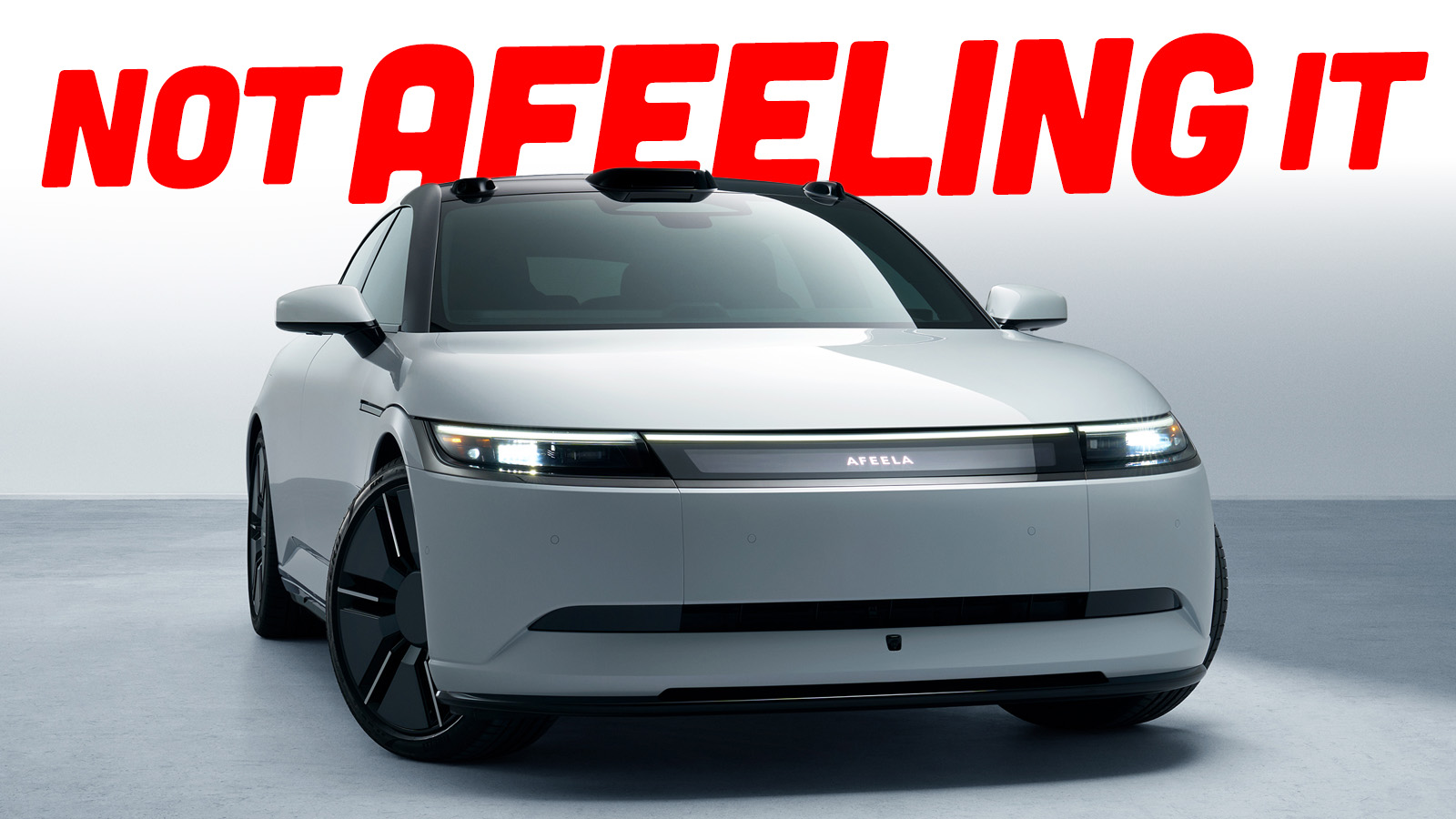
This is notable mainly because the first car, the Afeela 1 sedan, was basically ready to launch. The company showed a production-intent prototype earlier this year at CES in Las Vegas, which I saw in person. It looked like a real car! Plus, Afeela had six “studio” showrooms set up across California where buyers could sit inside the car and experience its tech. Just four days ago, it launched a whole delivery hub in Torrance. What great timing.
Even if Honda didn’t cancel its EV plans and Afeela moved forward with production, I think it would’ve been doomed anyway, since it wasn’t breaking any ground in the already highly competitive EVs space, whether we’re talking about looks, technology, or price.
Reservation Holders, You’re Getting A Refund

The joint venture between Sony and Honda responsible for the Afeela brand, Sony Honda Mobility (SHM), announced today it’s officially discontinuing development and the launch of both the Afeela 1 sedan and the second, unnamed Afeela crossover shown in January at CES. In its release, the company makes it clear this was pretty much out of its control:
[A]s a result of Honda’s reassessment of its automobile electrification strategy announced on March 12, 2026, SHM will not be able to utilize certain technologies and assets that were originally planned to be provided by Honda at the time of SHM’s initial business planning. In light of this change, SHM has determined that it does not have a viable path forward to bring the Models to market as originally planned.
Hilariously, the announcement to cancel Afeela’s cars comes just four days after the brand held a huge grand opening celebration for its delivery studio in Torrance, California. The event hosted executives, reservations holders, and the mayor of Torrance, and included free drinks and even a ribbon-cutting ceremony. Here’s what it looked like on the ground, going by this LinkedIn video:
The fact that this event happened at all is amusing in a sad sort of way. It was announced on March 16, four days after Honda revealed it’d be killing off its EVs and putting Afeela’s future into limbo. Why the company didn’t delay or cancel the celebration until it knew it had a future is puzzling, though, going by the video above, the vibes seemed pretty upbeat. Perhaps all of the catering was already paid for, and couldn’t be easily refunded. I wonder how all of these people are feeling right now.
It’s unclear what will happen to the delivery hub or the other five studios across California, though, seeing as how the Afeela 1 is effectively dead, there’s no reason to continue paying the rent or the employees to keep them open. The company says it’s refunding reservation holders and “will continue discussions with Sony and Honda regarding its future business plans,” whatever those might be.
Doomed From The Start?

Whether Honda canceled its EV platform or not, these Afeela cars didn’t have a promising future. As we pointed out in January of last year, when the car’s specs were revealed, the 1 sedan didn’t really make any sense. It paired two 241-horsepower motors with a 91-kWh battery pack, delivering an estimated 300 miles of range and a peak DC fast-charging rate of 150 kW, all for $89,900—specs that were uncompetitive back then and even more so now.
The Afeela 1 definitely doesn’t differentiate itself on design, either. It really just looks like a forgettable mashup of five different no-name Chinese EVs, without any defining features. The inside isn’t really much different, as it’s simply a sea of screen and black leather, with a steering yoke that I’m sure wouldn’t have been pleasant to use.

Where Sony Honda Mobility put all its efforts was into making the car a “software-defined vehicle,” using a suite of 40 sensors—cameras, LiDAR, radar, and ultrasonic sensors—for features like driver-assistance systems and high-end audio playback. Inside, occupants could control the car’s functions using natural conversation via the “Afeela Personal Agent.”
It also had a gigantic panoramic screen for a dashboard, and used Unreal Engine, a graphics engine usually powering video games, to run the display. SHM described it more as a fancy living room on wheels than a car. From that 2025 release:
The cabin of AFEELA 1 is designed with the concept of “Mobility as a Creative Entertainment Space.” Each occupant can enjoy a variety of apps and content provided by entertainment partners through an optimized, unique sound system and displays by seat. Sony Honda Mobility’s proprietary noise-canceling technology and expertise provides an overwhelming sense of quietness. The optimally placed speakers featuring Sony’s 360 Spatial Sound Technologies offer an high-quality audio experience with immersive sound. SHM is working on creating unique entertainment experiences using driving and vehicle data through collaborations with external creators and developers.

While all of that sounds pretty neat, it’s unlikely this would’ve been enough to win over buyers in America. When you can get a Lucid Air Grand Touring, with more power and a lot more range, all for less money, what’s the point in buying the Sony? It might’ve been different if Honda or Sony already had a reputation for good, cutting-edge vehicle tech, but this was going to be a first for both companies in this segment, so it was totally unproven.
Either way, it’s always sad to see a car die before it has the chance to hit the road. Perhaps in a few years, SHM will reemerge with something new. Until then, we’ll be waiting.
Top graphic image: Sony Honda Mobility



I guess I’ll just have to keep living out my Afeela dreams in Gran Turismo
/sad electric car and playstation controller noises
Does the Air GT start at $115k?
Yes it does. They must have meant the Touring at $80K.
Ah that’s it. And looks like $40k used with <20k miles. Wild.
They took all of the worst features of every EV (yoke steering, nothing but screens) and were planning to charge an insane amount of money for a very average car.
Even if the US had Bizarro World-ed itself into an EV Utopia, I highly doubt this would’ve been a successful venture.
Yes. Literally every complaint drivers would have expected a legacy brand like Honda to address.
Sadly, it seems like “mediocre first EV attempt as a learning experience” is basically a rite of passage at this point. Unfortunately, I think Honda has waited like 5 years too late for that to be acceptable. Maybe they are secretly pulling a Ford and working on a $35,000 EV, but I highly doubt it. The fact I can’t go buy a hybrid Odyssey or Pilot right now should also be a major point of embarrassment.
It’s kinda funny looking back at the Nissan / Honda takeover, and wondering if maybe the roles could be reversed in 10 years.
Wow, just wow. I did not see that coming /s
If it was called Accord EV without the gimmicks and priced according to the market, it could have a future. Can I be the next CEO? Thanks.
Sony has been saved from themselves. I think everyone questioned this idea when it was announced, and I still don’t see how it made a good business case. I trust Honda pretty well, but I don’t know what Sony brought to the table. The space they wanted this to play in is already crowded, and I’ve never seen anyone clamoring for Sony software.
I’m also convinced that barely anyone wants to talk to their car to make it do things. I could be wrong, I have no marketing data to back that up. But I think we’ve all had less-than-stellar experiences with Siri/Google/any other voice-activated product to know it’s an exercise in frustration.
In Star Trek, talking to the computer looks cool and futuristic, especially in 1980’s TNG when the best your car could do was tell you the door was ajar. In a car, it takes to much time to change the HVAC or radio versus just pressing a button or two.
I sometimes use Siri to dictate responses to text messages. It works pretty well for “I will get the eggs”, “See you in 45min” etc.
That’s about where it starts and ends for most people, I suspect.
I sometimes use it to find & set destinations, but generally it’s just easier to find the address on your phone before you even leave the house.
It’s absolutely rage inducing when Siri or Google can only find the address in the wrong province or country.
I completely agree with your assertion that most people don’t want to talk to their car. First, there are lots of times when it would be disruptive (sleeping children, music playing, carrying on a conversation, etc.)
Second, taking to any kind of software “agent” is never intuitive and human-like. There is always going to be some language that they don’t understand (e.g., saying “air conditioning” instead of “climate control” or “temperature,”) which is frustrating. Voice control has been around for like two decades now, and although it’s gotten better, it is nowhere near human conversation level and likely won’t be for a very, very long time.
I literally do not understand how auto manufacturers don’t understand this. Surely, focus groups will expose how little voice controls are used.
It depends if they are listening to the focus groups, or still in the “We will tell our customers what they want, and they will pay us a re-occurring subscription for it” phase.
Looks like the yoke is on them.
Yeah, Sony and Honda weren’t Afeela’n it so they took their ball and went home.
Two hardware companies, at least one of them with a terrible record for software development, trying to make a “software-first” car.. was probably always going to be a terrible idea.
Annnnd there goes another project I’m working on.
Oof. Sorry to hear.
Luckily for me I don’t think that Honda can afford to cancel the next two projects they have the company I work for contracted to do!
That’s at least pretty good! Good luck.
Honda’s actions are questionable. We’re also in the midst of gas prices soaring – which would be a more receptive audience for EVs again.
But, you know, gotta bend the knee to the administration.
Yeah, it’s totally baffling to me. It sounded like Honda wanted to put serious effort into releasing an EV only to yoink it right as a lot of folks are thinking an EV sounds pretty good.
I don’t think the Afeela was ever going to be a major hit—that interior looks like a nightmare to use, the specs are super uncompetitive, and who thought that handsy name was a good idea?!—but I’m genuinely confused by Honda’s pull-back, current administration or not. It all just seems like they’re shooting themselves in the wiener at precisely the wrong time.
And they are still behind the ball on hybrids.
It looks a lot like Honda needs to adjust its course. It continues to look like that merger with Nissan would have really helped them as much as Nissan.
As much as this admin has made running any business difficult, let alone an auto company, I’m not sure this car had a market as this article pointed out.
“We’re also in the midst of gas prices soaring”
The answer to high gas prices is a bland electric sedan with a $90k price tag?????
“gotta bend the knee to the administration”
The rest of the world still exists. Many other countries strongly incentivize and/or require EVs. If this was a competitive product, it would have no problem selling in the rest of the world. Further, you can still buy an EV in the US if you want one. Americans don’t appear want this particular EV.
It is easy to point the finger at trump whenever an EV project fails, but realistically, some EVs fail because they were either bad ideas from the start or good ideas that failed due to poor execution. Afeela seems like both.
I agree with you when it came to Honda’s three EVs, but no one was going to buy the Affela. As mentioned in the article, it’s totally uncompetitive. It would have been uncompetitive at $40,000, let alone more than twice that. It’s also in a market segment that has been dying for a long time. Why this wasn’t cancelled months ago is beyond me.