

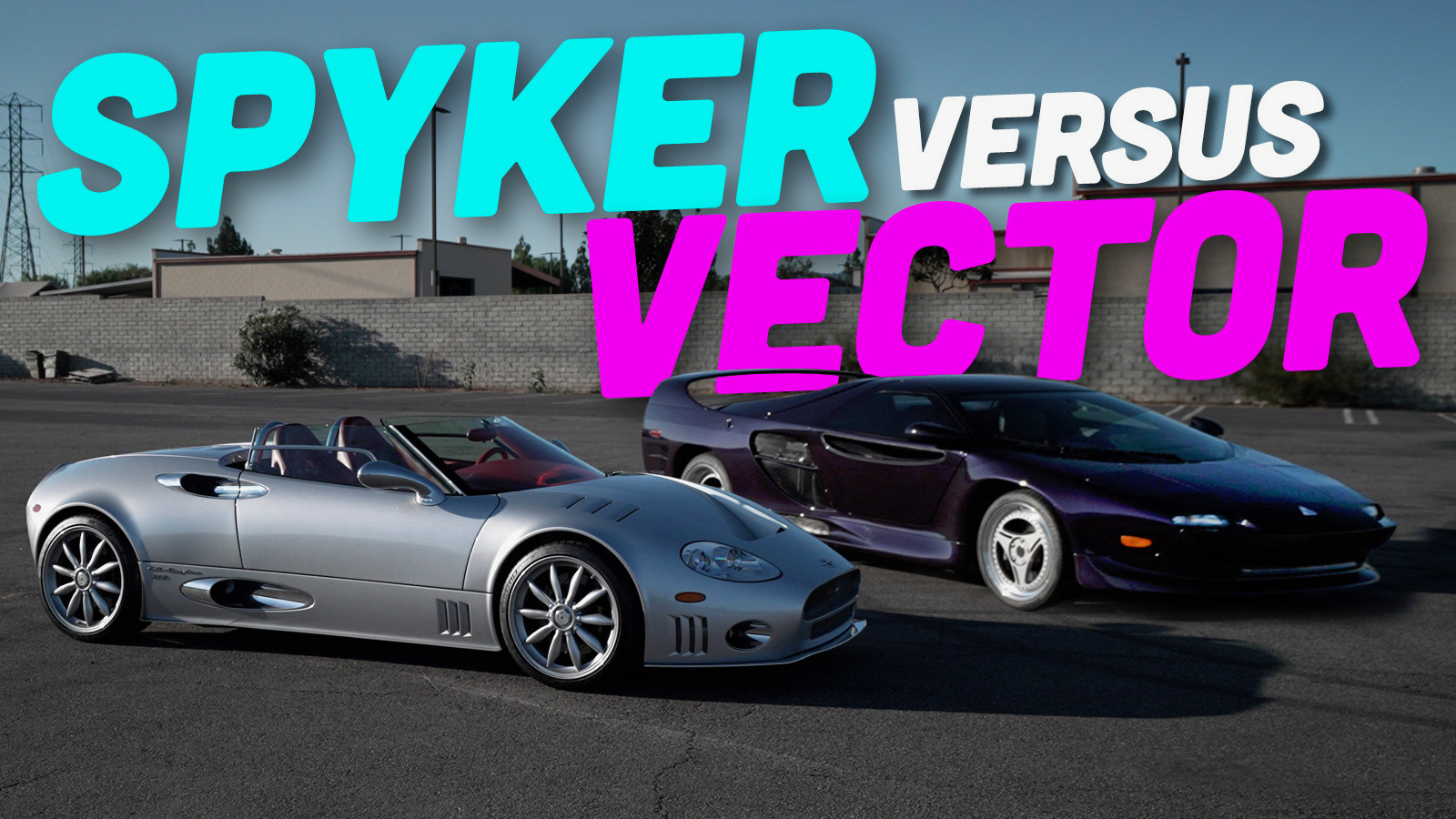
On paper, the Spyker C8 and Vector M12 have a lot in common. They are both the product of an eccentric visionary with patriotic motives; both were inspired by the aviation industry; and both are mid-engine, manual supercars that can melt your face off. And yet, driving the two cars, it became apparent to me that they are insanely different. The Spyker is an intricate, lightweight jewel and the Vector is a sleeker Cozy Coupe strapped to eardrum-bursting rocket. Both offer absolutely unforgettable driving experiences.
“BUZZ BUZZ BUZZ” my phone vibrated on a random weekday. I picked up to hear Autopian cofounder Beau Boeckmann telling me about a Spyker that had either been traded in or purchased by Galpin or…something. I don’t remember, but what I do remember was an idea so genius I couldn’t contain my excitement: Beau wanted to compare the Spyker to a car he had purchased recently but not yet driven: The Vector M12.


In short order, I found myself at Porsche Santa Clarita about to pilot two of the most interesting cars of all time.
First, there’s the Spyker C8 Spyder. The story of this car is a wild one; after a Dutch man named Maarten de Brujin developed a supercar during the 1990s, he partnered up with lawyer Victor Muller to turn that car into a reality, using the brand name of an old Dutch carriage and airplane company, Spyker.
The result was an elegant, Audi V8-powered supercar with a persona unlike anything I’ve ever seen or driven. It’s almost got a bit of a steampunk vibe, with everything mechanical and made of metal. Perhaps Rolex might be a better description; every touchpoint is absolutely perfect — the leather, the switches, the shifter. The C8 is absolutely magnificent.

As fascinating as Victor Muller is, especially given the financial and legal complications Spyker would ultimately find itself dealing with (it even bought Saab!), somehow he seems like a dentist when compared with Vector’s Jerry Wiegert. Originally from Detroit, Wiegert worked for American automakers for a while before moving to California, where he set out to build a red, white, and blue supercar to go up against Ferrari, Porsche, and Lamborghini.
Wiegert completed a concept car that he showed at the LA Auto Show back in the mid-1970s, shortly thereafter establishing the company Vector Aeromotive. He cobbled together enough cash/investment to build the edgy, iconic Vector W8, whose mid-mounted 6.0-liter V8 sent a claimed 625 horsepower through a modified GM Turbo Hydramatic three-speed automatic transmission and promised a frankly unbelievably top speed of 242 mph.
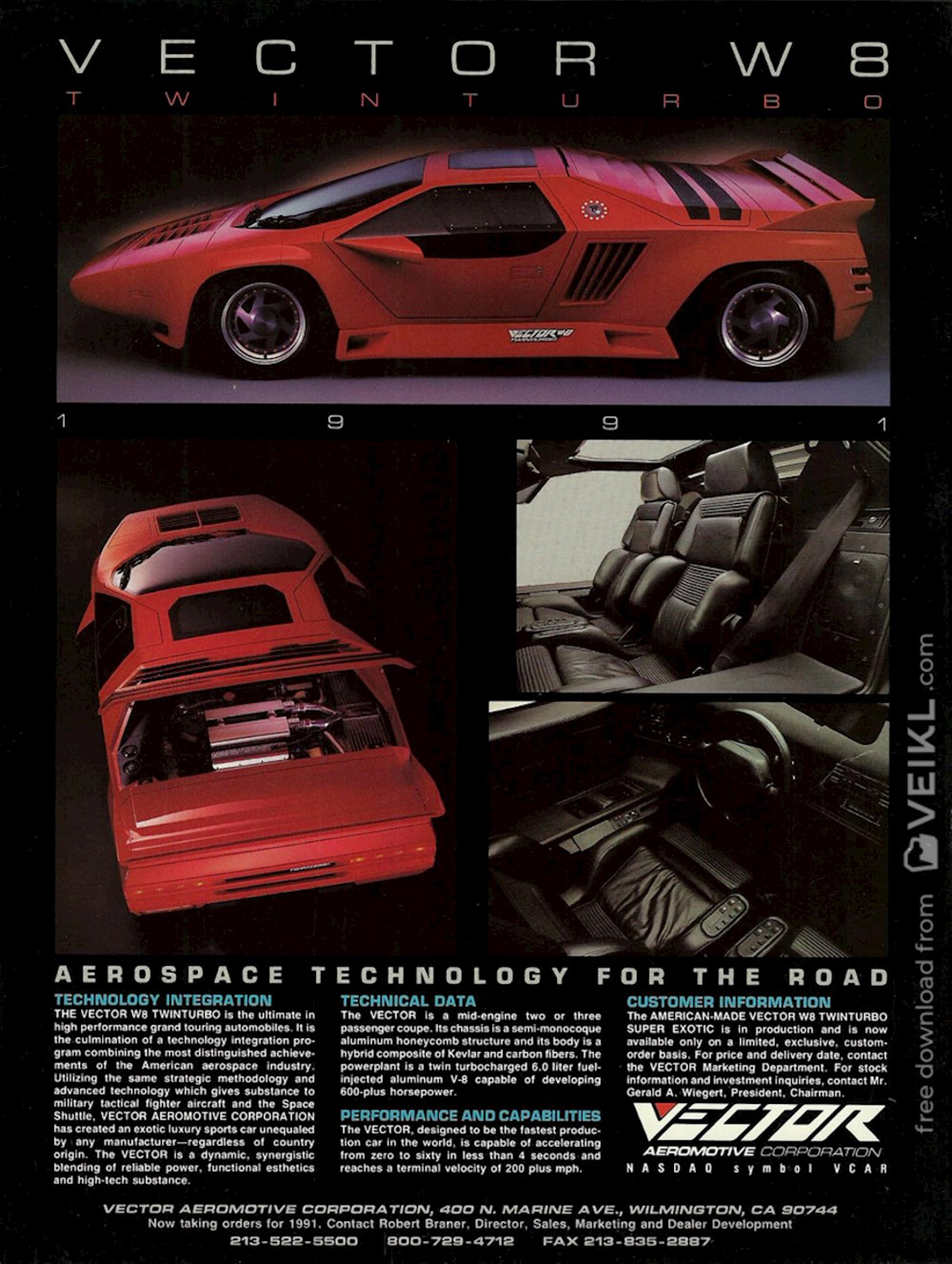
The launch of the W8 was complicated and involved tennis star Andrew Agassi allegedly rushing the car through production, leading to an infamous mechanical breakdown, a full refund, and a damaged brand image. As time went on, Wiegert’s Vector Aeromotive found itself embroiled in a conflict with then-owner of Lamborghini, an Indonesia company called Megatech, who executed a hostile takeover, booting Wiegert out of the picture.

Beau’s Vector M12 was the only Vector built post-Wiegert; some say it was Megatech’s money-grab that bastardized the vision of the company’s founder, eschewing many of the design features that made a Vector a Vector, instead simply re-bodying a Lamborghini Diablo in a skin that looked very much like the prototype car Wiegert had been working on prior to his ouster.
What Are They Like To Drive?
Even getting into the two cars couldn’t be more different. The Spyker has a beautiful, delicate hidden switch head of the mirror that opens the scissor door:

The Vector also has a hidden switch/latch, but it’s mechanical, and yields a door whose opening is, frankly, barely an opening:

Once inside, the Spyker is simply a masterpiece. Reading up the history of the brand, I got the impression that the car was a bit of a pet-project of a pair of Dutchmen, one of whom is extremely eccentric and, to some, a bit “out there.” This led me to completely underestimate the car, because one look at the build quality of the C8 made it feel like the antithesis of a pet-project. This thing felt complete, and rock solid.

The red leather is simply perfect. The gauges, the switches, the aerospace-inspired vents — absolutely gorgeous, not just visually but especially to the touch. They are deeply satisfying to use.

Every single part of the car is made of the very highest quality materials built in the most precise and gorgeous way. Just look at the pedals:

Even under the front “hood” (which does not contain an engine, as the Spyker is mid-engine), the suspension and mechanicals look refined:

The Vector was completely different inside; the Spyker is refined and a bit dainty; the Vector is crude and brutal.

The sills one has to jump over to get into the seat are massive, the steering wheel looks like a regular four-spoke you’d find in maybe an Oldsmobile, and the switches are straight-up out of any 1990s-era GM:

Look at the photo above the switch picture and you’ll see on the left side that the vent is coming detached from the dash. The Vector M12’s build quality is not great, to put it lightly. And compared to the Spyker? It’s a toy. Even the Vector’s steel tubeframe looked crude compared to the Spyker’s aluminum chassis.
Up front, unlike the Spyker, the Vector has a big, usable frunk whose prop rod is not actually a rod but rather a spring that one just bends to the side to close the lid; it’s very clever. Also clever are the repurposed Mazda Miata turn signals:

The only place under the skin where the Vector actually holds its own compared to the Spyker in terms of aesthetics is out back. The Vector’s 492 horsepower 5.7-liter Lamborghini V12 looks great:

By comparison, here is the Spyker’s 400 horsepower 4.2-liter Audi V8:

Based on these first impressions, it seemed to me that “steampunk” and “elegant” might be words to best describe the Spyker, whereas the term “insane” best fits the Vector. And this translated exactly to the driving experience.

The 2,750 pound Spyker is one of the greatest cars I’ve ever driven. The combination of its unmatched build quality, its lightweight chassis, its amazing exposed-linkage shifter, and that lovely 400 horsepower 4.2-liter Audi engine yielded a truly put-together driving experience. The Spyker C8 is special; anyone who drives it will probably use that very word. It’s simply special.


“It sounds so good; this car is way too good for it being so low volume,” I say in the YouTube video. “Oh man I love this car; I really love it!”

Beau and I suspected that jumping from that Rolex-in-car-form into this rather shoddily-put-together American supercar was going to be a disappointment, but we both knew the M12 had one weapon that could save us from having to shake our heads: That engine. “This might be superman dressed in a shabby suit,” Beau said.
Whether that V12 saved the Vector’s image in our eyes can be answered with this screenshot:

Yes. Yes it did.
That V12 is truly insane. The sound is a low, angry bark that made the symphonic Audi engine in the Spyker feel downright weak. Sure, the 3,800 pound Vector didn’t have the great shift feel of the Spyker, nor did it seem as precise overall, but in the world of analog supercars, sensory inputs are everything, and the Vector M12’s exterior design is candy for the eyes and its amazing V12’s exhaust note is candy for the ears.


It was an amazing day of driving one of the best-built, precision European supercars ever and possibly the worst-built, jackhammer American/Indonesian/Italian supercar ever. Both cars are endlessly compelling, in the way they drive, in the way they look, and in their deeply fascinating stories anchored by deeply fascinating men.
Check out the YouTube video above, and expect to read more about Beau’s Vector M12 (as part of our Should I Sell It series) as well as about the next-generation Spyker debuting (this Friday as part of our Monterey Car Week coverage).


Saw a couple Vectors at the Lingenfelter open house a while ago, wild looking machines! always loved the details on the Spyker (Thank you Top Gear), now i want to drive one…
Great article on some very interesting cars, but what I’m dying for is more info, videos, driving impressions, etc. on the W8. Instead of judging Vector based on their worst work after their founder was ousted, let’s see how they did on the one they thought was production ready! I remember the W2 articles and photos from my childhood. I was obsessed with this car.
Jet Li’s antihero drove a Spyker in War. Advantage: Spyker
I’m pretty sure the only thing that kept Vector in business was the sale, to 12-18 year-old boys, of posters featuring women draped over their cars.
The M12 instrument panel is a non-starter compared to the amazing/ridiculous W8 panel that includes – among other weirdness – a Hobbs meter for engine hours, a boost knob, a transmission pressure readout, and all the fuses accessible from the dashboard in case you need to cut power to your fuel pump while driving. For the price of a Vector, why limit your cosplay to the M12’s poverty-class interior?
Where’s the vote button? I was prepared to mash the Spyker button in today’s episode of “Shitbox Showdown.”
That’s freaking cool. I’m sure it would never get included in a mainstream car because someone would definitely slam their fingers trying to close it one-handed, but I love that it exists here.
I don’t doubt for a moment that getting to drive these two cars was an amazing experience, and I enjoyed your obvious enthusiasm in prose and pictures David. 🙂
While I’ve always admired and been amused by the Jules Verne/steampunk interiors of Spykers, having seen them at about a third of the LA Auto Shows that I’ve attended over the years, in reality I don’t think I’d ever aspire to own one. Of course, I freely and happily admit that I’ll never be in that tax bracket anyway, so of course my aspirations are moot. As is my opinion I guess, even though that’s what comments are for. 😉
Don’t get me wrong: I’m relieved that the car is well put-together and actually good to drive… so many ‘supercars’ don’t seem to achieve even those basic benchmarks (the Vector being but one example). The fact remains that many of the details on Spykers aren’t actually that special anymore, no matter how carefully they’ve been executed. Entry/luxury American and South Korean offerings routinely sport diamond-quilted leather, which is now so overused that it seems like a visual cliche. Stainless mesh chickenwire covering various grill/intake openings was a thing on Jaguars now depreciated enough to be cheap used cars, as well as having been a J.C. Whitney type of add-on for ages… in some parts of LA, it’s hard to spot a Chrysler 300 without a stainless mesh grill.
The lack of a frame member at the top of the windshield looks visually strange to me, though I suppose that it adds to the ‘chopped’ look of the car I guess, and I mean that in the traditional sense of the word, not how the kids use it today.
All JMHO of course.
I agree that Spykers these days come off as a pastiche of ostentatious, played-out design details.
Andrew Agassi even had to change his name to escape the publicity
I was briefly excited at this bit:
Now you’ve got me picturing moon-rover metal-mesh tires and sculpted all-metal racing seats. But then…
Just a sentence later, and the dream is ruined. It’s just another boring supercar with plain old rubber tires and leather seats and I bet the windows aren’t even metal. Sell ’em both, and buy a proper all-metal, all-mechanical car.