


Midcentury Ford was a company with a pretty coherent taillight theme, and I salute them for that. That theme was round. It was really a sort of subset of the greater Round Taillight category, a light inspired by jet engine intakes and exhausts. These were real hallmarks of jet age automotive design, and Ford leaned into the look with a determined gusto unmatched by pretty much any other automaker. Part of Ford’s design vocabulary was a pair of big, round, jet-like taillights, forming a pair of glowing red exhaust-like orbs that were very distinctive when you followed them. In 1965, they started to transition away from the round taillight, but hedged their bets, sort of. It’s a little odd, and seeing how this news is only 61 years old, this seems like the right time to explore it.
Ford had adopted a round taillight design starting around 1952; their first postwar cars used more oblong-shaped rear lights, but once they got a taste of that sweet, sweet circularity, they wouldn’t let go. It wasn’t quite universal across their lineup, but it was certainly a running theme. They made a number of variations of these round lights, but they generally tended to be fairly simple, a round red main lamp with often a co-centric inset detail that housed a reverse lamp, reflector, another red lens, or some brightwork blanking area.


Here, since we’re talking so much about it, I may as well show you a prime example:
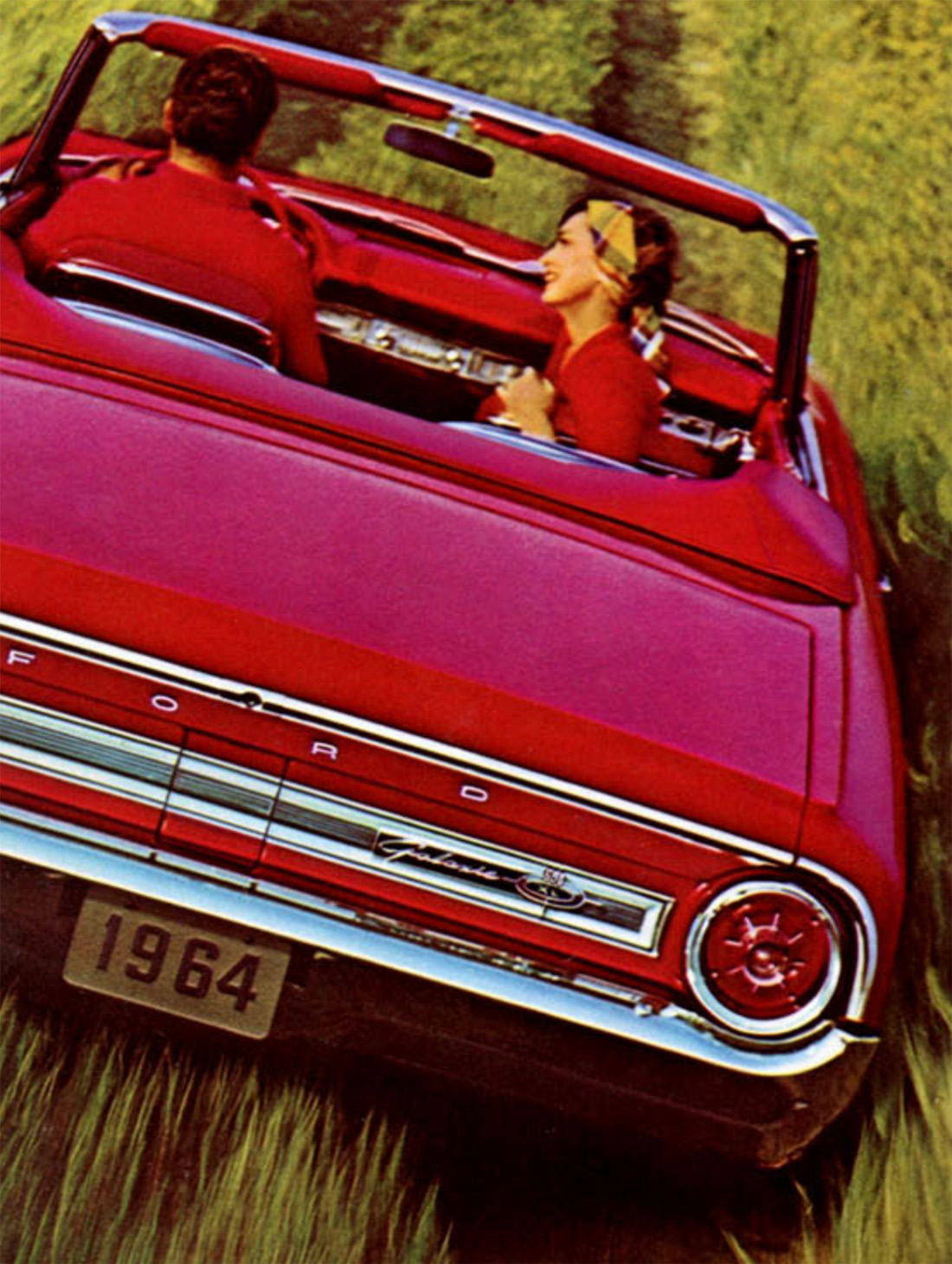
That one, from a ’64 Galaxie, also has eight little chrome-effect strakes radiating from the central cylinder there, for some extra visual interest. I picked this ’64 Galaxie as an example to show you how dramatic the change was one year later, when Ford did a major re-design of the Galaxie, inside and out:
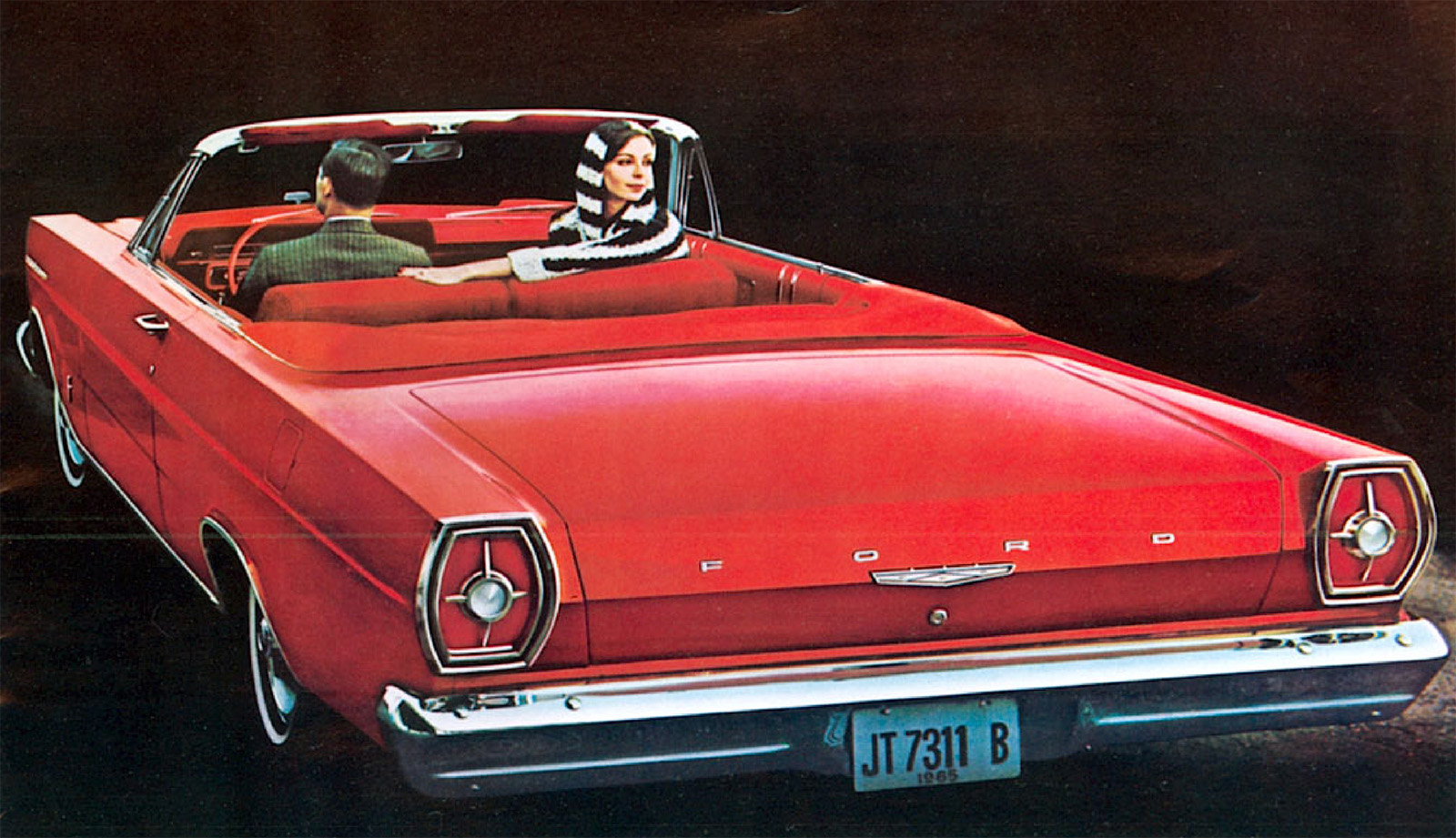
Look at that! The concept still feels a bit like a jet exhaust, but it’s now a more complex shape, flat on top and bottom, bowing out on the sides, perhaps a bit like a cathode ray tube television screen, rotated 90°. There’s still a round inset reverse lamp, and four of those chromy strakes.
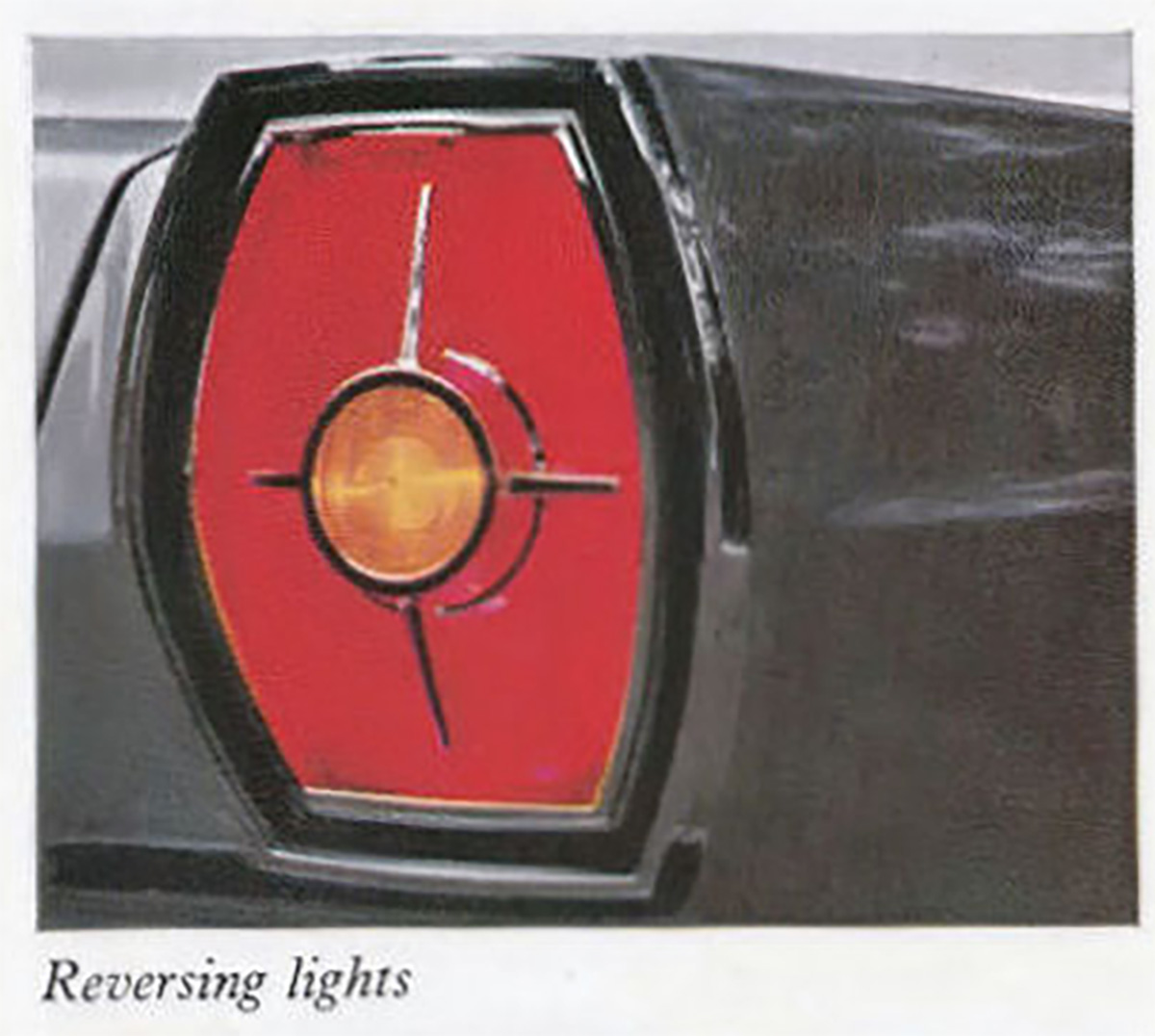
Just for fun, here’s the Australian market version, which required amber rear turn indicators, which did double-duty as reverse lamps, a unique Australian regulation.
Anyway, as you can see, these taillights are shaped to fit very specifically into the fender design of the new Galaxie; these are not generic lamps that Ford can just put on anything, they were clearly designed as a unified part of the new Galaxie.
That brings us to the part that sort of confounds me: for the lower-spec cars that shared the new Galaxie sheet metal, which Ford called the Custom and Custom 500, these taillights were replaced with round units like the earlier taillights, made to fit into the new body via aluminum filler panels:
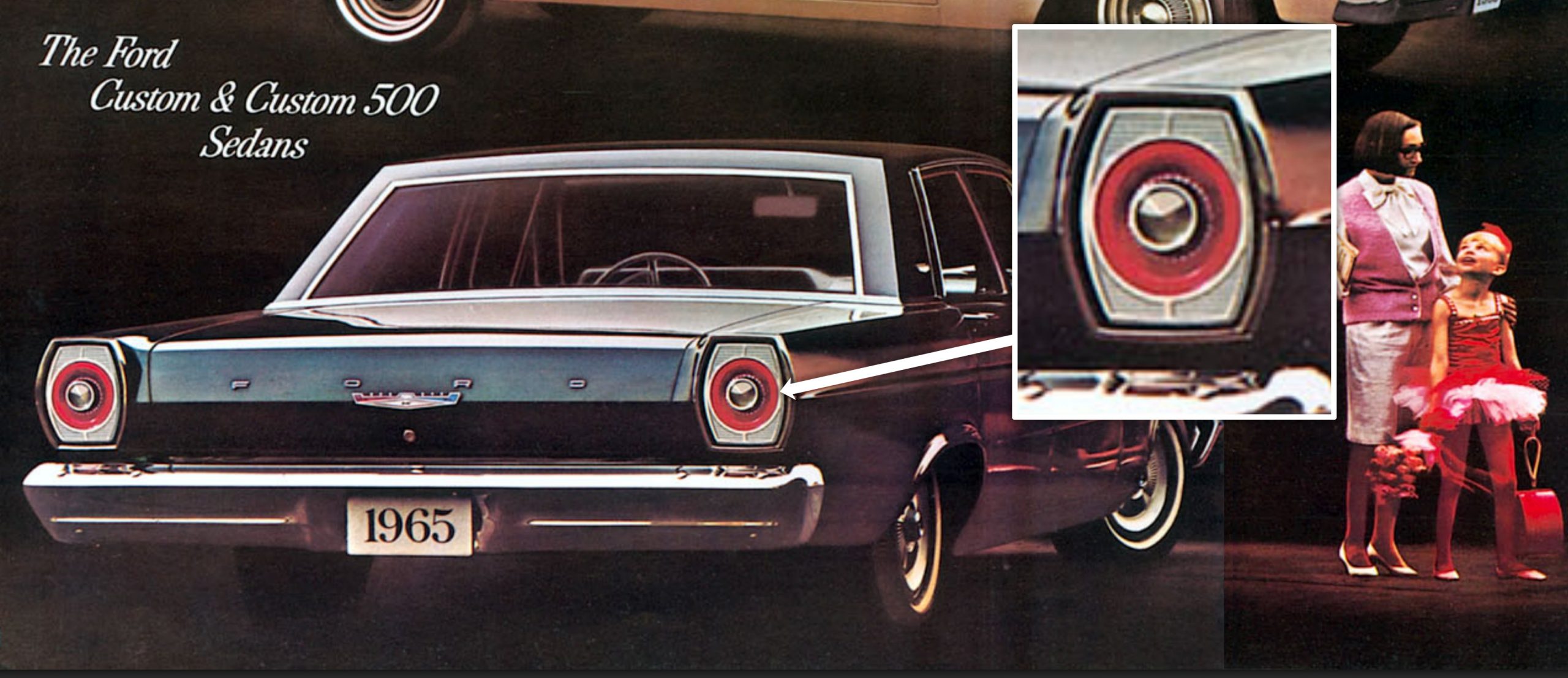
So, I have some questions here: since these were only fitted to the lower-spec cars, are they cheaper to produce? You would think that going from one part that is used across a car lineup to two separate ones would be more expensive, not less? Which makes me wonder if these round lights could have been leftover stock from earlier year cars? If so, then does that mean the width of the new lights were designed to accommodate these older round lights from the start?
And if they are leftover lights, what are they leftover from?
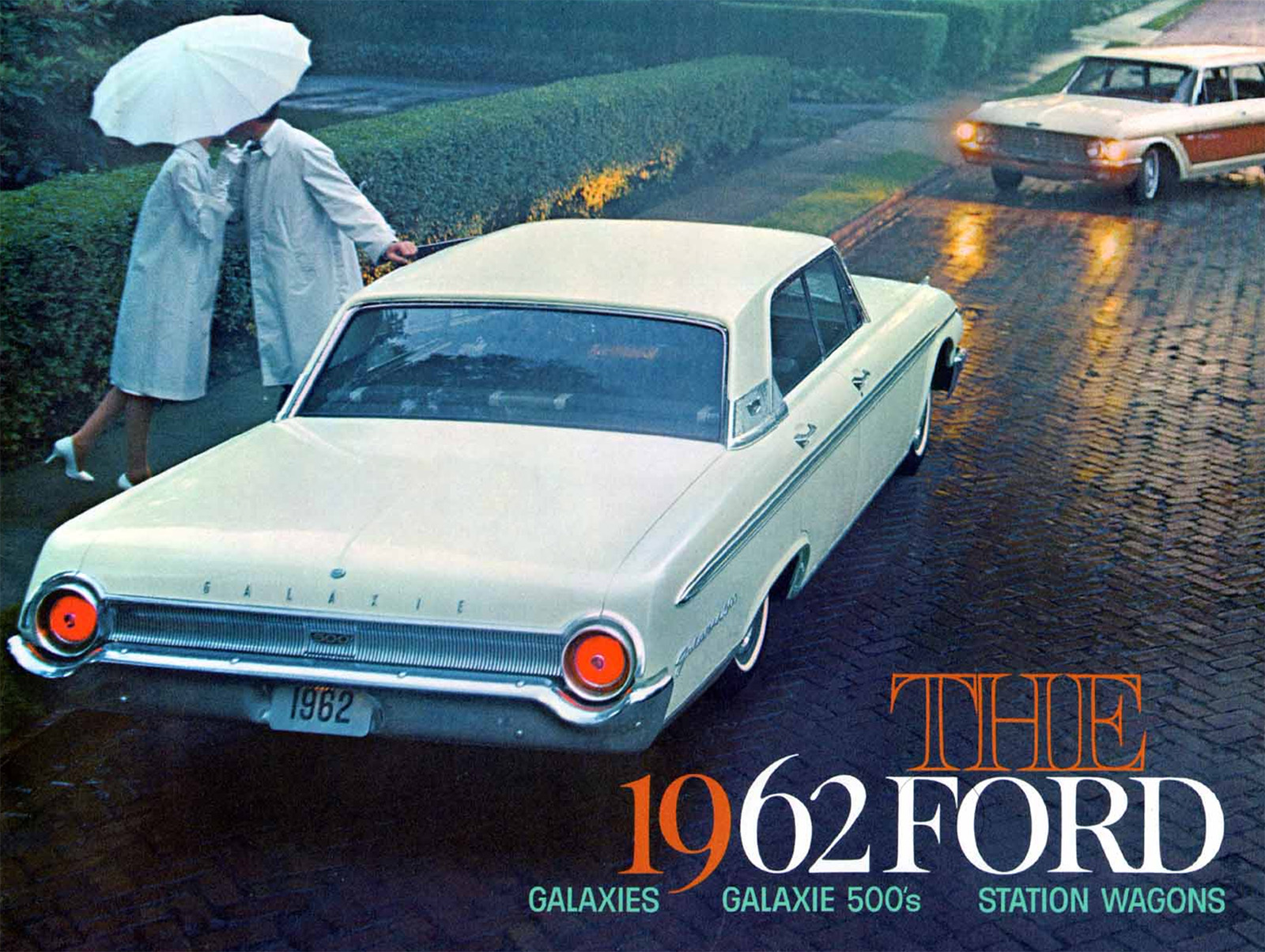
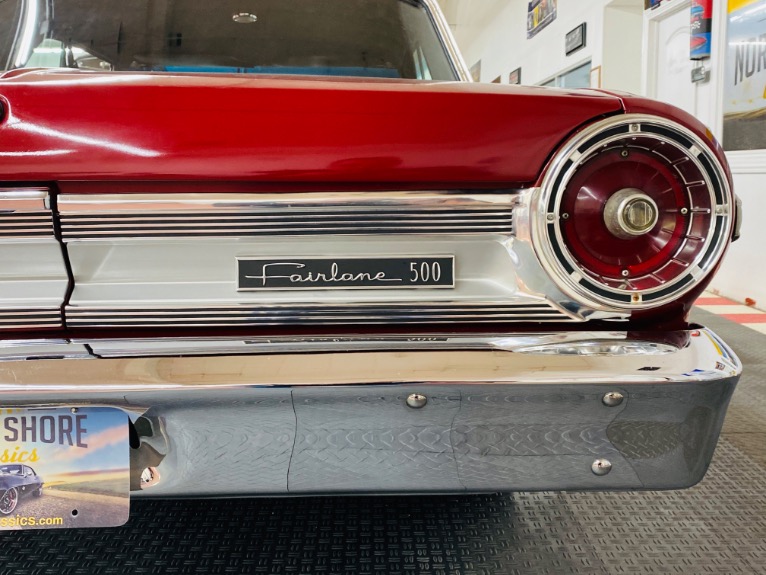
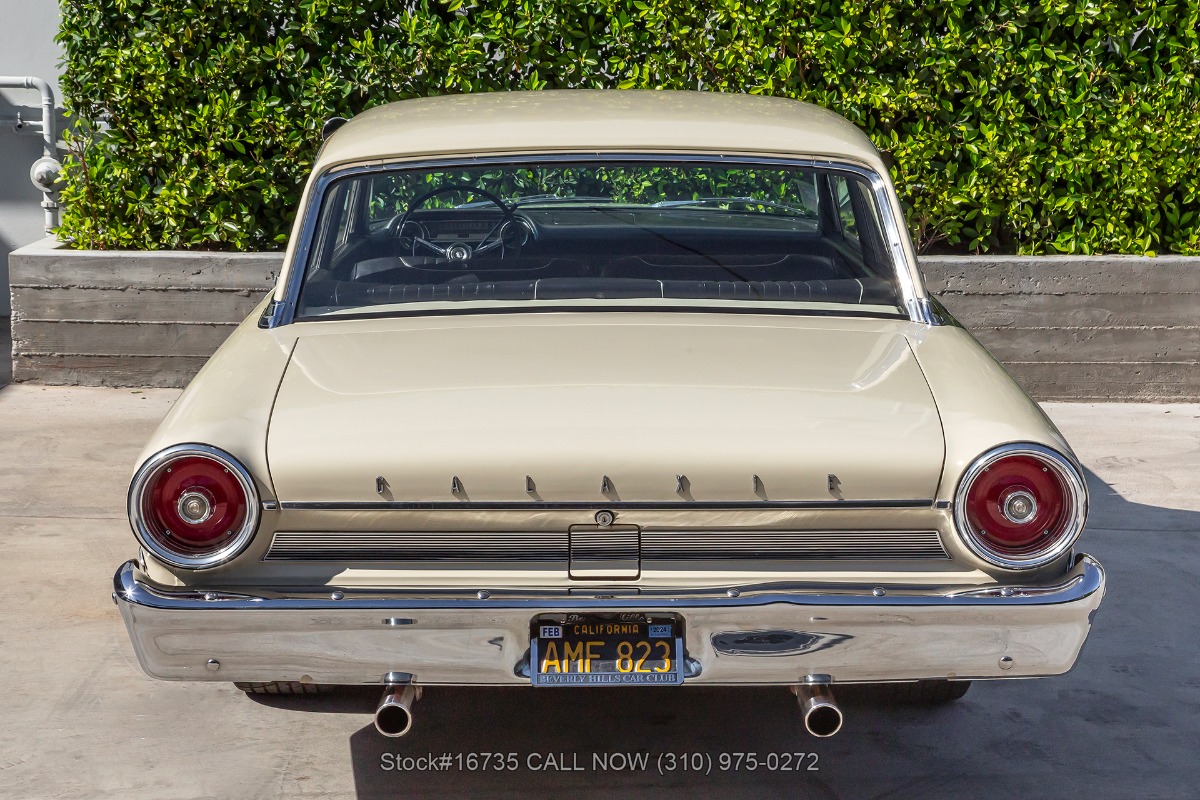
They’re not exactly like the ’64 Galaxie lights. They’re not exactly like the earlier Galaxie lights. They’re not exactly like the Thunderbird’s lights, they’re close but not exactly the Fairlaine’s lights, not quite the LTD – so, did Ford make new round lights just for the low-spec Galaxie/Custom?
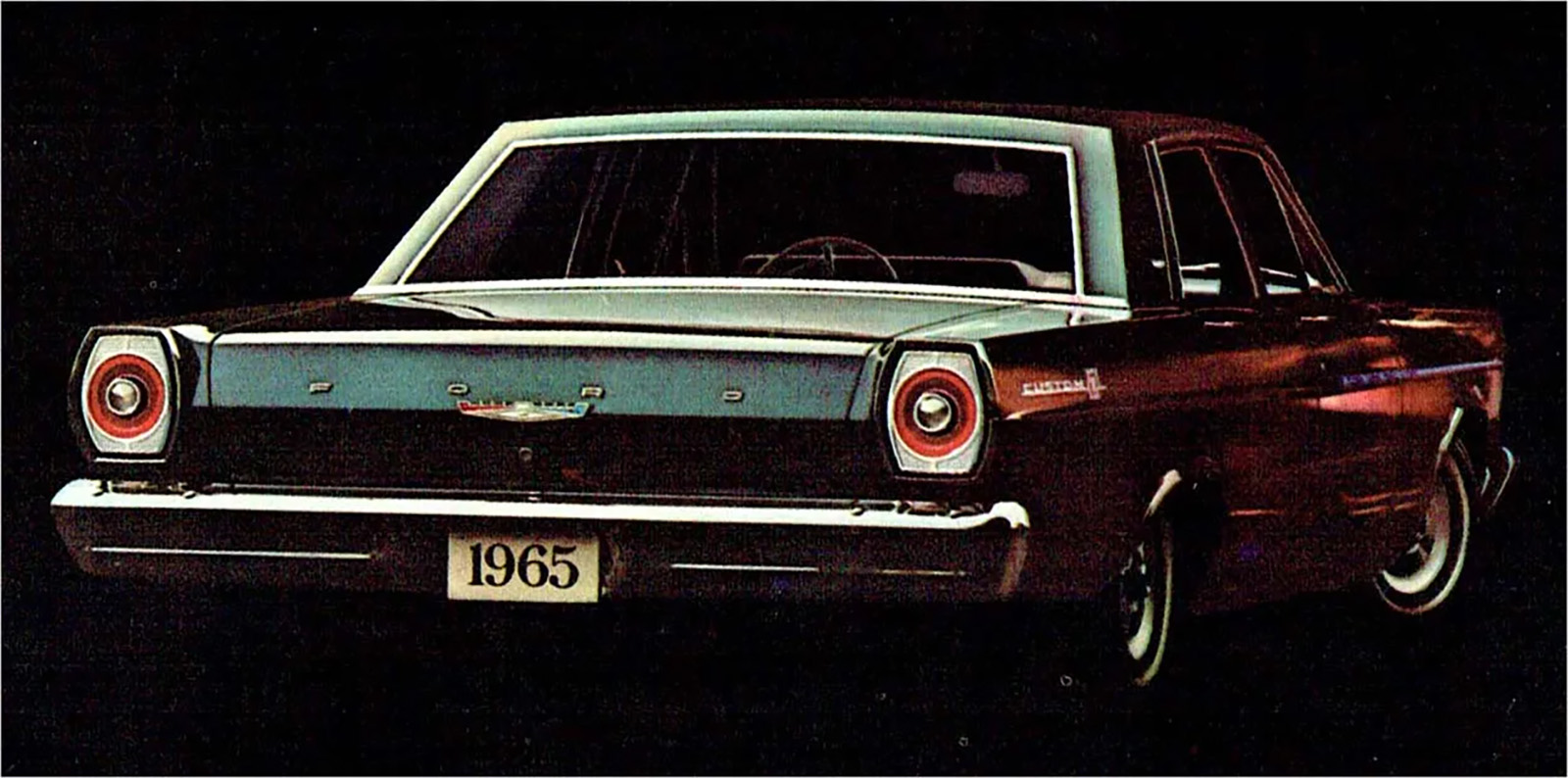
Is that what’s going on here? How does that make sense? If Ford made some filler panels to use a bunch of old stock round taillights, that would make sense. Waste not want not, right? But making new lights of a design you’re moving away from? I just don’t get it.

Now, some of these lights, like the ones used on these police-spec cars, do seem more like, say, the ’62 Galaxie lights; the inner cylinder/optional reverse light is smaller compared to the one seen in the brochure, which looks like an aluminum blanking disc. So maybe some of these used leftover taillights, but Ford also had new round lights to use as well?
I’m sure there must be some other examples of an old taillight getting adapted to a newer car; some of the lower-spec Volkswagen Beetles we never got in the US used ’62-’67-type lights even after the large “elephant’s foot” lights appeared in 1973, as you can see here, with the old taillights on the far left:

Off the top of my head, that’s the only example I can think of. In the taillight community, this is all considered quite fascinating, and knowledge of these strange Galaxie/Custom round lights is pretty much all you need to get laid in almost any taillight bar in America, so, you know, you’re welcome.
I’d love to know the full explanation behind this; I suspect that all of the people involved are likely dead or at least very retired by now, but I’ll reach out to Ford and see what they say; they have a pretty good archive department, maybe there’s some long-forgotten memo explaining the Full Galaxie Taillight Strategy somewhere.




We had a 1964 Galaxie 500 and of course it had those cool turbine taillights. It was robin-egg blue, with black vinyl seats that would sear your flesh in the summer. It was a cool car, about the only one of many we owned that I’d like to have back.
“Ford leaned into the look with a determined gusto unmatched by pretty much any other automaker.”
Jason! Have you forgotten what Cadillac taillights looked like back then?
Having watched a few Gemini launches in my early days, I was a bit puzzled with logic of red rockets going off, but the car is slowing down cough, (’64 Cadillacs) and not trying to achieve warp speed, not to timestamp myself. Jason can probably do a sermon, chapter and verse.
I really would like a button in my car that actually fired photon torpedoes, or at least sounded like it did.
It wouldn’t surprise me if they did just stamp those out from the old ’62 dies. Why not? I do remember a neighbor having one of these and thinking they looked very weird and like an afterthought.
For a second I thought the “taillight community” was a real thing
I don’t know whether or not I want that to be a thing. I suppose I do. I’m ok with whatever makes you happy.
I think assuming Detroit was making logical choices in the mid sixties is your first main challenge, haha
Dies are not cheap and they wear. So its possible it was nearly free to make 2 designs.
Chevy and gm trucks have different bed designs and that is “free” as tooling likely doesn’t last a year and already require multiple sets. So maybe the low production gm might last a couple of years while the Chevy makes a year on a die set with the gm pulling enough units. Dont know the exact math, but you gain options in higher production.
I bet the Marketing Department was in on this, too. It’s tougher to convince people to spend the extra money on an LTD if it looks just like the much cheaper Custom.
I was thinking marketing too, either the Galaxy was more opulent with many more square inches of glowing red. Or… The older round light would appeal to the “less change” crowd that didn’t want those psychodelia nonsense TVs
This is likely a good example of why the big three were suddenly doing so poorly. The example I usually cite for excessive costs is the exterior door handles of the Dodge Charger and Plymouth Road Runner – both E-Body cars. You’d think that they would have the same door handles but the one for the Dodge has a concave shape and the one for the Plymouth, convex. Can you imagine the engineering costs that were sunk into making bespoke metal door handles? AMC figured this out and said “one door handle for all the things”. I can easily see some Ford exec, totally unaware of engineering costs saying, “well we want people to buy high spec cars so lets make something cheaper and worse” and then not caring that the profit margins were terrible and made even worse by ordering bespoke poverty-spec parts for those models.
GM used the same door handles on everything for at least 30 years, probably more.
I tell my kids all the time that the “why questions“ are always the hardest to answer. I fear that we will never know the WHY of some Ford auto executive in the early 1960s.
Like is “could there be Life existing in the faraway Ford Galaxy billions of light years away?”
Some things are just best left unknown.
Lets look at this objectively:
In 1965, Ford sold over 2MM cars in the US alone – Include Canada, and you get over 3.3MM cars.
Nearly half of US sales were Full-sized Fords – half of those were Galaxie 500s, and over 100,000 were LTDs.
Ford could easily afford to produce distinct taillamps to differentiate their lower priced cars from the upper models.
They were not very bright lights. I got pulled over in 1985 while driving my 1969 Galaxie 500 and the officer said he pulled me over for dim break lights. I asked what should I do, after sitting on the side of the road for what felt like a long time. He said “nothing the car is old”. Later I realized it was to send a message to a car full of teenage boys.
I distinctly remember realising two full days after I’d been pulled over, that most of the experience was just the cop trying to ‘scare me straight’. It bloody worked, and I was kind of impressed by the cop, that it took me two days to realise that’s what was going on.
With domestic cars in particular, and especially in the yearly restyling years, I feel that it was considered more important that lower trims *look* cheaper rather than actually saving any money building them.
I tend to think so as well.
This is a great observation. I’ve always noticed that automakers seem to choose the ugliest possible design for steel wheels for base models, so even when they’re kinda covered with (themselves questionably styled) plastic covers, they scream cheap.
This was my thought as well while reading the article.
Certainly by the 1960s, and even the mid 50s. At least for the lower-priced brands. The mid-priced and luxury brands kept to the formula of a solid base that captured most of the volume (Buick LeSabre, Chrysler Newport), an intermediate line with better trim (Chrysler 300, Olds Delta 88), first in a sporty then more luxurious direction, and a top end model that emphasized luxury (Mercury Marquis, Chrysler New Yorker.
Cadillac broke that when they introduced the entry-level Calais in 1965. Unlike the previous base Series 62, the Calais screamed stripper, and the vast majority of sales were now De Villes.
Purely speculation but ill bet that the larger plastic lens was more expensive to produce in the 1960s than a stamped plate and smaller lens, even if they did have to create bespoke designs.
This is my thinking. Manufacturing wasn’t at the level it is now for parts like this, and the economies of scale may not have been the no-brainer that it is now.
I was a teenager when this happened. It was Shocking, I tell you! They also went to coil springs at the back, and the world was changed forever.
The Lamborghini Countach did the same thing. A fancy tail light shape, and a pair of taillights off a boat trailer, or more likely some piece of ag equipment.
They were from the 1972 Alfa Romeo Alfetta, and Torch has written about them previously
https://www.theautopian.com/how-lamborghini-completely-half-assed-the-lights-on-its-most-legendary-supercar/
Fortunately the Alfetta was sold in the US so those lights at least existed in DOT-compliant form. If not, Lamborghini and the importer had a ready substitute in the form of early Chevette ones. With or (more likely) without their characteristic heavy chrome surround.
Oh Jason, Google 911 R taillights.
Porsche put little round taillights on the Racing 911 in the 60s and there is a minor industry of making replica round taillights.,
Also the Corvair taillights on the Ford GT40
They wouldn’t be left over units, those left overs go into the replacement parts supply. It was just a way to ugly it up a bit to shame retail buyers into the higher margin models. As other have mentioned GM differentiated their different models by the number of tail lights while Ford just decided to make small and large versions.
We had a Corvair with aluminum blanking out two of the tail lights. It was stamped in the shape of the taillight lens and there was taillight hardware underneath. My grandfather could have gon to the auto parts store and bought a lens but he was really proud of having bought a Corvair with no options. It didn’t even have a heater or radio, but it did have eye searing red upholstery.
This is the correct answer.
Yeah, I read “leftover” as meaning “already existing molds”.
I would’ve assumed some decision maker at the time decided the Galaxie’s new lights were the cool new thing, and therefore didn’t want the lower spec car to get the cool new thing, thus mandating it get the adapted-version, and thus remaining less cool.
Yup. It’s the same thing nowadays with LED or incandescent tail lights. Both are usually completely different parts which increase costs, but you get plain old bulbs if you go for a lesser trim and LED strips in the fully optioned version.
Doing this isn’t cheaper for manufacturers. Even though the incandescent tail lights can be cheaper to produce I’m sure sticking to just LED would be far cheaper in the long run (simplifying parts stock, repairs, etc). They just want you to feel poor. It’s marketing, not costs savings.
Also, as someone else said: Ford wouldn’t reuse tail light surplus from other models as those would go into leftover parts supply for existing customers.
On the other hand, it was the early 60s and the idea of true automotive competition was considered laughable by the Big 3’s management. So entirely possible that yes, Ford did produce new lights specifically for lower end models.
It also could have been appealing to cheapskate old people who just wanted what they had before and none of this new flashy stuff thank you very much.
I was going to say something similar. This was the era of showboating, not squeezing the last drop of juice from the corporate parts bin, so I could see Ford making new lights for the lower trims as well.
“A long time ago in a galaxy far, far away….”
As a kid in the 50s the family farm in Wisconsin was on US 14 about 20 miles from the Chevrolet assembly plant in Janesville. Before the interstate system US 14 was the main route from Janesville to Chicago and so the transport trucks all passed by the farm on their way to Chicago. In the late summer when the new models were being delivered all the new cars on the transports were covered with tarps to prevent people from seeing the new models before the release date. We would sit out by the road and watch for one with a loose tarp where we might catch a glimpse of a tail light and get a sneak preview!
Thank you for that. In 1963-64 I was 9-10 and would watch the family issues of Time and Look magazines for the ads, which would go on for pages, about what the new Fords and Chevys would look like. I memorized all the visual details year by year. This article by Jason depicts the years of my peak interest in these all-important variations. Sadly it would be another decade before I could get admitted to a taillight bar.
Don’t speak too loudly about that… Torch might think you’re trying to impress him to get a job as bouncer at his taillight bar.
That’s like sitting outside the saloon hoping to catch a glimpse of some wanton woman’s ankle.
I’d say it has more to do with the introduction of the LTD, moving it upmarket and giving a distinct appearance with the extra cash vs. plebeian “Custom” buyers.
You also forgot the weird ‘58 taillights that are NOT rounds, and the awesome half round lights of the ‘60 with dimples in the rear bumper to complete the circle.
Even into the ‘80 Panther era LTD’s had a little chrome dot in the middle of the rectangular lens to mimic these old lights.
That dot was a simplified version of the Ford crest, used as a hood ornament in the early 50’s. Starting in 1988 they simplified it further to where it looks like a dude with a butch cut wearing sunglasses.https://i.ibb.co/xfcH5sP/sunglassesdude.jpg
You’re right! But it also think it mimicked the center in the lights Torch talks about here.
It was also in the center of the Crown Vic hood ornament.
Don’t forget the B-pillar trim.
For some years by this point Chevy had been doing something similar; Impalas had six round taillights, much smaller than Ford’s, the middle of each side’s set having the backup light. Lower spec Biscaynes and Bel Airs had four and unless the customer sprung for backup lights only the outer ones worked. But most years there were only two part numbers, backup light and stop/turn/etc. And of course the amber Aussie turn/backup ones.
Very good.
Huh. I totally would have suspected them using leftover/continuation parts from an older model, but if they didn’t that seems pretty silly.
Ford deviated from the round theme in 1960 too.
That seems like a logistics nightmare. Even if they had leftovers, I can’t imagine they over-ordered tens of thousands more than they ended up using. Or could correctly predict whether they’d accidentally sell too many Customs. I guess they would just “upgrade” the lights at that point.
It happens, that’s how you end up with UPS trucks with Oldsmobile Alero headlights.
Chevrolet Alero leftovers from the not so successful European launch? There is one in my neighbourhood, quite an unicorn. Or is it holy grail? Late 90’s were interesting.