


With EV road trips still being a time-consuming proposition and most North Americans living in single-family housing, there’s plenty of life left in the plug-in hybrid. While critics say the concept is a compromise, adding a modestly-sized battery pack and a charging socket to a regular car can also offer the best of both worlds. Plug it in overnight, and have enough electric range to get local errands done efficiently. Then, when the open road calls, there’s a gasoline engine to rely on. If this sort of thing sounds appealing, you could pick up something like the Kia Sportage PHEV.
Sure, its bones might be a few years old and it doesn’t offer the most electric range in its segment, but it has a seriously intriguing powertrain. Is it still worth a look when the incoming 2026 Toyota RAV4 plug-in hybrid and 2026 Mitsubishi Outlander PHEV offer more all-electric range? I lived with one for a week to find out.


[Full disclosure: Kia Canada let me borrow this Sportage PHEV for a week so long as I kept the shiny side up, returned it with a full tank of fuel, and reviewed it.]
The Basics
Engine: 1.6-liter turbocharged intercooled twin-cam 16-valve inline-four.
Electric motor: Single permanent magnet synchronous propulsion motor.
Combined output: 268 horsepower, 271 lb.-ft. of torque.
Battery: 360-volt, 13.8 kWh lithium-ion.
Transmission: Six-speed automatic with multi-plate wet clutch and integrated electric motor.
Drive: Mechanical full-time all-wheel-drive.
Fuel economy: 83 MPGe combined (2.8 Le/100km), 36 MPG combined when the mains charge runs out.
Maximum electric range: 34 miles (53 km).
Charging: 7.2 kWh peak through 240-volt Level 2.
Curb weight: 4,215 pounds.
Base price: $41,985 including freight ($48,395 in Canada).
Price as-tested: $48,685 including freight ($54,995 in Canada).
Why Does It Exist?

At this point, the compact crossover is the most popular genre of car in the world, so it only makes sense that every automaker has something in that field. Well, every automaker this side of Lamborghini, anyway. The Sportage is Kia’s rival to the Toyota RAV4 and Mitsubishi Outlander, and with both of those models offering plug-in hybrid variants, it only makes sense that Kia’s done the same.
How Does It Look?

Even after years of soak time, the outgoing Sportage was a challenging thing to look in the mug. A bizarre clash of shapes and textures congealed into one mass of plastic that made it look as if Kia hadn’t finished building the car before shipping it. Perhaps unsurprisingly, the weirdness has been toned down for 2026, and the facelifted Sportage no longer looks like it’s undergoing the automotive version of the Face/Off operation. By squaring off the front fascia elements and having daytime running lights frame the front end, it feels like Kia’s dialled in the sort of robotic sharpness it envisioned all along. More importantly, strong vertical forms make it look blockier, which is just about right for the times.

Beyond the updated face, the Sportage is still a melange of familiar 2020s crossover styling tropes. The full-width taillight treatment, the floating D-pillar, chamfered trim atop lower body cladding, and a rear licence plate down low on the bumper. However, there are a few neat details worth noting. Those four-spoke wheels are gloriously weird, while the LED reverse lamp in the center of the rear bumper is gloriously sensible. Also, check out the rear wiper tucked cleanly underneath the spoiler, shielded from UV rays. That ought to keep blades fresher for longer.
What About The Interior?

Just as the outside of the latest Sportage seeks to be less out-there, the inside adds the smallest touches of decluttering. One fewer spoke on the steering wheel, slimmer bezels with fewer edges for the digital cluster and infotainment screens, even the air vents have been toned down a touch. The big win: No shiny black plastic on any surface you’d touch or any horizontal surface prone to collecting dust. Thank you, Kia.

Elsewhere, it’s pretty much the same right-sized crossover that more than 100,000 Americans drive home every year, which means it’s quite good. The seats are surprisingly supportive if a bit short in the inseam, the swivel-away console cupholders are still Mensa-clever, there’s enough space aboard for the whole family, and you certainly won’t be starved for cargo room. From the soft-touch dashboard to the partially-sueded seats to the alloy-faced pedals, the Sportage also does a bang-up job of making some of its competitors feel a bit cheap. Of course, it also helps that everything feels assembled with the solidity of Windsor Castle. This pothole season in Toronto sits somewhere between Detroit in the Kwame years and Fury Road, yet there wasn’t so much as a single squeak, creak, or rattle from the Sportage.
How Does It Drive?

When is normalcy weird? When you’re looking under the hood of a Kia Sportage PHEV, of course. See, while some plug-in hybrids in the segment have no physical connection between their engines and their rear wheels, Kia’s entry does thanks to a six-speed automatic transmission and a power transfer unit. No eCVT here, and that’s only the start of the strangeness. See, this automatic uses a multi-plate clutch to lock the engine’s crankshaft with the transmission’s input shaft, along with an electric motor inside the gearbox for the option of silent propulsion. However, because the engine is a turbocharged 1.6-liter unit, the full-fat 271 lb.-ft. of torque is available essentially from idle.

This means that the Sportage PHEV virtually never has to work hard in the city, and there’s usually loads of power in reserve for freeway merging. Think power delivery of a lazy, big-cube V8 in a package that offers 43 miles of electric range if you plug it in and 36 MPG combined if you don’t. Sure, it gets a bit thrashy if you absolutely plant your foot through the carpet, but what small plug-in hybrid crossover doesn’t? Mind you, there is a spot of unusual behavior to contend with: Even in EV mode, and even though it’s equipped with an electric resistance heater, the Sportage is still weirdly willing to fire up its engine when the mercury drops. Even over days of short journeys that should’ve been possible solely on a charge pulled from the grid, I still used some fuel. How bizarre.

So, what about the ride and handling? Well, the Sportage definitely feels firmer-sprung than the incoming RAV4 plug-in hybrid, but the damping isn’t quite as refined. You’re going to occasionally find those firm-feeling bump stops over bumps in the city, but while the freeway ride could be a touch more nailed-down, there’s a generally pleasant balance here that most drivers will find reasonably comfortable. It’s the same deal with the steering, which is light around town but offers a quite good sense of dead-ahead on the highway, and the soft brake pedal is perfectly predictable.
Does It Have The Electronic Crap I Want?

If you’ve driven a modern Kia, you probably already know what I’m going to say about the Sportage PHEV’s 12.3-inch infotainment system: It’s great. Fast, easy to navigate, solid screen black levels, flawless wireless Apple CarPlay. However, we need to talk about what’s beneath it. For a few years, Kia experimented with making the climate controls and the radio shortcut keys the same controls. Two knobs, and bank of capacitive-touch stuff, permanent icons for key functions like the rear defroster and air recirculation, and one top-level key to switch what the panel does. Unsurprisingly, it’s incredibly distracting to use, even if you don’t have to touch it often. Real buttons for the heated and ventilated seats and heated steering wheel sit in the center console, so with automatic climate control, you mostly leave the dual controls in infotainment mode. Just don’t let anyone touch it, or having Maroon 5 come on the radio could result in accidentally setting the climate control all the way cold. Small wonder Kia already seems to be moving on from this arrangement.

Thankfully, the rest of the tech suite aboard the Kia Sportage PHEV generally works great. This fully-loaded test car gets a solid driver assistance suite, proper high-res parking cameras, a wireless phone charger, a smart power liftgate, and even a function to move the whole crossover with the key fob for parking in tight spots when you can’t be arsed to squeeze your body through a functional door opening the width of a number-two pencil. Just about the only generally underwhelming bit is the Harman/Kardon sound system, which doesn’t offer substantially superior range or clarity than a mid-range RAV4’s unbranded system. I suspect if you go for a more affordable trim, you won’t be missing much in the audio department.
Three Things To Know About The 2026 Kia Sportage PHEV
- Serious low-end torque makes it spry off the lights.
- The gasoline engine really likes to fire up in cold weather.
- Its climate control panel has a learning curve.
Does The 2026 Kia Sportage PHEV Fulfil Its Purpose?
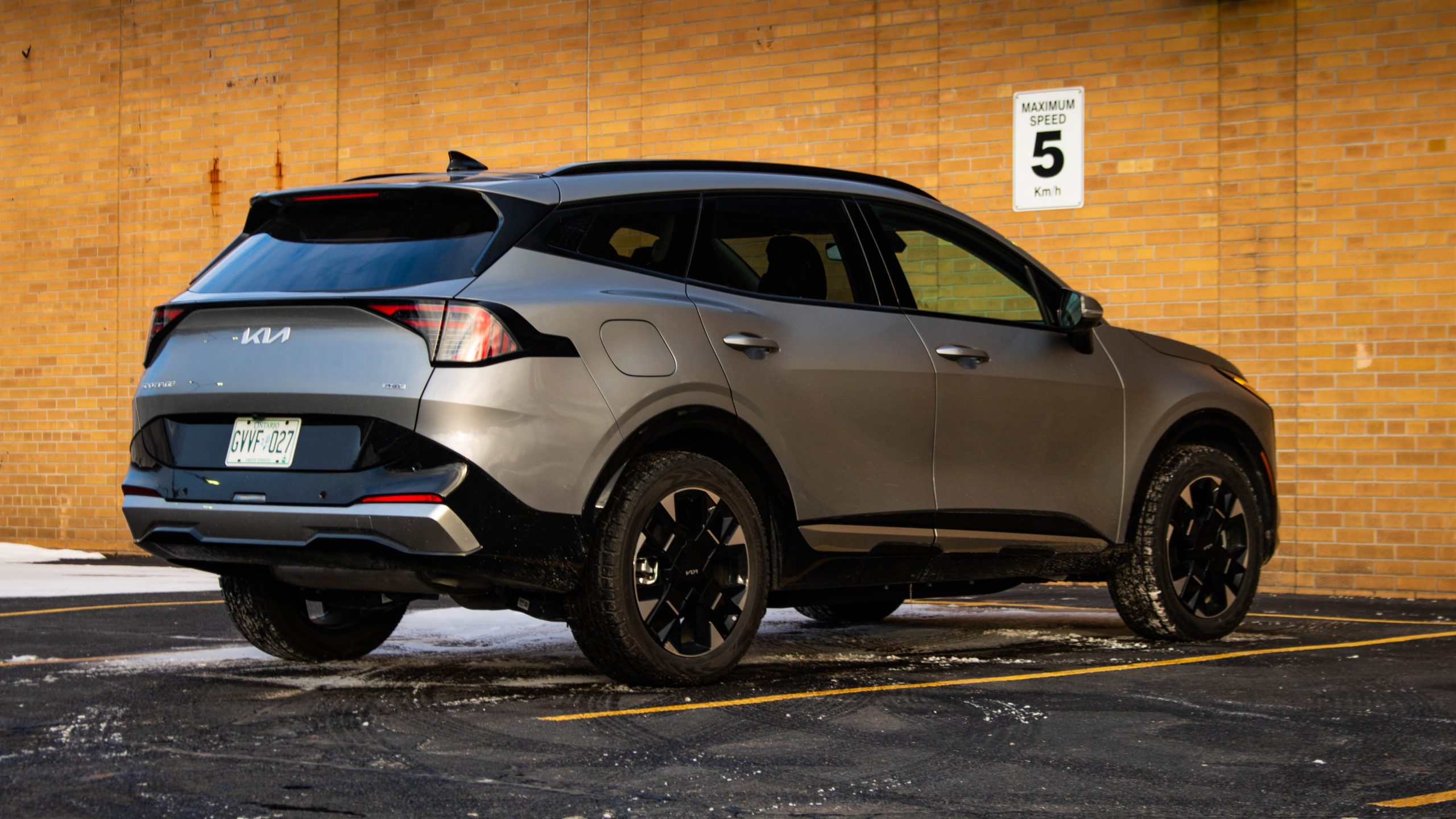
Absolutely. There are a few nits to pick, but that’s true of anything in the segment. What matters is that it’s quite comfortable, spacious, reasonably potent, has slick infotainment, and balances reasonable efficiency with the sort of physical torque distribution system that can really make a difference when local weather conditions get disgusting. It’s worth noting that the new Toyota RAV4 plug-in hybrid serves up substantially more range and is a straight-line hot rod, while the Hyundai Tucson plug-in hybrid offers the same basic powertrain as the plug-in Sportage but with real infotainment hard keys and substantially more interior storage. Still, if you want a reasonably priced plug-in hybrid crossover with a nicely-made cabin and have a strong distaste for shiny black interior plastics, the Kia Sportage PHEV is the one to get.
What’s The Punctum Of The 2026 Kia Sportage PHEV?

A remarkably agreeable plug-in hybrid crossover.
Top graphic image: Thomas Hundal


My parents bought a 2023 version of this car. It’s nice and seems to suit them well.
What a ridiculous start to the article:
“With EV road trips still being a time-consuming proposition…”
Lol no, as anyone who actually owns a fast-charging EV can tell you. Charging has added precisely 0 minutes to the road trips I’ve taken so far.
“…and most North Americans living in single-family housing…”
Living in single-family housing does not preclude one from being able to charge at home.
“…adding a modestly-sized battery pack and a charging socket to a regular car can also offer the best of both worlds.”
So all of the reliability and maintenance baggage of ICE vehicles with an extremely limited electric-only range? Sounds like the worst of both worlds to me.
Typical disclaimer: yes, I realize that, for people who genuinely cannot charge at home, EVs are a significantly less attractive proposition. I also realize that people with unusual driving habits may be better suited with an ICE/hybrid vehicle.
I just find it extraordinarily frustrating how the same misconceptions about EVs are paraded out on this site without taking into account the dramatic improvements to DCFC infrastructure and battery/range developments.
I still love the PHEV as an option if you have a use case for it. It’s so nice to have options when looking for a car. I only buy them pre-owned though, because the depreciation is steep.
The wife has a 1 mile commute to work. It’s so nice to have a PHEV for her. She’s not damaging the engine by not running it up to temp 2 times a day, 5 days a week. She can do her commute on all electric, but she still uses the engine on days where she needs more range. On long trips, her 330e gets about 42 mpg highway and she doesn’t have to worry about charging stations.
My son has a Bolt EUV for his car. It’s great for commuting, but if he’s going to do over about a 200 mile round trip, he takes another car from the family fleet.
We have (2) Level 2 stations at the house, one at 40A for the Bolt (it will charge at up to 48A) and one at 15A for the 330e (it will charge at up to 16A). If we got a 3rd EV/PHEV it would start to be a hassle to move things around after charging, especially since our cheap rates start after 7pm.
She DRIVES 1 mile to work?
Depending on where she lives, walking 1 mile might be practically impossible or at least very dangerous.
I regularly have to travel 1.2 miles between buildings at work. In the spring/summer/fall, I can walk, but all of winter it is basically impossible to do so.
The US is generally set up to make non-vehicular transport difficult.
That combination climate/radio thing is why we wound up getting a gas Kona instead of a hybrid Niro.
We looked at this and the ford escape plug in hybrid. Ford got the sale on a new old stock 25 PHEV for $27k! Only had 500 or so dealer miles on it. I much prefer the rock solid 2.5l normally aspirated Atkinson cycle engine and the slick Toyota-inspired e-cvt vs. the turbo and 6 speed. Not AWD though. Too bad Ford discontinued it as it checks the same boxes as the Kia/hyundais
Ford and Toyota independently came up with the same idea. One did not “inspire” the other. They cross-licensed it rather than having a patent fight that would have only enriched the lawyers. It is baffling that they are not making a Hybrid Bronco Sport since they offed the same-platform Escape, and you can still get it in a Maverick.
And I agree – that is the only hybrid drivetrain I trust to go real distances. What’s in this just feels like a mechanic’s wet dream about a month after the (admittedly long) warranty ends.
I drive about 90% of my annual 25000 miles electrically….but I recently needed to do a quick turn and burn trip that was just on the border of my range. Weather was cold and snowy, fast chargers spotty in the area. I opted to take my daughter’s car since it is gas and has snow tires. It’s a small car with a tiny fuel tank, so I filled up during the trip…Wow, what an experience after going a year without stopping at a gas station. There was a row of empty pumps, I didn’t need to use my phone or sign into an account, just tap my CC. The pump worked perfectly and I was done fueling in less than 3 minutes…and the cost was DEFINITELY cheaper compared to fast charging. I love EV’s but I think this is a good case to have a plug-in instead of two different cars. Most of my driving is about 70 miles of daily commuting and even being able to do half of that electrically would be environmentally and financially beneficial. I get the argument about carrying around a gas engine you’re not using, but what about the huge battery I’m not using most days? Where is the tipping point on cost/complexity for engine vs larger battery?
I’m not against a Plug-In in theory, but in practice I take issue mostly with the pricing.
It is a big jump between the regular hybrid and the plug-in.
It should be applauded that they’ve gotten the price of the hybrid so close to the gas one. But the jump to the plug-in is huge ($10k, but probably less if you compare like trim levels) and without some substantial incentives (from your state, since the feds don’t do that sort of thing anymore) you’re never making up the cost. Sure, if you can run in EV all the time that’s pretty great and it’s quite and efficient, but if you’re really doing that all the time and never turning on the engine, maybe it’s time for an EV?
For my wife, after having an EV for a year and a half, the plug-in seems like a good jack-of-all-trades solution to her charging woes. Maybe if you are only looking at plug-ins then this is a good option. But in applications like this (I think a plug-in is a great solution on pick-ups) I just can’t make it make sense.
I agree. Either a regular hybrid or full EV would make way more financial sense. Maybe there will be some really good lease deals on the PHEV, but I straight up don’t understand why we’re still fooling around with them at this point.
Our Volt will not kick the engine on unless its under 15F, and it will cycle on/off between 120F and 145F of coolant temperature. The good thing is that you can turn the resistive heater off and leave the fan running only, that way you only use the engine heat, not the electric one. The Pacifica PHEV uses both no matter what.
I dont like running the engine for short cycles, thats what got our EGR clogged in our Volt. Not a lot of PHEV that keep the engine off no matter how much you press the pedal or heat setting.
The Basics section says 34 miles electric range while later in the article it says 43 miles. Is one actual and one stated? Or just a typo?
33/34 is the advertised all electric range, 43 is a typo as that’s closer to RAV-4 plug-in hybrid range #s
It’s not awful looking, despite the chunky nose. Way nicer than the Outlander, and IMO a bit less annoying to the eyes than the new/current Rav4. Specwise, it seems like a very decent daily, though the small turbo motor and all the electronics give me a bit of agita when I think of owning it when it’s 20 years old (but that applies to all new cars pretty much).
But whyowhy with all the monochrome? The Sportage comes in seven shades of black/grey/white and that’s it. Not a single actual color. 🙁
It’s what the gray, boring people who buy this sort of thing want. Gray cars for gray lives.
Not everyone likes the things you like so its likely you won’t like the things they like either.
Unless Kia Canada actually lists a ptc heater I’m not sure the platform had one, the smaller Niro could be equipped with one optionally but if it’s like the Tucson PHEV besides the seat and or wheel heaters there’s zero electric heat available so if you use the climate control the engine is your only heat source. It’s also only 33 miles of all electric range in ideal conditions with hvac off. I had the Tucson for about 2 years and in summer it could easily meet or exceed that range with the ac on or at least get close, but the engine only operation struggled to get more than high 20s. It’s not a very good hybrid as it’s too heavily biased towards the EV part being efficient that the turbo hybrid engine is bad on fuel in the real world.