


With EV road trips still being a time-consuming proposition and most North Americans living in single-family housing, there’s plenty of life left in the plug-in hybrid. While critics say the concept is a compromise, adding a modestly-sized battery pack and a charging socket to a regular car can also offer the best of both worlds. Plug it in overnight, and have enough electric range to get local errands done efficiently. Then, when the open road calls, there’s a gasoline engine to rely on. If this sort of thing sounds appealing, you could pick up something like the Kia Sportage PHEV.
Sure, its bones might be a few years old and it doesn’t offer the most electric range in its segment, but it has a seriously intriguing powertrain. Is it still worth a look when the incoming 2026 Toyota RAV4 plug-in hybrid and 2026 Mitsubishi Outlander PHEV offer more all-electric range? I lived with one for a week to find out.


[Full disclosure: Kia Canada let me borrow this Sportage PHEV for a week so long as I kept the shiny side up, returned it with a full tank of fuel, and reviewed it.]
The Basics
Engine: 1.6-liter turbocharged intercooled twin-cam 16-valve inline-four.
Electric motor: Single permanent magnet synchronous propulsion motor.
Combined output: 268 horsepower, 271 lb.-ft. of torque.
Battery: 360-volt, 13.8 kWh lithium-ion.
Transmission: Six-speed automatic with multi-plate wet clutch and integrated electric motor.
Drive: Mechanical full-time all-wheel-drive.
Fuel economy: 83 MPGe combined (2.8 Le/100km), 36 MPG combined when the mains charge runs out.
Maximum electric range: 34 miles (53 km).
Charging: 7.2 kWh peak through 240-volt Level 2.
Curb weight: 4,215 pounds.
Base price: $41,985 including freight ($48,395 in Canada).
Price as-tested: $48,685 including freight ($54,995 in Canada).
Why Does It Exist?

At this point, the compact crossover is the most popular genre of car in the world, so it only makes sense that every automaker has something in that field. Well, every automaker this side of Lamborghini, anyway. The Sportage is Kia’s rival to the Toyota RAV4 and Mitsubishi Outlander, and with both of those models offering plug-in hybrid variants, it only makes sense that Kia’s done the same.
How Does It Look?

Even after years of soak time, the outgoing Sportage was a challenging thing to look in the mug. A bizarre clash of shapes and textures congealed into one mass of plastic that made it look as if Kia hadn’t finished building the car before shipping it. Perhaps unsurprisingly, the weirdness has been toned down for 2026, and the facelifted Sportage no longer looks like it’s undergoing the automotive version of the Face/Off operation. By squaring off the front fascia elements and having daytime running lights frame the front end, it feels like Kia’s dialled in the sort of robotic sharpness it envisioned all along. More importantly, strong vertical forms make it look blockier, which is just about right for the times.

Beyond the updated face, the Sportage is still a melange of familiar 2020s crossover styling tropes. The full-width taillight treatment, the floating D-pillar, chamfered trim atop lower body cladding, and a rear licence plate down low on the bumper. However, there are a few neat details worth noting. Those four-spoke wheels are gloriously weird, while the LED reverse lamp in the center of the rear bumper is gloriously sensible. Also, check out the rear wiper tucked cleanly underneath the spoiler, shielded from UV rays. That ought to keep blades fresher for longer.
What About The Interior?

Just as the outside of the latest Sportage seeks to be less out-there, the inside adds the smallest touches of decluttering. One fewer spoke on the steering wheel, slimmer bezels with fewer edges for the digital cluster and infotainment screens, even the air vents have been toned down a touch. The big win: No shiny black plastic on any surface you’d touch or any horizontal surface prone to collecting dust. Thank you, Kia.

Elsewhere, it’s pretty much the same right-sized crossover that more than 100,000 Americans drive home every year, which means it’s quite good. The seats are surprisingly supportive if a bit short in the inseam, the swivel-away console cupholders are still Mensa-clever, there’s enough space aboard for the whole family, and you certainly won’t be starved for cargo room. From the soft-touch dashboard to the partially-sueded seats to the alloy-faced pedals, the Sportage also does a bang-up job of making some of its competitors feel a bit cheap. Of course, it also helps that everything feels assembled with the solidity of Windsor Castle. This pothole season in Toronto sits somewhere between Detroit in the Kwame years and Fury Road, yet there wasn’t so much as a single squeak, creak, or rattle from the Sportage.
How Does It Drive?

When is normalcy weird? When you’re looking under the hood of a Kia Sportage PHEV, of course. See, while some plug-in hybrids in the segment have no physical connection between their engines and their rear wheels, Kia’s entry does thanks to a six-speed automatic transmission and a power transfer unit. No eCVT here, and that’s only the start of the strangeness. See, this automatic uses a multi-plate clutch to lock the engine’s crankshaft with the transmission’s input shaft, along with an electric motor inside the gearbox for the option of silent propulsion. However, because the engine is a turbocharged 1.6-liter unit, the full-fat 271 lb.-ft. of torque is available essentially from idle.

This means that the Sportage PHEV virtually never has to work hard in the city, and there’s usually loads of power in reserve for freeway merging. Think power delivery of a lazy, big-cube V8 in a package that offers 43 miles of electric range if you plug it in and 36 MPG combined if you don’t. Sure, it gets a bit thrashy if you absolutely plant your foot through the carpet, but what small plug-in hybrid crossover doesn’t? Mind you, there is a spot of unusual behavior to contend with: Even in EV mode, and even though it’s equipped with an electric resistance heater, the Sportage is still weirdly willing to fire up its engine when the mercury drops. Even over days of short journeys that should’ve been possible solely on a charge pulled from the grid, I still used some fuel. How bizarre.

So, what about the ride and handling? Well, the Sportage definitely feels firmer-sprung than the incoming RAV4 plug-in hybrid, but the damping isn’t quite as refined. You’re going to occasionally find those firm-feeling bump stops over bumps in the city, but while the freeway ride could be a touch more nailed-down, there’s a generally pleasant balance here that most drivers will find reasonably comfortable. It’s the same deal with the steering, which is light around town but offers a quite good sense of dead-ahead on the highway, and the soft brake pedal is perfectly predictable.
Does It Have The Electronic Crap I Want?

If you’ve driven a modern Kia, you probably already know what I’m going to say about the Sportage PHEV’s 12.3-inch infotainment system: It’s great. Fast, easy to navigate, solid screen black levels, flawless wireless Apple CarPlay. However, we need to talk about what’s beneath it. For a few years, Kia experimented with making the climate controls and the radio shortcut keys the same controls. Two knobs, and bank of capacitive-touch stuff, permanent icons for key functions like the rear defroster and air recirculation, and one top-level key to switch what the panel does. Unsurprisingly, it’s incredibly distracting to use, even if you don’t have to touch it often. Real buttons for the heated and ventilated seats and heated steering wheel sit in the center console, so with automatic climate control, you mostly leave the dual controls in infotainment mode. Just don’t let anyone touch it, or having Maroon 5 come on the radio could result in accidentally setting the climate control all the way cold. Small wonder Kia already seems to be moving on from this arrangement.

Thankfully, the rest of the tech suite aboard the Kia Sportage PHEV generally works great. This fully-loaded test car gets a solid driver assistance suite, proper high-res parking cameras, a wireless phone charger, a smart power liftgate, and even a function to move the whole crossover with the key fob for parking in tight spots when you can’t be arsed to squeeze your body through a functional door opening the width of a number-two pencil. Just about the only generally underwhelming bit is the Harman/Kardon sound system, which doesn’t offer substantially superior range or clarity than a mid-range RAV4’s unbranded system. I suspect if you go for a more affordable trim, you won’t be missing much in the audio department.
Three Things To Know About The 2026 Kia Sportage PHEV
- Serious low-end torque makes it spry off the lights.
- The gasoline engine really likes to fire up in cold weather.
- Its climate control panel has a learning curve.
Does The 2026 Kia Sportage PHEV Fulfil Its Purpose?
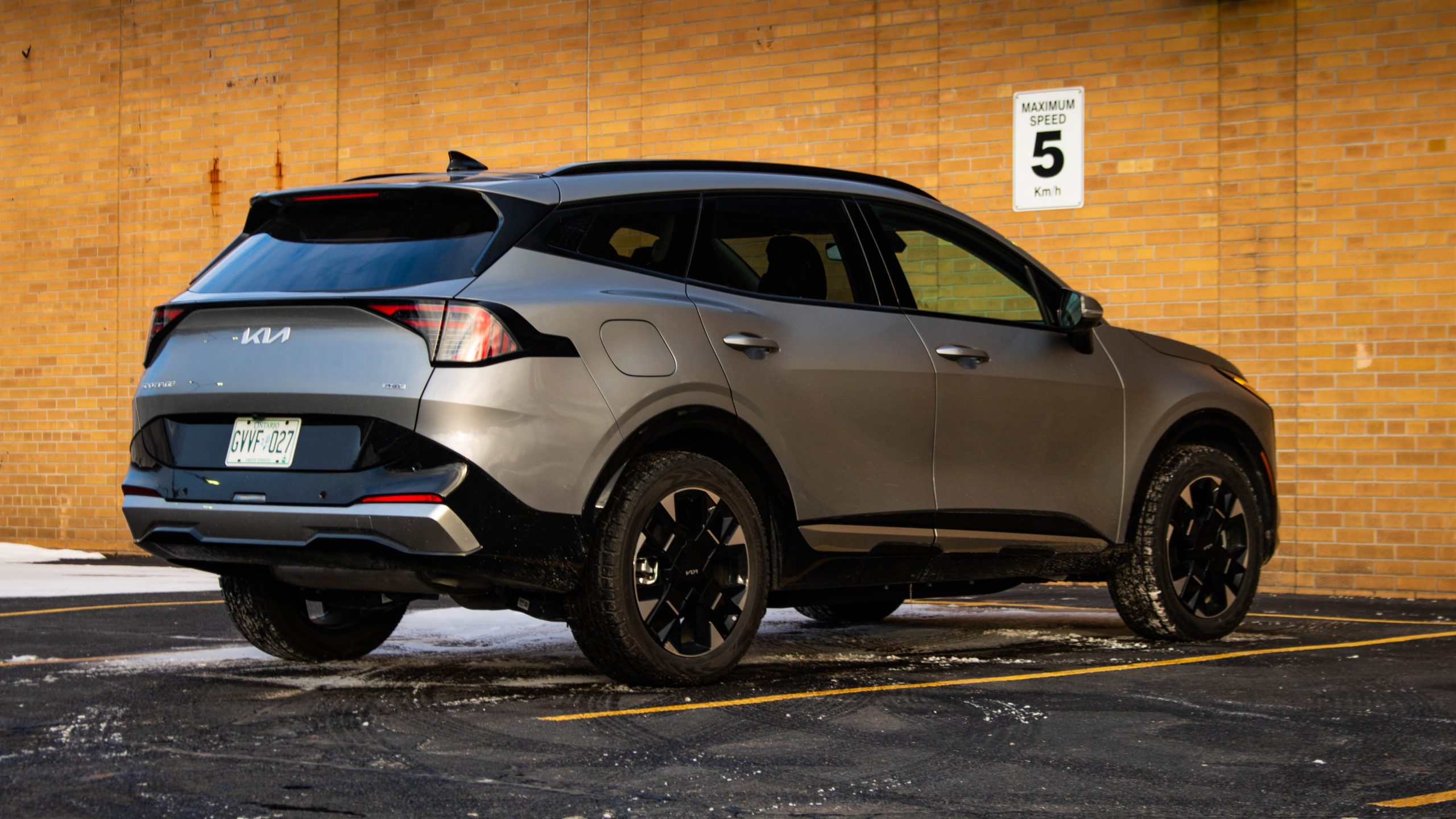
Absolutely. There are a few nits to pick, but that’s true of anything in the segment. What matters is that it’s quite comfortable, spacious, reasonably potent, has slick infotainment, and balances reasonable efficiency with the sort of physical torque distribution system that can really make a difference when local weather conditions get disgusting. It’s worth noting that the new Toyota RAV4 plug-in hybrid serves up substantially more range and is a straight-line hot rod, while the Hyundai Tucson plug-in hybrid offers the same basic powertrain as the plug-in Sportage but with real infotainment hard keys and substantially more interior storage. Still, if you want a reasonably priced plug-in hybrid crossover with a nicely-made cabin and have a strong distaste for shiny black interior plastics, the Kia Sportage PHEV is the one to get.
What’s The Punctum Of The 2026 Kia Sportage PHEV?

A remarkably agreeable plug-in hybrid crossover.
Top graphic image: Thomas Hundal




At US MSRP I’m not sure I’d take this. A Rav4 PHEV costs only about USD 1000 more, base trim vs. base trim (at MSRP).
But as I saw it, in some of the european countries a self-charging Rav4 (or CRV) costs more than a (short-wheelbase) Tucson, Sportage, or Tiguan PHEV – or a similar sized Stellantis or chinese PHEV, or an Outlander (only available here as a PHEV).
I wonder if Toyota and Honda even wants to sell any Rav4s/CRVs in Europe!
Rav4 Primes are unobtanium, & huge markup if you could. The latest Outlander Hybrid has a bigger battery, but the same slow onboard charger kneecaps it, & the uselessly tiny 3rd row has made the 2nd row even tighter. No thanks. (Also ghastly front end.) ++ issues with our Hyundai eons ago, but perhaps I’ll look at this when the 10-year warranty runs out on my Outlander PHEV in 2 years, if no other 4WD PHEV’s become available.
I notice the same tendency to fire up the engine in cooler weather in my older Outlander PHEV, which also has resistive heating so should not need it. However, I think the engine is warming up the battery to provide better performance. I seem to remember reading it had different chemistry than my Pacifica PHEV, which won’t fire the engine until well below freezing.
Hats off for the electric operation all year long, with 5-6 road trips (1,000-2,500 km each way) easily accomplished with the lack of drama that is ICE; no line-ups for chargers, non-functioning chargers, detours to find a charger, or walking back to the hotel from the charger. I never even look at fuel prices anymore.
I put 90,000 miles on a used 2019 Kia Niro HEV in three years, and generally liked it. Mileage was great, it was comfy, and the tech was easy to use.
That dual-clutch 6-speed automatic was a bit weird though. It sometimes felt like it wasn’t sure what gear to go for, leading to a split second of panic pulling out into roundabouts.
And when mine started using oil on the high side of 100,000 miles, I traded it off quickly. My daughter’s 2018 Sportage just ate cylinder 2 at around 106,000 miles and the engine had to be replaced. Hopefully Kia has done something about their engine issues, but that’s put me off the brand for a while.
Perhaps we can refrain from using oft repeated statements and talking points that have political or ideological origins, strictly for the purpose of pushing an agenda?
Amen. Not to mention that Thomas’ claims, cited above, are wildly inaccurate and misleading.
What exactly about these claims are wildly inaccurate? Pretty sure about 2/3 of Americans live in single family homes, and EVs remain disadvantaged when it comes to road tripping.
First, it was weird that Thomas mentioned “single family homes,” because plenty of those have access to off-street parking and could take advantage of an at-home L1 or L2 charger. Talking about the number of people who live in apartments with only on-street parking would have made much more sense.
Second, road tripping in EVs is no longer a “time-consuming proposition.” I feel like a broken record, but I’ll repeat it again – charging has added precisely 0 minutes of additional time to road trips I’ve done in my EV. My car is always done charging before I am ready to leave.
I think he was making the case for PHEVs over regular hybrids. PHEVs make zero sense without at home charging. So if we assume most single family homes have the potential for charging then the people in those single family homes would be decent candidates for a PHEV or an EV. This was not an anti-EV statement.
It’s fine if you tend to travel at a leisurely pace, but even with my family of 4, I never stop for more than 10 minutes. If we’re off the road for longer than that, something has gone wrong. Considering that rest stops on many of my frequent travels have charging areas that back up with people waiting (not all the time but boy have I seen some things on holiday weekends) I would likely lose my mind at that. Also the charging infrastructure around here is total ass.
All of the people I’ve known to go EV that use them as commuters? Super happy and would never go back. The people who have tried to use them as road trip cars? They gave up and switched to a hybrid. YMMV though.
I am tempted to get a Hyundai Tucson PHEV… the Sportage’s cuter cousin. I have a condo with a garage (which is wired and perfect for charging) and make a lot of short trips around town and then the occasional 700+ mile slog down to California.
I will have to test drive one. I doubt I can make an economic case for making the move as I have a ’17 Accord V6 with only ~75K on the clock. On those slogs to CA, it gets around 40 mpg. Around town, half that. We have relatively cheap hydro power (~ $0.09/kwh) while gas is currently $4.20/gallon at the cheapest place I can find within a couple miles of home.
I’d probably have to be really impressed to get rid of the Honda. But if someone runs into me and totals it… the Hyundai would be on my list of candidates.
A big delta between electricity rates and gas prices in your region makes a PHEV very, very appealing. Our electricity rates are around double that, and gas prices are around 3$/gal.
I’ve always figured that while a lot of people demand that their typical usage (commute) be covered entirely by the battery for PHEVs, I’d almost rather the engine run on occasion. I drive about 50 miles a day at a minimum, and I’d be totally happy with range close to that.
Apple, I’ve been driving EVs for 14 years. You saying that charging has added precisely 0 minutes of additional time to road trips is absolutely impossible. We used to drive 3-4 hour straight in an ICE vehicle, we simply can’t do that without substantial risk and unnecessary risk in our EVs.
EVs take longer to refuel. This is a simple fact. EVs require fueling stations that are far less abundant that gasoline. Another simple fact.
It absolutely takes longer to charge and also takes special planning to locate place to charge.
Yes. I love having a fuel charge every morning and never stopping for gas. However, road trips ARE a hassle and take longer to complete. A proven fact.
It’s the same talking points pushed out by the petroleum industry, picked up by certain people who vote a certain way. They’re the roadblocks to society moving forward.
I read this statement as reality, not a political talking point.
We have a Bolt, and we love it. But we don’t take it more than a couple hundred miles from home as a rule. Generally the longest trip it takes is where there’s a charger near the endpoint. Anything beyond that we take my hybrid.
The Bolt isn’t the fastest charging EV, and the charging infrastructure is still meh in Wisconsin. Could you drive it on a long road trip? Sure. Would it be a pain in the keister? Absolutely.
A 600-mile day would take 60-90 minutes of charging, plus some range anxiety while looking for a functional fast charger in unknown parts. That’s versus maybe 15 minutes at gas stations for my hybrid if I drag it out.
Charging tech and infrastructure are improving rapidly, but for now it’s realistic to admit that PHEV’s are a better option for lots of people.
Saying that your Bolt “isn’t the fastest charging EV” is like saying a Ford Maverick “isn’t the biggest truck on the market.” The Bolt maxes out at 50 kW and its 10%-80% charge time is 50 minutes, which only nets about 170 miles of range.
My 2025 Ioniq 5 maxes out at 262kW and has a 10% to 80% charge time of only 18 minutes, which adds over 200 miles of range.
Your Bolt takes almost three times longer to charge than a modern, high voltage architecture EV while adding far less range in the process. This is not a good comparison. There are currently no EVs on the market in the US that don’t charge at least twice as quickly as your Bolt.
That 600-mile trip you referenced would require about 25 minutes of charging in my car, plus with the longer range, worrying about infrastructure would be less of a concern.
Don’t get me wrong – the Gen 1 Bolt is a great car for local driving. It’s also one of the worst modern BEVs ever made for long-distance road tripping. It just isn’t designed for that purpose.
Complaining that it would take a long time to do a 600-mile road trip in a Bolt is like complaining that an F350 dually has trouble finding parking in NYC.
Thus the caveat about the Bolt. Ours is an EUV, which does charge faster – typically 30 minutes gets you around 80% if you have a fast charger – not that those are always easy to find or access.
And you’re right that the newest EVs are better.
But to use your car and my 600-mile road trip as an example… at 18 minutes for 200 miles, you’ve spent almost an hour charging. Meanwhile, I drove my Maverick 450 miles, spent 10 minutes pumping gas, buying chips and taking a bio break, and finished my drive.
Now, some people like to stretch their legs more than me and stop more often. And you can plan a charging break over lunch or dinner, so the time doesn’t matter. But pure EVs still are not at the level of road-trip convenience an ICE-equipped vehicle offers.
All of this to say… I think Thomas’s point is fair for many people and not particularly political. I’m totally okay with folks disagreeing with me. What you drive and the availability of charging infrastructure where you live and travel is going to make a big difference.
Except why charge to 80% unless towing? That’s well past the point that current EV’s start really slowing down at a DCFC. 10-60% is far faster, even accounting for the additional stop(s) needed. That’s done in about 9-10 minutes.
No, not on my I5. Mine will pull over 200 kW up to about 70% and well over 100 up to 80%. It slows down dramatically after 80%.
Those rules really don’t apply to EVs with an 800v architecture. The lower amperage dramatically negates battery cooling concerns until very high SoC.
Great! I wish my Model Y charged like that.
Yeah, I’m still surprised Tesla didn’t move to an 800v architecture with the Juniper update. Nevertheless, charging on your MY is still fairly fast compared to something like a Bolt, or even most VW EVs.
Your calculation assumes I would start at 0% SoC and immediately have to begin the trip at a DCFC, which is not how any EV owner does road trips (and being an EV owner yourself, I am surprised you made that obvious error).
I would get about 300 miles initially when starting from a full charge. That means one 18-minute charge to get another 200 miles, and one 7-ish minute charging stop to get back home. That’s a total of about 25 minutes worth of charging for a 600 mile road trip.
Edit: actually, if I planned the first charging stop during a meal time and let the car charge to 100%, I would be able to do the whole trip with only one charging stop and no additional time spent versus an ICE car. That would require the weather to be somewhat warm. Doing a hypothetical 600 mile trip in the winter would definitely require 2 charging stops.
I’m a pretty casual EV owner – more of a EV husband, as it’s my wife’s car. ;^D
Glad your car works well for you. Keep on cruising…
Are you claiming that your vehicle can get 300 miles of range traveling at highway speeds (75 mph)?
When I drove from Sacramento to Twin Falls Idaho in an EV my car was done charging before I could finish in the restroom. I am so tired of the complaints about charging time. There have been several road trips where I have had to extend the charge to finish my business before the car.
Yes, this has been my experience as well. One time, I literally got two bites of my Chipotle and then had to rush off to unplug my car (because I didn’t want to pay for more energy than I needed). It literally charges too quickly sometimes.
This reality is just something that you cannot pound into the thick skulls of the anti-EV crowd. At least, not until they experience it firsthand. My formerly very EV-skeptical friend went on a road trip with me and could not believe that I was done charging by the time his coffee was ready at Starbucks (“I thought we were gunna have a few minutes to sit and enjoy the coffee!”)
I keep saying the same thing – charging has added a sum total of 0 minutes to any road trip I’ve ever taken in an EV. During the time when a petrol car would just be sitting idle while I use the restroom and get food, my car is charging.
A NACS equipped EV that charges at 150 kW for 10-60% is fine for road trips. Each stop takes under 10 minutes every few hours. Considering that people have to use the bathroom about that often it works out fine.
I’m sorry, I’m missing it. What was ideological or political about that statement?
EV road trips take a long time with recharging. That seems like a fact, not ideology.
You could read any of the many comments above which clearly refute the idea that EV road trips take a long time with recharging. This would answer your question *and* make you better informed!
EV road trips definitely take longer than an gas car. I’ve read the above comments, and nothing there has changed my mind.
You assume that there is a fast charger exactly where you want it to be along the route (two of them in fact), and that they are operational and available, and you assume that you want to stop for a meal anyway. While those things may be true, they may not, and adding caveats means it is not an apples to apples comparison to gas.
The fact is that I can get gas at almost any exit, and it takes 5 minutes. EV charging has less availability and a longer time. That is a fact and will make the trip take longer.
Can a person engineer their trip to mitigate the impact? Yeah, kind of? Depending where you live.
I just bought a PHEV. Best of both worlds.
PS, discussing and debating interpretation of facts still doesn’t mean it was a political or ideological statement.
Your absurd fantasy of what it’s like to road trip with EVs, despite clearly never having owned one, proves that your comments are both political and ideological.
I can’t and won’t argue with stupid.
Every day I get to drive my EV, I’m thankful that I am not susceptible to easily disproven pro-oil propaganda. I haven’t stopped at a gas station in months. It’s a wonderful feeling (because I’ve saved so much time by charging at home, but also because I’m not lighting my money on fire).
https://www.theautopian.com/man-does-the-math-to-brag-about-ev-road-trip-savings-but-finds-it-would-be-just-as-cheap-and-a-full-day-quicker-in-a-hybrid/
Yeah, I’m not actually stupid, and I’m not doubting that your everyday experience is great. I only pointed out your apples to oranges comparison. If you don’t like my points, or can’t actually counter them, you don’t need to resort to personal attacks. Using personal attacks, and countering my points with some nonsense about “pro-oil propaganda” shows that you are possibly not entirely rational on this topic. I’m sorry for stirring you up.
Um, there basically are working fast chargers available places that they’re needed. At least in the Northeast and along the I-95 corridor from PA to FL. Not deep in the woods yet but there aren’t gas stations there either. I’ve had very few issues with public charging. It’s about the same number of times per year I have an issue with a gas pump.
Yeah, there are several YouTubers to whom I subscribe who live in a fast-charger wasteland compared to where I am, and they are still able to do road trips without issues.
I think it’s easier to find a DCFC than diesel around where I live. Plus, Tesla opening up their network basically doubled the number of accessible DCFCs available overnight.
Claims about being unable to do road trips due to a dearth of DCFCs are just made up anti-EV propoganda.
Problem is that unless you’re an existing EV driver you aren’t aware of all the fast chargers hiding in plain sight. They’re not advertised like gas stations so they’re hard to spot unless specifically looking for them or routed to it.
That’s actually a really good point. A lot of non-EV drivers may incorrectly assume there are far fewer charging stations near them than there actually are because they don’t use them.
Use the bathroom. Have some food. Stretch, and shake off some of that fatigue, which may be dangerous to other drivers. And simply stop and smell the roses for a moment, life isn’t a rat race. You can stop for a few minutes and charge.
Got to drive an earlier one in the past year or so. It’s neat and I’m a fan of plug-in’s, Hyundai/Kia’s tendency to sneaky fatal-flaws notwithstanding.
Anyways, it’s pretty interesting (neutral) getting automatic transmission shifts in EV mode and I enjoyed putzing around town in it. Highway cruising was fine, idling was fine and everything in between. I don’t doubt it can be a neat soft-roader over others that stick a motor on the non-primary axle. (angles, clearance, other crossover limitations allowing – naturally)
Not the biggest issue but in the hills of LA where this specific car I drove lives, it seemed like it favors second gear in electric mode and once it gets bogged down on an incline (plus a sharp turn) it had a very jerky shift into first whether automatic or prompted by paddle shifter so I’d probably prefer an eCVT over the current setup.
I wonder if it favors 2nd to avoid a potentially noisier 1st gear when possible?
I’d bet it’s because the torque available from the motor is good enough for most conditions and it’ll be able to reach higher speeds without shifting. This is more trivia, but Honda’s mid-sizers with the 9-speed actually start in 2nd in most situations too.
We have a 2023 version of this vehicle. Wife drives it daily. We absolutely love the vehicle. I was very skeptical of Kia prior to purchasing, but man, the vehicle has been awesome. She drives 13 miles one way for work, so *usually* it’s a battery only trip unless it’s cold, like now. I agree with Thomas that the amount of time the engine runs to heat the cabin during the cold is a bit counterintuitive, but the propulsion remains battery only during those times (unless you’re on the HWY doing over 70 mph or so), so the drive retains the smoothness of an EV powertrain.
I’d say my biggest issue with the vehicle is that on longer road trips it is a below average hybrid. I’d love for a better MPG on longer trips, but we don’t make those often enough to feel too bad about it. On a summer trip to Eastern Tennessee/Western NC in the mountains, we averaged between 31-35 mpg’s, which isn’t bad, but not the 40+ you’d get with a dedicated hybrid. The 31-35 was also vastly superior to the 26-28 mpg we would get on the ICE Forrester the Kia replaced. Also, the piano black that is referenced here is also the worst. THE WORST. I’m glad to see that they removed that.
We recently added a 2018 Volt to our fleet. In comparison, the Volt definitely wishes to be more of an EREV, where as the Kia is more of a 80/20 to 60/40 EV depending on the time of year. All of that is to say that the Kia seems to lean more into the compromise inherent in a PHEV than an EREV.
I totally get that the folks don’t like the complexities of the PHEV and/or the compromise, but we get to drive *mostly* an EV while plugging it into a normal wall socket, which is pretty damn great. One day we may add the Level 2 stuff, but for now, it’s a future kind of thing. The Kia has done a great job for us, and I echo pretty much everything Thomas says about the vehicle. As other commenters have noted, the Rav Prime is unobtanium, and at least when we were looking in 2023, the Hyundai equivalent was limited to only certain states (not ours…). We thought that maybe we were choosing the lesser evil with the Kia, but we couldn’t be happier with the Sportage. We would buy another one today if we were in the market for sure.
A crucial difference between the Sportage and Tucson PHEVs when we were looking in late 2024: The former was available in all 50 states whereas the latter was only available in states that follow CARB regulations. Looks like that’s changed now.
Also, got the Outlander PHEV as a rental vehicle last week. I loved it. Say what you will about its vastly less efficient PHEV system, but the fact that it was essentially always powered by two pretty beefy electric motors front and rear meant it was incredibly smooth and refined like an EV and shockingly spry when put in its “Power” mode. My hotel had free charging and I was able to do ~95% of my driving on pure electric power. 38-40 miles goes a longer way than I think most people realize.
Looks like it still has the same powertrain it did when I was looking. I don’t like the handoffs between electric and gas power. I dealt with them on the Niro, but now that I’ve had the Toyota system, I appreciate the smoother handoffs. And the heat pump that keeps the engine from kicking on for heat.
I drove an EV6 for a few weeks while the Niro was getting warranty repairs done, then redone, then fixed after mistakes. The dual-use climate/entertainment controls were annoying, but more because of capacitive touchscreen crap than the dual-use. Just stick them in climate and you have a climate knob, at least. I’d prefer the defrost and such be buttons, but the problem isn’t dual-use. I’d be okay with buttons/switches that pulled double-duty, though (although you don’t really need them to–wheel-mounted entertainment controls are fine, and the passenger can use the touchscreen).
I test drove one of these a couple weeks ago. Honestly the top tier phev available in my area. Rav4 prime for some reason don’t exist. I didn’t end up getting one because of the higher MSRP. I bought a 2025 escape with the 8k off from ford.
“For a few years, Kia experimented with making the climate controls and the radio shortcut keys the same controls. Two knobs, and bank of capacitive-touch stuff, permanent icons for key functions like the rear defroster and air recirculation, and one top-level key to switch what the panel does. Unsurprisingly, it’s incredibly distracting to use…”
No, it isn’t and I don’t even own one. My last 4 rentals have been Kia’s with this HVAC / radio control panel. It works fine. I have an easier time finding controls in these rental Kias than in my wife’s Acura with physical buttons that we have owned for 5 years.
The radio controls are completely redundant so it is nice that Hyundai / Kia didn’t waste space on them. Volume is controlled on the steering wheel. Everything else is handled on the touchscreen. That leaves the control panel for HVAC functions that I actually use and the buttons are large, easy to see, and easy to hit.
With the exception of Saab Incas….4 spoke wheels belong in the scrapyard
I love plug-in hybrids. I’ve been in a BMW 330e for 4 1/2 years now.
The specced electric range is like 23 but I rarely get over 20. In the cold with heating that can get down to 10-ish.
Even with those limitations it’s done 2/3 of its lifetime miles purely in electric mode.
When I had a commute, it fit inside that range, and I know that is an unusually short commute. I work from home now so only errands and small trips are in electric mode and the ratio is dropping over time.
40-ish miles range down to 20 in the cold? I think I’d only ever use gas going somewhere outside the city.
As for running the engine in the cold…
The 330e will fire up the gas engine if you ask for too much power, basically accelerating hard. As it starts getting cold it reduces the available electric power before it cuts over. Somewhere around 10-15℉ it’s not much more than the idle creep. After a below 0℉ soak it fires up the engine immediately.
As the battery warms up the full battery becomes available again.
You have to wonder who ever thought this was a good idea? Are they just rage-baiting? We all saw what happened when VW tried something similar with their window controls, and I would argue this is worse because you tend to interact with audio and climate controls a lot while in motion, whereas a lot of my window button use is stopped at a drive-thru or whatever.
Mystifyingly stupid and this is one rare instance where I hope someone not only lost their job, but got blacklisted from the entire industry so they don’t foist this nonsense on us again.
Kia’s multifunction panel actually is a good idea and works fine.
The audio controls on the panel are completely redundant – all that is handled by the touchscreen or buttons on the steering wheel. The very first time I rented a Kia with this panel I looked at the audio controls but since then I’ve never used it. All of my rentals with this panel are in the HVAC mode when I pick them up so it looks like I’m not the only one that sees no need for the radio controls.
The HVAC controls are large and easy to see.
“They’re so bad I use other methods to change those settings” is not a super-compelling argument in favor of this design. 😉
The only audio control on the panel I even use is volume – and that is easily toggled with the right thumb. The rest are for AM/FM radio.
Basically there is no reason for the audio controls at all but I’m not going to get mad at Kia for giving someone that might want to use them another option.
My parents bought a 2023 version of this car. It’s nice and seems to suit them well.
What a ridiculous start to the article:
“With EV road trips still being a time-consuming proposition…”
Lol no, as anyone who actually owns a fast-charging EV can tell you. Charging has added precisely 0 minutes to the road trips I’ve taken so far.
“…and most North Americans living in single-family housing…”
Living in single-family housing does not preclude one from being able to charge at home.
“…adding a modestly-sized battery pack and a charging socket to a regular car can also offer the best of both worlds.”
So all of the reliability and maintenance baggage of ICE vehicles with an extremely limited electric-only range? Sounds like the worst of both worlds to me.
Typical disclaimer: yes, I realize that, for people who genuinely cannot charge at home, EVs are a significantly less attractive proposition. I also realize that people with unusual driving habits may be better suited with an ICE/hybrid vehicle.
I just find it extraordinarily frustrating how the same misconceptions about EVs are paraded out on this site without taking into account the dramatic improvements to DCFC infrastructure and battery/range developments.
Don’t forget this website is owned (co-owned?) by an automotive dealer.
I think they do a pretty good job overall, but yes, they do stand to gain from the continuation of the status quo.
I still love the PHEV as an option if you have a use case for it. It’s so nice to have options when looking for a car. I only buy them pre-owned though, because the depreciation is steep.
The wife has a 1 mile commute to work. It’s so nice to have a PHEV for her. She’s not damaging the engine by not running it up to temp 2 times a day, 5 days a week. She can do her commute on all electric, but she still uses the engine on days where she needs more range. On long trips, her 330e gets about 42 mpg highway and she doesn’t have to worry about charging stations.
My son has a Bolt EUV for his car. It’s great for commuting, but if he’s going to do over about a 200 mile round trip, he takes another car from the family fleet.
We have (2) Level 2 stations at the house, one at 40A for the Bolt (it will charge at up to 48A) and one at 15A for the 330e (it will charge at up to 16A). If we got a 3rd EV/PHEV it would start to be a hassle to move things around after charging, especially since our cheap rates start after 7pm.
She DRIVES 1 mile to work?
Depending on where she lives, walking 1 mile might be practically impossible or at least very dangerous.
I regularly have to travel 1.2 miles between buildings at work. In the spring/summer/fall, I can walk, but all of winter it is basically impossible to do so.
The US is generally set up to make non-vehicular transport difficult.
As a GenXer I feel obligated to say I used to walk that distance solo to elementary school during my winter in Sweden no matter how dark, cold or icy it got. Coming from California it was quite a shock. And yes, it WAS uphill at least one way.
That obligation fulfilled I admit my path to school was all walkways and lightly traveled suburban streets. Even when I did have to cross busy streets I didn’t have to deal with the troublingly low standards and lax enforcement of US drivers. The driver testing there is (or at least was) much more difficult, painfully expensive and they are/were not nearly as forgiving of “oopsies”. That kept the worst qualified drivers off the streets and on public transit where they belong. And as you’d expect public transit there was excellent whereas in the US it’s more like hostile compliance to court ordered community service in many places. Sweden doesn’t get as life threateningly cold as some parts of the US do. So winter caution I can understand where *real* winter exists.
My friends wife drives the 650 metres to her work. And it is in a residential neighbourhood, with crosswalks at the only intersection. Some people are lazy.
But they could very well live where that 1.2 miles involves a major roadway with no crosswalks or pedestrian infrastructure. It is unfortunately common across large areas of North America.
Detroit area. She can walk in the summer, but won’t in the winter.
Because of *winter* or *winter drivers*?
I had a similar commute when I lived in West LA and my office was in Century City.
I used to joke that it took me longer to park the car in the parking garage than it did to drive door-to-door.
This whole discussion reminds me of the Simpsons episode where they showed Homer’s commute, with several minutes in heavy traffic, turns from at least one freeway to another, and an exhausting search for a parking space leading him to park at the outer edge of the lot next to a chain link fence, on the other side of which was his own backyard.
Sounds like Orlando.
And Texas.
That combination climate/radio thing is why we wound up getting a gas Kona instead of a hybrid Niro.
We looked at this and the ford escape plug in hybrid. Ford got the sale on a new old stock 25 PHEV for $27k! Only had 500 or so dealer miles on it. I much prefer the rock solid 2.5l normally aspirated Atkinson cycle engine and the slick Toyota-inspired e-cvt vs. the turbo and 6 speed. Not AWD though. Too bad Ford discontinued it as it checks the same boxes as the Kia/hyundais
Ford and Toyota independently came up with the same idea. One did not “inspire” the other. They cross-licensed it rather than having a patent fight that would have only enriched the lawyers. It is baffling that they are not making a Hybrid Bronco Sport since they offed the same-platform Escape, and you can still get it in a Maverick.
And I agree – that is the only hybrid drivetrain I trust to go real distances. What’s in this just feels like a mechanic’s wet dream about a month after the (admittedly long) warranty ends.
Surely a hybrid Bronco Sport is in the works? It seems like insanity to leave that money on the table.
End of the day, they need SOMETHING affordable, fuel efficient and vaguely car-like in the lineup. The Escape is incredibly popular in our rural Ontario area- I don’t really understand what Ford is playing at.
I wonder if it may be a packaging issue underneath since the Bronco Sport has a shorter wheelbase.
Seems unlikely, it’s quite a bit longer than the original Escape Hybrid that used basically the same drivetrain.
The original Escape hybrid had an air-cooled battery at the bottom of the cargo floor. The newer version, along with the Maverick, have it longitudinal beneath the passenger side floorpan on the vehicle exterior.
It’s only a ~2 inch difference in wheelbase between the Escape and BSport, but that might be just enough to make it too tight underneath. Especially since the fuel tank also sits in front of the rear wheels spanning the width and saddling the exhaust/driveshaft.
So use a different battery. Or cede the market segment just when hybrids are all the rage, whatever floats Ford’s boat – I’m not buying one either way.
One would certainly think so – but this is *Ford* we are talking about – a company second only to Stellantis for inability to organize an orgy in a whorehouse, metaphorically speaking.
I also ended up getting a 2025 escape. It’s not particularly exciting, but for the price? Pretty solid pick.
I drive about 90% of my annual 25000 miles electrically….but I recently needed to do a quick turn and burn trip that was just on the border of my range. Weather was cold and snowy, fast chargers spotty in the area. I opted to take my daughter’s car since it is gas and has snow tires. It’s a small car with a tiny fuel tank, so I filled up during the trip…Wow, what an experience after going a year without stopping at a gas station. There was a row of empty pumps, I didn’t need to use my phone or sign into an account, just tap my CC. The pump worked perfectly and I was done fueling in less than 3 minutes…and the cost was DEFINITELY cheaper compared to fast charging. I love EV’s but I think this is a good case to have a plug-in instead of two different cars. Most of my driving is about 70 miles of daily commuting and even being able to do half of that electrically would be environmentally and financially beneficial. I get the argument about carrying around a gas engine you’re not using, but what about the huge battery I’m not using most days? Where is the tipping point on cost/complexity for engine vs larger battery?
I’m not against a Plug-In in theory, but in practice I take issue mostly with the pricing.
It is a big jump between the regular hybrid and the plug-in.
It should be applauded that they’ve gotten the price of the hybrid so close to the gas one. But the jump to the plug-in is huge ($10k, but probably less if you compare like trim levels) and without some substantial incentives (from your state, since the feds don’t do that sort of thing anymore) you’re never making up the cost. Sure, if you can run in EV all the time that’s pretty great and it’s quite and efficient, but if you’re really doing that all the time and never turning on the engine, maybe it’s time for an EV?
For my wife, after having an EV for a year and a half, the plug-in seems like a good jack-of-all-trades solution to her charging woes. Maybe if you are only looking at plug-ins then this is a good option. But in applications like this (I think a plug-in is a great solution on pick-ups) I just can’t make it make sense.
I agree. Either a regular hybrid or full EV would make way more financial sense. Maybe there will be some really good lease deals on the PHEV, but I straight up don’t understand why we’re still fooling around with them at this point.
Yeah, that price jump was doable when you could get $7500 off on the lease loophole, but it’s rough now.
I have leased two Bolts two Niro EVs and one Niro PHEV. The family now runs two Niro EVs. If you lease a Niro, the cost monthly between the three models (EV / Hybrid/ PHEV) is pretty close, because you are only paying for depreciation. As for a use case, I think that the most effective use case was for 1 EV and 1 PHEV in order to have full EV use for day to day in both cars, and access to a PHEV for the 6-10 times yearly road trip of more that 150 miles.
Our Volt will not kick the engine on unless its under 15F, and it will cycle on/off between 120F and 145F of coolant temperature. The good thing is that you can turn the resistive heater off and leave the fan running only, that way you only use the engine heat, not the electric one. The Pacifica PHEV uses both no matter what.
I dont like running the engine for short cycles, thats what got our EGR clogged in our Volt. Not a lot of PHEV that keep the engine off no matter how much you press the pedal or heat setting.
Agreed. When it was cold enough this winter to switch on my Volt’s engine, I just put it in Hold mode so it ran in gas for the whole drive to get up to proper temperature.
The Basics section says 34 miles electric range while later in the article it says 43 miles. Is one actual and one stated? Or just a typo?
33/34 is the advertised all electric range, 43 is a typo as that’s closer to RAV-4 plug-in hybrid range #s
It’s not awful looking, despite the chunky nose. Way nicer than the Outlander, and IMO a bit less annoying to the eyes than the new/current Rav4. Specwise, it seems like a very decent daily, though the small turbo motor and all the electronics give me a bit of agita when I think of owning it when it’s 20 years old (but that applies to all new cars pretty much).
But whyowhy with all the monochrome? The Sportage comes in seven shades of black/grey/white and that’s it. Not a single actual color. 🙁
It’s what the gray, boring people who buy this sort of thing want. Gray cars for gray lives.
Not everyone likes the things you like so its likely you won’t like the things they like either.
But everyone SHOULD like the things I like, because I am just that good. 🙂
And some things simply aren’t actually subjective, even if the modern participation-trophy world tries to make everything so.
A gray car isn’t a participation trophy though. It’s just a car.
Mostly it’s just sad.
You seem to think people in beige (or gray) have given up on life, resigned to a state of mediocrity. I see it as a kind of minimalism. I’d much rather associate with someone like that than some insecure twat who seeks any kind of attention at any price.
Haven’t they though? Minimalism – ROFL. More like timid lemming conformity and complete lack of individuality.
The lemmings are the ones buying whatever crap marketers say will bring envy and respect.
Real individuals drive beige (or gray) because they DGAF what others think.
So gray 2-box jacked up blobular CUVs? That is what the marketers want everyone to buy these days after all.
I drive what I drive for me and me alone. <shrug>
So why are you so judgmental about what others drive? Unlike cosplay pickup truck and SUV mallcrawlers or wannabe racecars beige (or gray) cars are not putting you in any additional danger above baseline. Also most beige (or gray) cars are cleaner and more fuel efficient than their non beige (or gray) counterparts. If being *boring* is the worst of their offenses to your sensibilities I think there are more pressing pearls for you to clutch.
I miss the days when the automotive landscape was in technicolor and brought joy to one’s existence, and not the drab gray monochromatic sadness of today. Accepting this means it will never change for the better.
If one can’t judge, what is the point of living? Or as my late grandmother used to say – if you don’t have anything nice to say, come sit by me.
There’s always beige!
Beige is but a slightly warmer shade of gray.
Nothing some pin striping and decals can’t fix.
I suppose if by decals you mean a wrap in a tasteful actual color, sure.
I was thinking more of a giant screaming hood chicken and fender flames but sure a tasteful wrap works too.
I just went to the site, and there’s actually very nice blue shade available.
You’re right! The plain ICE Sportage and Hybrid are only gray/white/black, but the Plug-In gets that one decent blue. My mistake. Thanks Tallestdwarf! 🙂
I’d end up with a dark grey one because I like the anonymity, but if I wanted something colorful, that blue gets my vote.
Unless Kia Canada actually lists a ptc heater I’m not sure the platform had one, the smaller Niro could be equipped with one optionally but if it’s like the Tucson PHEV besides the seat and or wheel heaters there’s zero electric heat available so if you use the climate control the engine is your only heat source. It’s also only 33 miles of all electric range in ideal conditions with hvac off. I had the Tucson for about 2 years and in summer it could easily meet or exceed that range with the ac on or at least get close, but the engine only operation struggled to get more than high 20s. It’s not a very good hybrid as it’s too heavily biased towards the EV part being efficient that the turbo hybrid engine is bad on fuel in the real world.