


In some ways, it feels a bit odd for a company like Toyota to be introducing a bunch of new battery-electric vehicles right now. I mean, last year saw the loss of the federal tax credit for EVs, and the first significant drop in EV sales in a decade. That may get better this year, with more and better EVs to choose from, so who knows. Still, it’s a good reminder that Toyota was a bit late to the battery-electric game, even though they were pioneers in electrification with the then-revolutionary hybrid Prius line. Now Toyota seems to making up for lost time, as they’re expanding their bZ line of EVs to include new versions, including the off-road (ish) focused bZ Woodland, which is pretty much an off-road-capable station wagon that happens to be electric.
Now if the string of words “off-road capable station wagon” reminds you of another carmaker, you’re not alone. Subaru has been the go-to for go-anywhere wagons for decades, and that hasn’t really changed. In fact, the bZ Woodland is built in Subaru factories for Toyota (remember, Toyota owns about 20% of Fuji Heavy Industries, Subaru’s parent company) and Subaru builds their own badge-engineered version of the bZ Woodland called the Trailseeker.


So what’s the difference between the Trailseeker and the bZ Woodlands? As far as I can tell, a bit over $5,000: the Trailseeker starts at $39,995 and the bZ Woodland starts at $46,750. But the Woodland is what I drove, so that’s what we’re going to talk about.
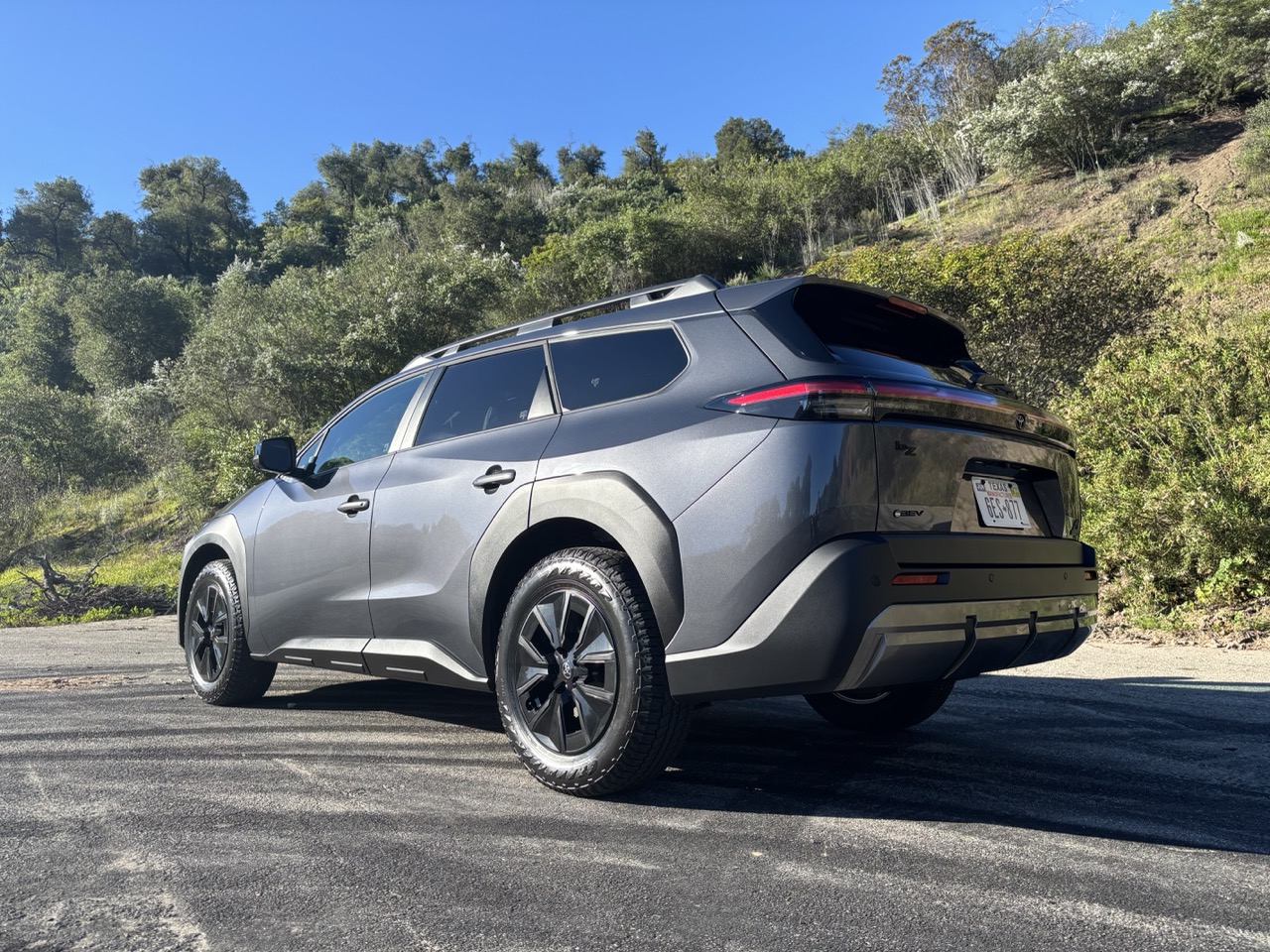
The biggest difference between the bZ Woodland and the other bZ (which Toyota has renamed from the original bZ4X, which sounded a bit too much like a droid in a Star Wars movie that you see way in the background in precisely one scene but still has a whole Wookipedia page devoted to it) happens at the back, as the Woodland is more of a wagon compared to the bZ’s liftback design, and is about five and a half inches longer than the bZ.
There’s a bit more power, too, thanks to the fact that the Woodland uses the same 224-horsepower electric motor on both front and rear axles, while the normal AWD bZ has a 169-hp motor at the rear. Using the weird, alchemical math that computing multi-motor EVs demands, that comes to 375 hp for the Woodland, good for getting from parked to 60 mph in 4.4 seconds, which is plenty quick.
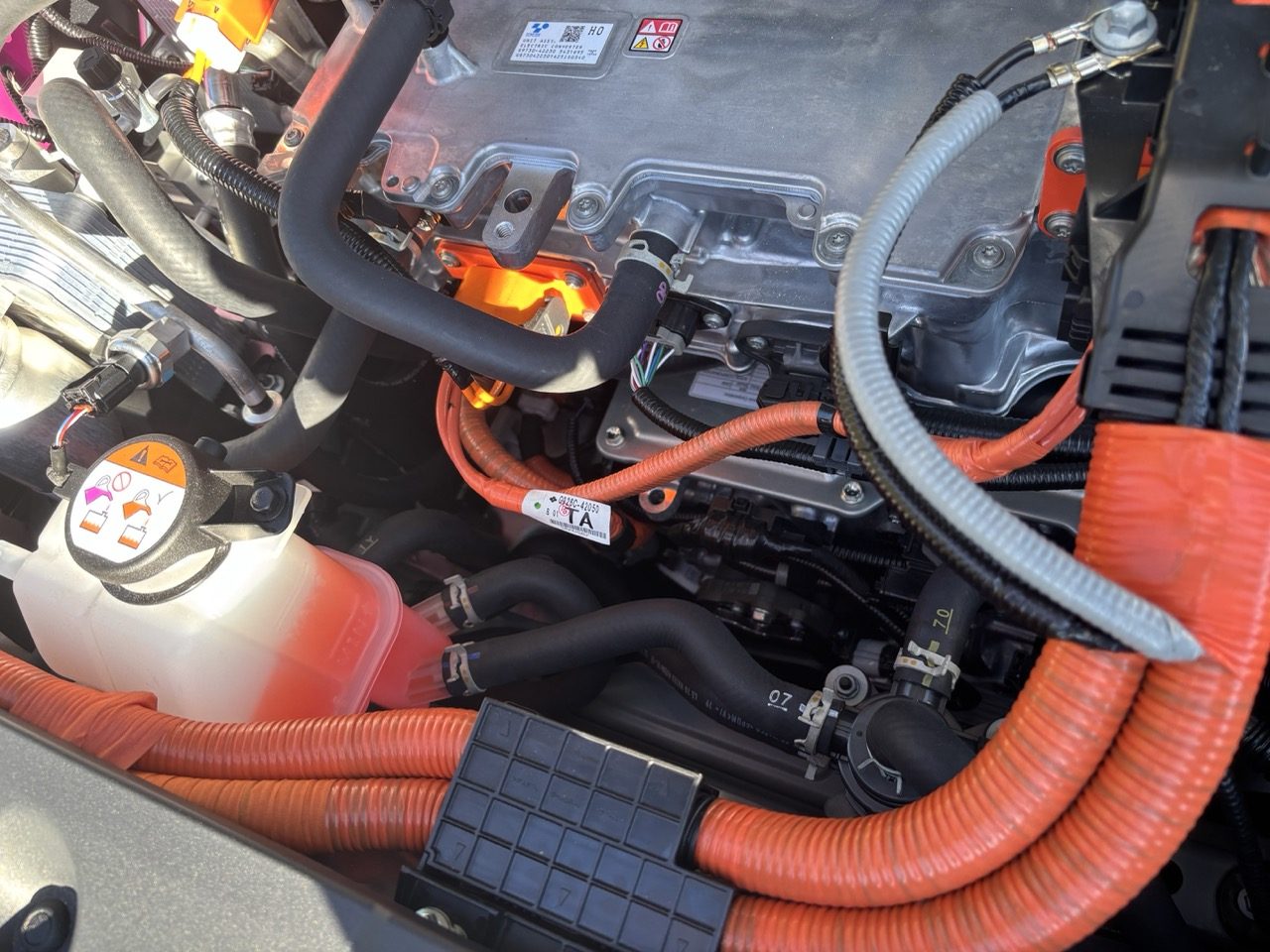
Since we’re already talking about how it drives, I guess we may as well make it official:
How Is It To Drive?
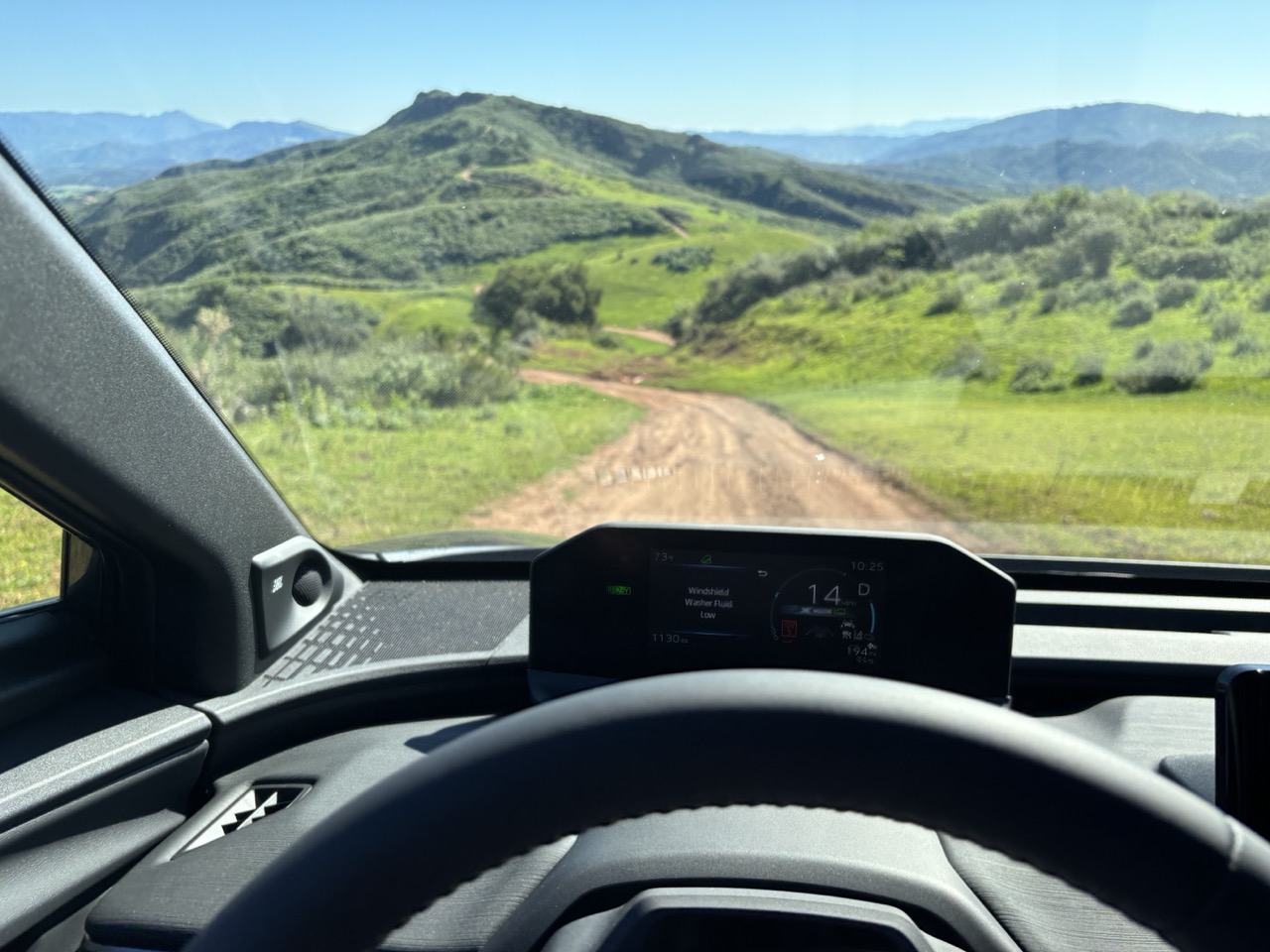
It’s fine.
I kind of want to end that there, because it’s true and is, if we’re being a little cynical and honest, it’s all you really need to know. It drives like the other bZs and like most other modern EVs: quick, quiet, easy. It’s not a particularly memorable driving experience, and I think that’s what most of the potential buyers of these will want. It feels safe and predictable on road, it’s a bit heavy but you don’t get an overwhelming sense of that, nor do you really get an overwhelming sense of anything.
There are four levels of brake regen, and while none of them will stop the car entirely, they can get close to one pedal driving in the highest regen mode, but you’ll still need that brake occasionally. Especially if you want to, you know, completely stop.
If you’re looking for a lot of robust exciting driver engagement, you’re probably not even going to be looking at this car at all. It drives like it’s supposed to, for the job it’s supposed to do. I didn’t get to take it on a track or anything like that, so if I tried to tell you what it’s handling is like “at the limit” I’d be lying to you.
But I did get to drive it off-pavement a bit! So let’s talk about that!
How Is It To Drive Off-Road
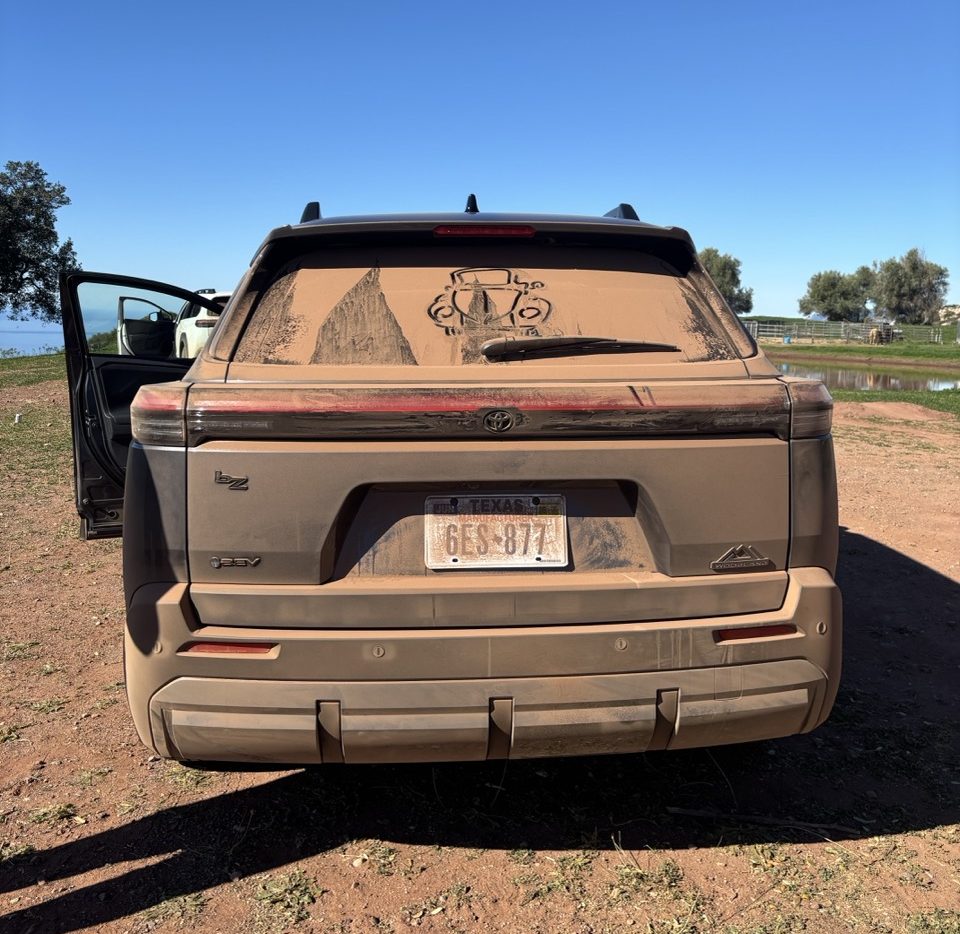
The “off-road” course that Toyota had set up for us was mostly dirt roads, with one little loop that had some zig-zagging holes dug into it and a few tallish mounds of earth we could drive over. Most of the off-road section you could probably have done in a Corolla, but the little loop of holes and lumps may have proved a bit more challenging.
More interesting is the former owner of the land we were driving on: this lovely bit of hilly pastureland, populated with cows and goats, was once owned by Paul Walker, the much-adored and currently deceased star of the Fast and Furious series, and also, unfortunately, someone who seems to have had some inappropriate relationships with underage girls. Not great.
Still, the land itself is staggeringly lovely, and there’s a really charming tree-less treehouse there, the bathroom of which I urinated within, which may be the only time I’ve peed where Paul Walker peed. At least that I’m aware of.
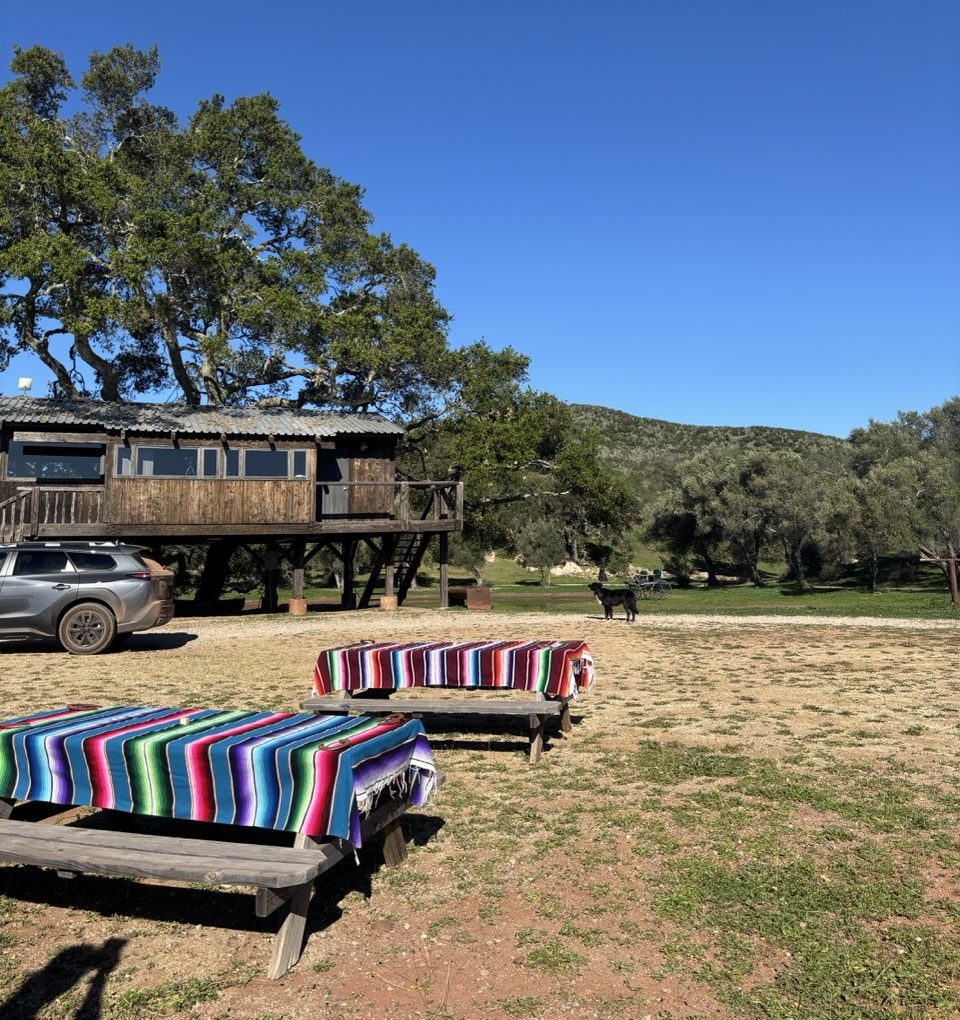
Also, see that dog there? One of the journalists had a drone they were using to capture footage of themselves driving, and that dog wanted to catch that drone so badly. There were a few times when I thought he might jump up and grab it, and I was pulling for him.
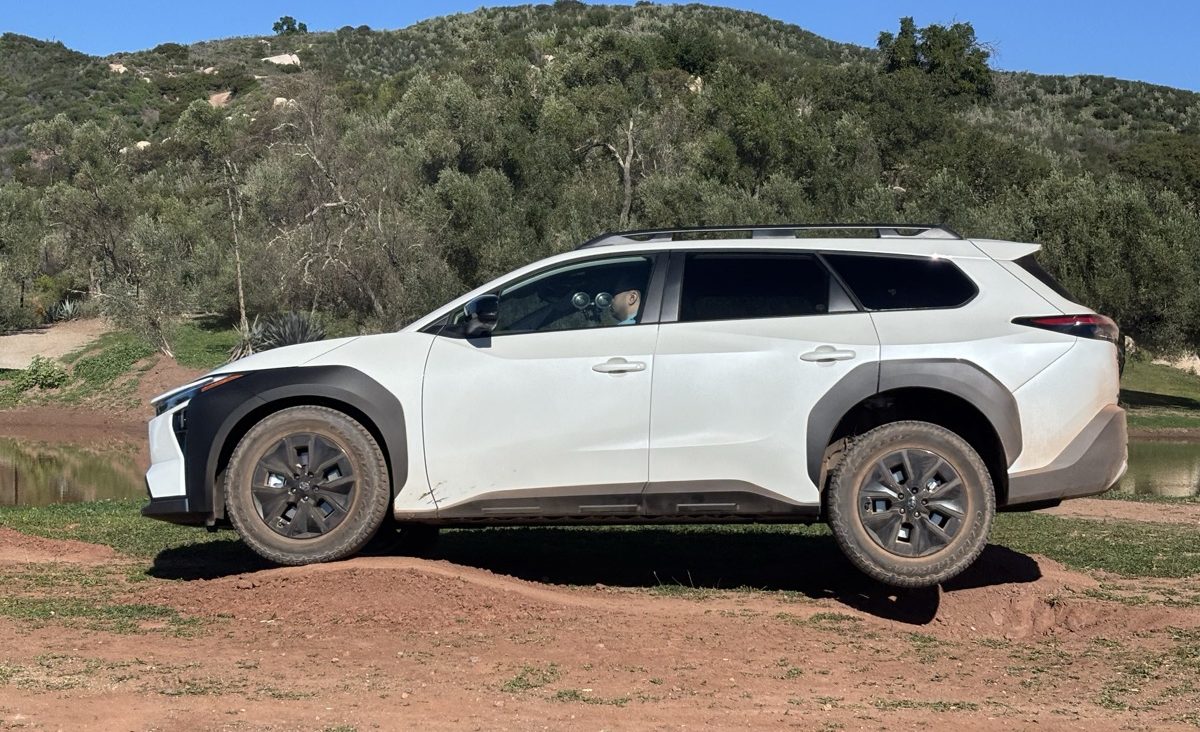
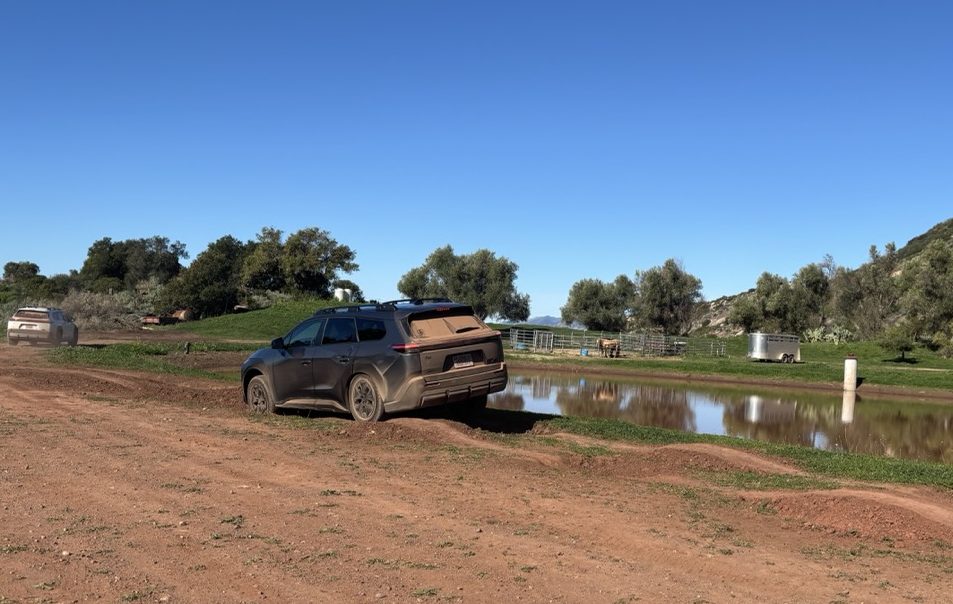
The Woodland uses Toyota’s X-Mode system of brake-and-power-transfer-based improved traction system that helps manage wheelslip and gets the Woodland over loose or rough terrain reasonably well. There’s also something similar to a hill descent system, like you’d see on more purposeful off-roaders, called Grip Control, and that lets drivers let the car handle throttle and brake so they can just focus on not driving off a cliff or into a lake or whatever. I took it down some steep, loose dirt hills in that mode, and it works pretty well.
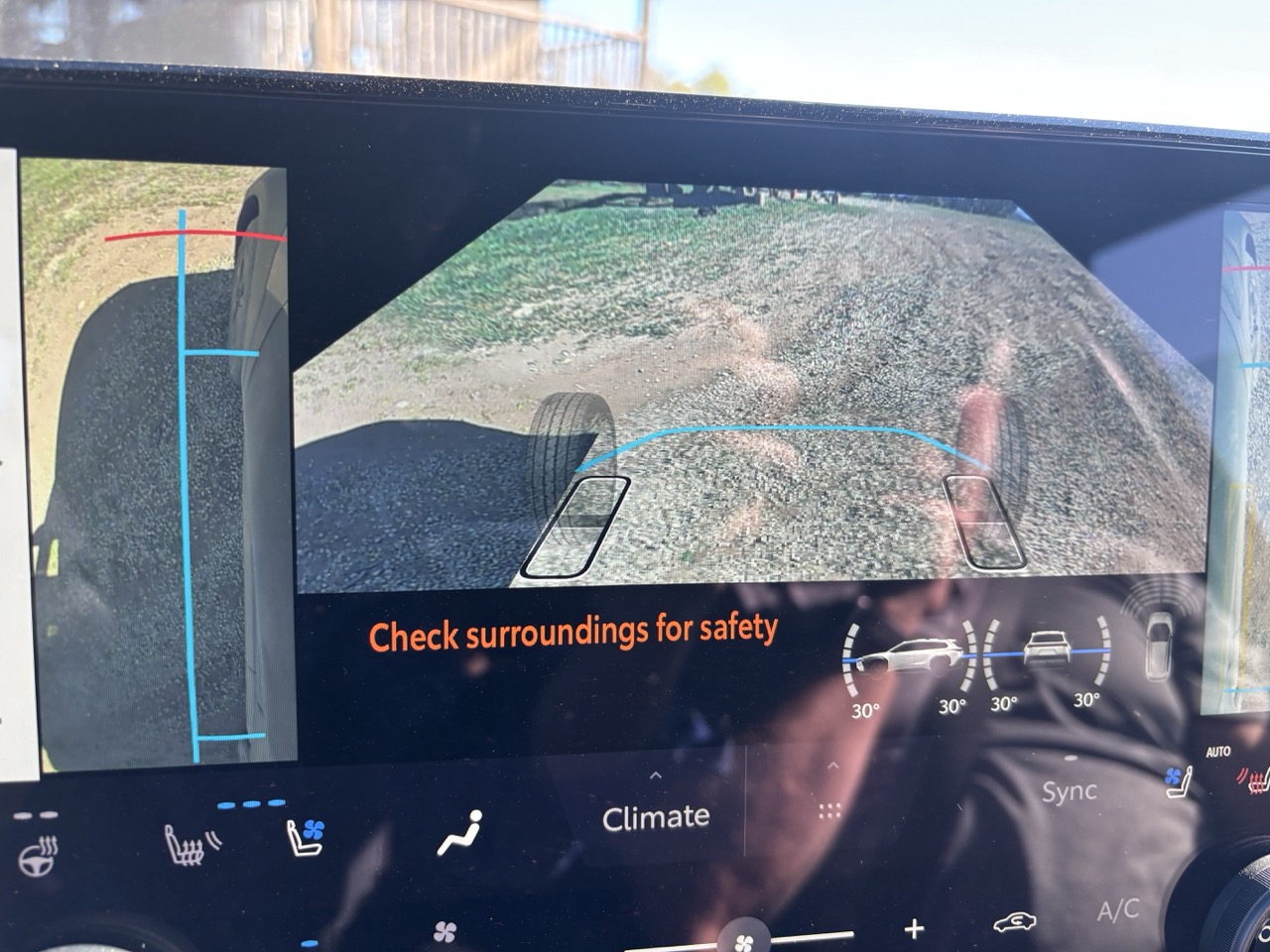
There’s also a good front camera that helps you see right in front of the car, which would normally be hidden by the hood:
The ground clearance is decent at 8.4 inches, but there aren’t any actual skid plates under the car, and it doesn’t really articulate like a true off-road machine, so I wouldn’t expect this to be your first choice for rock crawling, which I suspect is just fine by Toyota and most potential buyers.
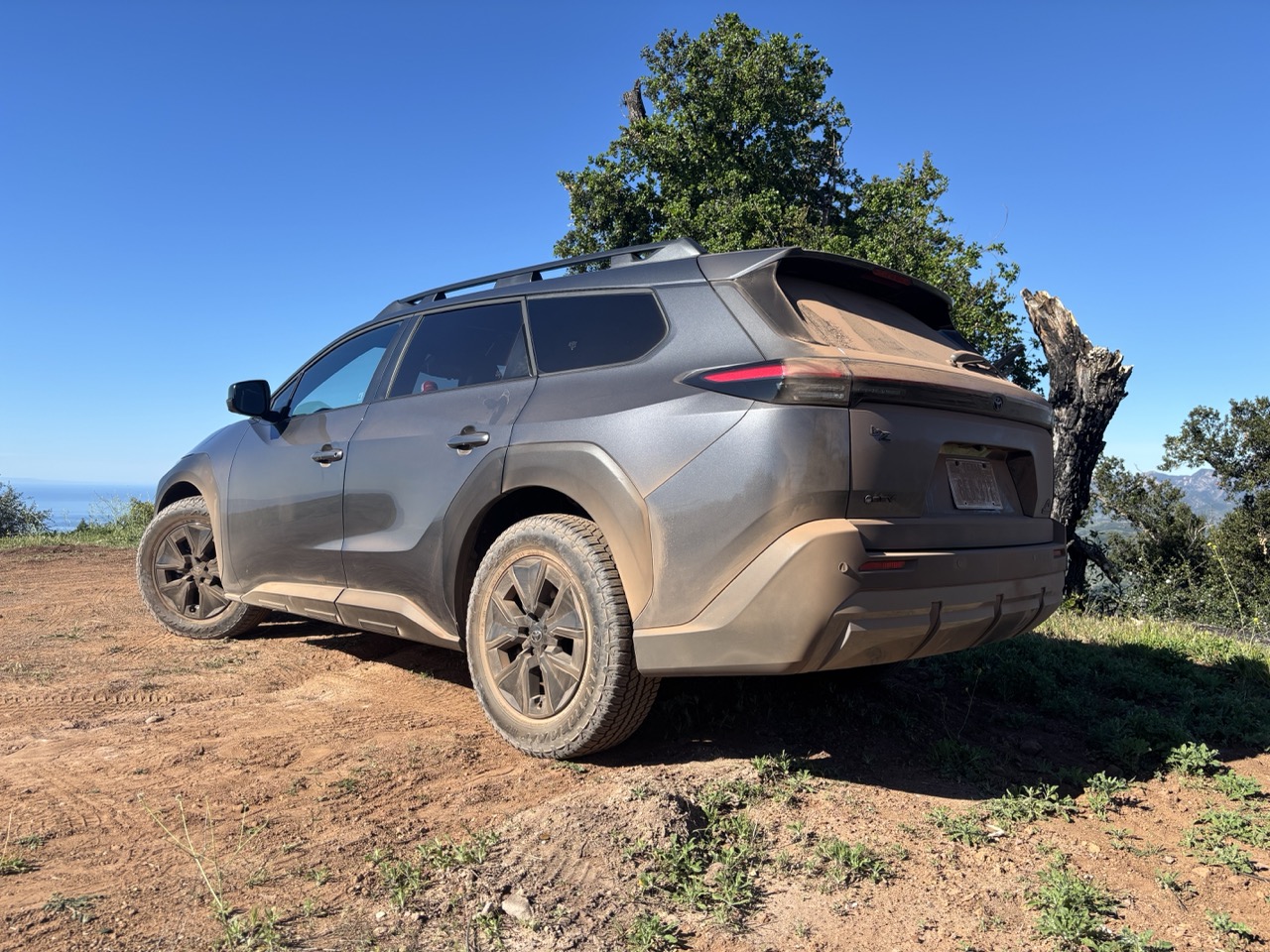
It’ll go on dirt roads and over rougher terrain, and probably will be decent in snow and some mud. The off-road properties of the Woodland are less about the act of off-roading for its own sake, but more about providing a means to get to places you may want to go even if those places aren’t especially street-car-friendly, and I think that’s probably good enough.
Oh, it’s worth noting that if you’re serious about getting your Woodland dirty, you should probably opt for the no-cost option of the all-terrain tires, though in doing so you’ll be reducing the range from 281 miles for one riding on all-season tires down to 260 miles. That’s a pretty big hit, and the real-world range is likely to be even less, but hey, you were the one who wanted to drive in the mud so damn much.
What’s The Interior Like? And What About All The Electronic Stuff And The Controls?
In the autojournalism business, we call the part of the car on the inside the interior. You may recognize this as the place where they keep the seats, and the best place to be in a car if it starts to rain. The interior of the Woodland is pretty nice; it feels well-put together, and the material choices feel good, including the SofTex-trimmed seats, the pelts of which are only harvested from softtexes bred in captivity, which will hopefully put a stop to all the brutal softex poachings that still plague the mountainous areas of countries like Upper Tarquania.
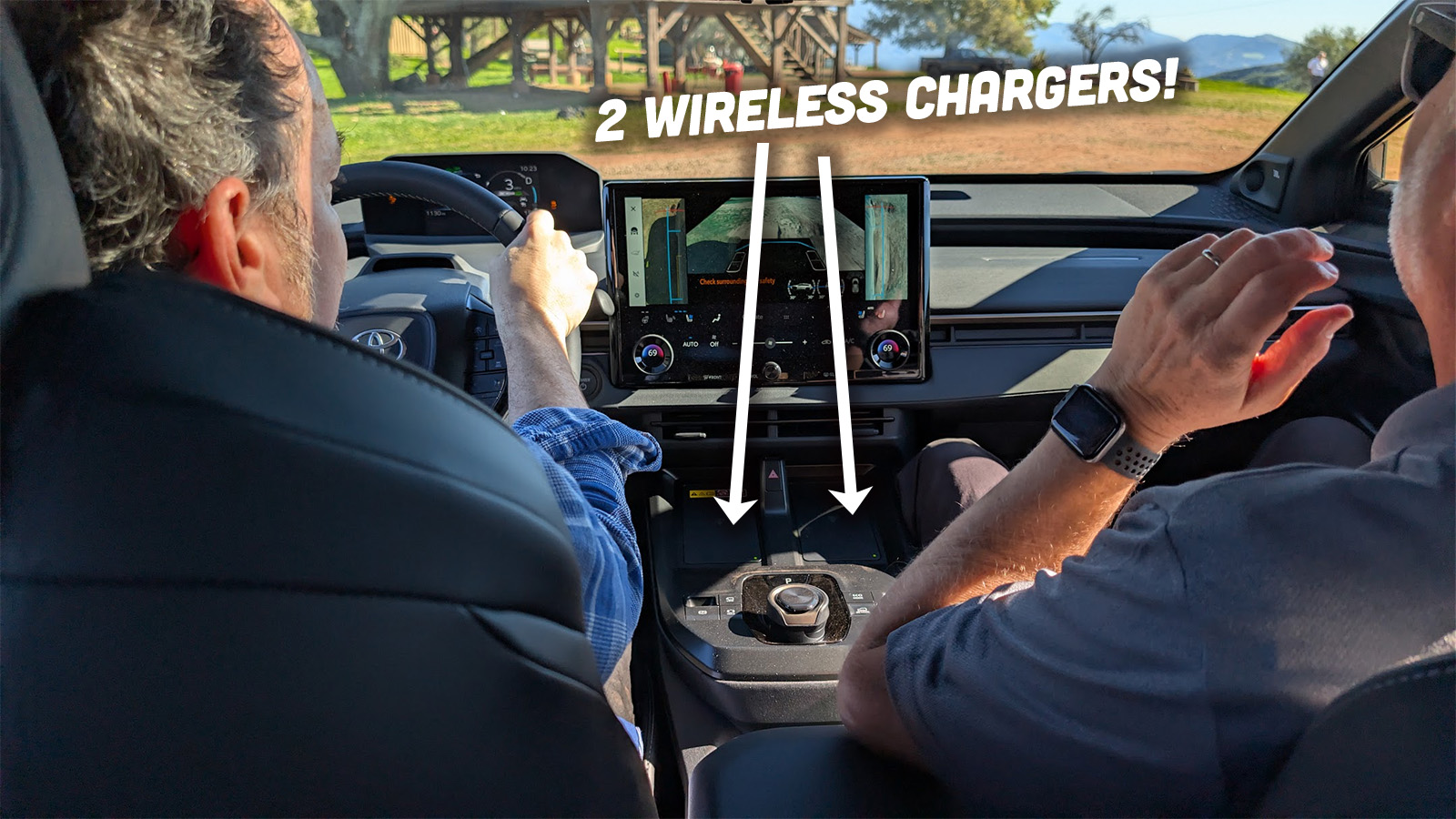
The interior is essentially the same across the whole bZ range of cars, and they have all of the expected electronic candy. There’s a pair of wireless chargers up front, which is nice, since we all have phones hungry for electrons, and there’s Apple CarPlay and Android Auto wireless connectivity.
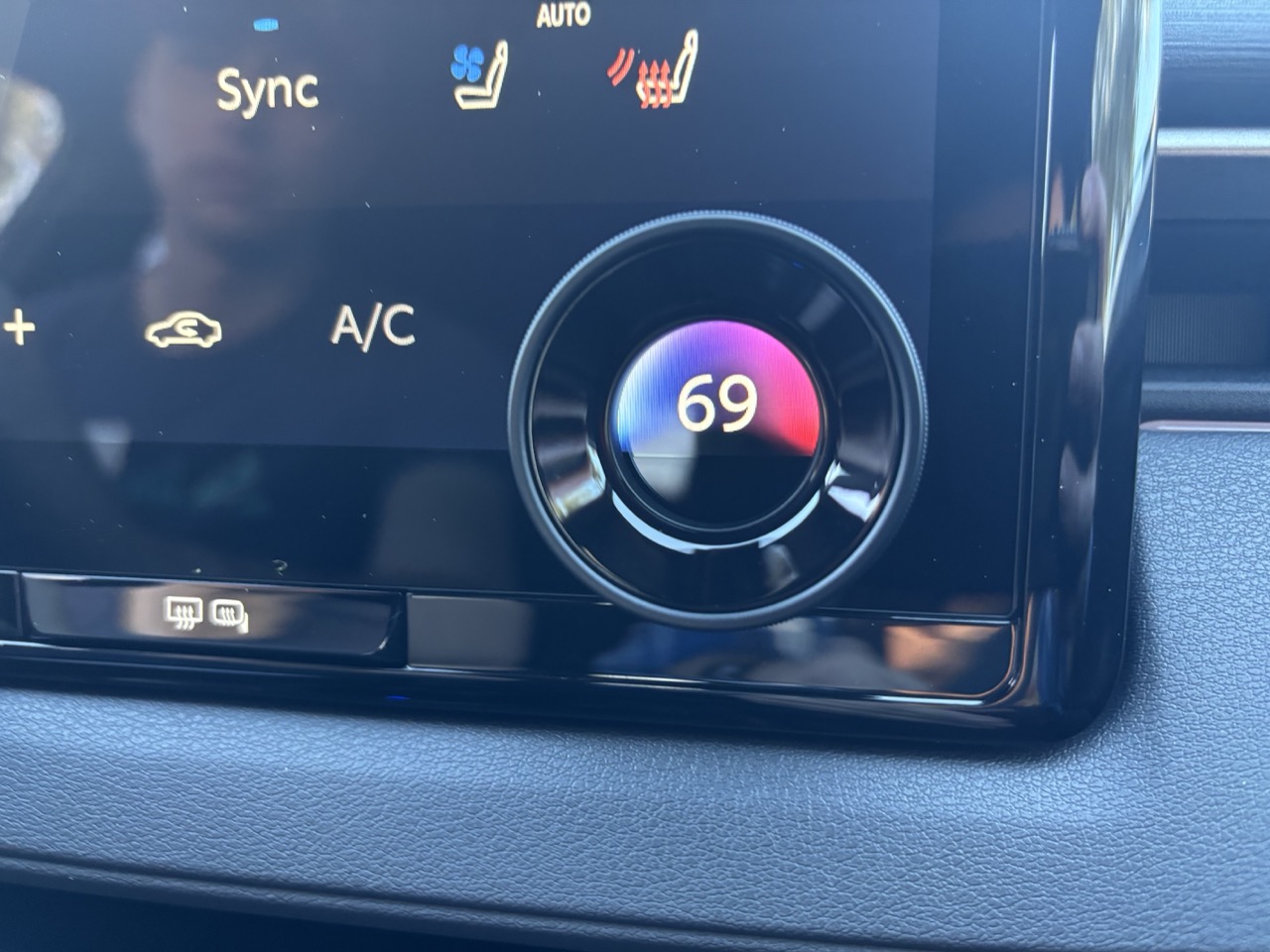
While it’s about as touchscreen-focused as most modern cars, there are still some physical controls, which is welcome, and I like the knobs-on-the-touchscreen method seen on some cars, including the bZ family, for controls like the climate temperature knobs:
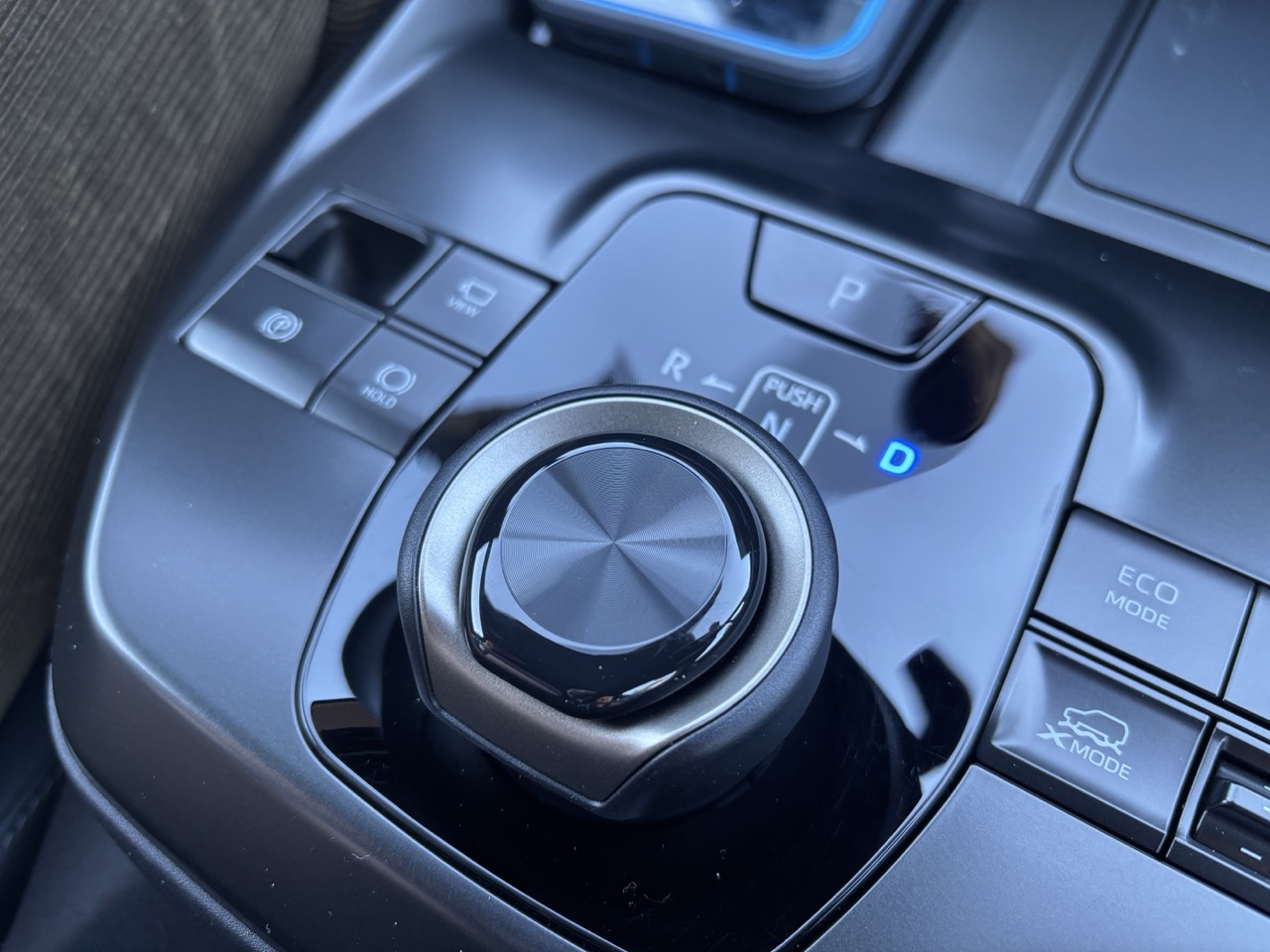
The shifter is a rotary knob thing that’s a little confusing to use at first; I’m not sure it really adds much, like all these rotary shifters, and if I’m honest, I think I’d just rather have the center area free from controls and a column-mounted shifter.
One unexpected disappointment was the lack of a glovebox:
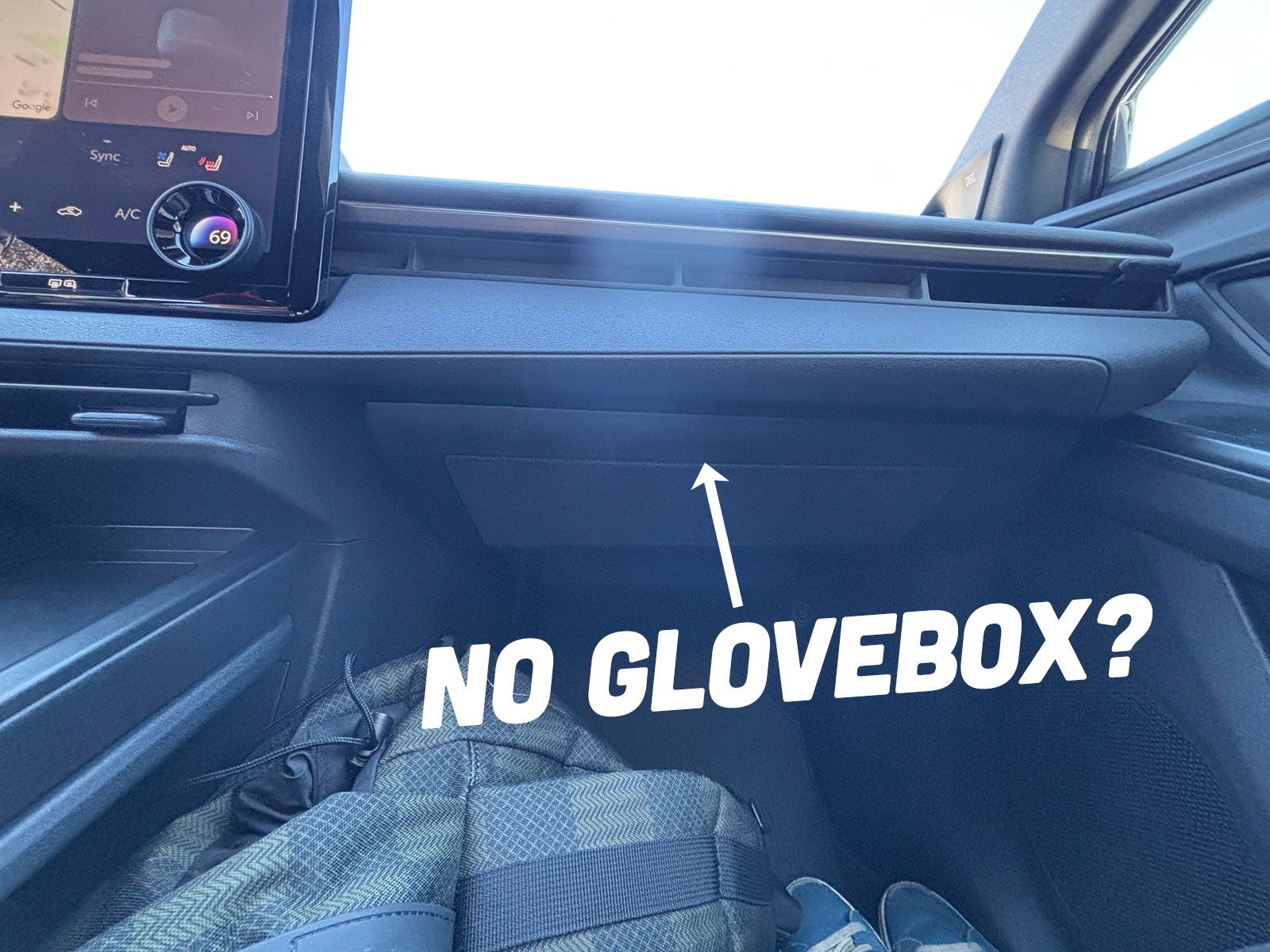
One of Toyota’s engineers told me the lack of a glovebox was to maximize front seat leg room, which I get, but it’s not like most cars with bulky engines lurking just in front of the front footwell haven’t managed to figure out how to still keep a glovebox. It feels like a packaging issue that perhaps should have been solved.
There’s other storage of course: in the doors, a shelf under the center console, and a little in-armrest storage cubby, but that still didn’t really seem like a great place to store the usual glovebox manifest of owner’s manuals, wadded up traffic tickets, some bulbs and fuses, and perhaps an expired condom.
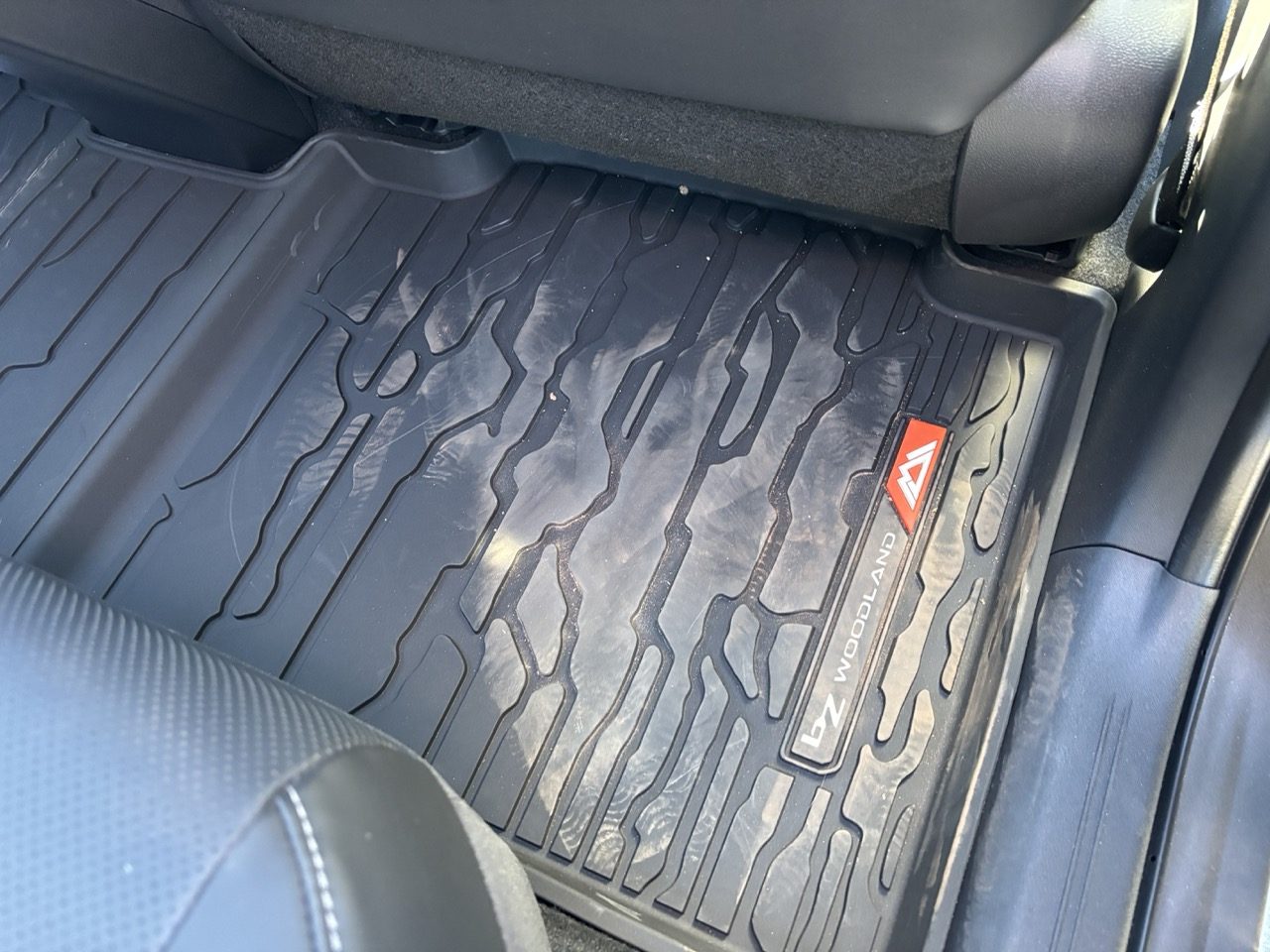
Speaking of the floor, though, I have to say the thick, rubbery, textured floormats in the Woodland are top-notch. Excellent for protecting the car from mud and gravel and grime, and they cover the whole floor, and even have the handy little “wall” around them, so if you remove them to dump out or hose off, you’re less likely to decant months’ worth of grime into your carpet.
Let’s keep going with the floors! Rear legroom, for example, is pretty good, though it’s worth remembering that I’m only tall in a room full of toddlers.
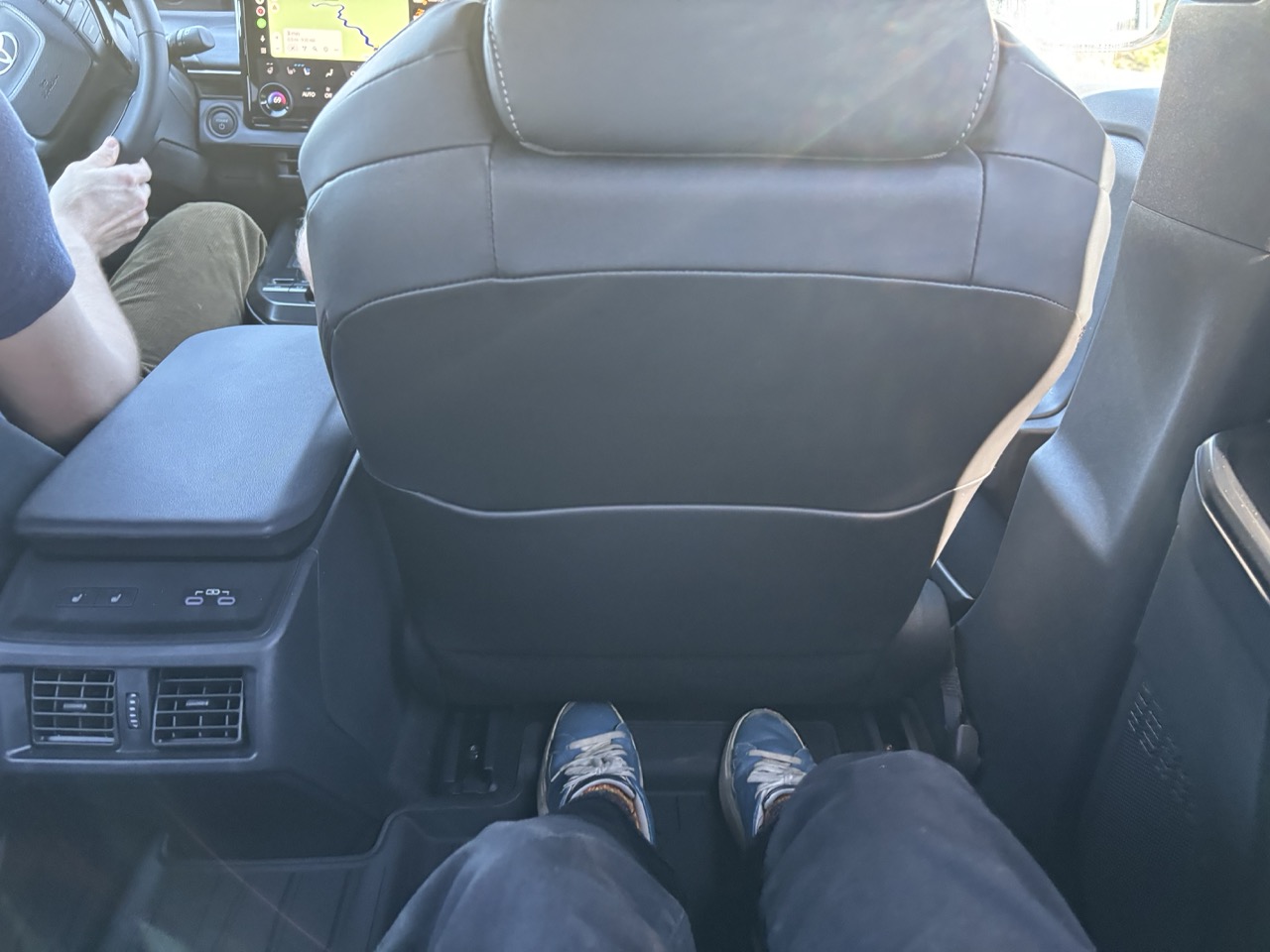
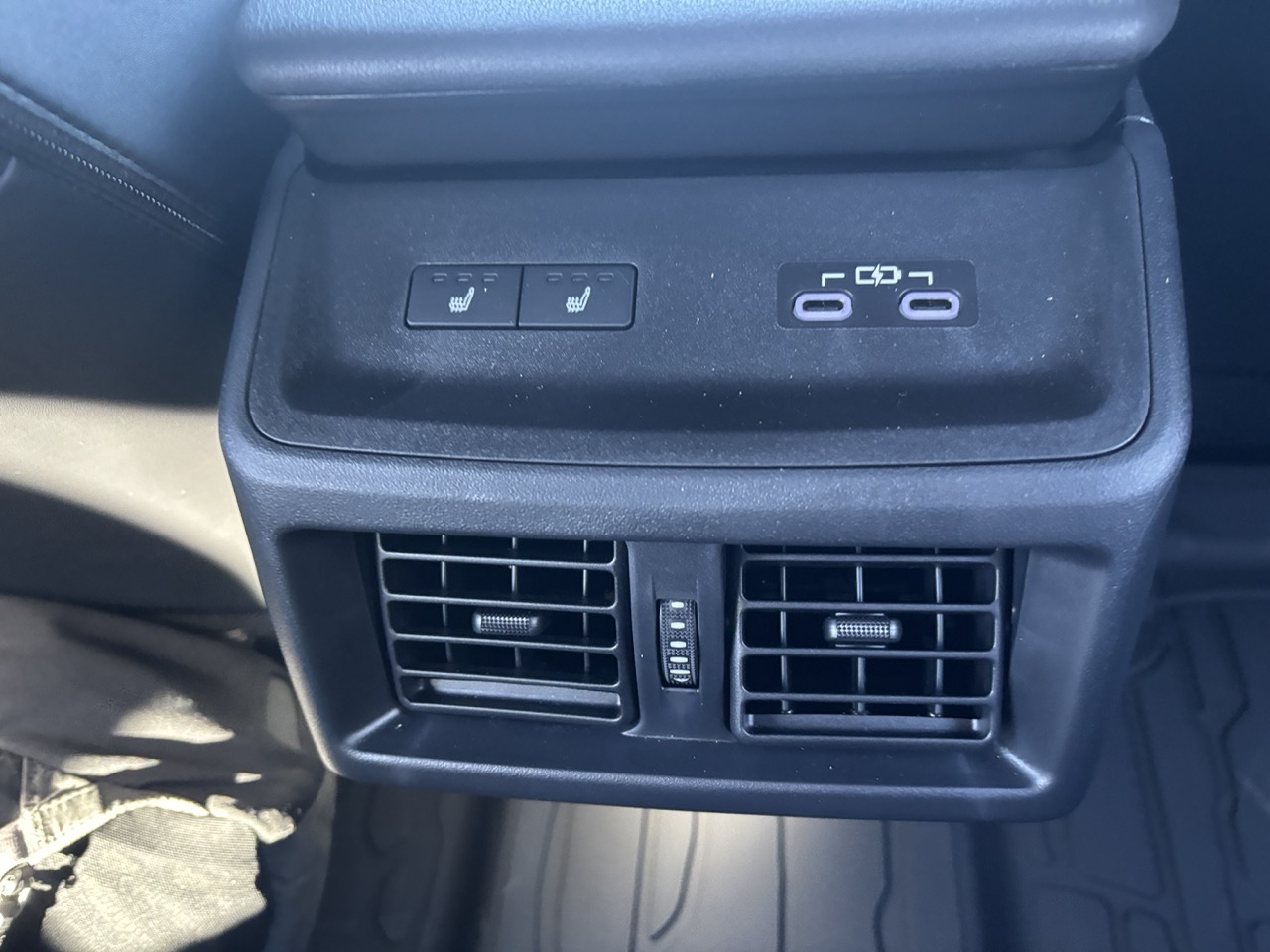
Occasionally, I’m smartest in such a room, too, but not always. The rear seat has heated and cooled seats, as well as a pair of USB-C ports and HVAC vents, which is nice.
Behind the rear seats, the cargo area is a pretty good size, keeping true to its wagon-shape, and offers between 33.3 and 33.8 cubic feet with the rear seat up (the rear seats are adjustable, you see) and between 71.8 and just over 74 cubic feet with the seat down, depending on if you opt to have a flat floor or choose to drop the false floor in the rear down for a bit more room.
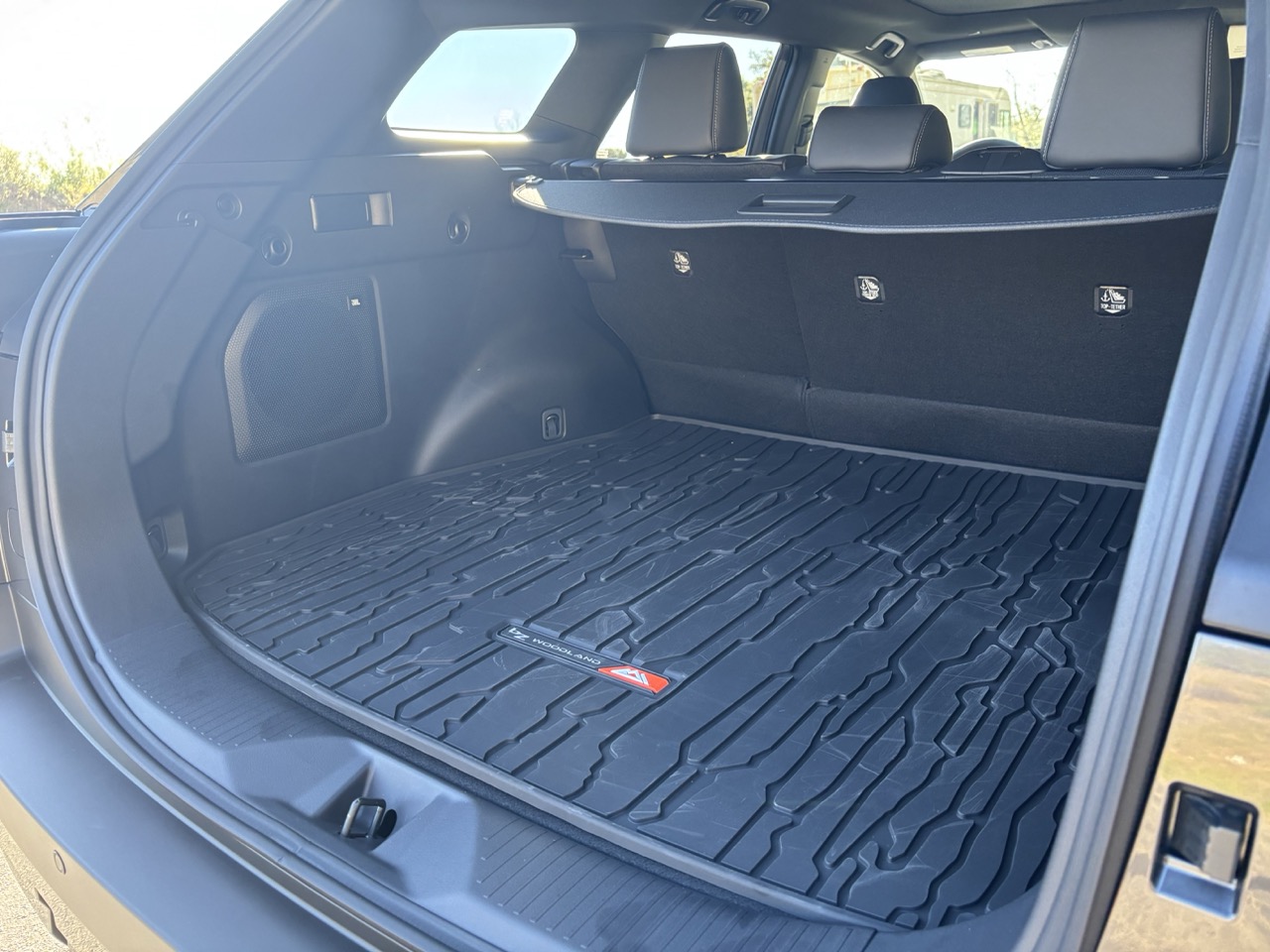
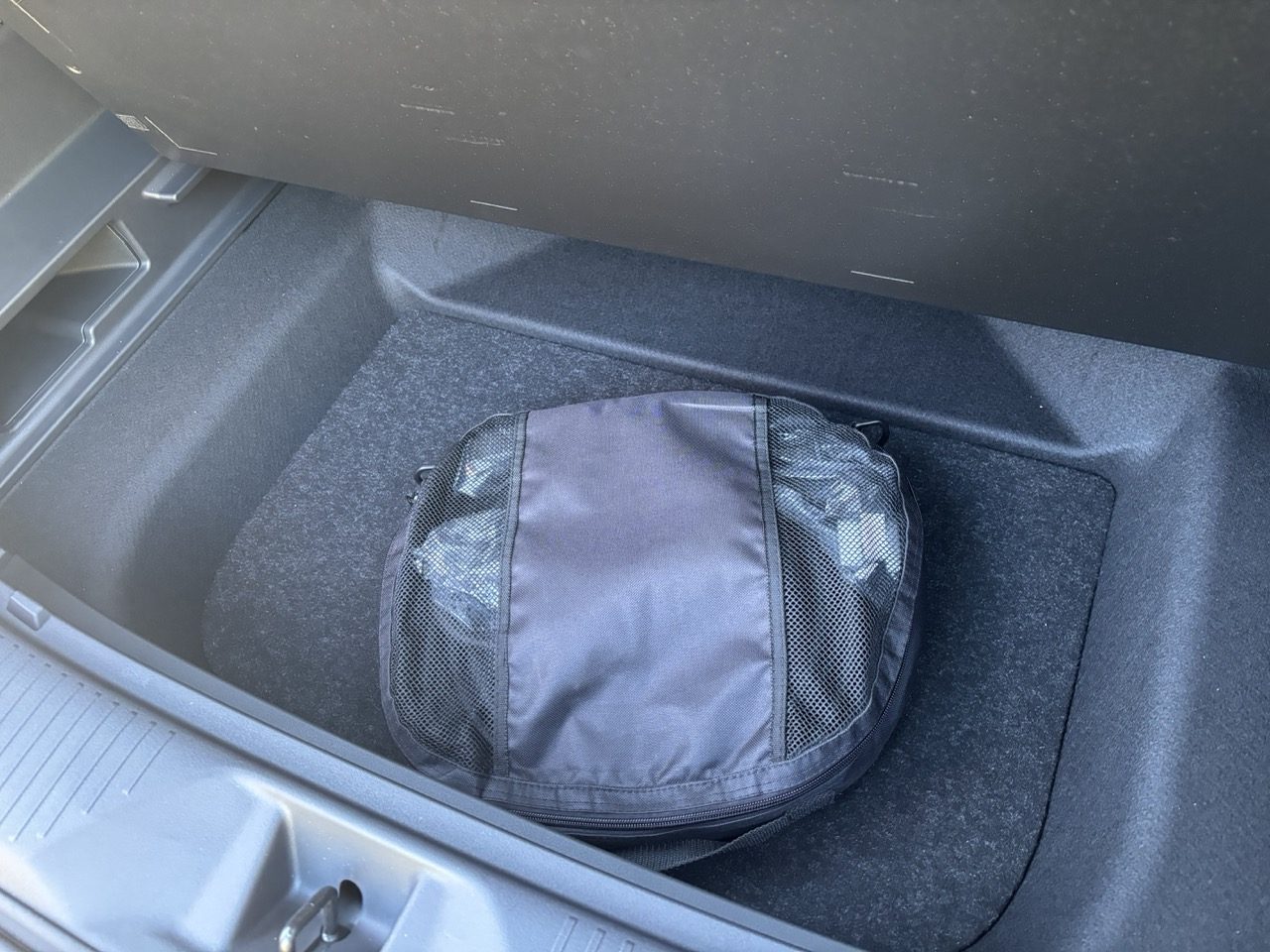
You’ll also note there’s a nice rubbery mat in the cargo area as well. There’s a good-sized well under the floor, and while there’s a sort of disc-shaped thing in there, it’s not a spare tire:
I bet you’re wondering if there’s a front trunk on the Woodland! Lots of EVs have them, and it’s appreciated!
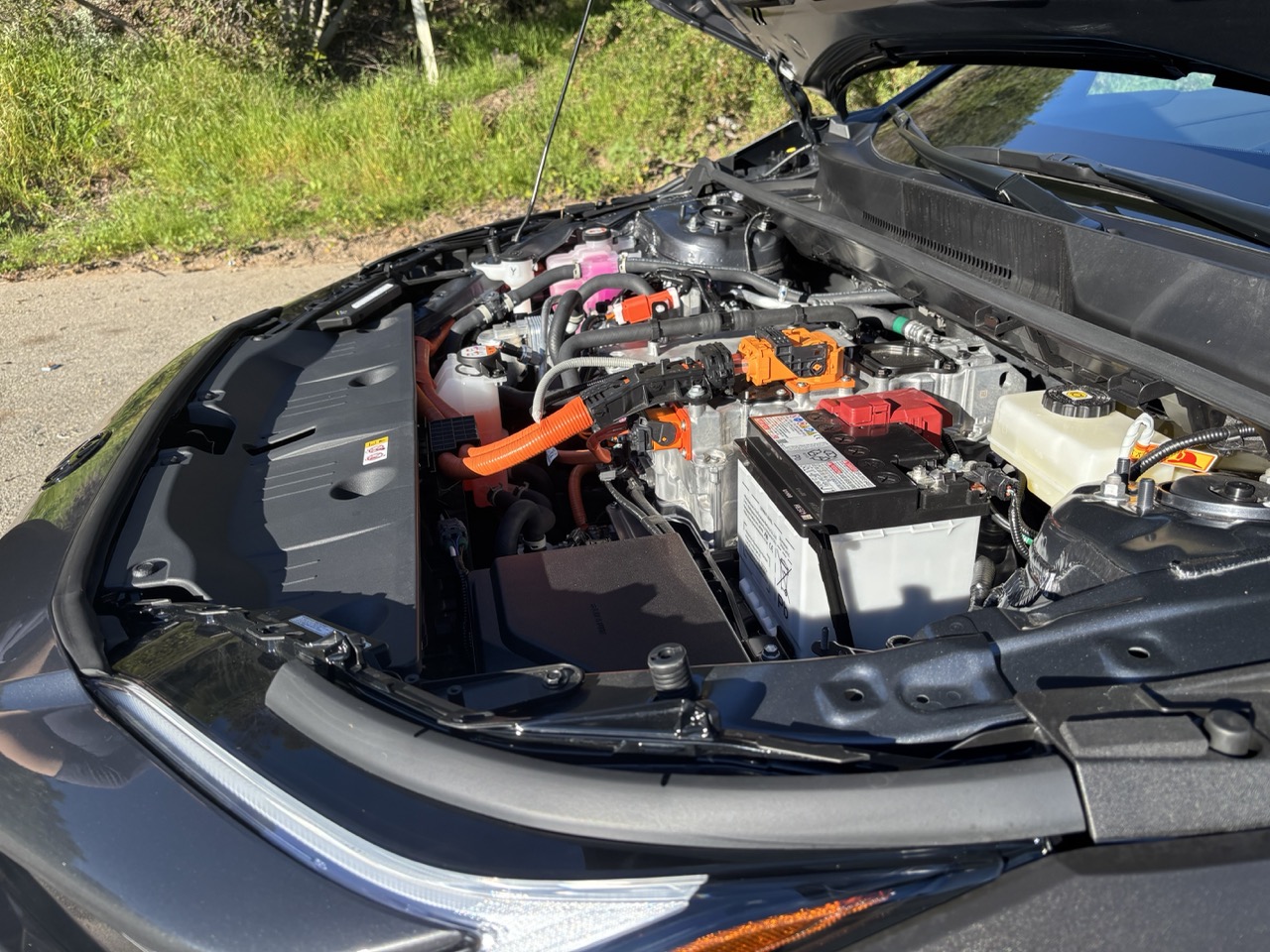
There’s not. I’m disappointed. It looks like there could have been a decent-sized little well to hold charging cables and stuff in front of the 12V battery, but I guess the engineers couldn’t be bothered.
How Does It Look?
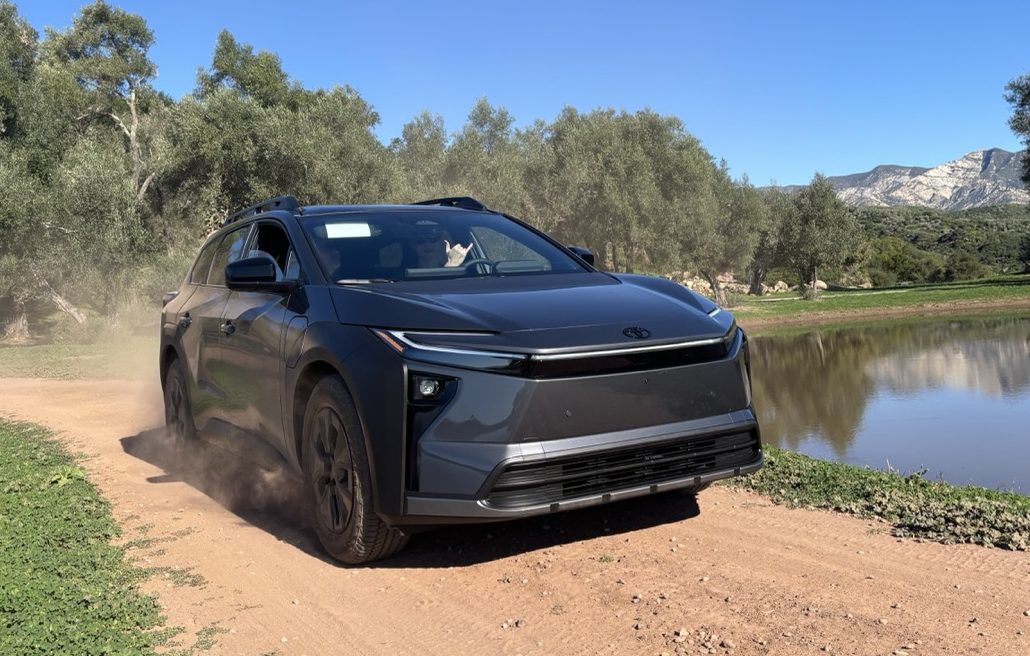
It’s not a bad-looking car; it has Toyota’s new corporate face, the hints of which we first saw on the redesigned Prius, and now on the facelifted bZ lineup. The Woodland is quite similar, with a mostly grille-free design save for a low, wide one below the bumper line, and a frontal DRL lightbar that kicks up into sorta of tong shapes at each end.
The fenders and lower bumpers on the Woodland are clad in black plastic to give the car a more rugged look, though you kind of lose the effect on dark-colored cars. You can see it better here, on a light one:
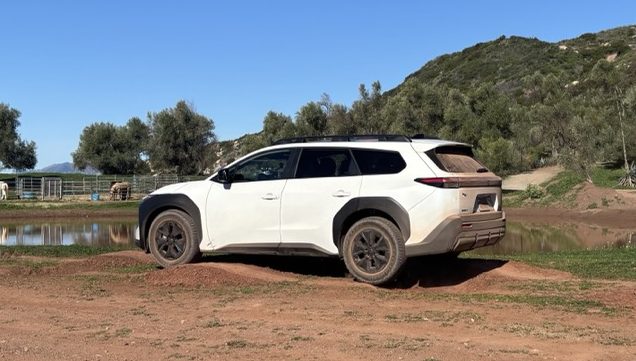
I suppose that adds some visual interest to the car.
The sculpting of the sides is interesting; there’s a kick up just aft and above the front wheel arch that leads into an upper character line, and there’s a lower, upward-angling character line as well that contrasts with the horizontal hockey stick line that works into the rear wheel arch. But I think I like the sort of scimitar blade-shaped intaglio part just under the rear window and continuing back to the taillight. There’s a good bit going on, but I think it generally works, even if the overall effect is still pretty anonymous and not that different than most modern crossovers and SUVs.
Charging!
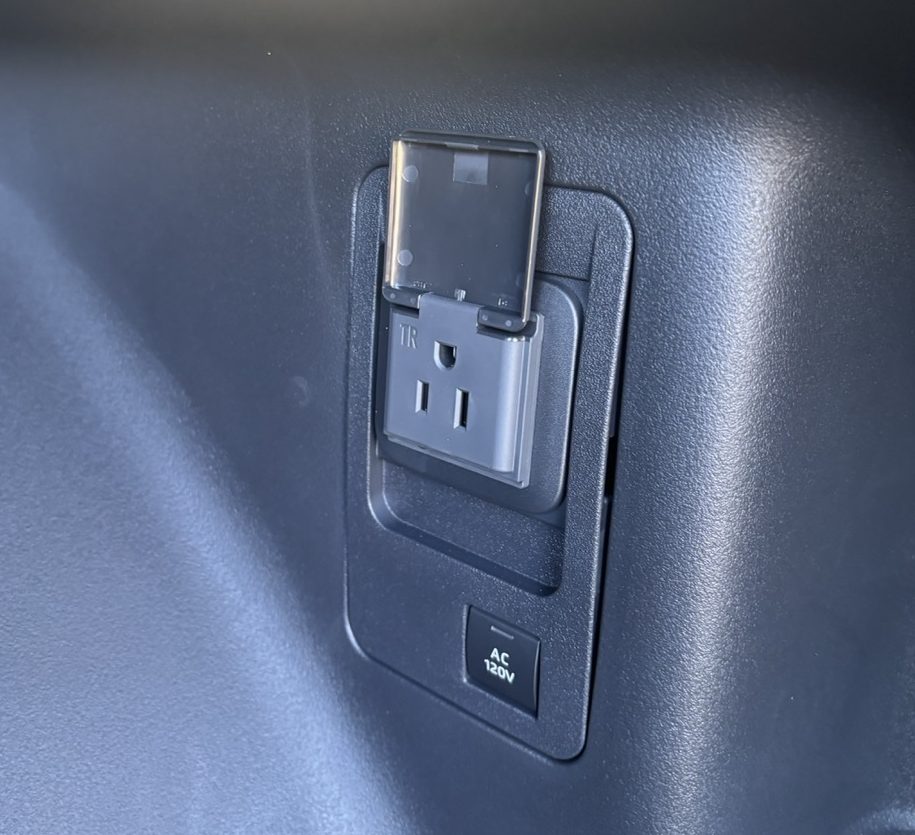
Just kidding, you don’t charge through that 120V outlet! But it does have one in the back, so I may as well show you. The big point about Toyota’s charging choices is that they seem a little too… I don’t know, timid? You do get a Tesla Supercharger-compatible NACS charging port, but the best DC fast charging caps out at 150 kW. For comparison, a Kia EV9 can do 350 kW. Toyota says their charger will charge the 74.7 kWh lithium-ion battery pack (about 67 kWh actually usable) from 10% to 80% in about 30 minutes. That’s not terrible, but compared to the competition, not great either.
Parting Thoughts
I’m sure there will be lots of people who would love a more rugged, occasionally off-roadable electric wagon, and this is that. But, so is the Subaru Trailseeker, which is essentially the same car, for, as I mentioned, about $5,000 less. If there’s some place where the Toyota one really makes more sense and is worth those extra five very big ones, I’m not entirely certain what that is.
I don’t think this is a car I personally desire, but I can see it being appealing to many people. Oh, and it can tow 3,500 pounds! I forgot to mention that! Of course, I didn’t try it, and it’ll probably turn the range to garbage, but still, you can take your catamaran to the lake or whatever if you’d like.
I’m sure the right people will love it. But would they love the Subaru-badged one and five grand in their pocket more? Probably.
Top graphic image: Jason Torchinsky


I wonder if it’s like the Mitsubishi Outlander and Nissan Rogue hybrids, or the BR-Z vs the GR86 the other way, where there’s a base model you can only get as a Subaru. Did you get a chance to compare spec sheets? I’m guessing not or you’d have told us what we get for that 5 grand.
Brutal headline. Way to call a spade a spade though. That’s why I’m a member.
I feel irrationally irritated that they didn’t bring the rear wheel cladding all the way down to meet the bumper and rocker panel. Was the extra three inches of plastic too much added cost for the design team?
It’s just like the previous gen RAV-4, and probably the current also. When it’s in white, which half of them, it looks like the tires are about to be popped by big mechanical pincers at the scrapyard.
I don’t care enough to see how they actually compare size-wise, but stylistically, this is a much more convincing new Outback than the actual new Outback. I could see the Subaru version finding a ready market there, especially at a lower price point.
AMC?