


The 2027 Chevrolet Silverado looks familiar on the outside; its powertrain options look familiar; the suspension geometry looks familiar; and the transmission looks familiar. But changes for 2027 are huge, mostly in the cabin, which is now less truck-ish than ever. The good news? The updated engines are more truck-ish than ever. Here’s what I thought of Chevy’s new bread-and-butter pickup.
As a general rule, when you have a winning formula, you don’t mess with it. Chevy clearly gets this, which is why the 2027 Silverado may be “new” in terms of how Chevy markets it, but it’s not that different.


The big changes have to do with the exterior, the interior, and the new engines. Let’s talk about those new motors first, before getting into the other changes and my driving impressions.
[Full Disclosure: Chevy flew me to Tucson, Arizona, put me up in the Four Seasons, fed me the biggest meal I’ve ever seen in my life, and generally tried to make sure I had a great time driving their truck. I did, but not because of the free shrimp. -DT].
Small Blocks Become Less Small: The 5.3 Becomes The 5.7, The 6.2 Becomes The 6.6


The 350 is back. That’s at least the headline that spread across the automotive universe, with the 350 cubic inch V8 replacing the 5.3-liter entry level V8 that’s been in Silverados for the entirety of the millennium. The new 5.7-liter “L76” engine maintains the 4.4-inch bore spacing that’s been common in small block V8s since the beginning of time, but it adds 6 millimeters of stroke to increase displacement. This applies to the 6.2 as well, now up to 6.6 liters (the L78 engine).
Both motors have been brought into modernity, and though they’re “all new,” they’re very familiar. “I think of it as an evolution of the gen 5 [small block],” Assistant Chief Engineer Ian Stahl told me. “We want to make V8s as great as they can be for as long as we can make them.”
The block is new, with the engine name cast on the front for fun (I say “name” and not displacement because the 400 is technically a 401, the 350 is technically a 346):

The pistons are new:

The crank is new:
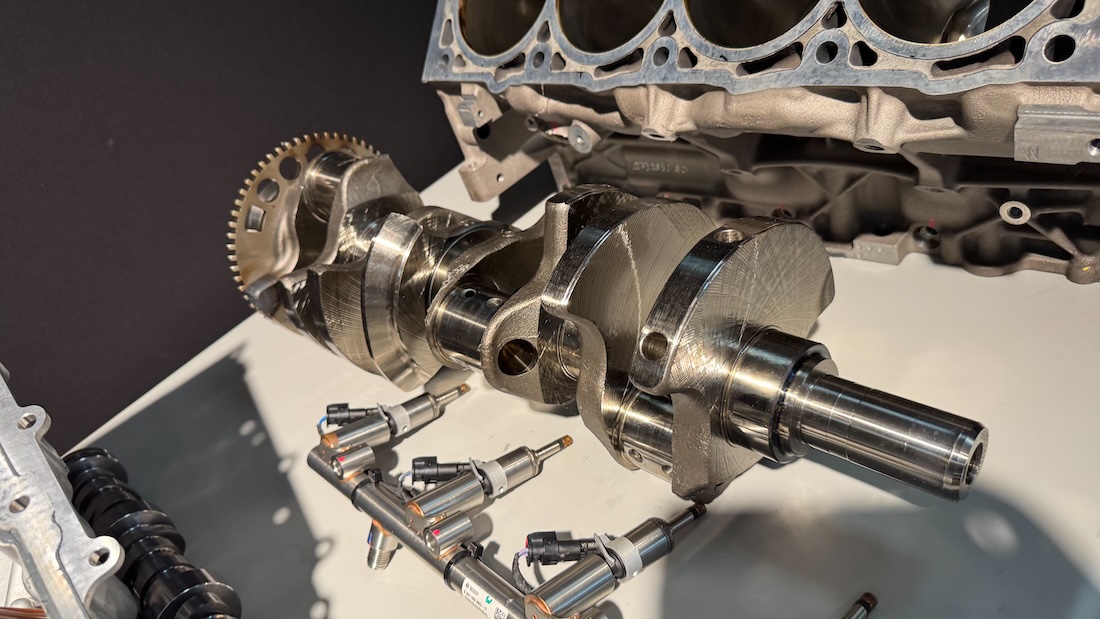
Stahl says this evolution of the company’s past engines is an effort to “future proof” the company’s bread-and-butter motors, with “dual fuel” — a combination of port fuel injection and direct injection — being a key upgrade. Here’s the fuel rail for the direct injection, which sends fuel directly into the cylinders:


The rectangular port fuel injection rail sits on the valve covers and reaches through it and the cylinder head into the head’s intake ports:
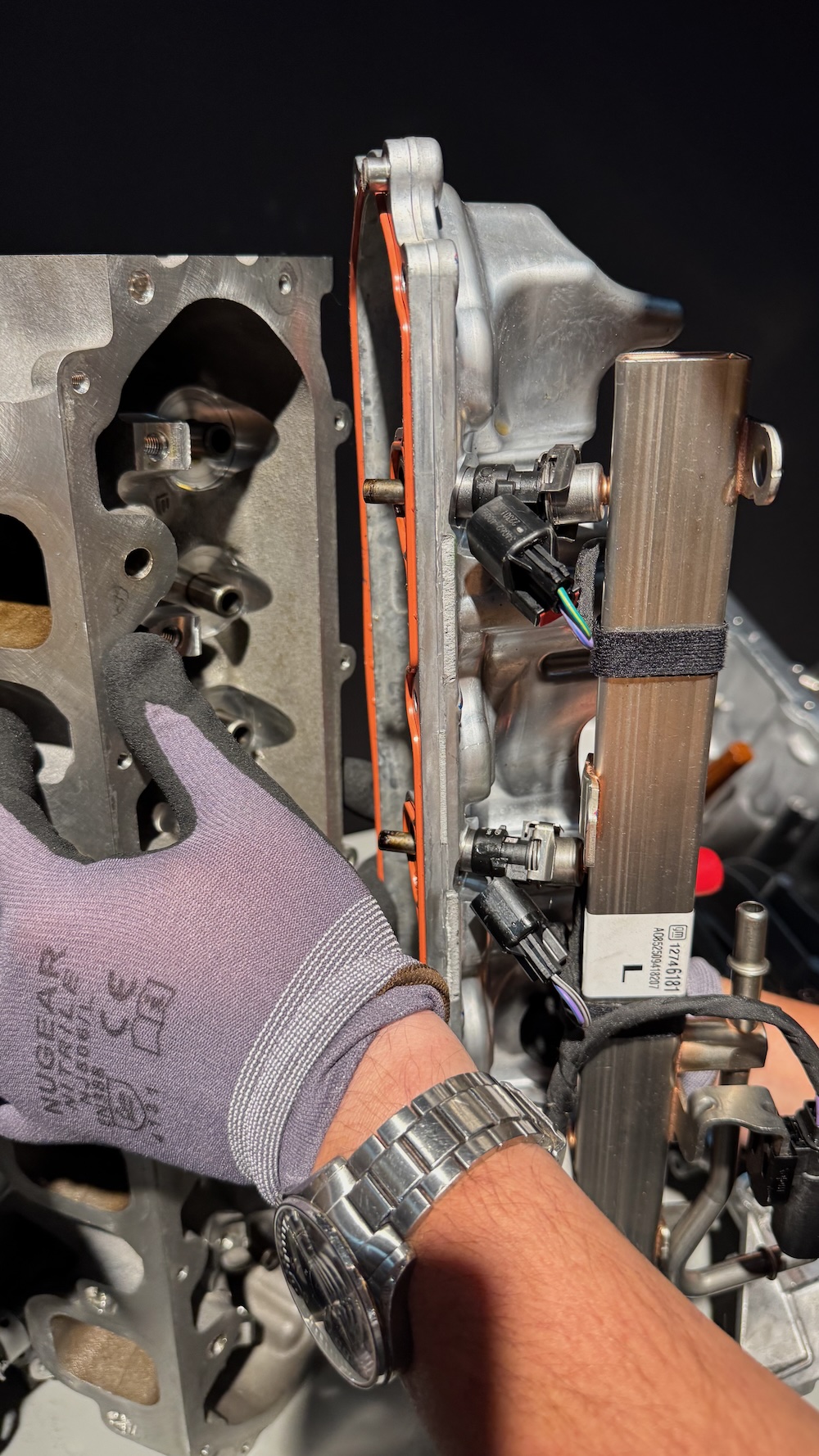
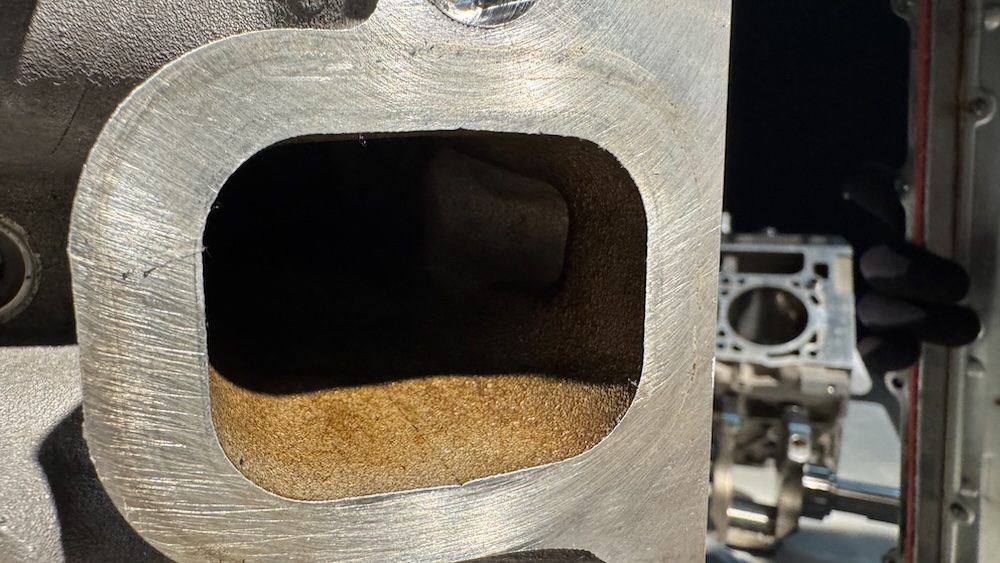
This change to add port fuel injection to the small-blocks’ direct injection, Stahl told me, allows the motors to run DI during a cold start in order to get the catalytic converter warmed up and functioning effectively as quickly as possible. When the engines are warm, Stahl told me, they run port fuel injection for a nice, quiet idle and reduced particulate emissions (the mg/mi requirements for automakers were originally meant to drop significantly for 2028). At higher speeds/loads, direct injection gives the engines the most power, with Stahl saying port fuel injection displaces air, and the less air entering a cylinder, the less power that engine can make.
On the two new engines, fuel is routed to the driver’s side low pressure (400 KPa) fuel rail on the valve cover:

A crossover pipe connects this rail to the low-pressure rail on the passenger’s side valve cover, and a braided hose goes from that rail to a high pressure fuel pump in the valley of the engine under the intake. That high pressure fuel pump then sends 25 MPa fuel to the fuel rails running near it (also under the intake, in the valley):


Here you can see how the whole fuel rail system looks on the motor:

Other upgrades, Stahl noted, include a continuously variable oil pump, which allows the motor to throttle its oil pump output even at higher RPMs (typically, oil pump output was directly related to RPM) — this helps with engine efficiency. What’s more, the engine oil cooler is no longer in the radiator end-tank, it’s now on the side of the engine, allowing for quicker cooling and more predictable oil temperatures:

And the thermostat is no longer a basic wax element that expands to open up and let flow to the radiator — it’s now a ball valve that can intelligently restrict or change flow depending upon where it’s needed most:

Stahl noted that the truck still offers Dynamic Fuel Management cylinder deactivation technology, which “shuts off” cylinders when they aren’t needed. Running the V8 on fewer cylinders allows those fewer cylinders to run at higher loads than they would if other cylinders were sharing the burden; as I understand it, this higher relative load means more efficient fuel burn and also fewer pumping losses since it allows the throttle body to be open wider.
Strategically-designed cooling jackets let Chevy crank up the compression ratio, two large main bearing feeds instead of just one ensures plentiful lubrication of those bearings, and perhaps more importantly, intake runners have been designed to maximize power on the 6.6 (shorter runners) and torque on the 5.7 (longer runners). The results, at least on paper, are impressive.
The 5.3’s 355 horsepower, 383 lb-ft of torque jumped up to 402 horsepower, 428 lb-ft on the 5.7. And it’s not just peak figures that are up — torque across the entire rev range is up, which means any time you tip in, the truck’s response should be significantly quicker:

The outgoing 6.2-liter’s 420 horsepower, 460 lb-ft peaks are up to 481 horsepower and 501 lb-ft on the replacement 6.6-liter, and again, torque is up across the whole rev range:

I’ve really only just scratched the surface on how Chevy evolved its Silverado 1500’s two small-block offerings (an evolution, it’s worth noting, that already took place on the debut vehicle for the generation 6 LS6 V8, the Corvette), but to me it seems like the same V8 we all know and love, but with more displacement; more compression ratio; and more intelligence in the form of an additional fuel system, a variable oil pump, a smart thermostat, and more. It’s just an LS, but optimized using modern tech.
Speaking of, let’s talk about a modern bit of tech that’s been seen as a bit controversial.
There’s No Dipstick. Here’s How Checking Your Oil Works

The lack of a physical dipstick on the new Silverado 1500’s V8s has been creating lots of buzz. This isn’t surprising; traditional truck buyers are naturally going to feel like this is a blasphemous step away from mechanical simplicity and towards complexity and the maintenance challenges that come with it.
How do I feel about it? I want a physical dipstick, but I also have no illusions about the average person buying a quarter-ton truck in 2026. These things are daily drivers around the country, and I bet most hoods stay closed most of the time. GM provided The Autopian with a statement on its decision:
For the new light-duty 5.7L and 6.6L V8 engines, GM’s decision to move to electronic oil-level monitoring was intended to simplify the ownership experience. The system allows customers to check their engine-oil level from the vehicle cabin through an on-screen readout, without opening the hood or using a traditional dipstick.
Some have speculated that packaging or crankcase ventilation optimization led to this choice; if I had to guess, this is more about preventing human error to reduce warranty costs. In any case, let’s have a look at how the oil level monitoring system works.
The cast aluminum oil pan features a ~1″ hole and three threaded bosses to allow an oil level sensor to be fastened from below:

Here at the bottom of the oil pan you can see the oil level sensor, a $30 off-the-shelf component built by German supplier Hella:

As for how you actually check your oil, you start by firing up the engine. Then you click Vehicle Status on the main screen:

You swipe over one page, and there you find your oil level:

Clicking that reveals this screen, which tells you the best way to get a good reading:

But of course, starting an engine before knowing its oil level seems pointless, and when trying to check the level with the engine off, I received the notification “Start vehicle to view Vehicle Status”:

So I asked Chevrolet how I could check the level with the engine off. Step one, they told me, is to, with your foot off the brake pedal, press and hold the engine start button:

This actuates a service procedure, causing the dashboard to light up like a Christmas tree:

Once in service mode, you can press Vehicle Status, and — like before — it’ll give you an oil reading:

It’s cleaner and easier than checking a dipstick, and it at least theoretically reduces the human-error element, though I do wonder if, without a dipstick and without knowledge of how to check the level with the engine off, this might lead folks to start engines with insufficient oil in the crankcase. (I’m unsure if the vehicle will allow you to start the engine with a low level, though it would undoubtedly give you a warning if you did).
“I personally think…it’s a more consistent measurement and a more convenient system,” Ian Stahl told me, acknowledging some of the pushback from what he called a “vocal minority.”
“The vast majority are going to find it a huge convenience,” he said. “I’ve checked my oil level more in the last four months than in 20 years; it’s an off-the-shelf part, [and] from that standpoint it’s robust.” Stahl made it clear that it’s a separate sensor than the oil pressure sensor, and noted that, while you can check the level in the service procedure with the engine off, you do need power in order to check the level.
The Truck’s Bones Are Familiar, But Its Skin And Insides Are Not
There were also some changes to the 2.7-liter (it got a 35 MPa fuel system to help with emissions; torque is also up 40 lb-ft thanks to a bigger turbo enabled by a new valve that prevents it from surging), and the 3.0-liter “baby Duramax” diesel grew its DEF and fuel tank to the point where it can drive 900 miles before refueling, but for the most part, those motors are carryover.
Also carryover is much of the truck’s basic architecture. In fact, nowhere in the new truck’s press release does it mention major chassis or even body-in-white changes, and when doing a walkaround with Lead Development Engineer Mike Norrito, he began by describing the truck as “an entirely restyled vehicle.” Chevy mentioned very little about improvements to ride, handling, or NVH, focusing instead on four main improvements: 1. Exterior and interior styling 2. Powertrain and 3. Infotainment and 4. Off-Road Capability.
As for styling, the exterior sheetmetal and fascia changes are significant, with Chevrolet describing its those changes for 2027 like this:
The 2027 Silverado 1500 introduces an all-new exterior with a bolder stance, stronger face and more premium execution. The design signals the next chapter of Chevy truck styling while staying true to Silverado’s work-ready character, balancing everyday usability, capability and presence. That fresh look is immediately visible in the truck’s new LED headlights and taillights, more pronounced wheel opening moldings and rocker treatments, and standard dual exhaust on Custom and above for a more refined appearance.
[…]
“The goal with the new Silverado was to create a truck that looks stronger, more modern with demanding presence at first glance, while staying true to the authentic truck character customers expect from Chevrolet,” Chevrolet Global Executive Design Director Phil Zak said.
Let’s have a look at those design changes. Here’s the outgoing 2026 truck’s front end:

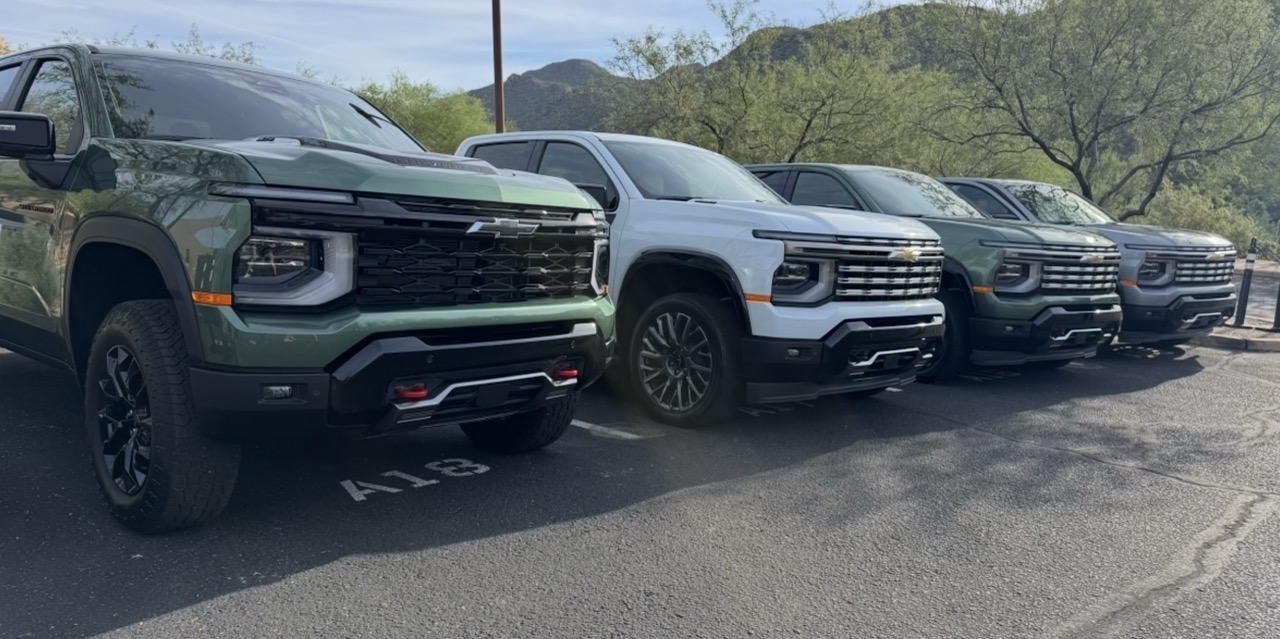
Here’s the new truck in various trims. You’ll notice the headlights now below the horizontal bar, the aggressive DRL accent lights around those headlights and above the bar, and just a less face-like front end. It’s definitely more aggressive.
Here’s the old truck’s rear end:

And here’s the new one:

It’s not an enormous change, but I do think the rear end looks cleaner and less busy.

Before I move on from exterior design, I’d like to give a shoutout to the new truck’s “choiler” (a spoiler with a CHMSL built in), which now integrates the sharkfin antenna you see in the 2026 front-end image above, along with some lights and cameras. It’s a clean bit of consolidation.
An Advanced And Useful New Interior, But A Bit ‘Dainty’
Perhaps the highlight of the new Silverado is its new interior — specifically the next-gen GM user interface debuting in the truck and trickling down to the rest of GM’s lineup.
Chevy touts the “class-leading” standard 16.3-inch center display and 12.2-inch driver information center, with the ZR2 and High Country trims adding an 11.5” front passenger screen paired with heads-up display and a rear camera mirror. GM says this lets “customers… experience over 60 [inches] of digital displays.”
GM describes the new UI, saying:
The new GM UI will debut on the 2027 Chevrolet Silverado 1500, integrating Android Auto and Apple CarPlay with the native Google built-in features like Google Gemini, Google Maps, and apps through Google Play.
Here’s a look at a couple of different versions of the new cabin, one with the passenger-screen and one without:


Here’s the outgoing truck’s interior:

In some ways, the new interior is a step forward, and in some ways, it’s a step backwards. A step forward is the deletion of the center tunnel-mounted shifter, which is just a waste of space. I applaud Chevy bringing back the column shift, though I have to admit: It’s a bit dainty and feels like it belongs in a sedan, not a pickup truck:

The entire cabin gives off a bit of a tech-y, not-particularly-rugged vibe. It’s not just the shifter, it’s the screen-ification of controls. Look at the 2026 Silverado’s interior and you’ll see tons of buttons; the 2027 truck, meanwhile, relies on touchscreen controls for almost everything:
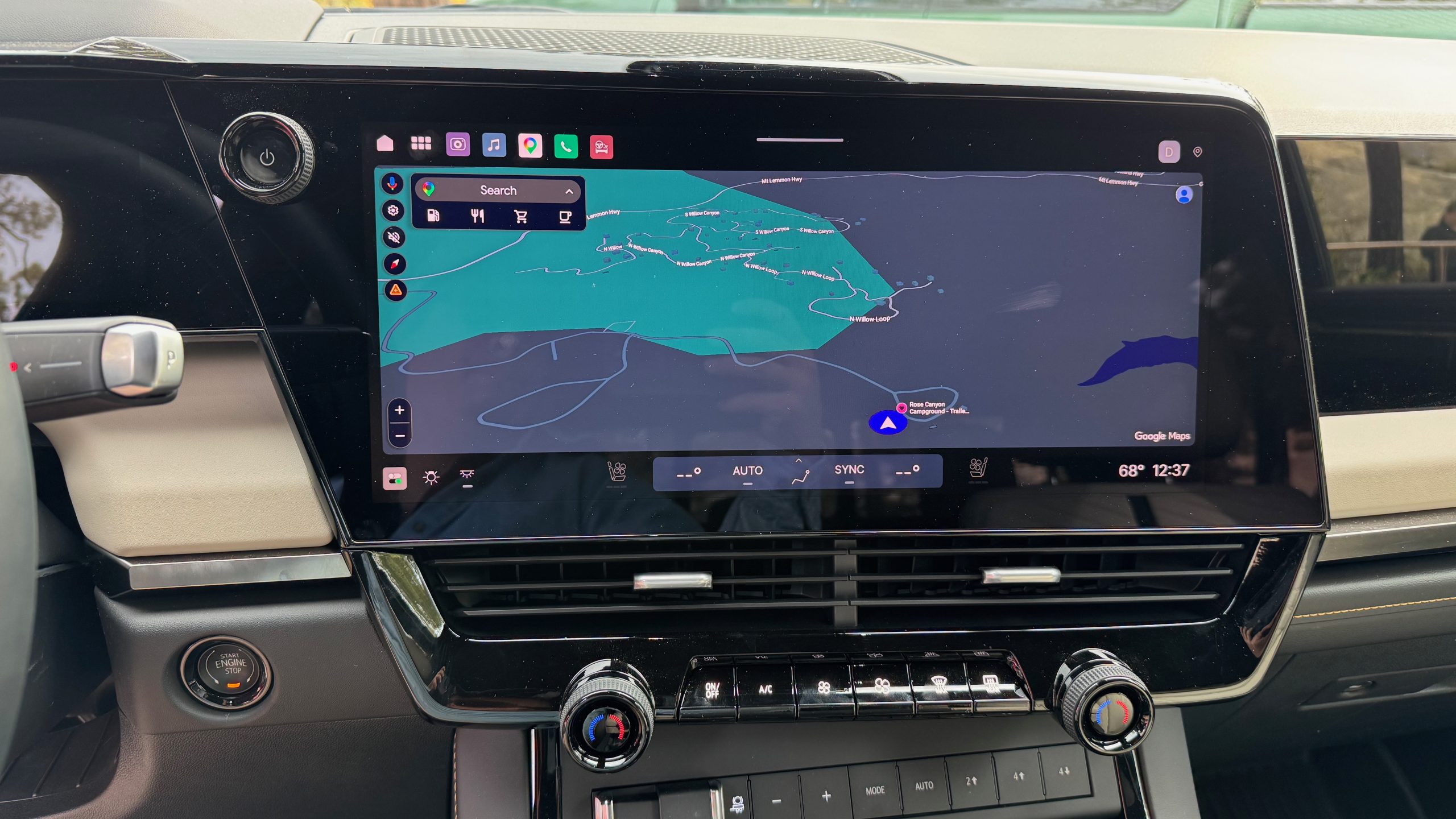
And look, I realize it’s 2026, and journalists complaining about a lack of physical switches is a bit cliche at this point, but this is the truck segment, and we’ve gotten rid of dipsticks, we’ve added a tiny plastic column shifter, and now lots of my controls are going to make me want take my gloves off or at the very least smudge my screen.

To be fair, at least Chevy kept physical switches for the transfer case and for some HVAC controls, plus there is a volume knob. There are also controls on the steering wheel:
One of the more interesting steering wheel controls is the volume. It’s actually two buttons that come off the right paddle shifter (which is actually a range selector; more on that soon). It actually feels like you’re still touching the paddle until you push, and then you realize you’ve got your two volume buttons there.

It works well, and so does Apple Carplay, which pops up on the right side of the screen, with the native software shown on the left (often presenting the current audio or tire pressure or some other useful info):

Down below is the trailer brake controller and transfer case switches, plus two magnetic wireless phone chargers that do something that so many other automotive wireless chargers don’t: They actually work. And they hold the phone even when the truck is bashing through rocks off-road:

Here are the switches on the left side of the steering column (yes, the headlight switch is in the infotainment screen, but at least the dimmer is here):

Storage is plentiful, with the cupholder able to actually slide back and forth for your configuring needs:

And a work-surface that doesn’t necessitate a fancy floor shifter that has to fold out of the way (ahem, Ford), is great as well:

From a styling and storage standpoint, the new interior is great. And from a usability standpoint, it’s reasonably intuitive. But I prefer physical buttons in a truck, and I want my shifter to feel substantial.
What The Silverado 1500 Is Like To Drive On The Road
Chevrolet gave me a chance to experience both V8 engines and the 3.0-liter diesel over a mile high in the mountains near Tucson, Arizona. Unsurprisingly, the bigger, more powerful versions of the beloved LS V8s were magnificent.
The 5.7 liter V8’s 402 horsepower and 428 lb-ft of torque were plenty to propel the 5,500 pound truck with vigor, despite the low air density at that altitude. The 10-speed automatic shifted great, the suspension — while a little bouncy — rode really nicely, and wind noise was more than acceptable. Based on my short drive, the new Silverado feels like a really great truck to drive everyday.

As for the 6.6-liter, to me, it wasn’t obvious based on my short test loops that its 481 horsepower and 501 lb-ft of torque gave it a huge acceleration or towing advantage over its 5.7-liter sibling; to me, the big difference was the sound. The 6.6-liter comes with an active exhaust valve that, when opened, makes some of the most glorious noises you’ll hear from any naturally aspirated pickup truck in the business.
The result is that the 6.6 liter Silverado feels sportier and gives off a more muscular vibe than the 5.7. Again, how much of a speed advantage there is, I guess we’ll see when publications get these in press fleets. All I can say is: It sounds badass and the power is awesome.

As great as the two revised LS engines are, though, I fell in love with the 3.0-liter “baby Duramax.” Our testing area was 8000 feet above sea level, and we were towing campers that weighed over 10,000 pounds. In this context, the diesel amazed me. Yes, it only makes 305 horsepower, and its 495 lb-ft of torque is less than the 6.6’s, but the diesel engine’s forced injection meant it could tug and tug and tug its trailer up that steep grade with a confidence that neither gas engine had.
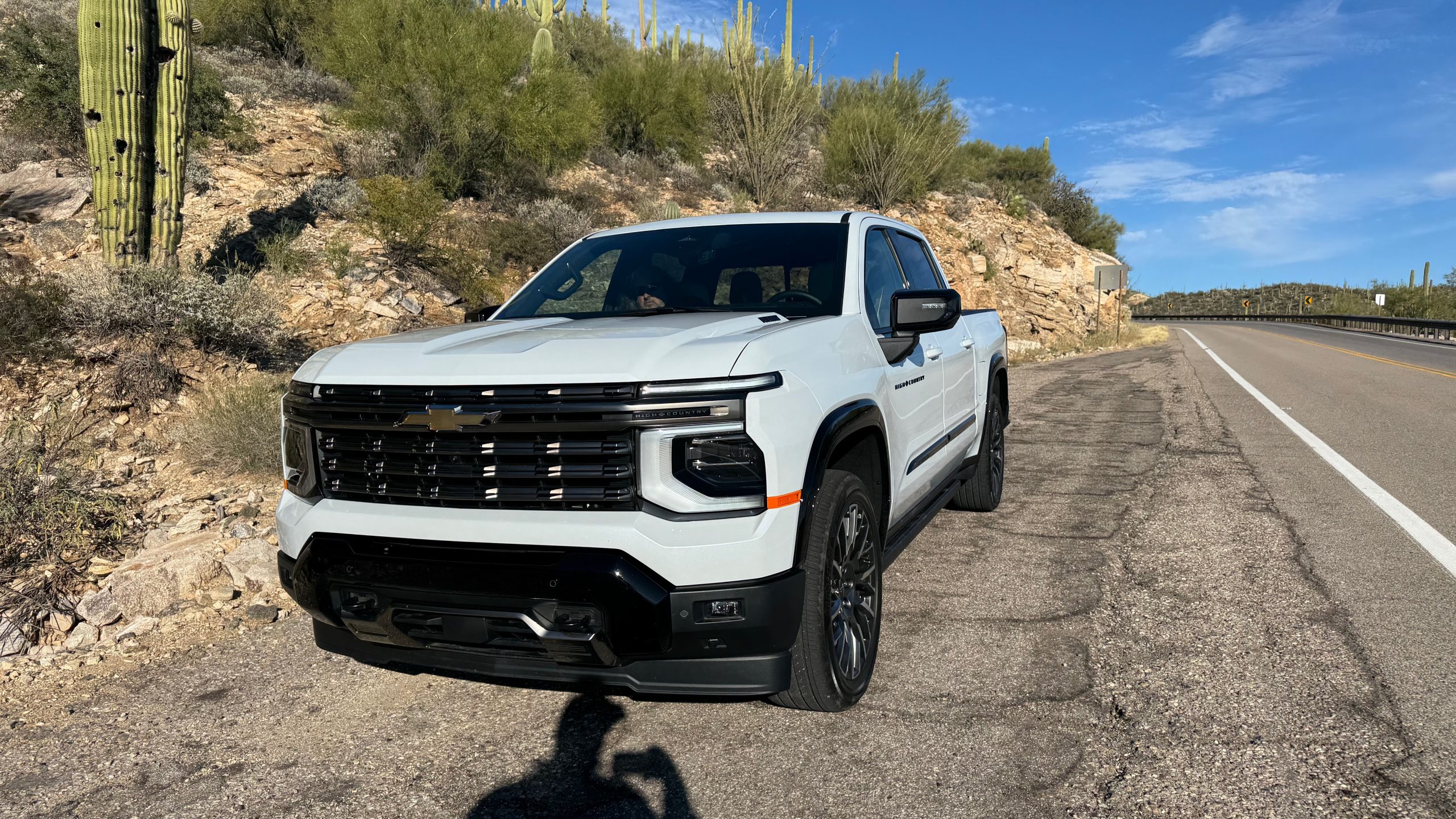
The gas V8s did a great job unladen, and if you’re not towing, they’re probably the move. But if you are towing heavy loads often, and especially if you’re at high altitudes, the diesel is simply amazing. Whereas the gas motors had to rev quite a bit to get up those mountains, the diesel felt like it was barely breaking a sweat. To me, in those conditions, that motor won me over, especially after Chevy told me that it basically costs the same as the 5.7-liter option (the base engine is the 2.7-liter inline-4).
The short of it is: These trucks are quiet, they ride fairly well, their interiors are high quality if a bit screen-y for my tastes, and the V8s are as epic as you hoped they’d be. But if you’re yanking trails in the mountains, it’s hard to beat a turbodiesel.
How Is The New Silverado Off-Road?

Another big change for 2027 is that the ZR2 trim gets 35 inch tires — a big upgrade over the 33s on last year’s truck. Not only that, but there are new drive modes and something I didn’t think I’d actually like but ended up loving: underbody cameras.

Those cameras allowed me to identify where my tires were, and make appropriate adjustments to ensure those huge tires were on the right line. Speaking of, I have to give credit to Chevy for choosing this particular trail, because it was not a bunny-slope; the brand clearly wanted to get journalists somewhat close to limits of their new truck’s capability:

As with any big truck, those limits are set by the big belly and rear overhang, though the ZR2’s ground clearance meant that rock scrapes were fairly infrequent on this trail, especially since those locking axles allowed the trucks to navigate the right line with precision.


Other than the belly and rear bumper, the front end was fairly well protected thanks to a good approach angle, though that front skid plate is a bit lower than I’d like and took a couple of scratches:

You can see the Multimatic DDSV dampers there and the new jounce dampers, though I won’t pretend to have experienced their greatness on such a low-speed rock crawling course.

If you’re curious about underbody protection, there are skid plates in most of the important spots, though — like many pickups — the fuel tank remains unprotected but tucked up above the frame rails.


It wasn’t just the lockers and the cameras, though, it was Terrain Mode. GM has done a phenomenal job dialing in this off-road mode, which allows you to precisely adjust the truck’s speed over the most technical obstacles. Typically, one would have to left-foot-brake while applying/modulating power with the right foot.
If you had to dip into the pedal to get over a big rock, for example, you’d often find yourself surging over that obstacle once the load on the truck was removed, hence the need for the left foot on the brake. But Terrain Mode just handles it all; even as you dip into the pedal and get up a rock, it knows not to surge the truck forward once up on the obstacle. This kind of thing is not easy to calibrate, and Chevrolet has done it perfectly on the new Silverado ZR2.

As one might expect from a relatively short-arm independent front suspension, the travel isn’t amazing, but the leaf sprung solid rear axle does a good enough job to make up for it, keeping the tires on the ground even on highly uneven surfaces.

It’ll never be a Wrangler, Bronco, or even a Colorado ZR2, because big trucks lack the most important ingredient of an excellent off-roader (favorable geometry), but the ZR2 uses well integrated cameras, Terrain Mode, lockers, and big tires to make the very most of its platform, and the result is a truck that can do go farther off-road than many might think.
The New Silverado: A Mechanical Evolution, A Tech Revolution

The new Silverado looks a bit different than the old truck on the outside, its engines are familiar but upgraded, the ZR2 model gets bigger tires and some minor upgrades, and the architecture is pretty much the same as the outgoing truck. But the interior tech is totally new, with tons of screens, a new infotainment system, a new steering wheel, a new shifter, and more.
I’d have to try the last-gen truck back-to-back with the new one to tell you whether I think the new interior is an upgrade. Though the storage is great, the Carplay integration seems intuitive, and the wireless phone chargers are legitimately useful, the lack of buttons isn’t ideal for a truck, and neither is the dainty shifter and the lack of a dipstick.
Still, even if I’m not sold on the cabin, the Silverado rides nicely, and its powertrain lineup more than makes up for any deficiencies, with the 3.0-liter diesel being my favorite engine in all of light-duty truck-dom right now, and the 5.7 and 6.6 following closely behind. Long-term durability and real-world fuel economy and performance will ultimately dictate where this new Silverado falls in the pantheon of truck greatness, but based on my drive, I expect these fantastic powertrains to propel the trucks to greatness.


When we talk about toxicity, it starts with comments like this.
Chevy flew me to Tucson, Arizona, put me up in the Four Seasons, fed me the biggest meal I’ve ever seen in my life, and generally tried to make sure I had a great time driving their truck. I did, but not because of the free shrimp. -DT
Well of course not! Once you experience Autopian discount shrimp by-the-wheelbarrow there’s no going back!