

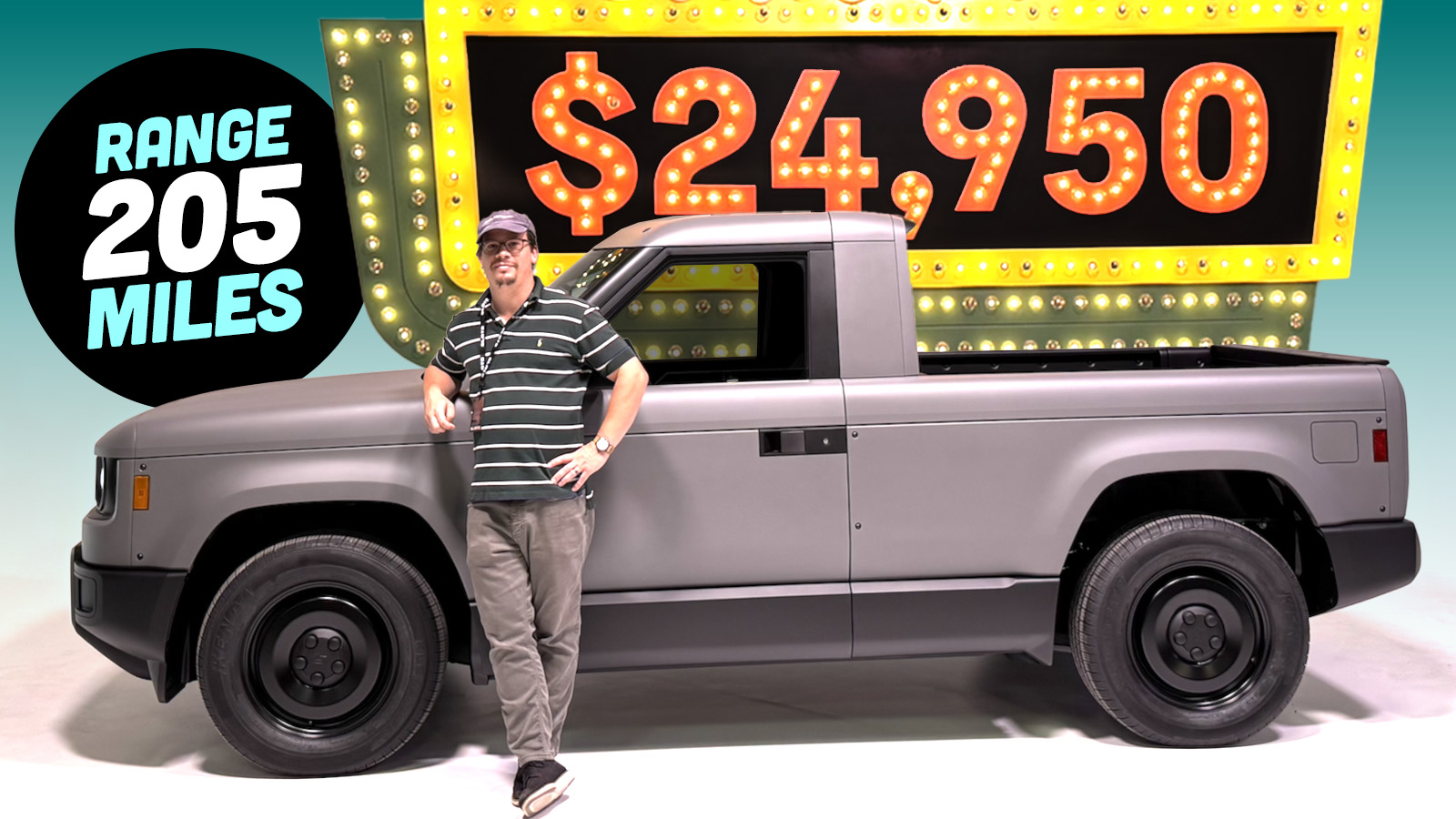
Obviously, I drove the new Slate EV, which is a big deal, but Slate also announced that its $24,950 electric pickup truck will not have a range of 150 miles, but rather 205. This bump, a result of a larger battery pack (and some small improvements in overall vehicle efficiency), leads me to a question: Does this change your opinion on whether the Slate truck — a regular cab, back-to-basics pickup truck with crank windows, no radio and no paint — is going to be competitive?
Two weeks ago The Autopian published exclusive photos of a prototype Ford Universal EV truck out testing in Long Beach. The images of the small four-door pickup that Ford claims will have a range of 300 miles and cost $30,000 got everyone talking about Slate, since it’s the other company with well-publicized plans to offer an inexpensive EV truck.


All this chatter led me to write the article “How Cheap Does The Slate Truck Have To Be To Be Competitive?” With that story having 249 comments and counting, it’s clear that people have opinions about the Jeff Bezos-backed (ish) EV startup, which is why it was such a big deal when, last week, The Autopian received a tip from someone who noticed an apparent error on Slate’s website. In the source code for the Slate’s “how to pre-order” page was this:
“26102SLATE_EXPLODED-HERO_v013_1400x800.mp4\”,\”contentType\”:\”video/mp4\”}}}]}},\”headline\”:\”THE MOST AFFORDABLE NEW \\\\nPICKUP TRUCK IN AMERICA.*\”,\”body\”:\”The Slate Truck has all the essentials for the CONFIDENTIAL price of $24,950 (reminder: we’re all still under NDA and prohibited from sharing this).**\”,\”cta\”:{\”metadata\”:
After giving Slate a courtesy heads-up, we wrote “The Slate Truck Will Cost $24,950 According To An Apparent Website Mistake.” In that story, we admitted that we had no clue if that leaked price was a legitimate mistake or Slate was playing some kind of game to perhaps surprise the world with a lower price later. It turns out, the answer appears to be “neither.”
Slate invited me to its headquarters on Monday, and though the company wouldn’t admit that it had something to do with that leak, I know a smirk when I see one. And what’s more, it turns out, the leaked price was real. Here’s a very cool display Slate had on hand at the Monday media event:

So yes, the $24,950 leaked price is legit, and while many of you likely already wrote your opinions of that price in the comments of our price-leak story, there was one crucial piece we were all missing: The actual range.
When Slate announced its truck about 15 months ago, it said the vehicle would come with a standard 52.7 kWh battery that would offer 150 miles of range or an upgraded 84.3 kWh battery, which would crank range up to 240 miles. Due largely to lopsided demand for the battery upgrade (which made justifying the added complexity of a two-battery option a challenge), Slate decided to offer a single, 65 kWh (63 kWh usable) LFP battery pack. Range for that pack? 205 miles. Top charging speed? 120 kW, or 20% to 80% in about 30 minutes.
Does this new range change the calculus for you?
On one hand, Slate initially promised this truck would be under $20,000. Then the tax credit went away, highlighting the risks of marketing around a volatile, highly political incentive. Still, even without the incentive, the truck was expected to be somewhere around $27,500. Now the price sans incentive is $24,950, and instead of the range being 150 miles, it’s expected to be 205. So, in a way, Slate is over-delivering.

But is it enough? If you compare it to other cars on the market, there are some vulnerabilities. The four-door, power window and radio-equipped Chevy Bolt costs $29,000, and it has the same battery size as the Slate. With its more efficient vehicle shape, it manages a range of 259 miles.

The Hyundai Venue is a gas car, but it’s got four doors, power windows, alloy wheels and standard wireless Apple Carplay/Android Auto — all for the low price of $22,650.
If you consider that, in order to seat more than two passengers, a Slate buyer has to choose the $29,950 SUV version (the hard top costs $5,000 on top of the base Slate truck), the financial cases become challenging to make. The Slate SUV costs about a grand more than the Bolt and $7,000 more than that Venue, and yet it’s not as well equipped as either.

But are these fair comparisons? The slate is a completely different animal than the Bolt and Hyundai Venue. Between its looks and its modularity, it’s just a much more fun proposition, and given how irrational car buying is, doesn’t that matter? Not to mention, for those who don’t need a second row or who need a 5ft truck bed, there’s no other game in town at this price point, gas or electric.
What do you think? Is the 205-mile, $24,950 Slate truck going to be competitive in the marketplace? What will be its biggest hurdles in reaching the company’s maximum production capacity of 150,000 vehicles per year?
[Edit: I just learned that the $24,950 price does not include destination fees, which Slate has yet to announce. So keep that in mind. -DT].
Top graphic image: The Autopian


It comes down to if you are willing to sacrifice some range and seats for the coolness factor.
Target audience is probably young adult or couple, no kids, maybe a dog. The Slate SUV at $30k is still a decent buy if you have no more than 2 kids out of car seats. 200 mile range is plenty, my EV has that, I never once wished I had more range for 99% of the driving I do.
I think these will sell a lot better than you think, I expect LA to be full of them.
Does an EV still get you solo carpool lane access in LA? CA? Or has that all been phased out? There were lots of people buying 1st and 2nd gen Priuses in the early to mid 2000s that would never have considered one otherwise only due to the free single person carpool lane access at the time that a Hybrid granted you. It was the magic ticket…and then when EVs came about and the car pool lane access changed to that it did a lot for EV adoption as well.
Not anymore
The two doors is going to be a very tough sell to most Americans. I can’t thin of any major autos that are two door with rear seats except Jeeps and Broncos, and how many of those configurations do you see on the road?
Getting over that 200 mile mark certainly changes the value proposition. That said, I do think some portion of buyers who care about range are going to see the new range as a reduction from the previous mentions of the large battery at about 250.
It would be enough for me, but I’d prefer a bit more for Christmas trips. I live in Boise, Idaho, my sister lives in eastern Washington, and there’s a couple sections of the trip that would be doable, but would make me nervous if anything came up to detour/delay me. From Boise to McCall is a 150 mile stretch with no charging stations (just checked plug share to verify).
And if it doesn’t have a heat pump, that just might not be enough for longer winter trips, especially with my partner, since she runs cold.
They are going to sell dozens!
I do see this being the darling of the urban delivery driver set. But I just don’t see how they can possibly sell enough of these to support the overhead of an entire company at these prices. $25K is still not cheap given the hairshirt nature of the thing, even in these inflationary times. And as noted, if you want/need a back seat, it’s another $5K.
Modularity has NEVER sold in the US market when it has been offered. People don’t really have that much imagination, other than things like Wranglers. And this sure as heck isn’t a Wrangler competitor.
You’re still doing this absurd “hairshirt” crap dude…it’s embarrassing for you
There might be some green peeps claiming things about this car, but I don’t think that word means what you think it means, dude
Hope mom’s Soul is still rolling well
I think he understands what “hairshirt” means and you don’t.
I had a hairshirt yesterday after my brother’s Australian Shepherd jumped on me
DOES THE SLATE COME WITH A DOG, BECAUSE THAT’S HUGE AND EVEN MORE SO DEPENDING ON HIS RANGE
Oh man, I’d buy like a dozen of them if it did
nope, gotta give ya a no on that one, dawg
Unless: are you seeing people taking about buying these for some sort of environmental benefit? I am not. Perhaps down the line, perhaps?
Minimalism and those that prefer it isn’t hairshirt stuff. Perhaps being a luddite?
I am quite confident that I know *exactly* what hairshirt means, both literally in a historical sense and figuratively when applied to a car.
Mom’s Soul continues to offer perfectly acceptable transportation for several grand less than this thing. Thanks!
The Slate was the only “new” vehicle I’d be interested in since the announcement of the $20k Ford Maverick that is now $27k. The Slate is now the single “new” vehicle I have interest in, and if I can find a way to scrape my pennies together for it, I’m going to get one.
I don’t really like or have a need for pickup trucks, but the Slate is the only new vehicle I’d even seriously consider buying.
Same. I’m seriously considering replacing my ’14 Mustang I use for commuting (now north of 190k miles on the clock) with one of these. For road trips we take the Expedition.
Honestly, I rent a car now for road trips as it is because it’s harrowing taking an entire family on a trip 4+ hours away in a 30+ year old car, so that aspect of my life wouldn’t change much. My commute right now is 140 miles a day, so during the winter it may take some planning (or an amazon diesel heater).
Marginally acceptable at best for the small cab. Anyone with the suv kit, in the winter, with resistive heat strips trying to warm up the entire large cabin and driving at highway speeds will probably opt for the ford EV with 300 mile range ( with heat pump?), 4 doors, and more standard features and options. A loaded slate with suv kit, maybe 150-100 mile range worse case?
At $20k it’s an affordable limitation, at $25k, maybe… at $30k, probably not.
At least they have the efficiency up over 3 miles/kWh. Wondering what the FORD will offer.
The smart move is to wait 2 years to see the real world numbers and what the competition cooks up.
The one thing that we will have to wait and see is if the $30k Ranchero and the 300mi Ranchero are the same vehicle. I can see the $30k truck having only ~200 or so mile range and that 300mi pack being an option that isn’t cheap.
Maybe but the reports are 300 miles under 30K. With proper aero, efficient battery and motor design (all done in-house from Ford I think) it’s more in line with today’s best tech.
Slate is relying on vendors for their motor and battery tech. I think they also went with a packaged charge-management system. Ford went in-house (and also, finally, is moving to a more efficient 48v sub-system).
300 is the new 250 these days.
Up until recently you could get a brand new Equinox EV with over 300 miles of range for well under 30k. Admittedly, that’s more aerodynamic than any truck will ever be, but it tells me that 300 miles for $30k is not unreasonable, especially with advancing battery and motor tech.
The range and the fact that it’s Lithium Iron Phosphate are a step in the right direction. You can treat LFP like crap and run it from full to empty. It also fares better in cold and hot situations.
I made a LFP based Razor pocket bike for my daughter in 2018. The guy who has it now still reports the battery to be unaffected range wise. Everything else has fallen apart though.
I’m still hung up on price and the bed length. If it’s 20k I can live with the bed…maybe. I realize I’m probably an outlier on use case.
I am curious though how this thing will do in Midwest winters being rear wheel drive. I would think with low center of gravity and decent tires it’d probably get around well enough.
get your sandbags ready!
Snow tires and modern traction/stability control go a long way toward making RWD livable in the winter. I’m curious if this (due to the battery weight and location) will have better grip at the rear wheels than an old RWD compact pickup and negate the need for sand bags
I think it’ll be good…kinda like the old VW bug. A good set of tires on one and you could go pretty well with the weight being in the rear. I looked around on Tesla forums to see what RWD guys were saying in winter conditions and a lot of them said a set of tires and you’re good.
Range is fine. I don’t anticipate this tempting anyone for their first EV tbh… I think it’s a little too out there. Previous EV owners know 200 is a good number. It won’t, however, convince anyone who might be cross shopping the cheap SUVs above or the Maverick and is on the fence.
If it weren’t for the need to do a long road trip every couple of months, 205 miles would be fine. But for my specific needs, the slow DC charging rate makes it a non-viable choice. If I were starting from scratch with zero cars, I could see a slate as an around-town and “do truck things” vehicle, and getting something else for the road trip needs, but I’ve got a truck already for truck things, and a nice car for road trips, and a small EV for daily driving. I’m looking to replace the road trip and daily driving roles, and this won’t do it for me.
I don’t know about competitive, but it’s enough for me. 150 mile range would make me “itchy”. This makes it great for a largely city use truck
I was really interested in this at the 240 mile range, but 205 hampers the usefulness for me. They released a screenshot that showed the Slate app and it would breakdown how much battery driving vs HVAC would use and because this isn’t a heat pump it was showing the HVAC system pulling 18% of the capacity! Granted this could be a “cold” start cooling down the cab quick situation, but double digits lost to HVAC is a massive YIKES especially with the range dropping to barely above 200 now.
Well being a LFP battery means that you have a similar practical range as that 240 mi range in a NMC battery. .9 * 205 = 185mi while .7*240 = 168 mi
Appreciate the insight. This would be my first EV (don’t count my electric motorcycle)
Note that range comp only really applies if you are charging at home. If you are using DCFC then it doesn’t make sense from a time stand point to charge to 100% as the charge rate drops significantly after 80%, though I’m not sure if it will drop as much as NMC batteries do.
If it’s an ‘honest’ 205 miles of EPA range, then yes, it should be fine for most people day-to-day… especially if it has a NACS connector and access to proper fast charging (defined as being at least as good as supercharging with an early Tesla Model S).
Of course there will be the odd idiot who will say it’s not enough because of the once or twice a year they do a trek across the country to “visit family” and they do it in one 12 hour drive and they “only stop for 5 minutes” or some other bullshit like that.
The range is totally fine. It’s the charge rate that kills it for me. TBH, the 140 mile range on my 500e is totally fine for 98% of my day to day needs. But I do take 600-1000 mile (one way) trips every couple of months. I’ve done about 13K miles in road trips since December, and have another 2K coming next week. So I’m only looking at EVs with 800V architecture anymore if I expect to replace both the leased DD and the long-distance car when the lease on the Fiat is up.
Yeah if you’re doing 13K miles in road trips per year, I’d say your needs are ‘above average’ and you’re not the target market for the Slate.
If they were serving a bare-bones pickup with 150 miles of range for $15-20K, I’d trade my gas-sucking pickup for it in a heartbeat. Because that’s just used for around-town stuff, like hauling bikes or kayaks, trips to the garden center, and the occasional motorcycle trailer. For that use case, charging speed is a moot point, since it’d just be level 2 charged at home when it needed it.
It won’t. According to what I can find, the early Model S charged at 150 kW. This will be limited to 120, which is painfully slow by modern standards. Even the Bolt charges faster than that now.
120kW charging still may be ‘good enough’ for a lot of use cases. It’s fast enough that it will be mostly charged over a 45 minute lunch or dinner break.
Probably won’t want to use this for regular cross-country trips but probably fine for the odd day trip.
But at least it does have a NACS port.
It has a NACS connector. But you can also get an adapter to CCS1 for about $70. They are software compatible. You won’t be able to charge at the oldest of superchargers, to my understanding, but nothing other than Teslas can. NACS is standardized around CCS1, not the other way around. The shape of the plug (and lack of dedicated AC charge pins on a NACS/Tesla plug) is no reason to buy or not buy an EV anymore.
Except for Leafs made until I think last year. Chademo is not something you will want in future (or now, really).
I think the range is okay my Polestar 2s real range at 90% is like 200-220 or so if I were to fully drain it on good weather days. I am actually more interested in the slate now seeing how customizable it is but I wouldn’t bite the bullet unless a 4×4/awd variant comes out as of now I wouldnt really want to deal with RWD in the Midwest winter.
The battery pack definitely changes the value proposition. Mainly because it is LFP meaning you could actually regularly use the majority of the range unlike most EVs where the practical range is ~70% of the stated range, assuming no or minimal climate control use.
However I still don’t think it is a good value. The whole DIY upgrades seemed interesting but the pricing for many of those items is just too high. The animated lights are particularly interesting. I just can’t see people spending $500 for animated tail lights for example, plus if you are doing those you probably want the animated lights for the front too.
SO many truck buyers are like: “I NEED it to tow a 7000 lb. trailer 1000 miles uphill with my 6 kids in it on a single charge or NEVER”
I still think is needs to be the cheapest new vehicle on the market to get people to consider it.
At this point I would take the Venue.
If this was at $20k I’d be putting in a preorder. It’s a perfect commuting / weekend runabout. I much prefer throwing my fishing kayak in a truck bed, although I would like a 6′ long bed and the regular cab makes it a bit tough to keep the rods inside..
That is what those rack mounted hard tube rod carriers are for. 🙂
Yeah, I’ve got a rod box.. used it for a season along with a bed rack on my current truck, but even just the rod box kills my highway MPG. Really tanks if I throw my kayak up there. So I’ve gone back to just putting the kayak in the bed and the rods fit fine in my extended cab.
not really for me. it is a start though. The extendo roof and extra seats need to be nearly free, and easy to place and remove as needed. also the RWD only ends it for me. I don’t want RWD in a slow truck in the midwest.
Why do writers hate tables and spreadsheets? I know you need to write an article, but a damn table at the end would be ideal here…
General math phobia? But the engineers turned writers should like tables.
Counterpoint: tabular data sucks, is difficult to make quick inferences from, and provides neither the additional context in the prose nor the understanding from a chart.
What chart type compares all of these values:
Oh, that’s like five different charts? Yeah, just make it a table.
That standard features column is going to be a formatting mess. The vehicles listed don’t all conform to those categories. You’re missing categories that are listed in the copy above. I still maintain: tabular data sucks and is a last resort.
I don’t hate tables…
Not a Buffalo Bills fan, huh?
I prefer TV trays myself.
It begs the question on what price we’d be able to achieve if someone put this kind of effort into making a bare bones 4-cylinder pickuptruck instead of an EV.
Has Ford/GM/Chrysler been holding back on us? Yeah, I’m sure they did.
If it could match this one in price I guess it could become a success. Keep in mind CAFE standards have been the biggest force against small trucks for over a decade.
A hypothetical regular cab, 6 ft bed Ranger, Tacoma, Colorado or Frontier with an avg. 63″ track and 110″ WB would need to hit at least 28 MPGs combined. Automakers would probably need to put a small 4 cyl turbo with an 8 to 10spd auto to achieve that which would affect the price tag and would no longer be a simple, easy to work on powertrain anymore.
Price tag is now north of the mystical mid-$20K price tag. Economies of scale would no longer save them money if they go with crank windows and manual locks as they would need to create new door cards, new cranks and the related tooling for them.
Pretty much no one has kept a simple, high displacement naturally aspirated 4 cyl in their lineup. Current midsizers achieve low 20s combined on a good day.
Not to say it’s not possible but unless they sell more than enough units to offset the investment it becomes a difficult proposition.
I don’t think you’re wrong as the CAFE rules were self-written to create bloat.
The Ranger/Taco/Frontier represented the pent up demand for the Maverick – a small(er) truck.
But even the Mav isn’t tiny, nor is it devoid of frills. It could just be, but it’s not. And that would be too low-margin; just think of those poor shareholders if you were to sell lower margin products.
My take: the general compromises of a single cab small truck will hamper sales. If they could get the number to $27,500 for the SUV options I think they’d have a better chance but as it sits those start at $30k. At $30k options begin to open up.
Is the 205-mile, $24,950 Slate truck going to be competitive in the marketplace.
No. Probably even hell no.
We’ll start with the obvious that the 205 mile range is probably going to be closer to 140 miles in real-world use. But only for a few years when the truck is new. Then the range will be closer to 120 miles. Then 100. Bad start.
We also know that buyers buy based on what they need 2% of the time. They might drive 20 miles most days, but if they take a road trip to a location two towns over once a month, they expect their new vehicle to be able to take them their conveniently (which, I might add, is not an unreasonable expectation). Which this thing can’t.
Also, I need to rant again about the price of this thing. $25k is a lot of money for a vehicle with limited range and no features. Most people won’t be a used 2G Leaf for $12k, and that has the same range and all the modern tech toys the Slate doesn’t have. And people like tech toys, even if those of us in The Autopian peanut gallery don’t.
And, no one is going to buy a $25k Slate. Everyone is going to add several thousand dollars worth of silly customization features. These are then going to be $35,000 limited-range, uncomfortable trucks. I’m skeptical anyone will want a bare bones Slate for $25k. I know people aren’t going to want a $35,000 bare-bones SUV with a brightly colored vinyl wrap.
Misanthropic Stig is not impressed.
Misanthropic Stig is also completely… right.
Real People don’t want to drive a penalty box. Only do if they can’t afford anything else.
And they will see the Slate as a penalty box, fair and square.
And yet, millions of people willingly drove ‘penalty boxes’ over the years with vehicles like the Mitsu Mirage, Chevettes, Ford Festivas, Type 1 Beetles and many other “cheap and cheerful” vehicles.
Hell… I’d take this Slate truck any day over the derpy looking Ford Ecosport with that stupid 1L Ecoboost with the wet timing belt and wet oil pump belt.
Yes once upon a time there were people who used to drive hair shirt vehicles and considered it a badge of honor. Unfortunately I don’t think many of those types of people are left.
I’m not sure there were that many of those people to begin with.
A lot of people love their cheap, basic vehicles because it is what they can afford. When these buyers can afford something better, they usually buy it.
Agreed there weren’t that many back in the day and even fewer now. That said back in the 70’s and early 80’s I knew more than a few people who had that hair shirt commuter car even though they could afford to spend more. They just saved that extra money for the family/wife’s car. My Uncle who was an engineer for NASA had Cadillacs for the family/wife while he drove a Beetle that rarely moved on Saturdays or Sundays as he would be driving the Cadillac.
Yeah, I do recall a time when some people had a “nice” car in addition to a cheap commuter.
I think that largely went away because cars became more reliable and last much longer. It is easier to justify commuting in a nice car if said nice car can be reasonably expected to last 200k miles, unlike older “nice” cars that were still expected to become junkers before 100k.
Good point about increased vehicle longevity having an impact. When you can expect to be able to get much more than 100k out of a vehicle buying a used car seems much more palatable to a lot of people.
Well you can’t buy what isn’t available.
One other thing though… many of those vehicles were bought by people like me who liked having an efficient daily driver.
With the advent of the modern hybrids and BEVs, it has turned things upside down.
It used to be that the most expensive vehicles were the least efficient.. and the cheapest were some of the most efficient.
But in the 2000s, the expensive hybrids and the BEVs that came after became the most efficient. That, in turn, has hurt the sales of the traditional basic manual small car… like the Honda Fit I previously had… which was replaced with a C-Max Energi plug-in hybrid
Eventually the vast majority of vehicles will be BEVs and things will eventually go back to ‘normal’ where the smallest/cheapest vehicles (which will be BEVs) will also be the most efficient
On the subject of my C-Max Energi.. it’s the most luxurious vehicle I’ve ever owned. But I bought it for the efficiency and lower maintenance.
But I find many of the luxury features to be annoying and I’d rather not have them… things like the stupid power liftgate, the stupid glass roof and the stupid rain-sensing wipers that work very inconsistently.
Current Dacia Sandero and Citroën C3 base versions have manual rear windows. I wouldn’t be surprised if they don’t survive another generation unless the take rate justifies it.
It doesn’t matter what you and me buy. What matters is what the general public wants. And it is not manual windows and no central locking.
It is the same reason why manuals are dying. Nobody wants to shift gears themselves.
“Current Dacia Sandero and Citroën C3 base versions have manual rear windows”
Which are both not available in North America… and I’m writing from the Canadian/North American perspective.
“It is the same reason why manuals are dying. Nobody wants to shift gears themselves.”
There are plenty of people that enjoy shifting gears… people like me.
However, hybrids and BEVs (along with better automatics in general) are a big part of the reason why manuals are dying.
Getting the manual used to be the best option if you wanted performance with better fuel economy. And there used to be a big performance/economy gap.
But that isn’t the case anymore.
In my day-to-day real-world driving, my C-Max Energi plug in hybrid uses 40-50% less fuel than the manual 2008 Honda Fit it replaced.
But I miss shifting gears and when the day comes that I need a 2nd vehicle, I’ve been toying with the idea buying a used manual Honda, Fiat 500, manual JDM Kei car or something like that.
The geographical perspective doesn’t matter in this case, the general concept still stands true here or in America. Humans like comfort and ease of operation.
There can be exceptions, but in general it is true. If it wasn’t you would be driving emission compliant 1960 Falcons and we would be driving emission compliant 1948 2CVs.
In my dreams we can buy brand new ‘65 Pontiacs with modern safety features and 389 V8s with 4-speeds. Someone get working on it!
W123 Benzes would also be available. No need to subject our European friends to 2CVs.
The Slate does come standard with power locks, but if you want a remote for them that is extra.
My wife and now my daughter love the hands free lift gate on the C-Max. My wife will no longer accept a vehicle w/o a hole in the roof.
Yes the auto wipers on that generation of Ford could be wacky from time to time. The good news is they have gotten much better as I’ve only had a couple of times where they didn’t work as expected on our Escape PHEVs while it was much more common on our C-Max Energi and MKZ Hybrid.
they’re still out there. But they pay 4 figures for their vehicles. $25K and up is not really affordable for many
I don’t think they did “willingly”. Just nothing else they could afford. People like features and convenience. If that wasn’t the case and there was a real business case, all cars today would have crank windows, manual steering, no aircon and no mobile connectivity.
Yup, when I was a penniless grad student, I schlepped around in my penalty box with manual windows (it had aircon though!). First proper paying job I ditched that for something fun and comfortable. Life is too short to willingly drive uncomfortable, unfun cars.
Which is why the Sandero is a great idea in theory, but if you can afford something else, you will. You don’t want to be in a crapwagon after working hard all week.
“I don’t think they did “willingly”. “
Sure they did. For example… Me. I drove ‘penalty boxes’ for decades because I deliberately wanted/want a vehicle with a lower TCO so I can have money available for other things.
” People like features and convenience. “
I have a C-Max Energi now and I find some of the features to be more annoying than useful and I wouldn’t spend a nickel on them. I only have a vehicle with those useless features because it came with it… useless crap like the glass roof, inconsistently-working rain sensing wipers and a power liftgate that makes me long for a regular non-power one.
“and no mobile connectivity.”
Oh thanks for reminding me of another useless feature I wouldn’t spend a nickel on… When I bought my C-Max, they called me and tried to get me to sign up for that… to which I refused. I have all the mobile connectivity I need in my cell phone. I don’t need a duplicate connectivity in my vehicle. And if I need a software update, I’ll just connect the vehicle to my home wifi.
I am sure you do, don’t get me wrong.
But there’s a much larger market out there.
I have a friend who likes cars, but that for personal circumstances traded an NC MX-5 for an Audi A3 about a year ago or so.
He is amazed at how much more convenient his new car is. And I am not talking about practicality. I’m talking NVH, equipment, etc.
I can tell you he is not going back to his Mazda. He has realised convenience and features bring.
“I can tell you he is not going back to his Mazda. He has realised convenience and features bring.”
So your friend has gone soft. LOL
The market *is* soft.
I disagree. First, this will be a third vehicle for most buyers. Don’t go electric for your one and only. Second, electric vehicles from the last 6 years or so do not drop in range like the first Leafs.
Normal usable range is 80-30%, so 100 miles, 60 in the winter with the resistive heat cranked up in the midwest. Plenty of range for the third vehicle, the fun runabout that runs into town for a few things, gets parked outside, tight turning radius, drive it out into the yard to pick up sticks, same as keeping an old S-10 around but without oil changes and never having to visit the gas station.
Cheaper than the old S-10? No. More convenient? Oh yeah.
“Cheaper than the old S-10? No. More convenient? Oh yeah.” That is the problem with this being a 3rd vehicle. If you only use it a couple of times per month and never take that far that old $10k or less compact truck leaves a lot of money to buy a lot of gas and oil changes.
$25k (again, bare minimum) is a lot of money to spend on a third car. Are people really going to want a $400+ car payment for something they occasionally drive in the yard to pick up sticks??? You can justify that with an old S10 that is no longer depreciating and costs peanuts to insure, but not with a new truck.
Yeah, new EVs don’t have have the same battery degradation as old EVs, but the batteries still lose capacity over time. Also, even if they don’t degrade, 60 miles of winter range is unacceptable for anything other than a golf cart.
How many people have a third car actually?
Also, even if true, what is the volume of that market? Can a business case be built on it?
I have five, but realistically, most of them are toys with one daily driver. It is easy to justify having a classic or a toy that is parked most of the time. I don’t think the same can be said about something that costs $30k and is depreciating. That may be cheap by modern new car standards, but $30k is still a lot of money.
Plus, you made a good point above about these being viewed as penalty boxes. The Slate strikes me as a vehicle a lot of people will be excited to buy, but these people might be far less enthused about living with it.
The idea is great, but the reality might be less nice to it than the theory.
Also this is no Lotus Elise…
Yeah, call it yelling from my ivory tower, but people with third cars should not be making payments on that car. I’m talking old fellers like myself who can pay cash for a convenience car. And I have a good dozen cars lying around. Most of them run. I don’t always want to jump in one of my more unique cars to run into town, get door dings at the grocery store, yada yada.
All that said you do bring me to a good point, there aren’t enough cash customers wanting a convenient extra little truck around to sell enough Slates for them to make it.
Personally I currently have a hybrid Clio (my everything car) and I am considering an MX-5 as a fun car companion. A third car would be hard to justify, store or even maybe afford.
Through the magic of US Census table B25044—and Google Gemini to find it— 29 million US households (22%) have 3 or more vehicles.
That is quite impressive. I am sure that statistic in Europe is significantly lower.
It varies a fair amount between US states. In DC (not actually a state and entirely urban) only 5% do. New York state is 14% and the rest of the northeast (Jersey, Massachusetts, Rhode Island, etc] is around 18%. Rural states like Wyoming, Montana are around 32%. But because of population size, that’s still 1 million households in New York state.
All of that to say, go get that MX-5!
Some ChatGPT search says that figure is between 5-10%. And under 8% for Spain.
I am very seriously considering the MX-5.
And how many of those have 3 or more drivers in the household? I fit into the or more category but I’m not buying new for anything other than our daily drivers. Trucks and Toys were all purchased used, or well used.
Can’t say how many drivers per household, but table B08201 says of 29 million 3 or more vehicle households, 19.8 million (68 %) have 3 or more people.
Also note this just pertains to vehicles kept at the home for personal use, not including motorcycles. It does distinguish owned/leased or new/used.
OK, I argued it all wrong. In the midwest how many people have two cars and a side by side? Midwesterners in small towns drive their side by sides to town, get groceries, cruise the park, all the stuff we used to do with our extra old truck. And we never actually need 4×4. The Slate for midwesterners is a street legal crash tested efficient side by side. Price parity!
We have a third vehicle, but it’s a toy (my Sunbird). The other two (my wife’s minivan and my Mazda6) must perform daily driving duties and kid-hauling jobs. Eventually, though, I will inherit my grandpa’s base model 2WD 2014 Toyota Tacoma regular cab/short bed. It’s basically a gasoline Slate.
The $24,950 Slate Truck Now Has A Range Of 205 Miles. Is That Enough To Make It Competitive?
Yes…at $18k OTD nicely equipped.
I’m loving the “Price Is Right” signboard.
Thanks for showing us something new!
And yeah – 200 miles for running errands, hauling mulch, commuting to work and jaunts to the weekend place where you can recharge before you come home is totally fine.
Has any vehicle since the site’s founding had so many articles published about it?
I get that it’s new and different but it feels like everything that can be said about it has already been said, and the vehicle will either succeed or fail based on criteria that most commenters on the site don’t consider when buying for themselves.
I’ve got Slate fatigue.
How quickly you have forgotten the Cybertruck era…
Someone can do a count of articles, but I’d venture more has been written about the Slate *by the authors* than anything else.
The CT had extensive and angry arguments in the comments.
Honestly, I’m just glad that DT has moved on from rusty old Jeeps.
One of these days he’ll start on his overlanding Jeep/kitten habitat with the holy grail spare tire carrier. It will likely be kicked off with an article exclaiming he only has ____ weeks to complete the build before driving it to ____.
“How quickly you have forgotten the Cybertruck era…”
Not to mention the many MANY articles on Elon Musk as well as the Model S when it came out in 2012.
More Cybertruck articles!
kidding people, relax.
2CV
Ford’s mini pickup/modular-EV has lots of time to catch up.
This site gets a bit excited over anything that resembles a small pickup truck.
I liked it when they featured the Scout upcoming EVs.
But they have suffered from repeated delays so I’m not too optimistic about those, either. Although from all the upcoming EVs those are the ones I’d like the most to succeed
Then skip the articles? Why do people forget that they don’t have to participate…
Because it is hard to control pedantic know-it-all-ism? 🙂
Because I pay for the site and the authors read the comments?
Curious why you don’t think that constructive feedback on the articles is something members should provide.
“Because I pay for the site and the authors read the comments?”
Well I pay too. And now I’m gonna say… I want more Slate articles… JUST TO SPITE YOU!!!
BUAHAHAHAHAAAAAA
I mean, there must be a demand for them. I just don’t think we’re breaking any new ground with any of these.
I don’t begrudge anyone voicing their opinion, even if it’s different than mine….after all what else are comment sections for?
Well, I stopped clicking on the Jeep articles months ago….
…and anyone who runs a website and does any online marketing can see where the clicks go –
And where they don’t.
I’m not sure I would call that “constructive”. Constructive criticism should be able to be used to improve upon. The only “out” you have given them is to run fewer Slate articles.
Going by engagement, that’s not an improvement.
My wife’s infernal Scion iQ is definitely high on the list. 🙂
I mean, the only way this thing could be more Autopian is if it were a brown manual diesel wagon. They’re going to sell dozens to Autopian members…and none to anyone else.
I have no interest in one and fully expect it to fail hard, but I do still find it interesting. I am extremely over the guerilla marketing they keep doing though. At least it’s being called out in the articles, I guess.
I’d put down a deposit tomorrow if it had a diesel engine. I don’t care what kind of transmission. Give me a JATCO CVT for all I care.
JATCO, Smarts, you really are a glutton for transmission punishment. 🙂
I mean, would you rather they write about the Aptera every other day?
Sometimes there just isn’t a lot going on in the Automotive world and in the grand scheme of things, a new car company being pushed by very high visibility backers IS news.
I’d rather a better balance in coverage, there have been 10x the articles about Slate vs the new Silverado for example, which is by any measure the more important debut.
I understand they need to follow the engagement, and maybe Slate provides it. If so, I guess I don’t begrudge them writing about it over and over. But so many seem to take it personally that I’m voicing this, as if suggestions for different coverage is outside the bounds of reasonable comments.
I think it has to do with a print source vs online. Most of the people here are aware that th Silverado will sell more trucks in a day than Slate will sell in a year. Most truck buyers are brand loyal so they might be interested in the changes but they might also get that info from a car specific forum. Truck buyers who are not brand loyal will probably pick up a traditional print like consumer reports and read the paragraph or so comparison between trucks.
As a website dedicated to vehicle enthusiasts, many people are interested in the new or significantly different for the sake of learning about something new and significantly different. For the most part, we are not in the market to buy a car, we are in the market to learn about and enjoy cars/vehicles in general. I already know how the Silverado gets built so its not interesting, but a factory tour of someone doing something new is interesting.
Also, sorry if my comment came across too harsh. I follow another general tech website that covers that Aptera at least once a week so it was meant as a reference to another site and not meant as a dig toward you, sorry about that.
The one battery explains the one sku the new CEO was talking about a month or so ago. I was sort of confused when he said that. I would imagine most use cases for the slate will be around town maybe stretching to exurbs. 200 seems enough to do that. Will probably always be someone with range anxiety until charging is truly perfect and everywhere. But why make a cheap vehicle more expensive based on someones anxiety.
It won’t be enough. But the real number that matters is, how does the range do at 70mph in the motorway with aircon or heater on and going from 100 to 20%? Because that’s the real range figure.
Also private buyers will no doubt choose the Chevrolet or Hyundai because they prefer the amenities. And power windows.
For fleet use it’s a pretty fantastic range
Yep. Urban fleets will be all over this.
Around me are a lot of fleet Ford F-150 Lightnings, and generally they’re very happy with them. For them a “long” trip would be 40-50 miles one way (most trips 5-20), so they have more than enough range for them, crank the AC during summer, the heat during New England winters, and still run tools and be fine.
I specced one for fun, and even with sales tax and fees it would’ve been sub-$29K. For an upstart company not yet producing in large volume that’s reasonable.
What’ll really make or break it are any teething issues, and reliability. For the long haul, repairability and parts availability will matter much more. If those latter issues get covered, it has a real chance in the marketplace.
EDIT: Oh, if anything will be truly make or break, it’s seat comfort. Even at ‘cheap”, people don’t tolerate uncomfortable seats or terrible ergonomics.
All of the Smyth Auto Parts fleet cars, pool companies, golf courses, utility/ISP companies, so many fleets can use small trucklets that don’t go beyond a 100 mile radius
Even at ‘cheap”, people don’t tolerate uncomfortable seats or terrible ergonomics.
This is true only for the driver though. The dog is fine with whatever the passenger seat has to offer and kids don’t matter, they’re cargo in the bed.
200mi rated, 100mi real-life would be more than adequate for urban: lawn maintenance, painting contractors, company electricians, Amazon deliveries…
Especially if the truck can charge battery electric tools between jobs.