

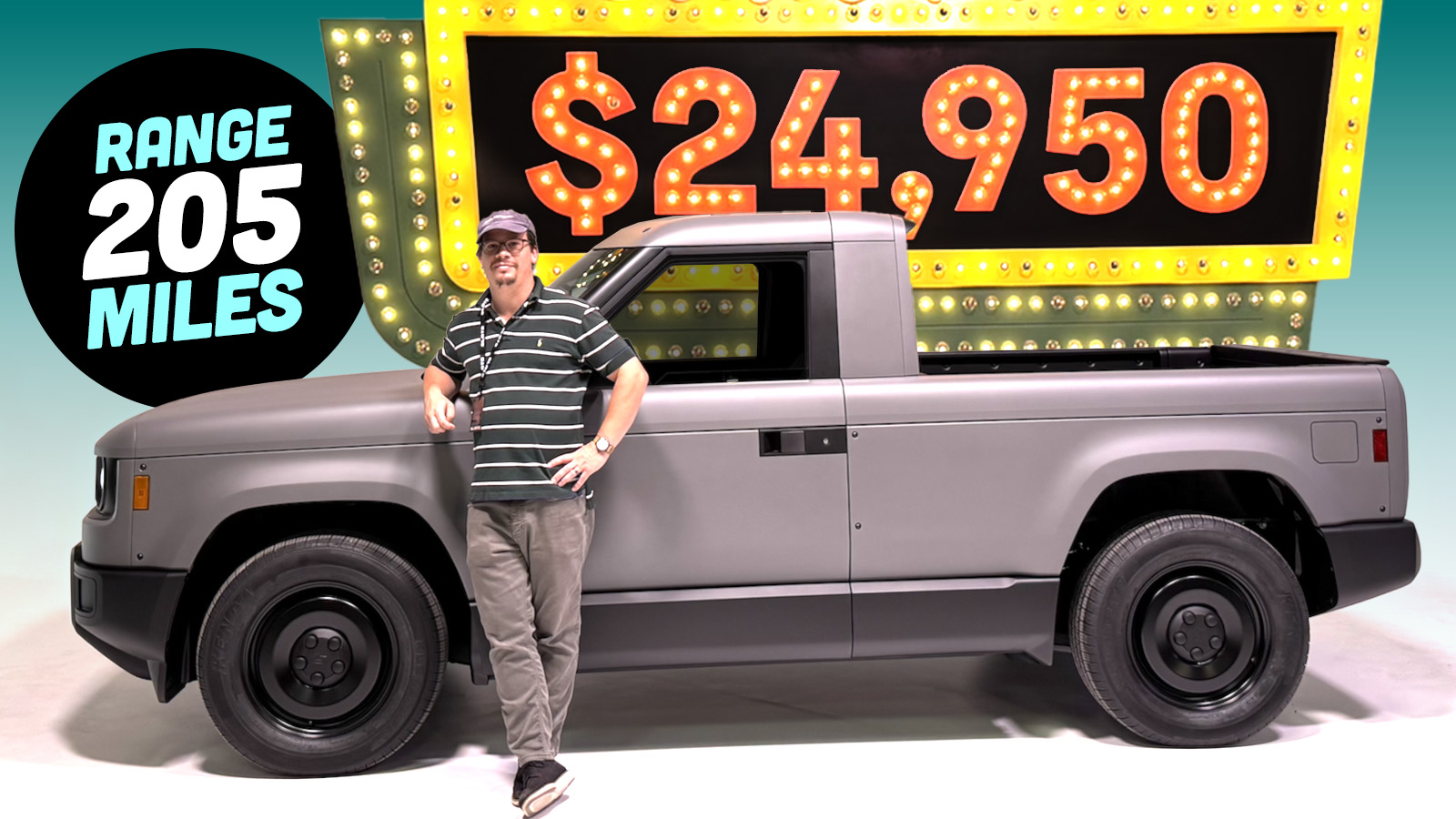
Obviously, I drove the new Slate EV, which is a big deal, but Slate also announced that its $24,950 electric pickup truck will not have a range of 150 miles, but rather 205. This bump, a result of a larger battery pack (and some small improvements in overall vehicle efficiency), leads me to a question: Does this change your opinion on whether the Slate truck — a regular cab, back-to-basics pickup truck with crank windows, no radio and no paint — is going to be competitive?
Two weeks ago The Autopian published exclusive photos of a prototype Ford Universal EV truck out testing in Long Beach. The images of the small four-door pickup that Ford claims will have a range of 300 miles and cost $30,000 got everyone talking about Slate, since it’s the other company with well-publicized plans to offer an inexpensive EV truck.


All this chatter led me to write the article “How Cheap Does The Slate Truck Have To Be To Be Competitive?” With that story having 249 comments and counting, it’s clear that people have opinions about the Jeff Bezos-backed (ish) EV startup, which is why it was such a big deal when, last week, The Autopian received a tip from someone who noticed an apparent error on Slate’s website. In the source code for the Slate’s “how to pre-order” page was this:
“26102SLATE_EXPLODED-HERO_v013_1400x800.mp4\”,\”contentType\”:\”video/mp4\”}}}]}},\”headline\”:\”THE MOST AFFORDABLE NEW \\\\nPICKUP TRUCK IN AMERICA.*\”,\”body\”:\”The Slate Truck has all the essentials for the CONFIDENTIAL price of $24,950 (reminder: we’re all still under NDA and prohibited from sharing this).**\”,\”cta\”:{\”metadata\”:
After giving Slate a courtesy heads-up, we wrote “The Slate Truck Will Cost $24,950 According To An Apparent Website Mistake.” In that story, we admitted that we had no clue if that leaked price was a legitimate mistake or Slate was playing some kind of game to perhaps surprise the world with a lower price later. It turns out, the answer appears to be “neither.”
Slate invited me to its headquarters on Monday, and though the company wouldn’t admit that it had something to do with that leak, I know a smirk when I see one. And what’s more, it turns out, the leaked price was real. Here’s a very cool display Slate had on hand at the Monday media event:

So yes, the $24,950 leaked price is legit, and while many of you likely already wrote your opinions of that price in the comments of our price-leak story, there was one crucial piece we were all missing: The actual range.
When Slate announced its truck about 15 months ago, it said the vehicle would come with a standard 52.7 kWh battery that would offer 150 miles of range or an upgraded 84.3 kWh battery, which would crank range up to 240 miles. Due largely to lopsided demand for the battery upgrade (which made justifying the added complexity of a two-battery option a challenge), Slate decided to offer a single, 65 kWh (63 kWh usable) LFP battery pack. Range for that pack? 205 miles. Top charging speed? 120 kW, or 20% to 80% in about 30 minutes.
Does this new range change the calculus for you?
On one hand, Slate initially promised this truck would be under $20,000. Then the tax credit went away, highlighting the risks of marketing around a volatile, highly political incentive. Still, even without the incentive, the truck was expected to be somewhere around $27,500. Now the price sans incentive is $24,950, and instead of the range being 150 miles, it’s expected to be 205. So, in a way, Slate is over-delivering.

But is it enough? If you compare it to other cars on the market, there are some vulnerabilities. The four-door, power window and radio-equipped Chevy Bolt costs $29,000, and it has the same battery size as the Slate. With its more efficient vehicle shape, it manages a range of 259 miles.

The Hyundai Venue is a gas car, but it’s got four doors, power windows, alloy wheels and standard wireless Apple Carplay/Android Auto — all for the low price of $22,650.
If you consider that, in order to seat more than two passengers, a Slate buyer has to choose the $29,950 SUV version (the hard top costs $5,000 on top of the base Slate truck), the financial cases become challenging to make. The Slate SUV costs about a grand more than the Bolt and $7,000 more than that Venue, and yet it’s not as well equipped as either.

But are these fair comparisons? The slate is a completely different animal than the Bolt and Hyundai Venue. Between its looks and its modularity, it’s just a much more fun proposition, and given how irrational car buying is, doesn’t that matter? Not to mention, for those who don’t need a second row or who need a 5ft truck bed, there’s no other game in town at this price point, gas or electric.
What do you think? Is the 205-mile, $24,950 Slate truck going to be competitive in the marketplace? What will be its biggest hurdles in reaching the company’s maximum production capacity of 150,000 vehicles per year?
[Edit: I just learned that the $24,950 price does not include destination fees, which Slate has yet to announce. So keep that in mind. -DT].
Top graphic image: The Autopian


205 miles is fine as long as you don’t intend to tow anything, which will reduce the range to something that is difficult to work with.
I think 205 miles is fine for an around-town or commuter vehicle. My commute is 120 miles a week total, so it would be great for that. I would need to charge it at least once a week or so.
Even if you’re road-tripping stopping every 2.5-3 hours to charge isn’t a bad rest stop interval anyway.
I just watched David and Griffin’s video on the preproduction Slate walkaround/testdrive (nice work guys!) and a couple others on Youtube.
I have to be honest and admit: this thing looks better and more desirable than I expected. By a fair margin.
Truck guys (especially big domestic truck guys) won’t be into it, but the Slate is essentially an EV city car dressed up like a minitruck/small SUV with enough range, speed, and cargo capacity to suffice for daily use and weekend warrior tasks.
I can’t even articulate my disappointment that this thing won’t start at $20K as originally envisioned, but of course, that’s beyond my control. If it were $20K (I don’t think I’d qualify for the federal tax credit anyway… wish they’d just make those regular copays/incentives) I’d literally be using my deposit/place in line to place an order NOW.
So many kudos to the Slate people re: making it easy to wrap (someone quoted regular full-body/single-color wraps somehow only costing $500-700) and keeping it truly minimalistic/modular overall. I LOVE being able to add power windows/speakers/bed cap LATER if/when I want ’em, rather than having to decide/commit/spend for them at the time of purchase.
I look forward to seeing how the production Slates turn out… the whole removable midgate thing gives me a little unease (in all such designs) re: flex/rattle/leaks and of course I’d want to know crash test results before buying one.
But Jeez… this looks to be an extremely decent and desirable small EV in an appealling boxy/utilitarian package. At $25K I’ll be patient. At $20K I’d have already placed my order for a base Slate with a forest green wrap, JBL bluetooth speaker, and power windows.
What a promising vehicle… I’m really impressed and pleasantly surprised. 🙂
The problem with this is it would need to be a 3rd vehicle in my household, it can’t replace my V8 pickup for towing the boat or camper, it can’t haul my kids around, so it would be to work and back, but then why sacrifice literally all features just to have a small bed? Especially with a 120 mile effective range (80-20%), let alone closer to half of that in the winter months here in Michigan.
I’m sure there are corner cases where this can useful, especially in cities, but it’s a long way from meeting the needs for most rural folks