

Affordability remains a big issue for many Americans, and no issue at all for a smaller subset of them. There’s an awkwardness to this, as the economy can be measured in certain ways that imply things are fine, but it doesn’t feel that way to most people.
What’s a good measure of this? In terms of mass affordability, something cheap like a Big Mac works. For more nuance, the price of a full-size truck might be better? The Morning Dump aims for accurate representations of economic trends, but failing that, will settle for fun comparisons.


Clearly, the President is also worried about affordability, and is headed to Michigan to make the point that things are fine. Will people believe him? GM CEO Mary Barra says that the company’s shift to EVs was also fine. Will people believe her? And, finally, Scout argued that it was a separate company and therefore could sell directly to customers in Colorado. Dealers said they couldn’t. Guess who the board believed?
Full-Size Truck Transaction Price Hits $66,386 In December
Am I hungry? I might be hungry, because for some reason when I read Kelly Blue Book’s latest report on Average Transaction Price (ATP) I thought immediately of hamburgers. And not just any hamburger. A Big Mac. There’s something about the Big Mac that feels like a good measure of pricing, in that its inputs are both essential agricultural goods and rent/labor. You can also get one almost anywhere.
Full-size trucks are also available everywhere, and they, too, have numerous expensive inputs. The difference between a hamburger and a full-sized truck is that most people who buy a truck could probably save a huge amount of money by buying something smaller or less-featured, whereas a Big Mac is an effective way to get a lot of calories at a low price (it’s neither the most efficient nor the healthiest, but it is calorie-laden).
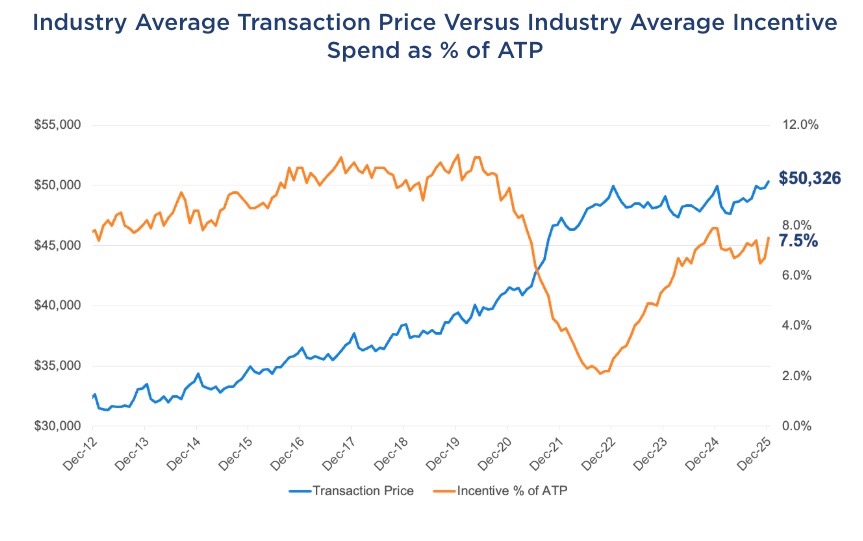
In that way, a truck represents both a necessity for some (work, transportation) and also a somewhat premium good. No shock, then, that the industry ATP reached a new record high of $50,326 overall, given how strong truck sales were:
Strong sales of full-size pickup trucks also pushed the ATP higher last month. With more than 233,000 full-size pickups sold, December was the best month for the segment in five years and the sixth best in the past decade. The average price paid for a full-size pickup in December was $66,386, slightly below the record set in October 2025. In December, combined revenue from retail and fleet sales of full-size pickups surpassed $15 billion for the first time, according to Cox Automotive estimates.
“We typically see elevated prices in December, as the market delivers a strong mix of high-end and luxury vehicle sales,” said Cox Automotive Executive Analyst Erin Keating. “It’s important to remember, the Kelley Blue Book ATP is a reflection of what was sold in a given month, not what is available. Last month, nearly 20% of shoppers bought luxury, a peak for 2025 – and that doesn’t include the volume of high-end pickups that were snapped up by affluent shoppers.”
American consumers and businesses purchased $15 billion worth of trucks in December alone! That’s a wild stat. If you take the average price of a Big Mac in Texas from last year and divide it into $66,386, you get a little over 14,000 Big Macs. That’s a lot of burgers.
Trucks are profit centers for automakers, and they’ll continue to get nicer and more luxurious until people stop buying nicer and more luxurious trucks. It’s possible that the removal of some costs related to effifiency will go away (active grille shutters, for example) under the new environmental regime, though it’s likely those same costs will be eaten up by spending on fuel.
Until then, I expect both trucks and Big Macs to increase in price.
President Trump Travels To Michigan, A State Hit By Higher Prices And Job Cuts
Clearly aware that the economy remains a prime issue for many Americans, President Trump is traveling to Michigan to visit a Ford factory and attend the Detroit Economic Club to try to bolster his credentials. Will it work? The perennial swing state might be skeptical, according to a new poll of Michigan voters from The Detroit News:
The survey found that 48% of respondents said Trump’s economic policies have made the national economy overall weaker, while 38% said his policies have made the economy stronger. About 10% said his suite of tariffs, tax cuts, regulatory rollbacks and more has had no impact.
Asked to grade Trump on his handling of the economy, twice as many respondents gave the president an “F” as gave him an “A.”
A 44% plurality of likely voters gave Trump a failing grade of a D or F, while 38% said he deserves an A or B grade, according to the poll results.
November is far away, and it does seem like some jobs will move from Canada and Mexico to the United States eventually. In the short term, however, uncertainty and supplier disruption have led to an increasing unemployment rate. If this sounds like a replay of 2023 and 2024, when the Biden Administration pointed to healthy employment while voters cried about costs, then you’re not wrong.
In Michigan, it’s the independent voters who tend to swing things, so this should be interesting.
GM’s Mary Barra ‘Would Have Made The Same Decision’ On EVs

General Motors is, at the moment, by far the most successful American electric car company other than Tesla. It was #2 in sales, its vehicles are largely competitive, and they are not huge money losers. That’s not a bad position to be in these days.
GM CEO Mary Barra spoke to a crowd at the Automotive Press Association annual event this week, and she said she doesn’t regret a lot of the company’s decisions.
“As I go back and look, everything that we knew at that point in time we would have made the same decision,” Barra said. “Once someone buys an EV, they’re 80% more likely to buy another EV. Some of our ICE vehicles are more fuel efficient than a hybrid.”
Barra has said that despite lower-than-expected consumer demand, GM’s electric vehicles remain the company’s North Star.
“Our destination is to get to the all-EV future we’ve been talking about,” she said. “Once we have a more robust charging infrastructure … we’re going to be pragmatic about it,” Barra said. “It will take longer, without the incentives.”
Which gas-powered cars are more efficient than which hybrids? I am curious! Maybe a diesel truck versus a hybrid truck? IDK, that’s a strange one. Other than that statement, I do think that Barra is pretty much on the money here. [Ed Note: I still think skipping hybrids was silly, but I respect GM’s EV efforts. -DT]. Will the EV transition be 100% and tomorrow? No. Will it be the majority of the market eventually? Yes. And GM is well-positioned in that regard at the moment.
Scout Can Sell Directly In Colorado
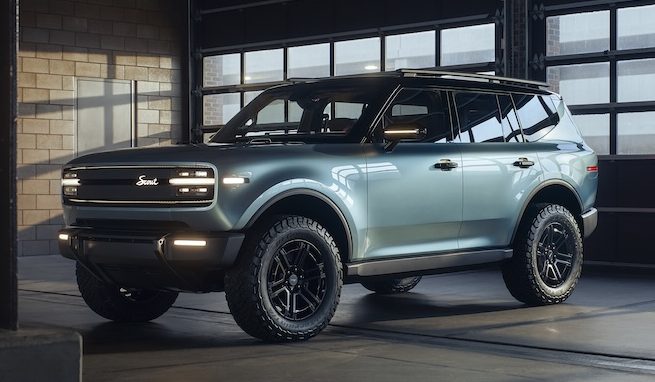
I, like all reasonable people, am excited about the prospect of the Scout brand. It’s offering a handsome, rugged, range-extended SUV and a similarly good-looking truck. Dealers have been a little less excited, pointing out that Volkswagen has agreements with its dealers that forbid it from selling cars directly to consumers.
This is especially important for VW dealers, who lack an interesting or exciting product to sell outside of, like, a Golf R. Dealers are suing in multiple states, and Colorado is the first to come out with a ruling, according to Automotive News:
Colorado’s Motor Vehicle Dealer Board voted 6-2on Dec. 16 to approve Scout’s application to become a dealer in the state, according to a spokesperson for the Colorado Department of Revenue’s Specialized Business Group, which includes the board.
The board has nine members, but the president of the board generally votes only if needed to break a tie, the spokesperson said.
The article points out that dealers can basically appeal at this point or allow Scout to see if it can operate without them. This ruling doesn’t impact a similar lawsuit in California, which is the biggest EV market in the country.
What I’m Listening To While Writing TMD
Fiona Apple is probably one of the most-selected artists here, and I’m just relistening to “When The Pawn…” as a way to start the day, letting the algo take over from there and pick more songs. “Get Gone” always hits me right in the chest.
The Big Question
What’s a more accurate (or amusing way) to talk about truck costs? It’s $66,386 divided by whatever.
Top graphic images: Ford; McDonalds; DepositPhotos.com





Big Macs are my favorite currency/comparison tool. Because of their exposure to agriculture, logistics, and labor (everything except commodities and housing), they do reflect to a degree an easy to digest (pun not intended?) non-housing purchasing power metric. It’s also transferable between currencies, countries, and culture.
For 30+ years (1960s–1990s), a new car consistently cost about 6,000–7,000 Big Macs.
The 2000s and 2020s stand out, with cars jumping closer to 9,000 Big Macs, reflecting faster growth in car prices than fast-food prices.
We can postulate why there was an inflection point starting in the 2000’s (I think there are a few factors), but the fascinating thing is that it’s easier to see that inflection point using Big Macs than Dollars.