

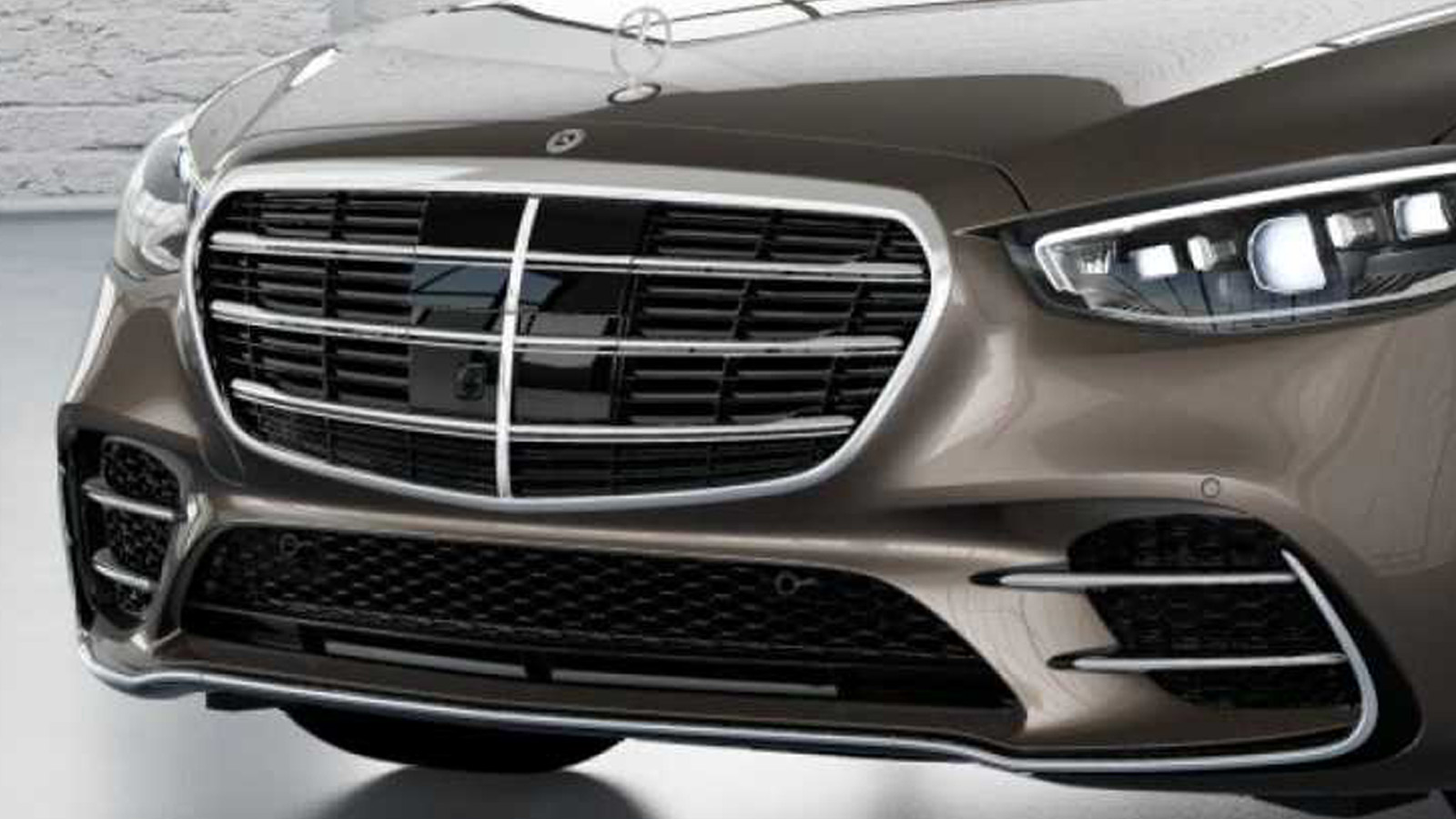
In a world where downsizing and electrification are the norm, it’s rare to see an automaker focus a lot of investment into the bigger engines in its lineup, especially in Europe. Mercedes-Benz, a company particularly famous for downsizing, has done just that with its longstanding 4.0-liter V8.
The German automaker revealed today plans for a mid-cycle refresh on its flagship S-Class sedan, and among the changes is a heavily revised version of the car’s twin-turbo V8 engine, which has been used across the lineup (and a handful of Aston Martins) since 2015. While the displacement is the same, there are a host of updates inside, the biggest among them being a switch from a cross-plane crankshaft to a flat-plane crankshaft (more on that later).


While I’m happy to see Mercedes’s V8 will live to see at least a few more years, one report suggests the refreshed V8 is actually bad news for the other big engine in the company’s lineup.
So What’s Been Changed?

It’ll be a couple of weeks until Mercedes reveals all the details on the new S-Class, but the company gave a few publications, including Car and Driver, a ride in the back seat as a preview, and also spilled a few details on the V8’s internals:
There are a bunch of changes to what’s under the hood, including improvements to the intake and exhaust ports, tweaks to the injection system, and—coolest of all—a freakin’ flat-plane crankshaft.
According to Autocar, the flat-plane crankshaft setup was chosen for emissions reasons. Usually, you only see V8s with flat-plane crankshafts in high-revving exotic cars, like Ferraris or the Ford Mustang Shelby GT350. On the left side of the diagram below, you can see the difference in the head-on view of the shaft. On the right side of the diagram, you can see examples of engines that use each crankshaft design, and their firing order.

As our contributor Steve pointed out at the beginning of last year in his excellent deep dive on engine noises, there are benefits and drawbacks to both crankshaft layouts, and one of the biggest differences is the exhaust note. Cross-plane crankshafts give off that deep burbly rumble associated with American muscle, while flat-plane crankshafts produce a higher-pitch, Formula 1-esque noise.
Weirdly, this isn’t the first time Mercedes has given its twin-turbo 4.0-liter V8 a flat-plane crankshaft. The company pulled off the same move for the low-production AMG GT Black Series back in 2020 (it made more power, but it also made the car sound like a washing machine).
In the case of this new S-Class, I doubt occupants will be able to tell the difference in pitch, given the quiet and subdued nature of the modern German luxury sedan. What they will notice is the power difference; the new engine makes 530 horsepower and 553 pound-feet of torque, 34 hp and 37 lb-ft more than before.
The V8 Will Probably, Actually, Replace The V12 This Time
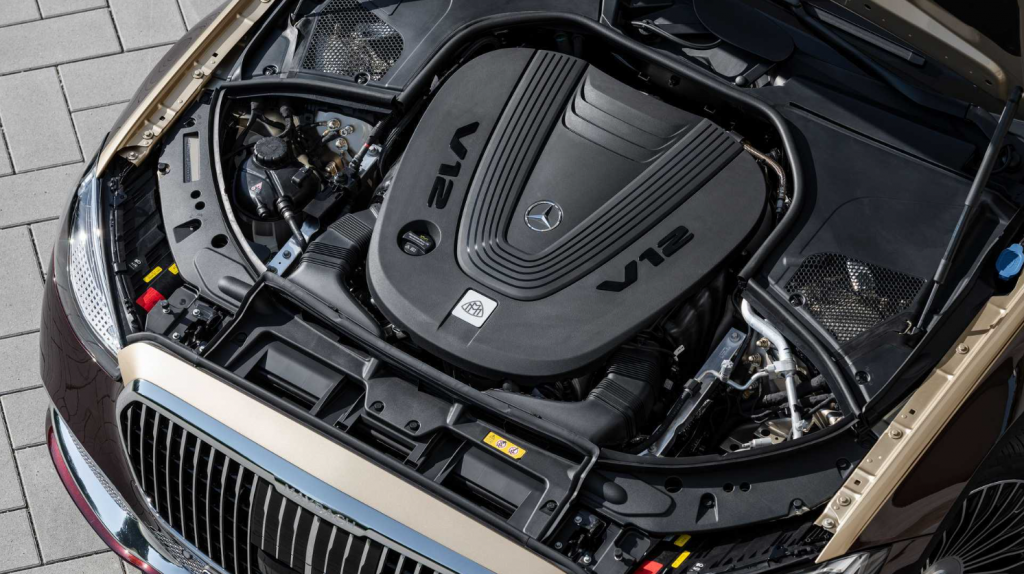
On its face, the V8 getting a big update like this is a good thing, because it means the engine will stick around for the foreseeable future. But according to Autocar, a more powerful version will end up replacing the crown jewel of the Mercedes engine lineup: The V12. From its report:
The ultra-luxurious Maybach S580 will follow shortly after, with the same engine cranked to 603bhp to replace the V12 it currently uses, which Mercedes will retire in Europe.
It’s unclear if this means the V12 will also die in America, but it’s rare to see an automaker like Mercedes keep a small-production engine around for a single market (a Mercedes spokesperson declined to comment when reached by email). That being said, the U.S. is an absolutely massive market that, as of right now, has no real federal penalties for emissions. So if any market can justify the engine’s production, it’s ours.
It’s worth noting that back in September, Michael Schiebe, who was head of AMG at the time, said the V12 would stick around into the 2030s. But he’s since been moved out of that position and replaced by Stefan Weckbach, the guy who oversaw development of the Porsche Taycan. So who knows whether that’s still the plan.

No matter what happens, the writing has been on the wall for the V12 for a while now. BMW and Audi, Mercedes’s two main competitors, haven’t offered anything with 12 cylinders for years. The fact that it’s still around at all is a small miracle. I hope it stays kicking for as long as possible. Where else is Pagani going to get its V12s from, after all?
Top graphic image: Mercedes-Benz


Am I the only one that feels that we’re missing a electric convertible either? Something fun but more specifically something large and luxurious to replace like the S-Class convertible
Here we’re all cheering for the V12 to live on in a new Benz, despite the vast majority of us never ever having one – let alone being able to afford one.
Can we go back dreaming of the sweet Mercedes A-klasse hatchback, incl. the A35 / A45, and some sense of obtainium?
Apparently the V12 stays for Middle East markets
*Any market where fuel is crazy cheap and associated taxes are virtually non-existent
“… the U.S. is an absolutely massive market that, as of right now, has no real federal penalties for emissions. So if any market can justify the engine’s production, it’s ours.”
Meanwhile, MBUSA sold just over 8000 S Class cars of all variants in 2025 – including the 6 cylinder hybrid and a few V12s – compared to over 20,000 of all variants sold in the rest of the world, 1/3rd of which were Maybachs.
Tell us more about how the US is a massive market for S Class V8s and V12s again?
It’s bizarre to me that Mercedes isn’t considering an electric powertrain replacement for the V12. It’s the only way to replicate (and actually improve upon) V12 smoothness, and never having to stop at petrol stations further adds to the luxurious experience.
I can understand high-strung petrol powertrains for the AMG stuff, but the standard S-class should really be all electric by now, imho.
Catch me on Kalshi, the V12 isn’t going anywhere
I get how going from V12 to V8 will help emissions (fewer cylinders = less unburnt hydrocarbons retained in piston rings*) but I’m curious how a flat-plane crank improves emissions. Maybe it has to do with retained exhaust gases and the L/R combustion rhythm?
*Thank you Kevin Cameron for explaining this stuff
You say that owners will be able to feel the 34 extra hp. In any car I drive, for sure, but is that really true once you’re in the 500’s? I remember hearing that it’s essentially impossible to detect any added hp below 10% (unless you’re a Really Good Driver who can detect when your left rear tire is 0.5 psi low).
I know it’ll do a quarter mile faster, but that is utterly useless for just about everyone who buys these things.
We cannot feel horsepower – which is what enables a vehicle to maintain speed.
What we do feel is torque – which is what enables a vehicle to accelerate and go up hills.
Touché.
The real questions is will Mercedes let Aston Martin, Ferrari and Lamborghini continue to make V12s while it only makes V8s? It seems like a $500k+ SLR with an 800hp+ V12 would be a great flagship for them to fly a German flag on.
there’s no way merc gives up the v12 entirely. i would bet money on it
I think they’re gonna drop it. They’re not even using it outside of the Maybach S Class. Mercedes probably sends more V12s to Pagani than they use for Maybachs.
That’s why they won’t. It costs nominal amounts to keep it in the lineup for very specific and expensive cars
I don’t think Mercedes really cares about their V12 at this point. You can’t get it in the SL anymore, the S Class Coupe is dead, the CL is LONG dead. The only car you can get the V12 in nowadays is the Maybach sedan. Not even the SL Maybach, the SUV, or the G-Wagen.
Yes but 1/3 of all S Class sales globally are Maybach variants.
“Cross-plane crankshafts give off that deep burbly rumble associated with American muscle, while cross-plane crankshafts produce a higher-pitch, Formula 1-esque noise.”
Well… I guess Cross-plane cranks can do it all, eh?
LOL
When speaking of flat-plane V-8s, you have to mention the sonic perfection that Ferrari has been doing for quite a while.
I remember reading about the GT350 and the 5.2L Voodoo being a flat-plane, but was deeply disappointed when I first heard one. I expected more of a shriek than the muscle-car sounds it’s actually so good at producing.
Both the 5.2 Voodoo and the Ferrari V-8s found in the 355/360 have the same cylinder numbering, but slightly different firing orders. 1-5-3-7-4-8-2-6 In the Ferrari and 1-5-4-8-3-7-2-6 in the Ford. I wouldn’t have expected it to be so dramatic a sound difference, but as Derek would say, “I’m lookin’ right at it.”
Yes, I know that exhaust routing plays a huge part here… but having driven both – they are light-years apart in how they sound. The Ferrari seems balanced and crisp, whereas the GT350 feels and sounds like an over-bored Coyote that has no redline.
I’m sure the Ferrari sounds terrific, but I will not stand for slander of the GT 350’s exhaust note. The first time I heard one on video I started googling for black market kidney prices to see if I could swing one. 😉
“In A World”
Yes I read it in Don La Fontaine’s voice.
We can still downsize engines while keeping V12s and V8s, why not a 3.0L V12 that revs to 15k? A 2.5L V8 making all the boost? With enough motivation, engineering, and disregard for long term durability anything is possible, V12s forever!
I had a BMW e34 with a 3-liter V8. The car itself was a crapcan, but the motor was glorious!
I still to this day think that Ford should have scaled the Voodoo down to 3.5L and ecoboosted it for the most recent GT. Would have silenced the “It ain’t got a V8!” critics and still met regulations for LeMans.
I’d love to hear what a 3L V12 sounds like…
https://www.youtube.com/watch?v=5SoZiTxdQyw
This.
Show’s my ignorance. I always forget how “small” those engines are relative to the performance of the cars.
Even Ferrari offered 2-litre V8 engine in the early 1980s. Of course, it gained the notoriety of being least powered and slowest Ferrari ever. Turbocharging the peewee engine helped a little bit.
Which was for tax reasons in the Italian market
I can go one better. The very first Ferrari – the 125S – had a 1.5 litre V12.
https://www.youtube.com/watch?v=EGkAYGS6BkI
My comment is in moderation for reasons unknown. No swearing! Just quoted a few lines from the article! Please rescue….
I made the mistake of using an ordinary word that contained a very nasty word. Took days for the comment to post.
Could be. Probably “freakin'” from the Car and Driver quote.
“680” branded vehicles already have V8s; I thought this was old news.
Is a V12 available in the US market still?
The Mercedes-Maybach S 680 still has the V12, but that’s it
Don’t forget Mercedes-Benz S 680 GUARD 4MATIC.
Only on the S Class I guess.
The SL680 is a V8, the GLS600 is a V8, the S680 is a V12. Makes sense!
The Maybach 680 S-class shows as a v12 on the Merc website
There’s only one V12 worth owning, as it is powered by the correct fuel.
The Audi Q7 V12 TDI.
6 liters of pure German efficiency.
*Bugs Bunny meme* Noooooo
Compression ignition supremacy is inevitable.
Nope, it’s that old V12 S-class that had the F1 exhaust.
https://youtu.be/sBvu7lxtzYM?si=JNWvFToYc4CbcIz_&t=317
Too many spark plugs. The correct number is Zero.
It’s my understanding that AMG has started building V12’s just for Pagani – I’m sure they have enough sway at Mercedes to keep them building a handful of V12’s a year.
Thank you for, uh, clarifying this?
I guess the flat-plane is completely silent then…
Coming here to confirm my insanity, but I’m guessing the first one is flat plane?
Very subtle quiz for the readers 🙂
flat-plane is the F1 sounding one, I’m just being obtuse.
Not at all, I was genuinely ignorant here.
of course, happy to help (thank you for catching this, it has been fixed!)
if it’s any consolation, I didn’t notice anything wrong with that sentence until I got to the comments.