

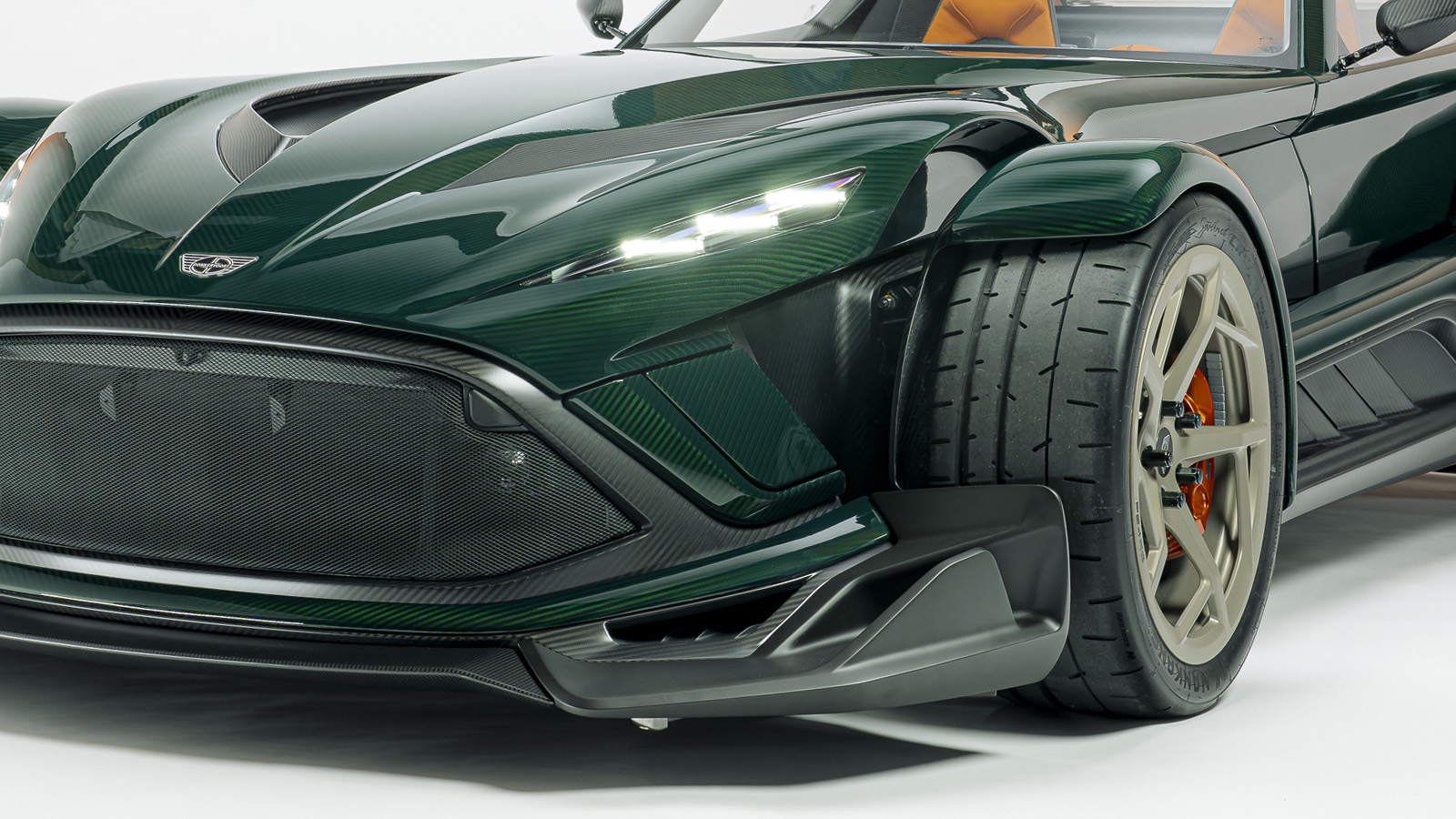
For the past 26 years, Dutch outfit Donkervoort has relied on turbocharged Audi engines to power some of the quickest, maddest sports cars on the planet. From the famously stout 1.8T four-cylinder to the monstrous boosted inline-five, German heartbeats helped take the firm’s conceptual evolution of the Lotus Seven format to new heights. However, Audi’s about to end production of its 2.5-liter turbocharged five-cylinder engine, and the loss of a major powertrain supplier means it’s time for a rethink. This is the Donkervoort P24 RS, and it’s somehow even more insane than the old Donkervoort.
First, we need to talk about the name, because it’s really quite sweet. Although it might sound like just another alphanumeric, the “P” references “Phébe,” the second child of CEO Denis Donkervoort – sort of like the story behind the name of the Lotus Elise. Anyway, engines. You’re probably going to love what Donkervoort’s done here.


Aside from things like the 3D-printed exhaust manifolds, new turbochargers and engine ancillaries, this is fundamentally a slightly detuned version of the same 3.5-liter twin-turbocharged V6 that Ford put in the second-generation GT. Think 591 horsepower compared to 647 horsepower in the Ford. However, while the 2017 Ford GT’s choice of engine received mixed reactions, I don’t think anyone will be calling the P24 RS boring for several reasons, and I’m not just talking about the lower, more central mounting position compared to the old inline-five.

Firstly, there’s the gearbox. It’s a proper old-school five-speed manual, the sort of row-your-own option you don’t really see in supercars anymore. Is it faster than a dual-clutch automatic? Probably not, but it means the driver needs to do a hell of a lot more. Secondly, there’s the weight. A Ford GT weighs around 3,300 pounds, but thanks to a blend of aluminum and carbon fiber, the Donkervoort P24 RS weighs 1,720 pounds. Not kilograms, pounds. This means it has a better power-to-weight ratio than a Bugatti Veyron Supersports, or a new Corvette ZR1, some 757.69 horsepower per ton.

It doesn’t take a physicist to understand that the P24 RS should be bonkers quick, which is perhaps why Donkervoort lists the thing’s zero-to-62 mph acceleration time as “Appropriate.” Could there be some traction limitations off the mark, even on specially-tailored Nankang CR-S semi-slick tires? Perhaps, no matter how smoky or traction-control-aided your launch is, this thing ought to make it back up on the top end. Figure zero-to-124 MPH in 7.4 seconds, Veyron-quick even with the torque interruption of several entirely driver-made shifts. That ought to put butterflies in your stomach.

If that sort of punch on tap all the time sounds a bit scary, don’t worry, Donkervoort’s thought of that. A little dial lets you reel things back in to 493 horsepower, or 394 horsepower. Add in five-stage traction control and available motorsports-style ABS, and the P24 RS promises just enough electronics to reduce your chances of being one with the scenery but just enough simplicity to be tantalizing in a way many modern supercars aren’t.

Speaking of old-school, this latest Donkervoort maintains a tradition of using really tasty traditionally-aftermarket bits. For instance, the dampers are fancy Tractive semi-active units with available hydraulically-adjustable ride height. The calipers are four-piston AP Racing units, clamping either steel or carbon ceramic discs. Those aforementioned Nankang tires may sound a bit funny to the uninitiated, but track rats around the globe are running seriously fast times on them. Oh, and the steering? Power-assistance is optional. Yep, a good-old-fashioned manual rack comes standard. You know, because at 2.3 lateral g, power steering probably isn’t the first thing on your mind.

Don’t think this is just some forbidden fruit, either. The Donkervoort P24 RS is being sold in America, and while the standard T-tops probably weren’t explicitly designed for the American market, they might help. Overall, this supercar is certainly a niche proposition, so we salute the handful of well-heeled speed merchants who will add this rolling festival of gills and flics to their garage. It’s just ice cool, a wonderful antidote to supercar fatigue.
Top image: Donkervoort





Starting price? 354K USD That’s a big nee for me. Probably not including tariffs.
Why yes, I do drive a Plonkervoorden Donklegogan. Why do you ask?
Bizarre enough? Check. Perfect color combination? Check. More
Comfy than a 7? Probably. Faster that I ever need to go? Check. Cost…..if you have to ask the no you cannot afford it. But I do want it
In my opinion, the most bizarre thing on the P24 is that Donkervoort kind of re-invented retractable headlights (take note, Jason!). See for yourself at minute 5:10:
https://m.youtube.com/watch?v=qo2H5h8E2lo
gorgeous!
(Just FYI, you can link to a specific time in a youtube video by going to that time and then hitting the ‘Share’ button, and ticking ‘Start at $time’, then it looks like: https://youtu.be/qo2H5h8E2lo?t=308)
You learn something new every day 🙂
Let‘s see:
https://youtu.be/qo2H5h8E2lo?t=49)
Excellent. Thanks a lot 🙂
Two observations:
1) I wonder why they used the 3.5L V6 rather than the 3L V6 for this
2) Isn’t the Lotus Elise named after David’s wife?
If the goal was to use the same engine as the GT…. it used the 3.5.
The Donkers Bonkervoort!
Mild to medium take: I don’t think V6’s are very supercar-like. They are fine for minivans and larger crossovers, but they don’t make the “right” noises or feelings for a supercar. I think that’s why people didn’t like it in the Raptor, either. I’m sure it’s a fine engine and makes plenty of power. But I want my supercar to have an inline 6, a V8, or a V12.
I think V6’s make a lot of sense in race cars and (non-super) sports cars, they’re shorter and lighter than an inline 6 and lighter but not shorter than a flat-6, but I have to agree that they don’t pass the vibe check for supercars, at least not in 60-degree or 90-degree guise.
I do love a good V6 downmarket though, any car small enough that it *actually* can’t fit an inline or flat-6, like the Emira and Stratos.
I appreciate the “new” (it’s like 10 years old now) GT because it was made to win a race, which it successfully won, but I don’t really want one, because I’m not a GT3 racing team.
The XJ220 has a V6 it that went 217mph. I’m aware it was originally touted to have a V12, but it seems to have got by just fine with half the cylinders.
Ex Stig Ben Collins just bought one and I just learned that Matt Farah has one as well.
Apparently they are ‘bargains’ which has to be a relative term lol.
They are “bargains” because they are V6 supercars. They’d be legendary with a nice V12.
Properly designed exhaust can fix V6 noises. I have heard some exhausts on the Explorer ST with the 3.0 that sound properly exotic
True. But even the crappiest, smoggiest V8 in some 70’s Dodge Motorhome still sounds awesome.
I don’t really think of a Donkervoot as a supercar, even though it has supercar performance, and presumably supercar price too. I think it’s because there’s just not enough car there to be ‘super’. It’s basically a Lotus 7 turned up to eleven-million.
Which I think is a good thing btw. Instead of being a “look at me”-car like most Ferraris, Lamborghinis etc, it’s a “wtf was that?!”-car. As something green and coffin shaped zooms past you, and all you could see was a big grin somewhere in the middle.
I like this bonkers Dutch Batmobile. The yellow leather on carbon fiber is sick, the green carbon fiber is excellent, the Saleen gills rip, the insane split wing situation, god this thing speaks to me.
100% Ace and Gary approved
Good god, forgot I even know about that. Spot on though.
Some part of me is glad that Donkervoort refuses to make a decent-looking car, I admire that kind of commitment to the bit.
I didn’t realize my van has the same engine as the Ford GT. Gotta start telling people I basically drive a GT.
You basically drive a GT40 Supervan
Displacement is the same. Pretty much everything else is different.
Love it. Wish it was available as a streamliner instead of this overly-aggro thing, but I’d rather have increased top speed to properly nutty levels to go with good fuel economy, rather than shave a few tenths of a second off the track time.
The aero kit is actually removable and fits in the trunk.
It has a trunk?!
I’m certain fuel economy was the most important design requirement for this car
/s
This is properly ludicrous. In the best ways possible.
They’ve gone a bit Lotus 7 by modern Aston Martin with the design. And I’m kinda okay with that. It’s plenty of warning of the insanity of what you’re getting into.
I guess Max Verstappen isn’t the only Dutchman powered by Ford this year.
One of my all time favorite brands. I love these guys. I yearn for the Bonkersvoort..
For the more knowledgeable here than I, what’s the long term of the Ford EcoBoost engines been like? Have they held up?
The 3.5 Ecoboost is also used in the Transit and F150, though with less spicy tuning. Mine only has 42k miles, but if they’re putting them in the volume sellers I assume it’s mostly good.
In transverse layout with direct injection only and the internal water pump, you are looking at new chains, pump, phasers, etc. to the tune of ~$4000 somewhere between 80k-100k miles for the 3.5 ecoboost. Carbon buildup is also an issue and you might as well have the valves walnut blasted while the chains and pump are being done, for another $800 or so.
The “updated” version in the F150 uses both port and direct injection and the water pump is not driven by the timing chain. You’ll still get chain slap at cold start around the same mileage but it won’t grenade the engine like in the SHO, Flex, etc., and the port injection keeps the valves clean.
They can make nice power with decent economy as long as you stay out of boost. It’s eco or boost, not both.
So basically free by supercar standards then.
I took my F150 with the 3.5 to 170k with no issues, tuned most of that time and I towed heavy some. Only traded it off because I wanted something different, that truck would have gone well over 200k easy. People talk about the problems but there are millions out there with tons of miles on them
And it can be yours today with zero down and $99,999 per month for 84 months!
I’ll wait for the Hot Wheels version.
Call me crazy – but to me a better use of this engine/transmission would be a Lincoln sedan/wagon variant of the Mustang platform, aimed at the Mercedes-Benz AMG E Class/BMW M5 Series.
Name it “Lincoln Capri”
I think you hit the nail on the head, here.
Sometimes chasing numbers, you’ve long since lost the fun.
I’m interested in how far the steering cranks the wheels. Even if the “fenders” turn with the wheel, there doesn’t seem to be much clearance there for a tight radius. Not that I’ll ever see one!
I can’t help but feel like this is where Lotus could’ve been had they not lost the plot whenever it was that they did.
Esprit. Nice car but off the rails for lotus
Bonkervoort.
Just saying.
I had to read the headline a few times to make sure I was actually seeing more than one word.
Yeah this could make me care about owning a supercar again
That thing is Donkers
I initially confused Donkervoort and Vanderhall, and was thinking how nuts 591hp through one rear tire was. Oops.
I think this is rad.