

In some ways, smartphones were a mistake. While access to pretty much the entire library of humankind’s knowledge in your pocket comes with wonderful possibilities, it’s also resulted in a digital world you’re never truly able to shut off. That email will find you, and after 6:00 p.m., it feels like a threat. Presentness feels endangered and precious, to the point where people pay exorbitant sums just to get away from it all for a week. Drop-tops feel endangered and precious in a similar way. At 70 MPH with the roof down, adding shareholder value through a Bluetooth call simply doesn’t enter your mind. Voice-to-text can wait until you’re parked; for now it’s just you and the road. That presentness’s been harder and harder to find as the number of affordable convertible models has dwindled, yet the Mazda MX-5 still promises the relief you’re looking for.
Whether you live in Canada or the United States of America, this is the least expensive new convertible you can buy by a considerable margin. The entry-level trim (Sport in America, GS in Canada) costs less than some well-specced economy cars, but it’s not some garden-variety compact car that’s had a run-in with the tin snips. It might just be the best-value real, thoroughbred sports car on the planet.


[Full disclosure: Mazda Canada let me borrow this MX-5 for a week so long as I kept the shiny side up, returned it clean with a full tank of premium fuel, and reviewed it. Fuel was paid for by yours truly.]
The Basics
Engine: Two-liter twin-cam 16-valve four-cylinder engine.
Transmission: Six-speed manual.
Drive: Rear-wheel-drive.
Output: 181 horsepower at 7,000 RPM, 151 lb.-ft. at 4,000 RPM.
Fuel Economy: 26 MPG city, 34 MPG highway, 29 MPG combined (9.0 L/100km city, 7.0 L/100km highway, 8.1 L/100km combined).
Curb Weight: 2,372 pounds.
Base Price: $32,045 including freight ($38,590 in Canada).
Price As-Tested: $32,640 including freight ($39,090 in Canada).
Why Does It Exist?

God bless Bob Hall and Mark Jordan, and godspeed Tom Matano. It’s difficult to imagine a world without the Mazda MX-5, but in some ways, it’s amazing this lineage happened at all. Hall first communicated the concept in 1976, ideation really started in 1982, and it wasn’t until 1986 that the project got final approval. By the time the first Miata (or MX-5, or Roadster depending on where you live) hit the market in 1989, the convertible sports car market was utterly decimated. Apart from an ancient Alfa Romeo, there wasn’t much out there for drivers looking for playful, affordable, rear-wheel-drive, wind-in-the-hair thrills. Mazda’s decision to take a classic formula and make it actually reliable caused an instant sensation. We’re talking mark-ups, waitlists, a surge of desire that opened the floodgates for the biggest burst of automotive joy since the 1960s. Mazda’s convertible set the stage for the BMW Z3, Mercedes-Benz SLK, Porsche Boxster, Pontiac Solstice, Saturn Sky, and Toyota MR-S among countless others, and while just about everything else in the genre has either faded out or taken a break since their respective launches, the MX-5 is still here. Still sticking to fundamentals, and still offering evidence that roadsters are for lovers regardless of income.
How Does It Look?
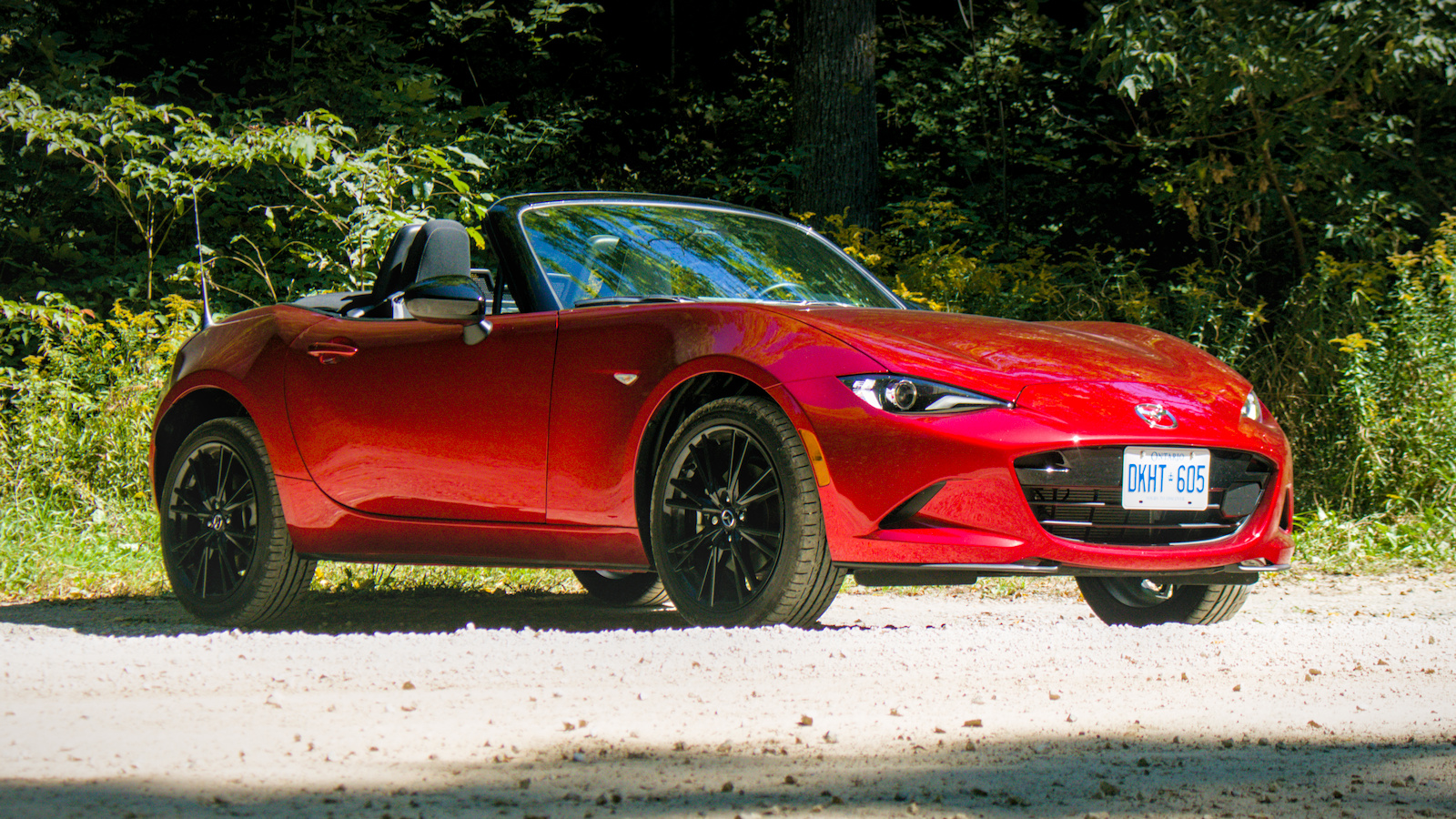
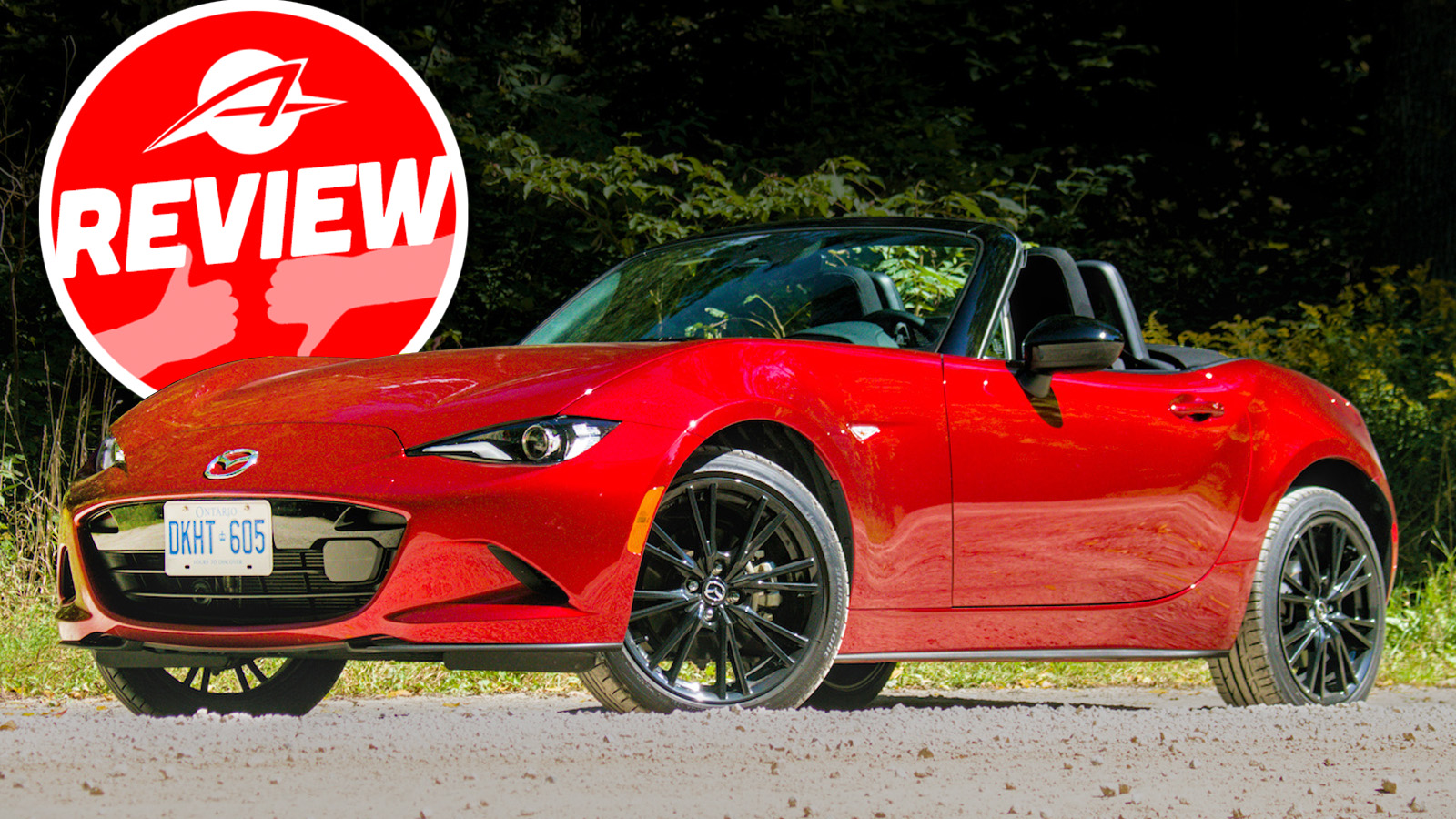
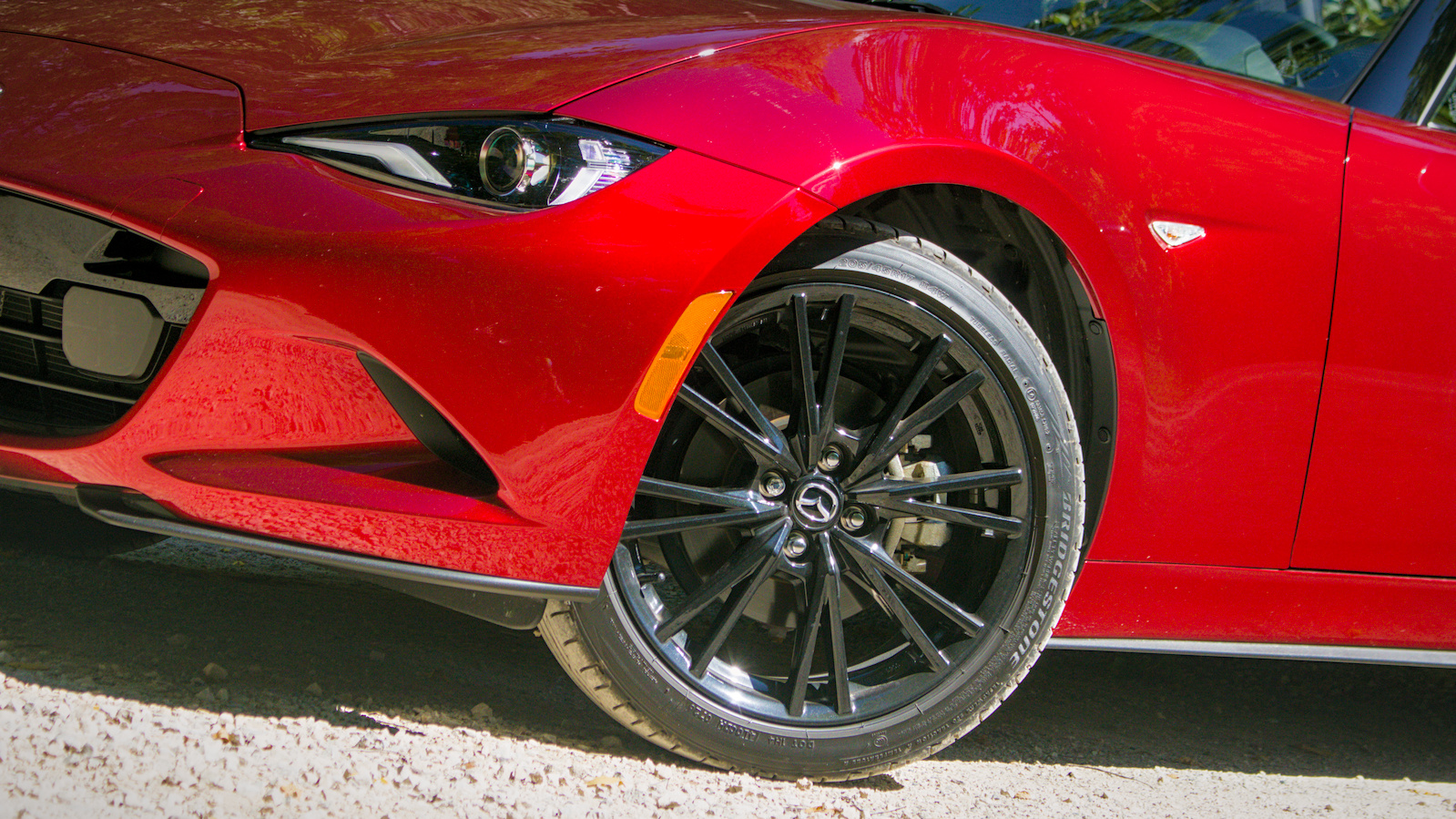
It’s been more than a decade since we first saw the fourth-generation MX-5, and it’s still nothing short of beautiful. The classically elegant dash-to-axle ratio and short deck are here, of course, but so are compound curves that captivate, surfacing that almost looks shrink-wrapped around the mechanicals, a convertible top that stows elegantly flush, and fenders that rise and fall in sports car tradition. A facelift for 2025 may have introduced a blocky radar sensor to the grille, but it also brought in new lights with integrated DRLs that cleaned up the front end. Drape it all in Soul Red Crystal paint, and the MX-5 still punches well above its price bracket. It may be theoretically possible to design a prettier entry-level convertible sports car, but practically, it’s difficult to imagine how.
What About The Interior?
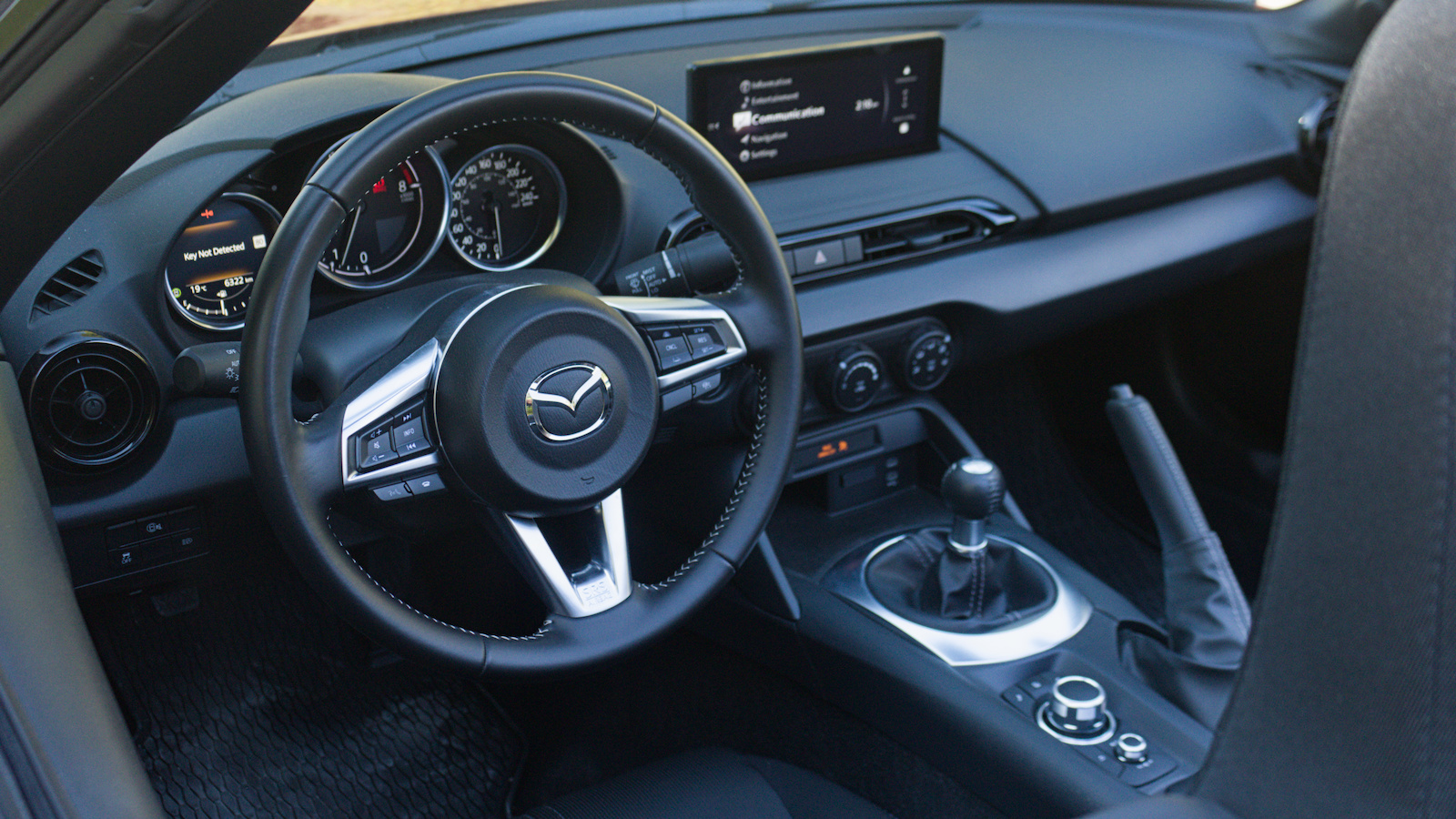
Slide behind the wheel of the cheapest new MX-5, and it’s hard not to notice exactly what Mazda’s stripped out to meet such an aggressive price point. The color-matched door trims of more expensive models have been thrown out, and you’d be hard-pressed to find a whiff of soft-touch plastics anywhere. None of that really matters though, because the fundamentals are just so right. It starts with the way you sit down, but not way down, in a soft-yet-supportive non-height-adjustable seat mounted on ramped tracks to offer a slight boost the closer you sit to the wheel. Speaking of the wheel, it’s a wonderfully thin-rimmed affair wrapped in delightfully supple smooth-grain leather. Naturally, the shifter and handbrake match, with the former falling just about a stretched hand’s width from the wheel and perfectly in-line with the console armrest. A telescoping steering column added several years ago seals the deal, and surprisingly compliant door armrests are the cherries on top. Everything you touch in the MX-5 feels ergonomic and high-quality, and everything else just melts away.
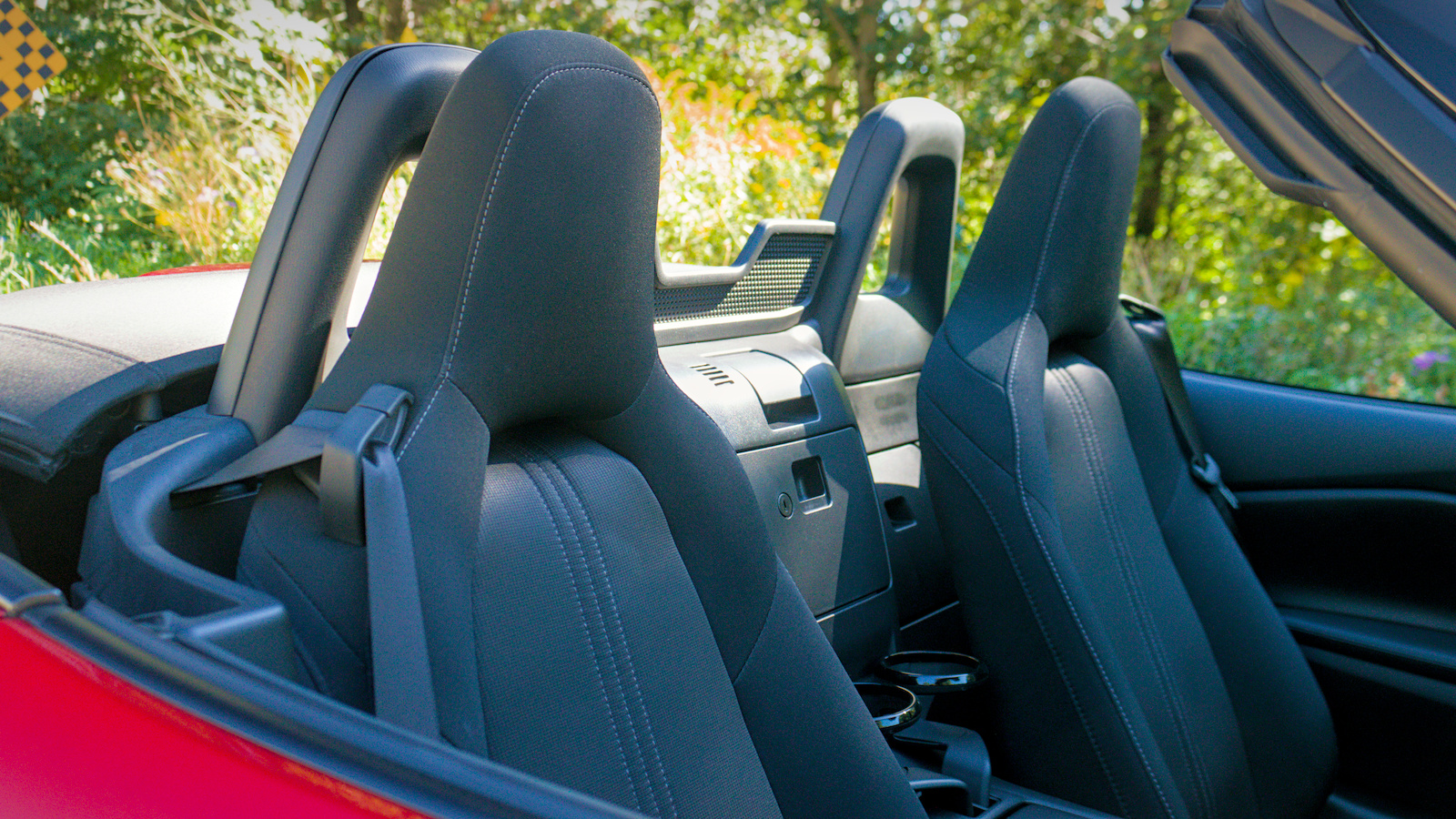
Granted, the fight between keeping compact dimensions and building in modern safety means Mazda’s compromised on in-cabin storage. The bin under the console armrest is far too small for any phone larger than an old-school Motorola Razr, the door bins are nonexistent, and you don’t even get a proper glovebox. A lockable bin between the seats is pretty much your only usable cubby, but it’s big enough for the handbook and papers and a pair of gloves. The handle above it releases the simple manual convertible top from its stowed position, and dropping the top ends with clicking it in place with a gentle push from an outstretched arm. As for trunk space, 4.6 cu. ft. doesn’t sound like much, but it’s just enough for a light weekend away or a modest Costco shop. Before you hire Marie Kondo, give Mazda’s roadster a shot. It’ll make you realize just how many objects in your life are unnecessary.
How Does It Drive?
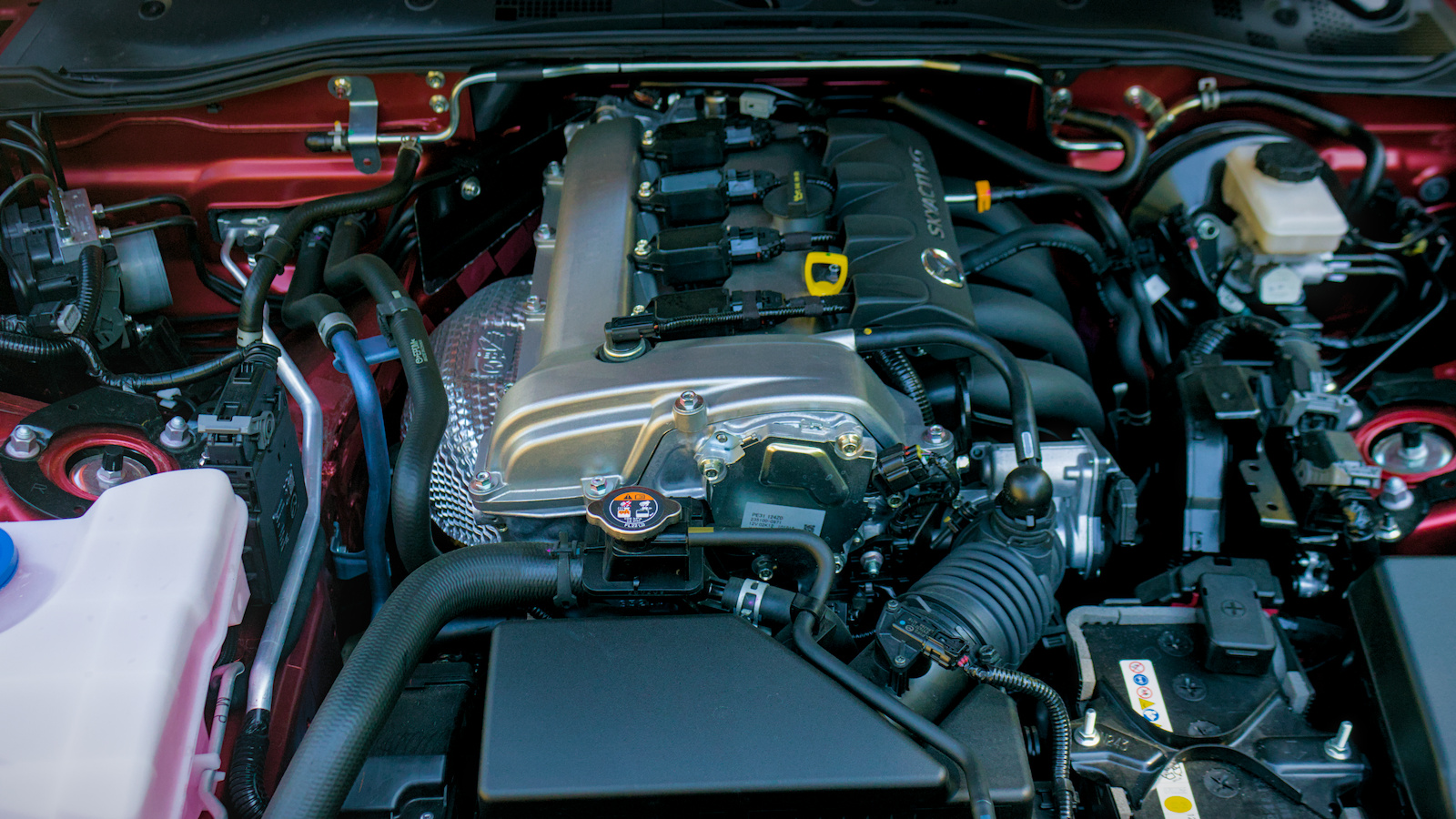
On paper, 181 horsepower doesn’t sound like much. That’s all the two-liter inline-four in an MX-5 is capable of kicking out, a figure dwarfed even by a similar 2.5-liter engine in the marque’s mainstream economy car. Except that figure alone is only worth so much, as the MX-5 has three powerful allies: Revs, weight, and gearing. Not only does this modest engine spin to 7,500 RPM, but each horsepower only has 13.1 pounds to push around. With help from short gear ratios, the end result is zero-to-60 mph in about six seconds, plenty quick enough to be proper fun without inviting too much trouble. You’ll be shifting often, and you’ll want to, thanks to the fantabulous snick-snick action of the six-speed shifter and the power peak arriving at 7,000 RPM. There’s real reward in chasing the revs here, which fits given the etymology of ‘Miata’.
Mind you, there’s also reward in taking it easy. That sensational gearchange mechanism even makes serious short-shifting fun, and reasonable torque off-idle makes changing up-and-down the ‘box early not only natural in traffic, but satisfying at the pumps. Despite an EPA combined rating of 29 MPG (8.1 L/100km), I actually averaged 34 MPG (6.9 L/100km) in the real world without much effort and with plenty of city driving. Talk about having your cake and eating it too.
So what can’t this convertible do on tarmac? It’s reasonable to think that the lack of a limited-slip differential in the base trim is a perceptible drawback, but it’s not nearly as big of a deal as you’d expect. If there’s a weak spot in the way the MX-5 drives, it’s in the steering. Like in just about every new car, it’s assisted by an electric motor, but there’s a strange mass damping effect just off-center that manifests itself as a stiffness and a slight reluctance to return to true center. Feedback through the helm is relatively light, but it’s that aforementioned trait that really feels strange in the context of the steering on the Subaru BRZ and Toyota GR86. Still, this fly in the ointment certainly isn’t enough to ruin the MX-5, and there are other ways it communicates.
The base suspension’s refreshingly soft, pitching and rolling around like a puppy on a polished wood floor. That might get irksome on track, but on the road, it’s both comfortable and tactile, writhing and wriggling with excitement while screaming at the top of its lungs about exactly what the car’s doing. Even with the immediacy of such a short wheelbase serving up confident rotation, you’d need appendages made from actual ham to spin the MX-5. It’s designed to play, and not beat you up or tire you out in the process. It’ll make you want to drive from the canyons of Los Angeles to the mountains of Appalachia via Banff, and there’s no higher praise than that.
Does It Have The Electronic Crap I Want?
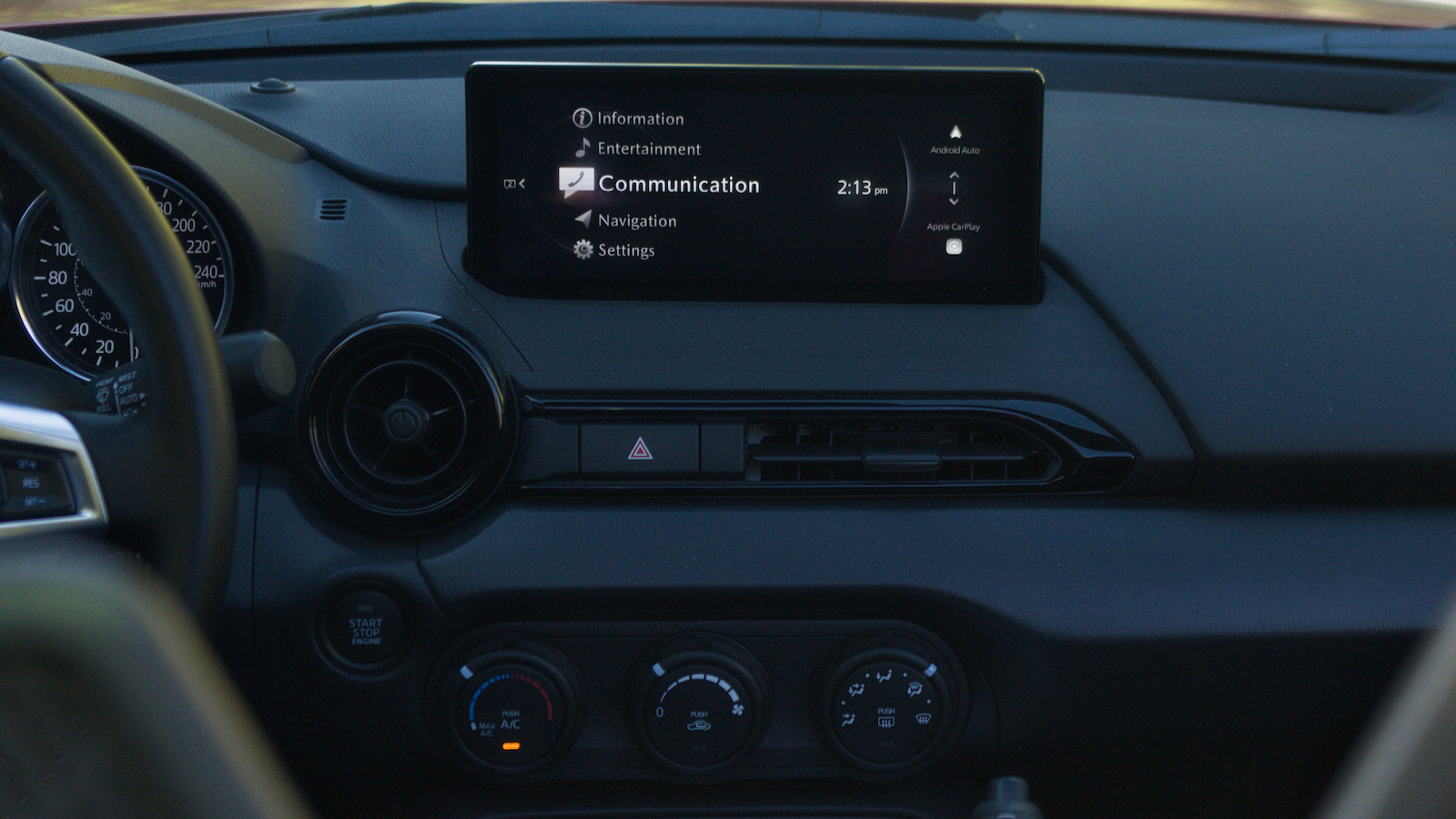
Maybe, maybe not. See, this is a base model, and while it does feature air-con and electric windows and motorized mirrors, it strips out a lot of fripperies. Let’s start with what’s actually on deck: A 2025 facelift introduced Mazda’s now-outgoing infotainment system, which is simply worlds better than the unit on prior models. The screen’s richer and has smaller bezels, but isn’t overpowering. The menu structure makes excellent sense, and while Apple CarPlay and Android Auto aren’t wireless, they are here. So are automatic headlamps, rain-sensing wipers, adaptive cruise control, and a shockingly cromulent six-speaker stereo.
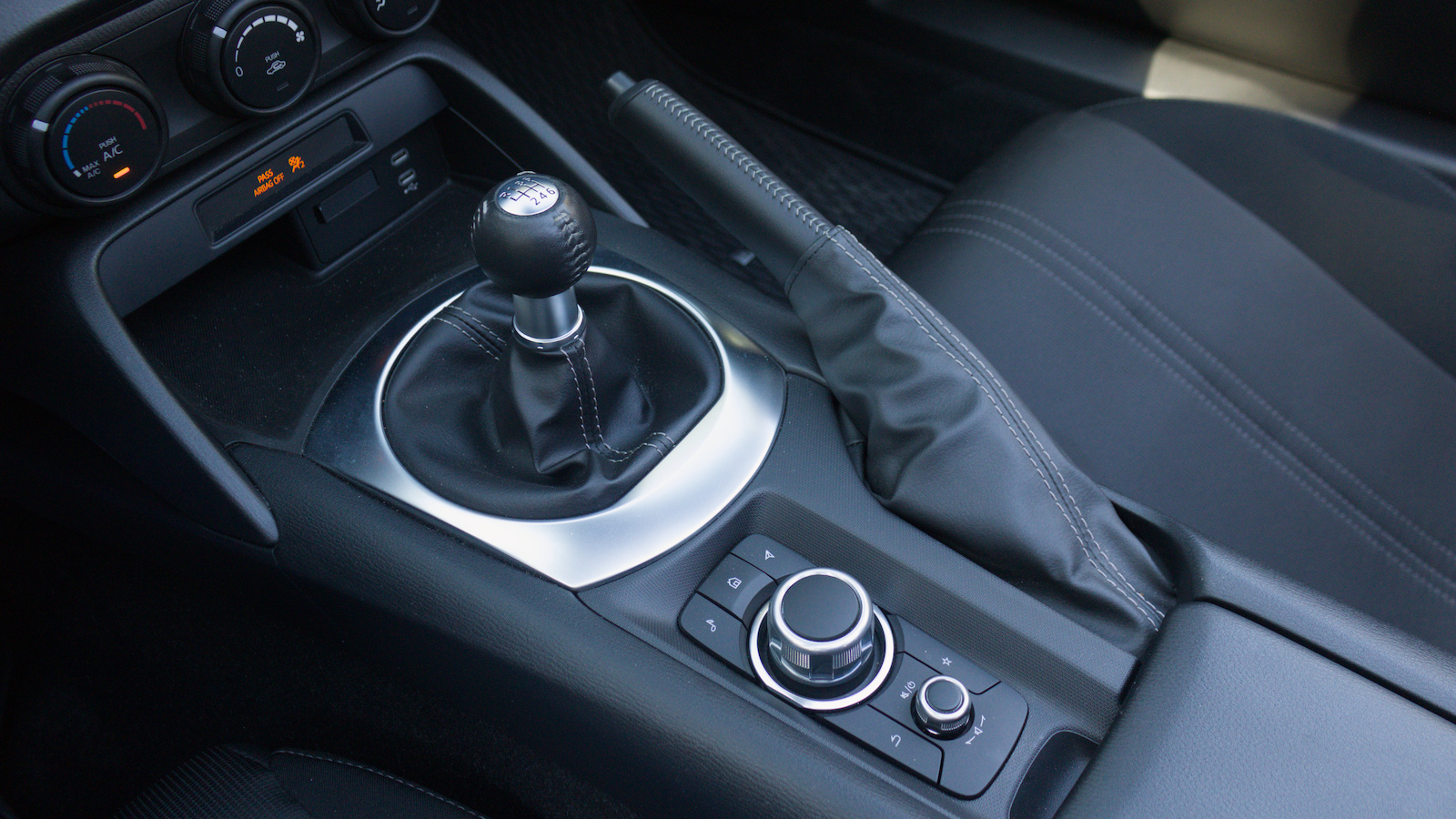
However, you won’t find heated seats, or auto-dimming mirrors, or clever bendy headlights here in this pared-back convertible. There’s no automatic climate control, no Homelink, the list goes on. Other than heated seats, I didn’t find myself missing any of that, and I even got on with the satisfyingly tactile rotary controller for the infotainment. A knob for volume, three knobs for heating and air-con, and one knob to select gears with. It’s really all you need.
Three Things To Know About The Base Mazda MX-5
- No limited-slip differential here.
- The cheapest trim is manual-only.
- Standard dampers make for remarkable ride comfort.
Does The Base Mazda MX-5 Fulfil Its Purpose?
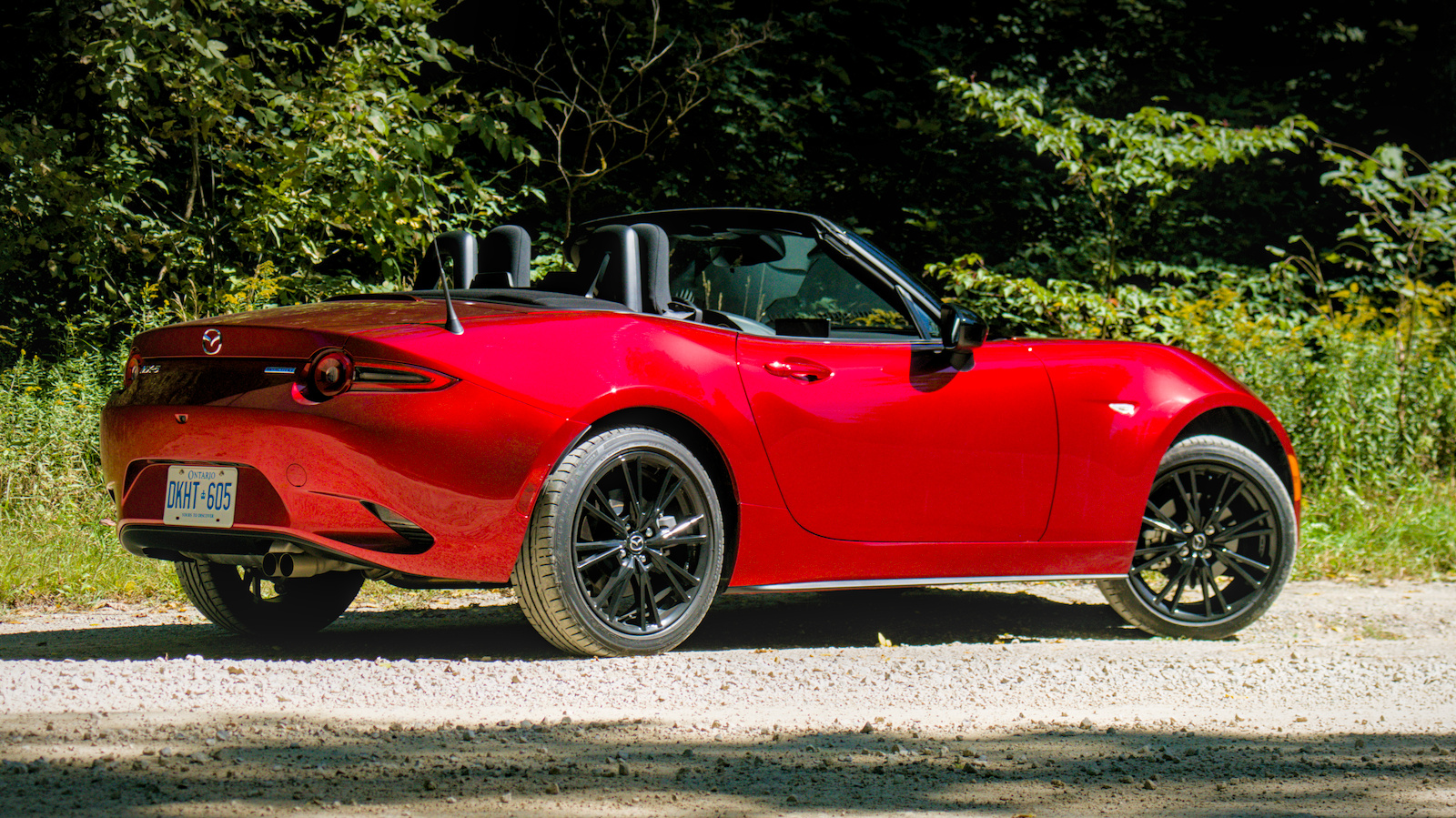
Yes, yes, a million times yes. The Mazda MX-5 is joy distilled, a whiff of that crisp October air the morning of the Scholastic book fair in an age of indifferent smog. A reminder that life is meant to be fun, an expression of ecstasy that doesn’t own you. It’s reasonably priced, it has a proper warranty, and even gets surprisingly stellar fuel economy. At $32,640 as-tested ($39,090 in Canada), it’s less expensive than a Honda Civic Si, about the same price as a loaded Toyota Corolla sedan, and right in the ballpark of just about every well-specced subcompact crossover under the sun. Sure, it might not have the space or quantity of cosseting gizmos of a regular car, but that’s a worthy tradeoff for stowing the convertible top and living in the moment with an ear-to-ear grin. Just add SPF 50.
What’s The Punctum Of The Cheapest New MX-5 You Can Buy?
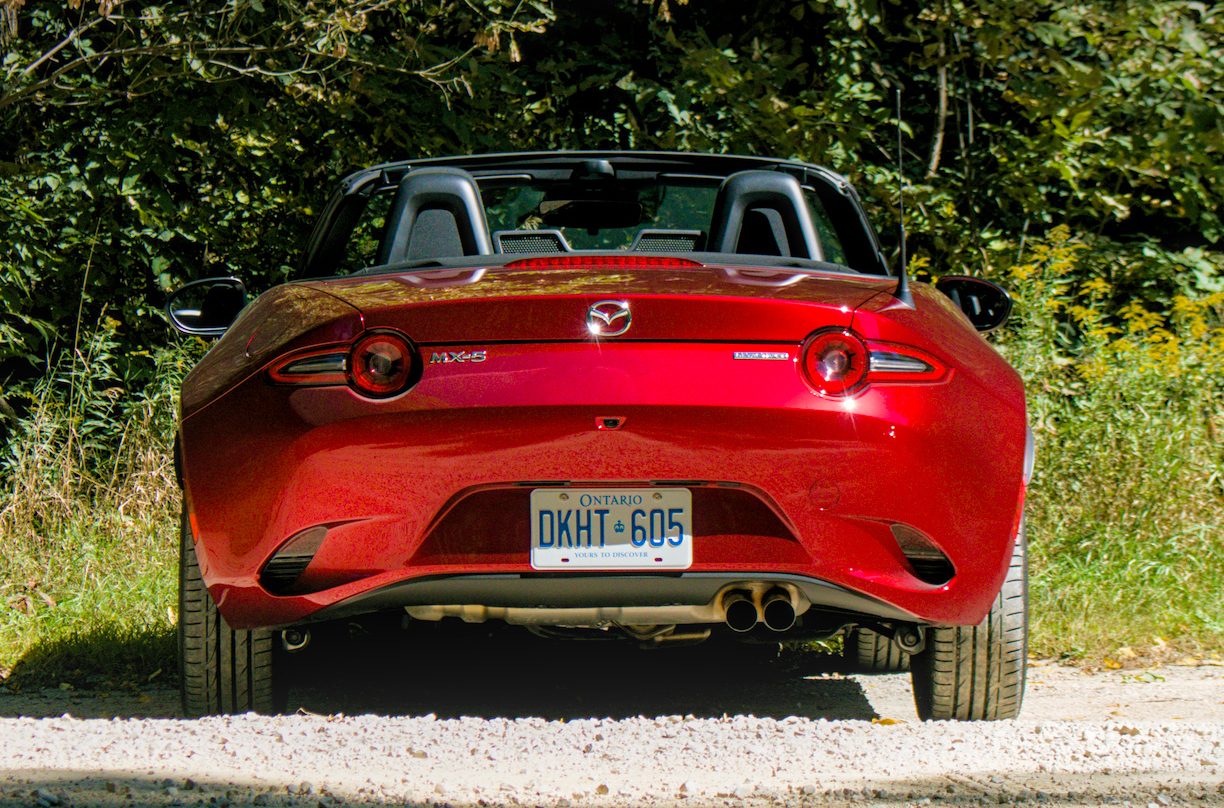
The most smiles-per-dollar of any new car, full-stop.
Top graphic image: Thomas Hundal


A base ND is the way I would go. However I’m tossing the factory suspension for Ohlins, adding an OS Giken diff, and some 17x9s with 245 RE71RZs. I’ve driven my friends ND that is set up this way, and it is perfect.
“In some ways, smartphones were a mistake. While access to pretty much the entire library of humankind’s knowledge in your pocket comes with wonderful possibilities, it’s also resulted in a digital world you’re never truly able to shut off.”
I solved this problem by not owning a smart-phone. It’s like people nowadays don’t realize that phones can be turned off while charging.
Back in the late ’90s and early 2000s when I had to carry a travel work phone for my job, that phone got turned off as soon as I got to the hotel each night and not turned back on until the next morning.
I remember the last time I was given a smart-phone for fieldwork and it didn’t even have a button to turn it off. I had to ask a co-worker how to get to the part where you had to swipe through a bunch of sub-menus to finally end up where you could tap an icon on the screen to actually turn it off – and then it would ask you if you were sure you really wanted to do that.
Now that I’m retired, I don’t have to worry about smart-phones at all. Plus, we have an MGB convertible we can take to the local A&W for a top-down lunch so we have the best of both worlds.
This statement is how I learned that a Wrangler now starts at $36K and a Bronco at $40K. Out the door pricing might make the gap smaller, but yikes my intuition was way off on both of those.
Crazy to think a base model wrangler starting at closer to 40k then 30k same with the Bronco. You would think a base wrangler would be 30k. Then again base RWD 4runner starts at like 45k or something stupid. Crazy times we live in.
The base models largely exist so the salesperson can say “But for only $50 a month more you can also get…”
I was also curious. The second cheapest convertible in the US appears to be the MINI Cooper C at $36k including destination. I’m not sure why I would choose that over a MX-5.
Life is short. Buy the Miata
We have a 2006 NC and a 2016 ND in the family. The ND really does average 34 mpg while having a ton of fun. The NC is noticeably roomier and gets around 27-28 in mixed driving. My son drives the 2016 as a daily, including putting winter tires on it too soon. If you can live with just capacity for 2 and a smallish trunk, it’s really worth considering a Miata. Something not in the review too, but they are very dependable cars too… There’s not really any major common issues with these cars and there are many out there with 200,000 plus miles on them. It really is one of the best combinations out there of cheap cost of entry, cheap running costs, dependability, fun, and open top driving.
In my humble opinion, convertibles take a good car and make it worse. Chassis stiffness suffers, reducing the effectiveness of the suspension, introducing a tremendous amount of body noise and affecting handling.
Chassis stiffening additions to help the vehicle cope with the absence of a roof add weight. I’m not certain whether a convertible top weighs more than a steel roof but my instincts tell me it’s a wash, to slightly worse with the convertible. THEN, to add weirdness to worseness, folding the top down moves its weight to a completely different place which has its own effect on handling.
Wind noise.
That’s it. End of complaints. I’d pay extra for the RF so I had a proper roof.
To each their own. Your points are valid, and would certainly affect track times.
For me, though, the Miata is about driving experience on normal roads and having fun at low speeds. Noise, vibration, and harshness make the experience more exciting! If I want a rigid, sterile ride, I drive my Tesla. For a raw, religious experience, I hop in the NB Miata.
(top down for best experience)
Joe Wall approved
Premium fuel? I don’t see a turbo anywhere, so I’m curious why it is required.
87-octane can be used, but with 13:1 compression, the ECU pulls timing. Besides, premium fuel is recommended, so it’s only fair to whoever drove this MX-5 next that the recommended octane’s met. The golden rule and all that.
Turbos are not the prerequisite for premium fuel use.
Some cars are just set up so that premium fuel is required to get the best performance and cleanest burning.
Yep, my 2013 Si also wants premium fuel, while I could run it on 87 Octane, it’ll pull a bunch of timing and limit VTEC, plus why would I want to handicap my performance sedan like that? If I wanted to be cheap on gas, I’ll drive my 03LX that will run on burrito farts.
13:1 compression ratio is the entire reason.
Evidently there’s a flex-fuel version that can run on E85 and delivers a bit more power, but this little go-cart barely weighs over a ton. You can skip extra power and just run with it.
My F150 had TWO turbos, but was happy drinking 87.
The induction does not maketh the requirements.
I am currently shopping for a car.
My wife wants me to get a Miata if I want one. My fun brain says yes, my logical brain says it’s a bad choice at the moment. My fun brain was borderline convincing my logical brain to go look at the new ND3 on the local dealer lot. Literally this morning this internal dialogue was taking place. And now this article?
Maybe it’s a sign….
If you do not and they go away will you regret it? We have limited time to enjoy life. Enjoy life.
Logical brain says I’ll be doing a ton of miles, mostly highway, and this isn’t the right car for the job. It also says that I need more utility than this offers, and that I’d need a 2 car solution.
Fun brain says that an FRS was perfectly fine automobile for all my needs for 9 years, so what’s the problem?
The big issue I’m having with this option (or a GR86, or a Civic Si, or a CPO Cadillac CT5) is premium fuel at $5+/gal. That’s a hard pill to swallow for 20k miles/year….
Life is short – Why deprive yourself?
I was at that same exact point in my early 20s. It was 1989, the brand new Miata was $14k, and I wanted it. I had a functional but boring DD at the time and ended up buying a 1971 TR-6 project instead for my “fun” car. I sometimes wonder if my whole life trajectory was established with that one decision…
No regrets and I still might get myself a Miata some day 🙂
In 2004, I was looking for a used Miata, and with the 2 kids in tow, I did’nt like the used one on the lot. There was a 2004 left over (this was late September), and my wife said to get it.
I never thought I’d even own another fixed roof car. Drove it year round (full snows in the winter) for 165K miles, and I loved it, until the bottom rusted out. I bought a used Mini Cooper (manual as a replacement), but my wife thinks a Miata is too small for me to drive now.
Get the Miata and join the Forum on Miata.net and enjoy!
ND’s are great, but if you can’t justify it as a primary car, I have an NC1 as a “fun car”. I drive it about 5,000 miles a year. It’s been just as dependable as anything else I own, despite being 20 years old. It lets me park my truck for most of the summer when it’s not towing my camper and I enjoy my commute so much more with the top down and the ability to row though the gears. I prefer the NC a little bit to our ND because of the extra room, the hydraulic steering, and it just feeling a little more connected to the road, but honestly, they are both just a ton of fun.
$32k is well below the average selling price of a new vehicle, just to give that logic side of your brain something to ponder.
So are there aftermarket LSDs I can install on it while still enjoying the best HVAC controls that ever existed?
Indeed! OS Giken has a popular option, plus an OEM limited-slip diff retrofit should still be possible on the base ND3.