

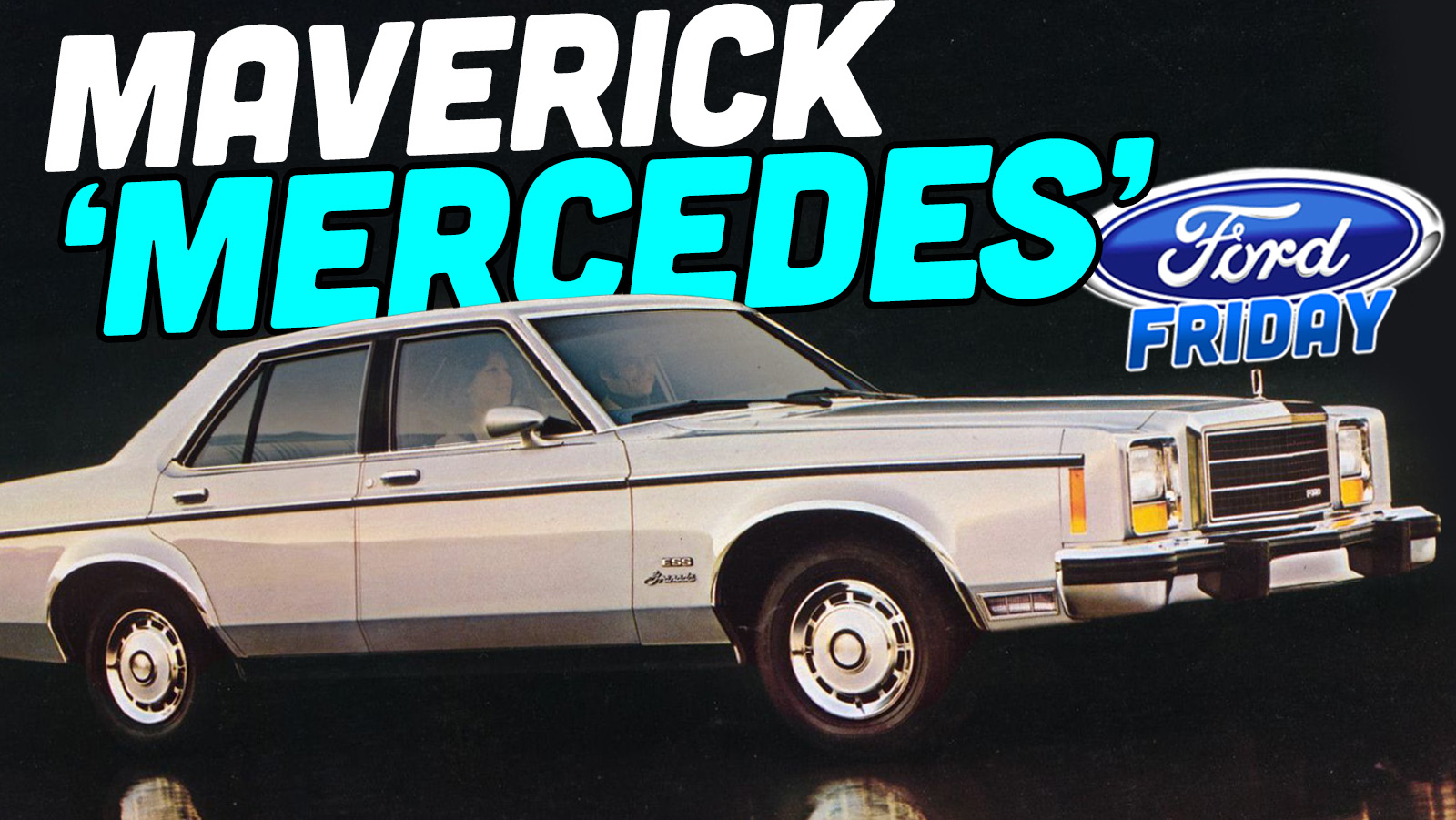
We all sometimes have delusions of grandeur and will happily accept whatever helps support this distorted vision. Car companies in particular are famous for this, and one of the best examples was Lee Iacocca’s 1975 Ford Granada, the “Maverick Mercedes.”
Ford was not content with just hinting that this inexpensive sedan was supposed to be a substitute for an expensive German car; they even made a version called the ESS that flat-out covered this poor thing in a Halloween costume to (badly) mimic the Benz. Even worse, people actually bought it, and they basically ignored a car sitting right next to it in the Ford showroom that was a far better approximation of a European machine.


Stay Classy, Ford
“Small cars equal small profits” is an old car-biz adage, and Henry Ford II was one of its great believers. Surprisingly, the person he promoted to president of the company in 1970 seemed hell bent on finding ways to disprove that theory.
With the 1964 1/2 Mustang, he created a money-making sporting coupe for minimal dollars that was a smash success. Ten years later, he attempted to repeat this feat using almost the same car. You see, the Mustang was basically a modified and rebodied Falcon, Ford’s mainstay compact car, which had been replaced in 1970 by the similarly laid out Maverick. This super-basic transportation device sold well but was never going to make big car money for Ford.
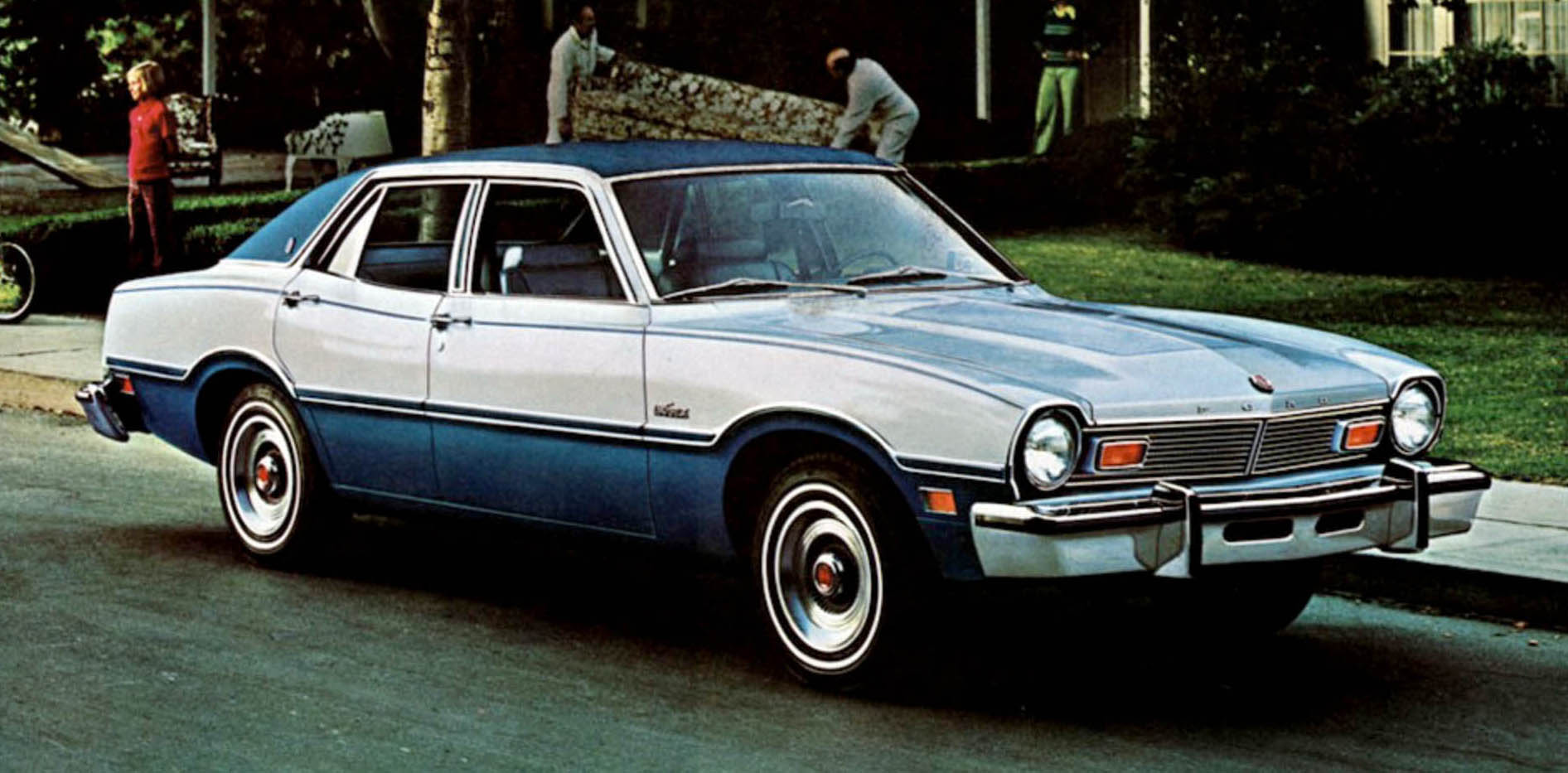
It was understood that tightening emissions controls and the rising price of fuel would turn “standard-size” Fords into dinosaurs, requiring them to rethink what an aspirational car might be for American buyers. For inspiration, Ford looked at rather small, boxy European sedans that were popular with affluent younger buyers, such as cars from Volvo and, most importantly, Mercedes-Benz. Buyers were dropping more than the cost of large Lincolns on these compact cars, a sign to Iacocca and Ford that there was money to be made in downsized products if they somehow related them to these upscale foreign sedans.
The new-for-1975 Granada would not replace the Maverick, but instead be marketed as a step up the ladder with a size and basic upright shape that mimicked the expensive German car.
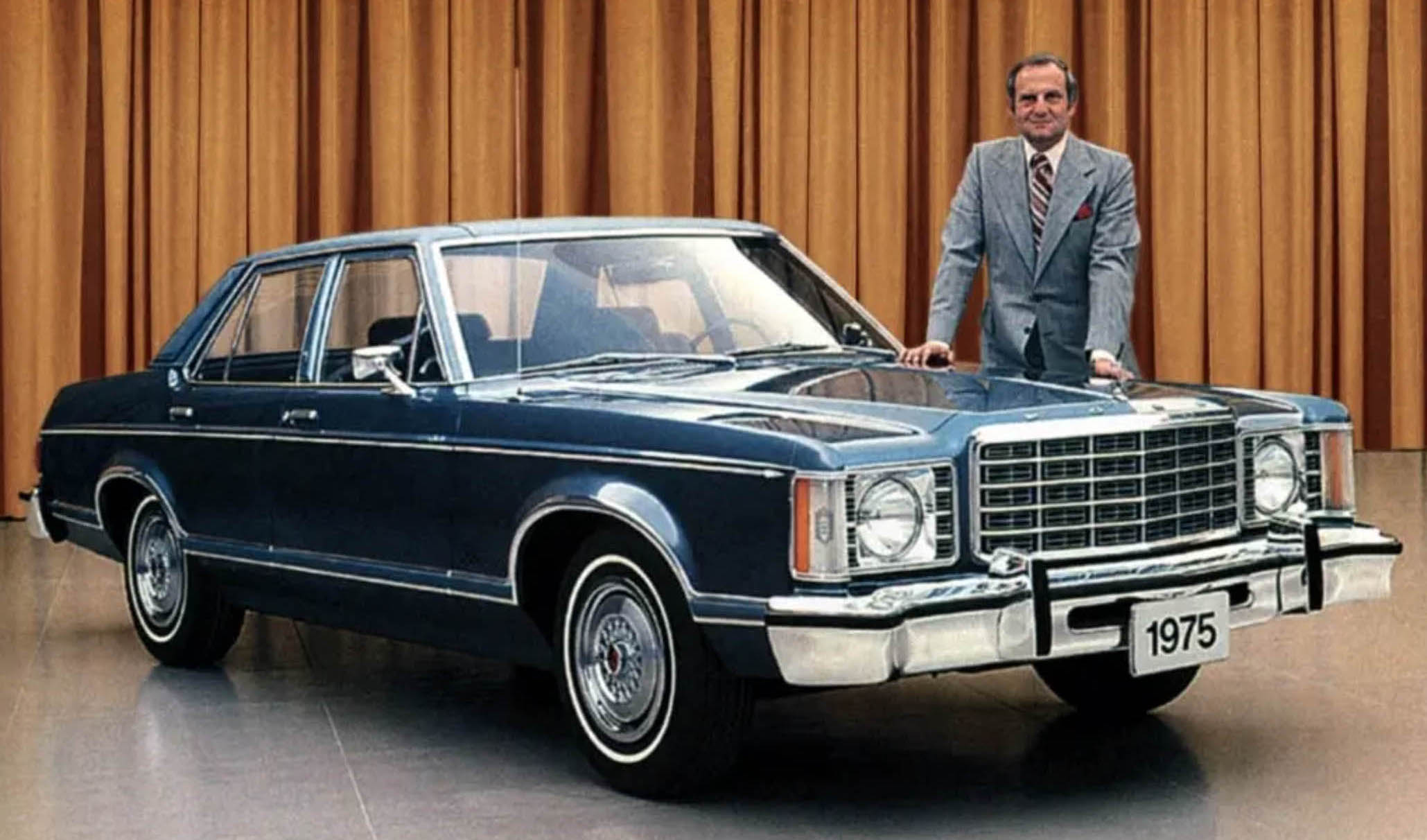
Well, “mimic” is a stretch, since you wouldn’t confuse this thing with a W114 280E or 240D on a dark and rainy night even if you were drunk and wearing sunglasses. Ah, but the average American buyer? This thing was a dead ringer for a Benz!
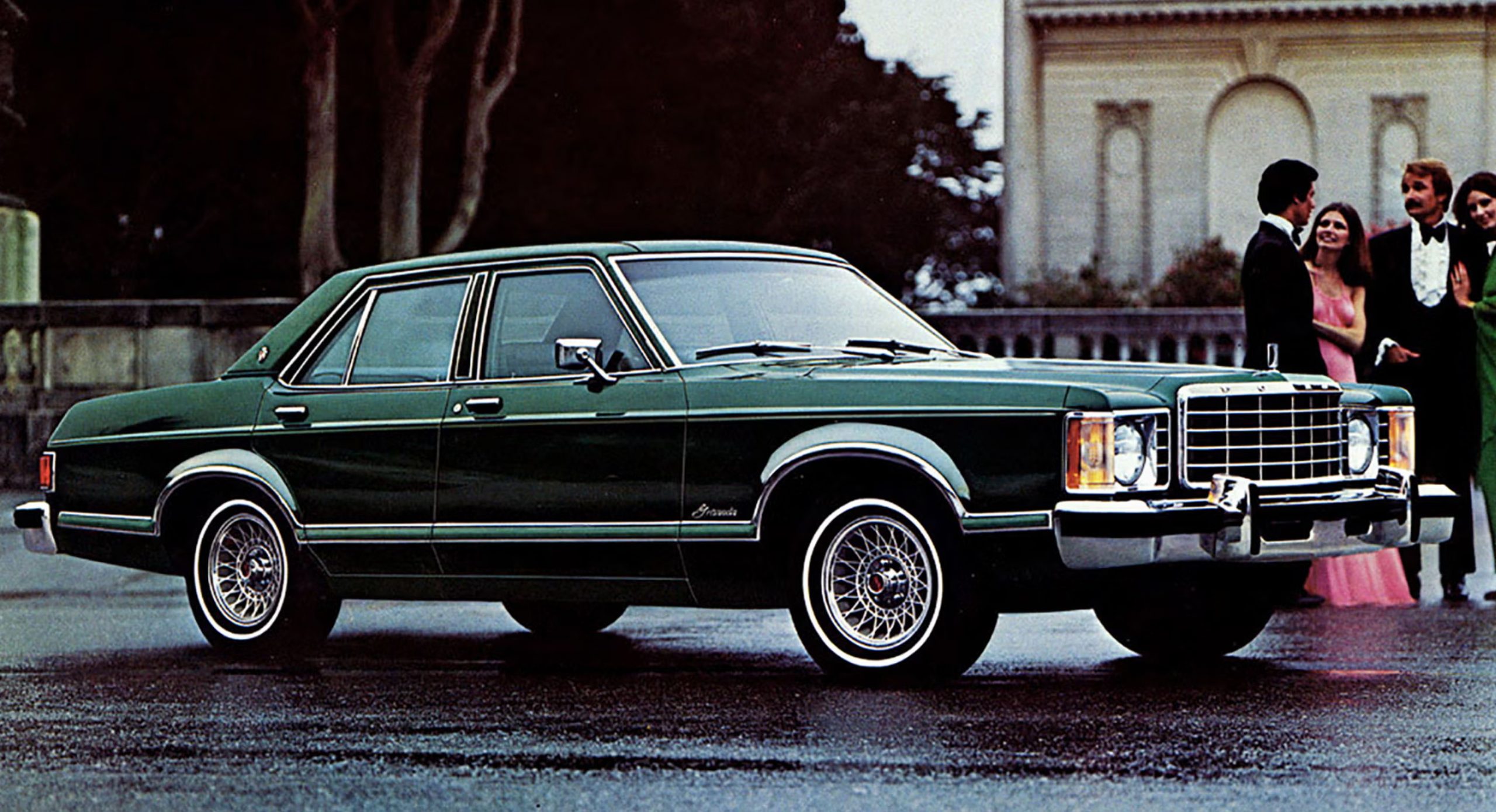
I’m dead serious; the Granada (and its Mercury twin, the Monarch) was an instant smash with buyers, selling over 400,000 in its first year. The chrome radiator grille and horizontal taillights with very-Euro amber rear turn signals were enough to convince people that this car had more in common with a Stuttgart-built creation than the Maverick/Falcon underneath its skin. The best part? The Granada wouldn’t really cost more than a Maverick to make, but they priced the Granada higher yet “still thousands less than a Mercedes,” a marketing move that made Ford gobs of cash on what would typically be a loss-leader size category of car.

Sure, next to a Starsky & Hutch-style Gran Torino the shape of the Granada looked a bit more like a Benz, but come on:
I remember reading a quote in an old car magazine where a Ford spokesman said that they took the Mercedes styling inside and out and added “more showbiz.” Yes, he really used those words, and you can see it.
Inside, that dashboard really shows that ethos. Shiny stuff and plastic wood everywhere, and essentially no instruments but a speedometer and a fuel gauge stashed somewhere amongst the controls.
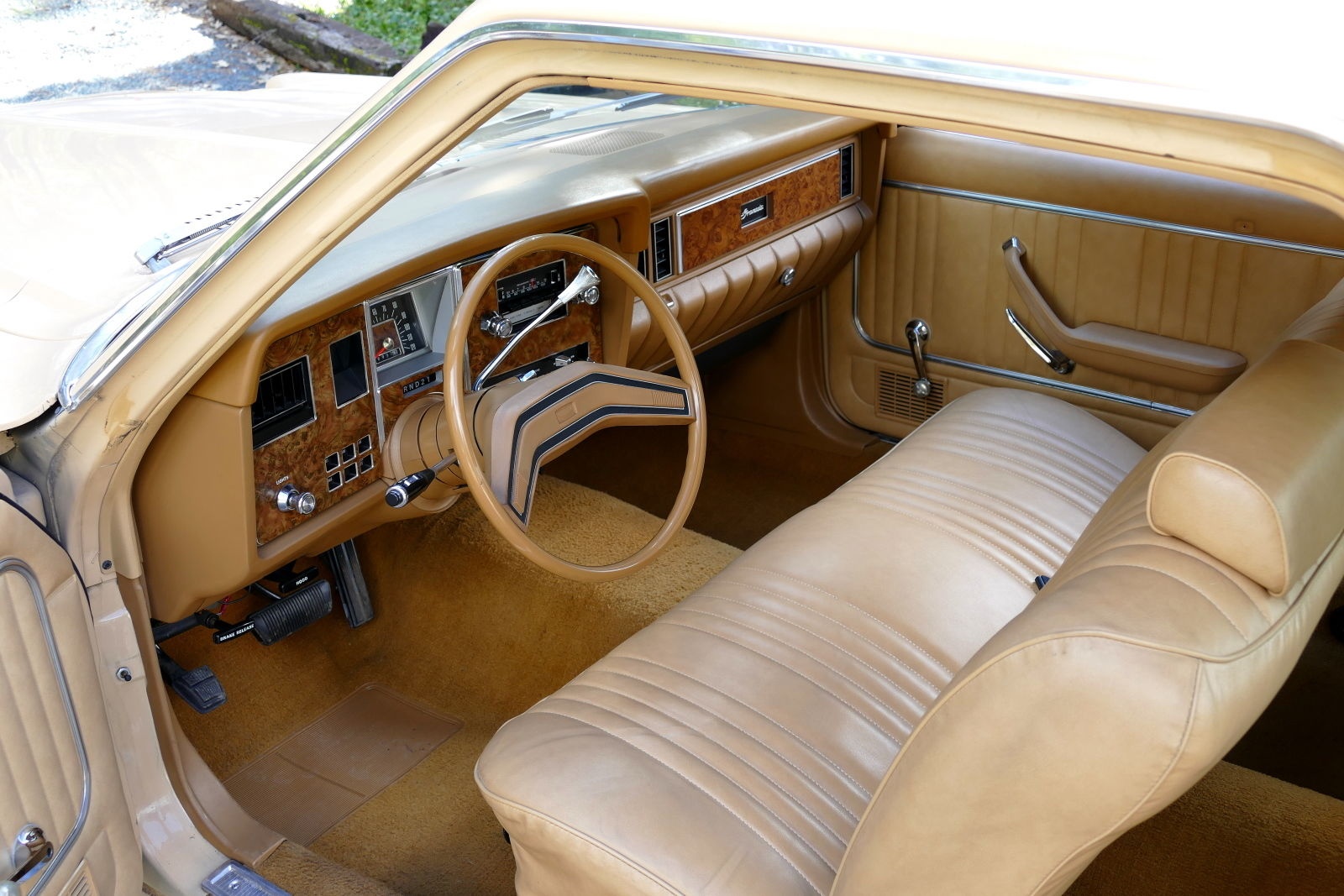
Under the sheet metal, you were just getting an old Maverick complete with the live axle in back on leaf springs. Base Granadas didn’t even come with power steering or brakes to go with the clunky “Thriftpower” 200 ci straight six.
Still, did it really look enough like a Mercedes? No, and just like dedicated-to-the-job celebrity impersonators getting plastic surgery to appear more like their idols, Ford knew they had to make an even more Mercedes-looking fake Mercedes for 1978. Enter the Granada ESS.
Mercedes Bent
Have you ever encountered a person who seems to have no concept of self-awareness? I’m talking about the all-hat-no-cattle types with nothing to back up their boisterous attitude behind their cellophane-thin cloak of respectability. That’s the Granada ESS.
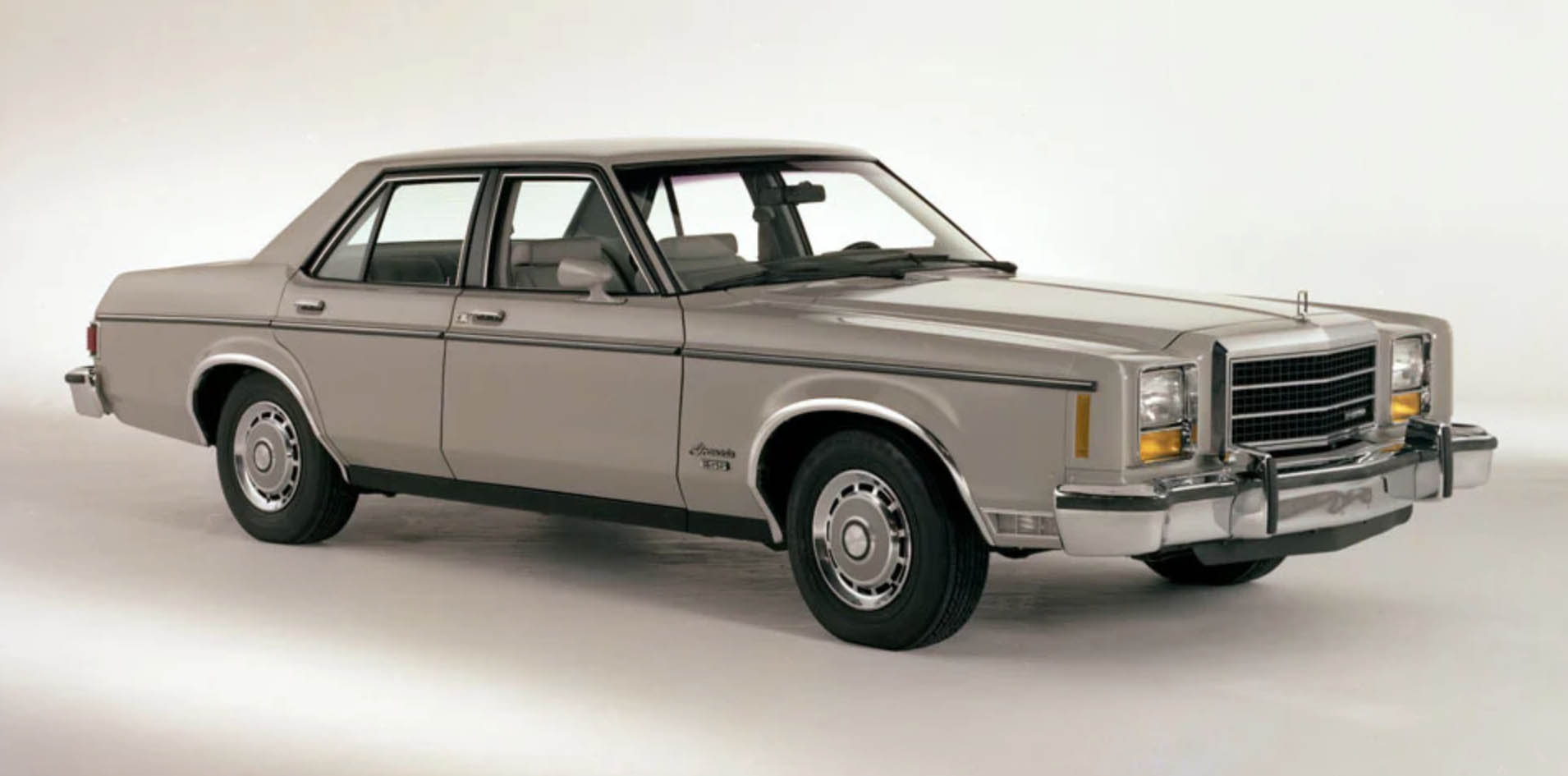
Color-keyed hubcaps with place keepers for three-pointed stars in the center? Sure. Blacked-out trim and logos with a blocky font to copy the trunk badges of a Benz? Got it. Ribbed taillights with amber signals? Yes, but these amber “lights” on later Granadas are just amber reflectors: Ford ditched the separate indicator bulbs and pocketed the cash.

Here’s the coupe with louvered opera windows that the above text says are “in the tradition of a European sport sedan.” What sport sedan would that even be?

Look at those so-called “European-type” Mercedes-shaped headrests! Were they serious?

In an ad, Ford even challenged you to discern the ESS from an actual Mercedes. Don’t peek at the answers first!

They just wouldn’t quit with the comparisons:
My favorite part of this is how Ford compares the Granada to a W116 S-Class that looks absolutely nothing like the Ford. Honestly, the only Benz it looked remotely like was the earlier W114 pre-E Class that was gone by then:
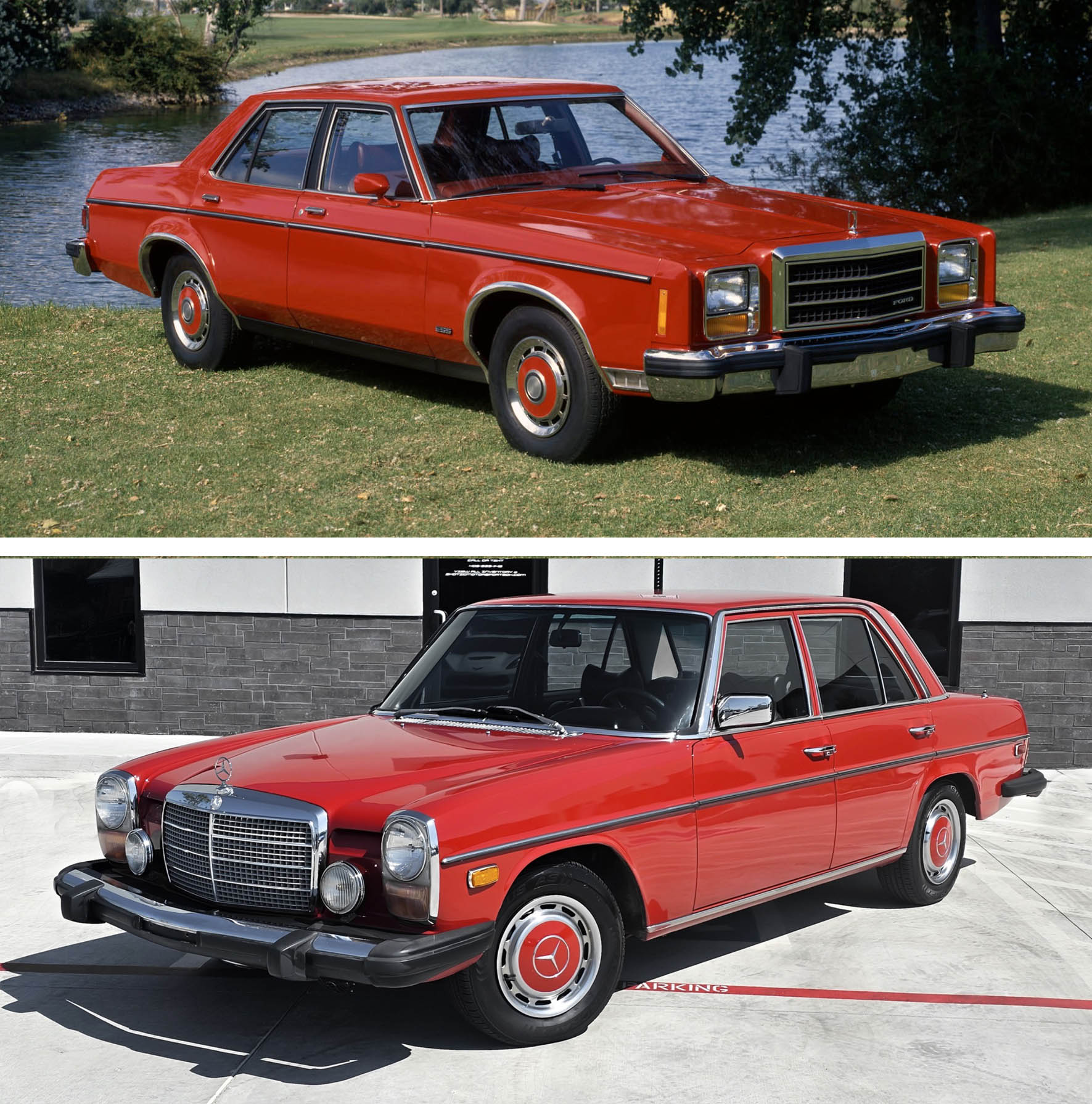
You want to know the saddest fact? Had the Granada truly been more like a Mercedes, it’s doubtful that as many Americans would have bought it. I think I can prove this pretty easily.
The Foxier Approach
Let’s face it: the Granada ESS was a bit of a joke. If Ford were serious about making a true European-style sedan they should have actually made an attempt to develop something where the “international” flavor wasn’t just pasted on. Ideally, they’d have built something with something like these parameters:
- Lighter weight than the Granada
- At least half a foot shorter than the Granada but more upright and far more space efficient inside
- Clean, purposeful, angular styling and minimal trim
- More modern suspension with something like MacPherson struts up front and coil springs in back
- Rack and pinion steering
- Bucket seats and full instrumentation in a workmanlike dash
Where could you have found an American car sedan at the time that fit that description? Well, if you were at the Ford dealership looking at the Granada or the Mercury store examining a Monarch, you’d have to walk at least twenty feet or so in the showroom over to a car Ford was already building at the time: the Ford Fairmont ESS and Mercury Zephyr ES Type.
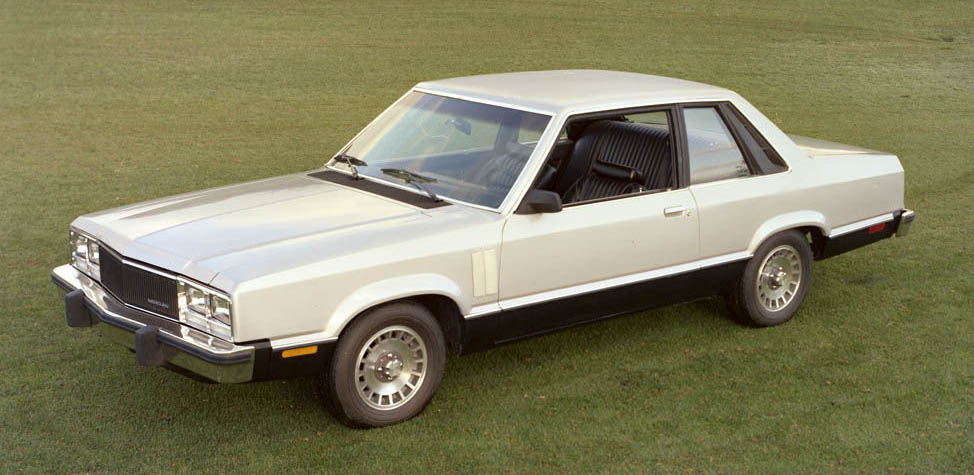
This was Ford’s first Fox body product in 1978, a car that began as an attempt at a “world car.” During the development of the global family car, Ford quickly learned that European and American buyers wanted very different things, and the Fox became a US-only product. Still, the bones of the Fox Fairmont were certainly based on the international design principles of the project. This clean and functional-looking car was not exactly a thing of unparalleled beauty, but then neither was a boxy BMW or a Volvo 240 (a car it was almost identical to in every dimension and basic technical specification). For 1979, Ford offered the “European Sport Option” for the Fairmont and its twin shown here, the Mercury Zephyr ES Type, with those awesome alloys. Just a straight-up no-nonsense design.
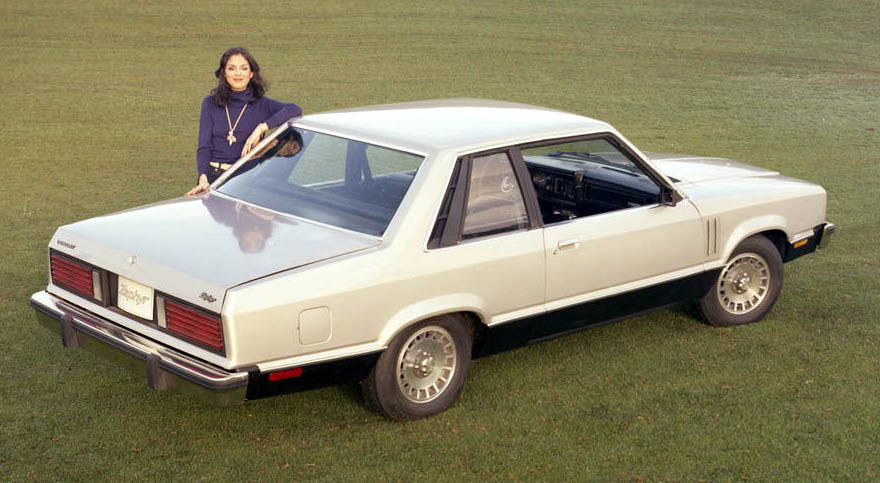
The ESO and ES Type package added a tighter suspension that included a rear stabilizer bar the standard car lacked, plus blacked-out trim, including the grille and rocker panels.

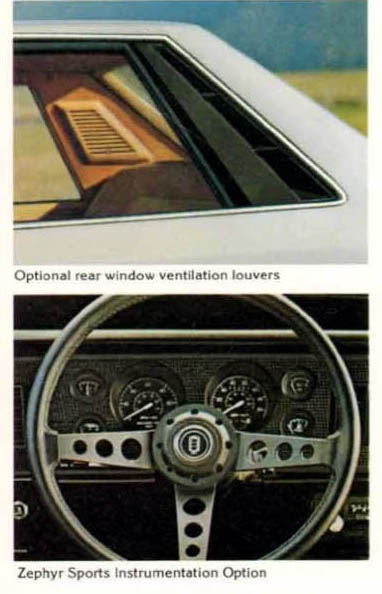
Even the black rear quarter vents were actual, functional air intakes for the back seat. Look at the ES dashboard; there’s a full set of round gauges, including a tachometer inside a decent steering wheel. There’s no “show biz” here, just honest design.
The ESO was essentially a Fox Mustang with a bigger back seat and trunk. You can see by the hood bulge with TURBO logo on the example below that the first four-cylinder turbocharged 2.3 motor was an available option for Fairmont, complete with a four-speed stick. Man, think of things you could do to this sedan with our current availability of modern Fox Mustang go-faster bits.

This Fairmont drove relatively well with a much lighter and more responsive feel than the Torino or Falcon-based predecessors. It was never going to challenge a 528i, but the pragmatic thinking behind it obviously showed that Ford knew better than to attempt the silliness they were doing at the same time with the Granada ESS, but they did it anyway.
There’s A Sucker Born Every Minute
I don’t have sales figures per model, so I can’t give an exact comparison between how many Granada ESS sold versus Fairmont ESO. However, as a car-obsessed Stranger Things-era kid, I was always aware of the vehicles around me; I know that I saw those fake Mercedes Granadas everywhere and hardly ever witnessed a Fairmont ESO.
This seems like unfathomable but undeniable proof that American buyers, or at least those of the seventies, would have rather had a distorted and glitzed-up look version of an imported sedan than a car that more closely followed the parameters of real European design. Once again, Lee Iacocca was right about the tastes of the market. Ain’t that depressing?
Top graphic image: Ford




Either the Granada or the Monarch were advertised as “Precision Sized” complete with a cut out template. On second thought the template may have been part of the satirical article in Car and Driver back when LJK Setright was still writing for them.
I was spared ever riding or driving one of these since we had a Volvo 164E, which was sort of like a well executed Granada with an OHV 6 and a live axle, but Volvo sprung for coil springs and a Panhard rod, plus fuel injection.
Lord have mercy, the Granada was a giant hulk of shit. It was based on a design that was already 20 years old, they rusted out when lightly misted with water, and they stayed together as if they were assembled by drunk 10 year olds. Not to mention that they were ugly as fuck. It’s hard to believe they sold a single one when you could get a Farimont, which was a much, much better car with modern underpinnings and didn’t look like ass.
I’ve never been a fan of the Granada. Bordering on hate.
I remember reading an interview with one of the design staff and they had said something about fun putting that car together was.
Fun?
All they did was scale the LTD down by 20%.. That’s barely work. More time for 3 Martini lunches though I guess.
“Here’s the coupe with louvered opera windows that the above text says are ‘in the tradition of a European sport sedan.’ What sport sedan would that even be?”
In keeping with the Mercedes theme, a 450 SLC.
The SLC is not a sport sedan. It says right there in the name (C for coupe).
And they said the Chinese were master copycats. Clearly America showed the way back then.
Except that their copying was more print “copy” than actual automotive design duplication. \
Only a blind idiot would believe that the Granada was anywhere near the Mercedes Benz in quality, appearance, performance, comfort or style.
I always thought American cars trying to be more European in the 80’s was hilarious and really bad. The quality, design, engineering and refinement was orders of magnitude better with a BMW or Mercedes of that era, even though it did obviously come at a much higher price.
Mr. Bishop, you forget America was still in the throes of the Great Brougham Epoch / Pimp Car Era. The Granada, Monarch, and Lincoln Versailles were undeniably more pimp than the Fairmont / Zephyr.
And they could have just imported the real Granada. Bah.
Way more expensive, would have been a better Lincoln Versailles, but, then, exchange rates
My dad had a 1979 Granada coupe as a company car. It was a slow, poorly built, pile of junk. His next car was a 1981 Buick Skylark that was a massive upgrade.
Dang, the sheer number! As a Xennial in a middle-class suburb I can absolutely confirm that these were EVERYWHERE in the northeast until they inevitably rotted or the target market (these *were* purchased by middle class folks) traded up to box Buicks /Olds or K LeBarons etc by 85-86, with the occasional Our friend who was a realtor had a loaded Granada for years. As for the Fairmont…they were bought by sporting types, weirdly; I remember my carpool buddies’ dad driving us in his tan on tan fairmont with actual driving gloves to school in 86-87 before he stepped up to a Country Squire that fall. Then it seemed everyone had a Taurus and then, the first person who had a whale Caprice in fall 91…..we all crowded the driveway to ooh and ahhh.
Ah yes, the “we’re too cheap to do the R&D required to develop engines that burn less fuel while still making decent power so let’s convince the public performance is dead and you can’t legally drive faster than 55 mph anyway and go all in on cushy seats, fake wood trim and gaudy accoutrements” era.
Mercedes themselves were actually pretty amused by this, calling out Ford on their “Conestoga wagon” suspension. They knew that luxury wasn’t about looks or comfort alone; it was about cars that actually drove better and would last.
Pity they gave this up to chase market share (for a while, at least).
The Mercedes of that era felt solid and indestructible. In comparison, the Fords felt like they were held together by Testers model glue.
There was a Granada print ad featuring an owner who’d gotten a parking ticket on which the vehicle make was entered as “Mercedes.” The owner was so thrilled he contacted Ford about it. That tells you all you need to know about the target Granada customer.
That was Elaine Finkelstein of Manhasset, NY, who had her Granada mistaken for a Cadillac
Ford Granada…the official car of “every third vehicle in the elementary school teacher’s lot” (credit: Mr. Regular for the inspiration)
I remember seeing that print ad, showing it to my brother, and we both laughed our heads off. Kids.
I remember thinking “what an ugly car” as a 7 year old kid when they were new.
The Lincoln Versailles version of the Grenada was the first vehicle marketed in North America with clearcoat paint and halogen headlights.
“Almost every Versailles was given a ‘dual shade’ (two-tone) paint job, an 80 dollar option. With flashy, long-lasting paint, the Versailles would later become the perfect drug dealer’s car. Lincoln wisely anticipated this, and proudly displayed in its 1977 press release that for only 416 dollars, the Versailles’ front seats were capable of reclining to a position now known as the ‘Gangster Lean.'”
Still had some bad orange peel issues regardless
I remember that steering wheel in the Fairmont, I used to drive my mom’s Mustang with that same wheel. It was pretty comfortable putting my hands on the metal spokes and my fingers in the holes in the spokes, but then I started thinking what happens if my tires hit something and the wheel jerks?
My grandma had a dark blue ’76 Granada coupe (no idea what trim level but no power locks or windows) – dark blue outside and in but the seats were vinyl. In the summer if you didn’t have a towel to sit on it would just about remove your thigh skin.
I actually prefer the look of the earlier round lamp Granada. In grade school, dad had a Fairmont. Even as a little kid, I could tell it was MUCH more modern than the Granadas I would see on the roads in the early ’80s.
WTF!? I paid 20K for a MERCEDES that looks just like a Granada ES? 😉
Even as a small child I knew, as did just about everyone else, that 70’s American cars were warm garbage.
Indeed they were!
When I was a wee lad, my neighbor bought a brand new 4Dr Granada, I remember that it was Powder blue and I also remember that after just three Michigan Winters his Granada had no rocker panels! I would not be surprised to learn that these cars rusted while in the showroom! 😉
( Like most all 1970’s cars) 🙁
My grandparents’ Ford Galaxie had bad windows from the day they bought the car but never bothered to take it back to the dealership.
I remember reading in Henry Ford II’s biography that in the 1960’s all of his rich Grosse Pointe friends were buying Lincoln Continentals that were all ridden with factory defects and that all of his friends were bitching to Hank the Deuce that the dealers were unable to fix them!
He got so fed up that he told his friends to stop buying them!
The Granada was also the most under-powered car of the Malaise Era. Certain variants approached 50 lbs of curb weight per HP.
Curbside Classic called it “The Most Malaise Car Ever“.
Yes! They were super heavy.
Kia pretty much used the exact same formula for the Amanti back in the early 2000s.
Hyundai and Kia aped many of the luxury models as they attempted to build a reputation of quality over the years.
I thought the original Genesis cars looks an awfully lot like an S Class when they debuted.
The Kia Amanti looked very MB-like from the rear and sides. However, the face on the Amanti was like a Merc with stage makeup — just too much of everything.
Marge, is Lisa at Camp Granada?
We watch that episode every Christmas.
Hello Mother, hello Father…
Hello Mudda, hello Fadda. I adore this song.
My buddy inherited his grandpa’s Grenada back in the day. It was silver with red interior, pretty loaded, I think it even had a 302.
It was in fantastic shape when he got it, but before long it fell apart.