


This weekend, I took a little pilgrimage to the very edge of my state to see something I’ve been meaning to see for years: the place where the Wright Brothers (I’m actually thinking maybe we start calling them the Wright Siblings, because their sister Katherine was absolutely crucial in making everything happen) took their first world-changing flight way back in 1903. There’s a nice granite memorial atop a big sand dune and a small museum, but considering the scale of what they accomplished, it’s really pretty modest.
There is, of course, so much that can be said about the Wrights and what they accomplished there, but this is Cold Start, so I just want to focus more tightly on one smaller yet absolutely crucial aspect of the whole thing: the engine they built to power that first Wright Flyer. It’s so much stranger than I realized!


I had always heard that the Wrights decided to build their own engine for the Wright Flyer because there were simply no options that met their requirements when they were building that first airplane in 1902. Those requirements sound quite modest by today’s standards, but they may as well have been asking for an engine that ran on dog poop and whose exhaust was pure happiness rays back in 1902. What they needed was something that made at least 8 horsepower (more would be better) and weighed under 200 pounds. No contemporary automaker could do that, especially when faced with an order quantity of one (1) engine.
What they eventually came up with to meet these requirements is one of the strangest engines I’ve ever encountered. It’s an absolute masterpiece of crude minimalism, almost shocking in what it doesn’t have as much as what it does. I first realized I was in the presence of something strange when I was looking at the reproduction Wright Flyer (built in 2003 for the centenary of flight) at the museum in Kitty Hawk (they have the original broken engine block on display there, but the actual original Flyer (which was actually re-built by Orville Wright in 1928) is in the Smithsonian Air and Space Museum in Washington, DC).
Looking at the plane, I tried to identify the engine bits I was seeing:
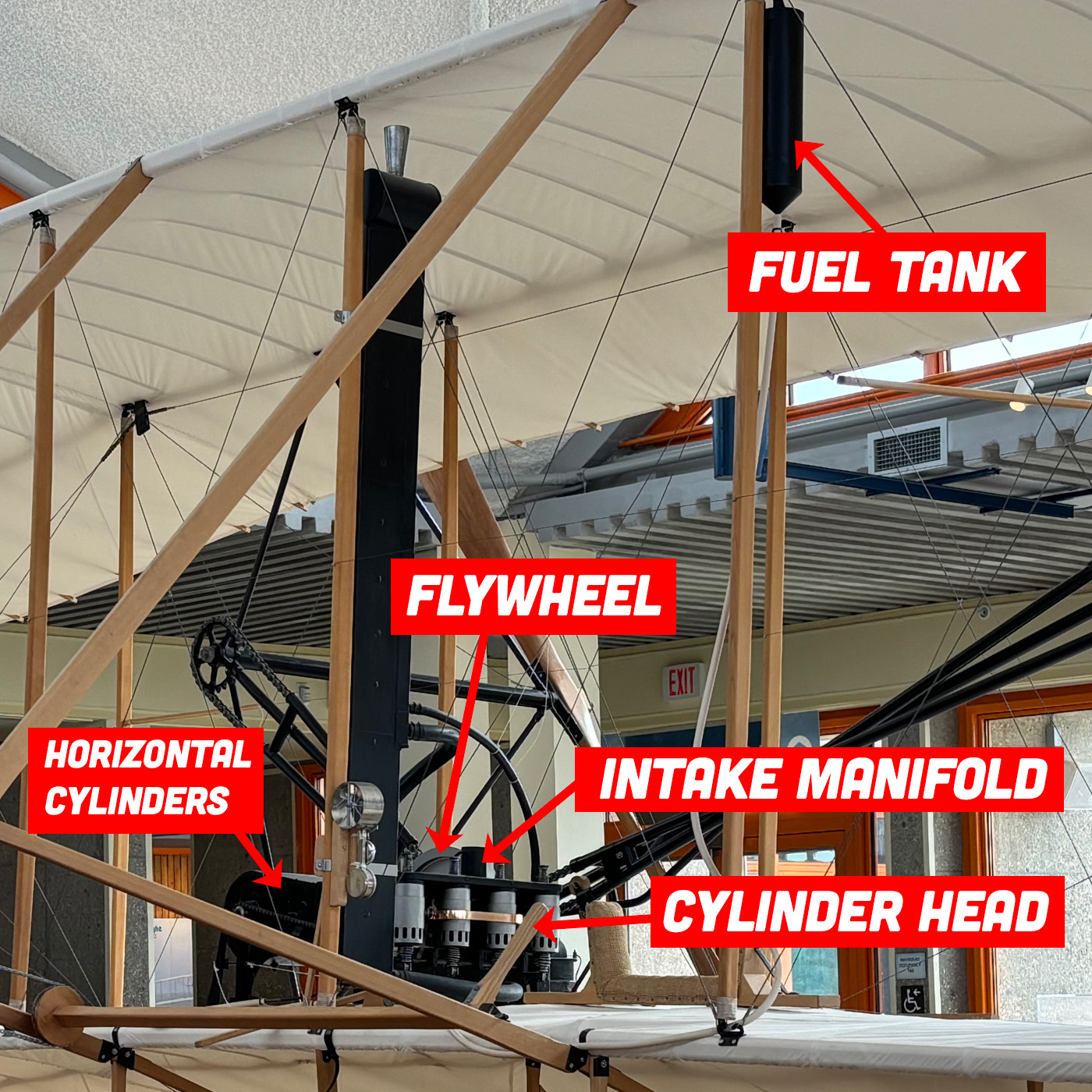
So, most of that stuff made a general sort of sense, at least from a distance, But I still had one big question:
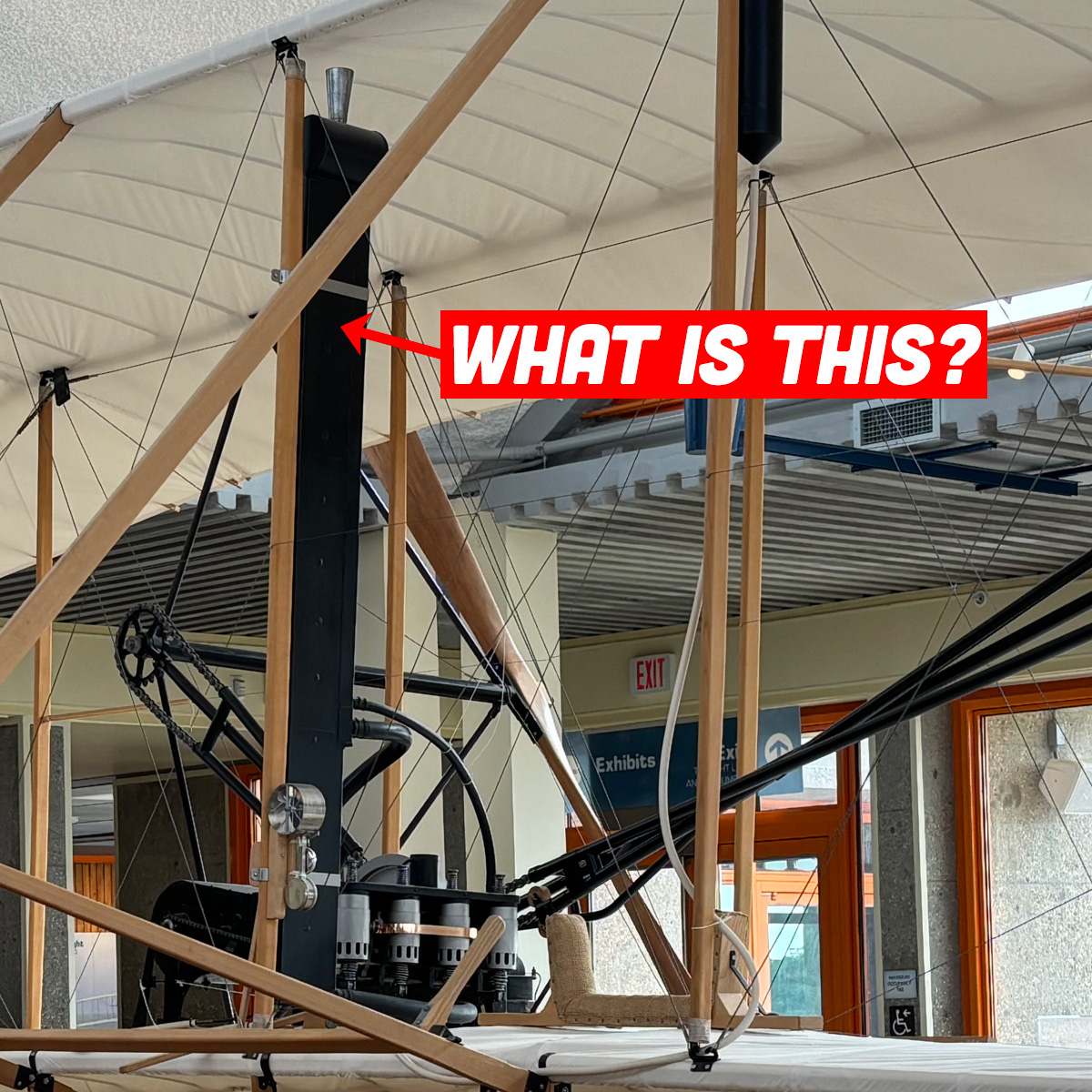
What the hell is that tower thing? It seems to have some sort of air intake funnel on the top? I mean, I thought it’s for air intake, but I now think I was wrong, because I asked a docent about it and they told me it was the radiator. Well, sort of. Here’s a video from the museum’s site that also calls it a radiator:
The problem is that it really isn’t a radiator, but it is the primary means of cooling the engine. It’s really just a water tank, because the way the cooling system worked was that water would flow out of that vertical tank via gravity, get splashed into the engine block, where it would turn into steam, and then more water would replace it. That’s it. That’s also why I now think that funnel up top was just used to fill the tank with water.
This sort of ultra-minimal approach is what defines all aspects of this engine, which was built by the bicycle mechanic at the Wright’s shop in Ohio, Charlie Taylor, using only a lathe and a drill press. Here’s how Taylor described the engine-building process:
“We didn’t make any drawings. One of us would sketch out the part we were talking about on a piece of scratch paper, and I’d spike the sketch over my bench. It took me six weeks to make that engine. The only metal-working machines we had were a lathe and a drill press, run by belts from the stationary gas engine.”
Taylor had the engine block cast out of aluminum, a pretty cutting-edge material and process back then, by an outside company, but everything else was pretty much hand-made by Taylor, even complex parts like the crankshaft, which Taylor lathed from a block of steel:
“The crankshaft was made out of a block of machine steel 6 by 31 inches and 1-5/8 inch thick. I traced the outline on the slab, then drilled through with the drill press until I could knock out the surplus pieces with a hammer and chisel. Then I put it in the lathe and turned it down to size and smoothness.”
This engine was so clever and crude, all at the same time. It was an inline-four, laid horizontally, displacing about 3.3 liters. It weighed about 190 pounds and made 50% more horsepower than they originally required, a massive 12 hp at a lazy 1,025 or so RPM. It actually made about 16 hp at startup, but when it warmed up that dropped to 12.
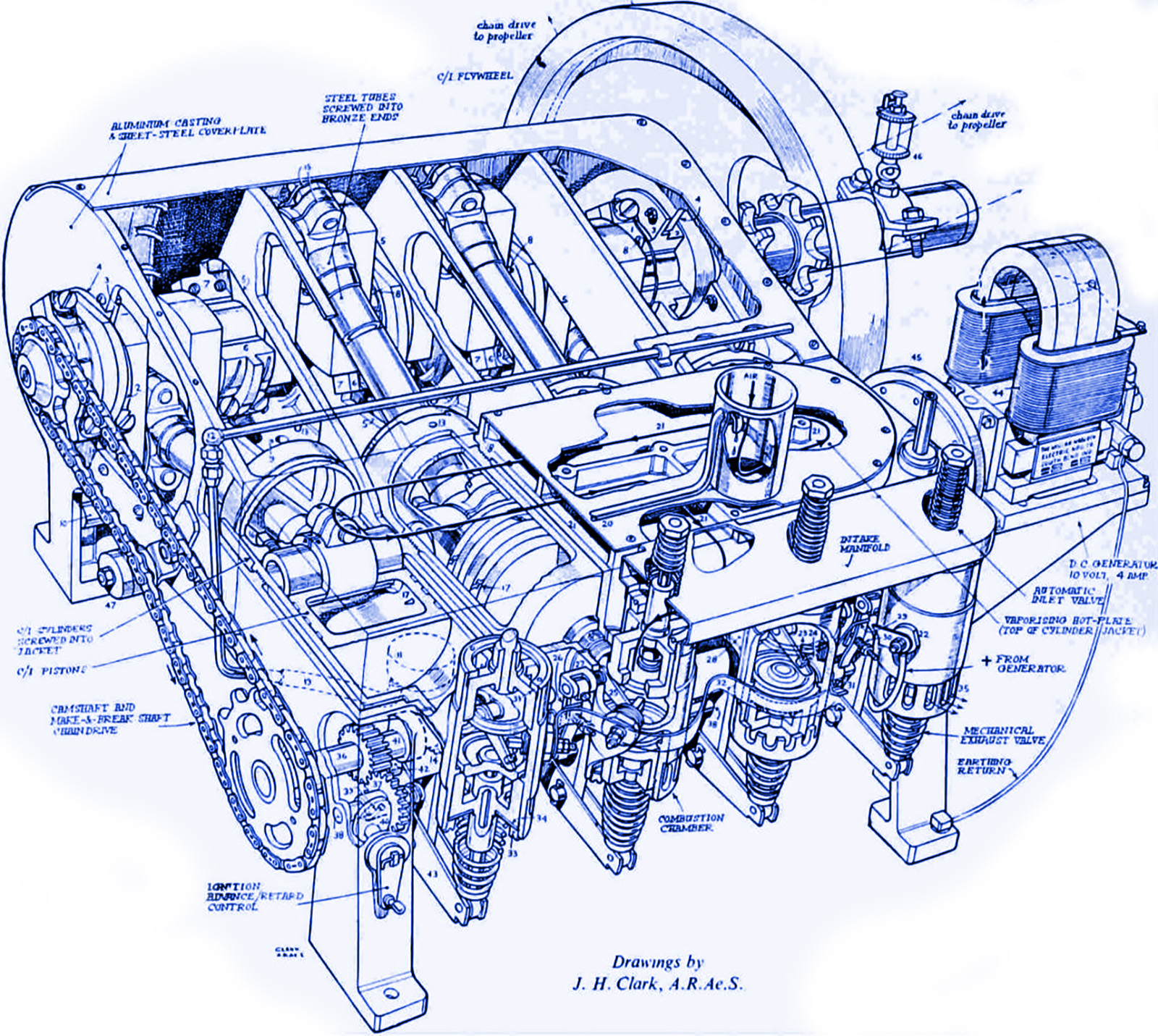
There was no carburetor! There was basically just a tube that raw gas just dripped down into, fed by gravity, which then landed on what was basically a hot tray that vaporized the gasoline, and that vapor got sucked into the cylinders. No throttle, this thing ran flat out all the time. There wasn’t even a mechanism for the intake valves to open; they were just pulled open by the vacuum of the piston in the cylinder during the intake stroke!
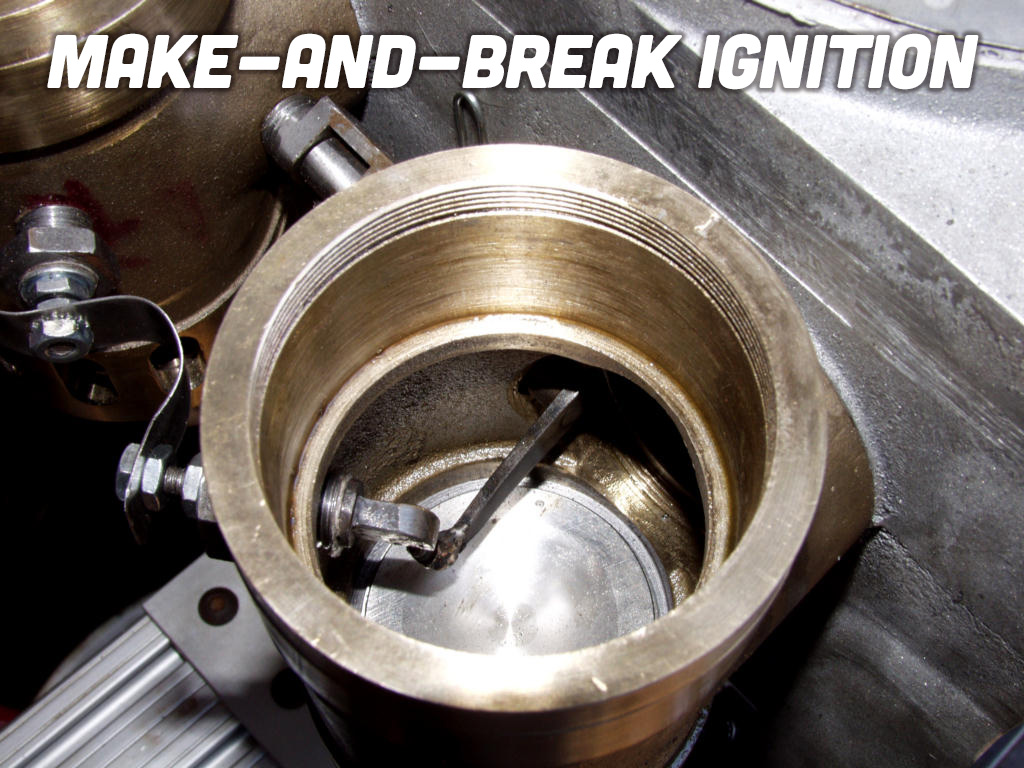
The minimalism keeps going into the cylinders themselves, because there weren’t even spark plugs in here, just what was known as a “make-and-break” ignition system wherein little arms driven off the camshaft would make contact with a point, creating a spark. The electricity for these points was provided by a 10-volt magneto. There was a stationary dry-cell battery used to start the engine, which was kept on the ground. You can see the battery rig in this picture:
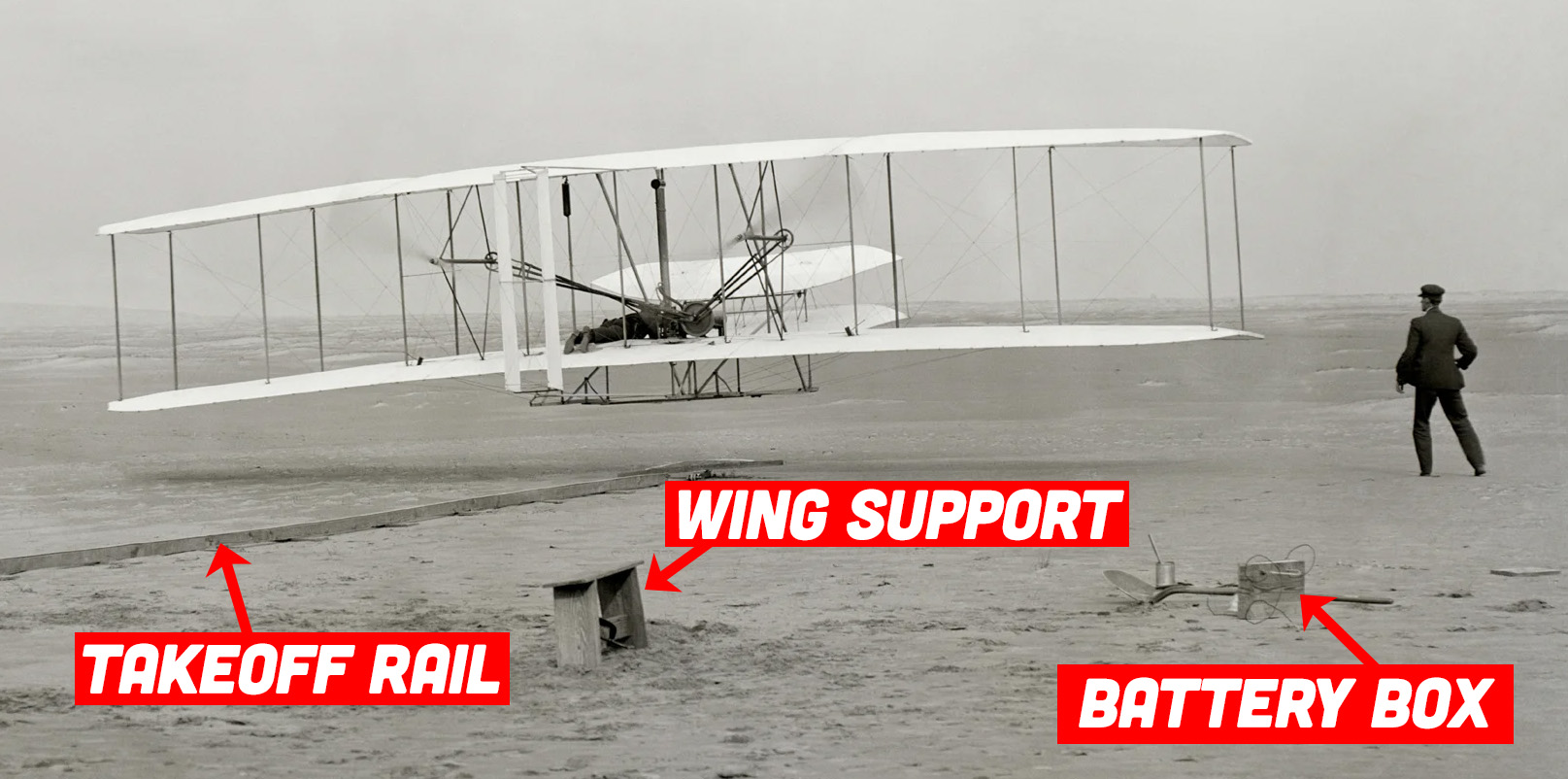
So, we have an engine with no fuel pump, no distributor, no carburetor, no water pump or actual radiator, cylinders that weren’t even actually bored out (they just relied on the piston motion to seat the rings, etc), no mechanical method to open the intake valves, and yet this incredibly crude and stripped-down engine worked well enough to spin two propellers and push the world’s first airplane into the air.
It is clearly not an engine designed to run for long periods of time, and the power-to-displacement ratio is hilariously low by modern standards, but in 1903, there was literally no other machine on the planet that could do what it did. It’s an incredible reminder that sometimes the most advanced problems need the simplest, most basic solutions.
Seeing this place where the world changed forever was genuinely inspiring, and it makes me feel both more determined and embarrassed about my Citroën 2CV, which has a similarly crude and basic engine, and how I need to get that thing finally running right.
How have I never known more about this incredible engine? How is this engine not talked about more when discussing famous, world-changing engines? I think we should all devote a little time today to be inspired by this crude and clever little engine. I know I am.
All images and top graphic, unless noted: Jason Torchinsky


You mentioned the original block cracked in half…what happened? Crash or did their cooling system give up the ghost? Certainly not judging as it’s beyond impressive, just curious what killed it.
Wind gust flipped the plane on the ground and smashed it.
What an ignoble way for it to go. At least it happened after it made history.
We can laugh at the Wrights as bicycle mechanics now, but in 1903 the bicycle was cutting-edge tech. Imagine traveling without a horse to feed and house! The safety bicycle even more so.
I knew the Wright’s engine was unusually light but never knew the details. It’s astonishing that less than 10 years later Gnome-Rhone was making a 9 cylinder rotary engine that weighed less than 300 lbs and put out 81hp.and under the pressure of WWI Bentley came up with a 200hp rotary, before they became a dead end supplanted by radial engines
That was something I took away from my time there. It seemed like the Wright Siblings created the catalyst for the airplane industry. What other “inventions” do you think had the same trajectory from invention to integral difference?
Consider me inspired!
Very, very interesting. I’m ashamed to admit that I never really gave their engine any thought. I assumed they bought it. The total loss cooling system is hilarious, but it got the job done. Way to go, Siblings. One of the most amazing facts ever is that we went from Kitty Hawk to the Moon in a scant 66 years. Yay us!
I had the same feeling — I’ve seen the replica in DC, “dad-splained” the various parts of it to my kids, and somehow never even considered all this weirdness that was right in front of me.
Even though the power-to-weight ration leaves a bit to be desired, they didn’t know that at the time. The idea that you could have the power of TWELVE horses (approx) in a compact machine that weighed a fraction of even one real horse…it must have been mind bending.
Jason, interesting, you’re getting precariously close to Mercedes territory.
As someone who has lived twenty minutes away from Stuttgart-Untertürkheim for years, I cannot see any danger in that 🙂
I don’t know if it was featured on television ads for M-B in Europe, but seeing late 60s sedans flying around the test track on the ads in the US was mind-blowing. But of course, you know I was referring to Ms. Streeter.
https://external-content.duckduckgo.com/iu/?u=http%3A%2F%2F2.bp.blogspot.com%2F_leoGYAeiH44%2FTMg_x2YvK2I%2FAAAAAAAAL3M%2FOXpRkqYZWSQ%2Fs640%2F5070411.001.1M.jpg&f=1&nofb=1&ipt=acc2e691cf1144c496dac908ca2cca9ac7c9454148c87379d012bb0970dffdd0
Hopefully that link works for you, but if you just search the test track and include bus in the search, you’ll find the wildest still photo I ever saw from there.
Of course 🙂
That test track is still alive – you even can see a section of it peeking from the upper levels of the Mercedes-Benz Museum.
As a TV news photographer, I got to lap the Indianapolis Motor Speedway in the mid-80s. In an employee’s daughter’s Datsun B210 as long as I didn’t exceed 40 mph/65 kph and didn’t pass the tourist bus also making the lap. I didn’t do either one, but it was and is still fun to say I’ve done that.
To be honest, these days, I’d rather be a passenger on the test track than behind the wheel.
There are also other crazy pictures of M-B sedans pulling trailers/caravans on “the wall.”
Back in the 90s, I got to watch Ferrari prototypes running around their test track in Fiorano.
I had a pretty charmed career.
I lapped Indy in a 1948 Plymouth with the flathead six. Still limited to 40mph, but… The muffler was gone, so a few times I pushed the clutch in and stomped the throttle just to hear the throaty roar of 90hp echo back from the empty bleachers. Not sure the other guys in the Plymouth 4 & 6 Cylinder Owners Club really appreciated it.
I might have done exactly the same 🙂
That‘s a summary to be proud of, I think 🙂
https://www.youtube.com/watch?v=voDVD-9itbo
I have a stationary engine from the 1920’s that uses engine vacuum to open the intake valve. The exhaust has a rocker arm and pushrod that is actuated by a connecting rod on an eccentric disc. It has no crankcase but uses an oil drip system that directly lubricates the piston and grease cups to lube the bearings. The cylinder housing has a big reservoir cast directly onto it which holds about 1.5 gal of water which steams off over time as it runs.
It weighs about 200# and produces 1.5hp at about 600 rpm. But it is still going strong 100-ish years later and should be able to keep doing so for a very long time.
https://www.youtube.com/watch?v=4pDcKZ_WhCY
Ah, yes, the humble hit n’ miss. Always like the “shuuuu-putt” sound they make when firing.
This one is not actually a hit n’ miss, but a throttle governed engine
Ah, neat!
Nice! The Wright cooling system seems a lot like the remote reservoir cooling systems on some of the hit-and-miss engines I see at the Oregon Steam-Up.
I always love how the hit-and-miss engine regulates its speed by leaving the exhaust valve open unless it needs to draw fuel and fire.
Quite astonishing! Yeah, such a weird mix of utter crudeness & genuine sophistication.
Great write-up! Yeah, seconding the comments from people wanting more articles about those things (including more about Katherine Wright!) especially since it’s all too easy to forget just how clever our forebears could be, like how, for instance, Léon Foucault (yeah, of pendulum fame) used rotating mirrors to measure the speed of light through air in 1862 (!!) and achieved a remarkably accurate measurement that was only 0.06% off from today’s accepted value.
More pedantry: camshaft would
makebreak contact with a point, creating a spark.FIFY. Breaking the point contact would induce the spark, making contact would create the capacitance, or shunt it to other cylinders, details on the generator are sparse. No coil is shown (I’m not sure that was a thing, my earliest engine experience is 1912) I’m surprised they didn’t use a magneto and spark plug, since both were available at the time, magnetos can provide timing, and the generator wasn’t needed for anything else.
We need a wacky early aviation engines series!
Glen Curtiss got his start building motorcycle engines. I would love to see an article on his progression to flight.
Santos-Dumont and Buchet collaborated on a series of weird engines. I would love to know whatever the hell is going on with this thing powering the No. 6:
https://www.meisterdrucke.us/fine-art-prints/French-School/1015405/Santos-Dumont-and-Buchet-visiting-the-engine-in-the-hangar-(engraving).html
Interesting example of the engine being designed for exactly one specific purpose. It would be completely useless in most other contexts, but here it was perfect.
Full deep dive article when?
David McCullough’s book on them is very thorough and fascinating. Highly recommend.
2nd this. An amazingly well-researched read. The idea that the world knows them as “Bicycle mechanics” is laughable. They knew machining, metallurgy, aerodynamics and how to fly a plane. None of it would have happened without all of the knowledge.
How to fly a glider? Planes didn’t really exist when the Wright brothers incorporated wing warping controls in their glider in 1899.
Exactly. They figured out they were going to have to learn how to fly this thing they build. There were others that were doing good designs, but had the unfortunate downside of crashing in them and dying, thus stopping the development.
The Wrights knew you had to get down from the flight to keep the process going!
I really can’t think of any aviation engine that is a good fit for general automotive use. The Westinghouse J46 out an F7U fighter might have been ok for the Green Mamba, but not in your daily driver.
And I don’t read about many (any?) Continental or Lycoming conversions going on.
yeah makes sense given the totally different use cases. Aviation engines run more or less at a constant RPM for long stretches, while autos are all over the place all the time (and rarely at wide open throttle). I’m not smart enough to know how you optimize for both scenarios, but it makes sense you’d end up with different designs.
IIRC, the boxer six in the back of Tuckers was a Franklin / Air Cooled Motors helicopter engine. Light(ish) and powerful, but also an expensive component that might not have been feasible if they reached true mass production.
You know… I think I read that somewhere too.
And I thought the RPM range of my TDI was limited. Imagine having a redline of like 2,700.
Old engines are fun to work on. Worked on an ancient Rolls Royce engine and everything is just bigger in the hopes that it made it stronger. I loved the castellated nuts with cotter pins holding the rods together.
interestingly enough, their abandoned factory is in the works to be taken over by the national parks service. it was on an episode of mysteries of the abandoned hidden america season 2. really cool stuff. i always wondered how they got outpaced when they got it right first. according to the show they spent more time and money tied up in court over patent infringement that they neglected R&D.
Hot take: the Wright technology was a dead end, and the airplane as we know it today was developed in France by Brazilian aviator and inventor Alberto Santos-Dumont, who flew his 14-bis in 1906. The aircraft we fly today largely derive from that aircraft, not the Wright Flyer.
As you note the Wright family (which included sister Katherine in the decision making process) devoted much of their effort to preventing others from capitalizing or improving on their work, rather than focusing significantly on future development.
Still, ’twas cool, and they deserve their place in history.
Yes! Absolutely.
oh, absolutely. the wing warping technique was never going anywhere other than live on in a glider if that. it managed to get them airborne but but without the advent of flaps, ailerons, and elevators, flight couldnt advance.
My first thought was that Chuck Taylor (the other hero in the story) was making his engine with just his imagination.
Essentially using his eyeball to guide a lathe, hammer and chisel and few other basic tools. This was akin to Michelangelo making the statue of David out of marble 400 years earlier. It’s basically a one-off piece of mechanical art.
Fun fact: if you hold a US Airframe and Powerplant certificate, the plastic card bears Charles Taylor’s portrait.
https://www.faa.gov/licenses_certificates/airmen_certification/charles_taylor
That is a fun fact!
I love that certain historical people/heros are remembered in their niche communities, especially when not known at large. That’s great.
Atmospheric (a.k.a. automatic) inlet valves were commonly used on internal combustion engines at the time. They work well enough at low RPMs but succumb to float at higher speeds.
I would love to see an Autopian article about the various people that claimed to be the first to fly heavier-than-air aircraft, and the validity of their claims. It’s amazing how close of a race it was, and how nebulous the results remain.
See: Sir Hiram Maxim (1840-1916). In the late 1800s he got a steam powered winged thing to create sufficient lift to rip out the railroad tracks it was anchored to.
Maxim’s big insight was that he needed something lighter than a steam engine to have a real airplane.
Hence the beauty of the Wright Brothers’ engine was it was built for one, and only one, purpose. To fly.
“Steam powered winged thing” really paints a picture.
Include Lyman Gilmore in that list. Interesting character. His airfield is now a middle school.
Love the breakdown on the engine. Had zero idea it was so simple.
That memorial needs better marketing from the entrance on US 158. You can’t see anything other than the entrance/exit roads and a grass berm from 158, nor the publicly accessible other sightlines. The entrance itself is really unremarkable … if you don’t know you’re looking for something, it looks like the perimeter entrance to any office campus albeit with modest NPS signage.
Apparently the adjacent GA runway (FFA) is operational. We vacation on OBX nearly every summer and I have yet to see a plane take off or land at that airstrip … NPS should leverage that more for events and such if they can.
The verb for making something on a lathe is turn not lathe. Please don’t verb nouns
SuperfastMatt would like to have a word with you.
This turned into a very pedantic comment.
Well played, I think?
Absolutely. Verbing weirds language.
“Verbing weirds language.”
You used the noun “verb” as a verb intentionally for ironic effect, right?
TIL the word verb is actually a noun. my head hurts.
Its a British thing. Irony and sarcasm are really the only types of humor we have
It all feels very Gilligan’s Island, but with less coconut shells. The Professor would be proud.
Sadly, the memorial in Kill Devil Hills is to be renamed the Trump-Wright Memorial as the President has now declared himself to be the “Godfather of Flight.”
Plz not to give them ideas…
It really bugs me how plausible that is. I mean, it’s utterly laughable and implausible, except…
I’m waiting for him to revive the Boeing SST project.
Just paint it gold and he’d be all over the idea.
Just after he returns Amtrak to its Age of Steam glory (yes I know Amtrak was much later, but I promise you he doesn’t).
“Amtrak trains will now be running on CLEAN COAL…Thank you for your Attention to this Matter!”
lol. beautiful, strong, american, coal. the best coal. the rest of the world wants our coal but they need to be much, much nicer if they want to have any.
He probably has ordered someone to figure out how to make planes run on coal
Most avgas still has lead in it, so that might be good enough for him
This may be the first time I’ve ever seen a write up on the engine itself in detail. I love a little shop hack of an engine. The thing flew a couple times that day, if I correctly recall. Flight 2 was much longer and demonstrated the controlability
The cooling system is interesting for its similarity to the cooling of some hit-and-miss engines with their water box on top of the cylinder. Just I imagine this engine boiled more water faster, being a four, hence the tank.
Bonus as the plane got lighter the further it flew (in addition to loss of fuel)
You can buy an 8hp engine from Harbor Freight for $250. I ran that backwards through an inflation calculator, and if the Wright Brothers had a time machine, they could have bought an 8HP engine for about 7 of their dollars. And it weighs under 60 lbs.
At just 60 pounds instead of 190, 8hp would have likely been more than enough. The entire plane weighed just over 600 lbs; with a cheap little Chinese Predator instead of the Wright’s mill it doesn’t even crack 500. Huge improvement.
Hmm. Let’s add back another 15 pounds for a speed reducer, since the Wright’s engine turned over fairly slowly and the Predators need every bit of that 3600rpm. Call it 490 pounds, built back with a Predator.
The propellors (yes, plural) on the Wright Flyer were driven by chains. The only speed reduction needed would be a different size sprocket. Weight difference should be minimal.
Dang it, that’s right. I completely forgot that. Never mind, we’re back to a ramp weight of 475 pounds.
It’s absolutely wild to me that, featherweight as it is, that’s still nearly twice the weight of a CFR 103-complaint aircraft. And there are dozens of 103-complaint aircraft to choose from.
Please don’t tell David Tracy. We all know that things would spin wildly out of control.
I’m waiting for some youtuber to actually do this.
I read a Wright Brothers biography 35-40 years ago (and it was oriented towards children, which I was then) and vaguely recall that they really did not want a one-cylinder engine for the flyer. I don’t remember them detailing why, maybe it would have vibrated the toothpick-construction apart… But recall that wanting it to be more-than-one cylinder being a factor in the decision to build their own engine.
That’s a long way of saying, I still don’t think they would have been happy with the Harbor Freight engine, but is still incredible that I could walk into a store today and come out with a working and reliable engine vs what they had to create by hand. 🙂
If you’ve ever ridden a thumper motorcycle (large displacement single cylinder) you know that there are a LOT of vibrations at low RPM. I’m sure that a single-cylinder engine of the era would have been pretty miserable. The Predator solves a lot of that problem by operating at a relatively higher RPM.
I’m out of my wheelhouse here, but it strikes me that a one cylinder would create a pretty ugly power pulse situation. I don’t know how props (and, what, 20 feet of chain?) would handle that. but just a guess.
They needed something more reliable.
I was there a couple years ago and didn’t take note of the engine details, so thanks!
It may be a fairly modest place, but it’s pretty cool to be able to walk the markers showing the initial flight(s?). Definitely worth a visit.
The Wright Brothers brilliance was their early recognition that power and control was key to sustained flight.
There were experimenters that were great at power…and others that could build crazy good kites/hang gliders.
But the Wright Brothers’ genius was their understanding of just how much energy was necessary to sustain a controlled flight. They balanced the weight of the motor with the energy output they got out of their propeller and lift they could generate with their wings.
They understood the entire equation before everyone else in the field.
Next to the transistor, and discovery antibiotics, probably the most impactful human invention of the past 200 years.
It still boggles my mind that we were able to go from the wood frame and cloth Wright sibling creation to landing on the moon in less than 100 years.
Indeed. Just 66 years, to be precise!
More precisely, 65 years, 7 months, 3 days, lol.
Yeah, funny, as today is actually my grandmother’s birthday; my siblings & I were observing that it’s always astonishing to think that since she was born in 1903 and lived until 1976 she was born before the Wrights flew and lived to see people land on the moon. Indeed, there were people who were *full-grown adults* when the Wrights first flew and were still alive for the moon landings…
My wife’s great grandmother traveled the Oregon trail as a young wife and mother. Had to bury her infant son on the trail. Later in life, she was able to fly back to the East Coast to visit family.
And in only 56 years after THAT we burn more coal instead of nuclear, think vaccines are toxic, advocate for eating lard (for health), and we are finally realizing our 1800’s imperialist ambitions!
Ahh, progress.
JJ from 10 years in the future: and we were only getting started! We’ve brought back slavery, limited the vote to landed (male) gentry, and converted over 80% of our economy back to steam.
yup. If you were born in 1893 and lived to be at least 76, you’d have been old enough to appreciate the importance of the first flight and also watch the moon landing. Somewhere there must be interviews and recordings of some of these folks. What an experience!
These were Octave Chanute’s insights, detailed in his 1894 book Progress in Flying Machines. The Wrights read his book, wrote him letters, and convinced him to visit them and offer advice on multiple occasions. Chanute corresponded with basically everybody building early airplanes. He was trilingual in English/french/german and very rich.
Air conditioning probably deserves a mention.
It’s such a crude aircraft overall. It’s fascinating that it even worked at all. There were no alerions, just the wing warping. More like a bird wing than what we think of as a wing.
A fact that is celebrated here in Dayton with beer.
https://warpedwing.com
Gamma Bomb is my favorite.
Trotwood is a good go-to after a hot day of wrenching.
Indeed it is!
The cause of, and solution to, all of life’s problems!
….Duffman, is that you?
Picked up some Gamma Bomb when back there for Thanksgiving. A truly great brew.