

If you’ve paid any attention to the news these past few weeks, or simply stopped at a gas station to fill up your tank, you’ve probably realized that gas prices are on the rise. The new conflict in Iran, as well as the ongoing war in Ukraine, means prices are probably going to stay elevated through the summer, which means you’ll likely be paying more for that summer road trip than you expected.
In an effort to curb rising prices, the Environmental Protection Agency (EPA) announced yesterday plans to issue a waiver to allow the nationwide sale of E15 gasoline—gas blended with 15% ethanol, popularly known as “winter gas”—during the first 20 days of May.


Compared to Summer-grade gasoline, winter gas is cheaper because it’s slightly less energy-dense. That also means it’s a tiny bit less efficient. And depending on what car you drive, it could do more harm than summer gas on your fuel system. Here’s what you need to know.
What’s The Difference Between Summer Gas And Winter Gas?
Back in 1989, the EPA began putting limits on the volatility of gasoline sold at gas stations nationwide. “Volatility,” in this case, doesn’t refer to my portfolio of high-risk tech and healthcare stocks I’m too ashamed to admit my lifetime gains/losses on. Instead, volatility is the point at which liquid evaporates, turning into vapor and entering the air. This is bad, as gas vapors contribute to smog, which can cause respiratory issues for people.

This law outlaws the sale of gasoline with a Reid vapor pressure (RVP) of over 9 pounds between June 1 and September 15, according to Car and Driver. In places like California, that time window is extended to between April 1 and October 31. RVP, according to the American Society for Testing and Materials, is the gasoline’s vapor pressure at 100 degrees Fahrenheit.
There are a lot of additives that fuel suppliers use to adjust RVP, but ethanol is the most significant. Basically, the more of the corn-based fuel you have in the gas, the higher the fuel’s RVP will be. And the higher the RVP, the more easily it will evaporate from your gas tank when it’s hot outside. During summer months, E10—that is, gasoline blended with 10% ethanol—is the standard, as that’s the most suppliers can add before reaching that EPA-enforced RVP limit. During the winter months, when the gasoline isn’t as susceptible to evaporating, more Ethanol is added to the mix.
Why is the percentage of ethanol higher in the winter? Well, in addition to offering a higher-volatility blend that works better in colder temperatures, it means the fuel can be cheaper. Amsoil explains it well in its blog on the subject:
Winter-blend fuel requires increased RVP. If the fuel doesn’t evaporate readily in cold temperatures, the engine will start hard and run rough when it’s cold outside.
To achieve this, refiners often blend winter gasoline with butane, a relatively inexpensive additive with a high RVP. They adjust the RVP of the final formulation to as high as 15.0 psi to help the gasoline ignite readily in the cold.
Of course, because Butane has a high RVP, it can’t be used during the summer because of the EPA’s rules. Here’s Amsoil explaining how fuel manufacturers make the switch:
Once the temperature warms up in summer, however, high-RVP gasoline can volatilize more easily, which contributes to increased emissions and air pollution.
For that reason, federal law restricts sales of gasoline with an RVP greater than 9.0 from June 1 through Sept. 15.
To comply, refiners reduce the amount of butane in the gasoline and instead use pricier additives, hence one reason gas prices generally increase in summer. The blending process also takes longer, adding to the cost.
So, now you know what those labels on the gas pump talking about ethanol blend are all about – not that it’s likely to matter much if you drive a remotely modern car.
How Does It Affect My Car?

The EPA says that cars after 2001 can safely handle gasoline with up to 15% ethanol blend, and that’s true for “flex fuel” cars, which are designed from the factory to handle up to 85-percent ethanol blends. But as Thomas wrote last year, some manufacturers don’t recommend it:
[T]here are lots of vehicles made after 2001 that aren’t designed for E15. For instance, BMWs only approves a maximum of 10 percent ethanol content in its vehicles, as does Mazda, as does Mercedes-Benz on all models not approved for E85. Volvo only approves a maximum of 10 percent ethanol content across its lineup, as does Mitsubishi.
Some other manufacturers like Nissan are more selective when it comes to E15 approval. The current Frontier, Rogue, Z, Pathfinder, and Altima can take E15, but the Sentra, Kicks, and almost all outgoing models like the previous-generation Armada aren’t rated to handle it.
The thing with ethanol is that it’s hygroscopic, which means it pulls in moisture from the air. And having water mixed in with your fuel is, of course, very bad. Anyone who’s seen those videos of vehicles attempting to ford a water crossing only to hydrolock their engines knows that. Also, ethanol, when mixed with oxygen, can form acetic acid, which is the active ingredient in vinegar. While the stuff is good for cooking and cleaning rusty car parts, it’s not so great for fuel system components.
Of course, that doesn’t mean your car will immediately fall apart if you run E15 through it. You’ve probably been doing it all winter without even knowing, along with millions of other drivers on the road. Today’s fuel systems are sealed pretty well, which means water egress isn’t a huge issue. If anything, the rubber hoses in your fuel system might degrade slightly quicker over the life of the car than if you ran E10 year-round. If you have an older car with rubber hoses that aren’t designed to handle ethanol, you might want to be a bit more cautious.

More important is the difference in energy content between winter gas and summer gas. Ethanol is about 30% less energy-dense than gasoline, which means the drop in ethanol from E15 to E10 results in summer gas being roughly 1.7% more energy-dense, according to Car and Driver. That’s enough for a small (but measurable) increase in fuel economy, all other things equal. So while winter gas might be cheaper, you might not actually be saving any money, since you’re using more fuel to drive the same distance.
Why Is The Government Doing This?
Officially, the EPA says it’s issuing a waiver to give drivers more options as the country inches closer to the Summer driving season. Here’s the relevant stuff from the announcement:
Through the waiver, EPA is fortifying the domestic gasoline supply chain and providing Americans relief at the pumps ahead of the summer driving season. Beginning on May 1, 2026, EPA’s waivers will work to prevent disruption in America’s fuel supply by keeping E15 on the market and giving Americans more fuel options.
According to the EPA, not only will drivers benefit thanks to lower prices, but corn farmers will also see a benefit thanks to the increased demand for ethanol, which is derived from corn. The announcement even threw in a quote from the Secretary of Agriculture:
Allowing the summer sale of E-15 will provide drivers more options at the pump, and deliver a bigger domestic market for American farmers,” said U.S. Secretary of Agriculture Brooke L. Rollins. “While today’s announcement is great news for farmers, year-round E-15 is essential for the farm economy, and Congress needs to find a common sense solution that provides much needed certainty to consumers and farmers.
The savings found at the pump are debatable for the energy density reasons mentioned above, but whether people actually realize that the slightly lower prices won’t actually result in any money saved is another story. As Bloomberg points out, the timing of this move to lower prices comes during a midterm election year, when voters are increasingly faced with higher costs of living. It’s a safe bet to assume this waiver is being used to counter the spike in oil and gas prices from the current conflict in Iran.
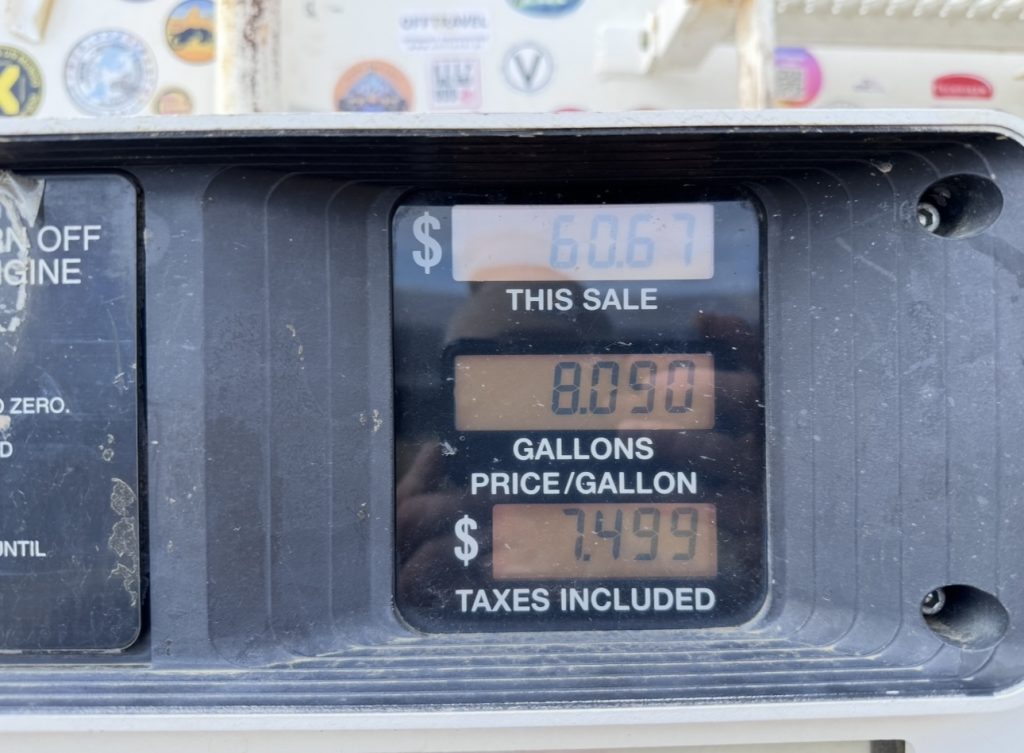
This isn’t the first time we’ve seen an admin use waivers on RVP to drive down fuel prices during an election cycle. The Biden administration did the same thing back in the spring of 2022, claiming to counter fuel price increases due to the war in Ukraine (though pandemic-induced supply chain ripples also contributed to those price jumps). These emergency waivers have been extended several times since, and they’re continuing again into the summer of 2026.
What does this mean for the environment? Well, more E15 gas in cars means more gasoline evaporating into the air when it gets hot out, which will likely result in more harmful smog. But that tracks with this current admin. Last year, it eliminated penalties for manufacturers that don’t meet corporate fuel economy targets and announced a $625 million investment into the coal industry. The push to keep winter gas flowing comes just three days after the Department of the Interior agreed to pay French company TotalEnergies $1 billion to walk away from an offshore wind power lease, directing the company to use that money towards natural gas projects instead. The government’s priorities are clear.
While this waiver is only set to last a few weeks, the EPA says it’s “ready to extend the emergency fuel waivers as long as the fuel supply circumstances warrant such action.” Seeing as how the waiver’s been extended for the last few summers past, I would count on that happening.
Top graphic image: DepositPhotos.com



Accumulating moisture in your fuel is not the same thing as hydrolocking an engine during a water crossing. Not at all.
Yeah I’d never thought of it as similar either. But then again, if you let gas sit long enough in a car with a high-compression engine, maybe? Disclosure: I have no idea how much water can actually end up in gas and if it’s enough to make a difference.
Water in fuel can cause corrosion issues, poor running, etc.
But hydrolock happens when the cylinder fills with enough liquid to physically stop the piston from rising. This isn’t possible with the tiny amount of liquid that’s injected during normal operation. It’s only possible when a large amount of liquid enters some other way (blown head gasket, submerged intake, stuck injector, etc.). The incompressible liquid is displacing compressible air.
Even a gas tank filled with 100% water cannot hydrolock the engine, because the fuel system will continue to inject its normal (tiny) amount of liquid.
Good point, I hadn’t considered that the amount of gas per ignition is nowhere near enough volume to make any difference.
It will result in a sudden and long-term jump in fuel prices because the refineries have to “re-tool” to adjust to the change in production.
Any excuse to increase profits and screw the consumer.
Yeah, this article isn’t right and is muddling things. The EPA waiver did 2 *separate* things:
(1) Allowed nationwide sale of E15 year-round.
(2) Removed the summer RVP limits.
Winter and Summer blends have always been a thing, with different RVP as you mentioned. There are winter and Summer blends of both E10 and E15.
The gas supply does not, however, as you imply, switch from E10 to E15 in the winter. That’s not how it works. It’s extremely unlikely you’ve used E15 without knowing it. E15 pumps are well-labeled.
There’s already E15 allowed year-round in places in the country under the reformulated gasoline (RFG) mandate. Those areas needed stricter RVP rules for smog anyway, and as long as E15 met those rules it was fine. In other areas, E15 was not allowed in the summer. It is this year.
This is like living in that splintered Biff timeline from Back to the Future 2, if it were allowed to continue in perpetuity.
Gross, more corn ethanol, such a waste of land, fertilizer, diesel, time, when we could put up solar panels and drive electric cars instead. *technology connections intensifies*
I love how Alec has gone full send on raging against the machine. The man is my hero.
Do your own test. Run 2-3 tanks of E0 and then try E15. The delta is not negligible. Ethanol is evil sheet.
It’s not “the government” whose priorities are clear. It’s this administration’s.
I would like to see a deeper dive article on this, because around me it doesn’t make sense. E15 is on sale year round here, as is E10. However, both pumps are labelled as “Up to 10/15% ethanol”, which means the E15 could be E10, depending on the time of year. It’s also theoretically possible they could both be E0.
I’m fairly dubious that the E15 is actually E10 in the summer though because the price difference is too large. There’s no way a gas station would sell E10 at a 25 cent/gallon discount just for fun.
I do live in the north, so I suppose it’s possible our temperatures don’t get hot enough to trigger this evap requirement, but we still hit 100 pretty much every year so I don’t find that plausible either. I would really like to understand what’s actually going on here.
Brazil has had E100 since the 70s. Why can’t we do that shit here? Lots of sugar grown in Florida, Texas, and Minnesota. That’s how Brazil gets their ethanol for fuel.
Sounds like a great way to create jobs for lots of hard working Americans too! I’m told a lot of people in the south are clamoring for these types of jobs that were being taken by illegal immigrants and would love an opportunity to work the sugar plantations.
If I remember correctly, Brazil has a bunch of oil but they sell it and use cheaper ethanol fuel instead. In the US, I’m not sure it would be cheaper enough than gas, and I think E85 was/is only cheaper because of federal subsidies for corn. And because it used so much fertilizer and equipment it wasn’t carbon neutral which was part of the narrative they were trying to push at the time.
Sugar supposedly has a better ethanol yield than corn. Doesn’t sugar get subsidies too?
Even if sugar and corn ethanol don’t cost less right now, they’d be more stable and less subject to the shit like Iran now.
I’m ignorant to the state of sugar cane farming in the US. I (incorrectly, it seems) assumed we got most of our sugar from central/south America. So I’m not sure what subsidies there are, but it’s probably safe to assume they exist since they do for most commodity farming.
Honestly, corn is a mediocre source of ethanol, but it just so happens to be a very abundant source in our country, which, combined with subsidies, makes it a very profitable business for corn farmers and ethanol companies. Same reason Brazil went with cane sugar, they had a lot of it. We could even go to using grass (something that everyone cuts for free), but that would introduce a lot of variables that I don’t think manufacturers would be happy to deal with.
Also, they grow sugar in Minnesota? Are you sure you didn’t mean to type Mississippi? I mean, Minnesota summers get hot and humid, but not like in the south.
MN mostly gets their sugar from beets
Ahhhh, TIL
It’s also a gloriously inefficient crop when you factor in how much water it requires and how relatively little you yield per acre compared to other plants.
yeah but then we’d be paying more for our Big Gulps which something something socialism/anti-freedom.
I’m sorry, is this sarcasm?
“I’m told a lot of people in the south are clamoring for these types of jobs that were being taken by illegal immigrants and would love an opportunity to work the sugar plantations.”
If not, exactly who is “clammoring” to work on sugar plantations? Where did you learn of this? It just seems so improbable/unlikely to be accurate.
yes it’s sarcasm.
Do they grow beets for sugar in Minnesota?
If I remember correctly, 100% ethanol for motor fuel is viable in Brazil because it doesn’t experience the kind of cold that’s common in much of the US, even in the far south. And even there it doesn’t work as well as petroleum-based fuels and doesn’t have the market it did when mandates were introduced by the dictatorship in the ’70s in response to high oil prices and a political desire for import substitution.
Iowa gets cold and has winter, and that is the state pushing corn/ethanol the most.
Minnesota has almost 400 gas stations that have E85, including far north of the twin cities:
https://e85gasfinder.com/states/minnesota/#/analyze?fuel=E85&tab=location®ion=US-MN&show_map=true
Yes, but if you read the owners manual of a flex-fuel vehicle, it will almost certainly tell you not to use E85 in the winter. Your mileage may vary, but here’s an excerpt from the owners manual of my ’08 Impala:
I ran E85 all this winter without any real problems, but 1; the car was parked in a garage, keeping the worst of the cold at bay, and 2; I did actually check the ethanol sensor a couple times through the OBD2 port, and it was showing ~50% ethanol in the system (if you read the fine print on E85 pumps, it’ll say that actual ethanol content ranges from 50-85%).
😮
NOOOOOOOOOOOOOOOOOOOOOOO
Yup. That’s also why any serious motorsports people running E85 are getting it as race gas from companies like VP, because (in addition to any other recipe changes & quality assurances) it has an exact ethanol content, which pump gas does not. I think lower E options like E20 or E30 stay closer to their nominal numbers, but I’d have to double check.
I do wish they’d tell you the exact content at the pump (I assume they know), but oh well.
I have one thought about how this administration could have kept gas prices low.
Just one? 😉
I think I can narrow it down to one.
For the record, I was annoyed when Biden did this.
It seems there are many things a US president can do to significantly raise gas prices, and little they can do to lower them. Go address literally any other cost of living issue!
But “gas prices went up” = “the politicians did something bad” is some kind of cultural rule…
It’s more of a PR move than anything else. They know (well, I trust Biden did, I’m less sure this regime knows anything) it isn’t going to meaningfully move gas prices, but they can point at it as something they’ve done when people get pissed at them.
And also with all the price shocks in gas based on global events/misadventures, good luck trying to find the E15 “discount” at the pump.
Biden started a war with Iran that sent global oil prices skyrocketing? Don’t quite remember it.
No, the “I lowered gas prices by a few cents by waiving emissions regs, and also the gas won’t make your car go as far so you’re not actually saving money” thing.
High gas prices during Biden’s term, I believe, were caused by Trump *crashing* oil prices during his first term and messing up supply chains. And COVID, which was also made a lot worse by Trump. And again, in case I’m accused of being “unfair”, I also disapprove of ways the Biden admin responded to COVID.
Prices spiked in 2022 when Russia invaded Ukraine, and everyone in the west pinky promised to stop buying Russian petroleum.
I don’t think anyone with a functioning melon was particularly upset when we climbed out of the lockdown and gas was no longer a dollar a gallon and the price of crude oil wasn’t negative. When it got to $5 a gallon in 2022 (not to mention the price of propane and natural gas for home heating), people were a bit peeved, and not unreasonably so.
President can do little to change the economy in a positive way. They all take credit for good financial times that happen while they’re in the office.
So they all deserve the blame when things get worse.
Any government policies intended to influence the economy eventually lead to a crash. Considering we went through a period where the economy was down 30% (covid) but housing prices rose across the board, there will be a reckoning. But that’s outside of the present issue, which can be traced directly to the oval office.
Taking 20% of any commodity out of the market will lead to increased prices for the remaining 80%. Somebody did something to keep 20% of a commodity from reaching customers.
However, the amount of crude that is not making it out is less than 20%. Much of it is being piped overland. The Strait of Hormuz is also not completely closed to shipping, rather, greatly reduced.
If everyone would use 15% less petroleum, then the crisis would be over. Demand for plastic water bottles seems to not have gone down at all, though.
20% of the world’s oil passes through the strait. It is not ‘closed,’ but the companies who insure ships will not cover that voyage – essentially shutting it down.
The power of insurance companies troubles me.
Clearly Trump supports the Green New Deal and did away with the carrot (tax credit) and is using the stick (higher prices). With my Bronco dreams dead, I’m taking delivery of a slightly used 2026 Prius PHEV in the next few days.
https://www.theautopian.com/prius-off-roading-is-popular-enough-that-theres-a-guy-dedicating-his-whole-life-to-building-prius-overlanding-mods/
Small consolation, but just because you’re buying a Prius doesn’t mean you can’t have fun with it.
It’s pretty standard business at this point. The pumps are labeled for it so they can do it. Having some acknowledgement that it is e15 vs e10 somewhere on the pump would be nice. The irony is if you can find a 88 octane pump they are e15 and often cheaper then the e10 pump that might be e15 anyway.
Did you know that the EPA has issued E15 waivers every year since 2022?
Wonder how many farmers will be choosing soybeans over corn to plant this year due to fertilizer prices/availability and what that will do to ethanol prices this winter.
After they couldn’t hardly give soybeans away last fall, idk about that.
Your article is a little off . I speak as someone in the industry for 40+ years, on both refining and marketing ends. E10 is the standard, winter and summer, full stop. E15 is sold in many places ( here in NC) and MUST be labeled as such, and sold from dedicated storage.
Summer and winter RVP is acheived at the refinery, while allowing for a predetermined ethanol blend at the marketing terminal. Prices rise at “changover” in spring and fall, because marketing terminal stock must be run down to allow inventory to be converted to RVP for the season ( an “artificial “shortage ).The storage at the marketing terminal has to test at the mandated RVP by the changeover date. The MPG loss is a dirty little story concocted by oil companys, because they want to sell higher profit gasoline, not lower profit Eth.. Any reasonably modern engine management will adjust timing and injection parameters to compensate for the tiny extra addition of Eth.. Fun fact, motor gasoline loses octane every time it is moved. No one seems able to explain this.
The following is my understanding, not an expert by any stretch.
Point 1 is absolutely correct. I’ve never even seen an E15 pump in Michigan. If it’s common, it’s not common here. I know in other states (especially corn belt and west) it’s much more frequent.
MPG loss from E10 to E15 is absolutely a thing, that’s simple energy per gallon loss due to the lower specific energy of ethanol. If you have used E85 with a standalone ECU, you have to either use a flex fuel sensor to automatically scale your VE table or you have to manually measure/adjust ethanol content. If you don’t, too high of an ethanol content will cause you to run lean. Buddy and I ran into an issue during a drag and drive last year where E85 getting hot on long drives would result in 3-4 point swings in the AFR, if autotune wasn’t enabled.
Octane rating dropping when moved from tank to tank sounds like small particle contamination to me.
That’s interesting. I don’t know how T-Pain fits into air/fuel ratio, but if it works…..
The difference here is that the E10 to E15 transition is a very negligible change in energy density and by extension AFR, advance, and timing. Modern cars that are not flex fuel rated do not have any sort of sensor in the fuel system to measure ethanol content, and any adjustments done are going to be extremely slight based on O2 sensor data. The adjustments will generally be far smaller than the changes made based on air density due to elevation or temperature, or charge air temperatures in forced induction cars.
As mentioned by C&D, there is a sub-2% energy density change, which is pretty directly analogous to a less than 2% fuel use increase. With E15 generally being 10% or more cheaper, it will almost always result in a net cost savings per unit of energy over standard E10.
I was with you until this. Ethanol has objectively less energy so there has to be some MPG loss when you add more of it to the mix. See also the atrocious fuel economy you get when using E85.
I will grant that going from E10 to E15 is probably not noticeable unless you track your fuel consumption very carefully, but there absolutely is a loss with ethanol.
With what France has said, the damage to oil production in the region is going to take years to repair, not months. If supply is really down 11M barrels a day, prices are going to continue to rise through the summer, and stay high.
Good thing the US has invested in alternate means of powering homes and driving cars!
Coal-fired home heating can’t come soon enough!