

If you’ve paid any attention to the news these past few weeks, or simply stopped at a gas station to fill up your tank, you’ve probably realized that gas prices are on the rise. The new conflict in Iran, as well as the ongoing war in Ukraine, means prices are probably going to stay elevated through the summer, which means you’ll likely be paying more for that summer road trip than you expected.
In an effort to curb rising prices, the Environmental Protection Agency (EPA) announced yesterday plans to issue a waiver to allow the nationwide sale of E15 gasoline—gas blended with 15% ethanol, popularly known as “winter gas”—during the first 20 days of May.


Compared to Summer-grade gasoline, winter gas is cheaper because it’s slightly less energy-dense. That also means it’s a tiny bit less efficient. And depending on what car you drive, it could do more harm than summer gas on your fuel system. Here’s what you need to know.
What’s The Difference Between Summer Gas And Winter Gas?
Back in 1989, the EPA began putting limits on the volatility of gasoline sold at gas stations nationwide. “Volatility,” in this case, doesn’t refer to my portfolio of high-risk tech and healthcare stocks I’m too ashamed to admit my lifetime gains/losses on. Instead, volatility is the point at which liquid evaporates, turning into vapor and entering the air. This is bad, as gas vapors contribute to smog, which can cause respiratory issues for people.

This law outlaws the sale of gasoline with a Reid vapor pressure (RVP) of over 9 pounds between June 1 and September 15, according to Car and Driver. In places like California, that time window is extended to between April 1 and October 31. RVP, according to the American Society for Testing and Materials, is the gasoline’s vapor pressure at 100 degrees Fahrenheit.
There are a lot of additives that fuel suppliers use to adjust RVP, but ethanol is the most significant. Basically, the more of the corn-based fuel you have in the gas, the higher the fuel’s RVP will be. And the higher the RVP, the more easily it will evaporate from your gas tank when it’s hot outside. During summer months, E10—that is, gasoline blended with 10% ethanol—is the standard, as that’s the most suppliers can add before reaching that EPA-enforced RVP limit. During the winter months, when the gasoline isn’t as susceptible to evaporating, more Ethanol is added to the mix.
Why is the percentage of ethanol higher in the winter? Well, in addition to offering a higher-volatility blend that works better in colder temperatures, it means the fuel can be cheaper. Amsoil explains it well in its blog on the subject:
Winter-blend fuel requires increased RVP. If the fuel doesn’t evaporate readily in cold temperatures, the engine will start hard and run rough when it’s cold outside.
To achieve this, refiners often blend winter gasoline with butane, a relatively inexpensive additive with a high RVP. They adjust the RVP of the final formulation to as high as 15.0 psi to help the gasoline ignite readily in the cold.
Of course, because Butane has a high RVP, it can’t be used during the summer because of the EPA’s rules. Here’s Amsoil explaining how fuel manufacturers make the switch:
Once the temperature warms up in summer, however, high-RVP gasoline can volatilize more easily, which contributes to increased emissions and air pollution.
For that reason, federal law restricts sales of gasoline with an RVP greater than 9.0 from June 1 through Sept. 15.
To comply, refiners reduce the amount of butane in the gasoline and instead use pricier additives, hence one reason gas prices generally increase in summer. The blending process also takes longer, adding to the cost.
So, now you know what those labels on the gas pump talking about ethanol blend are all about – not that it’s likely to matter much if you drive a remotely modern car.
How Does It Affect My Car?

The EPA says that cars after 2001 can safely handle gasoline with up to 15% ethanol blend, and that’s true for “flex fuel” cars, which are designed from the factory to handle up to 85-percent ethanol blends. But as Thomas wrote last year, some manufacturers don’t recommend it:
[T]here are lots of vehicles made after 2001 that aren’t designed for E15. For instance, BMWs only approves a maximum of 10 percent ethanol content in its vehicles, as does Mazda, as does Mercedes-Benz on all models not approved for E85. Volvo only approves a maximum of 10 percent ethanol content across its lineup, as does Mitsubishi.
Some other manufacturers like Nissan are more selective when it comes to E15 approval. The current Frontier, Rogue, Z, Pathfinder, and Altima can take E15, but the Sentra, Kicks, and almost all outgoing models like the previous-generation Armada aren’t rated to handle it.
The thing with ethanol is that it’s hygroscopic, which means it pulls in moisture from the air. And having water mixed in with your fuel is, of course, very bad. Anyone who’s seen those videos of vehicles attempting to ford a water crossing only to hydrolock their engines knows that. Also, ethanol, when mixed with oxygen, can form acetic acid, which is the active ingredient in vinegar. While the stuff is good for cooking and cleaning rusty car parts, it’s not so great for fuel system components.
Of course, that doesn’t mean your car will immediately fall apart if you run E15 through it. You’ve probably been doing it all winter without even knowing, along with millions of other drivers on the road. Today’s fuel systems are sealed pretty well, which means water egress isn’t a huge issue. If anything, the rubber hoses in your fuel system might degrade slightly quicker over the life of the car than if you ran E10 year-round. If you have an older car with rubber hoses that aren’t designed to handle ethanol, you might want to be a bit more cautious.

More important is the difference in energy content between winter gas and summer gas. Ethanol is about 30% less energy-dense than gasoline, which means the drop in ethanol from E15 to E10 results in summer gas being roughly 1.7% more energy-dense, according to Car and Driver. That’s enough for a small (but measurable) increase in fuel economy, all other things equal. So while winter gas might be cheaper, you might not actually be saving any money, since you’re using more fuel to drive the same distance.
Why Is The Government Doing This?
Officially, the EPA says it’s issuing a waiver to give drivers more options as the country inches closer to the Summer driving season. Here’s the relevant stuff from the announcement:
Through the waiver, EPA is fortifying the domestic gasoline supply chain and providing Americans relief at the pumps ahead of the summer driving season. Beginning on May 1, 2026, EPA’s waivers will work to prevent disruption in America’s fuel supply by keeping E15 on the market and giving Americans more fuel options.
According to the EPA, not only will drivers benefit thanks to lower prices, but corn farmers will also see a benefit thanks to the increased demand for ethanol, which is derived from corn. The announcement even threw in a quote from the Secretary of Agriculture:
Allowing the summer sale of E-15 will provide drivers more options at the pump, and deliver a bigger domestic market for American farmers,” said U.S. Secretary of Agriculture Brooke L. Rollins. “While today’s announcement is great news for farmers, year-round E-15 is essential for the farm economy, and Congress needs to find a common sense solution that provides much needed certainty to consumers and farmers.
The savings found at the pump are debatable for the energy density reasons mentioned above, but whether people actually realize that the slightly lower prices won’t actually result in any money saved is another story. As Bloomberg points out, the timing of this move to lower prices comes during a midterm election year, when voters are increasingly faced with higher costs of living. It’s a safe bet to assume this waiver is being used to counter the spike in oil and gas prices from the current conflict in Iran.
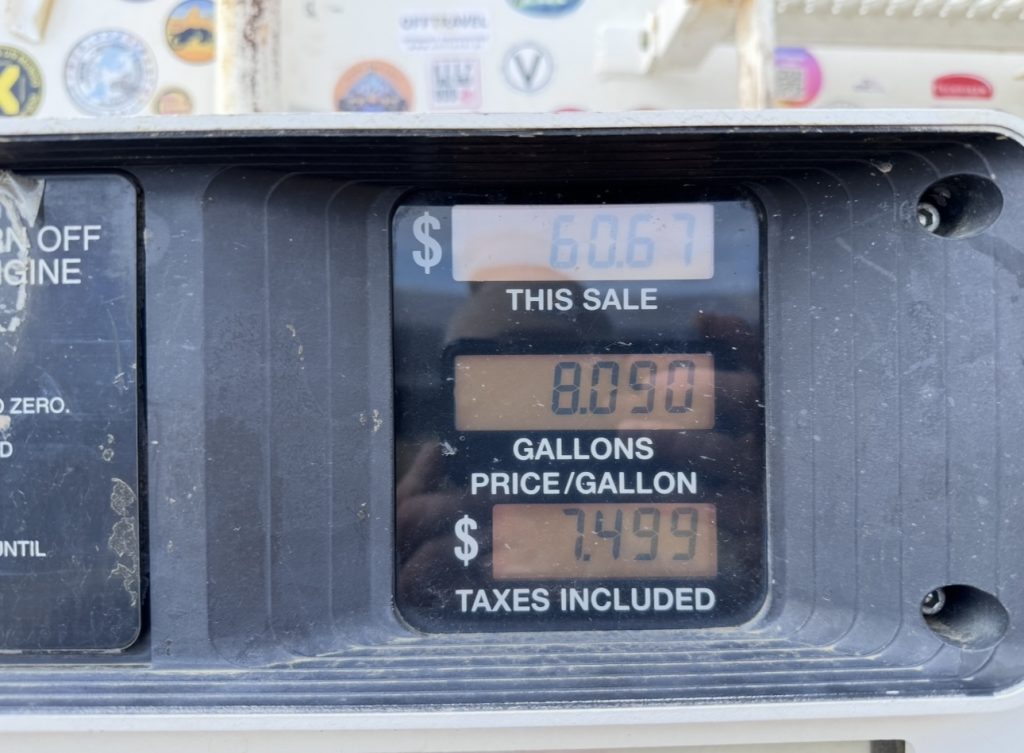
This isn’t the first time we’ve seen an admin use waivers on RVP to drive down fuel prices during an election cycle. The Biden administration did the same thing back in the spring of 2022, claiming to counter fuel price increases due to the war in Ukraine (though pandemic-induced supply chain ripples also contributed to those price jumps). These emergency waivers have been extended several times since, and they’re continuing again into the summer of 2026.
What does this mean for the environment? Well, more E15 gas in cars means more gasoline evaporating into the air when it gets hot out, which will likely result in more harmful smog. But that tracks with this current admin. Last year, it eliminated penalties for manufacturers that don’t meet corporate fuel economy targets and announced a $625 million investment into the coal industry. The push to keep winter gas flowing comes just three days after the Department of the Interior agreed to pay French company TotalEnergies $1 billion to walk away from an offshore wind power lease, directing the company to use that money towards natural gas projects instead. The government’s priorities are clear.
While this waiver is only set to last a few weeks, the EPA says it’s “ready to extend the emergency fuel waivers as long as the fuel supply circumstances warrant such action.” Seeing as how the waiver’s been extended for the last few summers past, I would count on that happening.
Top graphic image: DepositPhotos.com





Not supporting another bullshit war in the middle east would go a long way I bet.
What are you talking about? We’ve always been at war with Eastasia.
At least we have gas. Australia is facing rationing, as are other countries in that region. The United Kingdom is talking about it, as are other first world economies. Trump made a mess of things. All totally avoidable.
I am waiting for the global backlash to the US for this.
It has already happened. All of our former allies are cutting new trade deals with each other that exclude us. It will take a long time for the effects to be fully felt (if history is any indication, probably just in time for the next administration to take the fall for it), but it absolutely will. I don’t think most people understand how completely we have destroyed our international standing in the past year.
Quote of the year
As I understand it, the fact that oil is being moved as long as it’s trading on Yuan instead USD isn’t a “they are just trying to make us look bad” thing. It’s a “the US is getting cut out of the world economy” thing. Like, they could have tried that 3 years ago and it wouldn’t have been a big deal because none of our allies would do it. But our list of allies is growing shorter by the day….
Yep. The next administration has the thankless job of trying to repair all these messes. They will do that work and get no credit then we’ll get President Don Jr or someone terrible like that and do all this shit over again.
I’m confused as to whether adding in more ethanol is truly how all states accomplish raising the RVP.
All the pumps in my area say 10% ethanol max. Surely, they will have to report if they raise it in the winter.
Might depend on where you live and state law. I can imagine southern states maxing out at 10 due to their warmer temperatures.
I have 4 vehicles on the road. Only one is made this century, a 2002 S10. One is from the late ’80’s and the last two are from the ’70’s. I think I’ll be checking my hoses on those vehicles. Isn’t winning wonderful?
This had me curious. If E10 is only 1.7% more efficient and I’m driving a pickup that gets 17mpg, I will need an extra gallon of E15 every 1000 miles to make up the difference. That doesn’t seem too noticeable, and as long as the fuel is 8 or 9 cents cheaper there won’t be a difference.
So I guess my point is, why bother with changing the regulation anyway?
If your math is correct for your pickup, then your local weather (amount of rain and wind you drive in) and right foot have a larger influence on your mileage than the energy density difference between E10 and E15.
In my area, some stations sell no-alcohol gasoline. I’ve compared the mileage vs pump price for no-alcohol fuel in my least efficient vehicle — a lifted TJ — and found the $$ per mile to be a wash between no-alcohol and E10.
Where they get you is when E10 is 3.00 and E15 is 2.97 (which happens pretty frequently around me). That 3 cent discount doesn’t make up for the lost energy, but people will buy it anyway because it’s the smaller number.
If you can charge at your residence (or have access to reliable charging elsewhere) — get an EV. (A used EV can be a great cost-saving option, if purchasing/leasing are otherwise cost-prohibitive.) If you own your residence and don’t yet have rooftop solar, seriously consider that as well.
So we can have high gas prices and high food prices.
AND more pollution! Yea! But hey, I imagine my car runs better.
The whole world is going EV/PHEV so the US auto industry will become a backwater. So screw our economy as well!
It’s quite wonderful of the government to pay off a foreign wind power company to stop development and divert funds in dirty energy projects. Wonderful times we live in.
The Dept. of the Interior did indeed do that — but they didn’t bribe them with very much of our money, so no worries. It was only $1 Billion. (It’s almost tax time, and good to be reminded that our hard-earned money is being well-spent.) The legacy fossil fuel plants that won’t be replaced by wind energy will cost residents a fair bit more money every month while polluting a lot more — but those are minor considerations.
Haven’t you heard? Clean coal is the future! /s
Some things will never change
“And having water mixed in with your fuel is, of course, very bad. Anyone who’s seen those videos of vehicles attempting to ford a water crossing only to hydrolock their engines knows that.” For Pete’s sake that’s water mixed with your AIR intake not fuel.
And the water always got into my distributor, not my gas!
And water is even injected sometimes to cool combustion temps.
I already run non-oxygenated gas in my motorcycles, carbureted engines, and my Boxster, my daily can handle the elevated ethanol level but seriously who does this benefit other than corn farmers?
My avg fuel economy improves by 15% in summer vs the winter, but that improvement is because the fuel has a higher energy density, my vehicle spends more time at its operating temperature, and I commute less with my daily in summer and spend more time on road trips. Difficult to say how improvement can be attributed to each variable.
Thanks Trump and Israel!. I wanted to keep my worse cold weather gas efficiency…
And I was so enjoying the increased pollution. Yay!
Well, crap. BRP doesn’t recommend more than E10 in my old supercharged Seadoo. I was going to tote cans of road car 93 octane to help avoid marina fuel dock prices and lower octane gas.
Our 2024 Chevrolet Trax LS requires a maximum of E-10. For 2025 and newer, you can use up to E-85, but that first year of the 2nd-generation cannot use E-15.
Also, both my Yard Machines ( MTD) lawnmower and Craftsman snowblower both have stickers stating not to use fuel with more than 10% Ethanol. Of course, both of those sit for half the year, so I only run no-Ethanol premium fuel in them.
Interesting article. I didn’t realize that E15 was one more reason why winter fuel economy is less than summer in colder climates. I never paid that much attention to fuel economy numbers until I started driving my Mom’s RAV-4 hybrid where it’s constantly staring you in the face. Same driving that gets 37 mpg in the winter gets 41 in the summer.
Wouldn’t most of that be based on the temperature (friction) of the drive gear and not the 1.7% difference in energy content of the fuel?
It could be. There are a bunch of little things that add up to something noticeable. Hard to know how much each one contributes.
https://www.energy.gov/energysaver/fuel-economy-cold-weather
By law E15 can only be sold at pumps labeled as such, so if you aren’t pumping fuel from pumps labled E15 in the winter and ones labeled “up to 10% ethanol” in the summer that does not explain the difference in your fuel economy. With a hybrid that drop is due mainly due to the cabin heat demand and the fact that the engine has to run longer and more frequently to get the engine to minimum operating temp and maintain it.
Not great, the Armada doesn’t like anything beyond E10 indeed, it’s in the owner’s manual.
Not to mention motorcycles, even fuel injected ones don’t like anything more than E10.
Oh great, we can bust out the same checklist that applies to every policy from this administration!
– Increases pollution and GHG emissions for no justifiable economic or technological reason.
– Provides zero financial benefit to nearly everyone.
– Gives handouts to a small favored constituency.
– Associated justifications are absolute nonsense to anyone with even an elementary grasp of the subject.
It’s been fourteen months of this and I’m beyond exhausted.
But, now, you can get a Hemi in that.
And the clowns STILL defending him make me sick. Not to mention the Epstein shit. It is just one shitty thing after another.
another checklist item: Sticking it to Obama
Shrinkflation is coming to your gas tank!
The price levels out by giving you less for your dollar. Thank goodness it does more harm for the environment to boot.
FWIW hydrolock that occurs from vehicle water fording has little to do with water in the gas tank, it happens because enough liquid water enters the air cleaner, intake manifold and eventually cylinders and is incompressible resulting in internal mechanical mayhem.
The videos of the water crossings in England is a favorite pastime
Fuck it, I’m converting the GR Corolla to coal! 🙂
please lmk how this works out for you
So, essentially making it a Coalrolla’ ?
So much winning…
Also, don’t forget to change over your winter air in your tires to summer air
Unless you have NitroFill!
the ford guys put it in my truck before the sale, and I keep trying to get it out of my tires but they keep refilling it for me.
“Why go to the dealer” Well the recalls of course!
Summer air is blended with up to 15% marijuana smoke to keep those tire pressures high
If only there was something else they could do to fix this?
huh. I wonder what it could be?
Start a war with Cuba?
hey that might work!!!
30 years ago I had a 1988 Ford Ranger V-6 that would vapor lock and leave me stranded on the side of the road if there was anything more than 5% ethanol in the fuel and it was above 60oF. I learned that on a hot day in the middle of South Dakota.
I’m so sick of ethanol in my fuel. I don’t own a vehicle newer than 2001, so ethanol fuel just ruins my fuelling components and reduces my MPG. It also sucks nutrients out of arable land that could otherwise be used in crop rotations to feed us.
Crop rotations?
There’s probably quite a few farmers who will cash-in on by stretching another season of corn and then hosing it down with fertilizers*?
*don’t forget to pay your fertilizer tariffs, high-diesel cost for the tractors, all while you’re getting screwed by the grain buyers who’ll buy at an absolute minimum so they can profit off all of this.
Oh, I could go on a rant about monoculture in our farming and the incentive structures that have led to it, but that’s for another time, in-person, over several strong drinks…
I have zero sympathy for the farmers considering the voted the doofus in so they could get handouts.
And they’ll do it again just to make an extra $5 for corn after having to pay $10k extra for fertilizer and $20k in diesel.
It’s a cycle that all the corporations along the ‘food chain’ are happy to keep, and pass to the consumer.
Yeah and they love complaining about people on welfare when they are the ones on welfare. They are just hypocrites.
You probably know this, but not all farmers voted for Trump. In fact, a LOT of them didn’t.
But yeah, the one’s who did are certainly “finding out”. Well, except for the ones who are so brainwashed that they’re beyond reasoning with.
Absolutely. There is a channel on youtube I follow called farm to taber and she mentioned that. Sadly she said the majority of farmers did vote for him. So yeah I was generalizing but doesn’t change much.
Fuck corn gas through and through.
It’s incredible race gas. E85 is effectively 105 octane equivalent.
Sucks for everything else though. If it went away (especially E blended gasoline) I wouldn’t be mad.
A gallon of toluene for every 8 gallons of gas did wonders for my turbocharged Miata when I had it. Had to set up an account at Sherwin-Williams to buy it. 😉
That’s super inconvenient compared to just pulling in a gas station, even if it’s only at roughly 20% of them.
More welfare farming. I know that the corn they grow is not for human consumption (also an issue) but the idea of growing “food” to burn in transportation is morally repugnant.
Renewable fuel that reduces greenhouse gas emissions and it’s not locally produced in USA. I’m not opposed.
But hey, for those more comfortable with tar sands refinery pollution your welcome to build one in your backyard.
I am all for renewable energy I am opposed to welfare farming and starving people for Gigantic Truck fuel.
Factoring in the costs of growing and refining the corn into fuel, corn-based ethanol at best only breaks even with the carbon footprint of regular gas. Using it for fuel only works because massive corporate welfare, and saying it’s good for environment is just greenwashing.
Buying votes with your money!