

You remember Tesla’s Cybercab, right? It’s the gold-colored Level 4 self-driving taxi that, stupidly, only seats two people. I still can’t get over that absurd design decision. Only two people? For a taxi? So a family of three would need two cabs? Ridiculous. But I guess the upside is that if something bad happens, only the smallest possible plural of people could be in danger. Which leads me to what I want to talk about now, the Tesla Robotaxi First Responder’s guides, which were released just recently.
These guides reveal a lot of interesting details about Tesla’s automated-driving ridesharing program, not the least of which is clarification about nomenclature: the overall automated service is called Robotaxi, and can use either Model Ys or Cybercabs, and Cybercab just refers to that one particular model itself. That helps clear that up!


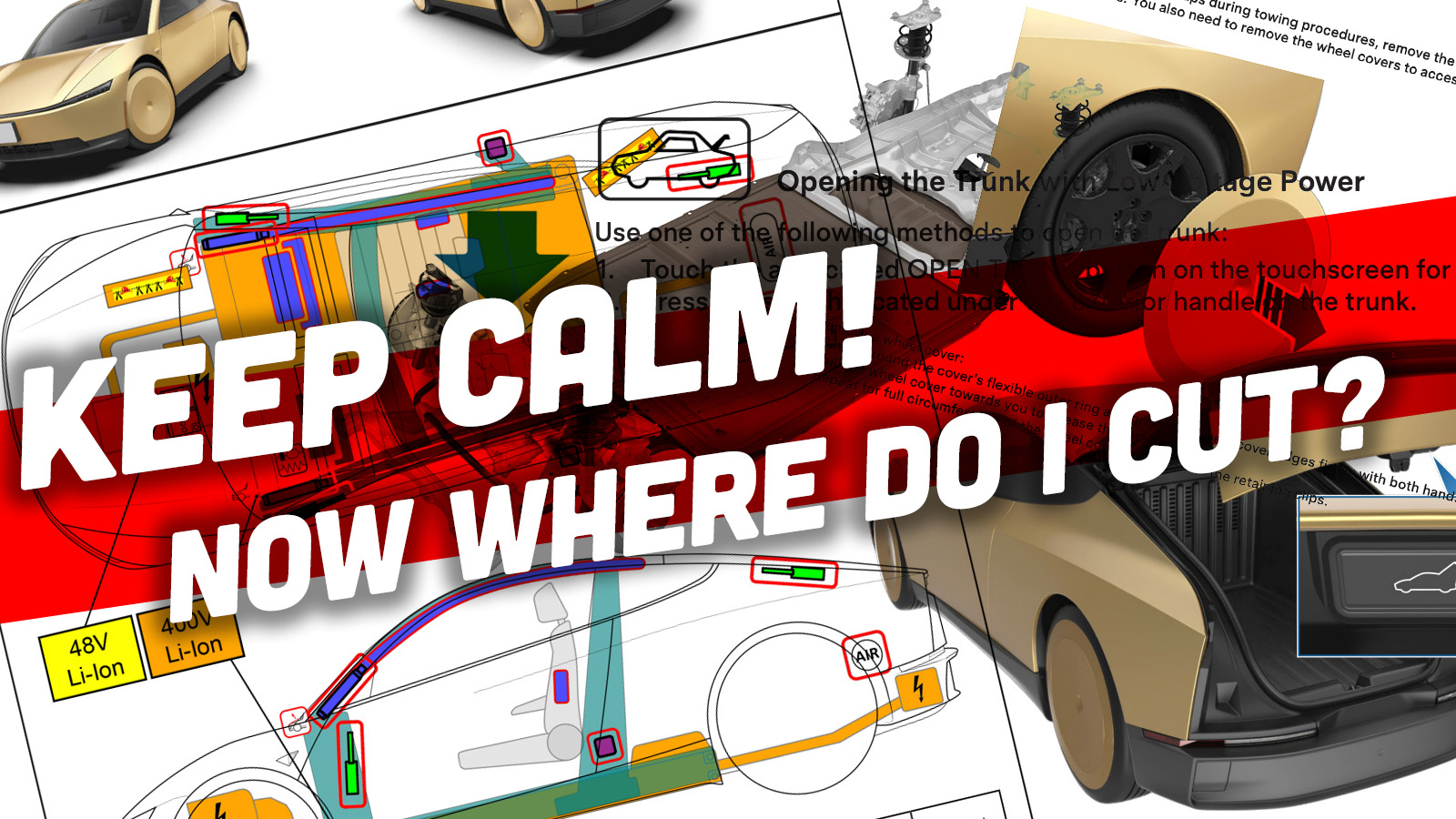
So what can we learn from what’s in these First Responder guides? An awful lot, actually, so let’s take a look. First, we get this nice revealing block diagram of the Cybercab:
Block Diagram

There’s a lot to see here. The floor-mounted battery is the big orange rectangle, the high voltage lines are orange, and, interestingly, the low-voltage system is actually quite high voltage compared to most 12V low voltage systems: it’s 48 volts.
Perhaps most notably is the confirmation that this is, in fact, Tesla’s first FWD car. I mean, look:
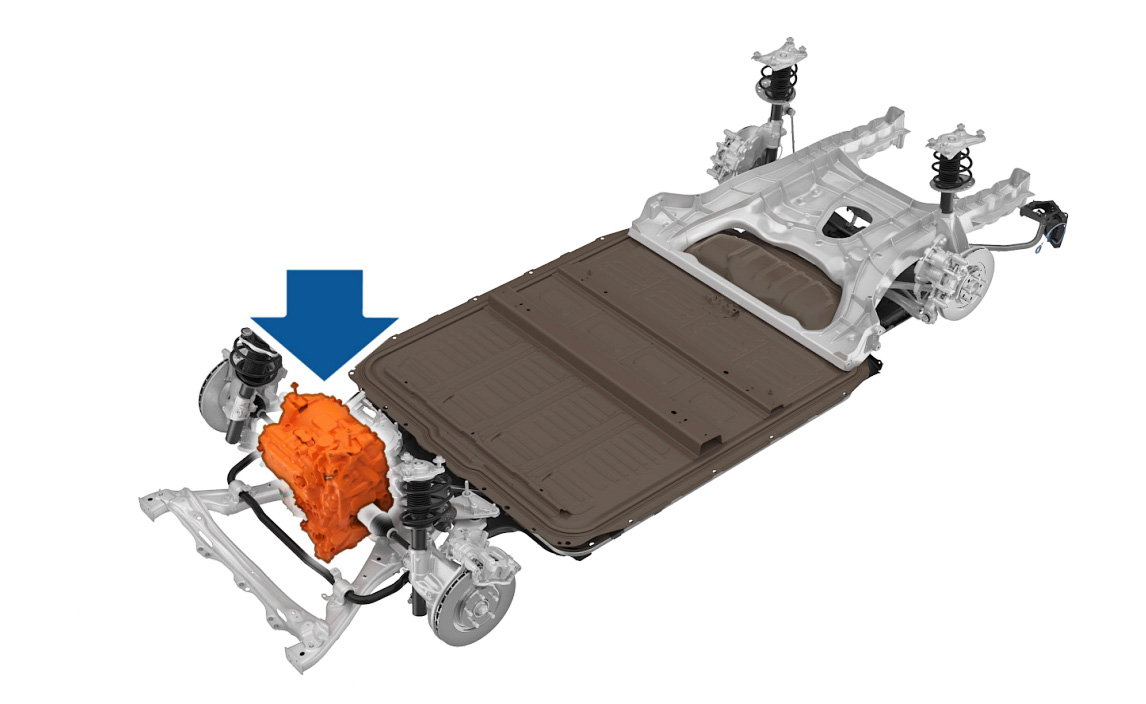
Holy crap, that’s about as FWD as you can F a D, W-wise. This layout is also how the Cybercab can have such a colossal trunk:
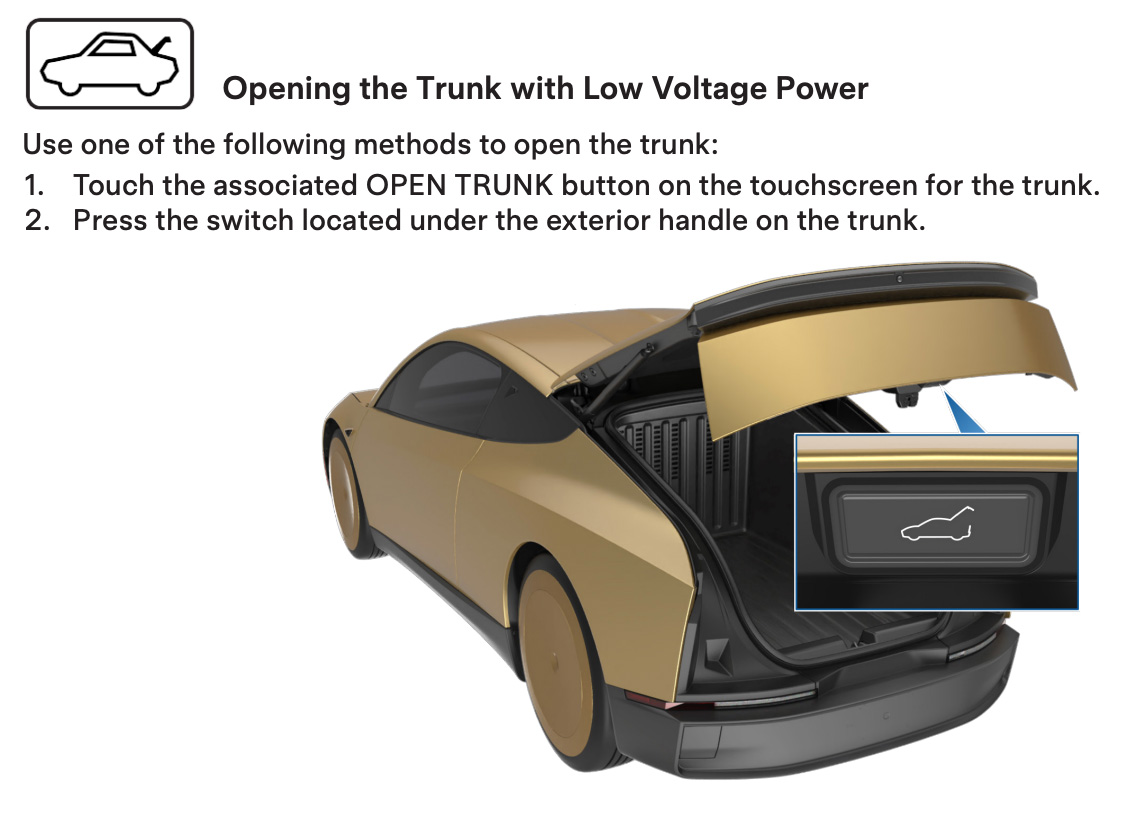
I mean, I still think the body design and packaging on the Cybercab is uniquely and powerfully stupid; a taxi that only seats two just seems like an inane decision. Have a family of three? You’re hiring two cabs, champ. Why did they make this desision? Do they really need a station wagon’s worth of cargo space for two people who are presumably not using this to move their entire household?
Anyway, now we know the trunk opening process takes two steps: touch the OPEN TRUNK touchscreen button, then the button on the handle. I guess the touchscreen button is really an unlock button? You’d think it could pop the trunk open with just the touchscreen button, but I guess then ne’er-do-wells could grab your treasures out from there as you’re finishing making out with the other passenger.
Autonomous Behaviours And Indicators
There’s a lot of interesting information about how the Cybercab interacts with emergency workers and vehicles. The Cybercab operates as a Level 4 automated vehicle – complete autonomy in a restricted, geo-fenced area – but what I find most impressive is that Tesla seems to have trained the Cybercab how to read hand signals and understand paths delineated by cones (emphasis mine):
“Beyond the capabilities necessary for dynamic driving tasks, Cybercab Robotaxi exhibits these notable behaviors:
• When picking up passengers, the vehicle shifts to Park. Then, the front and rear lightbars pulse and the hazard lights flash at a normal rate until the vehicle shifts into Drive or Reverse.
• When dropping off passengers, the vehicle shifts to Park. Then, the hazard lights flash at a normal rate until the vehicle shifts into Drive or Reverse.
• Cybercab Robotaxi is designed to continue autonomous operation after the passengers have exited the vehicle, closed the doors, and retrieved any luggage.
• While waiting for a new ride booking, Cybercab Robotaxi roams its area of operation or proceeds to a charging station or parking lot.
• If the Battery charge level is too low to conduct another ride, Cybercab Robotaxi proceeds to a charging station before accepting new ride bookings.
• If Cybercab Robotaxi experiences connectivity or hardware issues, the hazard lights flash rapidly and the vehicle attempts to pull over at the nearest safe stopping location. Cybercab Robotaxi is also designed to respond to clearly visible hand signals from first responders and can follow pathways designated by cones.
Hazard Light Innovation
Those hazard lights are doing a lot of work, and Tesla seems to have developed an alternate hazard light behavior: the rapid flash. These flash the lights at about 2x the normal hazard light flash speed, and seem to indicate that autonomous modes have been disabled:
When Autonomous Mode is engaged, vehicle hazard lights flash at the standard rate for pick up and drop off. When Autonomous Mode is disabled, the vehicle hazard lights flash rapidly. Rapid flashing of the hazard lights is at approximately two times the speed of standard hazard light flashing. If the vehicle is being manually driven and no safety critical event has been triggered, Autonomous Mode is disengaged and the hazard lights flash at the standard rate, if activated by the driver. Hazard lights do not flash when Cybercab Robotaxi is charging.
Interesting. But this next bit I think is the biggest and most long-desired innovation:
It Actually Can Pull Over
One of my beefs with all the current Level 2 semi-automated systems is that when they encounter a fault that disables semi-self driving, all they do is turn on the hazard lights and slow down, coming to a stop in an active traffic lane. This is, I think, terrible. Happily, it seems like the Cybercab is capable of pulling off the road to a safe location:
Cybercab Robotaxi is designed to detect when a first responder vehicle is following Cybercab Robotaxi with lights and sirens on. When Cybercab Robotaxi detects that a first responder vehicle is following with lights and sirens active, the Cybercab Robotaxi vehicle pulls over and parks at the first safe location available. When pulling over, Cybercab Robotaxi attempts to avoid entering or blocking private driveways. If on the highway, after moving to the rightmost traffic lane, Cybercab Robotaxi might take some time to identify a safe location to pull over and stop.
Branding
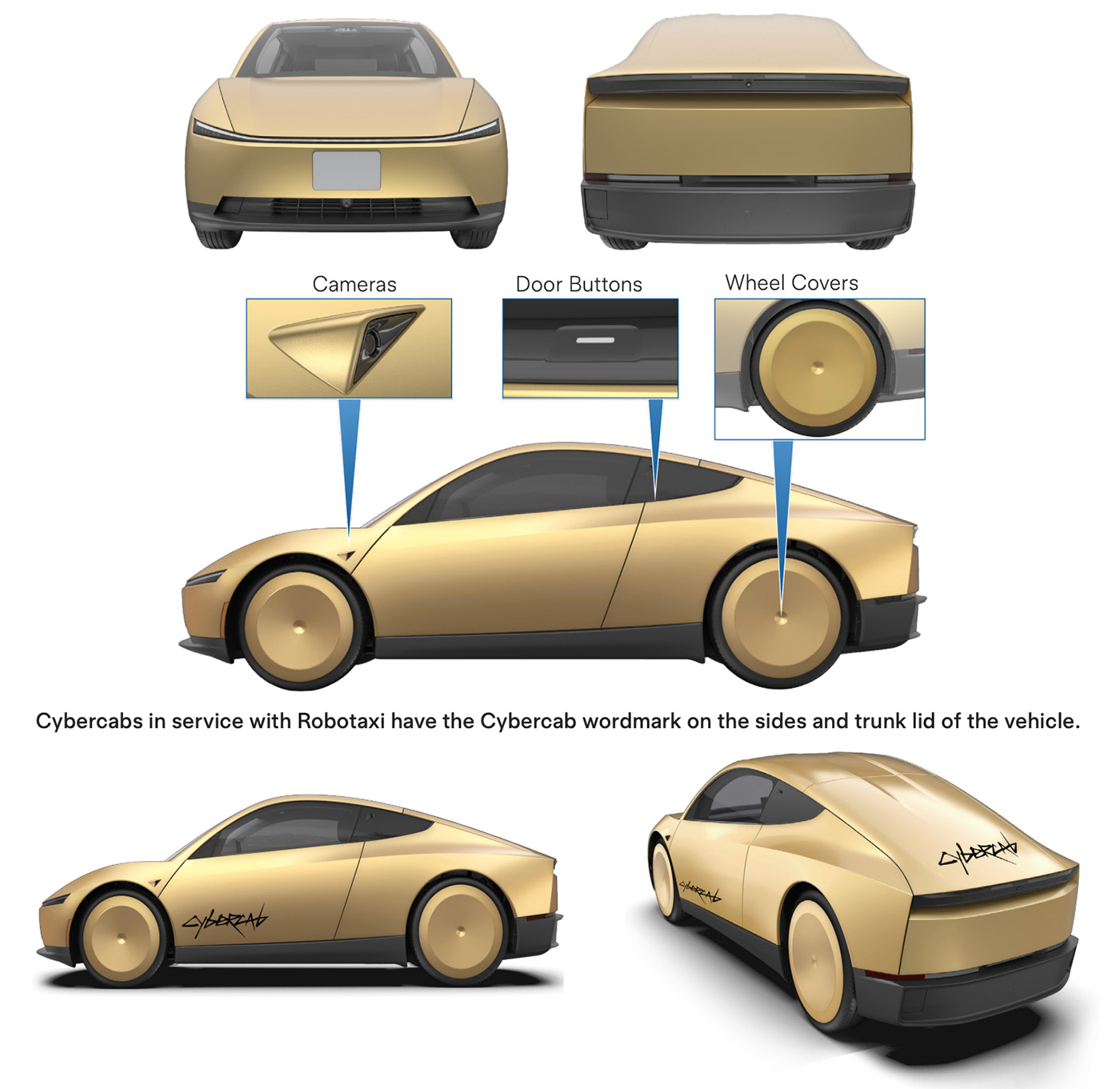
The stupid, almost-illegible logo is on the doors and hatch of the car, so you’ll know what the hell you’re looking at.
Emergency Gold Dinner Tray Access
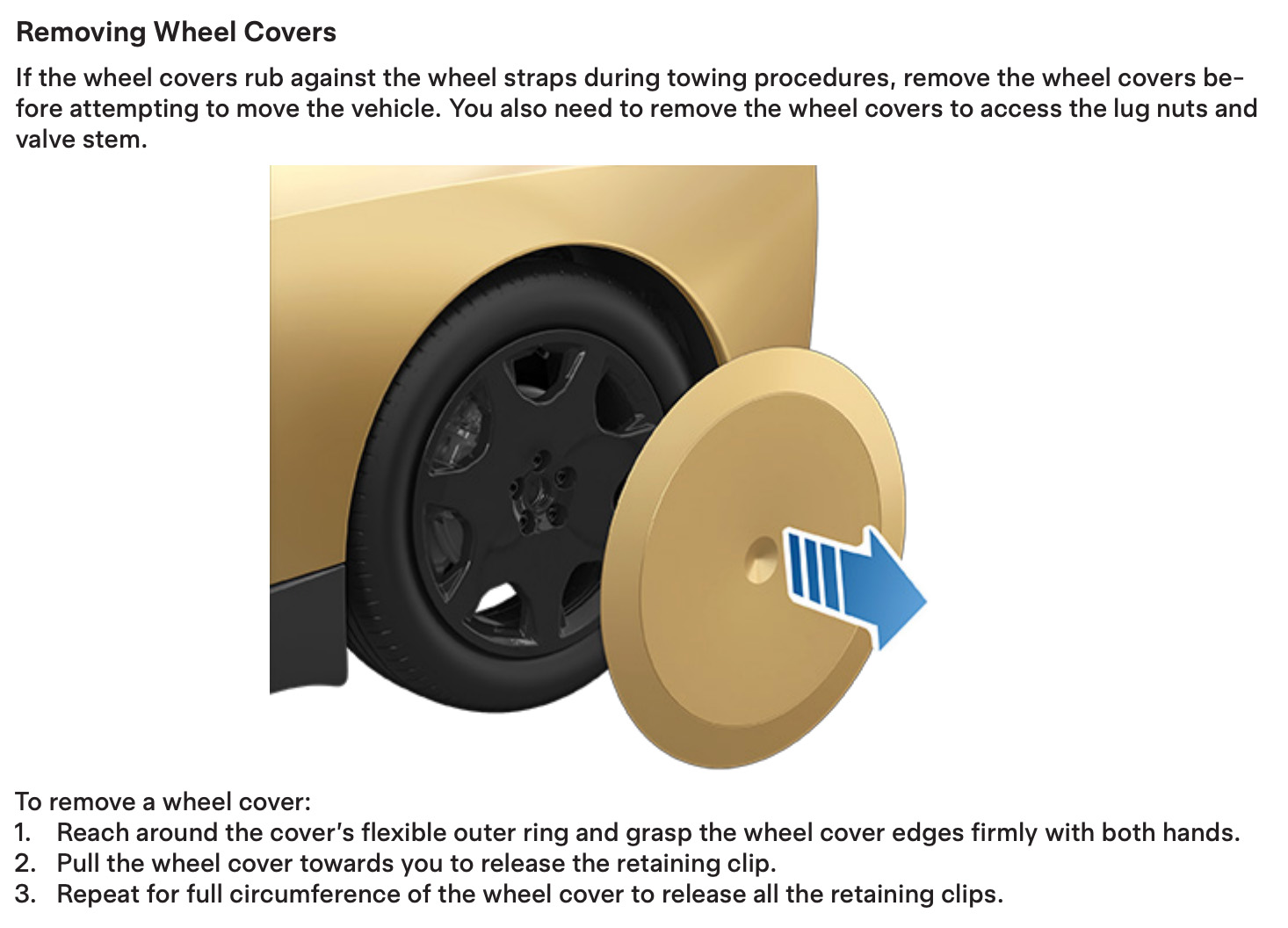
If you find yourself in desperate need of four large gold serving trays, this is how any Cybercab can provide a set of four. Basically, just grab and pull, all around the rim.
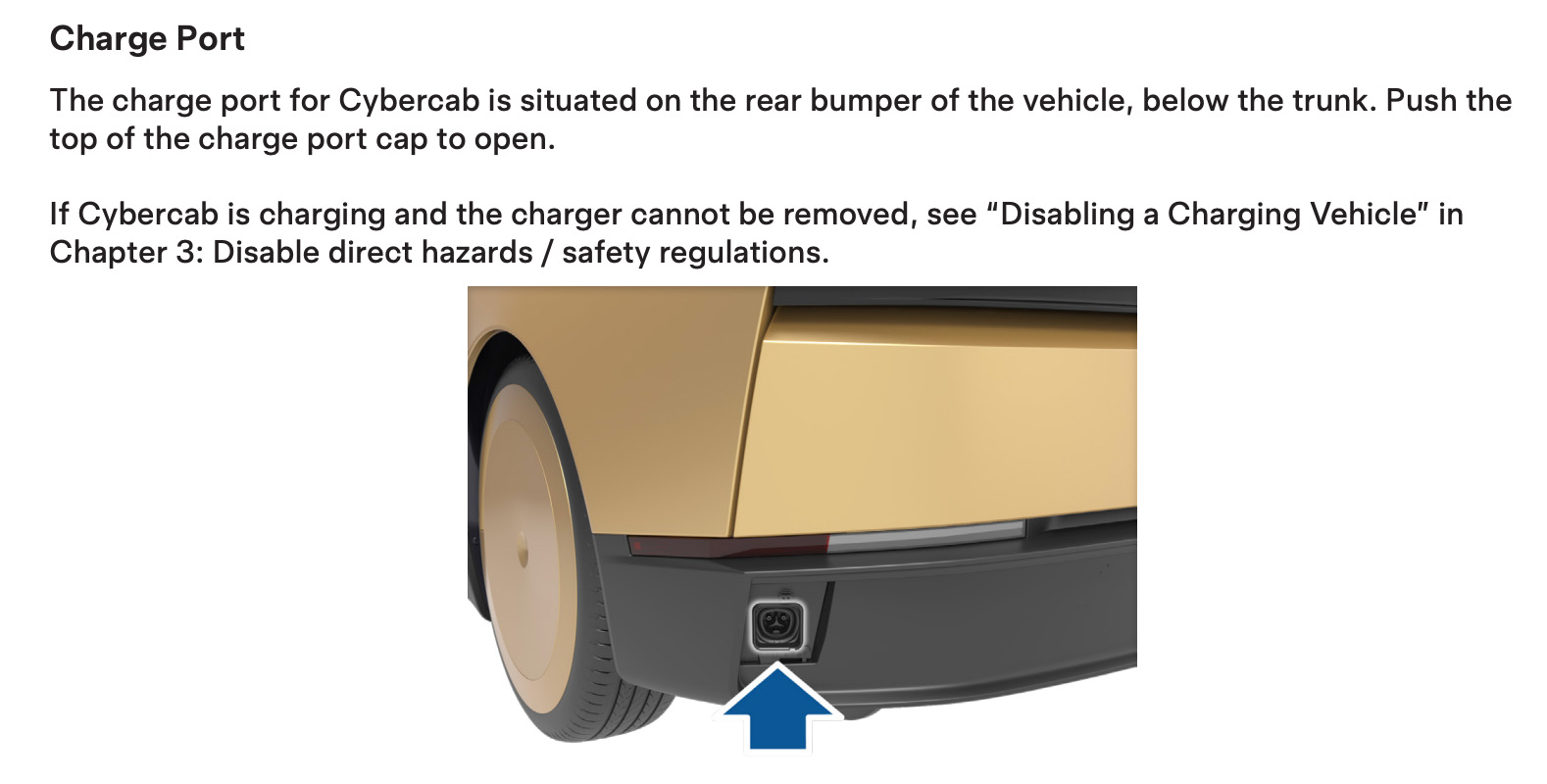
Where Is The Charger?
It’s way the hell down there, on the lower corner of the bumper! I suspect this location is designed to allow for automated plugging and unplugging of charging cables. Seems like a tripping hazard, so be careful out there.
It Sort Of Gets Treated Like An Animal
When in Autonomous Mode, the way the car is discussed feels a bit like wrangling an unpredictable animal. Like these warnings that, just because the car isn’t moving, it does not mean Autonomous mode is off:
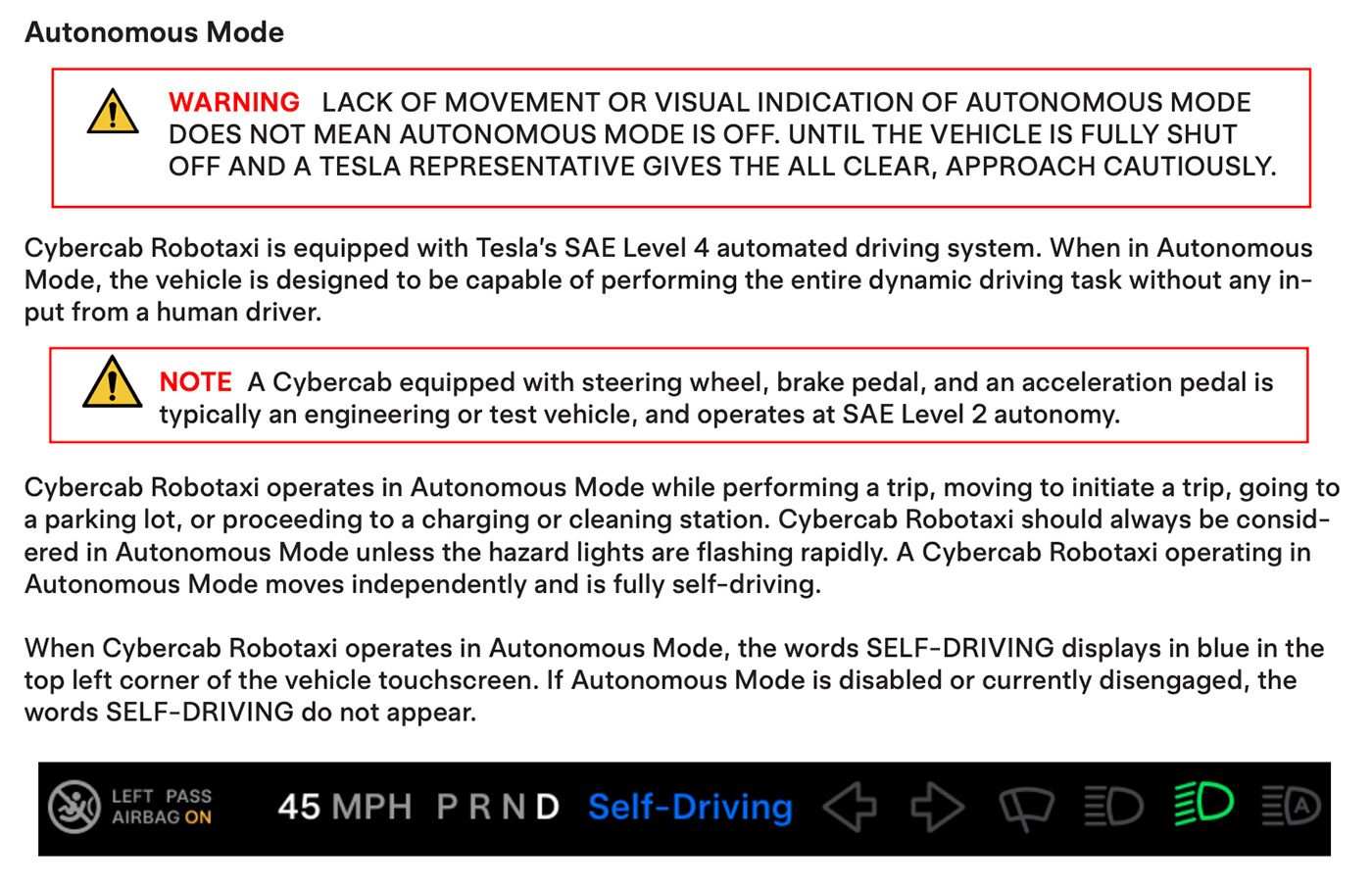
To help mitigate the uncertain behavior, the guide suggests a few things:
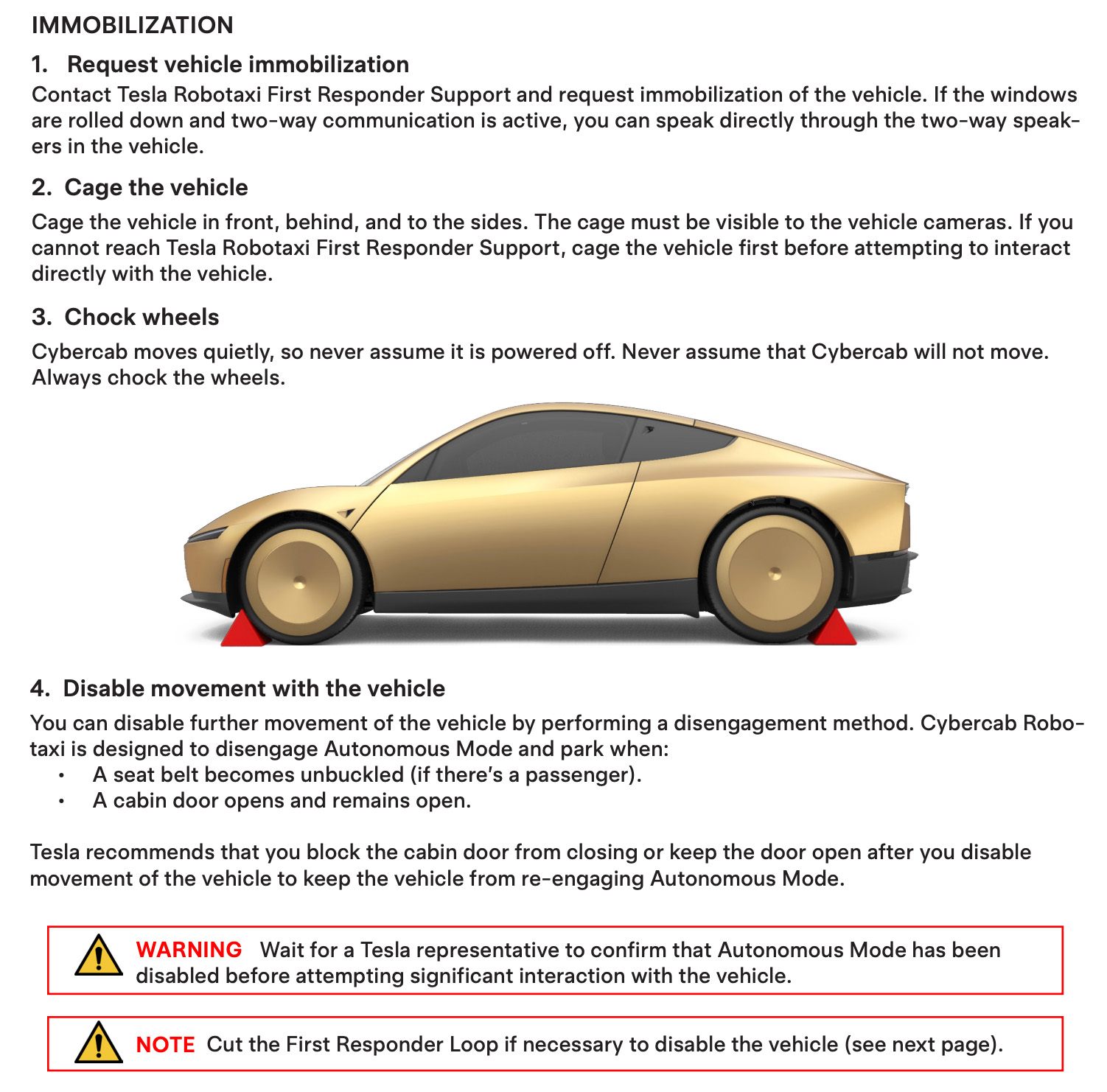
Chocking wheels seems obvious, but more interesting is the “caging” process, where visual obstacles are placed within view of the car’s cameras so it feels like it’s “caged in.” If you’ll indulge me, I predicted something like this in my book back in 2019, but more in the context of things that kids who want to make trouble could do to “trap” automated vehicles. Same idea, though!
What Does It Do If Shit Goes Sideways
If the Cybercab detects a “safety critical event” (that’s a festive-sounding euphamism) then these are the actions the car will take:
Collisions and Safety Critical Events
Cybercab Robotaxi is designed to detect the occurrence of a safety critical event (such as a collision or airbag deployment). When detected, the vehicle is designed to stop, park, and disable Autonomous Mode where possible.
Cybercab Robotaxi then:
• Flashes the hazard lights rapidly.
• Unlocks the doors for easier egress.
• Rolls down the windows to vent the cabin if airbags deployed.
• Initiates two-way communication between the vehicle cabin and Tesla Robotaxi Support. Tesla Robotaxi Support can then contact 911 if necessary.
Those all seem like reasonable things to do; of course, reality is messy, so sometimes things don’t happen so neatly. That’s why there’s helpful diagrams showing, for example, where not to cut through the body/frame:
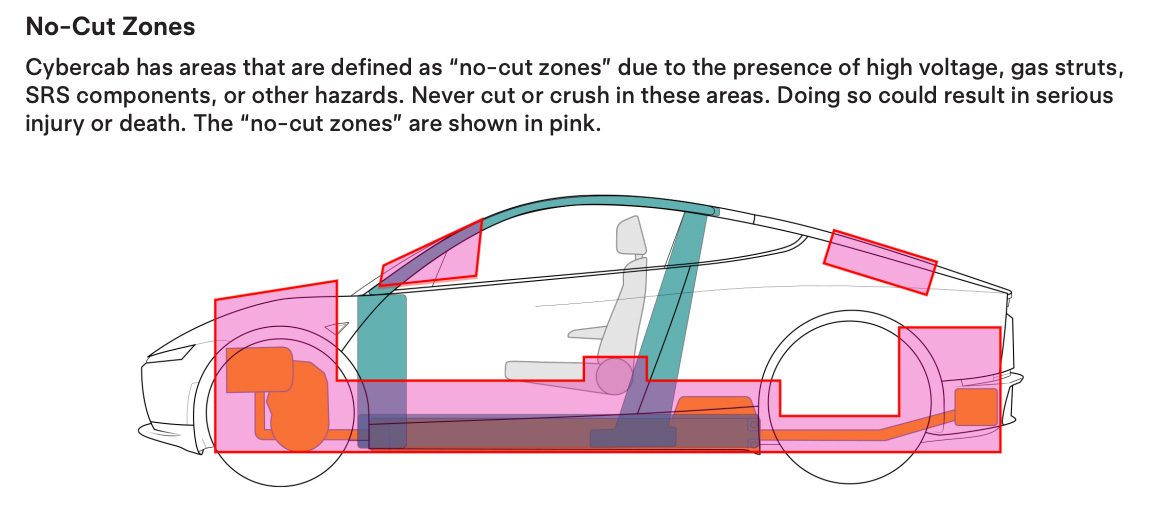
The drivetrain and battery areas are pretty self-evident, and the hatch has springs and gas struts – not sure about the windshield area zone, though.
How Does The Car Hear Sirens And Spoken Commands From Outside?
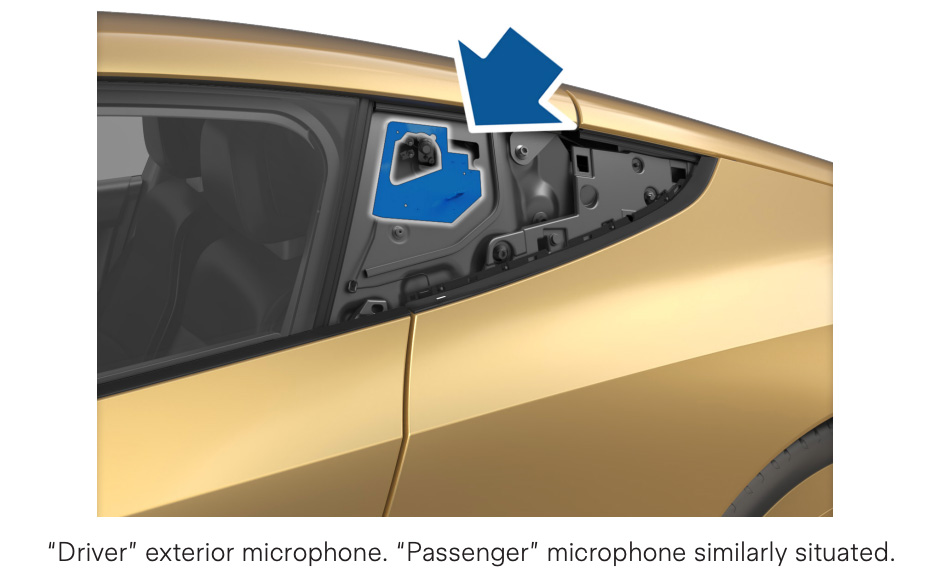
You know how: microphones! There’s two, on the B-pillars.
There’s No Hood Stay
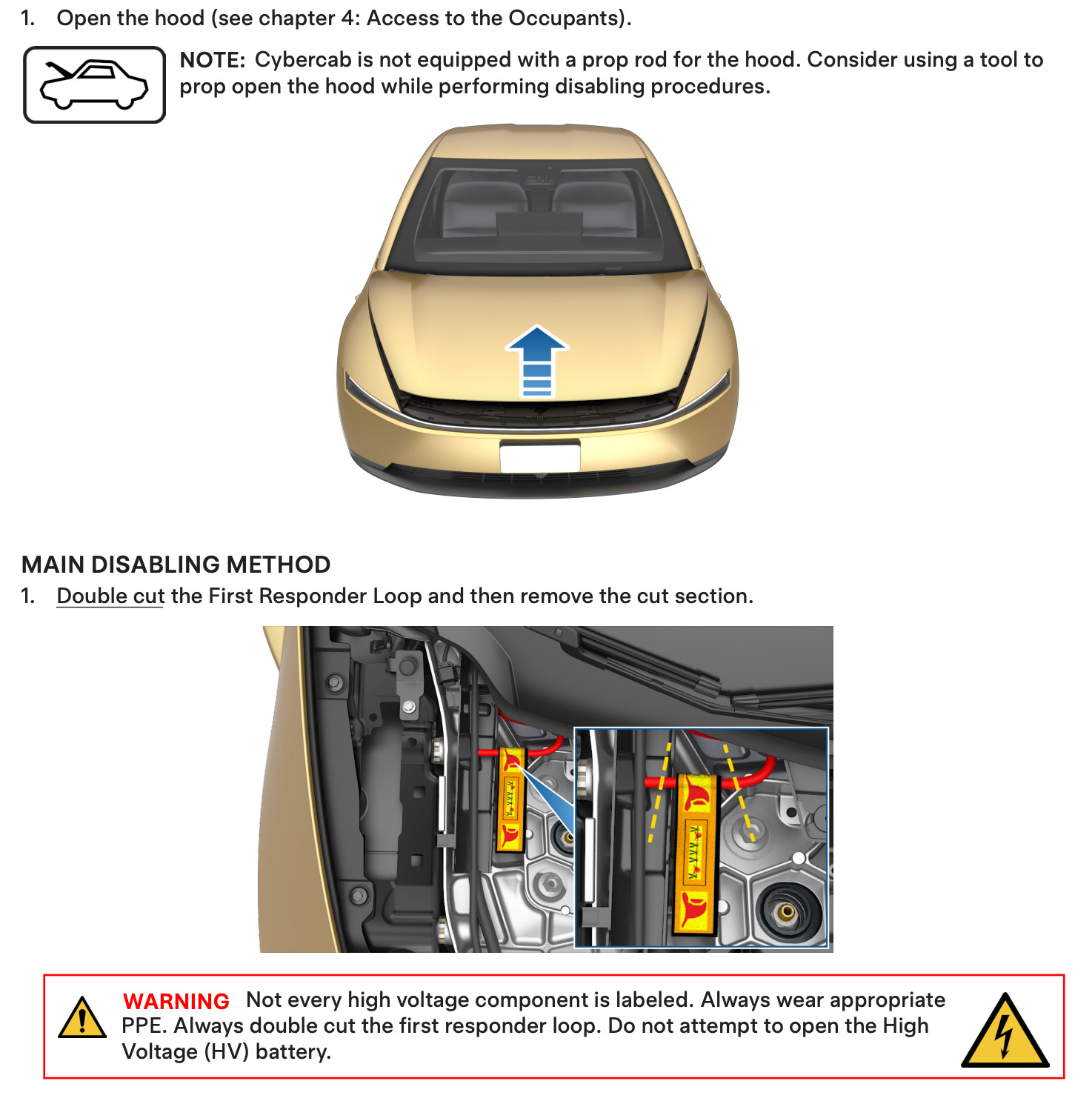
If you want to open the hood, you can, but there’s no built-in way to keep it open. Which is probably fine, since no one is really tinkering on these. The main power cut loops are under there, as you can see above.
What’s The Inside Like?
Hope you like minimalism! Because they added a ton of that in here! They just slathered on that nothing, on every possible surface!
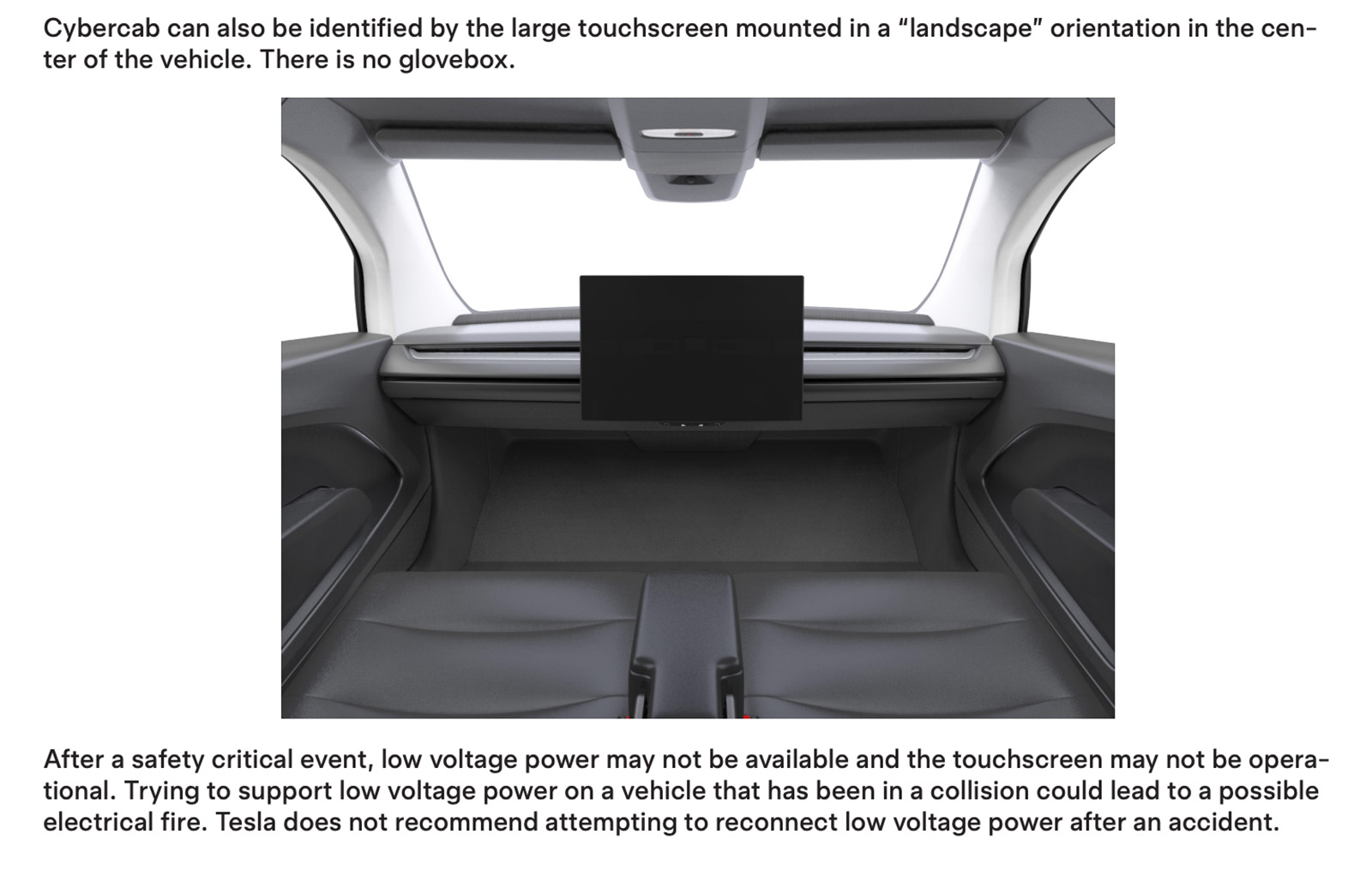
There really doesn’t seem to be any physical controls there, so if the power is compromised, it makes doing anything quite difficult.
Where Are The Emergency Door Release Handles?
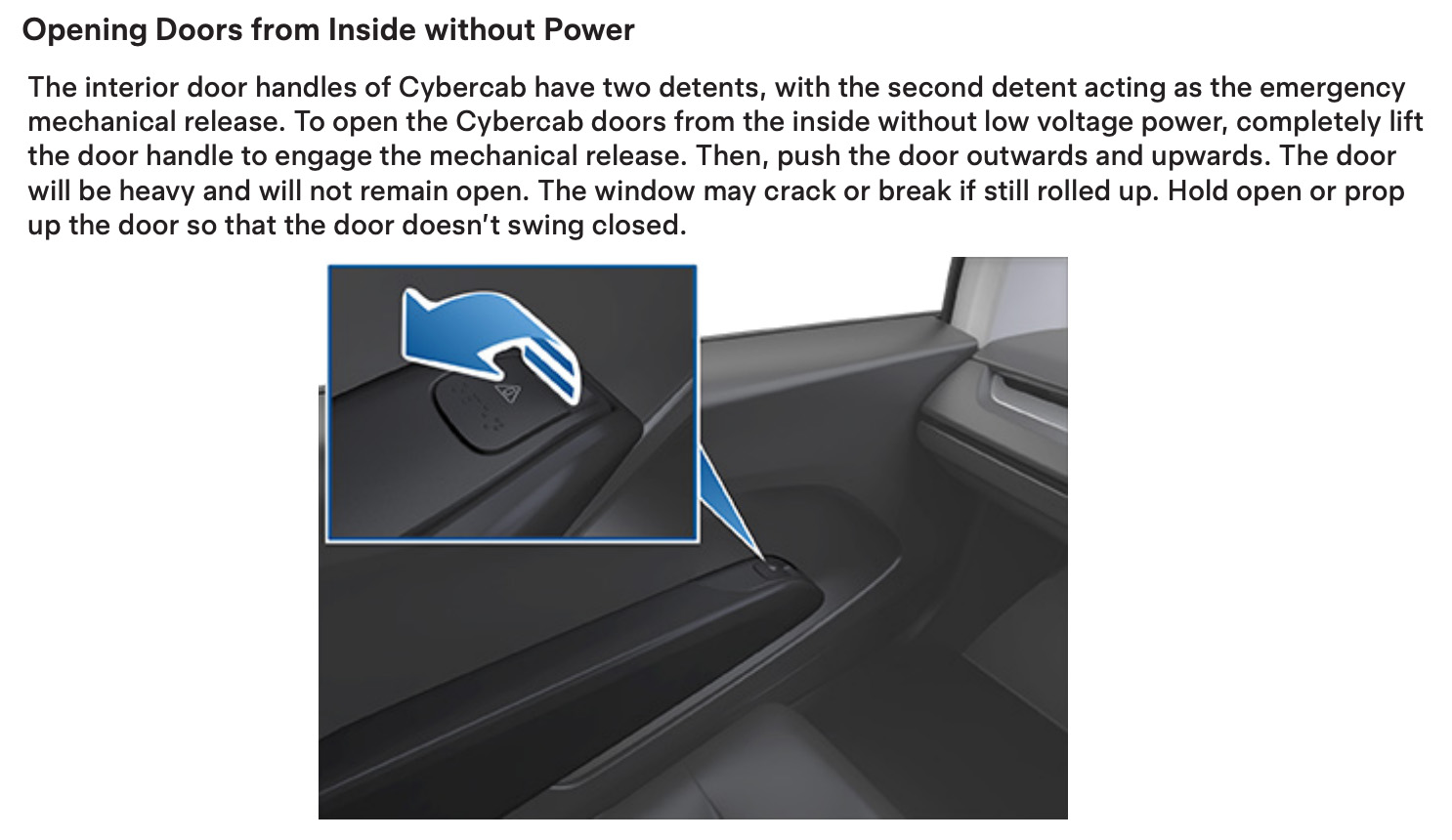
Right there, on the leading edge of the armrest. Like other Tesla emergency door releases, this one can break the glass. Why, Tesla, why? There has to be a better way.
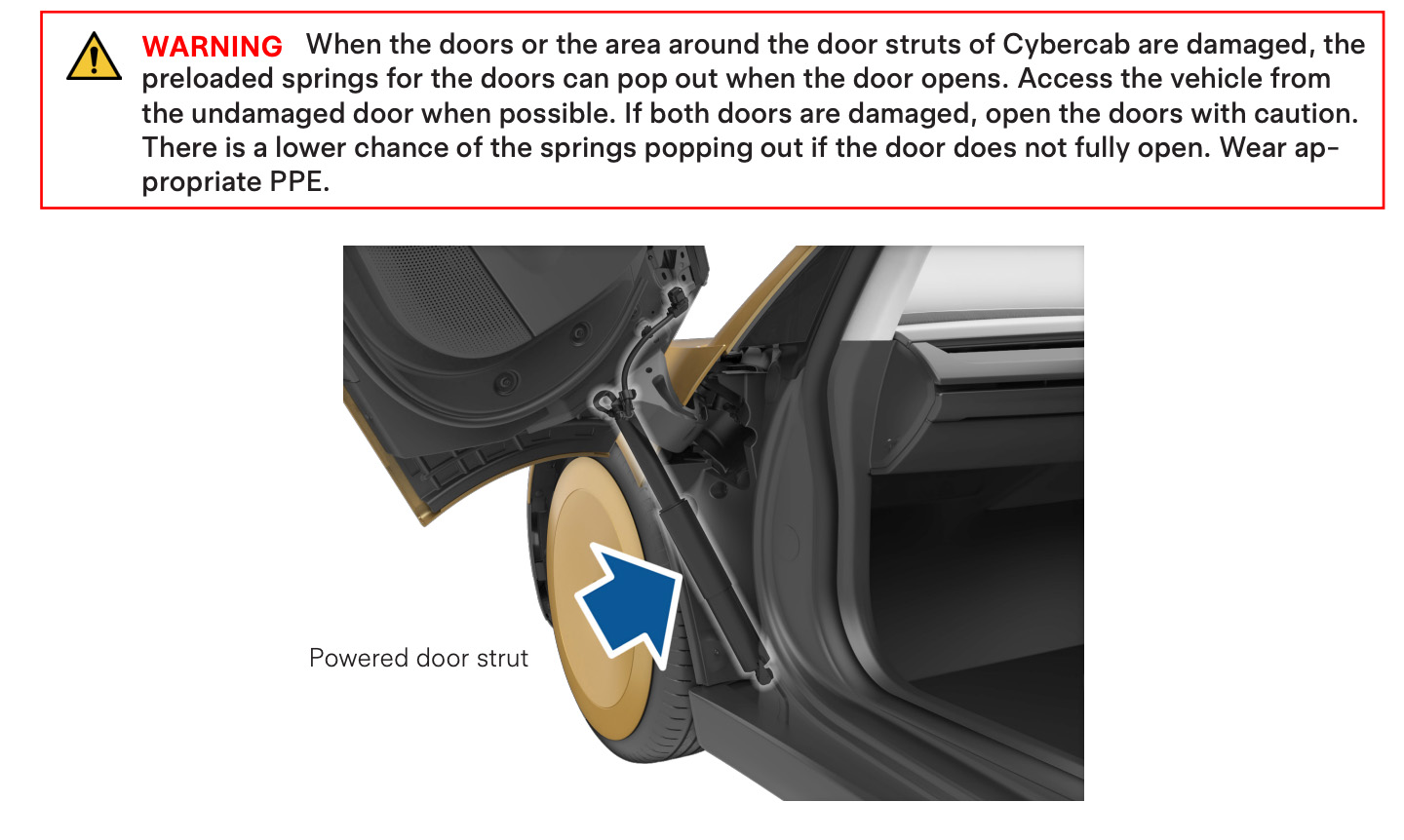
Oh, and when you get the door open, with some difficulty, be wary of this powered door strut. There’s preloaded springs in that thing! That’s a lot of stored energy; respect it.
Towing And Jump Starting
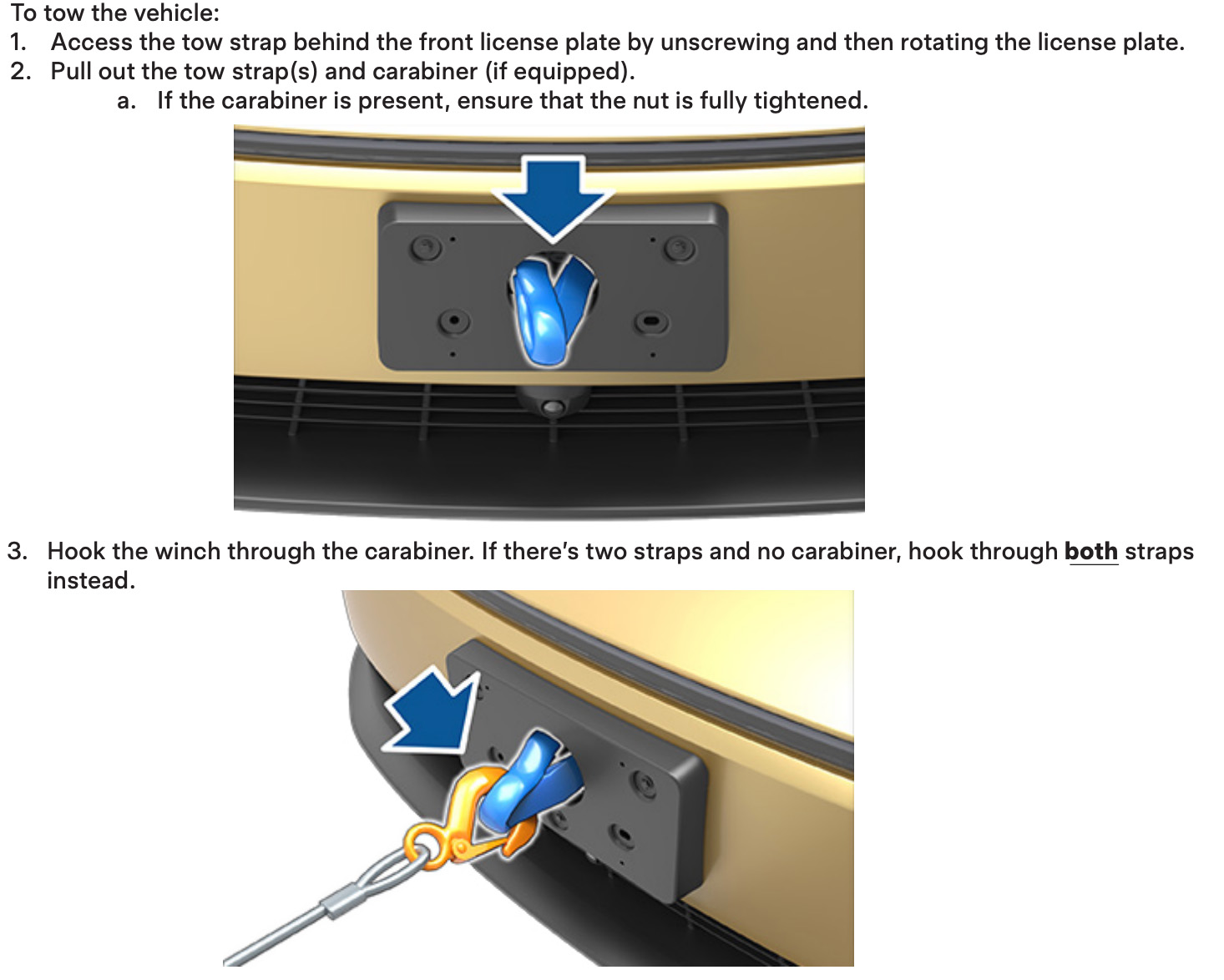
Want to tow a Cybercab? Maybe one that is trying to make a nest on your property, under your shed? To drag it out, you need the towing eye, which seems to be hidden under the front license plate mounting panel. It’s either a carabiner under there, or two straps. You should be able to get your ox hooked up to those to drag it away, for good.
Jump Starting
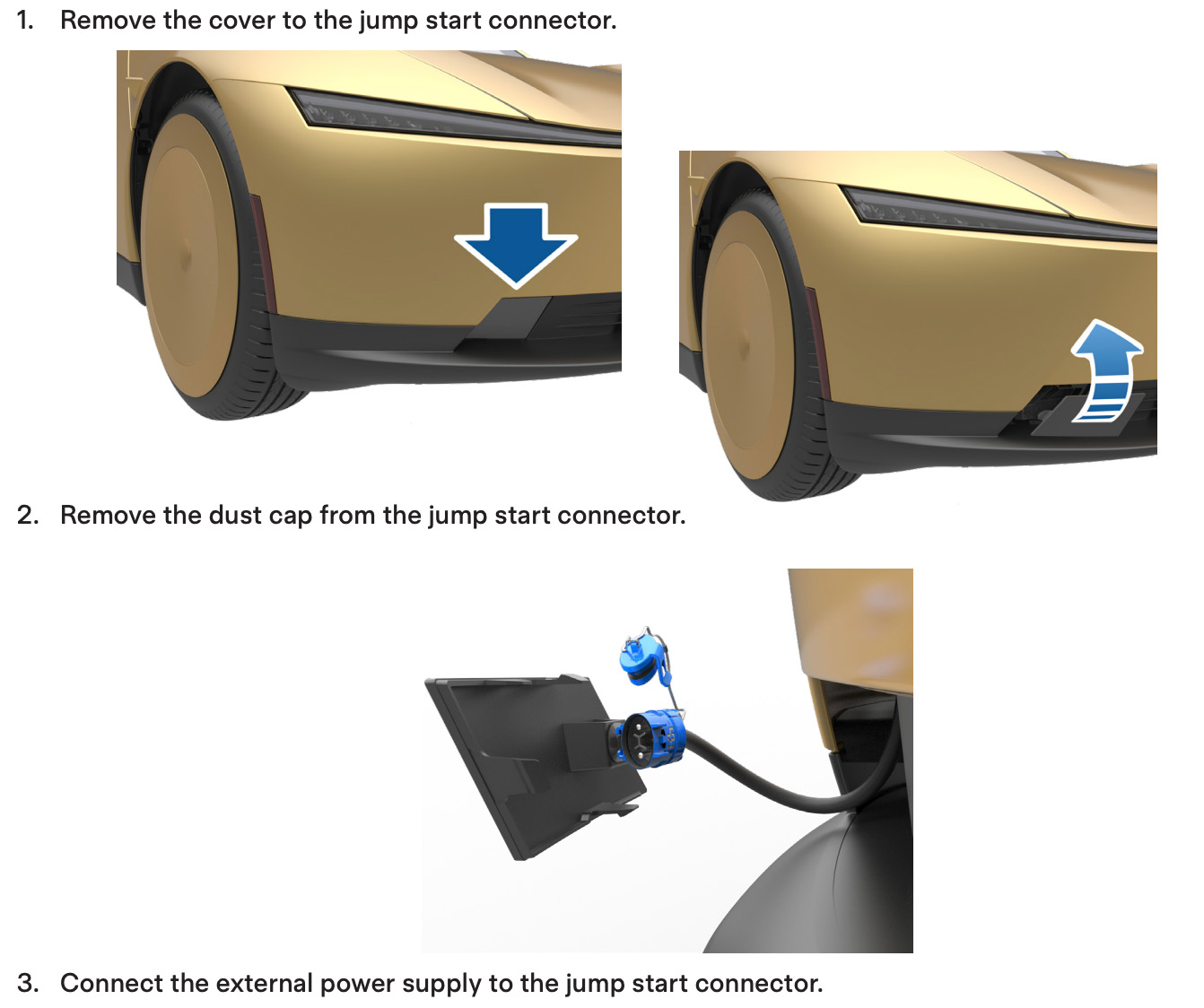
So this one is sort of deceptively tricky; there is a jump start connector, but you can’t just jump the low-voltage system with any car, because it’s a 48V system. Maybe you could wire four cars in series?
The Cybercab is definitely an interesting machine, but it does seem to offer a number of non-trivial challenges for First Responders. I’m most interested in its behaviors when interacting with emergency workers and vehicles; will it be predictable? Useful? Will it know when to get out of the way, what to avoid, and not make a nuisance of itself? Maybe. I hope so.
But with the vast entropy of the real world, who can say? I guess we’ll just have to see.




I love JT’s articles and The Autopian!
Separately, I just have to make a joke: I actually just read a Cybercab article so going to puke now…ha ha. That always happens though after reading anything fascist Tesla related.
“Why did they make this decision?”
Ketamine and smug fascist Tesla stan culture…
There’s a screen button to…POP THE TRUNK? FAILURE. That’s new fresh hell for me…that’s it, I’m keeping my Honda Accord FOREVER since you just pull a lever (yes, I’m a poet and didn’t know it)
This atrocity is one of the most fucking pointless pieces of trash I’ve seen…it’s still below the cYbErJuNkTrUcK though, which to me is THE worst vehicle ever made.
Also, all of this excessive “hazard lights flash” is fucking illegal outside of actually being a real hazard as mentioned in later instances. To me, the whole car and all Teslas are a fucking hazard anyway, ha ha.
“No prop rod”
Yet another new stupid fucking thing! I don’t give a shit about this car- it’s just SO fun to make fun of and I still can’t believe how unbelievably fucking stupid all vehicles like this and similar are…but still? Eventually someone will need to work under there, and they don’t get a prop rod? FAILURE.
I know it’s just a cab, but that is the most boring Interior I’ve ever seen just like most Tesla trash. I almost fell asleep seeing it. That’s how they see Tesla stans: “here, you don’t get shit” and they actually…WANT IT…and want a fucking YOKE. I’ll never, ever understand how fucking stupid they are. That’s just how it is and not even up for debate. Also, they are fascists. Don’t even get me started on the door handles. Tesla and fascist Melon Husk are mass murderers due all the people who have died where they couldn’t open the door due to these asinine designs. They should be sued into oblivion and he should be thrown in prison forever along w/ his ol buddy fascist Trump. All “e-door handles” should be illegal. What a whole bunch of absolute fucking nonsense!
“This layout is also how the Cybercab can have such a colossal trunk”
Or perhaps become the new electric minitruck/ute America so desperately needs.
What a stupid, pointless vehicle.
Why not make it wide enough for a single bench seat in front to seat 3? Doesn’t even look like that is an option with the current design because of how narrow it looks.
I think it is technically wide enough to at least have an occasional center seat that a kid could squeeze onto, they just didn’t equip it with a center seat belt
In a past life I was a volunteer firefighter / medic. I have handled over 100 Motor Vehicle Collisions. I actually read the linked document from Tesla. It looked a lot like the documents Toyota sent us way back when their Hybrids were new and shiny.
The biggest safety issue is the airbag systems. If I were handling one of these I would make good and sure that the low voltage battery cables had a chunk taken out of them, starting with the ground cable first.
Beyond that, nothing looks all that special for this vehicle. Any hybrid can be sitting there with the engine off and try to power up and move. Just follow the process and it really is fairly safe, and I didn’t see anything in the Tesla document that was different from any other electrified vehicle.
I think I have a new top reason to not like autonomous cars. That whole section about having to assume that the vehicle is still active sounds like an accident waiting to happen. An unlikely accident, yes, but one that is infinitely more likely to happen with one of these than with a traditional car.
This two seat taxi is really happening?
Sadly, I’ve seen one testing in Denver already. As Jason said, it’s colossally stupid to have an entire car meant as a taxicab only capable of seating 2 people when it’s a clean-sheet design.
The reason for two seats is that something like 90% of ride hail rides are one or two people (that may not be the exact number, I don’t remember), if you go on the Tesla Robotaxi app and say you have three or more, they will send a Model Y. They have Model Y taxis running in multiple cities around the country and are staging cars in many more cities preparing for launch there. The Cybercab is so cheap to produce the rides will be much cheaper than current options.
“if you go on the Tesla Robotaxi app”
I’d rather slit my fucking wrists…
ha ha
I think Jason is just wrong here. The vast, vast majority of taxi/ride hails are one or two passengers, but quite often those passengers need some substantial cargo space. So it’s built for the majority use case, which is a wise decision. There are apparently Model Y taxis as well, and with the new long wheelbase model you can sit 7 in those with a bit of cargo room. That would be the family option if required.