

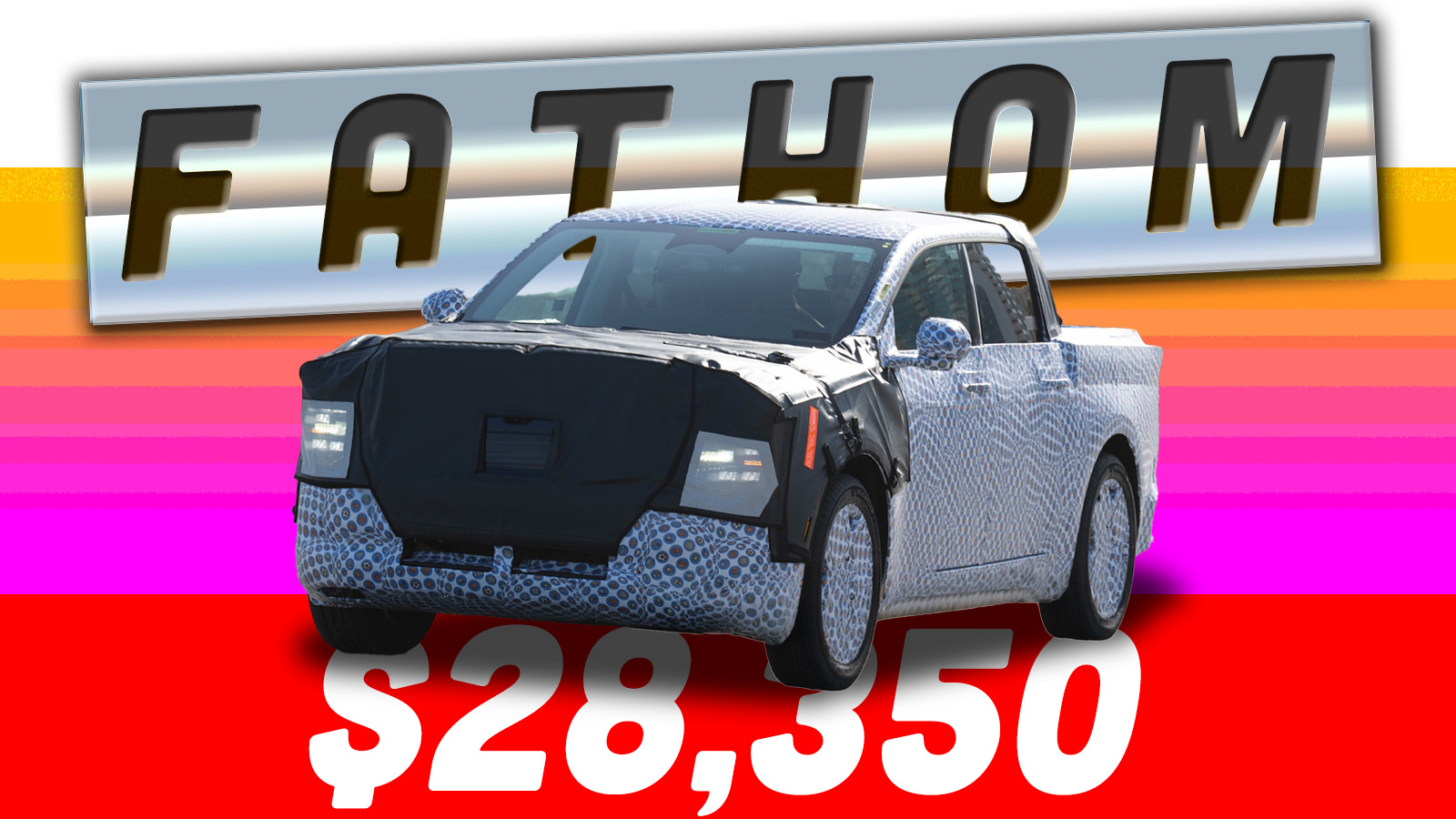
$28,350. That’s how much Ford’s all-new Universal Electric Platform-based pickup truck — which it is calling the Ford Fathom — will cost when it hits the market next year. This comes shortly after Slate announced pricing for its truck: $24,950. Which is the better deal? Well, it’s hard to know, especially since we’ve learned that its range will not be 300 miles as I previously thought.
Ok, right away, let’s add some destination charges. The Ford Fathom electric pickup truck comes out to $29,945, while the Slate costs $26,400. That’s $3,545 more for the Ford truck. Is it worth it?


I obviously don’t have an answer, since I haven’t seen underneath the Fathom’s camouflage and I haven’t driven it (I have driven the Slate; I found it charming). But I wouldn’t be a journalist if I didn’t at least conjecture a bit, and my guess is that the Ford will offer a decent bit more for the money. Not only will the standard Fathom almost certainly come with power windows, but it also gets an infotainment screen:
Available for pre-order in early 2027, the midsize electric truck, with standard-range battery, has a starting MSRP of $28,350* competing in the heart of the affordable EV market.
But the price is the least interesting thing about it. Projected to have more passenger volume than a Toyota RAV4, with a large, high-resolution touch screen, bidirectional power capability, digital key, as well as a frunk and bed for added cargo flexibility, Fathom seats five adults and is just as comfortable on a workday commute as it is on a weekend adventure.
Advanced technology adds value to the already well-equipped Fathom. Every truck is BlueCruise capable, and the Fathom’s BlueCruise integration with Apple Maps offers a more seamless on-ramp to off-ramp experience. Fathom is also Apple CarPlay and Android Auto capable.
[Note: The “the price is the least interesting thing about it” seems like an odd quote given that the price is the thing. -DT]
It’s worth noting that, later in the press release, Ford writes “It will also maintain compatibility with standard CarPlay and Android Auto.” I’m going to read that as those two being standard on the truck. Another, more important standard feature on the Ford and not on the Slate is four doors, which is pretty much a requirement on any high-volume vehicle in 2026:


But here’s the critical question we don’t have answered yet, and that I myself kind of thought had been answered: How far will the Ford Fathom drive on a single charge? (The Slate will do 205mi).
The reason why I say I thought it had been answered is that, on Ford’s website, there’s a Q&A in which The Blue Oval says its plan is to offer 300 miles of range:
Q: Is the goal to extend range as far as possible on the UEV, or is there a certain threshold of range, say 300 miles, that Ford deems sufficient to balance cost and range anxiety?
A: Our strategy is to meet the expectation of some customers of around 300 miles of range. Instead of using larger, more expensive batteries to achieve this, we are focusing on extreme vehicle efficiency through aerodynamics, weight reduction, and energy management to achieve similar range with a smaller, lower-cost battery.
We all know Ford — and any automaker — can offer an electric vehicle with 300 miles of range; just chuck a big enough battery into it. But the story of the Ford Universal EV pickup is its starting price of under $30,000, so to answer that question by saying the goal is to hit 300 miles of range without pairing that number with another constraint made me think that the other constraint was implied — i.e. it was the $30,000 starting price.
Anyway, it appears I was mistaken. Per Ford, the $28,350 ($29,945 after fees) base Fathom is not expected to achieve an EPA-estimated range of 300 miles. If you want 300 miles of range, you have to pay extra. And we don’t yet know how much. From Ford:
We have said previously that some customers will want to see an EPA-estimated range of around 300 miles and we will have an option for that customer.
The truth is, I suspected $100-per-mile of range was too good to be true. After Autopian member Life’s Short; Drive Fast! commented last month about the truck’s features, I admitted that — at the price point ($30,000; I think Life’s Short; Drive Fast! may have edited in the $40,000 figure after the fact), 300 miles seemed super ambitious:

I guess my intuition was correct, and my reading of Ford’s Q&A response was not. In any case, this all leads me to wonder: How much range does the base Ford Fathom have to offer to be competitive? Or, put another way, how much does the 300-mile truck have to cost to be competitive?
Let’s talk about the competition.
You can buy a Nissan Leaf with 303 miles of range for about $33,000 all-in:

A Chevy Equinox EV offers 319 miles of range for about $37,000:

For under $39,000, you can buy a Tesla Model 3 with 321 miles of range:

A Chevy Bolt, at $28,995, offers a range of 262 miles:

And a 245-mile-range Hyundai Ioniq 5 costs about $37,000:

But are these the Fathom’s competitors? I just named a bunch of crossovers/hatchbacks. The Ford Fathom is a small pickup, like the Ford Maverick Hybrid, a $30,000 gas car free from range anxiety and with basically the same base price as the Fathom:

Ford has made it clear that the Fathom is not meant to be a car solely for EV enthusiasts; Ford has called the Universal EV Platform the company’s “Model T Moment.” In other words: This vehicle has to appeal to everyone.
If the average person has to choose between a 38 mpg Maverick and a 220 mile Fathom, are they choosing the Fathom? What if its 250 miles? 270?
I don’t have an answer. We haven’t even seen what the Fathom looks like, or all the features it will offer. If it’s extremely stylish and feature-rich, maybe I’d be tempted at 250 miles for $30 big-ones? Or maybe I’d drop the $35 grand (or whatever it ends up being) for the 300 mile variant, as that’s still a great price if the vehicle is cool.
But with such heavy depreciation on EVs, $30-35 big-ones goes a long way these days on the used market. Though I remain excited about this truck, it’s a lot to think about; when we finally have the base range and the price for the bigger battery, plus a look at the feature list and the styling, I’ll be doing even more thinking about the new, sub-$30,000 Ford Fathom.
Top photo: Ford




I’m not so much concerned about the top-line range number, as you really don’t need much for daily driving. What I’m curious about is the DC fast-charge rate. That’s what will make it viable for road trips. Also, how much will we have to pay for a a ventilated seat option?
For MY use case (frequent ~1000 mile trips), at least, the delta between something with a fast charge rate (Hyundai eGMP platform) and something with a slow charge rate or a documented history of not being able to charge at the advertised rate (Looking at you, Charger RT), can be ~2 hours on the drive between OKC and Tucson.
If Ford has made the decision to cut costs on charge rate (say, under 200kW), I’m just not going to be interested, and I’ll continue with my F150 and a fast-charging EV for road trips, instead of consolidating down to one car.
Yep, DC fast charge rate is far more important than say 240 vs 300 miles of range, unless traveling to an area that has over 200 miles between chargers. It’ll be interesting if the base model has something like 220 miles of range, but fast DC charging with LFP batteries and the “upgrade” has 300 miles of range, but slower DC fast charging with NMC batteries, and the low range LFP version will complete a 500+ mile trip faster due to the faster charging rate.
Ford has at least hinted that they will only be using LFP in this. The thing is you need 300 mi of advertized range to have that 200 mi road trip range. Sure charging to 100% isn’t “bad” for LFP but the realities of physics say you aren’t going to want to DCFC to much more than 80% to keep total charge time low. Advertised range is combined and hwy will be less. Since most road trips include a lot if not most or all hwy you can cut that number down at least 10%. So now your usable range is 70% (10-80% charge) of 90% or less, of the advertised range and your “road trip useable” range is under 200 mi.
As stated above, the real question is the 10-80% charge time. Though I do think that if I can’t get at least 3 hours of highway range between charging stops, it’s not going to be a viable choice for me.
So, a Bolt or Leaf is going to be a comparable and the better choices here, then?
More reason to buy a Slate then.
Seeing as none of those are multi-row enclosed-cab open-bed vehicles, no, they’re not directly comparable.
People are comparing a single cab short bed EV truck to this crew cab short bed EV, and since all they share is truck and EV between them both, it’s only fair to compare this Ford to another multirow EV if we’re not doing a direct apples to apples comparison.
I’m one of the weirdos who would pay more to not have a screen. The fact that the Slate is cheaper is just a bonus. I know where my money is going in 2027.
I’m not a fan of the name, but this range detail does make the comparison to the Slate more interesting.
As I said about the Slate, it’s too much for what it is, but at sub $20k I could make an argument for it being a fun daily driver.
The problem with this is that it’s not all that interesting, so I’m not willing to spend “fun” money on it. So in that case it needs to cover more of my needs, which includes needing 300+ mile range for weekend camping/biking/paddling trips to locations without chargers.
In any case, though, both of these end up being too much money for what I’m willing to spend and I’ll be sticking with my current cars as long as possible.
You will never buy another new vehicle for sub $20k as long as you live. And $50k+ is now what constitutes “fun money”.
And I may never buy a new car at any price, which isn’t that big a change from what I was expecting. My parents have never bought a new car, and neither did their parents.
The Slate was just the closest I’ve come to considering it, since the reason I don’t spend $1000/month on new cars is so I can spend my money on other fun things and the Slate was fun enough to be part of that “fun” budgeting.
The Slate made a lot of sense when there was still the federal EV credit. Since that’s gone, the value proposition isn’t as great. It still appeals to people that want a barebones vehicle, but those people are few and far between for the general public.
And we’re too busy in bidding wars over old Toyota pickups.
I drove an old Toyota pickup (T100 4×4) for 14 years and it was an uncomfortable slow-ass clunker. The old pickups and Tacomas have comically tight interiors. If you love wrenching on suspension, fixing rust, and driving really slowly then I can see the appeal.
My friend has a 1st gen Tundra, and even it is still like sitting in a small truck because it still feels like you sit on the floor with your legs out, unlike say my Ram truck where you sit more like in a chair with your legs down.
Well apart from the name being a bit too up Lincoln’s nomenclature structure, at 28350 vs 29950 for the square back suv variant of the slate you get to keep the bed and frunk separate from the passenger compartment and have such basic luxuries as power windows and phone mirroring plus power windows, paint and likely still even more range on the base model than the slate.
Slate really needs to start delivering now to try and get out from the depths of which they will be crushed next year pun intended.
Yep, the Slate is toast. Even the base Fathom will offer much, much more value in features and usability than the price difference over the Slate.
The only way the Slate makes any sense now is for those who see value in its modularity and customizability (which also will cost money). Or, if you really truly only need two seats, and really truly need two thousand dollars.
Right so automotive anoraks or fleets, but apart from Rivian which made it big with the vans and Amazon first Slate has no major fleet customers announced and is also just a new startup vs the established company of Ford.
Ford is also going to make a delivery van on this platform for the fleets
They need a smaller van since they discontinued the Transit Connect. The E-Transit is too big and expensive.
The E-Transit is dead along with the Lightening. The new small van will be based on the Fathom platform and the Transit is going to get a hybrid version.
I prefer a regular-cab truck. I don’t care one way or the other about the $2,000.
I just think a truck looks better and more proportionate as a regular-cab. Back seats are for sedans.
This is a totally legit preference, but I just don’t think there are enough of you. Better-looking but less practical coupe versions of sedans died long ago. Is there space for a better-looking but less practical small truck?
Delivery and light service fleets.
Those two things don’t care about the looks though.
Correct. But if the price was right… Maybe Slate will offer fleet pricing for large groups of franchisees.
I’d say you don’t need a new EV if you truly need $2k.
Exactamundo. So to buyers who can afford a small EV truck, if 2k is essentially not a consideration, then it puts these two trucks in a direct, head to head competition based only on the product.
And the Slate will absolutely get demolished in that comparison.
Slate really needs to drop their price by at least $2k
The Slate needs to be $20K as originally planned (after the tax credit). Even then the regular cab makes it a niche vehicle.
Yeah, I agree. That would be a clear differentiator. Right now the Venns overlap too much.
I can’t fathom why Ford would have thought that was a good name for a new product.
Maybe it’s the first in a wider “thinking” theme?
The electric Ranger equivalent will be the Ford Reckon. Explorer equivalent will be Explain. Sport coupe will be Mus-understanding. Off-roader is Bronc-Know (and obviously Bronc-Know Sport).
And so on. I await my check from Ford’s Marketing Dept.
A fathom is six feet, so maybe it refers to a 6-foot bed. You know, the truck bed that is perfect for carrying a standard 3’x6′ sheet of plywood…
Ford likes the alliteration of model names that start with F. This is, apparently, the best they could come up with. They should leaf through the dictionary pages one more time.
This would be a great truck (in my opinion) if the hood and bed heights were lower, the bed were longer and the cab were 2 seats with storage space behind them. Many would disagree, but honestly, how often are all of the seats occupied by people? 99% of the time, it’s just the driver. The family car is for the family, the truck is for getting the job done (which is, in all honesty, often just commuting to and from work).
Standard size sheet of what
Oh, I get it now
I appreciate that it’s a “new” name. Probably not the name I’d have chosen, and the alliteration was a bit of a tired concept a decade ago.
Courier would have been my choice, if using an existing Ford name. “Freestyle” didn’t last long and could also have been used, as another possibility.
At least they’re spelling it out and using an established word. They could have gone for “Fenix”, “Fantom”, “Futura”, “FizzBox-1.0xQ” or some other gibberish.
F10 would be great. Keep the F-series of trucks going with additional sizes for an expanded customer base. Why not?
They could have gone full nutso and called it “X Æ A-Xii”
Gesundheit.
They’ve said previously that the base model would have a ~55kWh battery so I would expect around 200mi range. I’m hoping for a ~80kWh battery for under $40k. As for the name, Fathom doesn’t make sense for a trucklet. I liked Ranchero better.
If it looks decent, the user interface isn’t stupid, and it has at least 250 miles of range, I would seriously consider buying one. I might even pay the premium for the longer range, depending on the cost per mile. I like that they targeted efficiency over cramming a giant battery in it, because that means it would also cost less per mile to drive.
I’d be more interested if it were a hatchback.
The Bolt already exists, doesn’t it?
I mean, you’re one bed cap away from a pretty handy electric wagon. Wouild a split tailgate soothe your hatch itch?
With more body styles planned for the platform you are likely to get your wish.
It’s all SUV/truck all the way down.
Suppose that fits Ford’s direction these days.
Ford has shown 5 body styles for this modular platform.
Yes, and they’re all various SUV iterations.
No, they’re not.
I see two blobby crossovers, one two-row and the other three-row; a boxy SUV and this pickup. What am I missing?
You are missing the van.
It also depend on your dividing line between a wagon / hatch and a crossover. I suspect these EVs will have 6 to 7 inches of ground clearance and keep a lower overall height than a typical crossover. More Kia EV6 than Sportage.
Why deal with range anxiety when you can have Ford engine quality anxiety instead?!?!
There is no engine, what could go wrong? No oil bath timing belt, no came phaser issues, no powershift transmission, etc.
Ah the famous simplicity of electric cars.
20,000 individual battery components at 800 volts designed and built by the people who couldn’t make a rubber belt work.
You doubt their decision to go with a “wet battery”?
I doubt all of Ford’s decisions, as should Ford.
I’d trust Ford’s engines and EV know-how over a lot of other brands’. They’re not perfect (none is) but they’re more than tolerable.
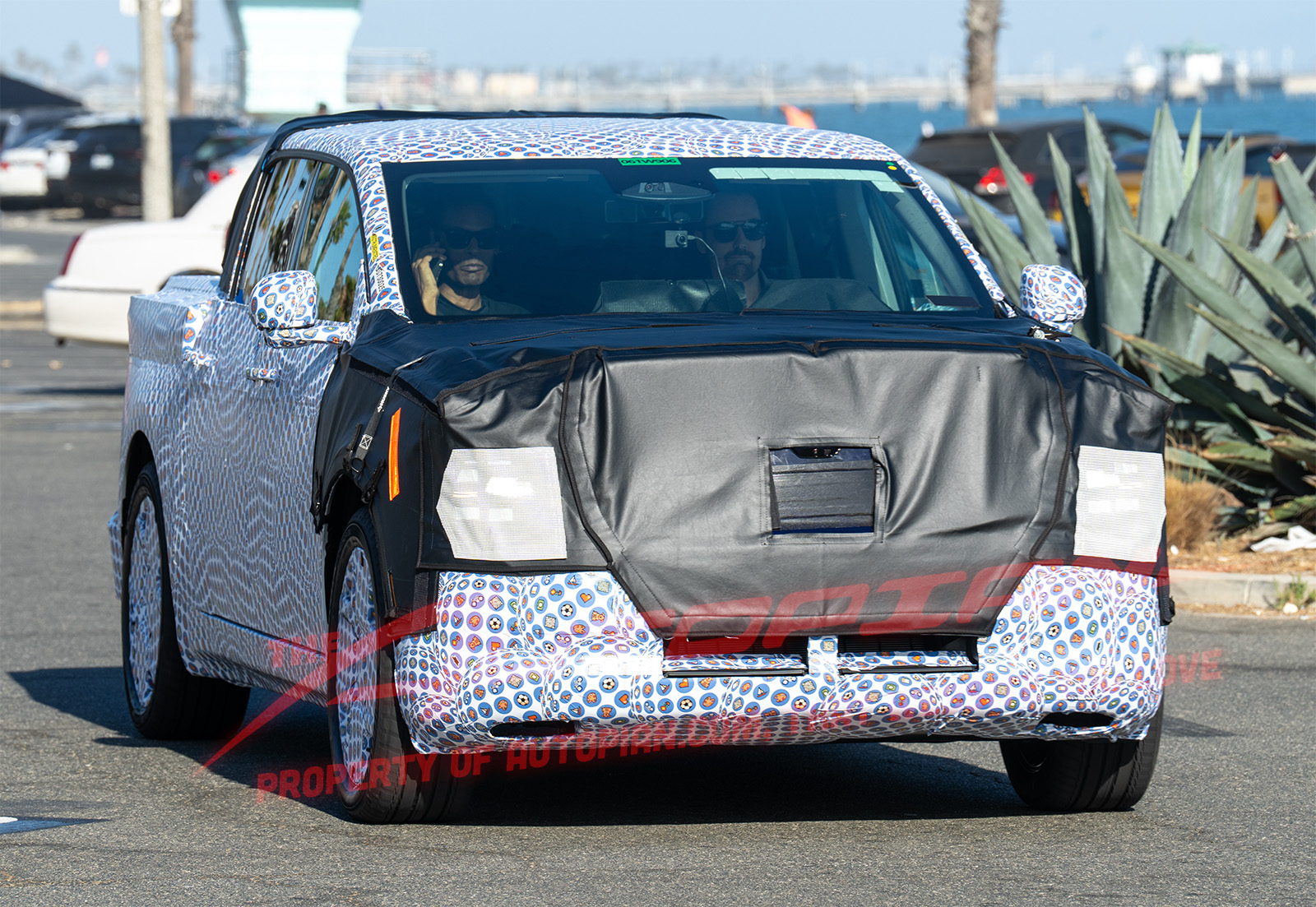
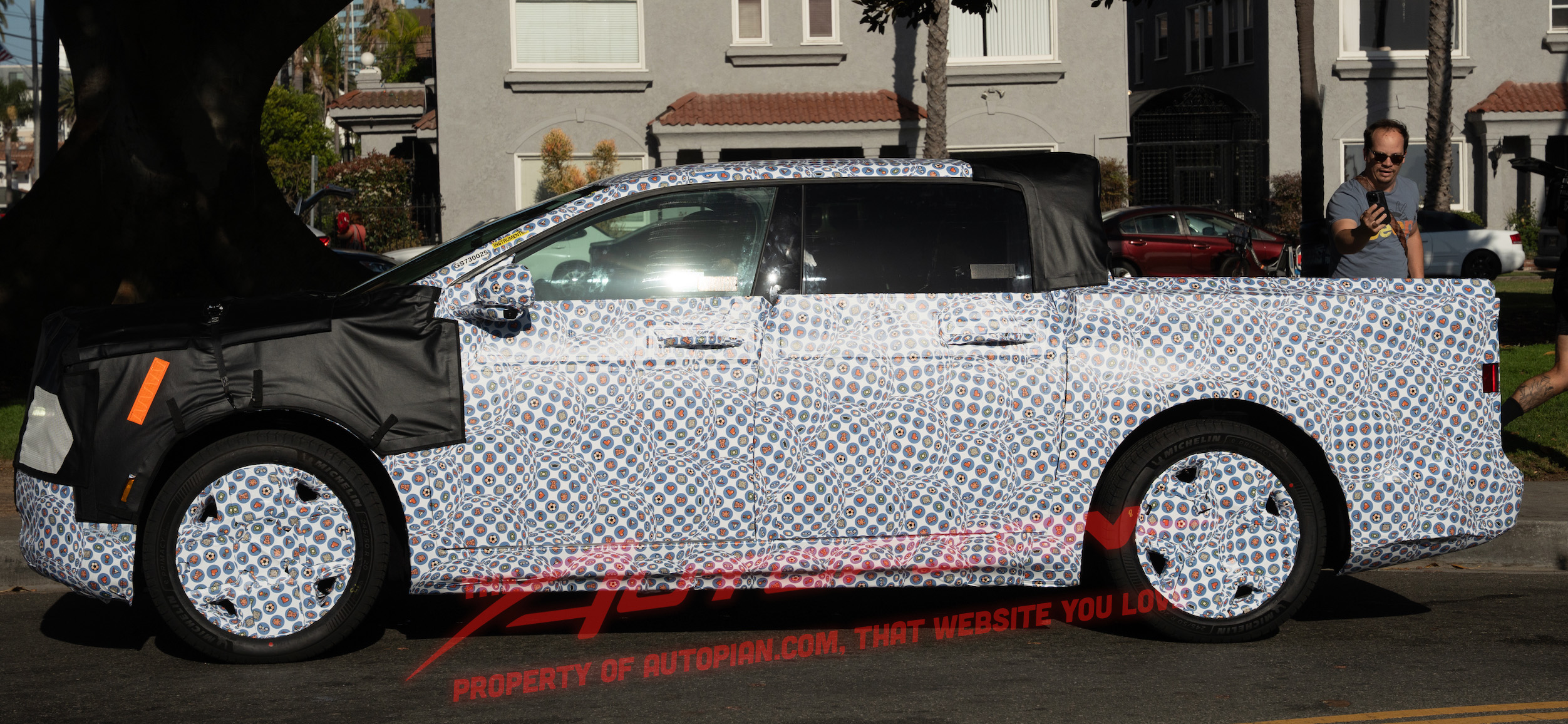
Even with all the camo you can see that they’re making the same
mistakechoice as Lucid – going all in on aero at the expense of design/appearance. The current zeitgeist for trucks and CUVs is blocky Tonka shapes. Will Joe and Jill Normal buy a lozenge-shaped truck in 2026?Ford knows trucks; I’ll be surprised if they screw up the styling.
The 1997 F-150 would like to have a word.
I dunno, they kinda sold a lot of those, didn’t they?
This was my thought exactly, but I was surprised when I saw one yesterday that the shape was much more appealing than it has been in the past. Maybe we really are ready for a break from the macho, giant grille, aggressive styling of current trucks.
Agreed. Dodge brought that to market with great success, and the followers are still following.
I bought a 1997 F150 recently and the styling has grown on me…a bit. Still not a huge fan though. What is impressive is how many F150s of that body style I still see on the roads today. I usually see several on my way to town, the newest of which would have been built in 2003. Most of the production run of those can now run historic plates, as I did with mine.
I certainly prefer the OBS and bricknose trucks, and the bullnose are my favorites. But comparing the tenth gen to anything newer I increasingly find myself liking the tenth gen, even if I still wouldn’t necessarily choose one.
I would have preferred a ninth gen one, honestly. But I didn’t want to spend a lot of money, and the ones in my price range were rough. Seems like those are starting to appreciate in value a bit.
The looks on my ’03 F150 have aged quite well, in my opinion.
The Jelly Bean was a huge success, despite its styling, so while style matters a compelling package will draw buyers.
I’d happily take the design of a “jellybean” F-150 over the current horrors that are the Toyota Tundra and 2016+ gm trucks. Yikes.
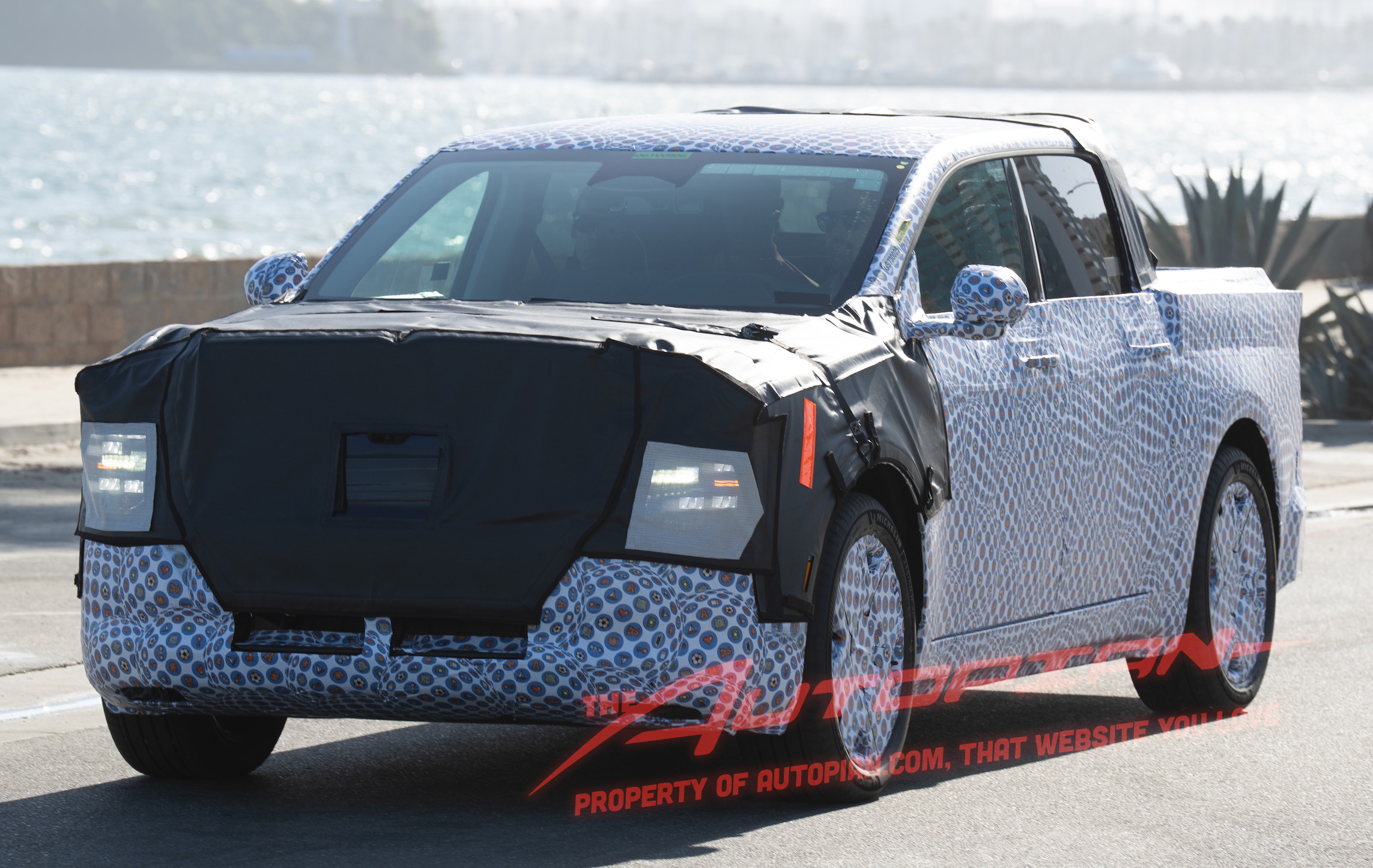
Yeah, that side profile in the last photo is just not appealing at all. It looks miss-proportioned.
Agreed, I am not a fan of the Urkel height belt line
I feel like that’s part of the camo. If I had to guess, the beltline is a good bit lower.
We can only hope. I haven’t been able to decide if it is or isn’t.
If you look closely at some of the photos you can see that the windows go down several inches below the camo, and start just above the door handles. So the window sills are at or below the top of the bed rails.
High beltlines on small and midsize trucks are a result of federal crash rules in the US. They will never go away.
You can see lines under the camo. I suspect the actually beltline is 2-3 inches lower and much closer to the Maverick.
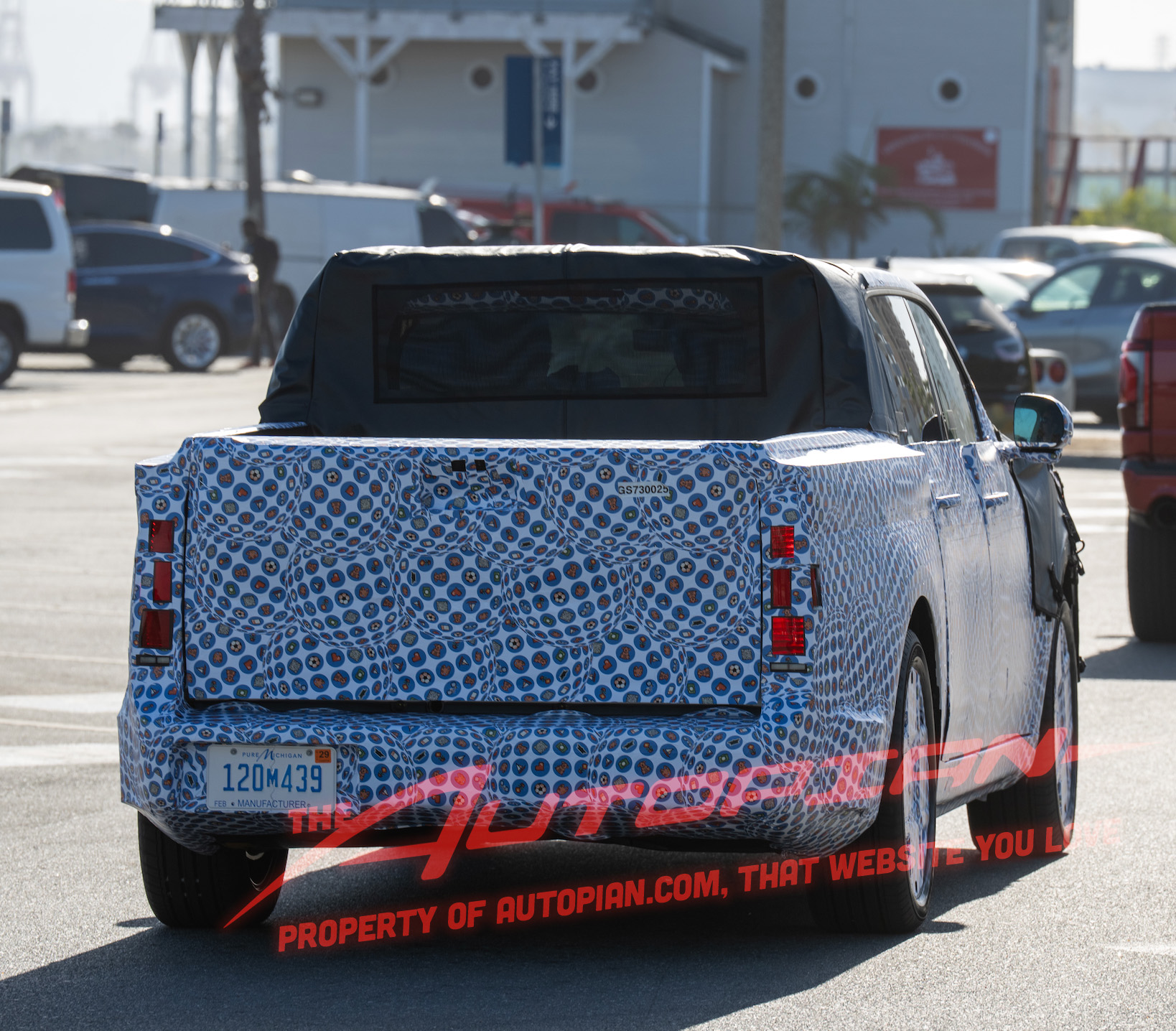
Imagine how much better the proportions would be with a shorter cab and a longer, more usable box.
So you want the efficiency to diminish, not be comparable to the most popular cab configuration, and have it not fulfill this product’s intended purpose and mission. Ford would sell about 5 of them.
There’s still single-cab F-Series for folks who want that configuration.
The comment to which I was replying was,
“Yeah, that side profile in the last photo is just not appealing at all. It looks miss-proportioned.“
Counterpoint; the blocky, big grille look has reached the point of self-parody which means it’s run its course. This will be like the 1960 Falcon after the fins-and-chrome excess of the late ’50s and, reaching slightly less far back in Dearborn’s archive, poised to pick up (npi) on the nostalgia cycle having caught up with the turn of the millennium Frutiger Aero look and the “bubble” 1998 F150.
Edit; Don’t even offer it in black, or with black rims at all.
Well that’s kind of the thing. This isn’t designed to appeal to specifically truck people, but to people who may have never owned a truck. So yes, I would expect it to look less over-the-top stupid than every other full size truck.
I’m not saying it needs the aggro look of full size trucks, but that errrbody is doing right angles right now. When even the RAV4 goes in for the boxy look, you know the normies are expecting right angles on their new “truck”.
My experience with normies tells me that they really don’t care too much how something looks. As long as it’s quiet, easy to get in/out of and lets them hook their phones up to it without a lot of hassle they’re fine. The fact that the new Outback is everywhere is proof of that to me.
They don’t care how it looks so long as it looks the same as everyone else. Which, like your Outback example, means it has to be chonky and squared off.
All I can see is a squashed Ridgeline. That’s not a compliment.
Ford has officially killed Slate. Even if it falls a bit short of 300 miles range at the base price it is going to have more range and way more features than the Slate for another $50 a month.
Ford is also a company that is likely to be still in business when the warranty expires.
I’m sure the Slate team is feeling like they got punched in the gut. Instead of trying to add range to make it a better value proposition, they needed to lower the price to differentiate it.
The problem is that when Slate was is the design phase a manufacturer could collect about $25,000 in federal and state manufacturer credits. ($20K in CARB ZEV credits, federal battery credits, federal CAFE credits). This allowed them to sell the vehicle for less than it cost.
Then the retail customer had a $7,500 federal EV tax credit that dropped the retail price to $20,000 which was a reasonable price for the vehicle.
Fast forward to today and both the manufacturer and retail credits that made the business plan work are gone and Slate is totally screwed. Which is a danger that comes from planning a product based on incentives not fundamental costs.
Why everyone is making such big assumptions on this killing the Slate when we don’t even know what exactly you get for the price, is crazy. Over on Reddit a bunch of people think this is coming with a 51kWh battery, which would make ~150 mile range likely. If that’s the case, I think Slate still has a great chance.
Which, for a four door small pick up, a battery somewhere in the ballpark of 50kWh kinda makes sense for the price. Heck, both the Bolt and Slate have a 65kWh battery, which even if we put that in this, gives you a ~200 mile range.
To get 300 miles of range, it’d take a ~100kWh battery, and that’s just not happening for this price.
Ford is making a big point about how efficiency was a top priority to allow it to achieve more range with a smaller battery. I expect the base model to have a ~200 mi range.
Almost every brand says that for electric vehicles except GM and their BT1 platform.
I was somewhat generous with my efficiency used for my calculations. 33.3 kWh/100 miles puts it alongside vehicles like the R2, the iX3, the Blazer EV, Mach-E AWD Extended…
Getting 200 miles on a 51kWh battery would have it be one of the most efficient EVs offered for sale in the US; top six according to FuelEconomy.gov with 25.5 kWh/100 miles. Even if we assume it’s a 65kWh battery and 200 miles of range, that makes the efficiency 32.5 kWh/100 miles.
Well Ford has also said that it will be cheaper to run than a model Y which comes in at a ~4mi/kwh combined rating for the standard range RWD. I do think that Ford will make good on the “up to 300 mi range” with the optional “extended range” pack even if it is exactly 300 or maybe 301. We will of course have to wait and see what the two battery sizes are and the resulting range across the various combinations of battery sizes and number of driven wheels.
I don’t doubt 300 mi range. I just doubt the size of battery they need to get there and what they’ll charge for it.
Plus, just saying “cheaper to run” is an easy way to obfuscate what they actually mean. A lower starting price is a big head start and would be totally plausible to include in that math.
But no, I don’t think it’s going to be more efficient than a Model Y (24 kWh/100 miles).
Heck, a Lucid Air Pure gets 23 kWh/100 miles, and that’s from the company that made efficiency and battery downsizing by far their biggest priority.
Actually the full quote was than a used Model Y.
As I mentioned Ford has said that efficiency and battery down sizing was a top priority. Was it their #1 priority, probably not, since they are building to a price point, but it could be #2.
We will just have to wait until “early next year” as I expect they will release those numbers by the time the start accepting orders.
Range isn’t everything.
People still road trip motorcycles, despite them not having great “range”, but they can be refueled in minutes (giving the rider a short break they probably need anyway), and back on the road.
If you were taking a 10-hour road trip by EV (which still doesn’t favor EVs, but this is hypothetical), would you rather stop to recharge twice for 30 minutes each time (1 hour total), or four times for 15 minutes each time (also 1 hour total)? If my recent road trips are any example, a stop about every 2-3 hours is fairly normal, especially if travelling with passengers. May as well top up the battery at the same time, just like filling the fuel tank.
People are assuming the Slate is dead because:
It is a startup that lost all the manufacturing incentives that made the math work.It is incredible overpriced now that the consumer incentive is goneIt is in a low volume niche (regular cab / RWD)
I also don’t think Ford is dumb enough to try to sell an EV with an 150 mile range. I’m expecting the base model to match the Bolt at about 250 miles
Ford lost the incentive as well. The development cycle is likely very close, and likely wanted that incentive just as much as Slate did. If it’s going to harm Slate’s value proposition, it hurts Ford’s too.
I’m not sure how it’s going to basically match the Bolt’s range while being a physically larger vehicle (and less aerodynamic shape) and be the same price. Unless it’s considerably more efficient (seems highly unlikely) that means it must require a bigger battery. Which then seems like it’d be a hard task to come in at the price they’ve sold. I think it’s much more likely that range will be reduced to hit the price. I just don’t see 250 mile range with a ~65kWh battery in this form factor.
Even if we assume it can beat Slate’s efficiency by 10%, it’d still require a 88kWh battery to hit 250 miles, and I don’t see that happening for the price they’ve listed.
Yes, Ford also lost incentives but they are a multi-billion dollar company that is not reliant on continuing cash infusions to survive. Their truck is also the start of a family of 5 vehicles on a shared platform instead of being a niche one-off. Looking at Slate is appears to be designed specifically to collect incentives not to actually be a viable stand alone vehicle.
As to Fatham vs Bolt. Ford is claiming their new modular assembly reduce the number of main components by 20%, fasteners by 30% and manufacturing steps by 40%. As mentioned above it is also a shared platform not a standalone like the Bolt. There should be significant cost savings if they come close to those claims.
Ford is also claiming a significant focus on efficiency and has spend a lot of time on aero while the Slate is shaped like a brick. Ford is claiming they are getting an additional 50 miles of range from aerodynamic improvements.
Slate is tied at the hip to a multi-billion dollar company. Sure, it’s still an order of magnitude smaller than Ford, but it’s still a multi-billion dollar company.
And the Lightning shared a platform with the F150, look at how that helped things.
I just don’t see the success you see in Ford and I don’t think it’s as bad as you think for Slate.
Time will tell.
Slate has no connection to Amazon. Bezos is an investor but that is a personal investment not one managed through Amazon.
People are sceptical about Slate because the business plan makes no sense without incentives and it is targeted at a tiny niche market.
Yes, time will tell.
I’m not talking about Amazon. Plus, Amazon is worth almost an order of magnitude larger than Ford… that should have been a give away.
Slate is part of ReBuild Manufacturing. ReBuild Manufacturing is worth several billion.
RE:Build Manufacturing is private start-up and has no public valuation or financials. Their last round of funding was $120 million. It also takes more than several billion dollars to start up a viable auto manufacturer. (Rivian has burned through more than $20 billion without making a dime)
Slate being partially funded by another start-up is not a positive for their outlook nor does it make their poor choice of product segment any better. Slate made sense as a way to harvest EV incentives. It does not make sense as a manufacturing company.
I highly doubt they will do a 150 mi pickup for the base. I don’t expect to be much over 200 though since the optional one is supposedly around 300 mi. To small of a gap and you reduce the incentive to opt for the larger more profitable pack.
I don’t understand it either. It’s not a binary thing. They both can live. The maverick and the Santa Cruz exist. Ford, Chevy, Mopar have had similar trucks for decades. The 90s had at least 8 mini trucks from different bands with lots of overlap.
I don’t really think the ford and slate are even a different demo or buyer at least a launch. It’s just different people and fleets will have different requirements, taste, and wants. For most buyers there will be a lot of cross shopping between the two. I’m not sure why you would want one to fail like so many of these people seem to want. Competition is very much needed in all the spaces they will both be in.
Out of spec had a data sheet that showed 52kwh for the $30k truck. They spent a lot of time on aero but who knows how efficient their drivetrain is. I could see around 170 mi range. They might claim 200 if they are really optimistic and figure out which EPA cycle gives them better results.
The Santa Cruz is dead, the next generation was canceled and the current one is stopping production earlier than originally planned.
That has more about Hyundai moving production around bringing out new products going heavier in to hybrid and bev and trying to get 80% US production for US vehicles by 2030 then anything.
That has everything to do with the Santa Cruz having dismal sales. It peaked at 37K.
No it is all about it not selling well, since introduction they have sold a total of ~140k units meanwhile Ford sold 155k Mavericks in 2025 alone.
Yes and some Hyundai models sell less then ford in the US. It’s apples to oranges. In 2023 ionic 5 sold 33k to Santa Cruz 33k. It sticks around 44k a year. Ford sold 92k maverick that year. It’s a global car with a US only modification in a company looking for production space. Launching a new model of the vehicle it’s based on. They have a new truck coming out sooner rather then later. It’s an optimization for a brand in transition.
In 2023 Ram sold 445k trucks to fords 750k.
Ram sold 371k trucks to fords 830k trucks last year. Ford had a good year. If they did do the new Santa Cruz there would likey be a bump in sales. The new tucan is shades hybrid. If they weren’t desperate for manufacturing space in us they surely would have.
No, it isn’t a binary thing.
The problem for Slate is that we have seen this play time and time again. Start-up comes in and claims they can build something for far less than established players in the market with huge economy of scale. They take deposits, most fail before making a single vehicle. A few make it to production and then fail.
Making a profit on a $25K EV that is manufactured in the USA is a pipe dream. The business case makes no sense without the EV incentives that are now gone and may never return. The product itself is incredibly niche which means it will never be sold in the volume that Slate claims is the target.
Startup + short range EV + expensive + unpopular vehicle type + extremely decontented is not a recipe for success. Especially in the current EV market in the USA.
Of the dozens that have tried the there have been zero successful new car companies in the USA since Tesla. Rivian and Lucid are still in business but are burning massive amounts of cash years later.
That’s what they always said about Polaris and can am breaking into more car like markets. Transportation changes sometimes it goes back to something from the past.
I thought it was doa but I realized that was based on assumptions that were longer true . The battery then initially had was based on a early 2024 contract with high prices. The truck appeared to be based on 2022 legislation. They fixed the battery problem. Us sourced lfp thats costs should reduce yearly. They didn’t design around the 2022 legislation. The backers aren’t who have been widely reported. Their reason and experience along with choices aren’t what has been wildly put out. They are also packaged for 4 doors. They just want to get the cost down. BEV with a warranty as basic transportation could could be a great thing for many people. People that have been overlooked by the automotive industry. Plus the whole fleet situation especially for smaller businesses.
If you want facts not speculation:
https://www.youtube.com/watch?v=EpisRfFU9uE
Can Am sells UTVs from $10K to $48K dollars. They have the benefit of not needing to meet automotive regulations and many of their models selling for more than a Slate. If you are talking about the 3 wheelers they are either $20K and up or made in Mexico. The cheapest Polaris Slingshot is $25,000 and like the Can Am models doesn’t not need to meet automotive regulations.
These examples of recreational toys have nothing to do with attempting to sell a bare bones EV truck in the USA.
So I read though the transcript of your link. First it is an hour of him saying nothing of real substance, some talking out of both sides of his mouth, and some statements that make me even less confident that they will make it.
First he doesn’t say anything about how they get to profitability besides the idea that batteries will get significantly cheaper over time. He talks out of both sides of his month when he says that Ford is going to try to upsell their Fathom customers while Slate the price starts and ends at $25K. Then he goes on about how customization is going to be a huge part of Slate. So… basically the idea is to upsell people but part by part instead of in packages.
However, the wildest thing he said is that Slate is targeting as their core customer someone that can’t afford to buy a car of any type today. So somehow someone that can’t afford a used car is going to buy a $25,000 Slate two door pickup instead of a $23,000 Corolla? That is just wild and it is even wilder when he says that he is going to sell the Slate to apartment dwellers that are going to charge by plugging into 110V outlets with extension cords.
Get ready for some production delays and recalls too. Part of how they saved money is scrapping the industry standard of doing 3 rounds of product validation builds after design lock. They only are doing one and he straight up said they aren’t dealing with top tier suppliers because those companies wouldn’t return their calls.
(I just did the first round of product validation builds on our 2027 product last week and … surprise, surprise …. we found a whole list of problems even after years of doing digital and physical mockups.)
The idea of this third vehicle a lsv, truck, sports car, utv, golf cart. That’s where slate is shining now. UTVs have grown into that third vehicle many parts of the country. The slate is well suited to take that mantle as the 3rd vehicle for many. UTVs have a lot to do and will likely be crossed shopped to some extent with what is extremely utilitarian vehicle that happens to be 50 state road legal and an EV.
It’s a new vehicle everyone knows there will be recalls. The ford will be recalls galore right with it. That’s the way EVs have gone pushed not fully tested. The Chinese do it , GM did it. With less systems it might a little fare better. OTAs via their app should help alot. Like they have with other EV manufacturers who basically beta test vehicles by sending out production vehicles that by recent standards might not be production ready.
The extension cord thing was a bit cringy but the logic is sound you can get 30mi a night back va a 110v outlet. He isn’t the only one in the ev space talking about how a 110v might be good enough for most people. They are mainly talking about dedicated 20a outlet, some string of 15a outlets like you might only get 10kwh over 8 hours.
He was talking about high residuals on leases and people with bus passes leasing instead of bus passes. Thats a bit far fetched but enabling small businesses I don’t think is far fetched. One thing they kind of float around is $25k is what it is now. But as their input costs reduce they will lower msrp. The accessories are their real profit source. I think that was made clear from day 1.
They are funded by a PE that primary mission is to do American manufacturing. Because they are backed with them they have been able to make deals with suppliers. They have spent about $1b on development. It seems like that was all PE seed money like you see in tech. The difference is slate was the brain child of that PE. With 3 guys from an 80s MIT program focusing on bringing American manufacturing back. Who have worked in various fields including power sports for the last 4 decades.
He said nothing about targeting “3rd vehicles” or competing with UTVs. He specifically said Slate’s core customer is someone that can’t afford a car and is using public transportation today. He also said he Slate couldn’t do market research because the market they are targeting doesn’t exist today.
Recalls on a start-up’s vehicle are more damaging than recalls from a company that has been around for 100 years. That is especially true for a company targeting the working poor for customers.
The idea that their material and labor costs are going to fall over time is unrealistic. In an inflation adjust view – sure that might happen but it is very unlikely in real dollars.
Every major automaker does US manufacturing. That isn’t unique.
He didn’t have to the market is responding with that.
He talked about the mirage as the cheapest thing with a warranty they tested. Basic transportation that should be protected against great expense. How terrible it was. His target demo to me seems more like a 5 year old slate buyer maybe. If it still has 5 years left on the battery warranty and has depreciated the same as other EVs.
But I can see what he is trying to say. A known payment for something that just works.
BEV components fall in price every year. At a greater pace then whatever precived inflation that may or may not be affecting the supply chain. We haven’t reached the bottom. Lots of supply with more coming on like with demand that as wide as was predicted.
Yes, he made fun of the Mirage as a crap car that nobody wanted to buy and then is putting out a product that makes the Mirage look like a luxury car. Another statement that doesn’t makes sense.
NVH should be significantly less. Plus the whole Scandinavian design less is more angle. With the former Volvo interior designer. Doubtful it sounds like a tin can with all fiber reinforced plastic panels.
“Fathom” sounds like the callsign of the pilot that flies a cargo plane full of rubber dog shit out of Hong Kong.
I will wait about 5 years so I can pickup the pickup for about $2500… and get 40 miles range.
If the battery degraded that badly in just 5 years I am sure the federal 10 year battery warranty might be able to get you a replacement. Though as David said at 5 years battery should still be near 100%
In 5 years, the battery will still be at basically 100%.
That is a genuine boost to the longevity of this and future EV’s.
I see and am offered so so many 1st-gen Nissan Leafs (Leaves) that I could create an actual fleet of them on my property!
As a salvage car buyer, there are so many of these cars with depleted battery packs that are otherwise great little vehicles that simply don’t justify replacement because a 12-15 year old car just isn’t worth the cost of replacement, similar to when an ICE CVT/engine blows out.
No way you’ll be able to get it at or below MSRP, no way.
Ford dealer will add markups for the people that want it now. Ford will then jack up the MSRP next model year. Just like the Maverick
Yeah, talking about the price being sub-30k seems pointless; the price will probably go up approximately 10 minutes after these actually hit dealer lots, and then the msrp will increase the next model year anyway.
And if you look at the Maverick everyone wants the XLT trim at minimum which adds $2,500 to the “starts at” price. This thing in a trim people will actually want will easily be $33k minimum.
I assume Granger Ford in Iowa will offer this at the typical 3% below invoice with minimal fees and no dealer add on BS eventually. No haggle. Great price… you just have to order what you want ( and not what you don’t want) and wait 6 months for it to arrive. No instant gratification like buying off the lot, but a great deal and you get the exact trim and options you want. That’s how we got our 25 Larait hybrid AWD Maverick with 4k tow option and spay in bed liner option, in desert sand. Worth the wait and the flight/ drive to get it.
This is not unique. I often wonder how hard people look when they claim that X brand of dealers all screw over their customers
Bet you can get the Autopian special at Gaplin Ford for MSRP.
The real question is which is riskier: buying from a completely new, unknown manufacturer (Slate), or buying from the manufacturer with a RECORD NUMBER OF RECALLS?
But JD Power ranked them number 1 in initial vehicle quality. Ford declared victory on quality being job 1 and Chris Farley’s cousin raked in a nice bonus.
The sides of this are really tall compared to the squished looking green house; probably compression from 28,000 fathoms of pressure.
Nissan’s website shows the Leaf S+ at $29,990 + $1,545 shipping for me.
I guess I’m not average, as I also cannot fathom buying something like this.
“That’s $3,545 more for the Ford truck. Is it worth it?” No.
Come on Slate, we’re waiting.
Waiting on the $5k 4-door expansion, right?
Even with that, I’d still take the Slate over the Ford. If I RECALL correctly, it will be exactly what I want.
Years from now they’ll both be chattin’ in the mechanic’s waiting room at the same age and mileage, one complaining from exotic diseases, the other from fordism.
Would you consider this a potential replacement for your i3, David?
If it had a range extender.
What do you think is a realistic price for an equivalent range extended vehicle?
I’d guess maybe a few grand more. For a larger truck, I’d say the REX-equipped truck would be cheaper, but we’re probably talking about 60 kWh on this base Fathom (guessing here), so the battery savings going to, say, 40, isn’t really going to overwhelm the cost of the ICE+ancillaries.
Both have room for a supplemental battery in the cargo bed…
After the from-scratch Jeep build I don’t think he’s allowed to buy any more cars until Delmar starts high school.
eBay paid for the Jeep as part of the promotional partnership, so I don’t think that’s a consideration. However, given the amount of time David had to spend on the Jeep getting Elise (NHRN) a nice new vehicle may be a very smart spousal move. I’ve been married many years and making sure our beloved wives have the car they want, whatever that may be and regardless of what we may think of it, goes a long way toward marital bliss.
The gave up the E’s and F’s nomenclature for other models why try to force an F word onto this one.
I don’t know if it’s because Fathom in itself is a bad name, or because “Ford Fathom” doesn’t roll off the tongue, or because I have a bit of a lisp and I have to consciously think about articulating the “th” sound, or because I’m from an area where our accent would heavily accent the “a” into a nasally “FAAAthom” pronunciation, but I think it’s a combination of all of those that makes it a really poor name.
I guess maybe we should be happy they didn’t decide to call it the Mustang Mach-F?
Ford Fantom would have been better.
Or how about the “Ford Model E”?
Or if it suffers from too many recalls and the owner resigns himself to his unfortunate fate, the “Ford F-Me”.
Seeing maverick prices yeah this with any kind of adaptive cruise + bigger battery is going to be pushing past 40k. For me this would be like any EVs and just wait for them to be slightly used and save 50%+ off the new prices but I am still more interested in the Slate if they ever offer a awd/4×4 option.
Between trimflation, dealer markups and just how Ford does things there will not be any to be found for under $35K and by the second model year the base price will be $36K.
This is the name?! Can’t say for sure yet of course, but wow does it sound like Ford is setting itself up for Aspire-themed mockery if this doesn’t all pan out exactly the way it expects.
I cannot fathom the prices once you option the Ford fathom out.