

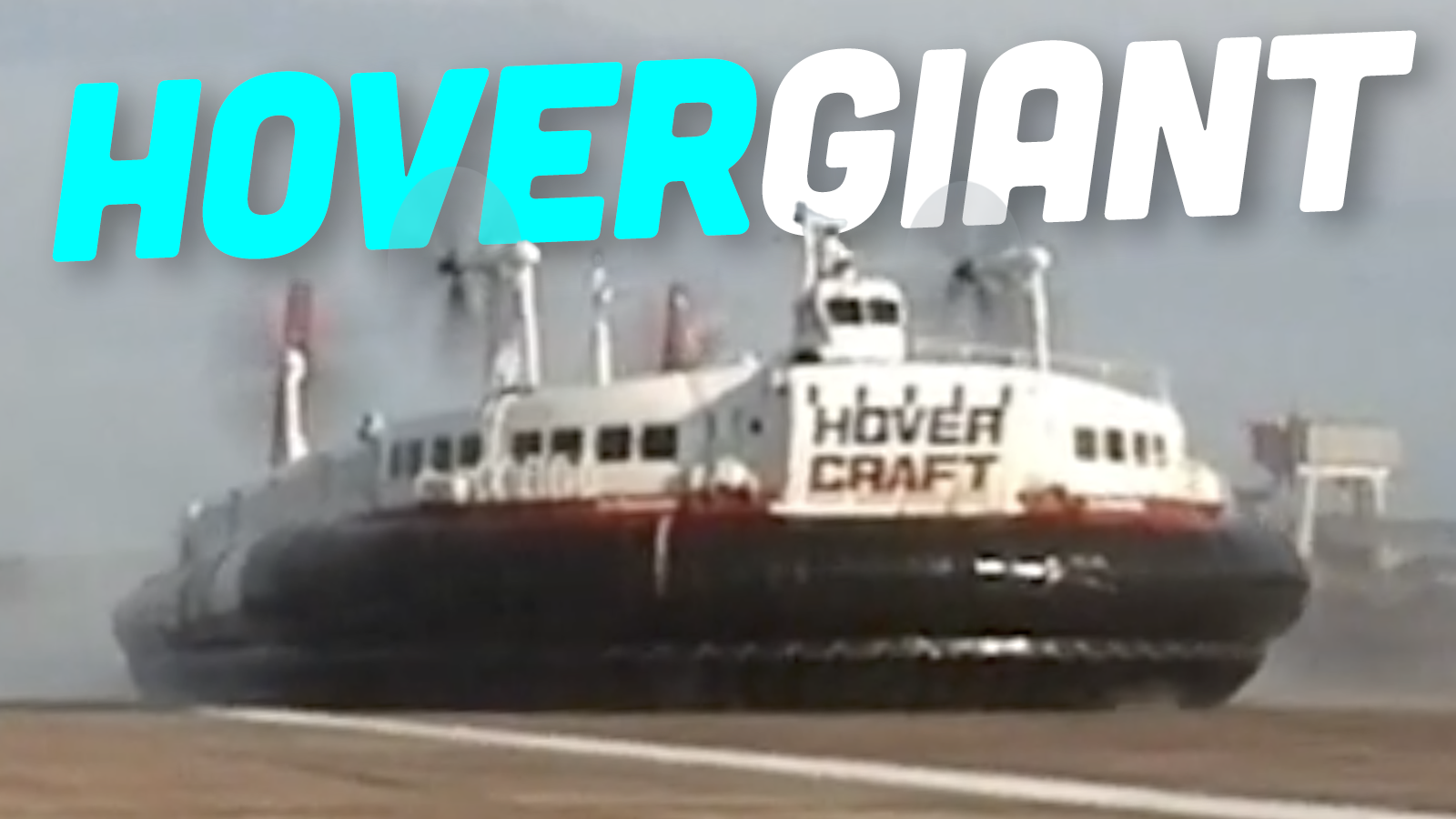
There was a brief window towards the back end of the 1900s that saw the United Kingdom leading the world in terms of commercial travel. The supersonic passenger jet Concorde (jointly developed with France) is probably the most famous and certainly the fastest, but the UK also had the world’s most ridiculous way to take cars and people across a 21-mile strait separating England from France: the Mountbatten-class SR.N4 hovercraft.
For a little over 30 years, and coincidentally across almost the exact same period of time that Concorde was in operation, it was possible for over 400 people and nearly 60 vehicles to descend on Dover in Kent three times a day to board a levitating office block, travel 30 minutes across the busiest shipping lane in the world, arrive in Calais or Boulogne – the gateways to continental Europe – and be on their way.


Cross-Channel sea voyages were nothing new, of course. Several towns on the south coast of England and the north coasts of France, Belgium, and the Netherlands served as ports for large boats at various crossing points. Dover in England and Calais in France were probably the most popular, as they’re close to the narrowest point of the English Channel between the UK and Europe.
Steam ships and mail cutters carried the first passengers in the 1800s, before the first dedicated craft for carrying cars were introduced in the 1920s. There was even the Night Ferry for train cars, which began in the 1930s and was, per Dover Ferry Photos, “the only through passenger train between Great Britain and Continental Europe” for almost 45 years. (A “through passenger train” being one where the travelers do not depart their train cars to complete their journey).
It wasn’t until the 1950s that the modern roll-on, roll-off (RoRo) cross-Channel ferries entered service, allowing travelers to simply drive their own car right into the hold of the ship and drive off again at their destination.
The journey could take a while, however. Even today, with the ferries still in regular service, this 21-mile journey takes over an hour and a half, and even on a good day when you’re not being tossed about by the waves, you’re still in what pretty much amounts to an airport departure lounge that constantly smells of marine diesel.
Enter the hovercraft. Invented by Christopher Cockerell, just as the ferries began their service but kept classified by the UK Government’s wartime “Ministry of Supply,” the idea was for a vehicle that could ride over the water rather than having to cut through it.
The notion of using air to allow a vessel to rise above the water wasn’t a new one, even in the 1950s. Earlier machines had done just that, pumping air from above directly into a void below the craft, with Sir John Thornycroft – one of the founders of renowned shipbuilders Vosper Thornycroft – creating an air-cushion vehicle in the late 1870s.
However, these machines faced challenges. Air would rapidly escape from the plenum chamber, requiring significant power to continually pump air back into it. They also couldn’t operate effectively on anything other than millpond-still water.
Cockerell’s innovation was to force the air into narrow channels around the outside of the hull, aiming inwards, demonstrating the effect with a hairdryer and a pair of tins — sometimes reported as two coffee cans, sometimes, per the BBC, with “a can of cat food.”
With one can nestled inside the other, the hairdryer blows air into the gap between them, increasing pressure underneath the smaller can and generating lift. This is also achieved with far less power than simply pumping air under the craft.
The proof of concept came in 1959, when Cockerell was aboard the Saunders-Roe Nautical 1 – SR.N1 for its maiden “flight” across the English Channel, accomplished in a little over two hours.
Development was rapid, with competing designs. For instance, one feature the original SR.N1 lacked in its original trials is something we associate with all hovercraft today: the skirt.
As explained by the UK’s Science Museum, “The addition of flexible skirts, patented by [C.H.] Latimer-Needham in 1962, was a big step in enabling the furthering of this technology, as these allowed hovercraft to traverse more obstacles on land and sea,” and it was later tested on N1 in various forms.
By the time the Mountbatten-class SR.N4 entered service in 1968, its enormous skirt allowed it to continue in “up to a Force 8 wind on the Beaufort scale and in 3.5m swell seas,” according to the craft’s own local Island Echo newspaper.
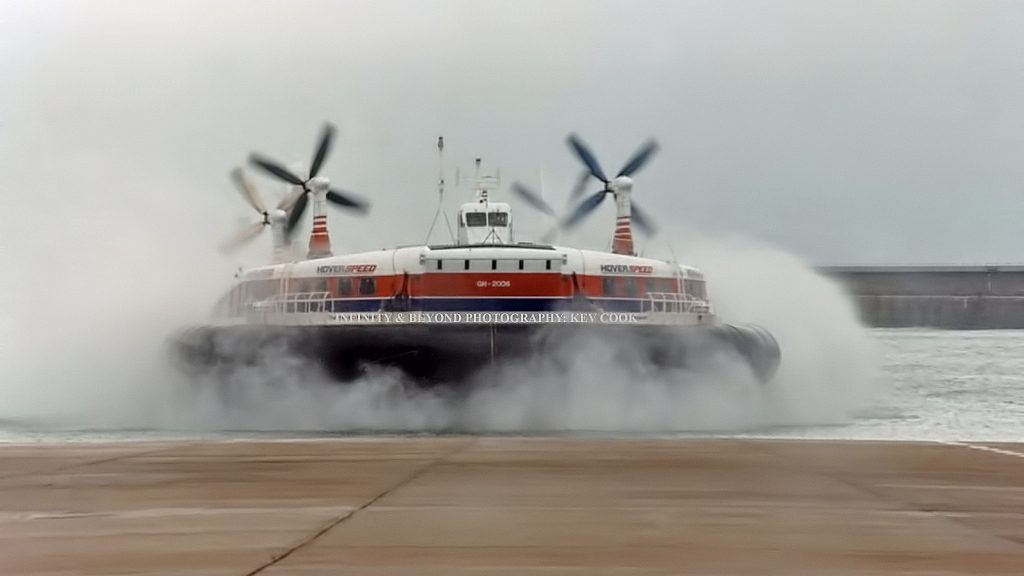
It also didn’t need specialist docking facilities; the craft could simply drive off the water onto a slipway big enough to take it: the SR.N4 was the largest commercial hovercraft ever made, occupying about the same space as two Boeing 737s parked nose to tail.
Rather than using marine diesel engines, the hovercraft had four Rolls-Royce Proteus gas turbine turboshaft engines, originally used for the Bristol Britannia airliner (and later the Bluebird Land Speed Record car) but modified for marine use.
In their hovercraft application, the engines were originally rated at a constant 3,400hp apiece. When enlarged in the refit to MkIII specification, the heavier craft also gained more power, with Museum Ships explaining that the engines were upgraded to 3,800 shaft horsepower (2,834 kW) units in order to maintain speed.
The engines pulled double-duty, powering both the huge, steerable, 21-foot propellers for propulsion and the centrifugal fans for lift, with each engine powering one prop and one fan through a splitter gearbox.
Remarkably, these complex craft ran with relative reliability and with few incidents. Despite being significantly larger than the SR.N1, and eventually capable of carrying almost 420 passengers and 60 cars in MkIII form, the SR.N4 could make the crossing in just 35 minutes, allowing for up to six trips a day.
One of the six completed vessels, the Princess Anne (GH-2007), once managed the Dover-Calais run in 22 minutes, which Guinness World Records still logs as a record. Not bad for something the size of four tennis courts and weighing 300 tons.
Although I never had the pleasure of crossing the Channel in the SR.N4 myself, friends and family who did said that the experience was somewhere between a ferry and a plane. With the hovercraft able to park on land, vehicles could simply drive up to and onto it at the hoverport without any special facilities. Passengers sat in aircraft-style seats alongside and above the vehicle bay for the short but incredibly loud trip, and disembarked with similar ease.

Autopian member Tj1977 got in contact with us to share his own experience with the SR.N4 from a trip in 1986:
I don’t recall much of a difference in the transition between land and sea. The sensations of motion didn’t so much come from the external (channel/water) but from the mechanical operations.
Our seats were near the front and if I recall, directly underneath one of the props. IT WAS LOUD. The seats were airline quality, but as the ride was quick (and I was a kid) I didn’t mind all that much. The excitement of being ON A HOVERCRAFT was more than enough!
As with Concorde, the economics of the hovercraft eventually turned against it. Those gas turbine engines consumed significantly more fuel (and more expensive fuel at that) than the workhorse RoRos, and the sole operating company – Hoverspeed – soon turned its attention to the SeaCat catamaran which, while slower by an hour each way, ran on marine diesel and had a far higher capacity.

It was the completion of one of Europe’s great engineering projects that truly signalled the end of the hovercraft, though, with the Channel Tunnel opening in 1994. With over 400 crossings a day, for both the Eurostar passenger train and the car-and-freight-carrying LeShuttle, at 35 minutes apiece — only 13 of which are spent under the Channel — Hoverspeed’s flights simply couldn’t compete, despite being a unique experience in their own right.
“For a kid on a six-week journey throughout Europe, the Hovercraft was an exciting experience. I also loved the toy hovercraft that we bought on the trip, and watching it buzz around the floor amused my cats today and is a charming reminder of a different time,” adds Tj1977, continuing, “For the sheer novelty and my interest in all things mechanical, I would absolutely pick a hovercraft as a cross-channel method. I have a son, and I would love to give him that chance but alas, those days have passed.”
The SR.N4’s final crossing took place in 2000, a year after Cockerell’s death, and the two remaining examples – four already broken up for spares or destroyed – were retired to the Hovercraft Museum in Lee-on-Solent in Hampshire, England.
Sadly, the museum had to choose just one to keep, resulting in the Princess Margaret (GH-2006) — which had a brief role in the James Bond film Diamonds are Forever — being scrapped and the record-setting Princess Anne now preserved sans engines.
If you want to see the craft yourself up close, along with other exhibits including Cockerell’s test cans, the Hovercraft Museum is open from 10 am to 4 pm on Saturdays only.
Top graphic image: Alex Waning APVW Aviation Videos


To paraphrase Randall Munroe on the field of economics, “the ‘dismal’ [part is] fine”
It’s just so cool that we used to have stuff like that, and sad that we don’t get to anymore
You can still take a hovercraft every day to the Isle of Wight
https://en.wikipedia.org/wiki/Hovertravel
Never got to go on this as a kid, my folks usually went for the ferries to Brittany. I did get to use the Eurostar for the first time a few years back, and that was pretty damn cool.
You drive your car onto a train and then that train goes under the sea! The security theatre takes about as long as the crossing, which honestly make the transition to driving on the wrong side of the road slightly jarring. At least on the ferry you have a few hours to get your head into the right frame of mind.
In the 80s my parents used to drive between the U.K. and “the Continent” regularly and I’d usually join them in the summer. My dad always preferred the hovercraft because he was a really bad sailor and it rolled much less than the ferry (plus the journey was shorter). My recollection is yes they were noisy; but not unpleasantly so, and the cabin was pretty cosy with seats in 70s knitted gold and green fabric. The downsides were that they couldn’t deal with really choppy so could be cancelled in a storm, and if you were really unlucky you got a French N500 Naviplane, which was super-unreliable, even noisier, and felt like it was going to fall over as the skirts filled with air. One memorable trip one of the windows blew in and the people in the front/side row got a good soaking. I’d been really pissed off not to get a window seat so I felt the gods were on my side.
I too am one of the “lucky” ones who travelled on this as a kid in the early/mid 80s, and was ALSO talking about it with my mum last week!
We only took it once because, well, we had a Not Good time. It was a pretty blustery day but as mentioned in the article, anything below Force 8 was considered no big deal. I can tell you that while the machine indeed may have made it, the state of the interior after our crossing was like something from The Exorcist.
As I only took it once, I can’t tell you if this was Standard Operating Procedure, but we were told in no uncertain terms that everyone was to remain seated, seatbelts on, for the whole “flight”. So no going out on deck (not that there was one) for fresh air, or even moving to a window to look at the horizon. Notice how wide and flat the beast is? Not many seats inside can actually see out of a window. Also as mentioned frequently by other commenters, it was unbelievably loud in the cabin. Like shout to your neighbour loud.
So combine all these factors, and within 5 minutes of hitting the water (and you do, when it’s rough – there’s no slicing through waves here, you either launch off them or slam into them) people started filling the sick bags in their seat pockets, And then the smell of that started circulating (doors are sealed, nowhere to go) and the next wave started puking. And so on, and so on.
#EuroStarForLife
What specific year what this? 1908? 1909?
If you fancy a trip on a hovercraft, you could always get yourself to the south of England and take a trip over the Solent to the Isle of Wight
As well as ro-ro car ferries and a catamaran, there is still a hovercraft service between the mainland and the island.
In fact it’s the only all-year-round scheduled passenger hovercraft service in the world
https://en.wikipedia.org/wiki/Hovertravel
https://www.hovertravel.co.uk/
Came here to mention this. My daughter goes to university in England and graduates next year. We are planning on taking a trip to the Isle of Wight afterwards on this.
My parents went on their Honeymoon to GB in…I guess 1983. They went there with the Hovercraft and they hated it. Slighlty windy day with some waves…must have been quite a ride.
Never got the chance to ride on one of those but I have been on a hydrofoil on Lake Baikal in Siberia. It was very smooth once up on the “foil.”
That would be a cool experience. We stopped by Lake Como and saw the hydrofoils parked, but none of them running. We didn’t plan to take the ferry around the lake, but I would have been disappointed to show up and see the hydrofoils running and not get to ride one.
Weirdly I was talking to my mum about this the other day. We were talking about Dover the other day and she mentioned how her and dad used to take it so they could drive back to england from switzerland because flying was still expensive with 2 kids. She just said, “yeah, fast and loud and convenient”. They weren’t rich it was just another ferry option.
I never knew there was supersonic flight in 1909. Those Wright Brothers were way behind Europe.
I don’t know exactly when people started referring to the 20th century as the 1900s, but it still throws me off, as I am still very used to that term only referring to the first decade of the century
It’s the youngest Gen-Z/oldest Gen Alphas’ thing since they were either not alive or too young to remember when the year started with 19-something. It isn’t just disrespectful toward people who were alive in/old enough to remember the 20th century, it’s ignorant of history. It actually was common in the early 20th century to refer to the year as “nineteen hundred five, nineteen hundred six, etc”, just like it was to refer to years in the early 21st century as “two thousand five, two thousand six, etc.” The “nineteen-[year number]” thing didn’t catch on until 1913 or so, much like “twenty-[year number]” didn’t catch on with the majority until about 2012 (though I started in 2010).
It wasn’t common to refer to the 19th century as the 1800s until the 1940s. So we should still at least be calling the 20th century at least decade by decade for another 10-15 years.
With a little bit of research, and drinking, I was able to discover another project across the pond, as it were. In the colonies during the 70s the Yankees were using traditional car/passengers to transport both to Amity Island during the summer. Apparently they were transporting the people as shark food and their vehicles to provide cheap used cars for the islanders taxi company. Apparently they had a taxi company to provide rides for the 600 residents. While many people were eaten many cars found a new life on the island. Which program was more successful? You decide
In all seriousness, that little ferry Mayor Vaughn ambushes Chief Brody on is the one between Edgartown and Chappaquiddick Island, the trip is only like 500 ft or so, 160ish meters, barely enough time for proper political intimidation
I didn’t know that. Is Ted Kennedys car still there?
It was his mom’s car, and they had to pull it out for the investigation
Kometa and Meteor on my beaches decades ago, 2x M-400 12ChNS18/20 four-stroke 12 cyl diesels, loud as hell, but fast – especially compared to the snail-like buses that crawled the coastal roads.
Huh?
I got to do this when I was a child. Although because I was a child my main recollection is my grandmother buying me a gigantic Toblerone bar.
Hope it wasn’t from the mini bar?
Definitely not, because I remember the concerned look on the attendant’s face when my grandmother ordered two Toblerone bars (for me and my brother) and a handle of vodka.
I only rode on this once. As said it was loud but the aircraft seating was much better than the crowded narrowed economy stuff of the day . There was something amazing about boarding on land , speeding up and sea and back to land. Very unique and sadly gone.
Was there a buoyant hull under that skirt to keep it afloat after an engine failure? Or was it like an airplane—1 engine failure is
fine, 2 and we’re ditching in the Channel?
Yes that is required for the hours the boat loads and unloads
I don’t know about SR.N4’s unpowered buoyancy specifically, but the fans had doors that shut in the event of engine failure to prevent air cushion air escaping and it could operate on just one engine. Just slowly.
They were capable of floating in place in the event of total engine failure, they had the same sort of ballast tanks and compartmentalized construction as regular ships. If that sort of fault happened, presumably it would just bob around on the waves until a tug came out to tow it in
It’s exactly this sort of thing that made the cinematic world of James Bond so appealing.
Like others here, I too rode on it a few times as a kid in the ’70s and It. Was. Glorious! (just like lots of other 70s stuff….) But my word, what an experience, so loud, so big, so spray-ey everywhere. And fast! Looking back I’m sure it just guzzled fuel like nobody’s business, but so much faster than a normal ferry, no time to get seasick, no “security” theatre, just excellence all around. A prized childhood memory for sure.
The Hovercraft were amazing in their time and put an end to the aircraft car ferries doing the Channel hop. I remember them flying out of Hurn Airport (now Bournemouth Airport) in the 1960’s, two cars at a time IIRC. Lord knows what it would cost these days, but back then it was a viable boat alternative for some.
I traveled on one of these when I was a child. One thing I remember was that the trip was called a “flight,” as if we were in an aircraft. I dimly recall it being loud too, but it was exciting, and of course much faster than the dull old ferry. Back then my grandparents lived in Lee on Solent (I don’t remember a “the” in the name), which meant that when we visited them we often had to stop the car on the street while a huge Royal Navy hovercraft lumbered across the road to get from the sea back to its base. My memory of it was that it was truly immense, but that’s doubtless a child’s-eye perspective (and cars were much smaller then too). Looking online now, I suppose it must have been a BH7.
Carrying 400 People And 60 Cars
But what is the number when it’s full of eels?
I will not buy this record. It is scratched.
Came here for this comment.
Well this makes that scene in Bon Voyage, Charlie Brown make a bit more sense. Even as a kid in the 80s I was like “whut”
I watched this with my kids the other day.
I got to do it as a kid – super cool, and indeed VERY loud. I remember it seeming absolutely immense.
Great example of one the things that fascinated me about the U.K. & Europe (as a 70’s child growing up in the U.S.)
I could only imagine the rate of fuel consumption.
All of it, as rapidly as possible.
It’s no doubt the main reason people were worried about running out of oil…
The various configurations of SR.N4 made finding actual numbers on this difficult, but one of the sources suggests that the final MkIII had a fuel capacity of about 9,400 US gallons and would burn through that in about 6.5hr. Which I guess is at least good for eight and a bit 35-minute crossings.
If my scribbling is right, that does mean a fuel economy of about 100ft per gallon…
If anyone is interested, The Tim Traveler has a neat video on YouTube about the French hoverport where these things landed: https://www.youtube.com/watch?v=caJ6aWFijkA.