

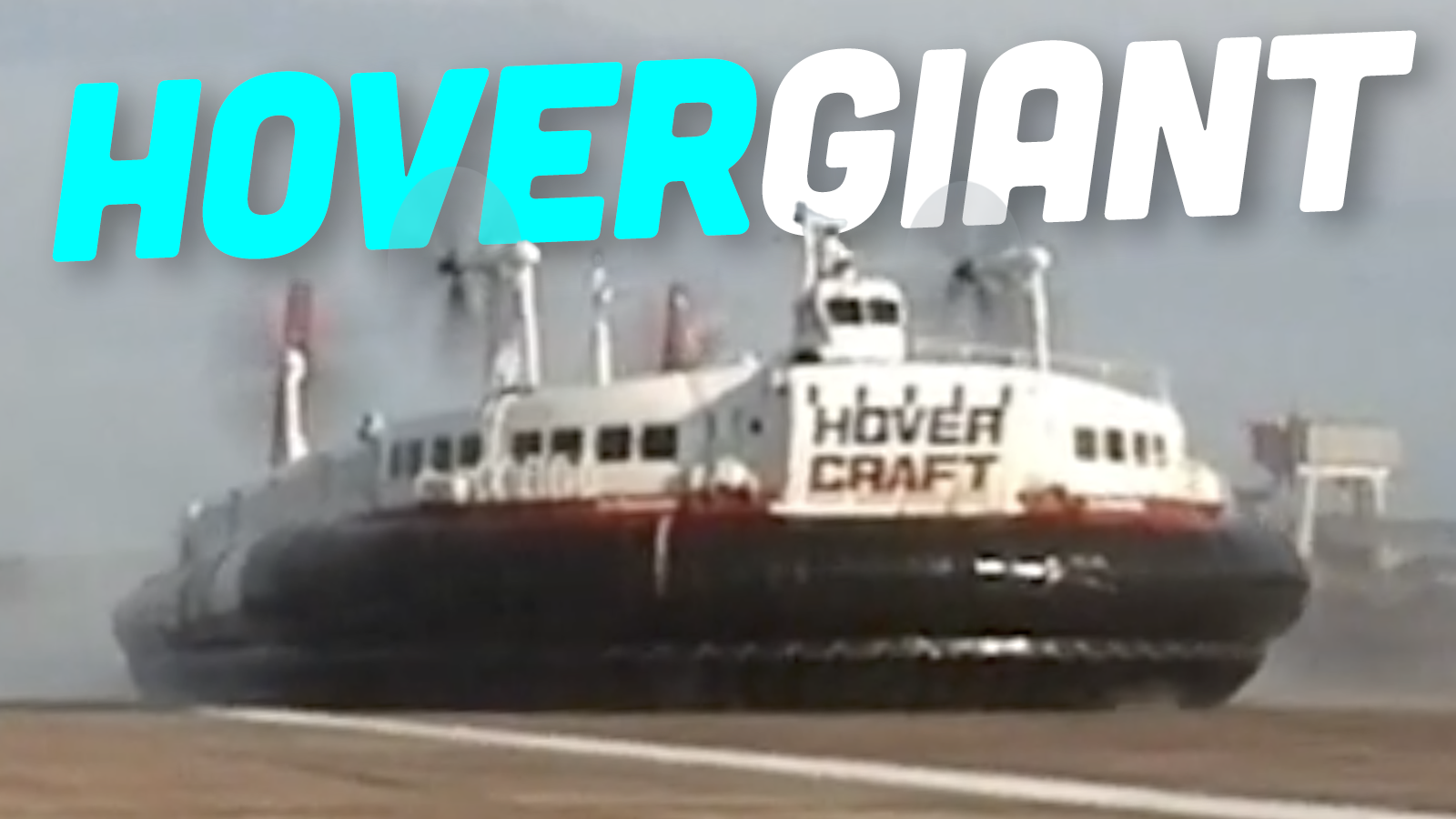
There was a brief window towards the back end of the 1900s that saw the United Kingdom leading the world in terms of commercial travel. The supersonic passenger jet Concorde (jointly developed with France) is probably the most famous and certainly the fastest, but the UK also had the world’s most ridiculous way to take cars and people across a 21-mile strait separating England from France: the Mountbatten-class SR.N4 hovercraft.
For a little over 30 years, and coincidentally across almost the exact same period of time that Concorde was in operation, it was possible for over 400 people and nearly 60 vehicles to descend on Dover in Kent three times a day to board a levitating office block, travel 30 minutes across the busiest shipping lane in the world, arrive in Calais or Boulogne – the gateways to continental Europe – and be on their way.


Cross-Channel sea voyages were nothing new, of course. Several towns on the south coast of England and the north coasts of France, Belgium, and the Netherlands served as ports for large boats at various crossing points. Dover in England and Calais in France were probably the most popular, as they’re close to the narrowest point of the English Channel between the UK and Europe.
Steam ships and mail cutters carried the first passengers in the 1800s, before the first dedicated craft for carrying cars were introduced in the 1920s. There was even the Night Ferry for train cars, which began in the 1930s and was, per Dover Ferry Photos, “the only through passenger train between Great Britain and Continental Europe” for almost 45 years. (A “through passenger train” being one where the travelers do not depart their train cars to complete their journey).
It wasn’t until the 1950s that the modern roll-on, roll-off (RoRo) cross-Channel ferries entered service, allowing travelers to simply drive their own car right into the hold of the ship and drive off again at their destination.
The journey could take a while, however. Even today, with the ferries still in regular service, this 21-mile journey takes over an hour and a half, and even on a good day when you’re not being tossed about by the waves, you’re still in what pretty much amounts to an airport departure lounge that constantly smells of marine diesel.
Enter the hovercraft. Invented by Christopher Cockerell, just as the ferries began their service but kept classified by the UK Government’s wartime “Ministry of Supply,” the idea was for a vehicle that could ride over the water rather than having to cut through it.
The notion of using air to allow a vessel to rise above the water wasn’t a new one, even in the 1950s. Earlier machines had done just that, pumping air from above directly into a void below the craft, with Sir John Thornycroft – one of the founders of renowned shipbuilders Vosper Thornycroft – creating an air-cushion vehicle in the late 1870s.
However, these machines faced challenges. Air would rapidly escape from the plenum chamber, requiring significant power to continually pump air back into it. They also couldn’t operate effectively on anything other than millpond-still water.
Cockerell’s innovation was to force the air into narrow channels around the outside of the hull, aiming inwards, demonstrating the effect with a hairdryer and a pair of tins — sometimes reported as two coffee cans, sometimes, per the BBC, with “a can of cat food.”
With one can nestled inside the other, the hairdryer blows air into the gap between them, increasing pressure underneath the smaller can and generating lift. This is also achieved with far less power than simply pumping air under the craft.
The proof of concept came in 1959, when Cockerell was aboard the Saunders-Roe Nautical 1 – SR.N1 for its maiden “flight” across the English Channel, accomplished in a little over two hours.
Development was rapid, with competing designs. For instance, one feature the original SR.N1 lacked in its original trials is something we associate with all hovercraft today: the skirt.
As explained by the UK’s Science Museum, “The addition of flexible skirts, patented by [C.H.] Latimer-Needham in 1962, was a big step in enabling the furthering of this technology, as these allowed hovercraft to traverse more obstacles on land and sea,” and it was later tested on N1 in various forms.
By the time the Mountbatten-class SR.N4 entered service in 1968, its enormous skirt allowed it to continue in “up to a Force 8 wind on the Beaufort scale and in 3.5m swell seas,” according to the craft’s own local Island Echo newspaper.
It also didn’t need specialist docking facilities; the craft could simply drive off the water onto a slipway big enough to take it: the SR.N4 was the largest commercial hovercraft ever made, occupying about the same space as two Boeing 737s parked nose to tail.
Rather than using marine diesel engines, the hovercraft had four Rolls-Royce Proteus gas turbine turboshaft engines, originally used for the Bristol Britannia airliner (and later the Bluebird Land Speed Record car) but modified for marine use.
In their hovercraft application, the engines were originally rated at a constant 3,400hp apiece. When enlarged in the refit to MkIII specification, the heavier craft also gained more power, with Museum Ships explaining that the engines were upgraded to 3,800 shaft horsepower (2,834 kW) units in order to maintain speed.
The engines pulled double-duty, powering both the huge, steerable, 21-foot propellers for propulsion and the centrifugal fans for lift, with each engine powering one prop and one fan through a splitter gearbox.
Remarkably, these complex craft ran with relative reliability and with few incidents. Despite being significantly larger than the SR.N1, and eventually capable of carrying almost 420 passengers and 60 cars in MkIII form, the SR.N4 could make the crossing in just 35 minutes, allowing for up to six trips a day.
One of the six completed vessels, the Princess Anne (GH-2007), once managed the Dover-Calais run in 22 minutes, which Guinness World Records still logs as a record. Not bad for something the size of four tennis courts and weighing 300 tons.
Although I never had the pleasure of crossing the Channel in the SR.N4 myself, friends and family who did said that the experience was somewhere between a ferry and a plane. With the hovercraft able to park on land, vehicles could simply drive up to and onto it at the hoverport without any special facilities. Passengers sat in aircraft-style seats alongside and above the vehicle bay for the short but incredibly loud trip, and disembarked with similar ease.

Autopian member Tj1977 got in contact with us to share his own experience with the SR.N4 from a trip in 1986:
I don’t recall much of a difference in the transition between land and sea. The sensations of motion didn’t so much come from the external (channel/water) but from the mechanical operations.
Our seats were near the front and if I recall, directly underneath one of the props. IT WAS LOUD. The seats were airline quality, but as the ride was quick (and I was a kid) I didn’t mind all that much. The excitement of being ON A HOVERCRAFT was more than enough!
As with Concorde, the economics of the hovercraft eventually turned against it. Those gas turbine engines consumed significantly more fuel (and more expensive fuel at that) than the workhorse RoRos, and the sole operating company – Hoverspeed – soon turned its attention to the SeaCat catamaran which, while slower by an hour each way, ran on marine diesel and had a far higher capacity.

It was the completion of one of Europe’s great engineering projects that truly signalled the end of the hovercraft, though, with the Channel Tunnel opening in 1994. With over 400 crossings a day, for both the Eurostar passenger train and the car-and-freight-carrying LeShuttle, at 35 minutes apiece — only 13 of which are spent under the Channel — Hoverspeed’s flights simply couldn’t compete, despite being a unique experience in their own right.
“For a kid on a six-week journey throughout Europe, the Hovercraft was an exciting experience. I also loved the toy hovercraft that we bought on the trip, and watching it buzz around the floor amused my cats today and is a charming reminder of a different time,” adds Tj1977, continuing, “For the sheer novelty and my interest in all things mechanical, I would absolutely pick a hovercraft as a cross-channel method. I have a son, and I would love to give him that chance but alas, those days have passed.”
The SR.N4’s final crossing took place in 2000, a year after Cockerell’s death, and the two remaining examples – four already broken up for spares or destroyed – were retired to the Hovercraft Museum in Lee-on-Solent in Hampshire, England.
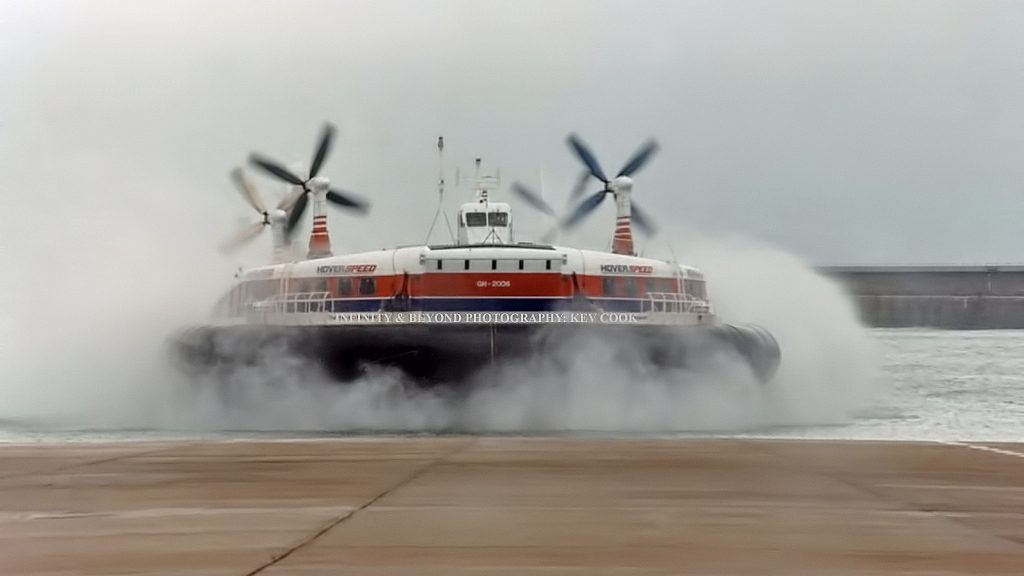
Sadly, the museum had to choose just one to keep, resulting in the Princess Margaret (GH-2006) — which had a brief role in the James Bond film Diamonds are Forever — being scrapped and the record-setting Princess Anne now preserved sans engines.
If you want to see the craft yourself up close, along with other exhibits including Cockerell’s test cans, the Hovercraft Museum is open from 10 am to 4 pm on Saturdays only.
Top graphic image: Alex Waning APVW Aviation Videos


Whoa! This thing is so awesome…I gotsta get me one of these! It would be such a rush to captain this beast.
“constantly smells of marine diesel” (on the ferry)
Sounds good to me!
“3,400hp apiece”
That’s it? ha ha
“four Rolls-Royce Proteus gas turbine turboshaft engines”
Awesome, those would be great to swap into my future land yacht! (which I can call my land hovercraft)
“size of four tennis courts and weighing 300 tons”
Oh, you mean most vehicles on the road these days? (wait, when I get my land hovercraft it will be about the same anyway, ha ha)
Loud? All ya gotta do is install a kickin system in this beast, and blast some metal on the stereo! That’s what I’d do w/ mine…
Expensive fuel? Guess I can’t yell “I can get 70 miles to the gallon on this hog!”
This thing would be great for Mercedes to get and store all of her vehicles. That’s what I’d do if I had a ton of $; get this, buy thousands of awesome rusty, junky classics + a wide variety of other vehicles and then cruise around the world…then I don’t have to pay for storage and I’d have any vehicle I wanted where ever I go, ha ha
It would be amazing to go see this in that museum…then I could make an offer on it (but they know what they got) Then I could yell “It (doesn’t) belong in a museum!”
Seriously, great article!
PS there is still a sub-culture of single-person racing hovercraft in the UK. Think most use Ford V 6 motors (Essex ones) after a year or two of sponsorship from Ford.
The SeaCat catamarans quickly got the name the “Vomit Commit.” If I remember correctly they were designed and built in Australia and the designers were astounded that they did not ride the same in the Channel.
They also went on longer routes, from memory Weymouth to Cherbourg was one, giving four hours of misery and so much vomit on the floor it had to be scraped off with rubber snow blades by some lucky crew member.
SeaCat did not last long….
One of the most 20th century things ever:
Just burn an insane amount of fuel, trying to get there a little quicker.
Spent an afternoon in Dover decades ago and watched some hovercraft. Very large and extremely noisy. Dover has it back to cliffs, so no escaping the noise.
I loved hovercrafts as a kid and was saving up to get a used RC one. Then I got to run it and find out how much steering commands are meek suggestions and it ate batteries. I found out that I liked the idea more than the reality and upgraded my Fox RC car instead (which also ate batteries and had terrible steering, but it would do 40 mph with the Reedy motor).
Unfortunately I never got to ride on this, I live in the north of england so it made more sense just to get a cheap flight. When I was a kid though my brother and I used to pool together parts from various toys and other electronic devices and make rudimentary rc car size hovercrafts for fun. good times. I’d forgotten about that until now. Thanks for the memories.
“There was a brief window towards the back end of the 1900s that saw the United Kingdom leading the world in terms of commercial travel.”
I assume you mean the century, not the decade. Although they probably did lead the world in terms of commercial travel back then too but with steam powered ocean liners. If they did have operational hovercraft by 1909 they certainly would have come in handy for Dunkurk.
I had the chance to be upgraded from a ferry crossing to a SeaCat one in 1991 during one of my crossing while being a student at Coventry. (for whatever reasons Sealink had cancelled my ferry and rebooked me on the SeaCat.)
The experience is akin to flying in a large plane, as there’s not much to do beyond sitting in plane like seats (with more legroom though) or going to the aft platform (where you gete bored rapidely as there’s not much to see beyond the receding coast)
Holy carp that is cool