

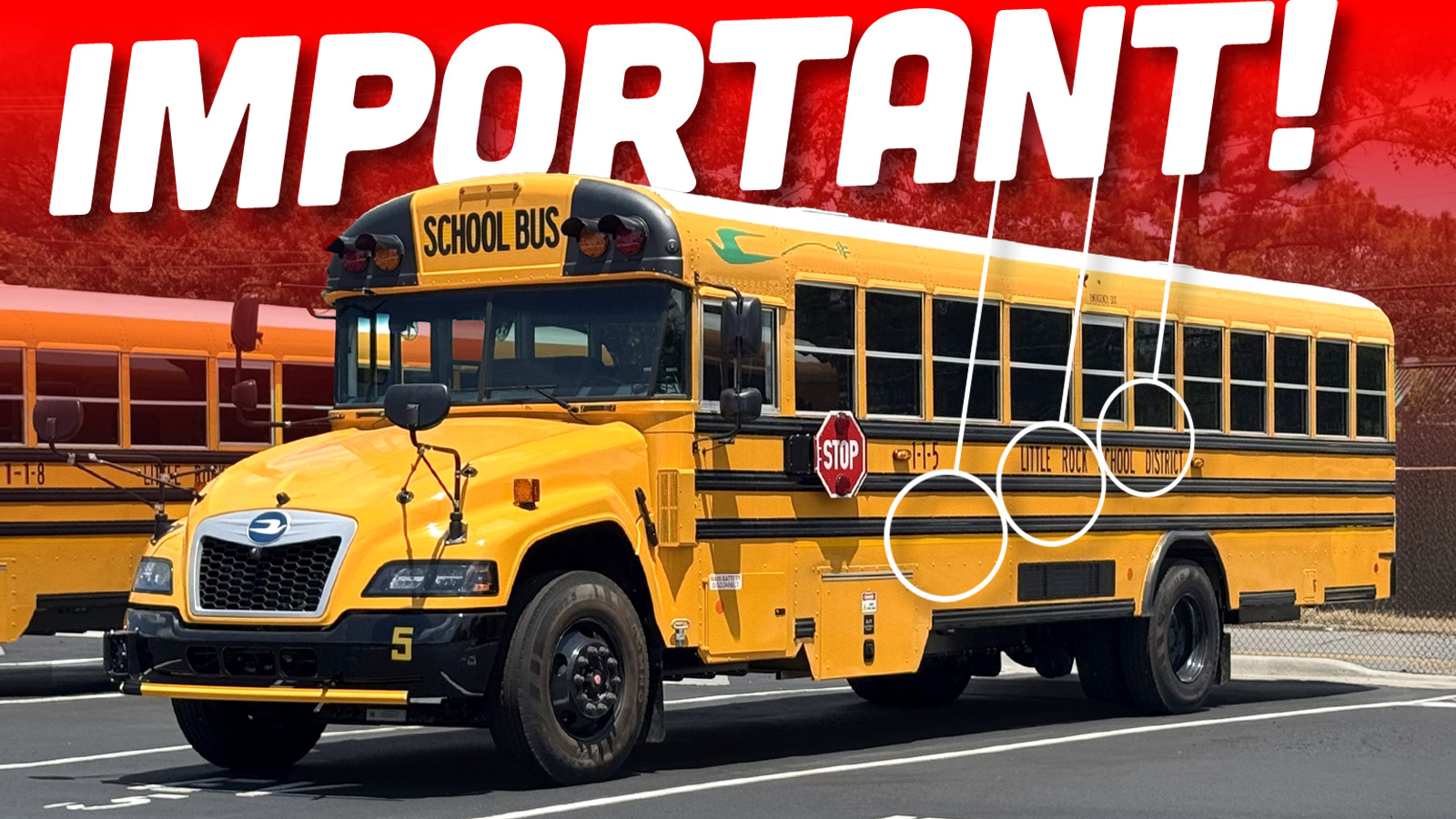
One of the loudest vehicles in America, visually, is the humble school bus. These mighty metal machines are tasked with carting children around safely. Thus, so much of the design of the school bus, from its eye-searing yellow color to the padded seats, serves an important safety role. One of the coolest style elements of the school bus, those long black bars along the body of the bus, also serve an important purpose. Here’s how those weird stripes help keep your kiddo safe.
The school bus is one of the simplest kinds of buses. On the surface, lots of school buses are basically just metal boxes sitting on top of a truck chassis and propelled by a reliable running gear. Look underneath, and you’ll often find leaf springs and hydraulic brakes. Lots of today’s school buses don’t even have luxuries like air-conditioning, and they can be worked on by everyday people. To put it another way, a transit bus is basically a space shuttle in comparison to a school bus.


Yet, don’t let that simplicity fool you. The school bus has been refined for longer than a century to haul lots of kids better than almost any other vehicle can. School buses are displaying their safety advancements proudly for all to see. Yet, unless you know what you’re looking for, you might not even notice. Think of the last school bus that you saw on the road. It was almost certainly yellow with black trim.
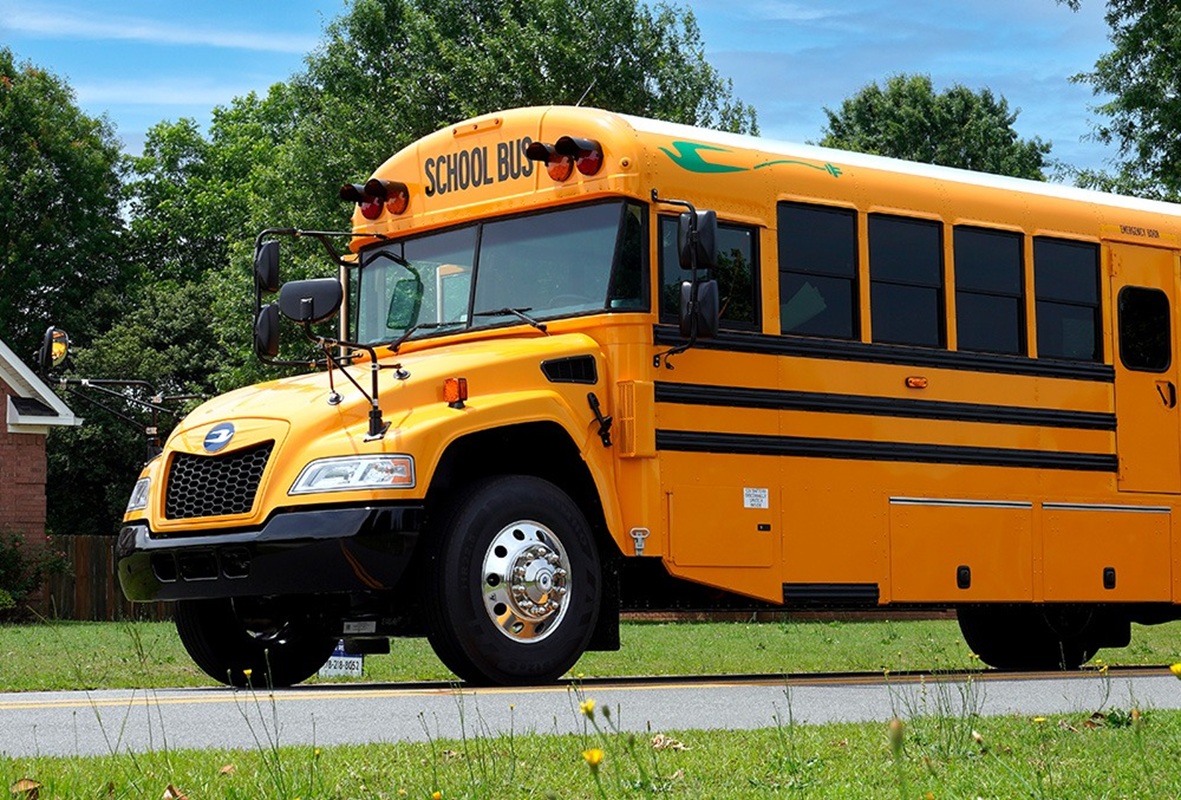
The sides of those buses have long black strips on them. You, like much of the staff of the Autopian, might wonder what those rails are there for? Are they there to protect the bus from scraping things along its side? Do they just break up the tens of feet of bright yellow?
These strips, like much of the design of the common school bus as a whole, are actually safety features that, you guessed it, are supposed to help keep kids safe. School buses themselves are amazing when you dig into their history
A Century Of Safety

Some of the earliest school buses were horse-drawn carriages in the late 19th century. These wagons were built out of wood and featured perimeter seating. These carriages were called school cars, school hacks, and kid hacks. Safety wasn’t much of a concern in those days, but in this image of a Wayne school hack, you can see that the basic shape of the school bus has been around the whole time.
As the 20th century rolled around, school hacks would eventually be replaced by motorized school buses. One of the first motor school buses was a 1914 model from the Wayne Works of Indiana. This bus featured a wood body and Ford Model T underpinnings.

The school buses of the 1910s got the job done, but wood turned out to be a poor building material. The rough, unimproved roads of the 1910s and the 1920s dealt serious blows to the wooden bus bodies. The damage to these buses was such a concern that, in 1925, Albert Luce, Sr., the founder of the Blue Bird Body Company, was concerned that his first bus wasn’t even going to last until its buyer finished paying it off.
Two years later, Luce improved his design by shoring up the wood body with steel framing. Meanwhile, in that same year, the Crown Motor Carriage Company introduced what was claimed to be America’s first school bus with dual rear wheels for a greater carrying capacity.

Perhaps the greatest school bus innovation came in 1930, when both Wayne Works and competitor Crown Coach both introduced school buses with all-metal bodies. The production of these two buses happened so closely together that some historians say that Wayne was first, while others say that Crown did it first. Either way, this was an incredible step forward in both safety and durability. These innovations didn’t stay novel for very long, either, as all-metal bus bodies became commonplace in the 1930s.

School bus advancements then took off in the 1930s. In 1932, Crown introduced a bus that had an all-steel body, a steel skeleton structure, and a chassis integrated with the body through welding. That year, Crown also introduced redundant braking systems and safety glass. Wayne would also adopt safety glass in its buses only a year later.
Another invention of the 1930s was the rub rail. While I could not find which bus builder invented the rub rail, Wayne Works is sometimes noted as a pioneer of the idea. These rails add some rigidity to the bus body, as well as add some side impact protection. However, the rub rails of the 1930s weren’t exactly the same as the rub rails that you see on school buses today, and that’s due to how widely varied school bus regulations were in the era.
Making Buses Safer In 1939
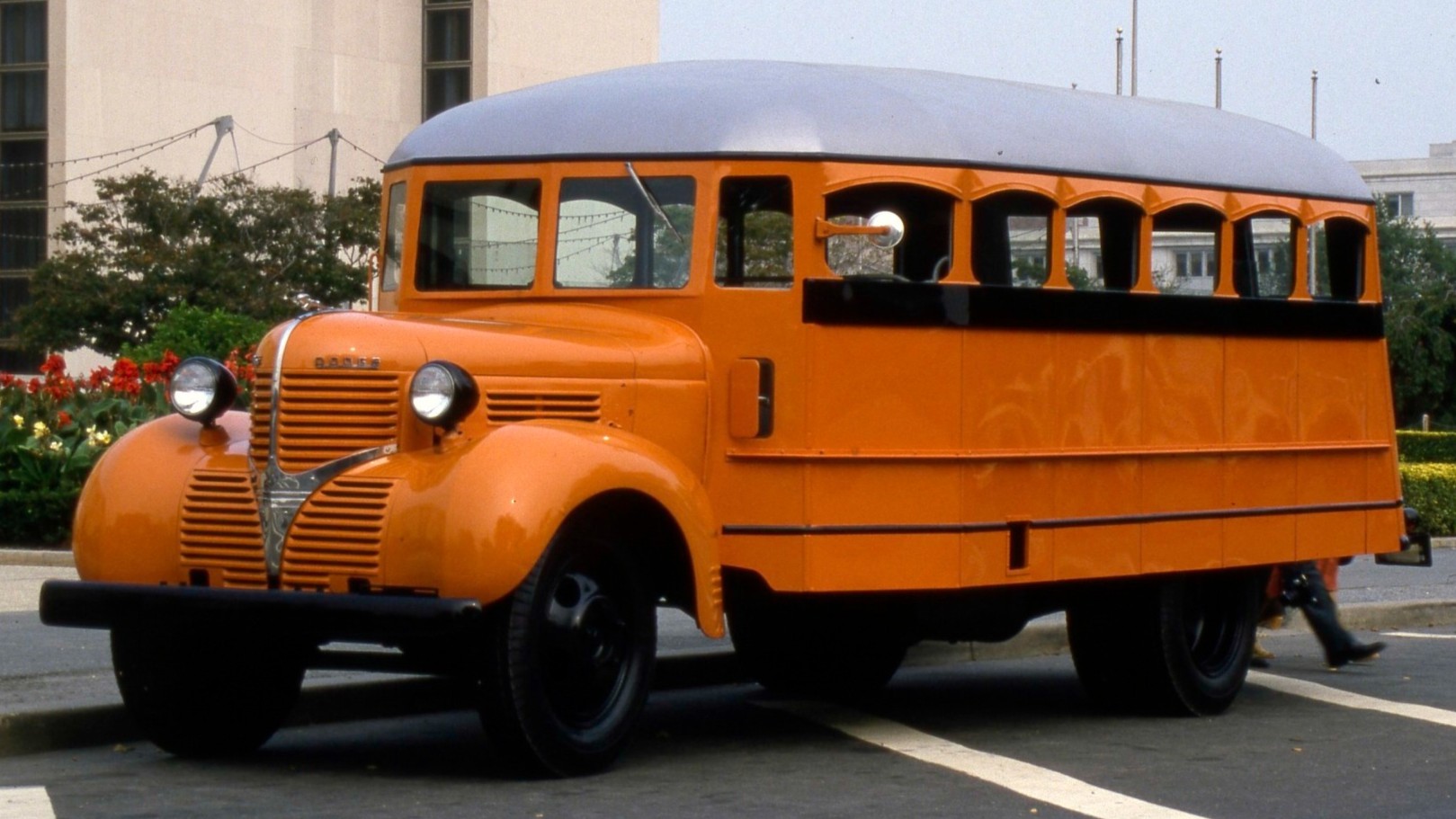
In 1939, Frank W. Cyr, a rural education specialist at Columbia University, joined forces with M. C. S. Noble, Jr. and Frederick M. Dutcher, both of Columbia University, to improve school bus safety. The men noticed that each American state had responded to technological improvements to school buses by enacting school bus regulations. The problem was that there were no true standards, so that a bus in one state could be very different than a bus in another state. From H. E. Hendrix, then President of the National Council of Chief State School Officers and State Superintendent of Public Instruction of Arizonа:
Pupil transportation, a necessary adjunct to the school system especially in rural areas, is a function created by state law and to a large extent is a state responsibility. For that reason the National Council of Chief State School Officers accepts the responsibility for setting up cooperative relations to formulate national uniform minimum standards of school bus construction, Accordingly, the conference of official representatives of the forty-eight state departments of education was convened for the purpose of formulating and agreeing upon a statement of uniform minimum standards. This publication presents the findings of that conference.
A large majority of the states by the authority of state law developed standards for school bus construction and operation which they thought were conducive to safety and economy. It now seems, however, that variations in construction standards are not resulting in economy because they hamper production of buses for a national market and compel the construction of buses as custom made jobs without materially adding to safety. It was therefore necessary that the state representatives discharge their responsibility for setting up uniform standards through cooperative action.
The National Council of Chief State School Officers is under special obligation to Frank W. Cyr and M. C. S. Noble, Jr., for giving us the benefits of their findings in the National Survey of Pupil Transportation and for organizing and conducting the conference of state representatives; and to Frederick H. Dutcher for acting as technical advisor to the conference; and to the General Education Board for the grant of funds with which to finance the conference. The full cooperation of the engineers of the automotive industry in providing technical advice is recognized. It is our hope that the standards proposed will result in greater safety and economy in school bus construction throughout the nation.
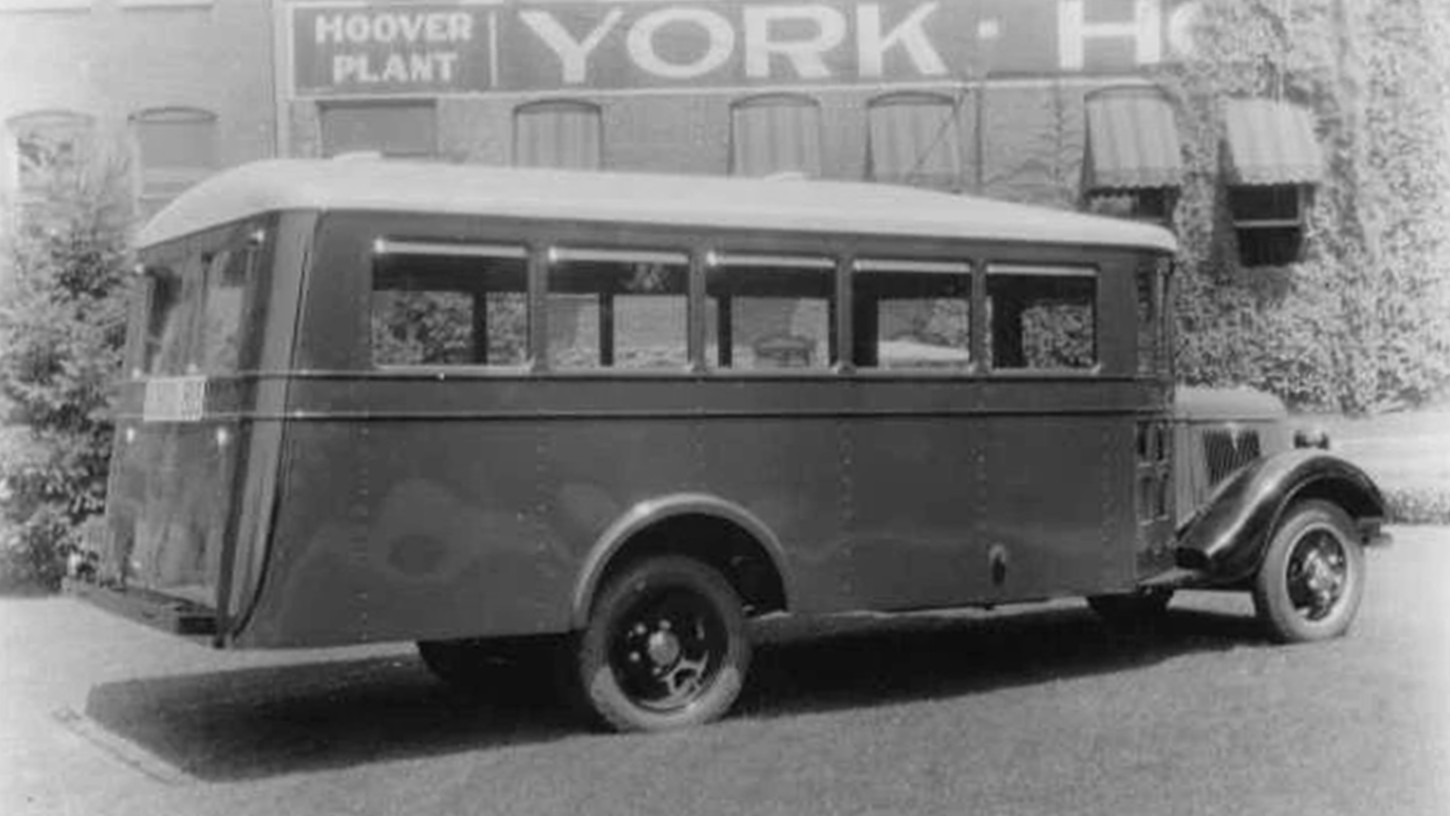
1939 was the inaugural year of the National Conference on School Bus Standards, where school representatives of the 48 states, chassis and body manufacturers, engineers, and other agencies met to create national school bus standards. Attendees included everyone from engineers from Bendix and General Motors to representatives from DuPont and U.S. Rubber.
That conference led to the creation of the “Minimum Standards for School Buses,” a manual that sought to create national safety and engineering standards for school buses. The manual set 44 standards for body length, ceiling height, standard, and aisle width. I have found the manual, and it’s fascinating. The manual describes what’s so important about setting standards:
The safe and economical transportation of nearly 4,000,000 children to and from school every day of the school year is a matter of first importance to millions of parents and thousands of school board members in all parts of the nation. In 1938, 86.099 school buses were in operation. The total number of school buses purchased from manufacturers annually is in excess of 10,000. At an estimated cost of $2,000 per bus the annual investment in school transportation facilities is about $20,000,000. These statistics indicate the extent of this important service. It is a problem of increasing importance, as indicated by the fact that from 1926 to 1938 the number of school buses increased 132%.
It would be practically impossible to make adequate consolidations of rural schools if it were not for the feasibility of pupil transportation. It is generally recognized that the need for future consolidation of schools will almost inevitably lead to expansion in pupil transportation systems.
The cost of pupil transportation may be considered as an addition to the ordinary cost of a satisfactory school program and in that sense it can be considered as a deduction from the total funds that might be available for superior school plant facilities and instructional programs. In view of this situation it is highly desirable that all possible economies consistent with pupil safetybe attained and practiced in the construction and operation of school buses.
The Minimum Standards for School Buses
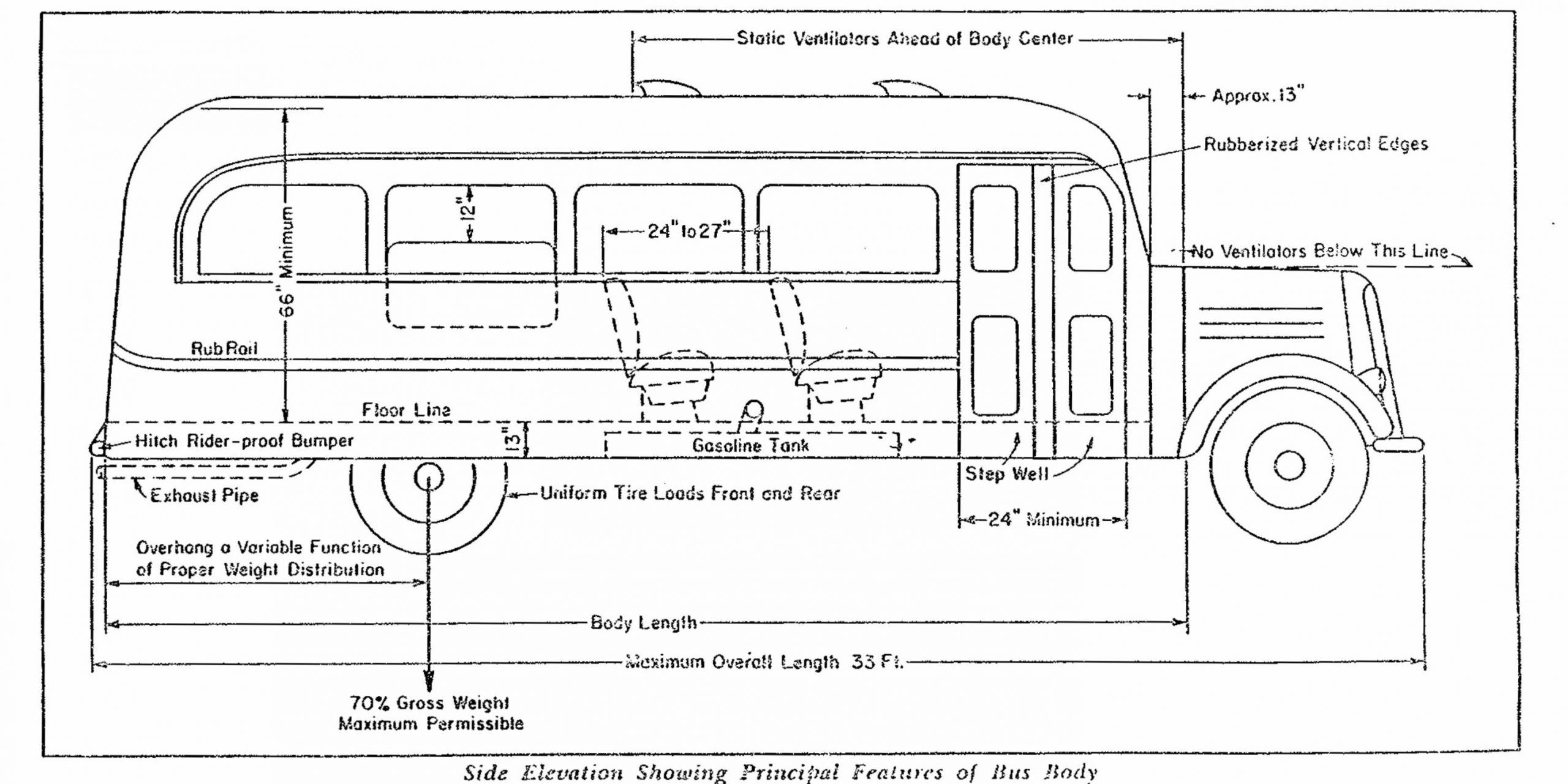
I won’t list all standards, but just the most interesting ones. The manual said that the rear axle of a school bus should be a full-floating axle. A battery of at least 120 Ah was required and had to be mounted outside of the bus body. Service brakes were required to stop a bus from 20 mph to a stop in only 22 feet. Compliant buses were also required to have a hand-operated emergency brake.
The manual even set standards for fuel tanks, which had to carry at least 18 gallons, and exhaust pipes, which had to be external and dump behind the bus. There were even standards for overall length and gradeability. The manual set bus length to be no longer than 33 feet and that buses should be able to climb three percent grades at 20 mph with a full load of kids.
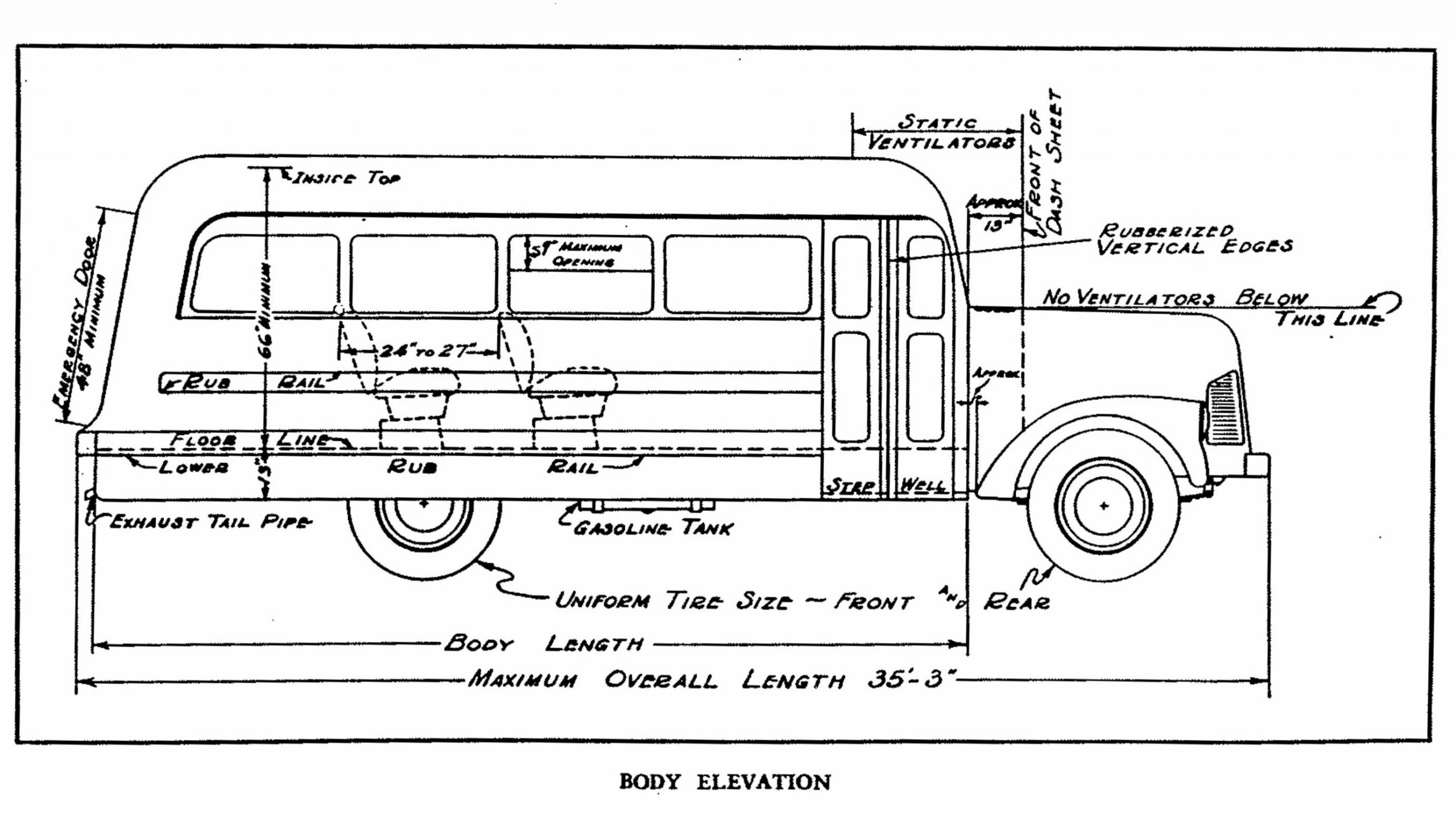
The safety standards were also pretty high for 1939. The bumpers were required to be rigidly mounted to the frame and were required to be able to push a vehicle of equal loaded gross weight without causing damage. The rear bumper was also required to be designed to prohibit the “hitching of rides.” Other safety standards included a required emergency door and a ceiling without protrusions that could cause injury in a crash. Buses built to the manual’s standards were even required to have first aid kits and fire extinguishers.
Many of the standards remain in use today, including the requirement that the capacity of the bus is painted on a panel inside, the requirement that buses be painted yellow with black trim, and the requirement that padded seats be permanently bolted or riveted in place. If you’re curious about what the color of school buses was back then, Frank Cyr developed a color called National School Bus Chrome. Today, the official color of a school bus is National School Bus Glossy Yellow.
Those Black Rails On School Buses

Then we get to the rub rails. In 1939, buses had only one rail, and it did not go the entire perimeter of the bus. The standard was simple, from the manual:
The body shall be protected by an applied or pressed-in rub-rail, located at the scat line of between the floor and seat lines.

In 1945, the rub-rail requirement called for two rails. This standard called for a rail at floor level and for another rail at the seat line. The 1945 manual describes why the rails were important back then:
Two rub rails of ample strength to resist impact and to prevent body crushing shall be provided on each side of the body. They shall be applied the full length of the body on the outside of the body, on the left side from the windshield post to the rear corner radius, and on the right side from the service door to the rear corner radius. One rail shall be located approximately at the seat line and the other approximately at the floor line. Pressed-in rub rails do not satisfy this requirement.
Later, rub rail standards would strengthen. The 1970 manual, for example, requires that rub rails be affixed to every body post and structural members. These rails had to be at least four inches wide, made of 16-gauge steel, and corrugated for additional strength. The 1995 manual added a third rub rail onto the side skirts of the bus body.

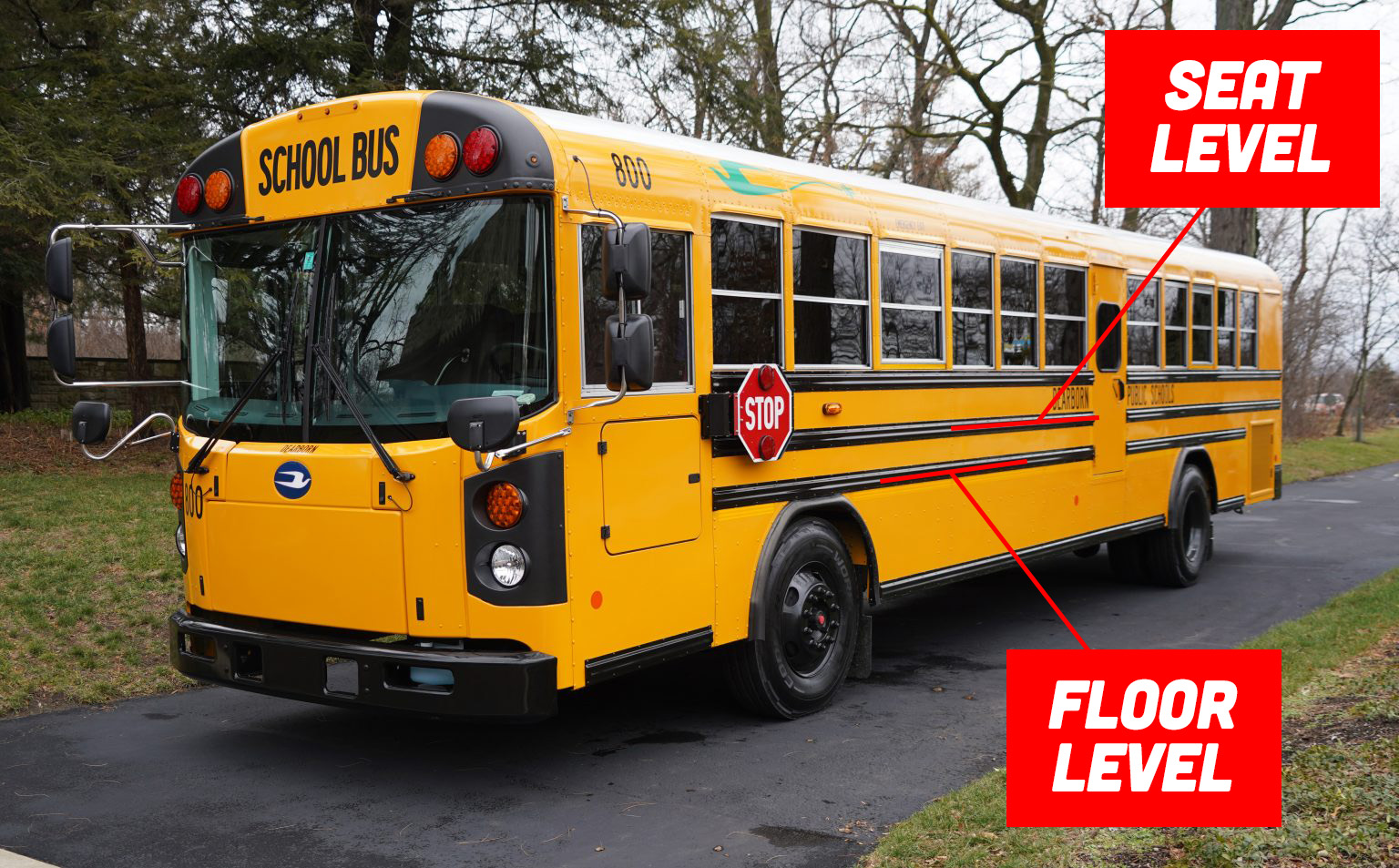
Today, school buses have four sets of rub rails in general. These rails will be on the side skirts, at the floor level, at the seat cushion level, and at the window level. The state of North Carolina explains further:

The rub rails of today still carry the same functions as they did in 1939: They add some reinforcement to the walls of the bus body at the safety points of the side skirts, floor, seating area, and window line.
An additional side benefit is that, in an emergency, the rub rails can be used by first responders to identify roughly where the floor and seats are. In the image below, for example, the rub rail at the floor level is actually a few inches above the floor.
Big Yellow Tanks
Modern bus regulations also require school buses to be tanks (metaphorically, that is). Here’s the standard for a modern school bus structure:
The bus body shall be constructed to withstand an intrusion force equal to the curb weight of the vehicle or 20,000 pounds, whichever is less.
Likewise, the National Highway Traffic Safety Administration has designed bus safety around the idea of compartmentalization. In the early 1970s, NHTSA discovered that school bus seats were often too weak, too low, and too “hostile” in a crash, leading to injury. As a result, NHTSA changed how it approaches school bus interior safety. From NHTSA:
Compartmentalization is directed toward ensuring that passengers are surrounded by high-backed, well-padded seats that both cushion and contain the children in a crash. If a seat is not compartmentalized by a seat back in front of it, compartmentalization must be provided by a restraining barrier. The seats and restraining barriers must be strong enough to maintain their integrity in a crash yet flexible enough to be capable of deflecting in a manner which absorbs the energy of the occupant. They must meet specified height requirements and be constructed, by use of substantial padding or other means, so that they provide protection when they are impacted by the head and legs of a passenger.
It is helpful to bear in mind the following highlights about compartmentalization:
1. Compartmentalization provides effective occupant crash protection, minimizes the hostility of the crash environment and limits the range of movement of an occupant, without using seat belts;
2. Compartmentalization ensures that high levels of crash protection are provided to each passenger independent of any action on the part of the occupant; and,
3. Seat belts are needed on passenger cars and other family vehicles and on small school buses (school buses with a GVWR of 10,000 pounds or less) because the crash pulse, or deceleration, experienced by the lighter vehicles is more severe than that of larger vehicles in similar collisions. Large school buses are inherently safer vehicles because they are larger and heavier than the vast majority of the other vehicles on the road. In addition, occupants in large school buses sit above the forces that are typically imparted to the bus by smaller impacting vehicles during a crash. The training and qualification requirements for school bus drivers and the extra care taken by other road users in their vicinity add to the safety of school buses.
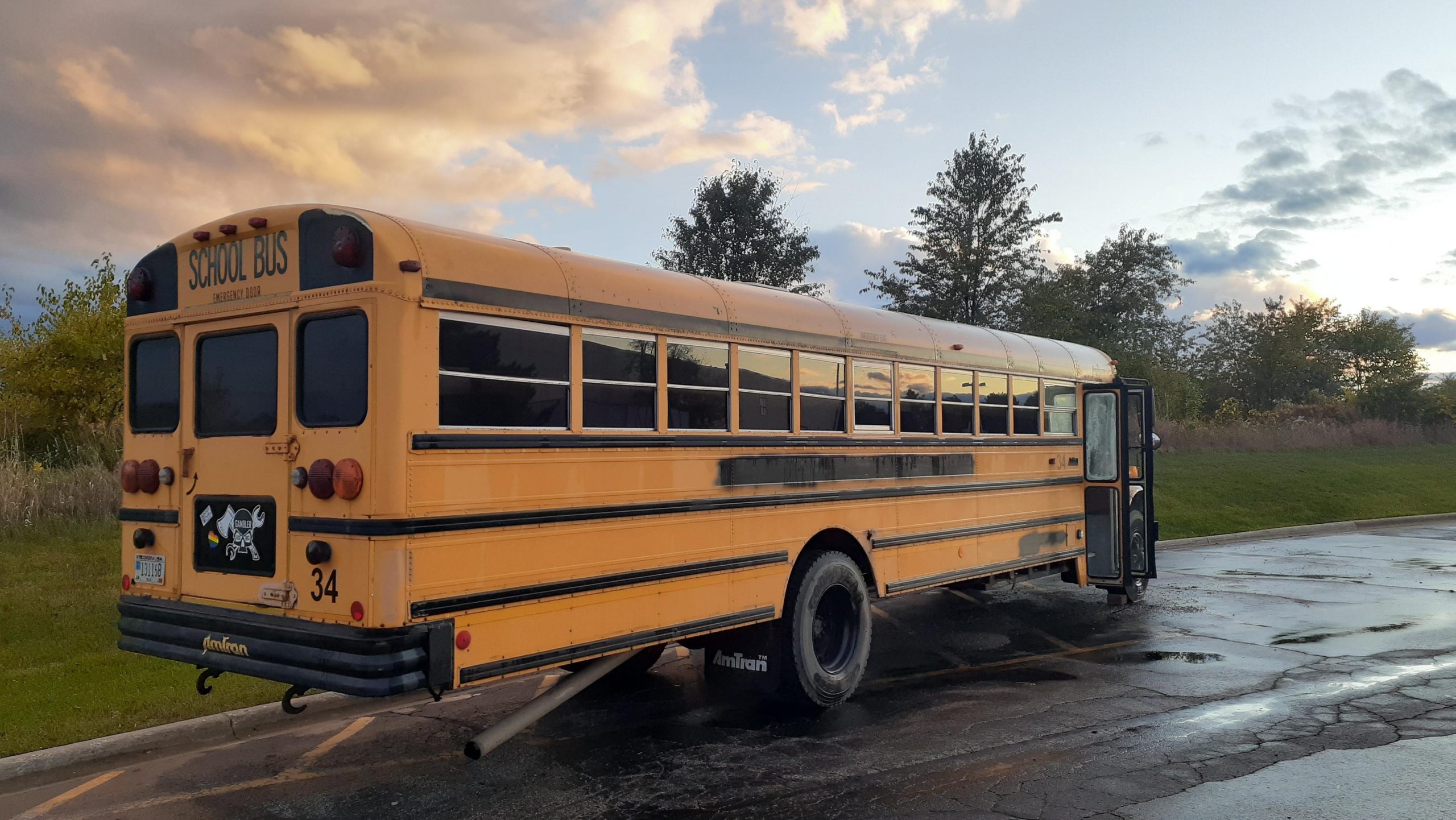
The result of all of this is that school buses are surprisingly safe. On average, 108 people die each year in school bus crashes, and most of those fatalities are outside of the bus. From 2014 to 2023, there were 971 fatal school bus crashes, in which 1,079 people of all ages were killed. The American school bus fleet is roughly 480,000 units strong, and each day, some 26 million students ride to school each day on a bus.
Of course, an average of 108 deaths per year isn’t zero. Engineers, bus companies, and educators are still working to make buses safer and to reduce those fatality numbers as part of the National Congress on School Transportation.
It’s amazing how far school buses have come in over a century. In the late 1800s, a school bus was barely more than a covered wagon. Today, it’s a big, yellow beast that dutifully serves school districts for decades while safely carrying millions of students every single day. So much of it is thanks to those standards set in the 1930s, including those seemingly random black rails.
Top graphic image: Blue Bird


Seeing school buses always make me sad for the kids that never got to walk to school. I know, I know, rural areas, suburban dystopia etc. But still sad.
I just checked and at one point lived 12 miles from one of the elementary schools I attended. Down the mountains in the morning, back up in the evening. That’d have been a bastard of a hike.
As it was, the bus stop was so far from the house(s) I still had to walk between half and a three quarters of a mile up roads and driveways to get home. That doesn’t seem so bad… Unless you were the poor bastard kid that had to be on at 6:15 am and didn’t get off the bus until 4:15 pm. Like I was.
I think that still part of why I hate commuting so goddamn much to this day. Even at 8 years old, and all the way up through 16 years old, I was having time stolen from me to go to a place I hated.
…I guess school really did prepare me for life after all.
Lol, the school bus only ran in the morning where I grew up. It was a multi-mile jaunt through city streets, trails, etcetera to get home. Ah fun times.
I mean, I grew up in the suburbs, but the school was only a mile and a half away, so I usually walked or biked. Would beat the bus to my neighborhood, too, since it took such a circuitous route to further away areas before looping back.
1939 was the inaugural year of the National Conference on School Bus Standards, where school representatives of 48 states
There were only 48 states at the time, so that was all of them.
Ope, I should have put a “the” in front of 48. Thank you for pointing that out!
Sorry for being that guy. I saw the 48, then wondered why two states abstained. Then google. Then post.
You’re good! I like when readers keep me on my toes. 🙂 Admittedly, it’s part of why a story like this takes most of a work day.
The Cucamonga School District, eh? I’m just a few miles from there, right now. Somebody call Bugs Bunny!
First thing I thought of. Bugs knew, Cucamonga is a happy word.
I knew this only because a high school buddy manages the bus fleet for a large school district and we’re nerds so why wouldnt this come up in normal conversation?
VEry interesting to read the history behind it. I had always wondered about the specific design choices that went into a school bus and realized that the horizontal bars corresponded to the floor, seat and shoulder level of its passengers, but didnt realize they were protective steel bars, only visual clues for first responders. The buses also look very tall and carry more visual similarities with a big rig trailer that carries its load in a rectangular box above its wheels and I figured this was only done for safety reasons as most cars and SUVs would impact below the feet of the students and not nearly be as bad news to them as it would everyone else being rammed in under the school bus.
Since this site and so many readers are quite knowledgeable in all things automotive, I’m hoping somebody can answer a question for me regarding modern car design.
I’ve noticed many modern vehicles… and it’s mainly Asian manufacturers… design the hoods in such a way that they don’t quite reach the grille.
Look at a 2025 Toyota Rav4 or a 2024 Mitsubishi Mirage. They all seem to have a skinny strip of body-colored material between the actual hood edge and the grille, introducing a line into the vehicle that, to me, frankly looks ridiculous. Like somebody ordered hoods that were slightly too short and it was cheaper to just slap a panel in to fill the gap than it was to re-order correct length hoods. This is different than, say, a modern Honda Civic. Sure, that hood doesn’t go all the way to the grille either, but the way the front end is designed, there’s no natural line for it to do so without adding lines into the front quarter panels too.
Why design them this way, and why does it seem to be primarily Asian manufacturers that do this?
There could be a couple of reasons.
One thing to keep in mind is the overstroke needed when slamming a hood. So vehicles that have a hook that shuts to the grill have a gap there with a big bulb seal so the hook doesn’t slam the grill itself. If you move that shut line to a horizontal surface instead of a vertical one, now there isn’t anything in the slam direction to worry about.
The other thing to consider is hook material. Aluminum is much harder to form than steel. And forming with bigger contours is more difficult/costly. So a sharp downturn at the edge of the hood to meet the grill could be impossible with an aluminum hood or at least more difficult with a steel hood.
Cost is probably the bigger driver and the overslam issue is just a nice perk.
Look at the 2023 Hyundai Elantra and Sonata. The Elantra has the extra strip, the Sonata does not. The Sonata has a very long hood. If what you say is the issue (hood slamming, overstroke, hook material, etc.), then the Sonata would/should have benefitted from using that strip too, no? Yet it doesn’t have it.
Meanwhile, you could take the strip off the Elantra and you’d have a nice full hood with a natural end point. If anything, the angles on the Elantra hood, if it were a full hood, would make less dangerous “sharp points” than the front corners and “sharp downturn” of the full Sonata hood. It’d make much more sense on the Sonata because of those angles. But the Sonata has the full hood, the Elantra does not. There’s simply no consistency for anything to make sense to me!
My understanding is that is typically done to have more separation from the bumper to the hood to limit the damage to the hood in minor fender benders and reduce insurance costs. I noticed that design trend started to become more popular around 2007-2010
Then why almost exclusively Asian manufacturers? But not all Asian manufacturers, and not on all their cars (look at the hoods on a 2023 Hyundai Sonata and Elantra… one does it, the other does not).
I mean its really a design/engineering decision. There are probably competing factors that go into it and it may just be that Asian manufacturers focus on different things than others. I would assume the designers typically prefer to not have it and the engineers and number crunchers focusing on designing for repairability do. Often the teams working on one car are different than the teams working on another and thus make different decisions. FYI I am an engineer by trade so I see stuff like this all the time.
Clearly, design-wise, I, too, imagine most would prefer a full hood and not needlessly introducing a redundant line into the shape. So what would the engineering reason be? Do full hoods end up getting chipped more on the edge than these 98% hoods? Cheaper hydraulics to hold up a slightly lighter hood? Other? All of the above? I just don’t see how it’d be any easier to repair/replace a damaged strip + the underlying structure it attaches to than to just replace a hood. Then again, I’m ~not~ an engineer!
Pedestrian impact regs play a role I’m sure. A plastic grille and bumper are going to be cushier than getting rammed by the sheet of metal that is a hood. Also you might not be looking that closely, Volvo has done this since the 2000s and nearly all recent German cars also have a ‘nosecone’ hood shutline with an additional plastic panel between the grille and hood. When it comes to implementation though, i.e. the Civic vs the RAV4, it’s all up to the designers (and more likely the accountants).
The full “nosecone” on the likes of Volvos are a different story. My buddy’s WRX is similar, in that there’s no break line just for the sake of a break line at the front couple inches of the hood, as the entire front bumper, which extends up around the grille to the hood, is all one piece. Heck, even my Challenger has a “nosecone” style and the hood doesn’t go all the way forward. I’m talking about the ones where it’s just a single, additional, fairly tiny piece of body-colored trim between the grille and hood. And I’ve only seen that on Asian manufacturer vehicles.
Also, if it was pedestrian impact, why wouldn’t all manufacturers be required to implement this on all their vehicles? The Kia K5 doesn’t have this. In fact, most Kias have hoods that go to the grille. The 2023 Hyundai Elantra does it, but the 2023 Hyundai Sonata doesn’t.
From a design standpoint, it looks ridiculous. And from an accounting standpoint, I’m not picturing how it’d be cheaper to manufacturer an entire new additional part and all the clips and attachments it would need than to just stamp out a hood that’s a couple inches longer. And, again, if it’s cheaper, why didn’t they do it on the Sonata?
Maybe it looks more ‘aggressive’. /s
Maybe to somebody? Just looks lazy and cheap to me!
Now if they could have some way to tell drivers approaching an intersection at 90o to the side of the buss that the red lights are flashing that would help. The yellow arm out is hard to see and not seeing the folded back stop side on just the right side of the bus in not enough I want some way to tell, at an intersection, that busses are letting kids out and not just waiting at the stop sign so I can look for kids.
(/Wayne Works) “Follow us for some more great kid hacks…”
Now what’s really neat is just how flexible some of these options, and some of the ones you don’t see are. The fleet I drive for has a few buses with an extra set of rub rails, and you can feel some of the extra rigidity in the body compared to buses of the same model and rough age without them. Then you’ve got some areas like NY which will sometimes paint their rub rails (and other black bits) yellow to match the body.
If you’re looking for a really special-interest-coded way to burn some time, go look at inventory from different bus dealers of the same make. Each dealer has their own default build sheet based on what their buyers want, and what they think is a good arrangement. There’s literally thousands of options on these sheets, with everything from visuals and comfort stuff like seat color, roof color, or driver storage solutions to underpinnings of the bus construction like the type of plywood in the floor, diff ratio, suspension type, and alternator sizing. Each one of these buses is built to such a particular specification that if you’re attentive and familiar with the area, you can guess which dealer a bus came from just by looking at it, and notice an out of region bus sticking out like a sore thumb.
For a real big difference, you can compare Wolfington, which is a huge IC dealer for PA, NJ, and NY, and then look at Model 1, California’s big IC dealer. Some of the choices are state related, but a lot of it also boils down to dealer/customer choice. Heck, you can go look at the Blue Bird factory lot in Fort Valley Georgia on Google Street view, and see a bunch of those differences next to each other.
Still not buying the whole “no seatbelts needed” angle though.
When we think about safety tools there is always the mentality of more is always better. Sometimes (often?) a point is reached where it costs more than it is worth to save more lives. As sad as it sounds the money could be put to other uses that could save more lives like extra crossing guards, extra security etc..
Here is one data point. The Clark County School District in Nevada is the 5th largest school district and has never had a student die in a crash on a bus. Not a single one in over 70 years according to a Google search. Meanwhile in 2025 84 kids were hit as pedestrians/bikers in or around the school some of them by DUI drivers. More safety rules is not always better.
Thank you for “schooling” us on this!
I never knew the reason for the rails… it’s interesting. Great article
Rode in one last month for 2 hours at -30, I can confirm the heating system is still inadequate, they have removed the chrome grab handles from the seats- and I swear pushed them closer together
As a kid, I remember the heaters being way beyond adequate, bus was ways like sauna temperature inside
A couple of points – while the rub strips may be part of the standards, having them painted black has not always been the case. Growing up the buses in my school district (in fact, all the buses in my part of rural Western NY) were all yellow.
Also, if we’re talking “eye-searing” yellow, let’s discuss the obnoxious “yellow” that was tested on some police vehicles in the 70’s. According to this website, it was “Safety Green” and was developed out of a study by the “National Highway Safety Department”, whatever or whoever they were.
Some firetrucks still sport that Safety Green color. I’m sure someone owns a Lamborghini or MacLaren that is also painted that color.
My dad was a firefighter. He’d always say those were just trucks that hadn’t ripened yet!
Chartreuse is the fire truck color’s name
Yellow police cars were used in Canada a lot in the 70s and 80s. People, even locals, mistook them for taxis.
OPP right?
Toronto city was the first to come to mind. Maybe Surete du Quebec but they went for a more baby-poop brown.
One of my favorite schemes was KCMO (back when I used to watch COPS in the 90’s). They were dark maroon or dark blue, with just a little KCMO logo. I thought that looked really classy on the box-era Crown Victoria.
I do love me some regulation reading, truly. I’ve probably downloaded the FIM MotoGP Technical Regs dozens of times by now.
I like how specific they get with the impact rails, to the point of specifying the style screw/rivet to be used. I wonder why they care about it being a pan head screw; my guess was that countersunk screws can have edges that could grab on clothing or something.
Have they mandated seatbelts?
For the driver, yes
I read somewhere that school buses have such low ‘per passenger mile’ injury and fatality rates that adding seatbelts wouldn’t make the stats significantly better. With something like 500,000 school buses on the road, the cost of installing belts would be hundreds of millions of dollars.
However, I do feel scared when I see a school bus travelling at 100 km/h on the highway. All the safety features that school buses have are designed for maximum speeds in the 50-60 km/h range.
Fascinating, thanks for sharing! I wondered the same thing, esp since much (but not all, as you point out) school bus travel is at lower speeds. And at least – I assume – they still have those thickly padded on both sides seats. Unlike a regular bus, all hard plastic and metal.
Hmmm. I think I’ll go and ask my little statistics how they feel about their safety.
I remember there being belts on all the school buses I rode growing up in the early 2000’s, but the only time they ever were used was kids whacking each other with them until the driver stopped and yelled at them.
The last time I was on a school bus (early 00s) the use of a seatbelt was solely a punishment for kids who refused to stay seated or were behaving badly. The bus driver would strap them to the (usually frontmost) seat (after the classic “DON’T MAKE ME PULL THIS BUS OVER” line) and if they took it off, they’d get an immediate “write up” and escorted right to the principal office upon arriving at school.
I’ve noticed some newer buses have normal 3-point shoulder seatbelts (my buses just had lap belts), but it doesn’t appear they are routinely used. Maybe some districts have policies that for longer/highway trips you’re supposed to wear them or something, or they have to at least provide the option to use them. Otherwise I suspect schools would not bother spec’ing the additional cost to install them.
Throughout college I was on chartered coach buses quite a bit and those typically did not have seatbelts at all (beside for the driver).
I’m old enough to have ridden school buses with the low-backed seats and the transition to high-backed seats. And the oldest low-backed seats weren’t padded on the backside of the seatbacks; it was a metal panel on the back facing the occupants behind. Then there was one Blue Bird bus with some kind of “deluxe” low-back seats that had extra cushioning on the backs of the seats facing the occupants behind. Possibly anticipating the “partitioning” standard that led to the high-back seats.
Technically, all the buses that were built in my school years had the split side windows with the upper pane which slid down from the top and stopped in line with the lower pane, halfway down the window opening. But I occasionally rode on older buses with the full-height single window panes, which dropped into the side of the bus and could go all the way down to the bottom of the window opening. The old, bigger windows sure let in a lot more cool air on a hot day. Even worse, the state eventually required that all the windows of the modern half-opening kind could only be lowered halfway in their range of travel (effectively only 1/4 of the total window area, and there had to be decals or painted lines indicating the maximum allowed opening. I don’t think anybody liked that decision. And once in a while we got a bus that had somehow “escaped” the line-painting or decal job. The windows typically got lowered at least one notch below the middle… “Ooops!”
The seatbelt debate has gone on for as long as I can remember. I can recall one much older bus, old enough to have low-back, metal-backed seats and fully-lowering windows. But it had seatbelts. And instead of typical button-release latches, they used the lift latches like airplane seat belts. It was probably built in the early 1960s.
There were also early van-based buses that I rode on — they were just Chevy G-series vans with a raised roof like a conversion van, only made out of steel in a school bus roof profile, just narrow enough to fit atop the van body. No seat belts, and low-back seats that were smaller and narrower than normal school bus seats to still allow a center aisle. And the van windows were replaced by a strip of narrower, but still standard-height modern split school bus windows. They even had properly-applied rub rails on the sides. Even the regular van door was modified to be operated by standard school bus door crank. They were interesting little buses that retained more of the original van body than later van-based mini-buses. When they become too small to be practical any longer, one of them got sold to one of the school’s full-time drivers and got repainted and used as her daily-driver van for years!
There is still too much variation in state regulations for school buses that are keeping costs high, especially for EV buses.
One example, Vermont has a max weight that no other state or the FVMSS has.
And some states impose too-low age limits for dudes, which helps weaken the finances for EVs
Thank you for the very in-depth article!
So, people, this is why I always recommend Skoolies over any other large vehicle for an RV conversion.
They’re about as safe as you’re going to get, because they’re designed to keep children alive.
Airport shuttles, accessible vehicles, and RVs are all made out of Balsa wood and paper Mache compared to a proper school bus.
I’ll add the caveat of only full-size buses being ‘proper school buses.’ Short buses (based on Ford Econolines/Transits, and Chevy Expresses) are much closer to your airport shuttles. They’re miserable to drive, and visibility is atrocious. They also seem to squeak, rattle, shake, and clatter from the factory. Whereas full-size IC, Bluebird, or Thomas buses are actually pretty decent to drive, and hold up much better.
I’m still not convinced I’d want to do serious highway miles in a Skoolie, though.
Yeah, any cutaway chassis is crap by comparison.
Except one with an ambulance body bolted onto the back. Ambulances have their own set of federal standards that include roll-over and side impact. One of the reason that I chose an ambulance for my RV conversion. (Along with the welded aluminum body instead of the aluminum skin over plywood found on a box truck)
It is also interesting to see how the body is built to the test. When I stripped the interior I found that the right side had extra bracing in the roof and side wall because the side impact test is done with the impact on the right side.
Side impact:
https://www.youtube.com/watch?v=s_7qWX3IBV0
Roll Over:
https://www.youtube.com/watch?v=P2sPsVHl1tw
That makes total sense.
The one exception to that rule would be a transit bus or a coach bus. Those things are also tanks, but are much more complex than a school bus.
A transit bus is just a black hole for your wallet. They exist to make boat ownership seem more appealing.
Can confirm…my bus is probably why I have some gray hair now. 🙂
If you really want to experience peak transit bus cost sink, we have a few de-commissioned ADL double deckers you can buy!
They are as safe as you can get if you want to spend only $100k~150k on a bus. They could be made a lot safer if they weren’t so cost conscious. But school bus purchases have to (generally) get approved by local voters, and no one is more price sensitive than the people that show up to local ballot measures.
We spend over a mil on each of our transit buses, and they’re no safer than a school bus.
Why are you assuming that the $850k extra is going towards safety?
That city bus has a longer life span, will see higher usage, easier to board, is more comfortable and likely doesn’t require having a single weird bus in the fleet to support wheel chair users.
Is your thinking that if we quadrupled the cost of a school bus, that it really isn’t possible to make the safer, especially when seat belts aren’t even mandatory!
Besides seatbelts being a terrible idea on school buses and also not present on transit buses,
City buses do not have a longer life span, have comparatively insane running costs to go with those higher usage numbers, and the comfort thing will vary wildly based on numerous factors.
Source:
-When I was wrenching at International, we had the maintenance contract for several school bus companies
-The last 10 years I’ve spent wrenching/training people on a municipal transit fleet.
I’ve seen all the numbers from purchase to what they sell for when decommissioned.
Our double deckers, at $1.2mil/ea, lasted 10 years before deemed economically unsustainable due to chassis rot, averaged 2500km(no, I’m not missing a zero there) between major repairs, and ended up selling for around $9k per bus when scrapped.
Last time I checked, some of them were upwards of $100k in parts/labour in an average year.
our best buses (cough, cough, Nova) average about 20,000km between major repairs, and still cost about $30-50k/yr in parts/labour.
Life span is measured in more than years; miles and duty cycle. How many of those city buses ran for 2 hours in the morning, sat for 6 hours, ran for 2 hours in the late afternoon, and then sat for 14 hours until the next day, all while averaging a total of 80 miles in a day, and only ~185 use days per year? None of them.
Put a school bus under a city bus duty cycle, and you wouldn’t get anywhere near 10 years out of them.
But again, you think if you had $850k to spend on top of a $150k school bus, you couldn’t make it any safer? Really?
Rush hour is a thing, more of the fleet sits during the day than you think. The majority of the operators are on split shifts. 4 hours on, 4 hours off, 4 hours on.
We also reduce our service levels when school is out of session.
That is still 4x the amount of use on an active day (assuming the transit line only operates 16hr/day) as a school bus, let alone that transit buses probably operate for 2x the number of days per year. So super rough estimate and probably being generous in favor of the schoolie, a transit bus still has 8x the duty cycle of a school bus in a given year. If that is true, I’m actually impressed they only cost 5x-6xish the price.
They typically do about a million km in our hands. The double decker fleet got about half that.
We get 300-500k out of an engine and trans.
Your typical transit bus lifecycle is 14 years, with a full refurbishment at 7 years. In places that don’t deal with salt, I imagine they can and do run longer.
They also average 3mpg.
Canadian $
Fun fact: you can tell what powertrain a Bluebird bus has by the color of the bird above the driver and service doors. Black = diesel. Blue = gasoline. Green = propane. And Green with a trailing plug = EV.
Thank you! I spied that pooping green bird in the article and wondered …
The stories from the early years of school busses are sometimes so interesting. Lots of model ts and a’s with home built wood bus structures and wooden benches or just chairs thrown in. Especially in rural areas. Lots of crashes especially brake issues from overloaded chasis.
26 million kids riding busses. 480,000 diesel-powered units. Why the heck aren’t (at least the majority of) school busses EV? Most of them run simple, known-distance, short loops twice a day, with multiple stop-and-go’s for regeneration. And then sit in between those loops – perfect charging opportunity. Yes, yes, obviously the hyper-urban routes wouldn’t work well.
Up-front cost. Paying 2x to 4x per unit, plus the cost of charging infrastructure, is unappealing to school districts and contract companies.
It’s unappealing to property tax payers because they are too short sighted to realize that the higher upfront cost is (generally) offset by the lower operating costs, which according to NYS, translates to lower lifetime costs in favor of EV buses.
So, hey, we need new buses and it’s going to cost 2-4x more upfront, loses ballot measures.
That’s over-simplistic. There’s several other factors at play. One place I worked at kept their busses for 3 years and then replaced them. Busses live a hard life, and lots of stuff is just worn out after only a few years. If the time to make a return is longer than 4 or 5 years, it’s likely not worth it.
Otherwise, there’s also the costs of maintenance facilities, and mechanic training.
I’m not anti-EV bus, I’m just saying it’s not as simple of a math problem as it’s made out to be.
Yikes, that place sounds like a complete joke if it can’t manage to keep a bus going longer than 3 years. Was that a school district? Most school busses should last 3x-4x that, transit busses even longer. The problem is how inept that place must be if it can’t even muster 1/3rd of the expected life out of something.
I think they just found it was cheaper to run newer busses and less maintenance staff. It also helped with driver retention, as we weren’t driving clapped out units like some other bus companies in the area. They contracted with upscale school districts, so they also probably wanted to keep appearances up a little.
That kind of explains it. I noticed that the private bus companies always seemed to have newer buses, while my public school used buses until they turned to dust.
Ignoring the weirdo places that prematurely replace buses every three years, is the sort of simplicity that online comments need.
The bus depot near me is out in the middle of nowhere, surrounded by wheat fields. I guarantee they do not have sufficient line voltage coming in to supply enough chargers to recharge their entire fleet of buses at the end of the day. They don’t even really have plumbing, if the row of porta potties by the drivers’ parking lot is anything to go by
Its interesting you mention that, I imagine for parts of the country it is harder to do in the winter, also, see Mercedes’ previous article: Vermont Has Electric Transit Buses That Can’t Charge When It’s Cold Outside, But It’s Not Because They’re EVs – The Autopian
And with the right infrastructure, those in-between charging stops can also use the bus battery for grid stabilization, not just charging, and potentially generate revenue.
Some school districts in Virginia partnered with the local utility for that. The utility paid for the extra cost of the Thomas Built electric busses and charging infrastructure with the agreement that they will be plugged in and used as grid storage during peak hours.
They should be, however I bet it’s a cost thing. School budgets are not excessive, they’d rather be penny wise pound foolish than cough up the cash for vehicles with way lower maintenance requirements, lower fuel costs, etc.
Funny thing you mention different safety standards by state see I have two worth with a manufacturer for buses it is funny seeing some of the buses with seat belts and some without. Growing up in Illinois we never had buses with seat belts so seeing buses with them is always a bit weird to me.
I got a tour of my kid’s bus on his kindergarten orientation, and I was surprised that the body and interior was exactly the same as the bus I rode 30 years earlier. Only difference was that the Chevy 350 was replaced by a vastly more expensive DT466.
And vastly more reliable. Those 466s are the cockroaches of the diesel world.
Not the Maxxforce DT! They managed to fuck up a perfectly good 466 with that generation.
The 466 might be my favorite-sounding diesel of all time. I could listen to one of those idle all day.
The National Survey of Pupil Transportation recently found that the Autopian transports my pupils to some weird and wonderful places every day.
Uh oh, Deja Vu. I feel I read the same exact article on here in the not too distant past. I dig the historical info – very interesting.
Jason wrote about this subject for Jalopnik in 2021. I decided to go deeper than he did!
Oh boy, further back than I thought, getting old sucks!
Either way, thanks for schooling us on bus history.
Hey getting old is the best case scenario
Very interesting article. One thing I was thinking about is how to make them more safe to drive. There were two students killed by school buses just this year in Maine. I believe one was hit when he got off and the driver was distracted. Obviously, with short children, and tall hoods, is there a future for cameras and more monitoring?
Or at least a warning sensor that something is in front of you.
There is existing tech developed for heavy trucking with cameras replacing side mirrors that give a 360 degree view of the cab, and they increase fuel milage by 8% this would be a great use case for them, even adding a few extra cameras to cover the rear of the bus.
In middle school a group of us got in trouble for crossing the street from our bus stop in front of the bus, as the driver couldn’t see us over the hood. She kept reprimanding us and it didn’t stick until we got referrals to the principals office who wanted to know why the six of us were so dumb. Man the 80s were wild.
That’s funny, because when I was growing up it was the opposite. We had those sticks that swing out so you cross far enough out that the driver can see you and were required to cross in front of the bus so the driver can watch us cross and make sure it happened with the stop-sign still out and traffic stopped. We had to stop and wait for a wave or on a more major road he would keep the door shut until traffic stopped and then let us off.
Yeah I don’t think those bars existed when I was a kid.
I recently had to take a basic drivers safety course for, uhh reasons; and it was surprising to me how much they had changed the material since I took drivers ed, that was in direct conflict to what we were taught. Well we weren’t really taught much, it was mostly good luck, don’t die LOL. For once though, it all actually made sense.
I’m not sure what the regulations for them are even today. I see them on all the big buses, but my mini bus didn’t have one. It did have the mirrors that let you see directly in front of the bus – I had to take those off immediately, they are extremely distracting in regular driving.
The low-tech solution the industry came up with is that stick which swings out to make sure that kids walk out far enough to be seen. Also, front cross-over mirrors show you everything directly infront of the bus from two angles.
I think that is the reason our school district used flat fronted blue bird buses. Engines were next to the driver up front inside the bus. And LOUD!!! All of them were diesel, barely any sound insulation. The ones with cummins 12 valve(dodge pickup truck engine) were really obnoxious