

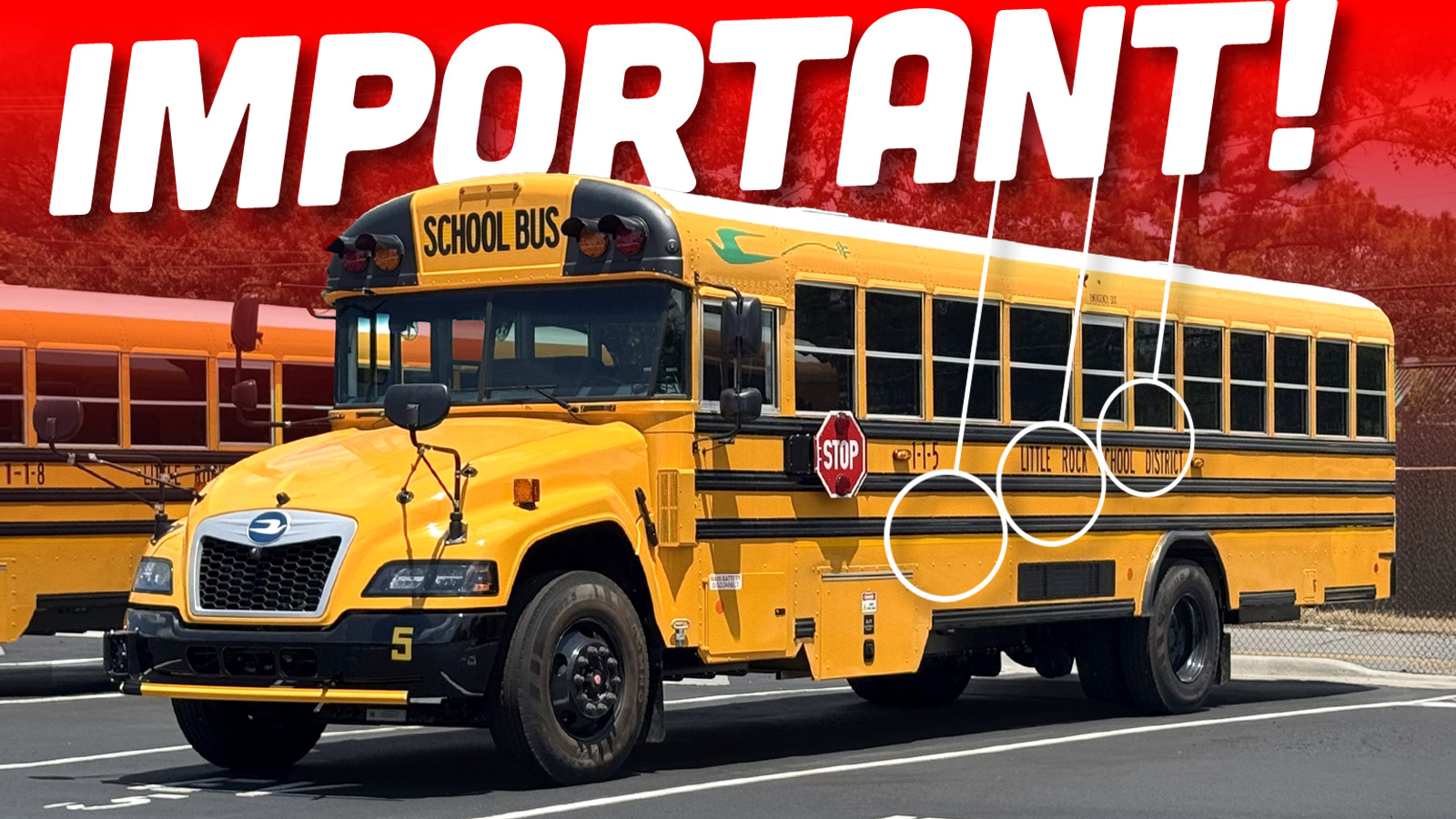
One of the loudest vehicles in America, visually, is the humble school bus. These mighty metal machines are tasked with carting children around safely. Thus, so much of the design of the school bus, from its eye-searing yellow color to the padded seats, serves an important safety role. One of the coolest style elements of the school bus, those long black bars along the body of the bus, also serve an important purpose. Here’s how those weird stripes help keep your kiddo safe.
The school bus is one of the simplest kinds of buses. On the surface, lots of school buses are basically just metal boxes sitting on top of a truck chassis and propelled by a reliable running gear. Look underneath, and you’ll often find leaf springs and hydraulic brakes. Lots of today’s school buses don’t even have luxuries like air-conditioning, and they can be worked on by everyday people. To put it another way, a transit bus is basically a space shuttle in comparison to a school bus.


Yet, don’t let that simplicity fool you. The school bus has been refined for longer than a century to haul lots of kids better than almost any other vehicle can. School buses are displaying their safety advancements proudly for all to see. Yet, unless you know what you’re looking for, you might not even notice. Think of the last school bus that you saw on the road. It was almost certainly yellow with black trim.
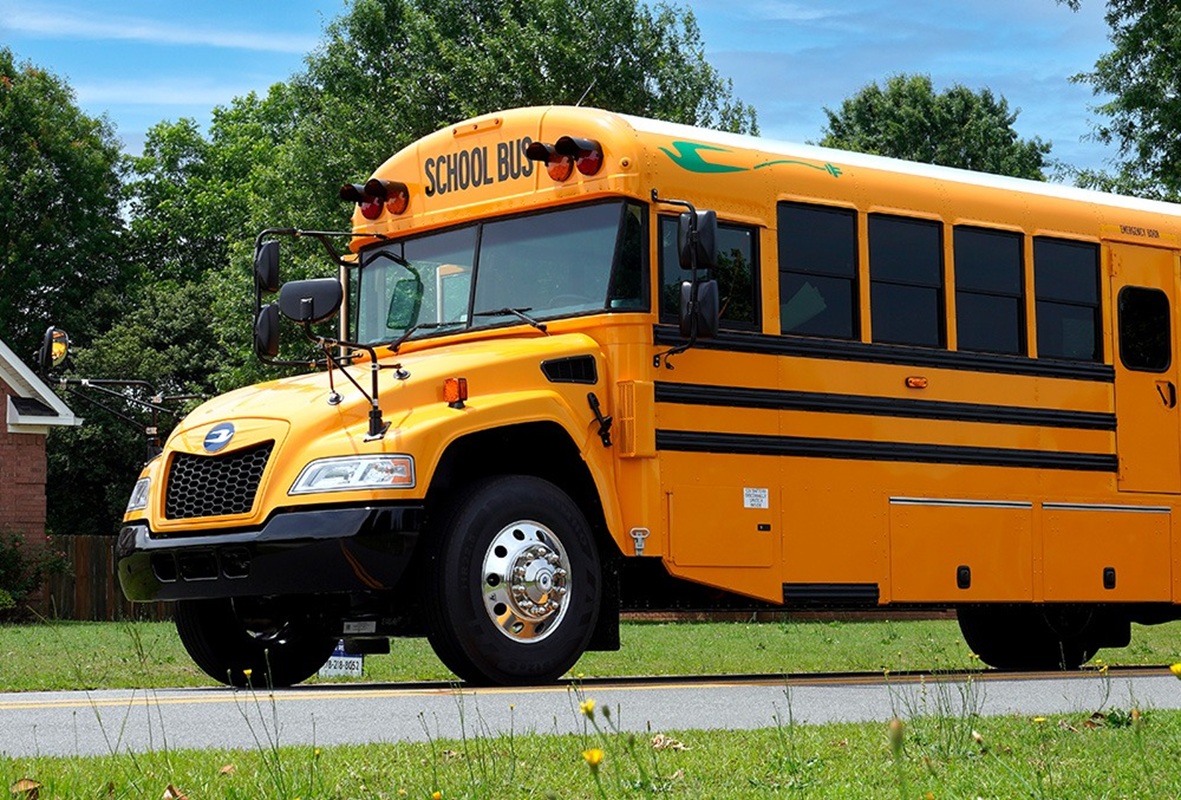
The sides of those buses have long black strips on them. You, like much of the staff of the Autopian, might wonder what those rails are there for? Are they there to protect the bus from scraping things along its side? Do they just break up the tens of feet of bright yellow?
These strips, like much of the design of the common school bus as a whole, are actually safety features that, you guessed it, are supposed to help keep kids safe. School buses themselves are amazing when you dig into their history
A Century Of Safety

Some of the earliest school buses were horse-drawn carriages in the late 19th century. These wagons were built out of wood and featured perimeter seating. These carriages were called school cars, school hacks, and kid hacks. Safety wasn’t much of a concern in those days, but in this image of a Wayne school hack, you can see that the basic shape of the school bus has been around the whole time.
As the 20th century rolled around, school hacks would eventually be replaced by motorized school buses. One of the first motor school buses was a 1914 model from the Wayne Works of Indiana. This bus featured a wood body and Ford Model T underpinnings.

The school buses of the 1910s got the job done, but wood turned out to be a poor building material. The rough, unimproved roads of the 1910s and the 1920s dealt serious blows to the wooden bus bodies. The damage to these buses was such a concern that, in 1925, Albert Luce, Sr., the founder of the Blue Bird Body Company, was concerned that his first bus wasn’t even going to last until its buyer finished paying it off.
Two years later, Luce improved his design by shoring up the wood body with steel framing. Meanwhile, in that same year, the Crown Motor Carriage Company introduced what was claimed to be America’s first school bus with dual rear wheels for a greater carrying capacity.

Perhaps the greatest school bus innovation came in 1930, when both Wayne Works and competitor Crown Coach both introduced school buses with all-metal bodies. The production of these two buses happened so closely together that some historians say that Wayne was first, while others say that Crown did it first. Either way, this was an incredible step forward in both safety and durability. These innovations didn’t stay novel for very long, either, as all-metal bus bodies became commonplace in the 1930s.

School bus advancements then took off in the 1930s. In 1932, Crown introduced a bus that had an all-steel body, a steel skeleton structure, and a chassis integrated with the body through welding. That year, Crown also introduced redundant braking systems and safety glass. Wayne would also adopt safety glass in its buses only a year later.
Another invention of the 1930s was the rub rail. While I could not find which bus builder invented the rub rail, Wayne Works is sometimes noted as a pioneer of the idea. These rails add some rigidity to the bus body, as well as add some side impact protection. However, the rub rails of the 1930s weren’t exactly the same as the rub rails that you see on school buses today, and that’s due to how widely varied school bus regulations were in the era.
Making Buses Safer In 1939
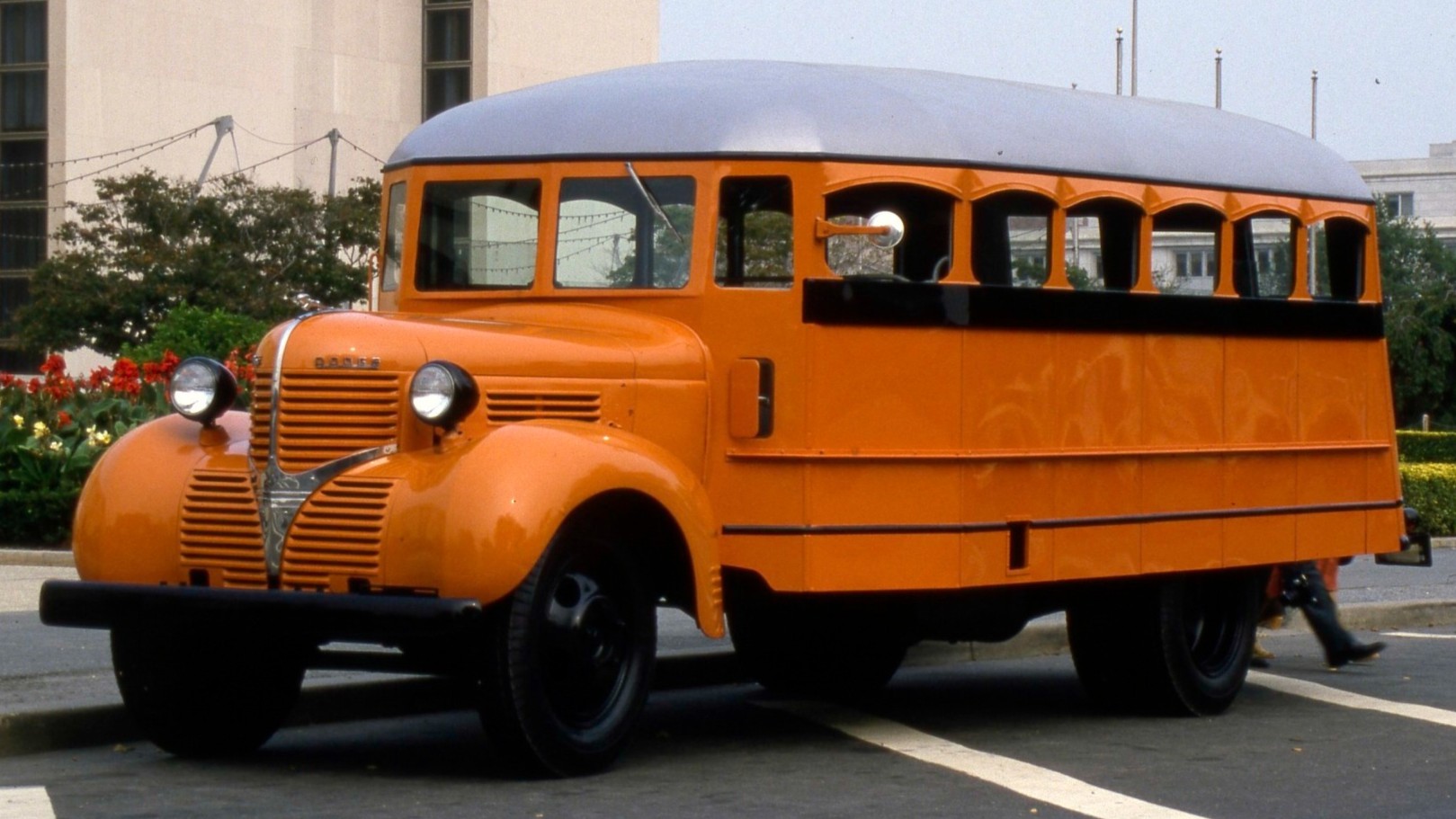
In 1939, Frank W. Cyr, a rural education specialist at Columbia University, joined forces with M. C. S. Noble, Jr. and Frederick M. Dutcher, both of Columbia University, to improve school bus safety. The men noticed that each American state had responded to technological improvements to school buses by enacting school bus regulations. The problem was that there were no true standards, so that a bus in one state could be very different than a bus in another state. From H. E. Hendrix, then President of the National Council of Chief State School Officers and State Superintendent of Public Instruction of Arizonа:
Pupil transportation, a necessary adjunct to the school system especially in rural areas, is a function created by state law and to a large extent is a state responsibility. For that reason the National Council of Chief State School Officers accepts the responsibility for setting up cooperative relations to formulate national uniform minimum standards of school bus construction, Accordingly, the conference of official representatives of the forty-eight state departments of education was convened for the purpose of formulating and agreeing upon a statement of uniform minimum standards. This publication presents the findings of that conference.
A large majority of the states by the authority of state law developed standards for school bus construction and operation which they thought were conducive to safety and economy. It now seems, however, that variations in construction standards are not resulting in economy because they hamper production of buses for a national market and compel the construction of buses as custom made jobs without materially adding to safety. It was therefore necessary that the state representatives discharge their responsibility for setting up uniform standards through cooperative action.
The National Council of Chief State School Officers is under special obligation to Frank W. Cyr and M. C. S. Noble, Jr., for giving us the benefits of their findings in the National Survey of Pupil Transportation and for organizing and conducting the conference of state representatives; and to Frederick H. Dutcher for acting as technical advisor to the conference; and to the General Education Board for the grant of funds with which to finance the conference. The full cooperation of the engineers of the automotive industry in providing technical advice is recognized. It is our hope that the standards proposed will result in greater safety and economy in school bus construction throughout the nation.
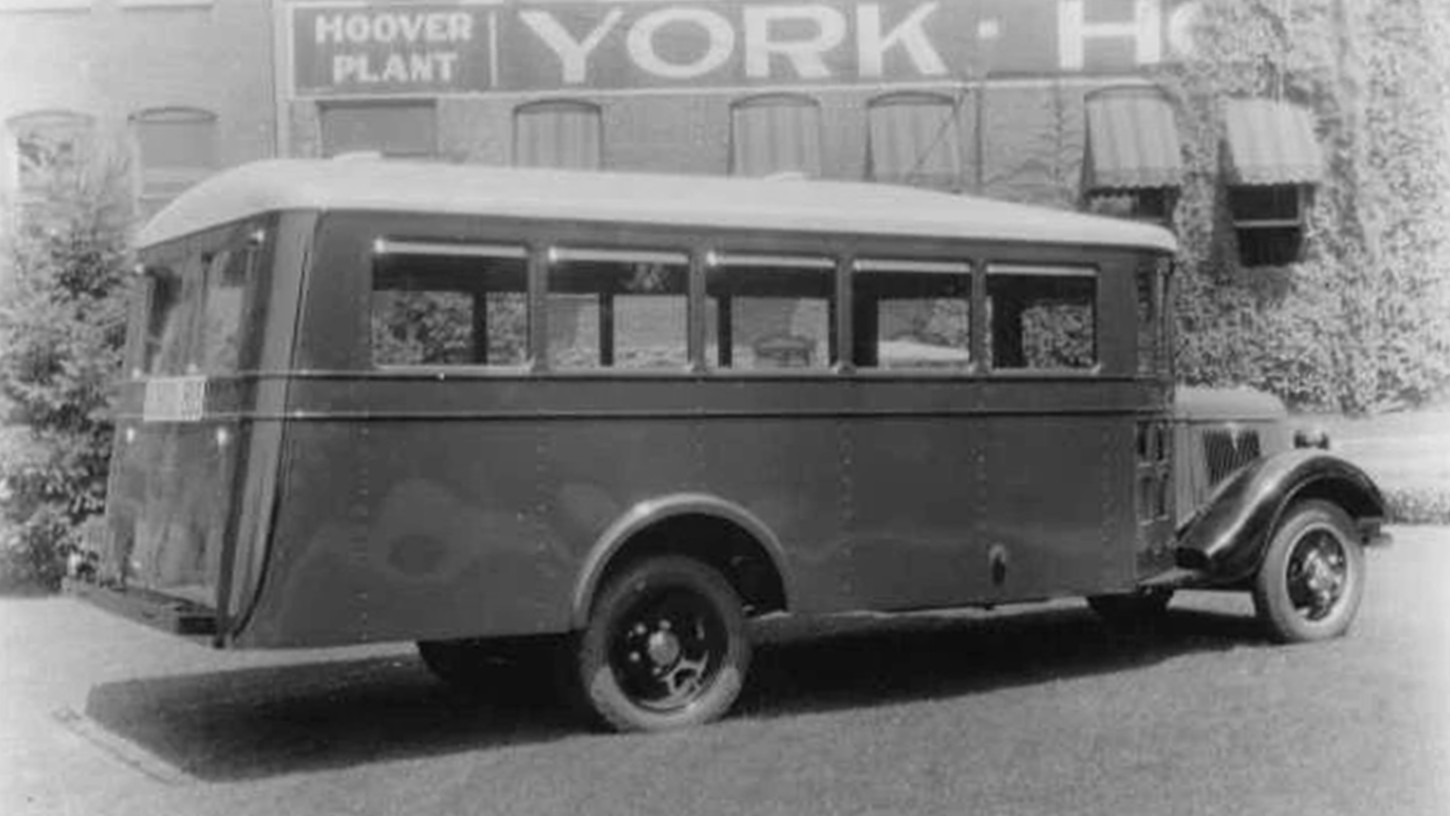
1939 was the inaugural year of the National Conference on School Bus Standards, where school representatives of the 48 states, chassis and body manufacturers, engineers, and other agencies met to create national school bus standards. Attendees included everyone from engineers from Bendix and General Motors to representatives from DuPont and U.S. Rubber.
That conference led to the creation of the “Minimum Standards for School Buses,” a manual that sought to create national safety and engineering standards for school buses. The manual set 44 standards for body length, ceiling height, standard, and aisle width. I have found the manual, and it’s fascinating. The manual describes what’s so important about setting standards:
The safe and economical transportation of nearly 4,000,000 children to and from school every day of the school year is a matter of first importance to millions of parents and thousands of school board members in all parts of the nation. In 1938, 86.099 school buses were in operation. The total number of school buses purchased from manufacturers annually is in excess of 10,000. At an estimated cost of $2,000 per bus the annual investment in school transportation facilities is about $20,000,000. These statistics indicate the extent of this important service. It is a problem of increasing importance, as indicated by the fact that from 1926 to 1938 the number of school buses increased 132%.
It would be practically impossible to make adequate consolidations of rural schools if it were not for the feasibility of pupil transportation. It is generally recognized that the need for future consolidation of schools will almost inevitably lead to expansion in pupil transportation systems.
The cost of pupil transportation may be considered as an addition to the ordinary cost of a satisfactory school program and in that sense it can be considered as a deduction from the total funds that might be available for superior school plant facilities and instructional programs. In view of this situation it is highly desirable that all possible economies consistent with pupil safetybe attained and practiced in the construction and operation of school buses.
The Minimum Standards for School Buses
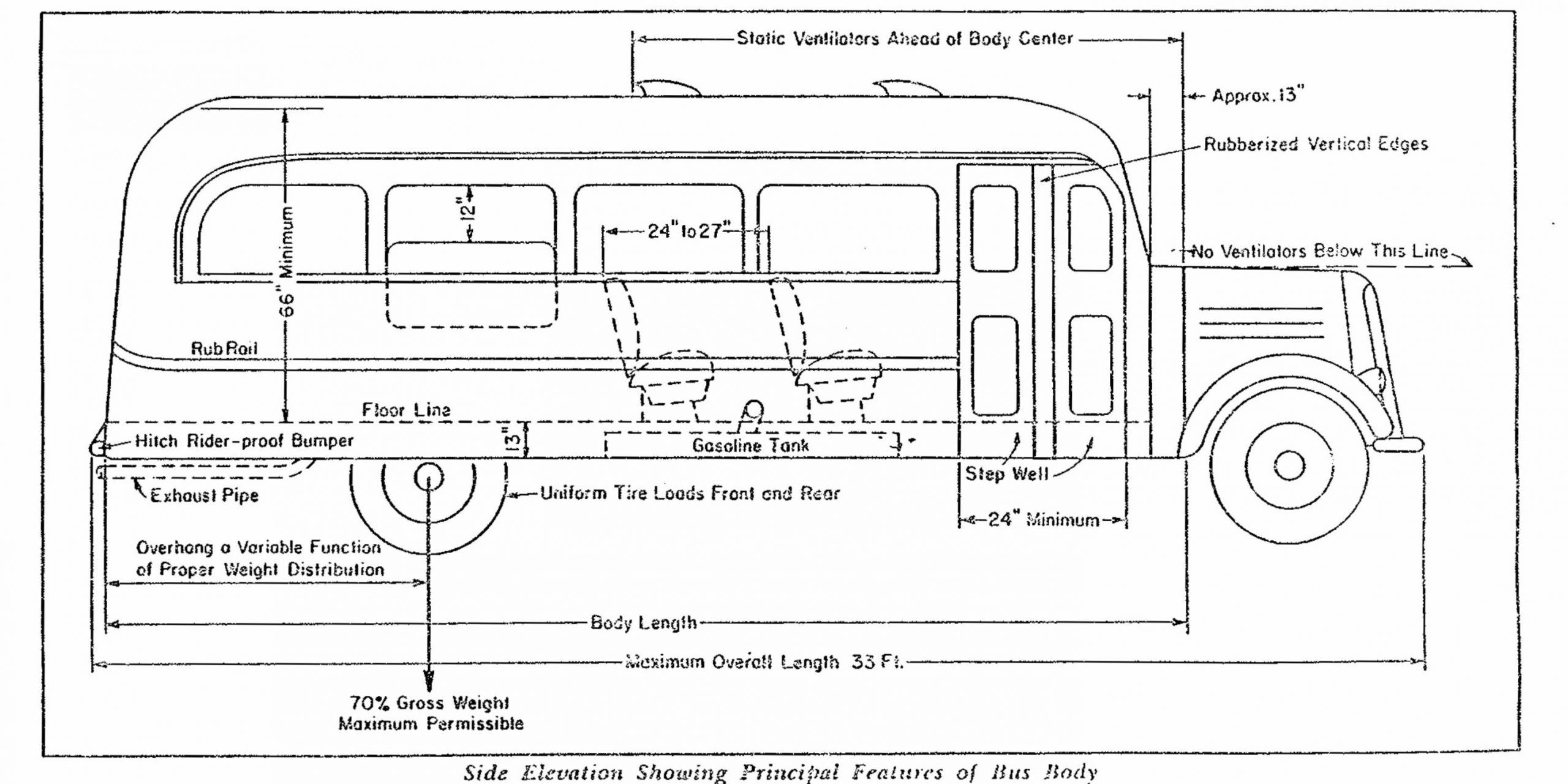
I won’t list all standards, but just the most interesting ones. The manual said that the rear axle of a school bus should be a full-floating axle. A battery of at least 120 Ah was required and had to be mounted outside of the bus body. Service brakes were required to stop a bus from 20 mph to a stop in only 22 feet. Compliant buses were also required to have a hand-operated emergency brake.
The manual even set standards for fuel tanks, which had to carry at least 18 gallons, and exhaust pipes, which had to be external and dump behind the bus. There were even standards for overall length and gradeability. The manual set bus length to be no longer than 33 feet and that buses should be able to climb three percent grades at 20 mph with a full load of kids.
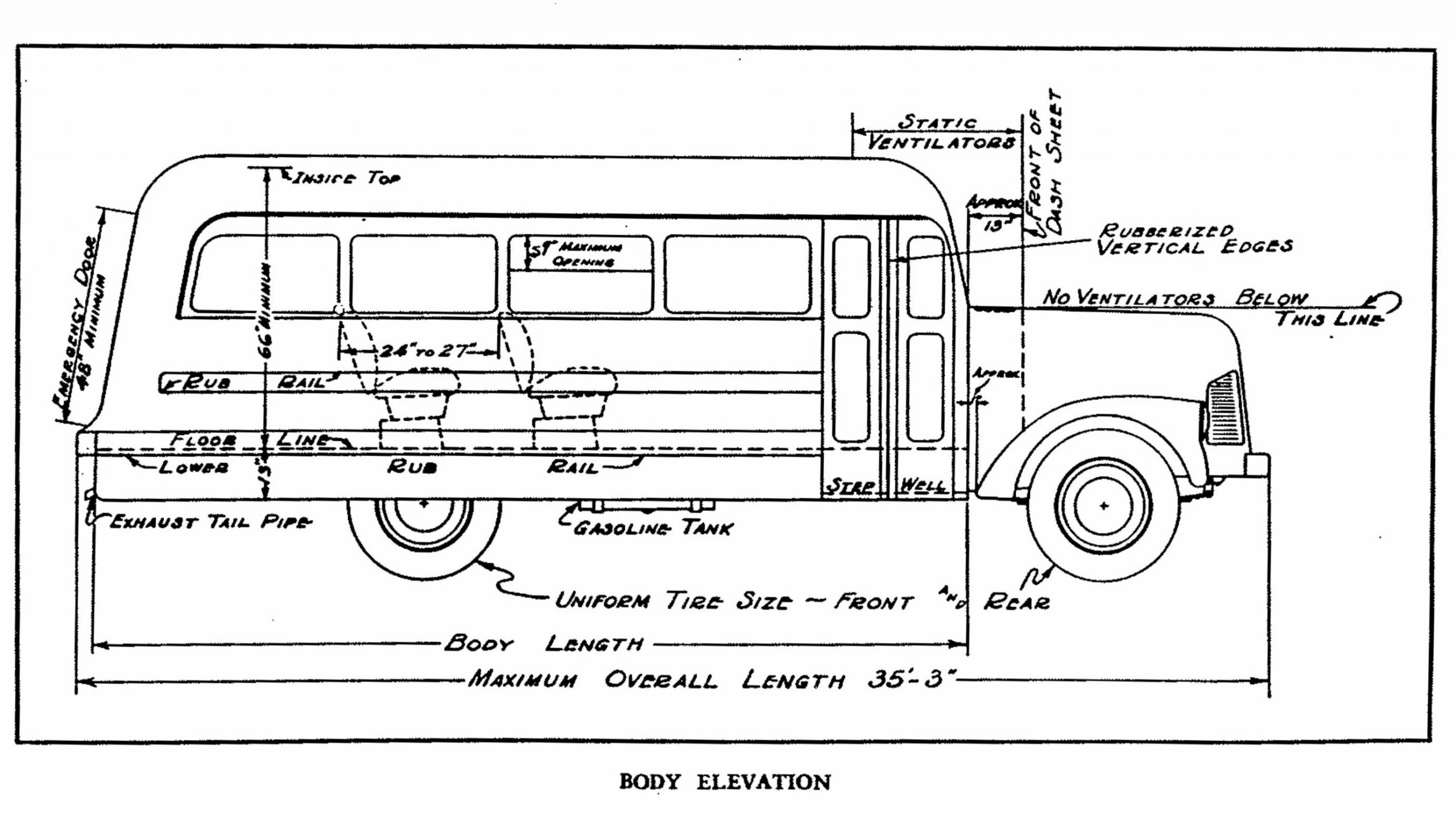
The safety standards were also pretty high for 1939. The bumpers were required to be rigidly mounted to the frame and were required to be able to push a vehicle of equal loaded gross weight without causing damage. The rear bumper was also required to be designed to prohibit the “hitching of rides.” Other safety standards included a required emergency door and a ceiling without protrusions that could cause injury in a crash. Buses built to the manual’s standards were even required to have first aid kits and fire extinguishers.
Many of the standards remain in use today, including the requirement that the capacity of the bus is painted on a panel inside, the requirement that buses be painted yellow with black trim, and the requirement that padded seats be permanently bolted or riveted in place. If you’re curious about what the color of school buses was back then, Frank Cyr developed a color called National School Bus Chrome. Today, the official color of a school bus is National School Bus Glossy Yellow.
Those Black Rails On School Buses

Then we get to the rub rails. In 1939, buses had only one rail, and it did not go the entire perimeter of the bus. The standard was simple, from the manual:
The body shall be protected by an applied or pressed-in rub-rail, located at the scat line of between the floor and seat lines.

In 1945, the rub-rail requirement called for two rails. This standard called for a rail at floor level and for another rail at the seat line. The 1945 manual describes why the rails were important back then:
Two rub rails of ample strength to resist impact and to prevent body crushing shall be provided on each side of the body. They shall be applied the full length of the body on the outside of the body, on the left side from the windshield post to the rear corner radius, and on the right side from the service door to the rear corner radius. One rail shall be located approximately at the seat line and the other approximately at the floor line. Pressed-in rub rails do not satisfy this requirement.
Later, rub rail standards would strengthen. The 1970 manual, for example, requires that rub rails be affixed to every body post and structural members. These rails had to be at least four inches wide, made of 16-gauge steel, and corrugated for additional strength. The 1995 manual added a third rub rail onto the side skirts of the bus body.

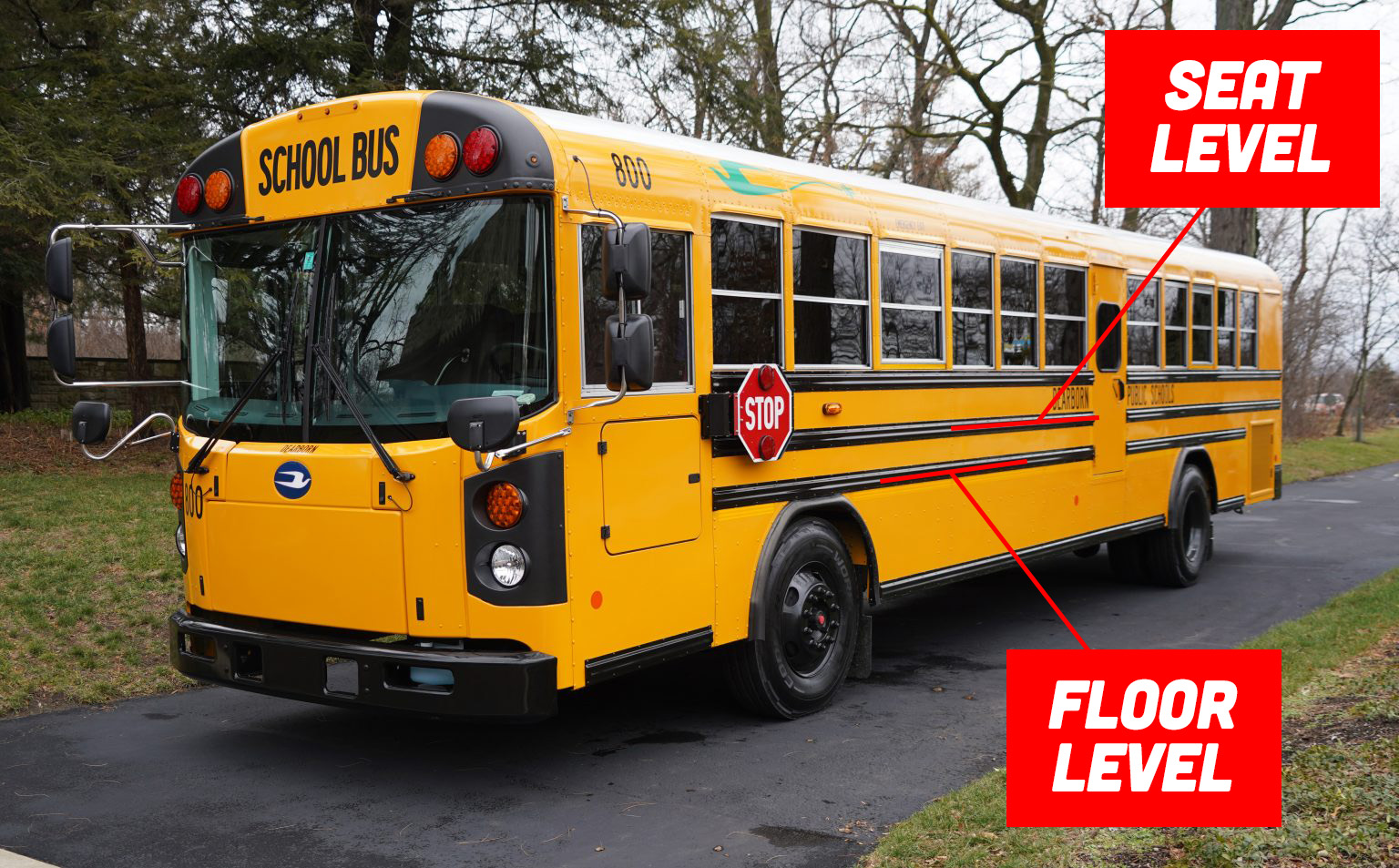
Today, school buses have four sets of rub rails in general. These rails will be on the side skirts, at the floor level, at the seat cushion level, and at the window level. The state of North Carolina explains further:

The rub rails of today still carry the same functions as they did in 1939: They add some reinforcement to the walls of the bus body at the safety points of the side skirts, floor, seating area, and window line.
An additional side benefit is that, in an emergency, the rub rails can be used by first responders to identify roughly where the floor and seats are. In the image below, for example, the rub rail at the floor level is actually a few inches above the floor.
Big Yellow Tanks
Modern bus regulations also require school buses to be tanks (metaphorically, that is). Here’s the standard for a modern school bus structure:
The bus body shall be constructed to withstand an intrusion force equal to the curb weight of the vehicle or 20,000 pounds, whichever is less.
Likewise, the National Highway Traffic Safety Administration has designed bus safety around the idea of compartmentalization. In the early 1970s, NHTSA discovered that school bus seats were often too weak, too low, and too “hostile” in a crash, leading to injury. As a result, NHTSA changed how it approaches school bus interior safety. From NHTSA:
Compartmentalization is directed toward ensuring that passengers are surrounded by high-backed, well-padded seats that both cushion and contain the children in a crash. If a seat is not compartmentalized by a seat back in front of it, compartmentalization must be provided by a restraining barrier. The seats and restraining barriers must be strong enough to maintain their integrity in a crash yet flexible enough to be capable of deflecting in a manner which absorbs the energy of the occupant. They must meet specified height requirements and be constructed, by use of substantial padding or other means, so that they provide protection when they are impacted by the head and legs of a passenger.
It is helpful to bear in mind the following highlights about compartmentalization:
1. Compartmentalization provides effective occupant crash protection, minimizes the hostility of the crash environment and limits the range of movement of an occupant, without using seat belts;
2. Compartmentalization ensures that high levels of crash protection are provided to each passenger independent of any action on the part of the occupant; and,
3. Seat belts are needed on passenger cars and other family vehicles and on small school buses (school buses with a GVWR of 10,000 pounds or less) because the crash pulse, or deceleration, experienced by the lighter vehicles is more severe than that of larger vehicles in similar collisions. Large school buses are inherently safer vehicles because they are larger and heavier than the vast majority of the other vehicles on the road. In addition, occupants in large school buses sit above the forces that are typically imparted to the bus by smaller impacting vehicles during a crash. The training and qualification requirements for school bus drivers and the extra care taken by other road users in their vicinity add to the safety of school buses.
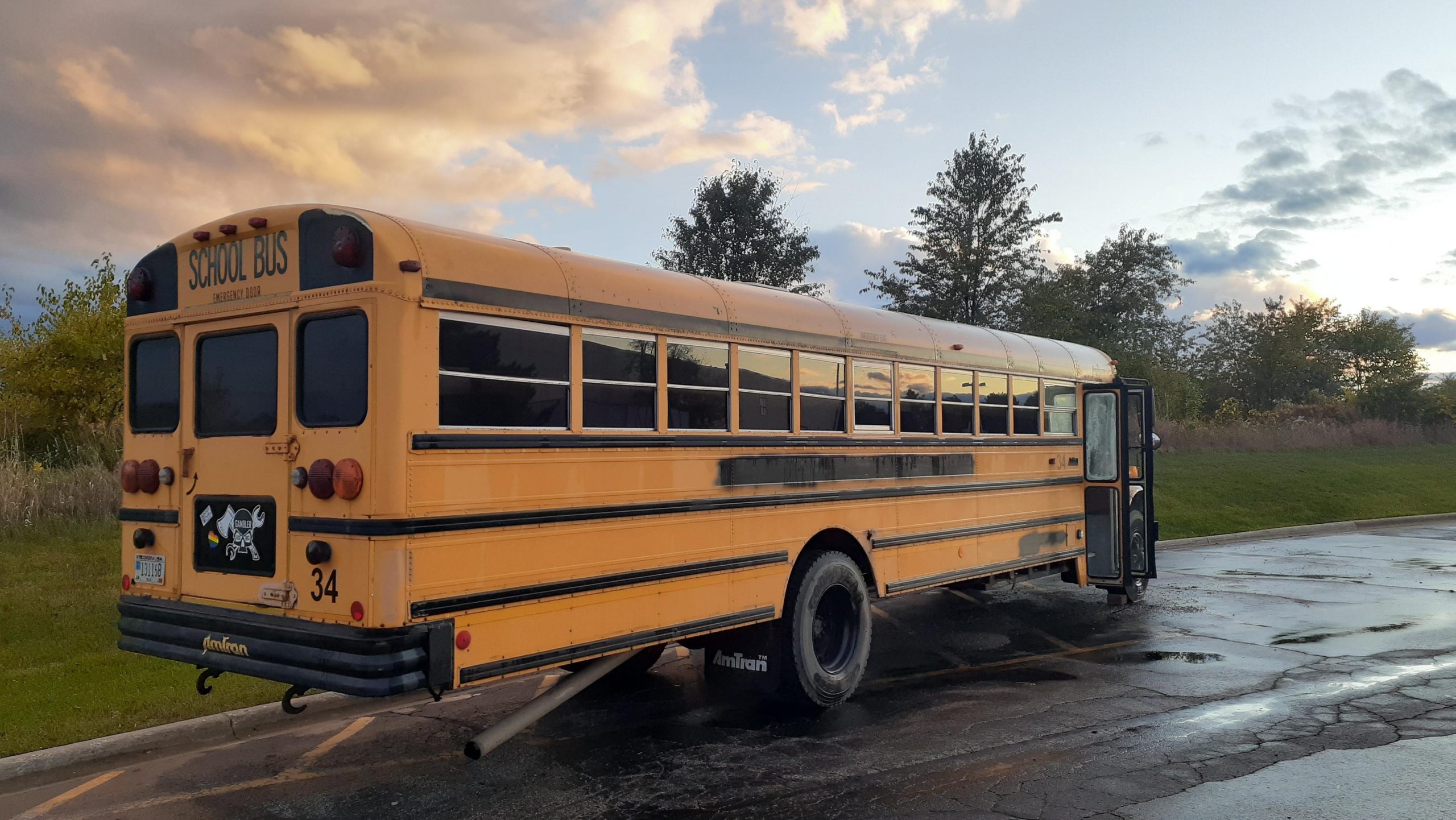
The result of all of this is that school buses are surprisingly safe. On average, 108 people die each year in school bus crashes, and most of those fatalities are outside of the bus. From 2014 to 2023, there were 971 fatal school bus crashes, in which 1,079 people of all ages were killed. The American school bus fleet is roughly 480,000 units strong, and each day, some 26 million students ride to school each day on a bus.
Of course, an average of 108 deaths per year isn’t zero. Engineers, bus companies, and educators are still working to make buses safer and to reduce those fatality numbers as part of the National Congress on School Transportation.
It’s amazing how far school buses have come in over a century. In the late 1800s, a school bus was barely more than a covered wagon. Today, it’s a big, yellow beast that dutifully serves school districts for decades while safely carrying millions of students every single day. So much of it is thanks to those standards set in the 1930s, including those seemingly random black rails.
Top graphic image: Blue Bird


@mercedesstreeter Yet another well-researched, entertaining article about an obscure subject I wouldn’t have thought about much BUT I’m glad I got to read about!
I SO enjoy your writing, and this is an example of why I’m an Autopian subscriber. And if you are reading this and aren’t…shame on you!
Keep up the great work!
This is EXACTLY why I chose a Skoolie over an RV. They are built like brick shithouses. If I’m not there and a tree falls on it, it might leave a dent but it’s not going to go all the way though like pretty much any RV ever made.
The rounded roof is a huge benefit as well since sheds snow like crazy, which prevents leaks.
I hunted out a Ford e450 Econoline Cutaway Van, with the 5 window shorty bus body built by Thomas. We like it a lot and live in it as much of winter as possible.
“Large school buses are inherently safer vehicles because they are larger and heavier than the vast majority of the other vehicles on the road. In addition, occupants in large school buses sit above the forces that are typically imparted to the bus by smaller impacting vehicles during a crash.”
So school buses are clearly becoming substantially less-safe with the proliferation of >10,000 lb GVWR SUVs and lifted pickups.
Yeah, that stuck out to me too
My school used red London double deckers:
https://localwiki.org/davis/Double-Decker_Buses
School buses do nothing but block traffic!!!!! I HATE THEM!!!! Get rid of them!!!!!!
Seriously? Put each of those 60 kids in a car and see what happens to the traffic flow. In many towns, you don’t get to ride the school bus if you’re within a mile of the school, so traffic near the school becomes gridlock as everyone too close for the bus, but too far to walk drives their kids. Two miles away from the school (where the busses run their routes), it’s just a normal commute.
A bit orthogonal to this, but it got me thinking…
If we have the FMVSS and the NHTSA and the NTSB and the rest (including this effective national-level school bus safety standard), why do we have separate state-level licensing standards and vehicle safety requirements?
The state level is the most ideal/correct way to implement laws in federalism. In the interest of efficiency, national standards were adopted.
I don’t follow your thinking. There are plenty of federal laws and rules, in addition to state laws. You’re saying that state (or equivalent) laws are the ONLY laws that count? Or just that they are more correct than federal laws?
Specifically in this case, of we’re willing to have an adjustment of federal laws and regulations around vehicles, traffic signals, signage, and all manner of inter-state transportation (obviously on that last one), why not federal licensing and safety?
Interestingly enough the feds are not usually in charge of signage and traffic signals. If a state said wanted to they can change all the signs in their state to be aquamarine, the worst that could happen is they pull the federal highway money from them. Nevada had a big fight with the US when the feds put in the 55mph limits. At first they just refused to comply, then they made it a token fine for speeding. The feds threatened their money and won in the end. This was not how the US government should work. But the federal government has only grown stronger over the last 100 years.
In federalism laws should be as local as possible so that the people they effect the most have the greatest say in the matter. Since school busses do not usually cross state lines it’s not a federal issue. For cars that’s trickier but it seems to be working out.
And here I thought this was going to be about how the black visually contrasted with the background yellow to catch your eye, much like stinging insects (or ones that want you to think they can sting) have alternating black and yellow pigmentation on their abdomens.
Those of us of a certain age can remember when school bus seats had a big steel hoop with zero padding as the main structure in front of your face. And those riding in the last rows getting catapulted into the luggage racks above our heads due to Maine frost heaves in my case.
I will say, having driven buses from school, to transit, to over-the-road coach, Mercedes is spot on in the comparison of them. School buses are designed with two primary goals – to keep the kiddos safe, and to be CHEAP (and I wouldn’t dare guess which is the higher priority). They are usually low utilization vehicles built for low acquisition and running costs first, with passenger and driver comfort about a distant tenth. With exceptions – my hometown has a couple VERY nice pusher school buses with coach seats and A/C that are used for field/sports trips and as shuttle busses in the summer. But that town also has more money than they know what to do with as a rule.
I only daily rode in school buses for a few years back in the late 60s. Some of us intentionally chose the last couple of rows to sit in, unrestrained, and get launched over big undulations. I think there was a half-inch thick of high-density foam padding on the back of the metal hoops.
When I lived in SE Texas, there was a roadside memorial to two young women who perished (partially ejected, I believe) in 2006 when the bus in which they were riding enroute to an intermural sporting event near Houston left Highway 90 west of Beaumont and rolled over. At the time, Texas had no seat belt requirements whatsoever. Nor did the country as a whole. Austin was the only district in the state that had any restraint requirements.
Although the bus and driver involved were chartered from a local firm, the Beaumont Independent School District committed later that year to having three-point belts installed on all new buses it purchased going forward. The belts added about $11,000 (~10%) to the cost of buses, which were going for a little over $111,000 per unit at the time. I don’t know whether they were retrofitted on any of the existing fleet, but in the intervening years, the whole fleet has been replaced.
It’s sad that it took something like this to get any movement on the issue. RIP Alicia and Ashley.
My hometown tried seat belts in buses some years back. After the third little darling went to the ER because another little darling whipped them in the head with the lap belt, they were removed. And impossible to enforce the brats wearing them. More trouble than it’s worth given how *incredibly* safe school buses are, sad though the occasional fatality is.
Surprisingly, Florida is one of the states that does mandate them, and since 2000 at that.
An article I read said compliance about actually wearing them was, unsurprisingly, much more of an issue with middle and high schoolers.
When I take an Uber/Lyft, I wonder what the driver thinks when I wear the seatbelt. Do they think I don’t trust their driving? Sometimes the corresponding buckle is buried down where it’s difficult to dig out and click it.
Many of the Uber/Lyft drivers I have ridden with have been so bad I wished for a helmet and a Nomex suit, never mind a seatbelt. It does seem to be a default job for the “fresh off the airplane” set in most major cities (I assume very few emigrate by boat anymore). One got in an accident turning into the building where I was waiting for them – I figure I dodged a bullet with that one. My gripe is soooo many cars have absolutely terrible rear seat belts – especially the ones that just keep ratcheting tighter and tighter. But better uncomfortable than sorry.
Thankfully, I only ever had to wrangle college kids on busses (and I was only a few years older being a grad student), never the younger set. I’m the sort who would have kicked their ass off the bus on the side of the road for being dumb. Which I did to a few drunken idiots in my driving time. I was decent enough to get off I-94 first though. On the transit buses, I wouldn’t let them board if they were obviously drunk – only took one time of cleaning puke off the seats to make that my personal rule. You can walk your drunk ass around campus, you are NOT getting on my bus…
“Lots of today’s school buses don’t even have luxuries like air-conditioning, and they can be worked on by everyday people.”
No, you should look at Texas. Lot of school buses there have air-conditioning system in response to the concerns from the parents and students. It does get damn hot inside the school buses during the hot days.
In the Southern half of the US, sure, school buses often to probably nearly always today have A/C. Up north, LOL – nope. My hometown in Maine probably has the only couple of air-conditioned school buses in the state, as they are also used as shuttle busses during the town’s annual summer festival. The majority of the fleet uses “22-30” cooling – 22 windows down, 30mph breeze as they trundle around that small town. But for sure they are far more common today than when I was a kid everywhere. They all are here in FL, and non-functional A/C gets a bus redlined if the temperature is over some number, I think 80F or so.
Having sweated my whatsits off in school buses as a kid, Maine can be plenty hot the first couple and last couple of months of school, I say it builds character – and the schools didn’t have A/C either. The heaters in the damned things weren’t much good in a Maine winter either 40-50 years ago.
I grew up in Dallas in the late 1970s and rode the school bus for an hour each way as we lived far away from the magnet school. Arriving home, I was often grouchy, sweaty, sticky, and such during the hot days. The morning ride was fifty to seventy per cent better than afternoon ride, depending on whether we had morning rain that could get very humid fast.
Opening windows to circulate the hot air was wishful thinking when the bus hurtled on the highway at 50–60 mph. The gale force wind whipped our hair, flapped our shirts, roared through our ears, etc. If it rained outside, tough luck. The vinyl seats didn’t help at all.
You’re right about building character. When I visited the magnet school about fifteen years ago, I was gobsmacked to see the massive air-conditioning unit installed in the gym building and the school buses with air-conditioning system. So, the students wouldn’t faint from the heat during the PE. The students there were shocked that we survived the PE without air-conditioning in the 1970s.
It’s absolutely crazy how different things are for kids today at all levels of education in terms of amenities. I went to one of THE richest school systems in my state, and our high school was a shit hole in the ’80s. A cinderblock prison basically, with about the same amenities. Today, it has been TOTALLY rebuilt, air-conditioned, carpeted, high tech everywhere in the whole place. And with the growth of the town, what was 7-12 is now only 10-12, with a new 7-9 “Middle School” having been built down the street.
College is the same. I am at universities for my job all the time, and it is astounding the absolute damned LUXURY that college students live in today. They have absolutely no idea how good they have it. My dorm rooms were barely big enough for two twin beds and two tiny desks (or in one case, three of us in the room with a single and a bunk bed, and we had to share the desks (pretty sure that would be considered cruel and unusual today), no A/C, not a whole lot of heat either, and the slop at the cafeteria was two choices – bad, or worse, plus a salad bar. Today, cafeterias are like an around-the-world smorgasboard at most schools. And the technology (which pays my salary to be fair), has to be seen to be believed. At my school form ’89-93, the school ran on a single AS400 minicomputer, and there were two computer labs. One Mac Lab with about 20 SEs, and one PC lab with about 40 networked 286s and 386s. But we did have the very early pre-WWW Internet, and I had an e-mail address in 1989!
But it’s no wonder it all costs so much today!
It’s because governments will gladly pass the cost of new buildings onto the tax payers but refuse to pay teachers a decent wage. :\
It’s all of it – death by a thousand cuts. Teachers in my hometown are actually EXTREMELY well paid. But that is a largely local decision, and it’s a rich town.
This has been one of my peeves since graduate school. Back then the students voted for a new rec center and sports arena. OK, I can get on board with that…to a point;
HOWEVER
WAY too much emphasis (and money!) was spent on stupid superficial crap like replacing a $10 whiteboards that used no electricity whatsoever with $3000, 500W plasma TVs. The justification? Fucking ad revenue!
We also built a fancy new chemistry building that IMHO used space and energy very inefficiently but gee whiz it looked cool. In fact when completed it alone consumed about 20% of the electricity of the entire campus. Soon afterwards came the great California power crisis of 2003. Not only did power prices skyrocket but there were the added fun of rolling blackouts.
Oh and they replaced the school’s sign with a giant self illuminated active display billboard, again for ad revenue.
UGH!
That graduate school waste story reminded me of my k-12 district I worked at. Someone decided (probably got a bribe) that every classroom needed a Smart board in the entire district whether the teacher wanted one or not. That’s over 300 schools with 25-60 classrooms each easily tens of millions of dollars.
The best parts were they provided no training, it had buggy software and you couldn’t even use it as a whiteboard. Almost nobody used them, they lasted about 10 years before giving up completely… Just in time for new smartscreens. People have no idea how wasteful our district is.
What got me was it was the STUDENTS who voted for the rec center and sports arena as their “legacy”. Well they got it.
New students can thank those yes voters in part for skyrocketing tuition.
One other thing, buses built for the southwest will have insulation in the ceiling. Those built for the midwest will not.
Not my experience – they all have insulation. The biggest difference is painting the roof white on southern buses, and dark tinted windows. You rarely see that up north. Not like it doesn’t get to 100F+ even in Maine, and school buses see a good bit of use in the summer too.
Eric, that sentence doesn’t say that there are no school buses with AC.
I mean, that’s just one state. There are a lot of school buses here up north that still do not have air-conditioning.
Thanks for the excellent and thorough primer! Looking forward to the transit and tour bus breakdowns/comps (assuming you haven’t already published them elsewhere)!