

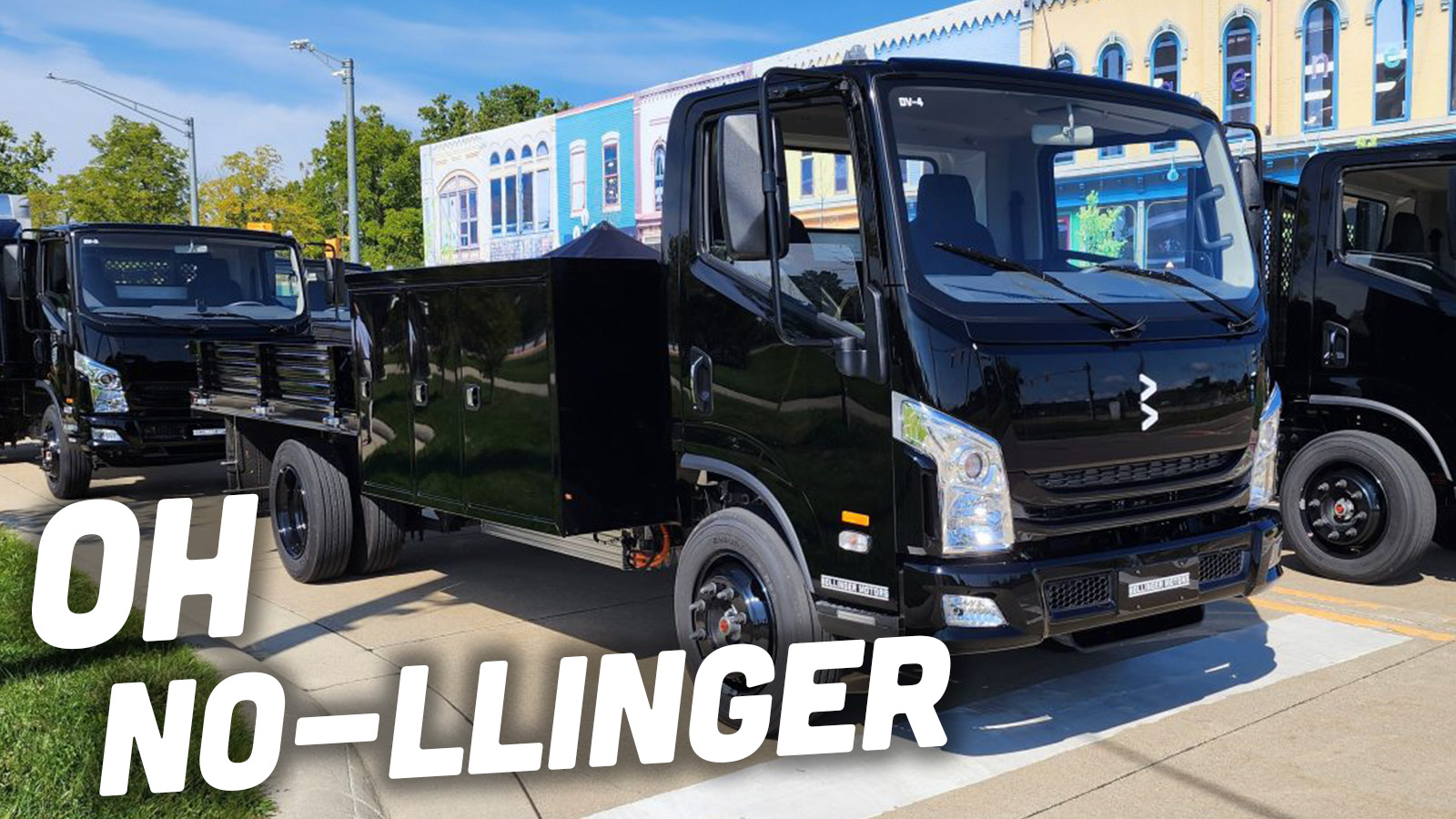
The story of Bollinger Motors has been quite the rollercoaster ride. The company first promised a gloriously blocky off-road truck before pivoting to a shockingly fun electric commercial truck. Amazingly, Bollinger even managed to kick off production. But things haven’t been so rosy for the company lately. According to a recent report, conditions within the Bollinger are rough, as employees have been laid off and others haven’t even gotten their paychecks.
Normally, a story like this wouldn’t pop up on my radar, but I was one of the fans of Bollinger Motors. I drove the company’s B4 electric trucks back in 2023, and they were honestly way more fun to drive than any delivery truck had any right to be. The B4 is a box truck that you could hoon!


I was also excited to hear that, against all odds, Bollinger actually brought the truck into serial production. Too many startups deliver nothing but vaporware, but true to Bollinger’s word, its trucks have actually delivered real goods in real life. Sure, Bollinger wasn’t building anything as cool as its original ideas, but I love a good Detroit underdog story. Sadly, what started as a story of triumph is now one of pain. According to both Crain’s Detroit Business and the Detroit Free Press, Bollinger has been struggling so much that suppliers and employees aren’t getting paid.

How We Got Here
It’s been a hot minute since we last talked about Bollinger, so let’s review how the company got here. This is what I wrote in my previous reporting:
Robert Bollinger founded Bollinger Motors in Hobart, New York [ten] years ago. At the time, Bollinger had ambitious plans, stating: “Trucks have had the same design flaws for a hundred years and someone needs to do something about it.” How ambitious are we talking about, here? Bollinger said he was going to build the “world’s first all-electric on- and off-road sport utility truck.” Now, keep in mind that this was before today’s popular electric trucks and SUVs hit the road, so this statement had impact. So, Bollinger announced an electric SUV and an electric pickup truck; from my B4 commercial truck first drive:
Bollinger’s truck ideas rose from a need. See, Bollinger’s enjoyed a colorful career working for Manhattan ad agencies before pivoting to an organic hair and skincare company then finally landing at co-founding a grass-fed cattle farm. While running the farm, Bollinger felt that there really wasn’t a truck out there that was both a practical farm vehicle and a fun off-road toy. This motivated Bollinger to fulfill a lifelong dream and he created Bollinger Motors with the idea of creating a heavy-duty Sport Utility Truck that got work done during the week and had fun on the weekends.

In 2018, the company moved to Ferndale, Michigan, to grow its team and take advantage of proximity near automotive suppliers, engineering talent, and potential manufacturing partners. A year later, Bollinger moved again to Oak Park, Michigan. Bollinger had been working on the B1 SUV and B2 Pickup for years. Development started with a team of engineers who lived with each other in a bunkhouse before the truck was first unveiled in 2017. Bollinger then missed its delivery targets multiple times as development continued. The company also briefly flirted with a panel van concept and chassis cabs.
Bollinger canned the B1 and B2 in 2022, disappointing the strong fanbase he built. But the company wasn’t really giving up. Instead of building a funky off-roader, Bollinger said, it was secretly working on a Class 4 commercial truck platform. This was because Bollinger had seen lots of interest for a Class 4 truck for local deliveries and landscaping. Demand was already there for a commercial truck, so Bollinger followed the money. That year, Mullen Automotive bought a controlling stake in Bollinger.
The Trucks Are Fun

The B4 truck also signaled a change in philosophy for Bollinger. The B1 and B2 were clean sheet designs intended to use as many bespoke components as possible. But the B4? It was designed to source as many components from other companies as possible. That way, Bollinger didn’t have to build an entire vehicle from the ground up. Everything from the truck’s cab, which comes from China, to its battery, which comes from Our Next Energy in Michigan, is thanks to an army of suppliers. The trucks are assembled right there in Michigan by Roush.
I also thought the trucks were a riot to drive:
The Bollinger B4 surprised me in how much it didn’t drive like a commercial truck. The Mcity proving ground was too small for me to really find the limits of the Bollinger trucks, but I got to do things with those trucks that I’d never try with my bus or any of the other trucks I’ve driven.
Out of the gate, I decided to punch the accelerator. The B4 moves like any other EV. It takes off with a satisfying kick of torque and the electric motor gets the speedometer rising way faster than you’d expect a commercial vehicle to go. I’m sure you’ve gotten stuck behind garbage trucks and the like at stoplights. Well, the B4 accelerates fast enough that it could be a garbage truck that is faster than you are between stoplights. The B4 is not “fast,” as in, it’s not going to pull your face’s skin back, but it’ll make a comparable diesel look like it’s sitting still. It’s fast enough that Bollinger tells me some customers want a power limiter so that drivers don’t have too much fun.
That quick dose of power is supported with surprisingly good handling. See, “handling” and “delivery truck” don’t tend to jive well. Try to go full lock and full throttle in a regular truck and you might have a bad day. Bollinger’s trucks have their center of gravity so low that the engineers actually encouraged going full lock while hard on the throttle. There was tons of body roll, sure, but the truck felt planted even when I was at full lock and pushing the truck harder and harder. The tires gave up traction long before the truck felt unstable.
I wouldn’t even drive a U-Haul truck as hard as I sent a Bollinger.
Everything seemed promising. Bollinger had businesses that wanted its trucks, and its trucks weren’t reinventing the wheel, just taking existing technology and packaging it well. In theory, it should have been successful!
A Bumpy Road

Well, as it turns out, my optimism might have been misplaced. Crain’s Detroit Business released a report on Monday that paints a depressing picture of the company:
Electric truck manufacturer Bollinger Innovations Inc. is facing dozens of complaints over unpaid wages and a new stack of lawsuits by suppliers seeking millions of dollars in past due payments — and the state of Michigan is among those with money on the line. The Oak Park-based startup, which promised in 2023 to invest $44 million and create 237 jobs in metro Detroit, is in default of its incentives agreement with the Michigan Economic Development Corp. The company was awarded $3 million by the state to help launch its Class 4 EV and has collected about a third of the cash.
[…]
As of Sept. 30, Bollinger had no qualified new jobs and 50 base employees, MEDC spokeswoman Danielle Emerson said. The company has laid off employees since then, Crain’s confirmed, though it is unclear how many. Company representatives did not respond to requests for comment.
Bollinger has until May 4 to cure the default by reaching job milestones and “will be required to pay back all or a portion of those funds” if it fails to do so, Emerson said. At the same time, the company is under investigation by the Department of Labor and Economic Opportunity, which has received 59 claims against the company about unpaid wages or benefits, department spokesperson Keely Lovern said.
It somehow gets worse. In March, Robert Bollinger–who stepped down as CEO before eventually leaving his company–sued Bollinger Motors for a $10 million loan he gave the company back in October 2024. This summer, the company claimed it was broke and sought help via recievership in June to pay back that loan. Since then, Crain’s writes, Mullen Automotive CEO and chairman David Michery paid Robert Bollinger back and promised to do the same for suppliers.

Post-receivership, Bollinger and Mullen were merged to create Bollinger Innovations. Unfortunately, it sounds like the money problems were never really solved, from Crain’s:
A half-dozen suppliers sued Bollinger earlier this year, demanding payment of more than $5 million in outstanding bills, Crain’s reported in July. Those cases have since been disposed, but six different suppliers are now suing the company in active cases, according to Oakland County Circuit Court records.
Canadian supplier Promark Electronics Inc., German supplier Thyssenkrupp AG, Brazilian supplier Metalsa, Livonia-based Testron Corp., Troy-based Engineering Technology Associates Inc. and California-based Aibond Corp. are the plaintiffs in those cases.
Bollinger Innovations was delisted from the Nasdaq a month ago after failing to meet its market value requirements. Michery tried to remain in compliance by conducting nine reverse stock splits in three years, but its share value continually fell below the $1 minimum. The company is trading stock on the open markets at 13 cents per share as of Monday afternoon.The company incurred a net loss of $304.4 million for the nine months ended June 30, according to the most recent financial statement filed with the Securities and Exchange Commission in August. Its accumulated deficit at the time was $2.6 billion.
The Drive also wrote about this, quoting an anonymous tipster. That tipster claimed that payroll is weeks behind, there is no operating cash left in the company, and the company’s customers and dealers have no idea what’s actually going on. I have reached out to Bollinger for clarification and comment on its current condition.
It’s also unclear what this means for Bollinger’s future. The company wants to make a larger Class 5 truck called the B5. Robert Bollinger also isn’t giving up his electric pickup truck dream. But all of that is going to take money, and it seems Bollinger is struggling with that part right now.
I will update this story if I learn anything more. What’s most important, I think, is that everyone gets paid. Then, hopefully, Bollinger can get past this pothole and keep on trucking. Time will tell.




“Bollinger canned the B1 and B2 in 2022, disappointing the strong fanbase he built “
Yeah I remember when they did that, I thought the decision was stupid.
I thought that they had the design worked out, so they should at least start selling it to recoup their investment into that design instead of cancelling it and pissing away the money that was invested.
The box truck idea wasn’t a terrible idea. But to pull that off, they would need a good service/support network for the commercial buyers who buy that type of vehicle.
It would be something to do at some point AFTER B1 and B2 production/sales were humming along and some revenue was coming in that would enable them to expand their service/support network.
Mercedes, thank you for the pre-obit. I think I was first introduced to Bollinger by a Torch (maybe DT or both?) article on the B1 and their excitement for a pass-through hauling space from bumper to bumper. Made a lot of sense. Early simple to manufacture ideas seemed great, too. Hard to get off the ground, and the commercial truck pivot to generate income also seemed to make a lot of sense. Your 2023 B4 review was a fun read and I was hopeful.
I like what I’ve seem from the guys at Edison, but they seem to be struggling too. I guess until you get one of the big truck manufacturers on board, with their manufacturing, supply, and distribution chains, these electric companies will flail.
“Trucks have had the same design flaws for a hundred years and someone needs to do something about it.”
This is the same fertilizer that disrupters everywhere spew. The current xyz has it all wrong and I know better. News Flash – markets and industries function the way they do because it’s the most efficient use of capital and all these disrupters eventually figure this out once the government subsidies and grants run out.
Bollinger’s enjoyed a colorful career working for Manhattan ad agencies before pivoting to an organic hair and skincare company then finally landing at co-founding a grass-fed cattle farm.
A common theme among these disruptors is they often know nothing about the industry they’re going to disrupt. They play this as an advantage ‘I’m not burdened by history’ when reality is naive hubris.
All I can ever think of is the film “Glass Onion”- lucky idiots…
And Shitheads.
Sad to hear this. 🙁
Also, how is it that the original B1 and B2 designs look so much better than Elon’s masturbatory fantasy, the Cybertruck? The world never got the B1/2, but now I’ve got to look at those awful looking monuments to the boundless vanity of a white supremecist pretty much every time I drive anywhere in SoCal.
BTW, did you catch Elon at the black tie dinner for Crown Prince Mohammed bin Salman the other night at the White House? You too can have your critics murdered and dismembered and still get honored by the president of the United States, provided you’ve got enough money and oil.
Was to be expected once Mullen got involved. Im really surprised Michery hasn’t been taken to club fed for some time off for all his hard work. The irony is if he was even slightly more honest he could probably just import Chinese vehicles and knock down kits to sell in underserved markets. He was able to sell mini trucks to various college campuses because it was exactly what they needed at a price that wasn’t terrible. The Chinese are setting up their own importers now like they have for other industries he lost a foothold being himself. Horizon truck is one that is brining in kits and assembling them in Ohio they are basically the same class 5 and 6 trucks being sold by Michery just without the obvious fraud. Too bad Bollingers name will be associated with Mullen and Michery.
Does that diagram at the end indicate that the Chinese supplier for the cab is named “Mobile Eye”? Probably just a weird translation, but sure makes it feel like a piece of spyware!
Isn’t Mobileye a blind spot alert system? If that’s a typo, and that’s what they meant, that would make some sense for a commercial vehicle
Its the Chinese adas supplier for the Chinese made truck.
https://www.mobileyechina.com/
The Chinese franchise of the Israeli/American company of the same name – It’s a household name brand in Israel, and their ADAS is installed on almost all trucks here
How in the world has Mullen been in and around the EV space for the greater part of like two decades and is still a functioning entity despite everything they’ve been associated with having failed spectacularly? Anyone ever heard of the Mullen Three? Didn’t think so. Remember Coda? Yeah Mullen bought their leftovers and were going to relaunch it it as the Mullen 700e. Where does the money keep coming from?
It’s almost as if buying the chintziest Chinese bodies in white that you can find and then stuffing them with batteries isn’t a viable business strategy.
That’s too bad. Turns out it’s not just hard to make cars, but also hard to make trucks.
We hired one of their former engineers. He is a great addition to our team and was proud of what Bollinger accomplished. But sad about how it ended.
Yet another rich grifter, laughing all the way to the bank.
Dude, please. You have no idea what you are talking about. Robert Bollinger lost most of his personal fortune trying to get this venture going.
So who grifted him?
Did he really? So you’re saying that Robert Bollinger didn’t see a dime of the $148 million Mullen paid for Bollinger Motors?
Really? REALLY????
I find that hard to believe.
When I look at the Bollinger Motors wiki page, I read about how he showed the world the B1 and B2, got 1000 pre-orders and then proceeded to NOT getting them built and instead, started talking about doing a panel van which would use a different chassis.
Then not long after that, announced a cutaway chassis version.
Then he cancelled ALL those plans and decided to shift to the box truck idea and then returned the deposits for the B1/B2 preorders (which could only have caused the finances to go from bad to worse)
To me, it sounded like Robert Bollinger was suffering from ADHD and couldn’t make up his mind on what to do.
He had no focus, over-extended the company into starting too many things, which overextended the company… which resulted in nothing getting finished and making it into production.
That led to the company becoming almost insolvent which led to the sale to Mullen… who has a long history of failure in the EV segment. But the company DID get sold for $148 million.
And that money went somewhere.
And I very seriously doubt 0% of it went to Robert Bollinger.
So from what I see, Robert Bollinger absolutely does deserve the bulk of the blame.
And I’m gonna guess he very much IS a rich grifter Michael Beranek asserted.
This is a story that we at Automotive News have covered extensively since the day Bollinger showed up here in Detroit from Hobart, N.Y.
Use your Googler before commenting — or risk looking like an idiot.
Bollinger refunded all the deposits for the B1 and B2.
Why the switch from those to commercial EVs?
(1) he found it impossible to do business with supplier who wanted to be paid up for for small runs of parts.
(2) The feds in the Biden administration rolled out massive incentives for commercial EVs, a segment virtually wide open. The plan was to get up and running with a profitable, salable line of commercial EVs and then get back to developing B1 and B2.
(3) I came to know Robert well. He is not a thief or a grifter. If he is guilty of anything, it is being [initially] naive on how the auto industry supply base works.
He financed the whole project out of his own pocket until Mullen came along. And the company was deep in debt. He left Detroit with a lot less than he came here with.
When he was trying to fund it himself, did he ask himself whether he had $2 billion of his own money to allocate to his company?
Why do I say $2 billion? Because that’s what it roughly cost Tesla to bring the Model S to market. And that was the cost after already having some things worked out with the prior Roadster production/sales.
Maybe your friend wasn’t a grifter. And I can understand how you don’t like having people shit on your friend.
But again I have to ask… did exactly $0 from the sale to Mullen go to him? He may have left Detroit with less, but my guess is he still left with way more money than I have.
And I also have to wonder… did he not pre-educate himself with the Tesla playbook or what it cost other small companies to bring even a lower volume model like the Model S to market?
Call me an idiot all you want. But too much of what you told me makes me think “what the hell was he thinking?”
See, there’s a difference between grifters like Elio Motors and Trevor Milton, the Nikola scumbag who got caught doing all sorts of bad shit, and Robert Bollinger, who came here, hired a small but dedicated crew and worked his ass off trying to make his dream come true.
He didn’t know what he didn’t know. That’s his only crime, and that is a misdemeanor at best.
You may recall the B1 and B2 were very technically complex, with essentially, a transmission in each wheel hub. Had he chosen another route and tried to put the vehicles together with off-the-shelf parts, it would have been far less expensive. But less capable.
But let’s give credit where credit is due:
(1) He actually got a truck in production and sold a few and would have sold more had the current D.C. regime not ended support for electric commercial EVs. And as Mercedes has written, it is a kick-ass truck. I have driven it. It’s the real deal. It works.
(2) He paid his bills when he was running the company. That Mullen has stiffed employees and suppliers is not on Robert. He left the company months ago. He doesn’t control it.
(3) Before the Rivian R1T launched I rode around Detroit with RJ Scaringe. I asked him if he had any idea how hard it is to build a vehicle from scratch. He sighed and pointed to a small chrome trim piece on the steering wheel. He told me the original supplier went bankrupt and that one piece set the project back by 3 months.
Think about that.
The basic Mullen plan of just using Chinese designs with gradual import substitution of parts while assembling IP from 30 broke startups was perfect, but it took them way too long to get going and they didn’t achieve viability by the time the crunch came (now).
There’s just so much bad karma about Bollinger:
They ripped off the Land Rover Defender design and used the company name of an expensive champagne (yes I know he’s named that, but the company could be named something tech’y and cool anyway)
And a work truck isn’t supposed to be cool. It just has to be reliable and cheap in the long run. The generic asian cab on them certainly looks cheap, no matter if you paint the whole thing black or not.
My last name is just close enough for me to care about the fate of this company, although they probably would not have sold anything in Europe
Don’t be so provincial in the finger pointing and making this an exposition on EV failures. Everyone is having problems right now. Layoffs are accelerating, unemployment rolls are ballooning, factory shifts are being curtailed, investments are frozen. The BLS can’t even tell us any solid numbers, by design. The global economy is teetering. We told you this would happen, you didn’t listen.
My company worked with Bollinger over the years, including on the B1 and B2. They are a good bunch of people: Smart, dedicated, passionate. But it takes SERIOUS cash to make an SUV from scratch, and while no single challenge was unsurmountable, collectively the development time and cash needs were too much. Just my $0.02
Cash is about to dry up in this economy.
Yea, you need pennies to make $0.02, and there are no pennies left.
This is unfortunate. I’m hoping that Edison Motors doesn’t have the same struggles.
I think it helps that they’re building hybrids. And Canada/Canadians, for better or worse, are very stubbornly patriotic when it comes to buying/supporting Canadian companies.
Edison is building hybrid prototypes that don’t meet highway emission regulations – and complaining about those regulations that everyone has to meet.
Who is everyone? Who else has a commercial series hybrid diesel on the road in North America?
NASA’s Crawler-transporters are series hybrid diesels. Not sure if the Crawlerway counts as a “road” though.
Who is everyone? – all the companies building Class 6 – Class 8 trucks and selling them in the USA. Adding some batteries doesn’t change the rules.
They have exactly the same options as anyone else selling a HD truck.
You didn’t answer the question, you side-stepped it. They already have regulatory approval to build conventional drivetrain trucks (and plan to build some). The issue lies in this SPECIFIC drivetrain, as NO ONE else is doing it.
Their system is built around a series hybrid kit, which requires a generator. They picked the one that has the most up-to-date emissions available. The exact option they need doesn’t exist.
They’re not trying to cheat anyone, they’re just the first ones in the field. Kinda hard to have a generator meet an on-road regulation that doesn’t exist.
The closest to commercially viable to them would be BAE System’s Hybridrive. But they don’t currently make anything for the Class 8 market.
Which is a shame, we use the same BAE system in our buses (minus the generator, we’re full electric) and it’s a great system.
Looking at the BAE website they do in fact offer both hybrid and series system for HD truck. So there is an off-the-shelf system if Edison wanted to use it.
Up to class 6, sure. Class 8 is outside their scope (currently).
You answered your own question. BAE is doing road legal heavy duty diesel series hybrids.
It is possible – Edison just doesn’t want to follow the regulations.
Oh ffs. Transit has different regulations/applications. Right down to the ECM calibrations and the actual turbo compressor wheels used in transit vs. other diesel applications for Cummins.
The one for class 8? doesn’t exist. Which is where their market is. They are TRYING to get approval with the equipment that is available to them.
BAE got their way because they’re a fucking defense contractor. Novabus was able to pull that partnership because they’re owned by Volvo.
Edison isn’t big enough to take the path those companies did, and they never will be if there can’t be some exceptions made on emerging products.
Trucks and Buses are different applications – they don’t have different emission regulations. In both cases the engines are certified by the manufacturer on a dyno and the allowed emissions and test cycle are the same.
Class 6 or Class 8 – it doesn’t matter the regulations are the same.
BAE and Novabus didn’t get some special exemption. They are certified to EPA on-highway regulations.
No, Edison should not get special treatment because they are small.
They’re not the same. There are calibration for firetrucks I can’t legally load on to a box truck in the same weight class, and dozens of other examples.
“Everyone is equal, but some are more equal than others.”
If we want we can Stonewall startups and bury them in legislation, or we can work with them while regs and industry catch up.
There’s still no license coverage for working on high voltage systems as a 310T truck & coach mechanic.
Does the entire industry park the vehicles and sit on their hands until CSA figures it out? Or do we follow best practices from adjacent industries and use the equipment that’s available to us to keep the world moving?
Firetrucks are emergency vehicles and get different rules. We aren’t talking about emergency vehicles.
I’m well acquainted with the variation in emission requirements – deal with them every day.
You can find the regulations here – including the regulation from 2012 that allows exemptions for Ambulance and Fire Trucks.
https://www.epa.gov/regulations-emissions-vehicles-and-engines/regulations-smog-soot-and-other-air-pollution-commercial
They are no new emission regulations needed for series hybrids – Edison just has to follow the same rules as everyone else.
Nobody makes a HD series hybrid today. That is completely irrelevant to the regulations. EPA and CARB both say that any engine in a vehicle that provides power to drive the wheels must meet on-highway regulations. End of story. Doesn’t matter if that power is transmitted through mechanical gears or electric motors.
The path forward is clear as it was done back in 2014 with the BMW i3 REX and will be done again next year with the 2026 Ramcharger and Grand Wagoneer Ram isn’t trying to put a generator engine into the Ramcharger. They are taking a road certified Pentistar V6 and programming it to run as a generator.
Edison can buy an off the shelf Cummins X10 that meets on-road regulations as the base of their system and then do the software integration to make it power their system. They just don’t want to.
They actually specifically requested to do exactly that, and Environment Canada told them the moment they change the ECU parameters to be able to run as a genset, it no longer meets regulations.
They have to run it, as it comes, from Cummins. Which, for obvious reasons, does not work.
Edison cannot change the fueling and other engine parameters. They can obsoletely send the ECU a signal that says – run the engine at a steady 2,000 RPM. There are plenty of companies with autonomous trucks on the road today that are sending the engine commands separate from the accelerator pedal.
Or they could do it the janky way and put use an actuator to push the accelerator pedal to control the diesel engine. Then they could have a separator pedal to control the electric drive.
There is a way – as you have pointed out – BAE is doing series hybrids in buses – which have the same regulations as MD and HD trucks.
Yeah, and those buses and their systems cost 1.5 million per unit. That’s when we buy 100+ units in a batch.
That’s not economically feasible for their application.
Genset logic isn’t that cut & dry either, it’s a demand based system and you have different safeguards to manage as well. Hell, just integrating the high voltage interlock system could be enough to substantially change the programming.
I didn’t say it was cheap or easy – I said it was possible and allowed by regulations.
Every HD truck manufacturer today writes software to run their on-road engine as a demand based generator when running PTO loads. Plenty of HD vehicles do far more hours parked than moving.
A PTO and running a 3-phase high voltage generator are not the same thing.
All PTO is, is a remote throttle control. The OEM’s body control module makes a request on a dedicated input that Cummins has for that application. HD vehicles are a bunch of separate OEM systems with a central system that just makes requests. They don’t really talk to each other.
There’s a reason that our EV buses have 12 CAN networks and our diesel ones have 3. There’s a TON of important info and safety protocols bouncing around. Most of them are SAE/CSA regulatory requirements. It’s a completely different game from traditional HD vehicles.
PTO’s don’t just run hydraulic pumps. They can also run A/C generators.
Real Power will set you up with a chassis mounted 60 kW PTO driven A/C generator to run a job site. 480V, 3 phase, varies the engine speed to demand.
I’ve well aware of the complexities of building battery electric trucks – I’m directly involved with designing and building them.
“Yeah, and those buses and their systems cost 1.5 million per unit.”
No way… not even close
For their hybrid bus order back in 2018, the Toronto Transit Commission paid about CAD$860,000 per bus
That’s around US$610,000
And since that time, the tech has only gotten cheaper and more widespread.
And even the recent order for pure electric buses don’t cost CAD$1.5 million per bus. The most recent purchase works out to about CAD$1 million per bus (CAD$300 million for 300 buses).
I dunno what to tell you, I was part of the procurement of our E-bus fleet, which is actively being delivered through 2027, and it cost us 1.5 mil each.
TTC’s fleet is 3 times the size of ours. They get preferential pricing.
Well there is a suburb of Toronto called Oakville whose fleet is way smaller than the TTC (125 buses vs over 2000 for the TTC).
So in spite of them being small, they are getting 15 electric buses for 23.1 million… which is about CAD$1.5 million per long range Electric bus.
Not hybrid… Electric.
If you guys are paying $1.5 million (even in Canadian funds) for hybrid buses, someone needs to show your procurement people what Oakville transit pays and have a serious talk about why they are getting worse pricing than a small transit agency like Oakville Transit… and why they can’t get pricing closer to what the TTC pays by increasing the size of a given order by doing a joint purchase with other transit agencies.
We don’t have hybrid buses, we’re all long range electric.
Hoping for Mishawaka Indiana factory to be sold and once again assembling vehicles. Mullen no longer controls it.
It’s a beautiful facility.
Wait, is that latest bit of vaproware going to be called the B5 or the BS? (Apologies to the Cadillac CT?.)
In the last year they have had 5 reverse stock splits; 1:60, 1:100, 1:100, 1:250, and 1:250. The stock and company are full on meme stock up there with gamestop, bed bath and beyond, and AMC. Company has been dead for a long time.
That’s crazy. Is that to boost perception of value? Keep them out of penny-stock range?
Yes.
Holy RoaringKitty, Batman! By my math that means every 1 share today used to be 37.5 billion shares!
After the B1 and B2 were canceled I was like “well see y’all at the auction house”
well well if it isn’t the sound of my wallet getting a restraining order pre-emptively
Wait, it transitioned from a land cruiser built in a metal supermarket out of various cuts of square tubing to an actual industrial vehicle?
It is a socialist abomination…. BAD Truck, bits of it are Italian and those people in Oak Park are terrible people, Crondall Parish council are TERRIBLE PEOPLE and they make horrible cars.
https://www.crondall-pc.gov.uk/your-council/planning/oak-park/
Umm…Oak Park, Michigan
Yup. Oak Park. The answer to the question “is it possible to be an older Berkley but closer to 696…”
So close they’re on top of it!
What are you smoking?
Sir, this isn’t Facebook. It’s highly recommended that you read the article before entering the comment section.
The truck may be a socialist abomination, but the CEO is a capitalist abomination.
Yup, in answer to all the above comments, I was making jokes, not smoking but drinking Macallan. The Trump Organisation tried to buy Oak Park golf club (which I know is not in Michigan). Apologies all round.
They lasted longer than I ever thought they would, so I guess that’s something?