

National stereotypes are usually tired tropes, but one that keeps coming back is German humor – or the lack thereof. Imagine, then, a car buyer who considers German humor too rich for their blood and will only accept a car with the joke scrubbed off.
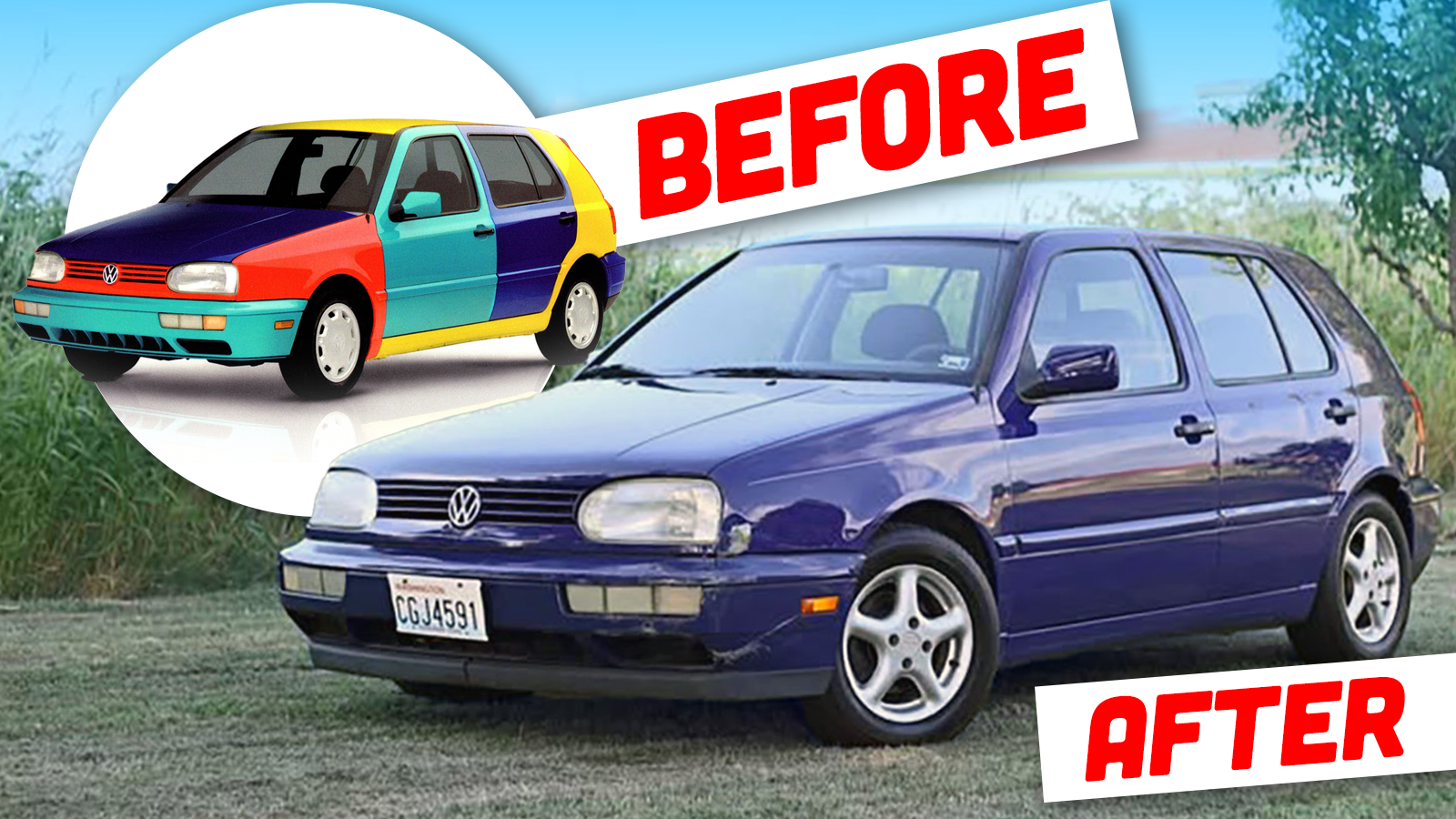
In the mid-1990s, Volkswagen created multicolor special editions of its two best-selling hatchbacks. The Volkswagen Golf Harlequin and Polo Harlekin were built from blue, yellow, green, and red hatchbacks with their body panels swapped out, resulting in weird and wacky cars with no two panels the same color when bolted next to each other. In Europe, the Polo Harlekin (not Harlequin) was a success, with the original 1,000-car production figure easily overshot as Volkswagen ended up building 3,800 of the things. The Golf Harlequin, solely sold in North America, was a tougher sell: fewer than 300 were made, with some of them only changing hands when the car’s unique feature, the multicolor appearance, was removed. This Golf is one of those.



The original Golf Harlequin was a response to the Polo Harlekin. Volkswagen of America built four cars called the Golf Design, all different as they shared their panels, to truck around from car show to car show, and they got such a good initial response that a production run of 60 units was scheduled to be built at the Puebla assembly plant in Mexico.
As those sold, Volkswagen arranged for another 200 to be built, all with the “2.slow” 2.0-liter, 115-horsepower engine. The perfect number of Golf Harlequins must have been somewhere in between, as the final cars proved to be sales proof.
Chris Bernlohr, sales manager at York Volkswagen, told the Pennsylvania newspaper The Sentinel in August 1996 that it wasn’t “the end of the world” if the Harlequins didn’t sell. “If nothing else, when it’s parked out front, it draws attention. Your best display is what is parked out front”, said Bernlohr. The York dealership also used their Harlequin as a parts delivery car, as it was a mobile advertisement of sorts.
Some dealers, fed up with the clown cars sitting on the lot, simply repainted them and sold them as regular Golfs, which is the most boring yet not quite the cheapest way to do it.

Jim Ellis Volkswagen, of Atlanta, solved the matter in an even cheaper way. The dealership gathered eight unsellable Harlequins and simply rearranged the bolt-on panels again to create unicolor Harlequins. Each bodyshell received the same color panels with which it was initially built, before the Great Swaparound. Jim Ellis had an easier time selling two Ginster Yellow, two Pistachio Green, two Flash/Tornado Red and two Chagall Blue cars (with the color named after the Russian-French artist known for his use of blue), which continued their lives as Harlequins just like all the rest, only almost completely indistinguishable from regular Golfs.
The original asking price for the Harlequin was $13,775, or $150 over a stock Golf, with the automatic transmission a $875 option. It may well be that these swap-swapped cars even came with a stack of cash on the hood just to move them, in case they had sat on the lot long enough.
The Puebla-built Harlequins also didn’t get blue steering wheels and shifters like Polo Harlekins did, so only the Mondrianesque “Joker” upholstery would tell any onlooker that they were looking at a Secret Harlequin. As most Golf Mk3s seem to have been red, those have likely been the most anonymous next to the blue ones.

This reversal has in turn created the rarest possible Harlequin, a car that’s a special edition of a special edition. Out of the eight cars rearranged at Jim Ellis, the surviving blue one has popped up on Facebook Marketplace, and it’s currently for sale in Enumclaw, Washington.

The seller, who has listed the extremely rare Golf for sale for $15,000, says the car is now one of one. He’s the second owner, and he had the car verified at Jim Ellis in 2017 – it definitely is one of the de-Harlequined ones converted there.
Out of the 200-car run, it’s number 123, and its whereabouts were unknown for years before the current owner got his hands on it.
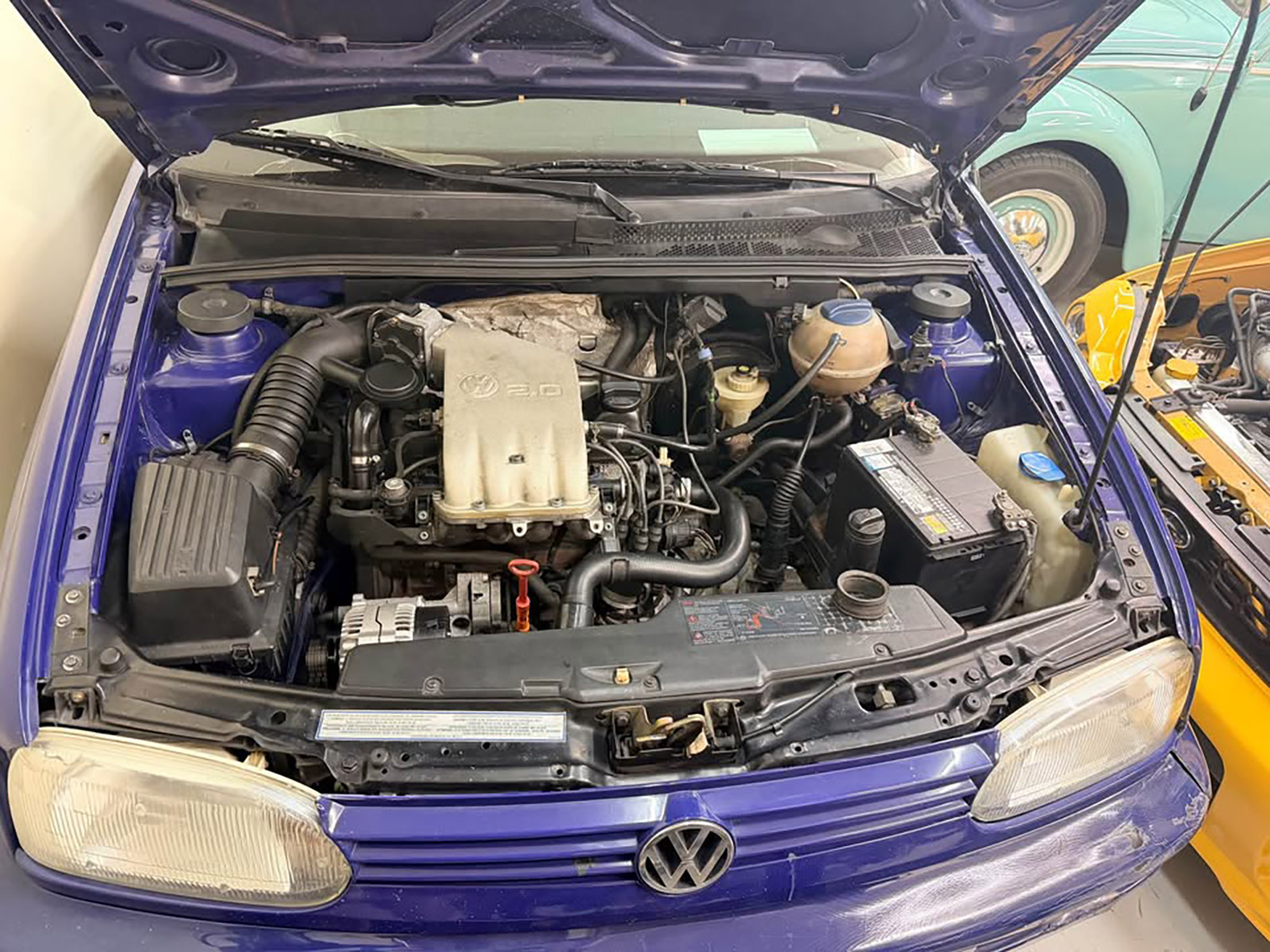
It’s said to be rust-free, especially at the rust-prone shock towers (man, do Mk3 Golfs rust in salty conditions), and it currently sits at 142k miles with supplied history. The 5-speed gearbox has been replaced with a new one at Volkswagen. Polos of the same age seemed to suffer manual gearbox issues, so I wouldn’t be surprised if the Golfs did, too.
Is it worth 15 grand? Sure. You can get a fine Golf for much cheaper, in the same condition, but this is one of those cases where the car’s history and story count for so much more than what you get in metal, rubber, plastic and cloth. Naturally, it takes a real niche Volkswagen person to “get” it, but for a specific buyer it could be just the thing to complete a collection. After all, these days Harlequins are cult cars and definitely cherished.

I’d also say the Mk3 Golfs are on a redemption arc. The first two generations are loved for their blocky design that’s aged incredibly well, the fourth generation brought a new kind of perceived quality to Golfs inside out, leaving the Mk3 as a sort of in-betweener that’s nothing like the older or the newer cars. It didn’t look like the old ones, nor did you get the quality feel the newer gen gave you (though Mk4 Golfs and Jettas have had their share of issues once they become regular used cars), so it often takes a special edition for a Mk3 to really stand out.
A good friend just replaced his latterly troublesome Mercedes E-Class wagon with a bone stock, super simple base model 1994 Mk3 with unpainted black bumpers, in non-metallic red, and he considers it his reset car, back to the basics, wind in the hair thanks to the OEM sunroof, worry-free thanks to having less stuff to break. It’s one of those extremely-1990s cars that once were seemingly everywhere and now seem to stand out when so many have vanished. He didn’t pay 15 grand for his, but ten percent of that: but it also doesn’t make him feel like a clown when driving it, unlike the Mercedes.
Images: Facebook Marketplace




WHOA! This is so awesome…I really love the Harlequins…they are just so unique and make me happy. They are just fun! I think I’ve heard this story before about the panel swapping of the 8 Golfs but I can’t believe that 1 of 1 blue one is for sale!
I would buy it RIGHT NOW if I could and keep it forever. I would even turn it back into a regular Harlequin for fun, and keep the beautiful blue panels so I could turn it back whenever I felt like it just for the hell of it since I love blue. Great article!
The Three Shortest Books in Human History:
de-harlequin? Straight to jail. <insert that meme>
He might be in for a surprise. I had a 1996 Mk3, and it was amazing how a car with basically nothing in it could have so many troubles. There was the ECU (twice, or was it three times?), a pressure hose for the power steering, exhaust manifold (because an apprentice at the VW shop cranked off one of the screws and told now one about it), brakes of course and stuff I forgot. The sole extravagance were heated washer jets (yes, those count as extravagant on a car with window cranks) and they always worked reliably for about two weeks after they had been fixed again. Great seats, though.
I guess the question is: of the original (less than) 260 buyers, how many remain and are still in love with it? I mean, it would basically be a conversation starter.
I drove a mk3 jetta (tdi) which was fun to drive for 12 years as my daily in MN. It always needed something fixed, which I did myself.
VWs can be a good for someone mechanically inclined to learn how to spin wrenches, if you’re not so inclined, dont buy one
2025Sept I saw a clean looking Porsche 968 convertible with 140k miles with a “for sale” sign at Road America $13k asking price
That was tempting, even though I knew even if I had garage space (not at the moment), a bunch of the plastic and likely rubber parts would be of age to be replaced like the shift linkage, shifter, likely the ignition switch, oil cooler gasket, cooling hoses, etc…
Still a beautiful convertible sportscar maybe worth the price.
This vw will have the same maintenance needs and it is priced higher? Crackpipe
Sure, there’s less to break on a Mk3 Golf vs. the average E Class, but both cars are going to require an assortment of parts to be replaced as the plastics get brittle and age. This happens to all cars of course, including Japanese ones, but IME (having owned a Benz, an Audi, and a bunch of air and water-cooled VWs) it seems to happen more often on German cars for some reason (in my very subjective experience) and the penchant for German ‘over-engineering’ means that replacing the broken part will often be a phenomenal PITA. Just ask anyone who’s done the 120+ step procedure to replace the busted window regulator brackets in a VW Golf. The first time I did it (of three times) I hated it so much I just drove around with no window glass on the driver’s door for months.
I’ve seen a Harlekin Golf in person a few times in LA (no idea if it’s one car or more than one) and I like ’em. I was never into the Mk3 VWs that much, but over time, as all cars got more complex and more expensive, I find myself liking them more (I’ve owned Mk1s, Mk4s, etc…). Given a choice, I’d prefer the Polo to the Golf of course, but only because we never got Polos here in the states.
The German cars definitely seem to use a plastic that is less suited to the conditions of the engine bay. I don’t know if it’s an environmental thing having them seek out a chemical composition that just doesn’t work well or what it is, but they do seem to more rapidly embrittle. I don’t know about the earlier ’90s, but in the early ’00s, I remember replacing headlight bulbs (in a car less than a year old—at the time, it was uncommon to see a contemporary VW product with all its lights operational) in new Beetles and have the plastic part of the connector crumble in my hands. Of course, other German brands are notorious for bad plastics as well, some far more critical parts than a headlight connector. Nothing killed the myth of German engineering superiority for me like working on their cars and being able to directly compare them to Japanese and domestic. That typed, when I worked at a German-owned lighting company, I loved dealing with the engineers. Unlike the stereotypes of both engineers and Germans, they were very funny, but it was a dry sense of humor, so I wonder if the myth of German humorlessness is as much down to dummies not getting the jokes as anything based on reality.
My personal/anecdotal experience working on a variety of German cars vs. Japanse ones is very similar to yours Cerberus. Again: all plastics brittle over time, especially if exposed to sun or heat cycles. Which makes me worry about all the underhood plastic parts (even intake manifolds!) on modern cars.
I like the dry/stoic German sense of humor when I encounter it in a YT video or something like that. Though none of them are German, the engineers I’ve known personally have all been pretty funny people IMO too. 🙂
Intake manifolds are a big one that scare me for long term lifespan. This has been borne out on some cars that have had them a long time. It’s great if it’s an engine that had an earlier aluminum intake to change to, but newer engines never had that option. Simpler, smaller parts can be more easily subbed or replacements fabbed up, but an intake manifold is a lot larger and more complicated than even a resourceful DIYer can handle.
I wanna say I’ve seen someone on YT 3D printing some car parts out of metal, but maybe I’m imagining it. I mean I know it’s a thing, but probably out of reach for all but the richest/most self-indulgent of car guys.
I gather Ford’s been using plastic for oil pans and transmission pans too. My fuzzy understanding is that though the oil pan is supposed to be reusable, sometimes it necessary to replace it altogether if you remove it due to damage or a leaking gasket or whatever.
But yes, the use of plastic for intake manifolds (which SO many companies do now… it might actually be more common than metal these days) really disappoints me. When short-run 3D metal printing gets cheap enough, there will probably be a small market for metal replacements.
There are 3D metal printers, but I doubt there are any home units and definitely not large enough to handle a part that big. No idea how much it costs to have that outsourced, but you’d have to have the CAD data, which might not be easy to get. I don’t know how you’d scan the inside for parts like an intake manifold, though I suppose it could probably be extrapolated from the outside data and the available inside sections that can be accessed to measure.
All valid points. 🙂 they have those little laser scanner things to generate geometry but of course, it can only see inside so far. But like you said, it’d probably be possible to extrapolate and keep a semi-consistent wall thickness. Some smart punk might also fill the manifold with water to measure internal volume and use that to inform his/her edumacated guesses when tweaking the geometry so to get close to the real part. Heck, somebody with fluid dynamics/flow software might even be able to improve on the factory part.
I don’t have and am not going to get a 3D printer, but if I were younger/more ambitious to master new hobbies, I’d be into them. There are some guys a pal of mine works with (at Dreamworks) who use them (for hobby projects) and what they do is amazing (to me, a layperson) 🙂
I have one and I have yet to use it. While there’s a learning curve, the tutorials for the sort of odd-shaped things I want to make don’t align with what the software actually puts out (I assume some update screwed things up), and I get annoyed and do something else. With hands-on building things I have the ability to persevere through my lack of patience, but this doesn’t apply to anything involving software.
I truly understand and empathize with your last sentence especially Cerberus. 🙂
I believe starting sometime in the early to mid 90s German law required carmakers to increase their percentage of recyclable plastics. The problems is as anyone who’s owned a late nineties to mid to aughts BMW can tell you is that all those plastics, most fatally used in coolant system components, live much shorter lives than their non-recyclable predecessors and ironically were probably responsible for taking a lot of cars off the road sooner than otherwise would’ve been the case due to overheating problems. No idea if they’ve figured out how to improves this or not, my hunch is if it can reliably make it to 80K-100K they don’t care much beyond that if the law doesn’t force them to.
That’s about what I imagined happened as it doesn’t really make sense otherwise that they would have plastics that are that much worse than competitors from other countries. It seems the whole industry now is chasing tiny mileage improvements for the sake of the environment at the very real cost of longevity that I suspect results in a net deficit in terms of environmental benefit, never mind the cost to the consumer. Even if, say, a new engine is covered by warranty, what’s the environmental cost of running the foundry to make more engines than would otherwise be needed? If we’re talking a relative handful, probably negligible, but if we’re talking a massive recall involving 100ks of units, like so many we’ve seen in the last decade from many companies, that’s a lot of wasted energy and material.
Yeh it feels like lifetime emissions including manufacturing, shipping, etc as part of the overall carbon footprint would be more useful than just tail pipe emissions.
It seems that vehicle life span peaked by the late 00s and while I’m all for lower emissions if cars are getting taken off the road drastically sooner I have to wonder where that pencils in terms of overall emissions.
Same here. Too many things are treated like individual elements when they’re actually part of a system and should be treated as such.
After owning a bunch of older air and water cooled VWs, I bought my first new VW, a 1995 Golf Sport, at that same dealership. It was good to me, got my a few autocross trophies, but I got hit, the car was totalled, and I replaced it with a 2000 GTI 1.8T. VW had lots of fun cars around that time, like Corrados, Cabrios, GTIs. They hadn’t drunk the Kool-Aid, even though we were screaming for them to import the Amarok truck. Now VW is a lot less fun, mostly SUVs, and looking to drop half their models over the coming years. Sad.
A 1998 GTI was the first car I bought with my own money nearly 30 years ago.
Aside from 2 of the 4 cylinders shitting the bed a couple times, constantly getting flats on those little 14″ tires, VW making it next to impossible to replace the fog light bulbs (which crapped out after two years of ownership) without a masters degree and my wipers also shitting the bed whilst driving in a deluge from Raleigh to DC, it was a great car.
That I’d never, ever fucking buy again, regardless of the body panel colors.
I’d say VW had a pretty good sense of humor when they foisted these pieces of crap upon the public.
My son has had much better luck with a Jetta Trek he bought a few years ago that he uses as his daily driver. Thankfully, it’s a short drive.
Anywho….Crack Pipe on the Usedtabea Harlequin.
It’s a car that’s only claim to fame is that it had some body panels swapped out and put back in again later because these were so undesirable. It’s also damaged and has seen many miles. Now, it’s just a regular, blue Golf that once had mismatched panels, but for 15k, just so you can tell an obscure car story for other VW nerds about Golfs that effectively no one wanted?
Is this what Fahrvergnügen does to the brain?
I want to point out that the lead picture is wrong, as the body color is yellow on the before car (see the c pillar and roof). So it should turn into a completely yellow car, not a blue one.
Yep! But there wasn’t a suitable press photo of a blue body car.
I get that the Harlequins are coveted, but … This isn’t a Harlequin anymore. They’re coveted because they have the cool panels in different colors, not because of the sheet metal they’re made of. If the panels all match, then it’s just a regular-ass Golf and its Harlequinness isn’t a thing anymore.
Yeah. It’s like they kidnapped a clown, took off his shoes and red nose. Then made him shower to remove all the makeup. No longer a clown. Just another schlub like the rest of us. Also, less likely to make babies cry.
I Googled the interior and can’t tell what’s correct. But if it’s the Mondrian look alluded to in the article it’s worth something.
The wheels do look good on it, though.
But it certainly isn’t worth 15 grand.
If they could somehow prove that the panels currently on this one were the literal panels taken off it before the swaps to make the Harlequins, I’d be kind of intrigued. But if it’s just all-same-color from some Harlequins, that’s a whole lot less fun.
I wanted one of those back in the day. When I was 16, I managed to convince my Mom to buy a Mulberry MK3 GTI with the VR6 manual. The dealer tried to sell her the red one in stock but she firmly insisted she would wait the few months for a Mulberry one to arrive from Germany. It was a great car and had many great stories too.
It’s not an interesting car in the first place and the only thing that made it stand out was eliminated. Who is going to care about this story? The owner will have to push it on anyone as nobody is going to ask anything about it unprompted and anyone they tell will think they’re an idiot for spending $15k on a bland old VW that’s not in mint condition. Are even VW fans going to care? Most I imagine anyone might give is a shrug and a, “yeah, that’s cool, I guess,” before they move on to something more interesting. If this guy can get that much, good for him, but it’s going to take finding a very limited edition weirdo to sell at that price.
If you really believe that painting a special edition car so it looks the same as a standard car makes it even more valuable then you might be interested in buying my Hertz Shelby GT. I painted it avocado green and replaced the engine with a standard 6, so it should be even more valuable now. /s
This isn’t a repaint. Jim Ellis took 8 Harlequin Golfs and re-arranged the body panels to make 2 of each standard color.
I get it. It’s still a standard-color Golf, and I don’t see many people as believing it’s any more valuable than any other Golf.
If the seller repainted each panel to make it a Harlequin again, and the VIN indicates that it was a Harlequin, then maybe someone would pay something near his asking price.
This is about as special as the 2007 Yaris I drove that was perhaps the only one in the country without a rear windshield wiper.
I had a ’92 Volvo 740 Turbo wagon with no rear wiper!
(By the time I got it, anyway.)
It was even Tropic Green with a contrasting Wine Red hood.
(My ’07 Yaris still has its rear wiper. Unless you meant yours was a really-base version I haven’t encountered, or of course a sedan.)
That’s what I meant…it came without it. It might have been a 1-of-1. A must for any enthusiast’s collection
Even though I knew plenty of trivia about harlequin Golves, I still learned something from this post (and about my own car’s relatives, even) thanks to you. I’d been looking at US promotional material and hadn’t seen the rear wiper even mentioned, but pulling up the ’07-model-year Canadian Yaris brochure… sure enough, no standard rear wiper/washer on 3-door CE. (I realize now you didn’t mention which country.)
It was in the states. Also came without a stereo. Or, as it said on the sticker, was “radio ready.”
Like the real estate listing where the “how many” garage box is completed with “room for.”
The saddest part is that in todays market, that blue would be considered too “out there”. Grey, black or white only please.