

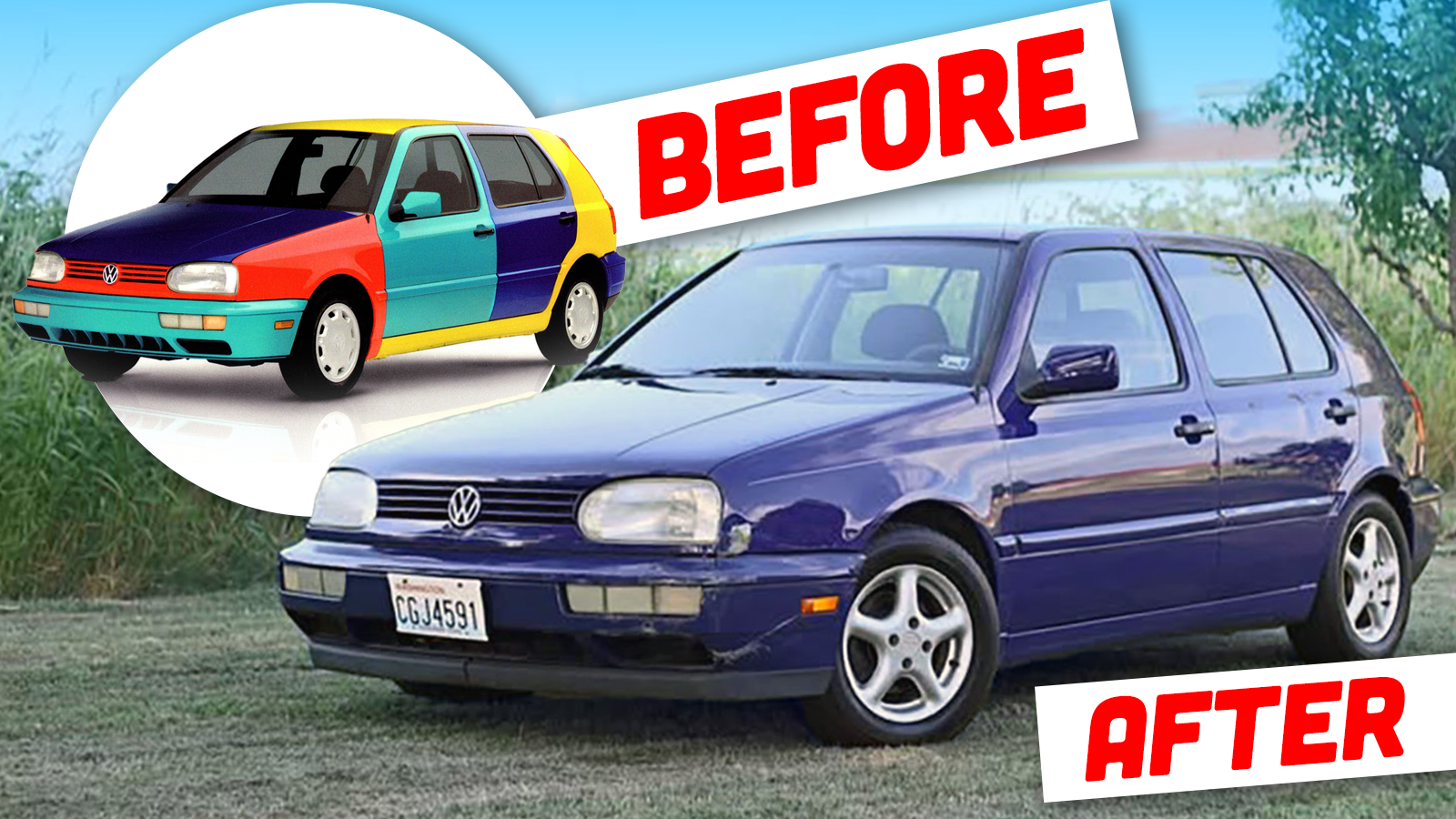
National stereotypes are usually tired tropes, but one that keeps coming back is German humor – or the lack thereof. Imagine, then, a car buyer who considers German humor too rich for their blood and will only accept a car with the joke scrubbed off.
In the mid-1990s, Volkswagen created multicolor special editions of its two best-selling hatchbacks. The Volkswagen Golf Harlequin and Polo Harlekin were built from blue, yellow, green, and red hatchbacks with their body panels swapped out, resulting in weird and wacky cars with no two panels the same color when bolted next to each other. In Europe, the Polo Harlekin (not Harlequin) was a success, with the original 1,000-car production figure easily overshot as Volkswagen ended up building 3,800 of the things. The Golf Harlequin, solely sold in North America, was a tougher sell: fewer than 300 were made, with some of them only changing hands when the car’s unique feature, the multicolor appearance, was removed. This Golf is one of those.



The original Golf Harlequin was a response to the Polo Harlekin. Volkswagen of America built four cars called the Golf Design, all different as they shared their panels, to truck around from car show to car show, and they got such a good initial response that a production run of 60 units was scheduled to be built at the Puebla assembly plant in Mexico.
As those sold, Volkswagen arranged for another 200 to be built, all with the “2.slow” 2.0-liter, 115-horsepower engine. The perfect number of Golf Harlequins must have been somewhere in between, as the final cars proved to be sales proof.
Chris Bernlohr, sales manager at York Volkswagen, told the Pennsylvania newspaper The Sentinel in August 1996 that it wasn’t “the end of the world” if the Harlequins didn’t sell. “If nothing else, when it’s parked out front, it draws attention. Your best display is what is parked out front”, said Bernlohr. The York dealership also used their Harlequin as a parts delivery car, as it was a mobile advertisement of sorts.
Some dealers, fed up with the clown cars sitting on the lot, simply repainted them and sold them as regular Golfs, which is the most boring yet not quite the cheapest way to do it.

Jim Ellis Volkswagen, of Atlanta, solved the matter in an even cheaper way. The dealership gathered eight unsellable Harlequins and simply rearranged the bolt-on panels again to create unicolor Harlequins. Each bodyshell received the same color panels with which it was initially built, before the Great Swaparound. Jim Ellis had an easier time selling two Ginster Yellow, two Pistachio Green, two Flash/Tornado Red and two Chagall Blue cars (with the color named after the Russian-French artist known for his use of blue), which continued their lives as Harlequins just like all the rest, only almost completely indistinguishable from regular Golfs.
The original asking price for the Harlequin was $13,775, or $150 over a stock Golf, with the automatic transmission a $875 option. It may well be that these swap-swapped cars even came with a stack of cash on the hood just to move them, in case they had sat on the lot long enough.
The Puebla-built Harlequins also didn’t get blue steering wheels and shifters like Polo Harlekins did, so only the Mondrianesque “Joker” upholstery would tell any onlooker that they were looking at a Secret Harlequin. As most Golf Mk3s seem to have been red, those have likely been the most anonymous next to the blue ones.

This reversal has in turn created the rarest possible Harlequin, a car that’s a special edition of a special edition. Out of the eight cars rearranged at Jim Ellis, the surviving blue one has popped up on Facebook Marketplace, and it’s currently for sale in Enumclaw, Washington.

The seller, who has listed the extremely rare Golf for sale for $15,000, says the car is now one of one. He’s the second owner, and he had the car verified at Jim Ellis in 2017 – it definitely is one of the de-Harlequined ones converted there.
Out of the 200-car run, it’s number 123, and its whereabouts were unknown for years before the current owner got his hands on it.
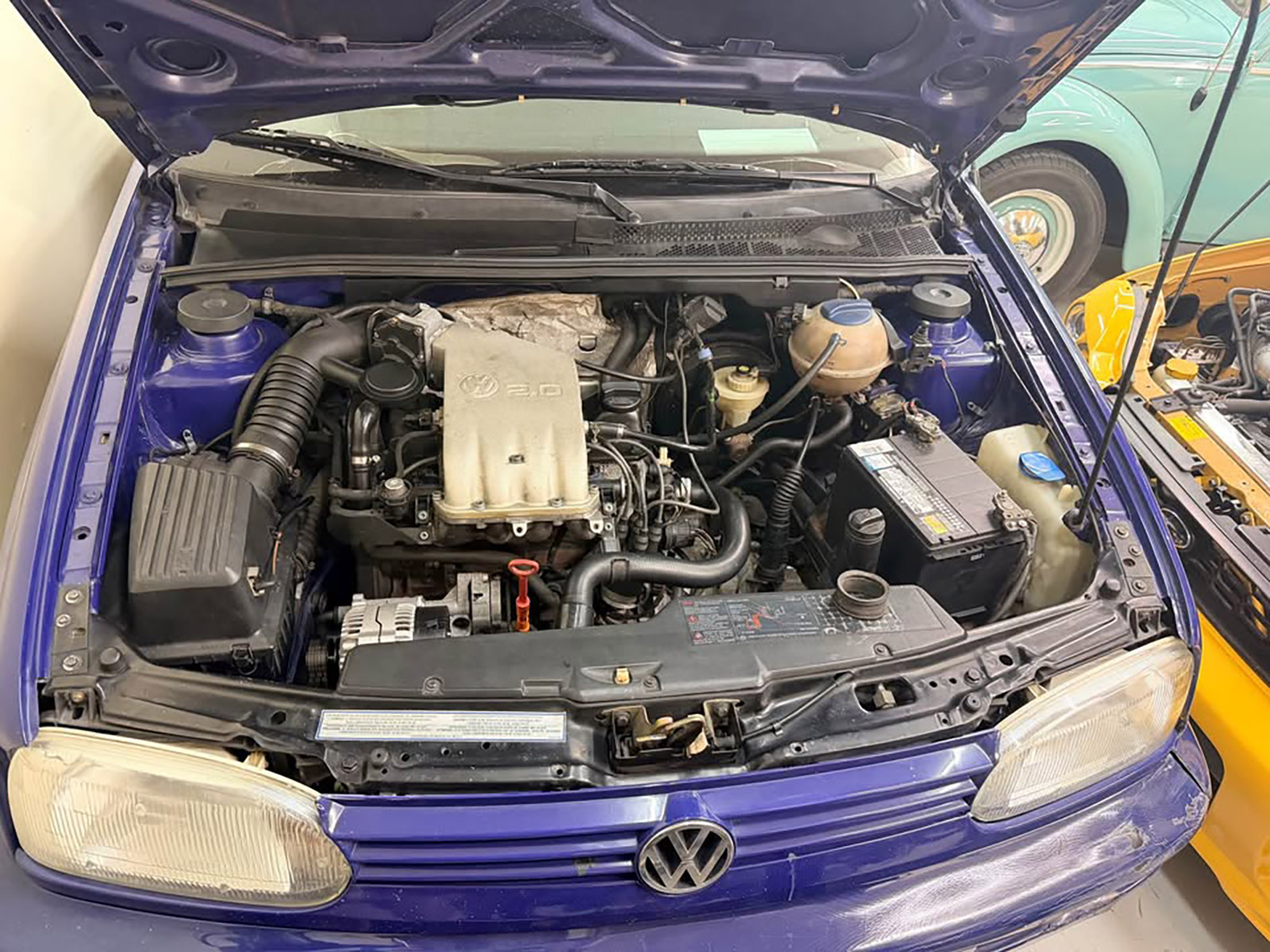
It’s said to be rust-free, especially at the rust-prone shock towers (man, do Mk3 Golfs rust in salty conditions), and it currently sits at 142k miles with supplied history. The 5-speed gearbox has been replaced with a new one at Volkswagen. Polos of the same age seemed to suffer manual gearbox issues, so I wouldn’t be surprised if the Golfs did, too.
Is it worth 15 grand? Sure. You can get a fine Golf for much cheaper, in the same condition, but this is one of those cases where the car’s history and story count for so much more than what you get in metal, rubber, plastic and cloth. Naturally, it takes a real niche Volkswagen person to “get” it, but for a specific buyer it could be just the thing to complete a collection. After all, these days Harlequins are cult cars and definitely cherished.

I’d also say the Mk3 Golfs are on a redemption arc. The first two generations are loved for their blocky design that’s aged incredibly well, the fourth generation brought a new kind of perceived quality to Golfs inside out, leaving the Mk3 as a sort of in-betweener that’s nothing like the older or the newer cars. It didn’t look like the old ones, nor did you get the quality feel the newer gen gave you (though Mk4 Golfs and Jettas have had their share of issues once they become regular used cars), so it often takes a special edition for a Mk3 to really stand out.
A good friend just replaced his latterly troublesome Mercedes E-Class wagon with a bone stock, super simple base model 1994 Mk3 with unpainted black bumpers, in non-metallic red, and he considers it his reset car, back to the basics, wind in the hair thanks to the OEM sunroof, worry-free thanks to having less stuff to break. It’s one of those extremely-1990s cars that once were seemingly everywhere and now seem to stand out when so many have vanished. He didn’t pay 15 grand for his, but ten percent of that: but it also doesn’t make him feel like a clown when driving it, unlike the Mercedes.
Images: Facebook Marketplace




Now I wish I had suggested to Mercedes when the drama with the iQ was going on for Sheryl get a Golf TDI and harlquinize it just to troll the haters.
says the car is now one of one
He must be selling this to buy a corvette.
I will never understand people who modify cars with one interesting defining feature by undoing that feature.
“this car was once really unique and now you can’t even tell!!!!!!”
To be fair, it seems to be a dealer’s handiwork.
For $15K, it has to be in mint condition, still have the original Harlequin combo, have way less than 142,000 miles.
As it sits, this is a $5000 car to me.
Crack pipe at $15K.
There was a VW dealer on Long Island that used one of these as their delivery car. It had vanity plates “PARTSCAR” or something like that.
Wait, in looking at the photo of the car I don’t see how eight cars give you eight solid color cars. Anyone good with puzzles? Figure this out? I mean, what if two of the cars that you have have yellow front left fenders?
The color distribution wasn’t random, it followed a specific pattern. In fact, that’s how the cars were built—VW Puebla would build a red car, a yellow car, a blue car, and a green car, then swap the panels around according to the pattern to make four Harlequins.
Color A (the one that matched the car’s VIN): the unibody (roof, C-pillars, rockers)
Color B: Rear bumper, rear doors, hood
Color C: Front doors, front bumper, hatch
Color D: Front fenders and fascia
Thank you
That’s what I love about this site is when someone like you knows the answer and answers in a chill well thought out manner.
I still don’t understand why they had to fully build the cars just to “unbuild” them at the end of the line.
I think it was the simplest way to get a quality paint job.
There’s a special place in hell for people that go around taking joy from the world. BOOOOO!
Whoever buys this car is almost certainly going to lock innocent bystanders into a conversation resembling this article at absolutely every opportunity.
There is a car show down the street from me right now. I drove by it on my way home.
It’s all muscle cars. Owners sitting in lawn chairs. That’s why I’m here.
So the Polo Harlekin was a sales success in Europe, with Germany being the largest market, but the Golf Harlekin wasn’t in the US? Seems this indicates that Germans have more humor than Americans, at least in this very specific instance, or at least take themselves less seriously.
From what I read about the German inspection process, I assume most of the cars on their roads are well maintained and properly repaired when damaged.
In the USA, these just looked like a car someone in the South dragged out of a junkyard.
True, even simple modifications in Germany need official approval, so you can probably even change “most” to “all”. Doesn’t look just like another junker there.
That backstory is worth about 50 bucks
$15,000 and the front corner has tangled with something. Fentanyl laced crack pipe.
Isn’t this just a car without original paint and other stuff
Sounds like it is original paint, since the dealer just swapped the painted panels from multiple cars to assemble these into single-color Golfs.
The only way to get that green in the US was the Harlequin.
Also, that is a crackhead price.
Back in the late 90s I knew a girl with a Harlequin Golf. Somewhere around 2001 I saw a Golf painted that particular shade of green and, sure enough, it was her behind the wheel. I guess she got the car repainted, and honestly I think she chose the best of the color options because it looked pretty darn good on the car.
I imagine having everyone staring at you and asking questions every time you went for a drive would get old pretty quickly.
Undoubtedly. Then again, this was Houston, which at the time was known for the sheer number of cars built from other cars, so questions were probably not “Why is your car so many colors?” and were probably “How did you wreck so many body panels?”
Not worth the money, but the Mk3 styling aged very very well.
Styling aged better than the body panels in any road salt part of the US.
Hooptie Edition
This price is *extremely* ambitious.
like fixing a Picasso so the perspective is correct
“We had part of a Slinky once. We straightened it.”
-Egon Spengler
Let’s review, it’s a funky, special edition car with a generally limited appeal to begin with that was stripped of everything that actually made it kinda funky and special NOT by Volkswagen, just by some random car dealer who couldn’t sell it originally. Sooo…. it’s basically just a regular used car now… a regular, generic, blue, 30 year old VW Golf with 142k on the clock… and he thinks it’s worth $15,000?
Are we still doing the crackpipe thing?
I understand there were some Plymouth Super Birds that dealers converted to regular Road Runners.
Bbbbut the VIN!!!
Never understood the harlequin. Perhaps for someone who craves the vibe of a BHPH beater that has been stitched back together from whatever body panels could be salvaged from the wrecking yard…but who doesn’t want to wait 20 years for it to occur naturally.
Oh I would totally drive that, this was my car when I was about 25
https://share.icloud.com/photos/0faTiFdFQdsQc15vK53BX7tBA
I’m glad it exists and, also, that I don’t have to drive it.
As someone who appreciates contrarian cars (I voted the juke this week), I wrestle so hard with this. The Harlequin edition is contrarian in itself, but this is contrarian from the contrarian for the sake of being a contrarian within the context of an already-contrarian car.
But I don’t lke it. It’s only cool to people who know what the harlequin edition is. And most of those people probably prefer the harlequin. To everyone else it’s just an old hatchback.
That said, the blurple color on these and the mk4 R32s is fantastic.
The first step on the dark road to Nardo Gray.
Otherwise known as “Oops, We Clearcoated The Primer” Gray.
“surely no one would be stupid enough to pay more for that.”
It’s Rustoleum Professional gray. I painted my S13 that color. With a roller.
This is the opposite of automotive joy. “Special edition of a special edition,” no. It is a de-specialed edition. It is mundanity restored to its power of humdrum ubiquity. Dare not stand out, lest ye be noticed.
I say this having once owned, and unabashedly driven during daylight hours, a minivan with life-sized mermaids painted on it.
I prefer the harlequein paint job it had, but it looks even better on a car more-suited to clowning. Say, a Vokaro kit car on a VW Beetle chassis with an LS1 swap. Or an early 2000s BMW M Coupe.
Or just the M1:
https://encrypted-tbn0.gstatic.com/images?q=tbn:ANd9GcTw9VuggBo19beDd0ABK8Z7w8TFrBVR5Ef-tMNF1KBEoJuU1pXMEH6RDv0&s=10
https://cdn.shopify.com/s/files/1/0905/5702/2506/files/a-bmw-m1-that-will-always-rewind-to-the-80s-1476934612476.jpg?v=1738634012
https://encrypted-tbn0.gstatic.com/images?q=tbn:ANd9GcSEznrY3nhsrIvDt5jNzk5i0MHmtGLs79fr-f6R1CDWMQ&s=10
Glorious.
Looks way better.
…and way less interesting.
Interesting ≠ good.
It does, when that’s the only thing that made a factory car special.
Interesting = good when it’s the only aspect that made the car valuable.