


If you were to find a person at random, throw a filthy, stained Trader Joe’s tote bag over their head, cram them into the trunk of your car, and hold them in a crudely-constructed cell in your downstairs bathroom for a couple of days, and then pull the bag off and ask them to name a type of car engine, I suspect that the odds that they will scream “V8! V8! For the love of everything holy, set me free! V8!” because I believe that the V8 is likely the best-known internal-combustion engine configuration.
And there’s a lot of reasons for that; when a car has a V8 engine, the carmaker tends not to try and hide that fact. Chrome V8 badges are likely on that car, like jewelry, proudly boasting about those eight angled pistons under that hood. V8s are associated with power, with prestige, with status, with speed and virility and everything that goes with that.


That’s why I was surprised to learn that this wasn’t always the case; in fact, it was so much not the case that it dictated the name of Ford’s first Mercury. Would you like me to explain a bit? Too bad, I’m going to anyway.

Mercury was a brand that was really demanded by Ford dealers to fill the massive hole that existed between the Ford and Lincoln brands; Ford was best known for the incredibly affordable Model T, and Lincoln was known for making extremely high-end, no-expense-spared luxury cars. You could have built a town in the gap between the two brands, and with the mid-range car market expanding in the 1920s and 1930s, Ford dealers desperately wanted to fill that chasm.
Lincoln’s closest attempt at filling the mid-range was the Lincoln-Zephyr, but it was decidedly not middling enough.
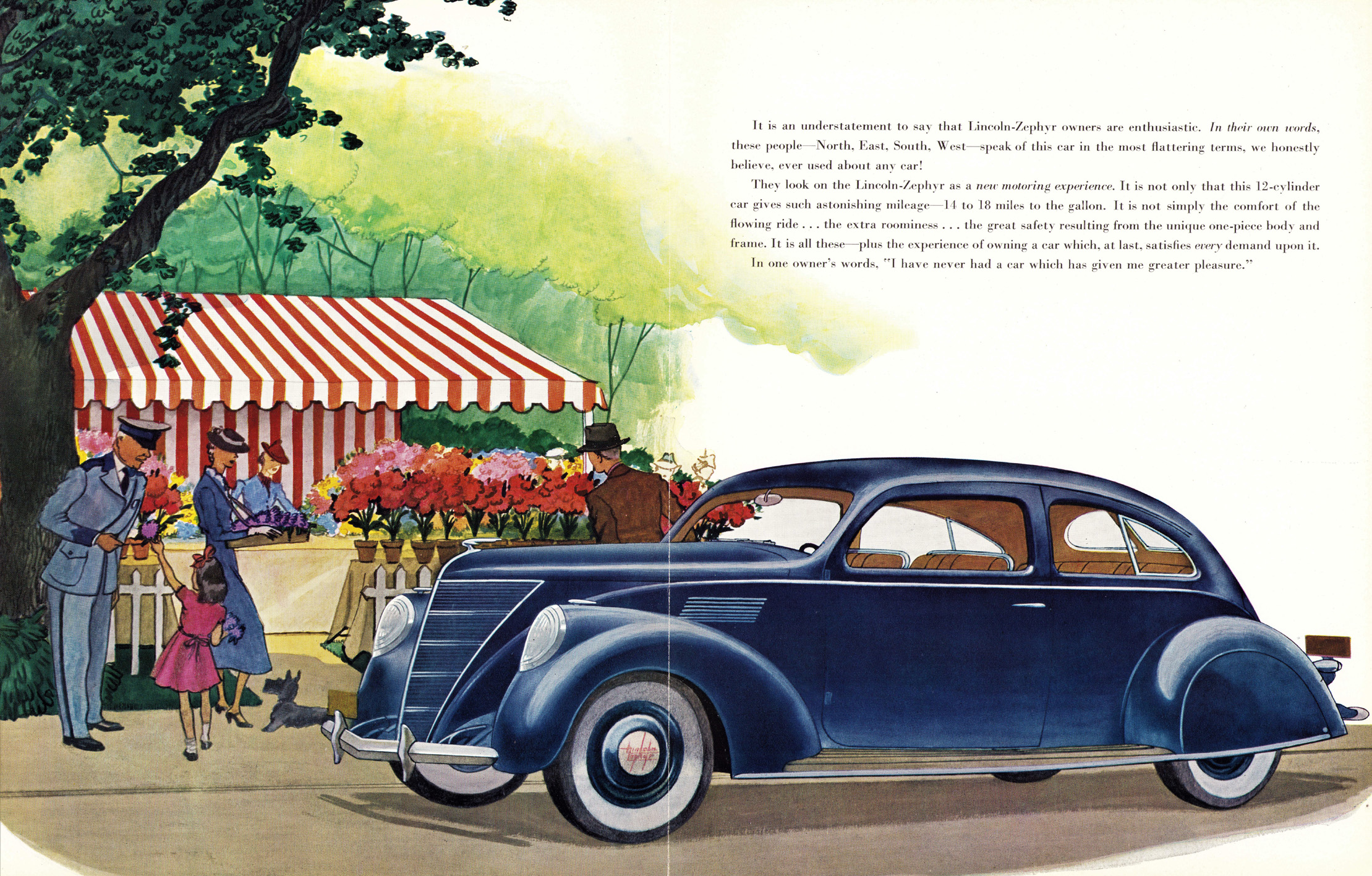
It had a V12 engine, for Ford’s sake! If this was as downmarket as Lincoln could sink, then Ford truly needed another submarine to get to the required depths.
What Ford eventually came up with was a car that took styling inspiration from the Zephyr, and had a body that was a bit wider and roomier than the larger Fords, but most of its mechanicals came from the Fords below it, including the legendary flathead Ford V8, which will be significant to the naming question I’d like to discuss today.
The late-’30s stigma associated with the Ford V8 was a byproduct of its incredible success; Ford managed to truly democratize the V8 engine, making it, for the first time, accessible to the vast majority of car buyers. This was absolutely fantastic for the car-buying public, and made what was often considered a classless vehicle, but the perverse human need to assign and show status never relents, and it didn’t take long before the affordability of all those cars with V8 badges meant that the pair of that letter and number soon became associated with something cheap at worst, common at best.
Not the best way to launch a new, more upmarket brand.
So, when it came time to name the new car, after Mercury – referring to the Roman messenger god with the hat that looked like it could fly, not the stuff in thermometers you’re not supposed to drink – as much as Ford wanted to let people know that it had a powerful (95 horsepower! That’s 10 more than the Ford versions!) octet of cylinders under the hood, it didn’t want to call that engine a V8. Hence, the name Mercury 8.
Look at the lengths early Mercury brochures went to to avoid saying V8 (text embiggened here):

It’s a “V-type 8-cylinder engine” as the copy says here, and notes that it has the “proved advantages of the Ford V-8 engines,” but doesn’t come out and say it’s one of those.

Here’s another “V-type, 8-cylinder” reference. Anything to not just say “V8.”
In Automobile Quarterly, Vol 35, issue 1, there’s an article about the start of Mercury, and there’s a quote that notes not just this stigma, but the associations that Ford wanted Mercury to have by simply naming the car the Mercury 8:

That Ford’s new car was promoted as the Mercury 8 rather than Mercury V-8 also has significance.
Although the latter engine type was then used by Cadillac and LaSalle and within a decade-and-a-half would become the configuration of choice in medium- and low-priced passenger car powerplants, the term had low-priced connotations in 1939 – thanks to the success of Mercury’s sibling, the Ford V-8. On the other hand, the “Eight” or “8” designation carried an aura of prestige as a result of advertising and badging emphasis given it by the leading contemporary builders of straight-eights: Buick, Oldsmobile, Packard and Pontiac.
See what they did there? The “8” plays off the reputations of earlier straight-8-engined cars, which were exclusively premium, high-end vehicles with long, elegant hoods and prices that would make most consumers weep, openly and unashamedly.
Even though by every metric the V8 was a superior engine, these older straight-8s had something Ford’s V8 still had yet to earn: status.

It’s fascinating to me that there was once a time when the V8 didn’t have the status it enjoys today, and an essentially-extinct engine type’s lofty esteem was borrowed to make the Mercury 8 understood to be something Ford owners would aspire to, not just some alternative sibling.
The early naming of the Mercury 8 also had another interesting wrinkle: Edsel Ford wasn’t really eager to leave his surname off the car, so very early ones had hubcaps that read FORD-MERCURY:

It was soon realized that for a new marque to work, it had to be free of other associated names and stand on its own, so very early in the production run, hubcaps were redesigned to just say MERCURY, and dealers were instructed to swap the old hubcaps off any existing Mercury 8s that came in for service. As a result, these FORD-MERCURY hubcaps are extremely rare and sought after.

Also, I can’t talk about the Mercury 8 without noting its taillights, which were incredibly forward-thinking and, I think, criminally uncelebrated. See them up there? They look like they’re rotated 90°, because they have a large red lens on the side of the taillight housing, making these what I believe to be some very early examples of (intentional) side marker lamps! Incredible!
I’m sure these twin-lensed taillights improved rear noticeability significantly, especially in that era of tiny taillights!
Top graphic image: Ford


“V8 still means cheap”
-V10omous
It still, does, really. V8 is just a budget version of an I8, which is a polite way of telling the world you can’t afford a V12.
I love you in a totally not-creepy para-socially appropriate way Toch. Your writing always brings a smile to my face.
If you think a 95 HP V8 is cheap, wait until you drive it! Also, a modern turbo 3 cylinder would smoke this thing, and can have triple the HP.
you’re a peach
I have another example for you.
During the SZ-platform era, and specifically between 1984 and 1992, there was a Bentley model called the Eight, which was the entry-level model. It became quite popular. Although all of the production Bentley and Rolls-Royce models at the time were powered by the L-series V8, in 6.75-liter flavor, along with GM-derived automatic transmissions (initially a THM400, later a 4L80-E).
That’s an interesting thing to say about the lights on the back of a car.
They were really more of a side-grade than an upgrade anyway.
I’m reminded of that low budget Canadian cruise line, Strand Cruises, who printed menus with “sausage in mustard sauce”, because they couldn’t bring themselves to just say hot dog