

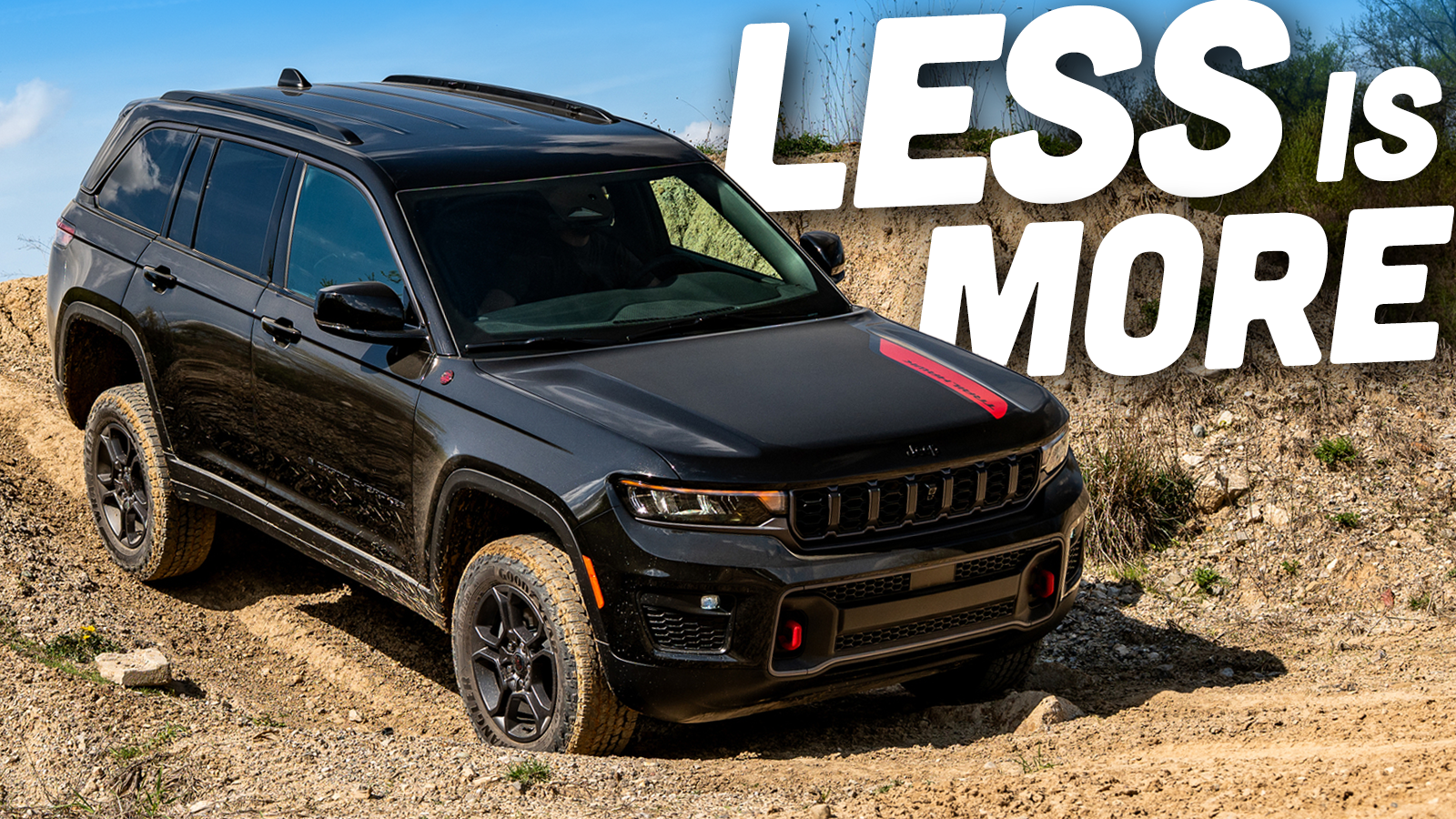
People just can’t seem to get enough of beefed-up crossovers and SUVs. Sure, all-terrain tires won’t ride as nicely or get the same fuel economy as highway tires, but chunky meats and a little extra clearance look cool. Making a return to this sub-segment, the Jeep Grand Cherokee Trailhawk is back, and it comes with some interesting trade-offs over the old one.
If you’re thinking, “Hang on, wasn’t there a Grand Cherokee Trailhawk last year?” you’d be right. Immediately distinguishable thanks to its bright blue towing hooks and chunky sidewalls, the plug-in hybrid 4xe Trailhawk held a lot of promise. Off-road capability and 26 miles of range for running errands around town on silent electric power. Early reviews were pretty good, with road testers lauding the ride quality and level of equipment. There was just one problem, though, and it took some time to emerge.


In September 2024, a recall was issued covering plug-in hybrid Grand Cherokees produced through Nov. 16, 2023. The problem? Bad batteries, and not the benign kind either. The separator material that prevents the electrodes from shorting had been reportedly damaged in some cells, resulting in multiple reports of fires. Thermal runaway isn’t fun. Just over 13 months later, another recall landed, this time covering some 36,840 more Grand Cherokee 4xe models built between July 19, 2023 and March 3, 2025 for the exact same problem. If that wasn’t enough, another recall was issued for engine failure on 36,840 Grand Cherokee 4xes built between July 19, 2023 and Aug. 3, 2025. Around the same time, Jeep announced the discontinuation of its 4xe plug-in hybrids, and thus, the Grand Cherokee Trailhawk. There’s no proof those events are related, but man, talk about timing.
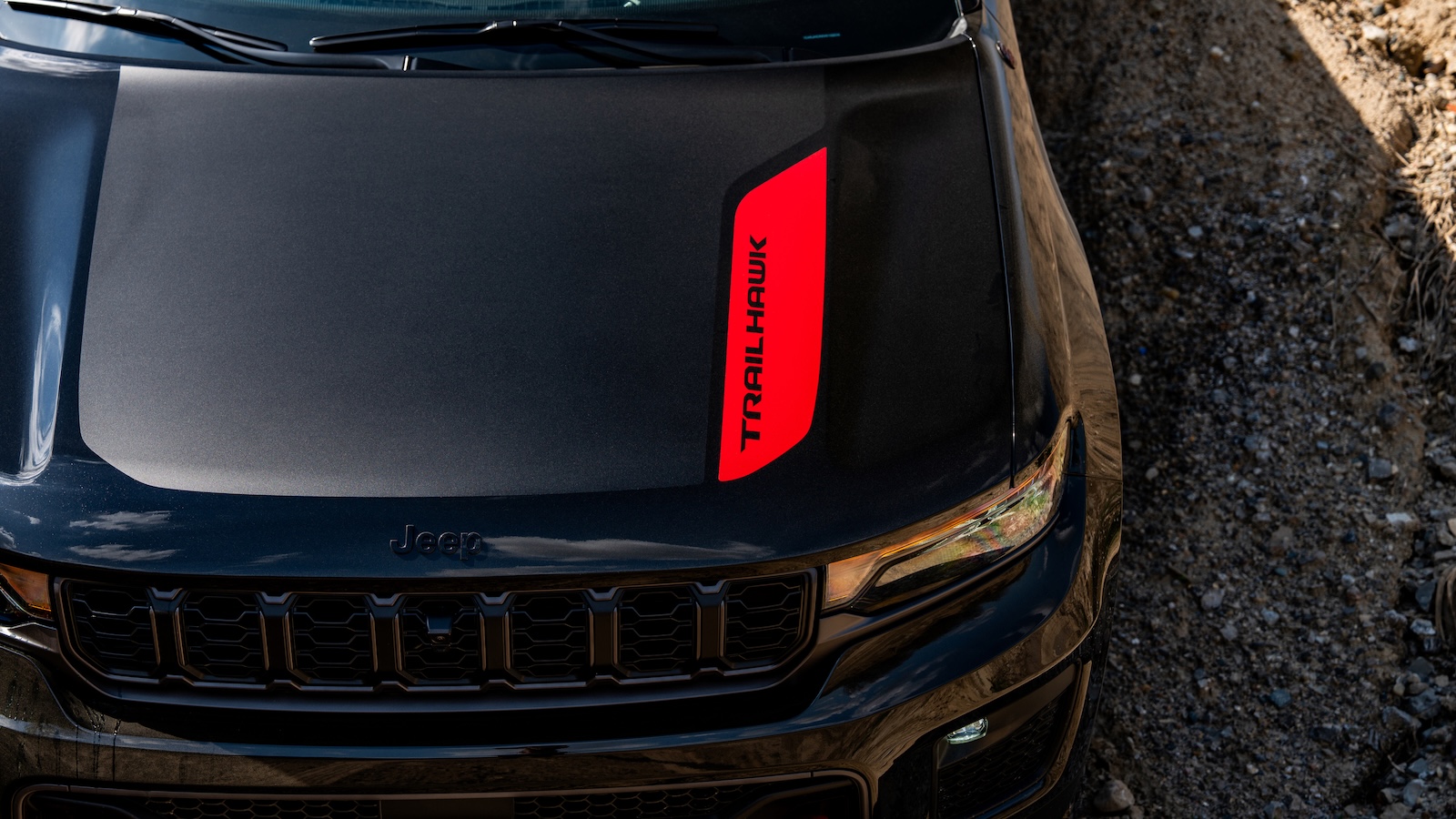
As such, the new Grand Cherokee Trailhawk skips high-voltage electrification and adopts the two-liter turbocharged four-cylinder engine found in other new Grand Cherokees. Pumping out 324 horsepower and 332 lb.-ft. of torque, it enters the game with a huge output deficit over the old electrified Trailhawk. We’re talking a deficit of 51 horsepower and 138 lb.-ft. of torque. Mind you, it does still have a licence-built eight-speed automatic gearbox, so it should still get out of its own way. The real party piece lies downstream anyway.
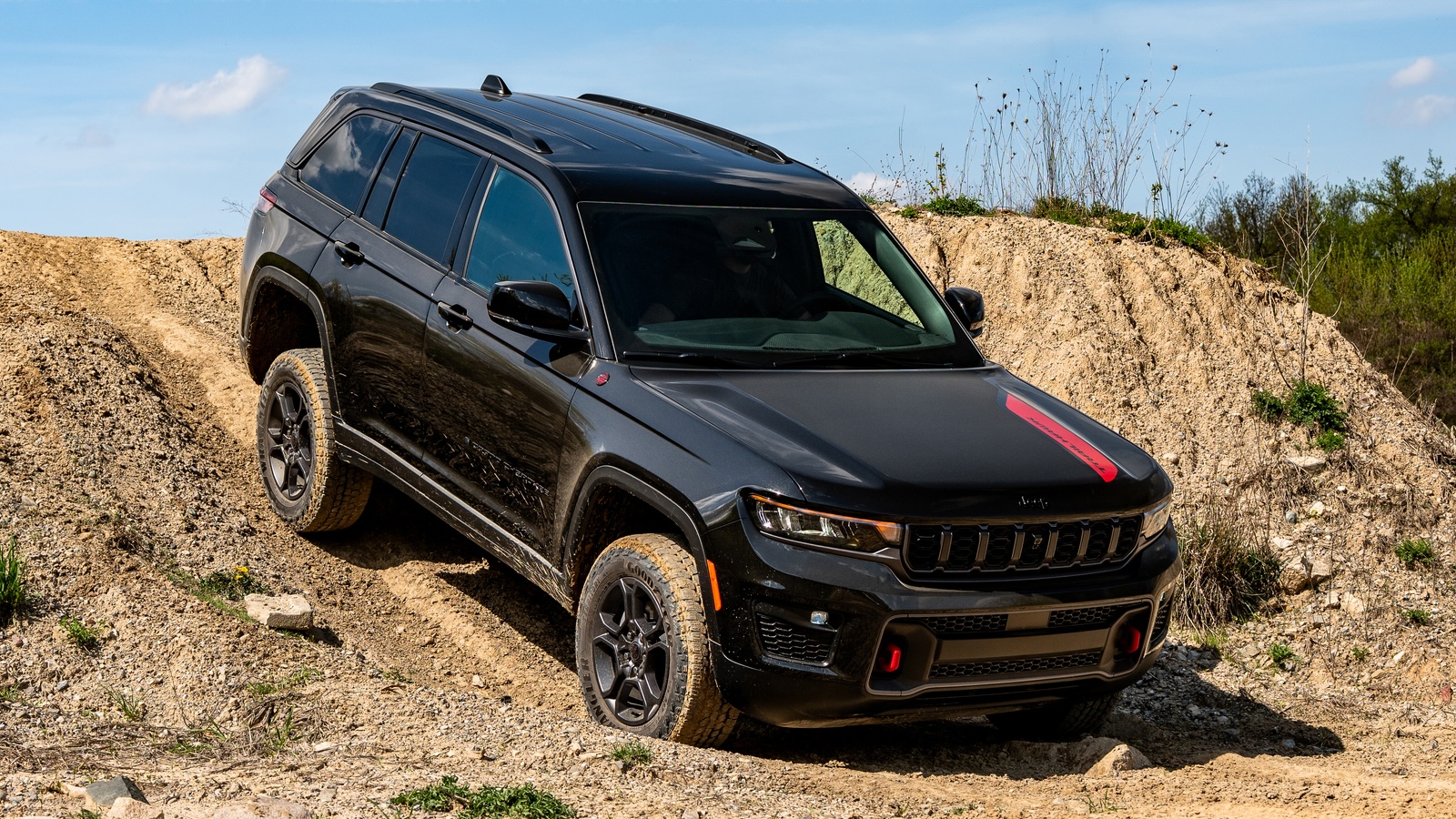
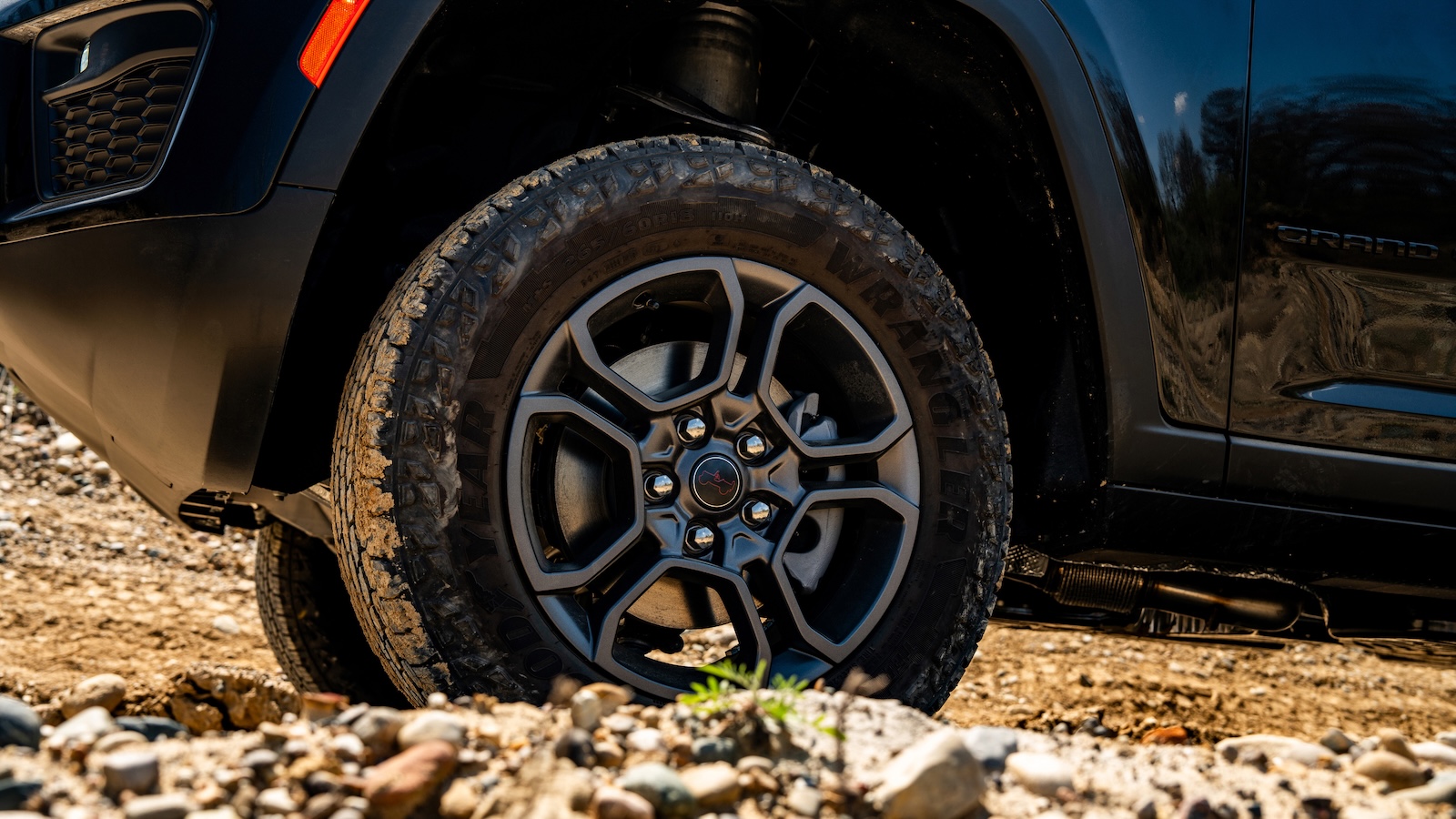
On the subject of off-road hardware, the Grand Cherokee Trailhawk diverges from most of its two-row unibody SUV competition thanks to the addition of a two-speed transfer case with proper low range. It lets drivers select a much shorter output ratio, multiplying torque substantially across all gears for rock crawling, steep hills, and other tricky scenarios where gearing specified to work nicely on the highway might come up short. Of course, a four-wheel-drive system is usually only as good as its differentials, so the rear axle gets a limited-slip unit. Oh, and since limited-slip differentials only effectively distribute torque if a tire can put it down, a set of 30.5-inch Goodyear Wrangler Territory All-Terrains comes standard.
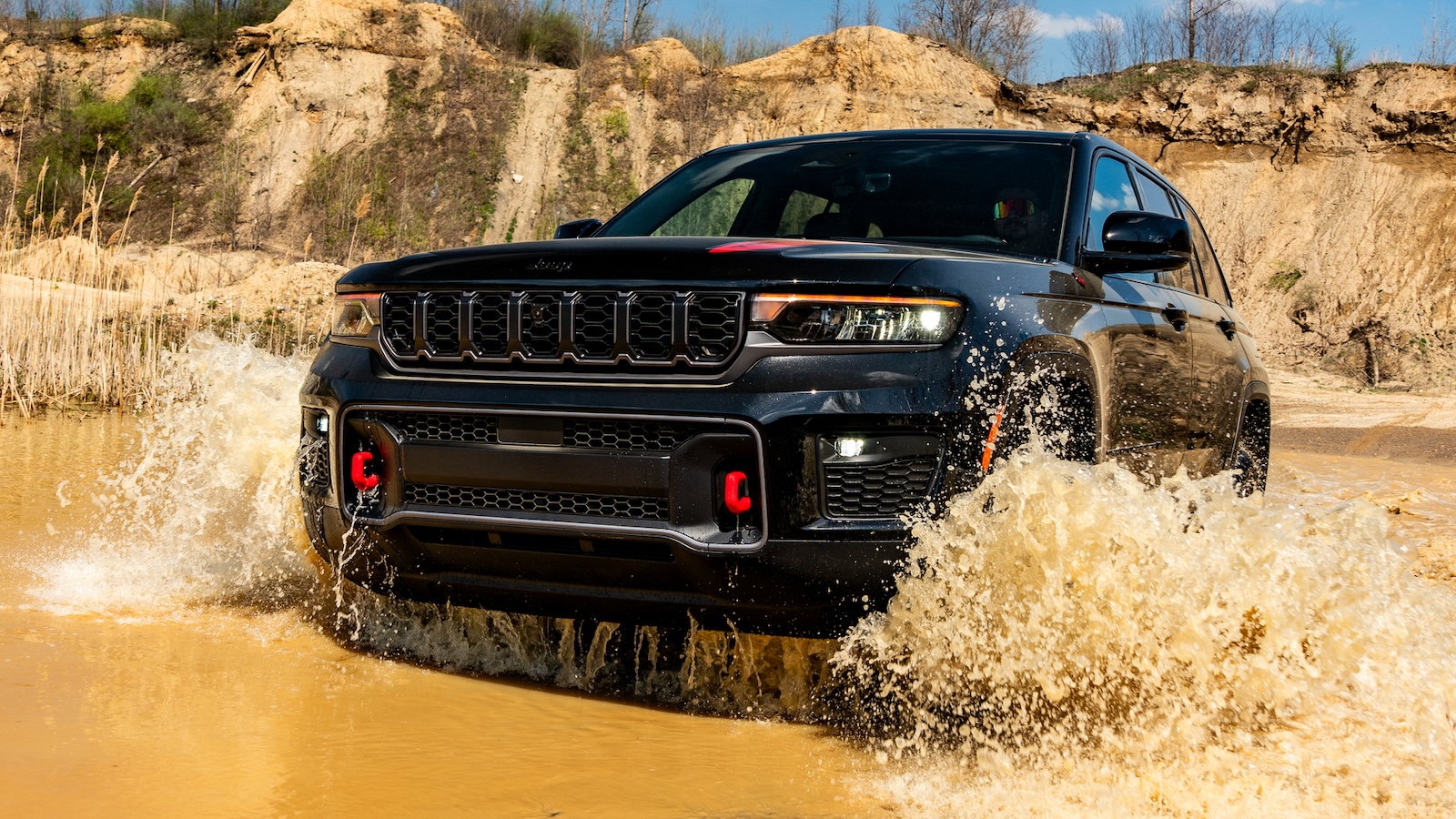
So then, what about angles and clearance? The Grand Cherokee Trailhawk does come standard with air suspension that can jack this SUV all the way up to 11.4 inches of ground clearance. In its highest setting, Jeep says that’s good for 36 degrees of approach angle, 24.4 degrees of breakover angle, and 30.3 degrees of departure angle. That’s a step down in capability from the 38, 28, and 40-degree respective figures of a Land Rover Defender 110 with air suspension, but it still blows many SUVs out of the water. A 4Runner simply can’t touch the Grand Cherokee Trailhawk’s approach angle, and falls slightly short in breakover and departure angles. Once you run out of breakover angle, you’ll probably be fairly thankful for the Trailhawk’s skid plate system. Six in total cover the engine, transmission, transfer case, fuel tank, and several suspension components.
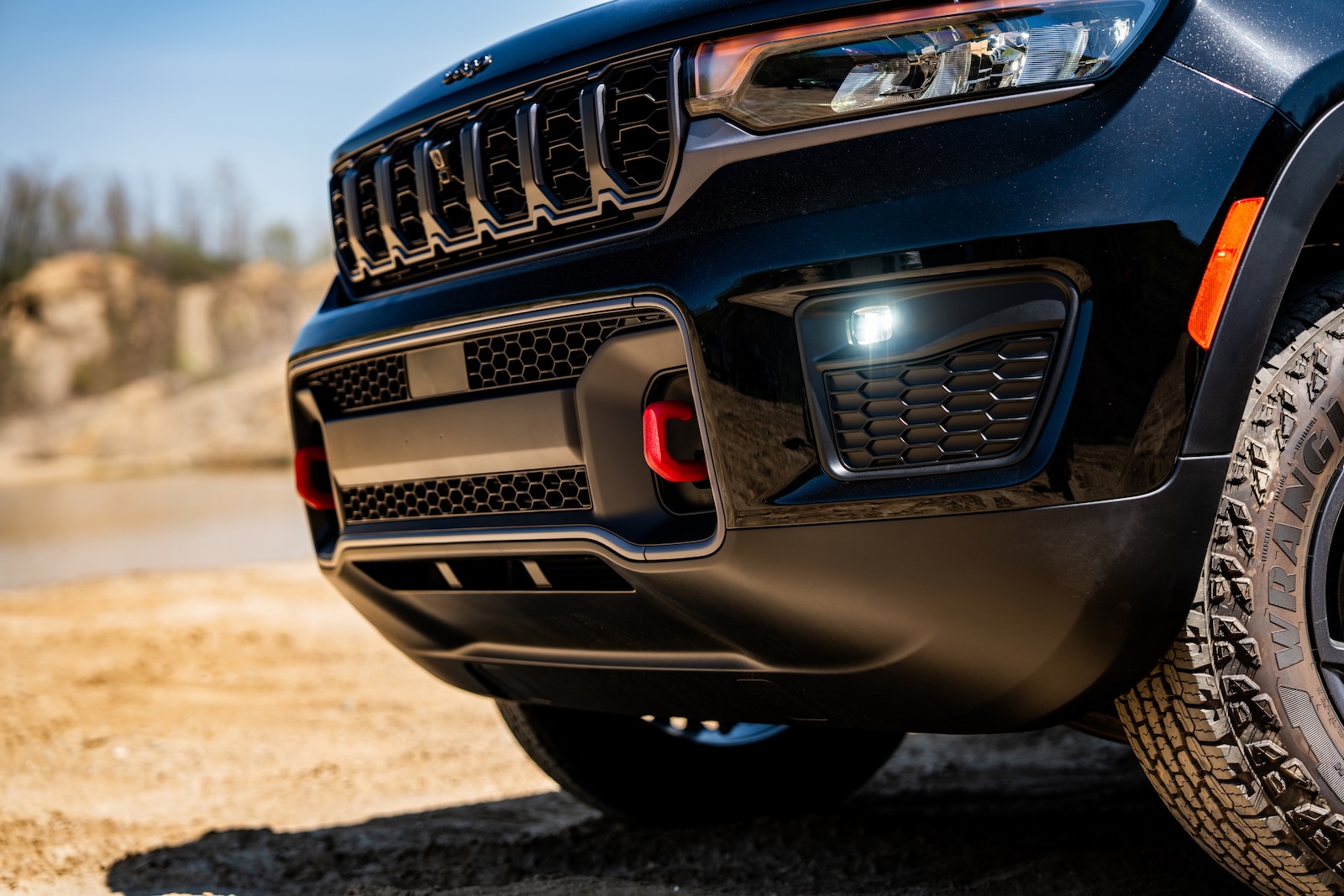
Beyond the high-clearance front bumper and tow hooks, the only other major functional new toy standard on the new Grand Cherokee Trailhawk is an upgraded camera system. The headline piece here is a forward-facing camera with tire trajectory overlays that can act as a second spotter, but the washer system for the backup camera will probably see more use in the real world.
While Jeep hasn’t announced pricing for the new Grand Cherokee Trailhawk, we can take an educated guess based on standard levels of equipment. The presence of Nappa leather upholstery indicates that it’ll likely sit somewhere around the Limited Reserve trim, which retails for $53,910. Could be above, could be below. We’ll know a lot more later this year, when the ruggedized Grand Cherokee goes on sale. Either way, it should be cheaper than the old $67,980 4xe Trailhawk, and that’s a good thing.
Top graphic image: Jeep



Still amazed the GC isn’t sold with the Hurricane-6.
A buddy of mine just got a new GC, and I was actually pleasantly surprised by my short test drive of it. I just can’t imagine paying that much, for a turbo-4 experience. I mean, I have no real complaints about the engine from my drive, but it just didn’t seem fitting of a nearly ~$50k experience. While I also think the Passport is overpriced, it at least comes with a V6.
You can go spend close to 80K on a loaded Landcruiser and get, wait for it, a turbo 4.
I don’t really have any complaints with that as long as it’s not buzzy.
Agree though, the Hurricane would be great in a GC. I love the Hurricane, it’s so buttery smooth you can barely tell it’s running.
i’m with you. I think stellantis probably having supply issues with the hurricane i6 with the ram, wagnoneer, grand wagoneer all getting them. maybe the v8 rams will free up production to move the hurricane i6 into the grand cherokee or maybe they just can’t make it fit who knows.
Why didn’t they use the Hurricane I6 instead? A Stellantis turbo 4 is just asking for trouble.
My 2022 Pentastar Trailhawk was the biggest pile of shit I’ve ever owned even with non of the hybrid issues. It had many problems with the suspension and infotainment system that even the dealer could never fix. That thing put me off Jeeps forever basically.
I’m not any sort of off-roader, but isn’t low-end torque what you want for that activity? Seems to me this makes a turbo 4 an obvious choice (assuming it’s properly designed/built). I know this is apples-to-oranges, but last year I went from a V6 KL Cherokee to a turbo 4 Mazda (both vehicles weigh about the same) and in most driving situations the T4 makes the NA V6 feel like a slug. 310 lb/ft @ 2000 RPM just walks away from 239 lb/ft @ 4400 RPM. Yeah I know the Pentastar will win WOT @ 90 mph but I’m not driving that way on the street and don’t know anyone who does.
The big question is: will they include the leaking oil cooler and cam-destroying roller rockers in the design at no extra charge?
Nailed it. Low end is the best for off-roading, or even just daily drivability. All the Toyota fanbois lost their minds when Toyota ditched their peaky V6’s for turbo 4’s, but everyone that’s actually driven one raves about it.
My least favorite thing about my old 4Runner was the driving experience from that V6.
Fewer horsepower, not less
My bat signal!
Actually, “less” is right – we aren’t counting individual horsepowers the way we’d count individual cars or lightsabers or dinner plates. “Horsepower,” just like “power,” is an uncountable noun. Things have more or less power. 🙂
I love to see someone who lives their screenname.
On paper, it’s everything I should want in order to kick my 4Runner to the curb. Torquey engine, low range, lots of ground clearance, looks great, better road manners. But if I’m buying an offroad SUV, I want to be able to trust it well beyond 5 years and this has an air suspension and a new Stellantis engine. Sell it at 5 years and the depreciation will beat you like a brick bat. Lease it and you’re going to get charged for the clearcoat scratches. Oh well, back to the oxcart.
Twice now I’ve seen recent Land Rovers with their air suspensions jacked up to max because the owners either thought they needed it to get down a road a sedan could manage, or they were so desperate to peacock in their toy that anything not-pavement was considered reason enough.
Seeing appealing “on-paper” Stellantis vehicles has been a trend for me.
PHEV off-roader or minivan? They got (had) it.
Back when I didn’t think I wanted as much capability off-pavement? They had/have a compact crossover and midsize-ish crossover with optional low range. (Cherokee, Durango)
The Recon’s formula is right up my alley!
(I don’t like the overall Jeep look though but that’s not their fault)
But I want my car to work first and not have any unexpected “quirks” for at least several years.
So this “good reason” is that Stellantis is just giving up on hybrid? Its a reason, I’m not sure its good though.
Its a good reason because they have no idea how to build a PHEV properly.
I would have expected a bit more snark in the title. But maybe this isn’t the old lightbulb factory afterall.
“It is now less likely to spontaneously combust, you’re welcome!”
I 4 turbo durability worries me. not that regular FCA quality is stellar
I would want the option of the 3.6 Pentastar.
It’s a good thing because it doesn’t have the troublesome 4XE system tied to it, but it’s still bad because it has Chrysler air-suspension still.
I’m sure it’ll get the cam & lifter eating Hemi at some point, so it can rev to nearly 4,000 rpm to produce its peak torque, which is apparently what off roaders want.
I don’t even vaguely trust this powertrain and don’t really understand why it exists. Is it so they can sell it in more European markets? I’ll just assume that’s it. Anyway, while I’m the furthest thing from one of those BUT MUH DISPLACEMENT guys I’m really not sure why they didn’t just stick with the Pentastar for this trim.
The Hurricane 4 won’t be any more efficient in practice, it sounds worse, and 162 Stellantis horsepower per liter seems like a great recipe for getting stranded mid adventure. Literally no one asked for a 4 cylinder in the Grand Cherokee. I have to imagine that this was a Tavares joint that was too far along to try to put back in the bottle.
And it may be too far along to add the GC to the brilliant, not at all shortsighted HEMI ALL THE THINGS plan as well…since by the time they’ve got that working the administration will be changing and almost certainly not into the “let’s pollute as much as possible to own the libs” agenda. Woof.
In conclusion: just buy a Passport.
Nobody will buy these in Europe. The last Grand Cherokee seen in any sort of meaningful numbers was the WK2 with the VM Motori V6 diesel.
Oh I know, you all buy sensible cars over there. I just think maybe trying to change that while following the stringent regulations is what was behind the downright bizarre choice to give this allegedly off road capable SUV a smaller, more complex engine…
This can tackle a rugged trail. In between dealer trips, that is.
Precisely why you should cross the street and buy the Honda version of this SUV
Crazy how far the Grand Cherokee has fallen, that it’s competing with Honda Passports. Imagine, in the year 2000, telling someone that the Jeep Grand Cherokee and Honda Passport would be similarly priced, direct competitors.
Maybe the crazy part is how well Honda has done improving the Passport…
I’m not sure I understand how the pricetag works, but it seems steep for a Jeep Royale with Cheese.
I think that Stellantis needs to do what Volvo did in the 90s and have a 5 cylinder version of the hurricane engine which slots in-between the 4 cylinder and 6 cylinder versions. Grand Cherokees, Pacificas, base model Ram 1500s, Promasters.. I think that’s where the 5 cylinder version would be a good idea, if it could fit transverse and longitudinal. It could share so much NRE, production tooling, and parts…not to mention 5 cylinders can make a great exhaust note (if done correctly).
100% they should’ve.
The 5-cylinder would’ve been a GREAT base engine in the half ton Ram’s, and a great upsell for the Grand Cherokee/used as the base engine in the Grand Cherokee L.
Volvo’s result didn’t lead to comments of “power of a 4 with fuel consumption of a 6” like GM’s did.
A 5-cyl, done well, would be a nice goldilocks engine.
Looking across to what GM learnt, from their foray, a big 2.7L-Turbo-4 seems to have been received rather well.
Agreed. The GM 2.7 is a much better engine vs what most people expected. I think that the difference between the GM Atlas 4/5/6 is that those engines were physically a little too big to be used across more product (transverse). Stellantis is putting hurricane 4’s in transverse applications. The Atlas engines were also a victim of the time too…in the early 2000s people wanted 6 cylinders or a V8 for all the applications they put the Atlas in, no way GM would have been successful at a turbo 4 or 5 cylinder Atlas engine in a Silverado 1500 back then…but now there are lots of turbo I-4’s, I-6’s, V6’s. Now we all are cool with inline turbo engines in applications we didn’t expect before.
I do think that the GM Atlas engine didn’t get the respect it deserved though, they were mechanically very good. It’s just they were put in platforms with other issues.
I’m sure they’ll be throwing a hemi in there any day now to make up for that lack of power
Even the boring 5.7 liter Hemi in the Grand Cherokee was a blast to drive when you pushed the accelerator down all the way. I would almost always giggle when it downshifted, rocked me back into the seat and the engine roared.