

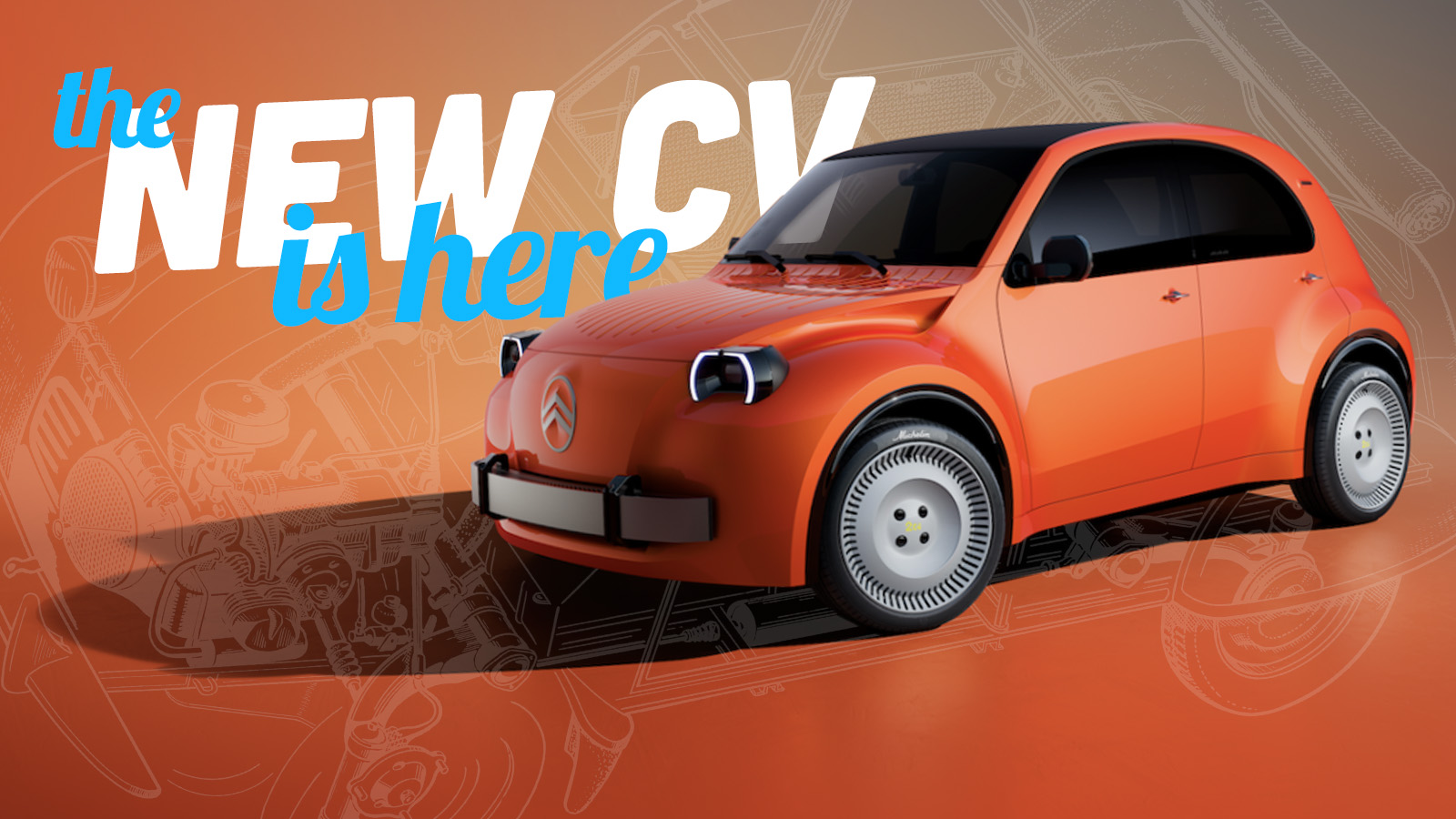
I’ve been very excited about the re-imagined Citroën 2CV ever since Citroën started teasing images of the car, in varying levels of detail, starting from this summer. I’ve been excited to hear that the car is intended to fit the spirit of the original 2CV (you can read that as affordable) and not just be a retro, nostalgia-flavored cash grab. Well, yesterday the full new 2CV concept was revealed at the Paris Motor Show, and I’m happy to say I think Citroën did a damn good job of translating the archaic 2CV into a modern design vocabulary. It’s not perfect, but who among us is?
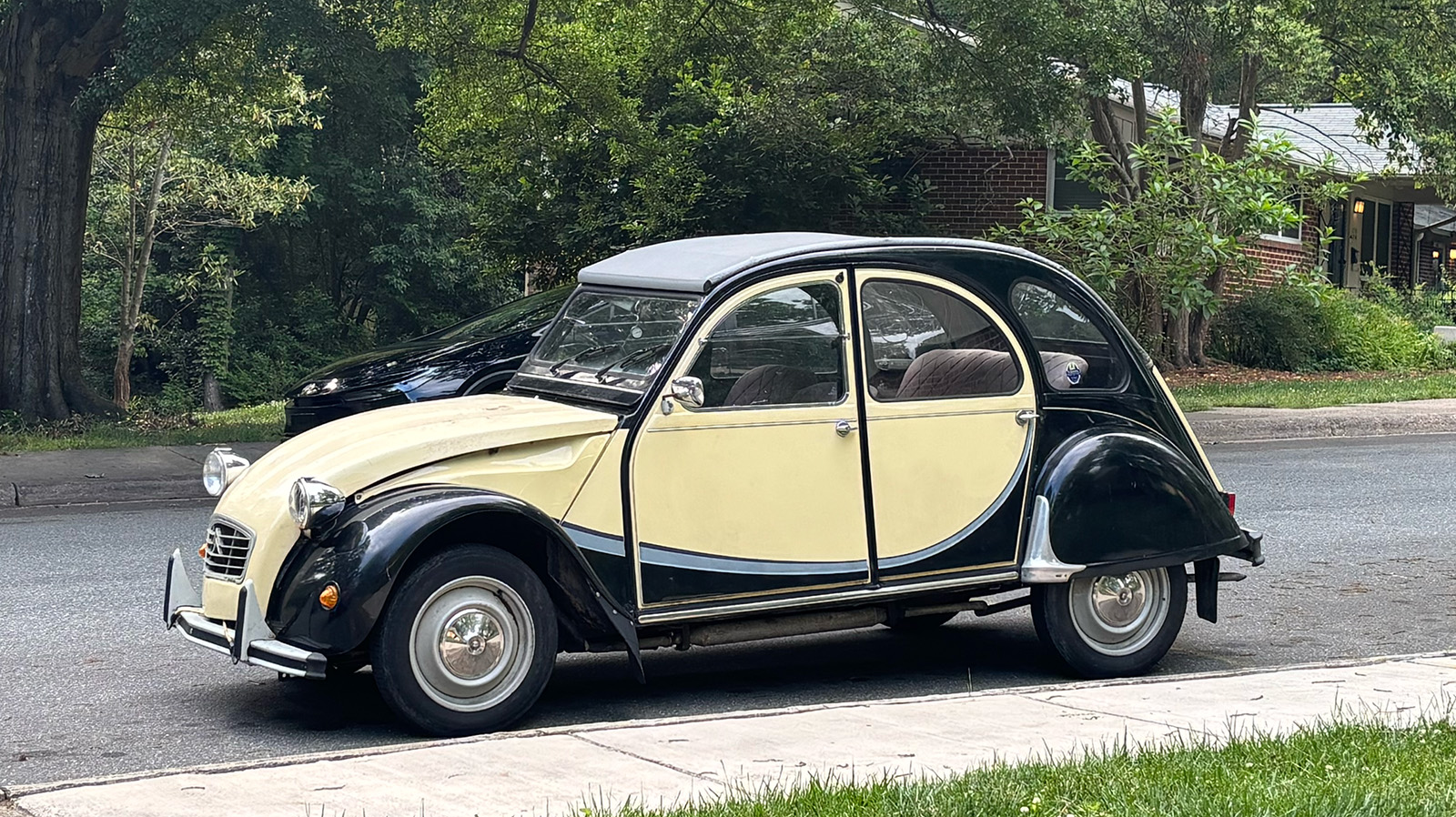
I should probably disclose that I myself am an original, old school, all-of-29-horsepower 2CV owner and driver, so I may be inclined to be a bit more of a stickler about a new 2CV maintaining if not all of the details, then as much of the charm and character of the original 2CV as possible. I actually find myself a bit surprised to find that I think Citroën has managed to do just that.


There’s a quote in Citroën’s press release from Xavier Chardon, CEO of Citroën, that I think gets the idea across pretty well:
“Reinventing the 2 CV isn’t about replicating a car from the past; it’s about reinventing what made it unique: its simplicity, its accessibility and the freedom it offered. With the 2 CV Concept, we’re bringing that spirit into today’s world to make electric mobility simpler, more human and more desirable. The world has changed. But the idea remains the same: to make life more beautiful with Citroën.”
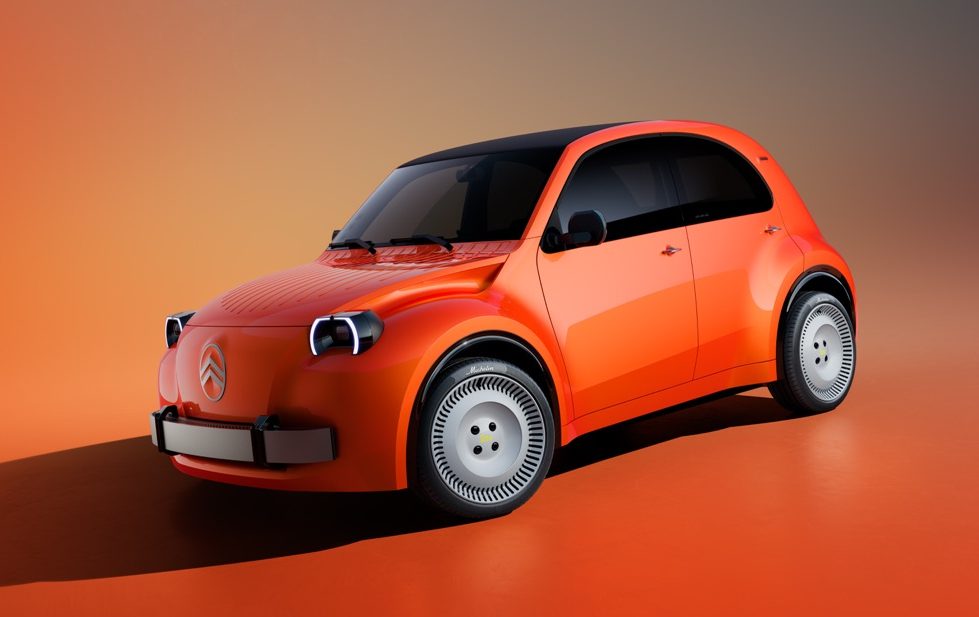
If the focuses of this car were simplicity, accessibility, and freedom, then I think those are all excellent concepts to work with, and I think the design of this reconsidered 2CV manages to express those pretty well. Let’s take a deeper look at this thing.
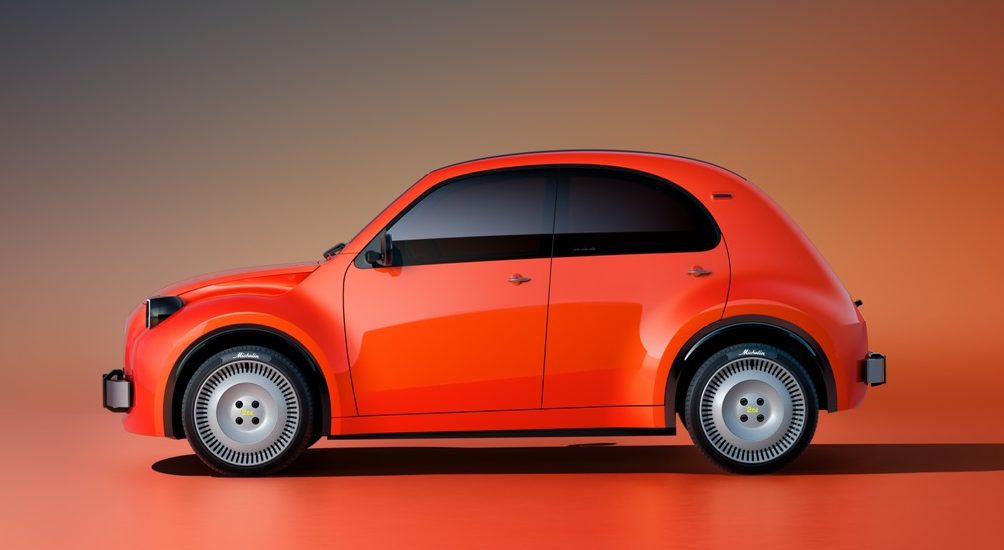
In profile, it’s a bit shorter than the original car, and the proportions are a bit different; they’ve been modernized a bit, the greenhouse a bit less tall, the hood less long, the beltline a bit higher, and the window graphic changed to eliminate the B-pillar. It’s almost like a cartoon version of a 2CV, which is saying something.
The fenders still have the illusion of being separate pieces, even though they’re actually part of other body panel stampings in the concept car. That makes sense from a production standpoint, as cars haven’t had separate fenders like the 2cv has for, well, decades. The one significant misstep design-wise that I can see has to do with the fenders. Specifically, the rear fenders:
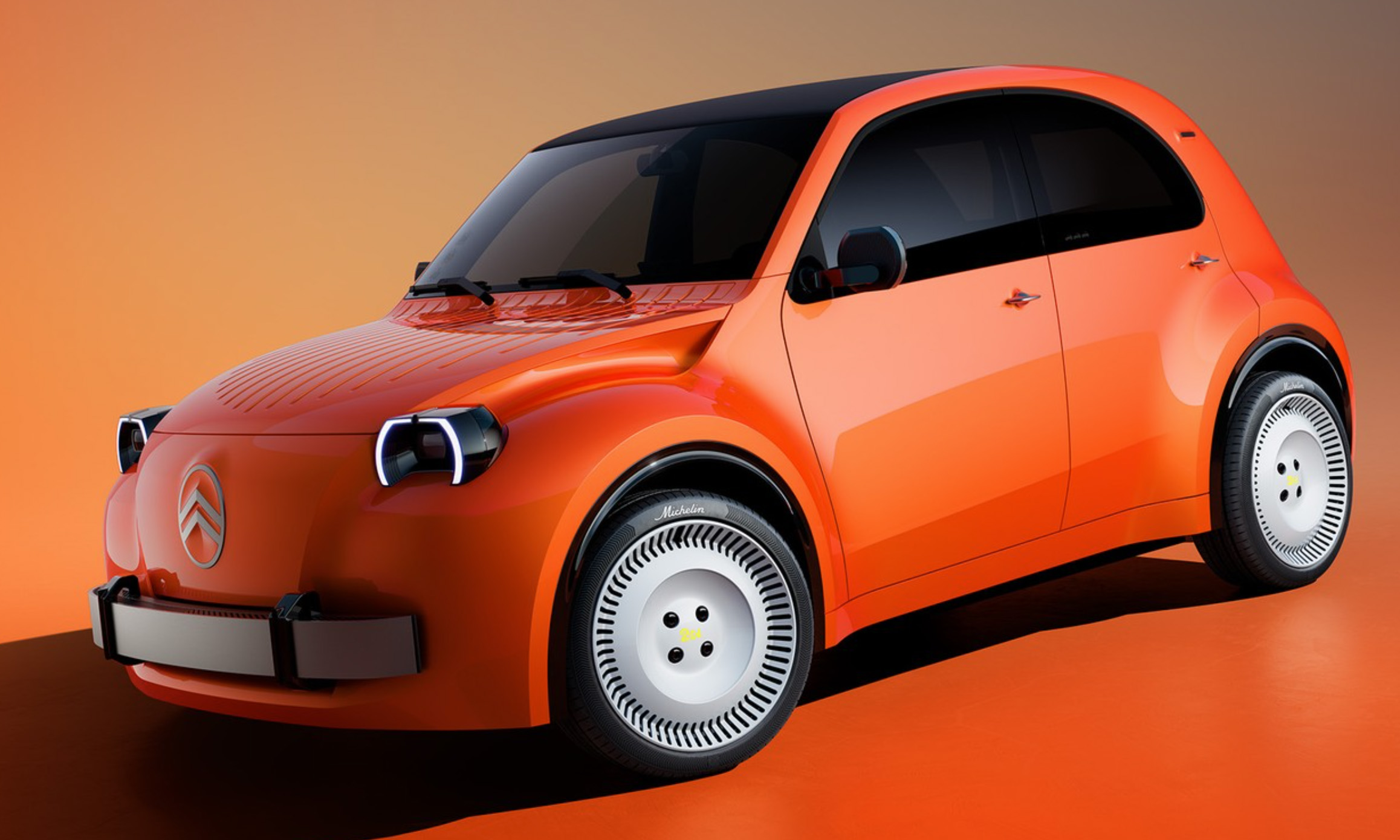
The issue is that one of the key – possibly even crucial – design elements of the 2CV is the rear skirted fenders. There’s something about the way they look that just complete’s the 2CV’s distinctive look and differentiates its silhouette from other cars. For example, with some detail changes, one could almost turn the overall shape of the 2CV concept into a new-new-new Beetle concept. But once you skirt those rear fenders, it’s unmistakably a 2CV. Here, look – I had the Bishop quickly mock up a fender skirted 2CV concept:

That’s so much better! And it would have been trivial for Citroën to do! I have no idea why they didn’t. I suspect that should this car make it to production – and I hope it will – the aftermarket will pick up the slack to correct this misstep.
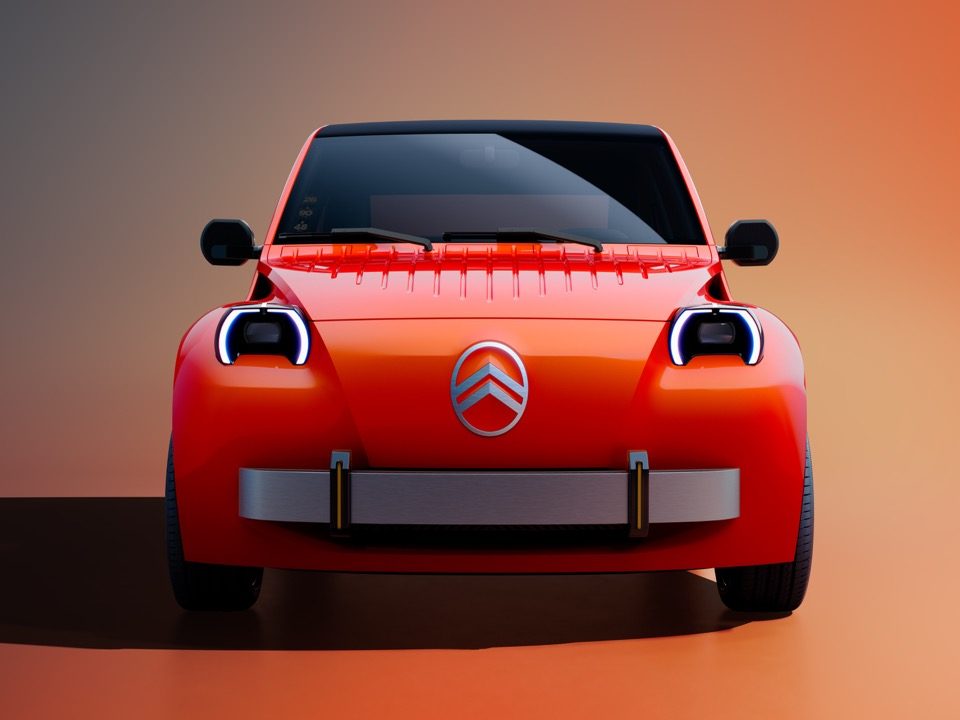
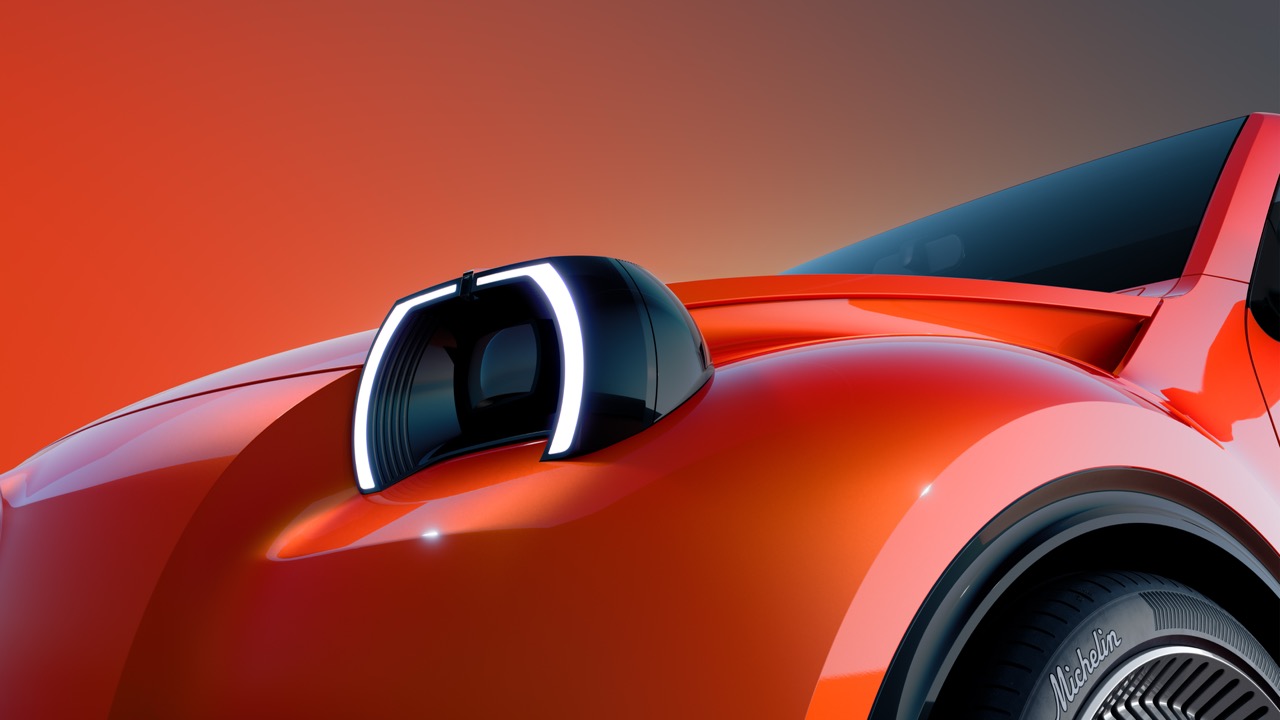
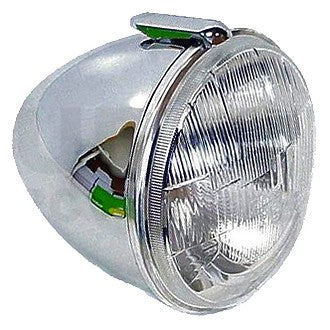
Otherwise, I’m really quite taken with this updated 2CV look. The large, separate headlights have been retained, with a shape that is somehow both round and rectangular, covering all the types of 2CV headlights, and the turn indicator has been integrated into the headlight unit in a way that I think suggests the old car’s headlight tab that was used to open the lamp to change the bulb; it’s the little tab in the center (I think):
The rear of the car also has a lot of very direct old 2CV design quotes, including the black color, which suggests the very early cars that used a canvas rear trunk lid, but also has a physical trunk lid with the same three embossed thin vertical thin rectangles in the center, and a T-shaped trunk lid handle:
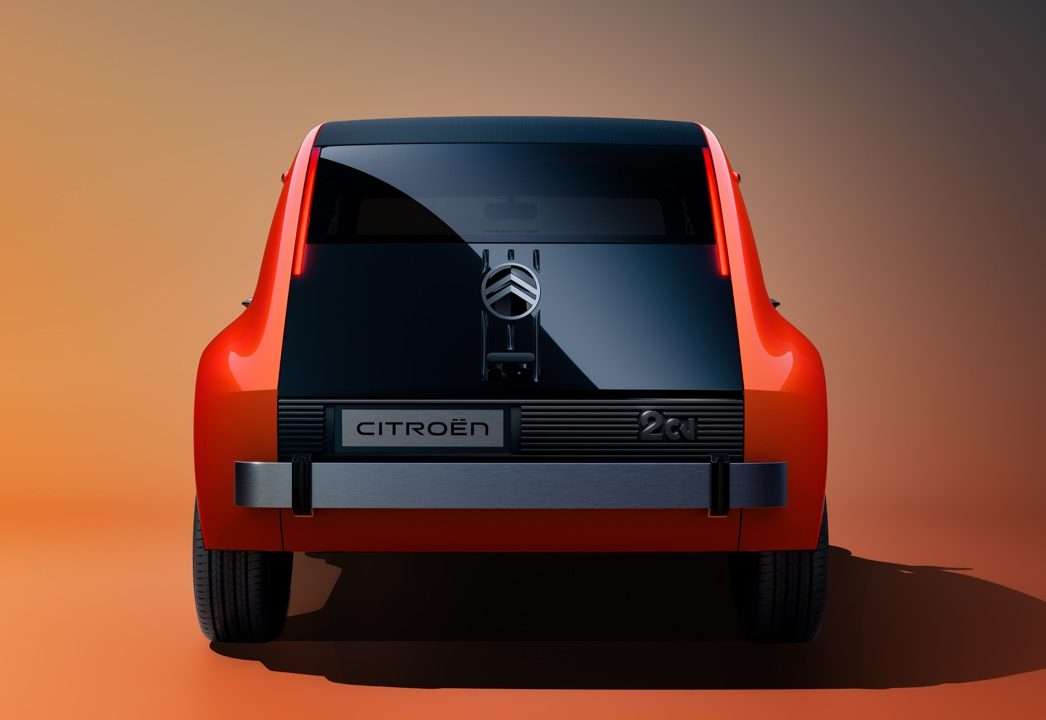
The off-center license plate is reminiscent of really early 2CVs also, though those thin taillights aren’t really anything close to what 2CVs have had in the past. 2CVs had low-mounted taillights, and I’m a little surprised not to see lights integrated into that ribbed lower panel.

Speaking of ribbed, not only does the hood have the 2CV’s trademark ribs, but this new one also has opening air vent flaps right there on the cowl, just like the original did. Here there’s multiple smaller ones instead of one full-length air flap like on the original.

I do very much appreciate this detail, that scalloped intaglio scooped-out area under the hood and on the between-hood-and-fenders filler panels of the original car. They really help sell the deux cheveauxitude of the car.
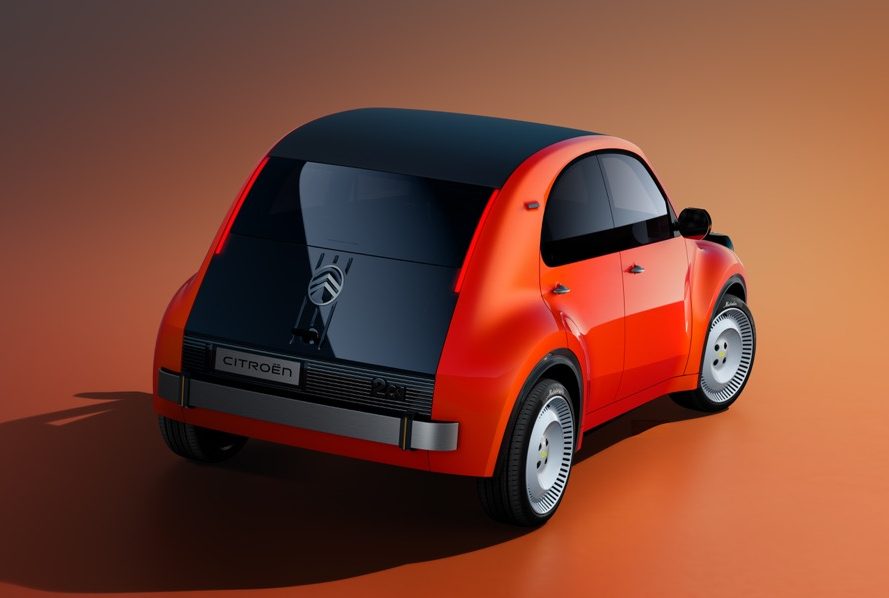
It’s also worth pointing out those stainless steel-looking bumpers which feel a bit like the old car’s bumpers and are quite different from the essentially non-existent bumpers of modern cars, which tend to be painted plastic caps on either end of the car. These bumpers actually seem like they may be useful for protecting the painted body panels from damage, and the press release seems to confirm not just that, but that they are, in fact, separate pieces designed to be easily replacable:
“Innovation isn’t always about adding features; it’s also about simplifying. Design choices that also take into account mass production and ease of repair: flat surfaces and direct air intakes beneath the windscreen, bumpers separated from the bodywork and replaceable independently…”
I love hearing that from a major automaker.
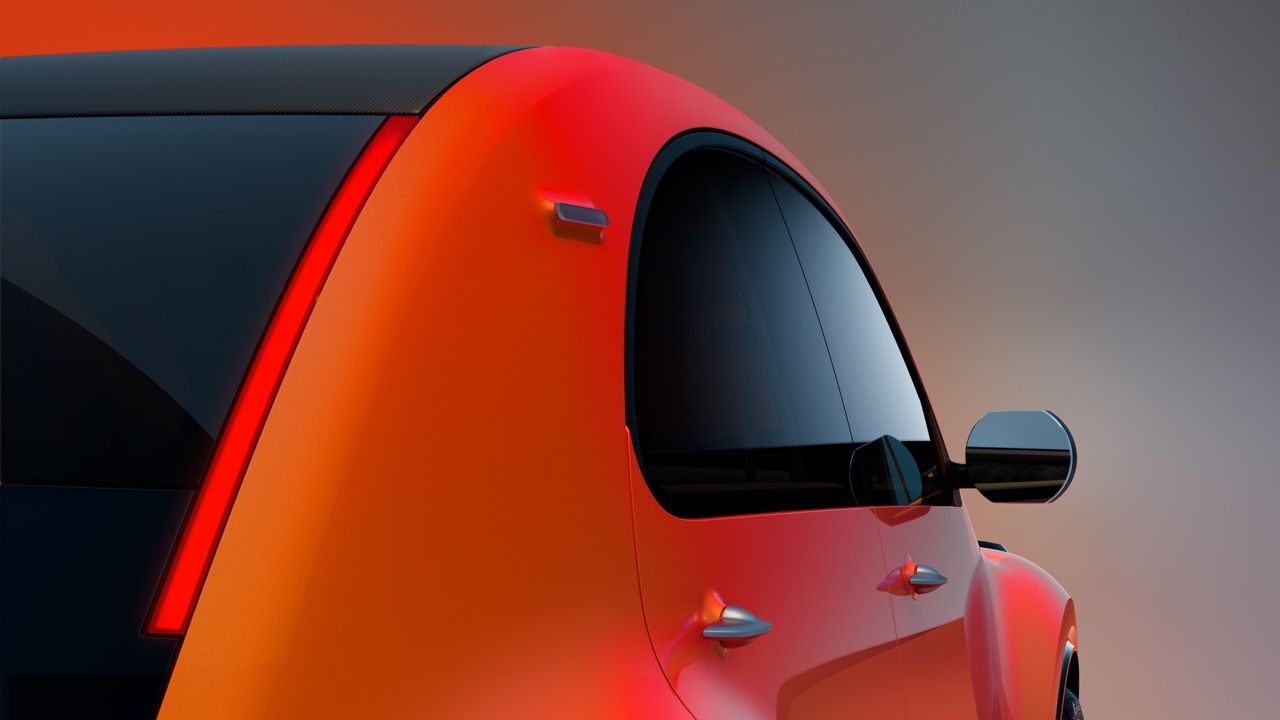
The C-panel-mounted indicator repeater is a nice touch, especially since the design is based on the pre-’65 versions with no third side window, and those door handles are charmingly close to the original. But when it comes to this car’s real charm, I think the interior is absolutely laden with it:
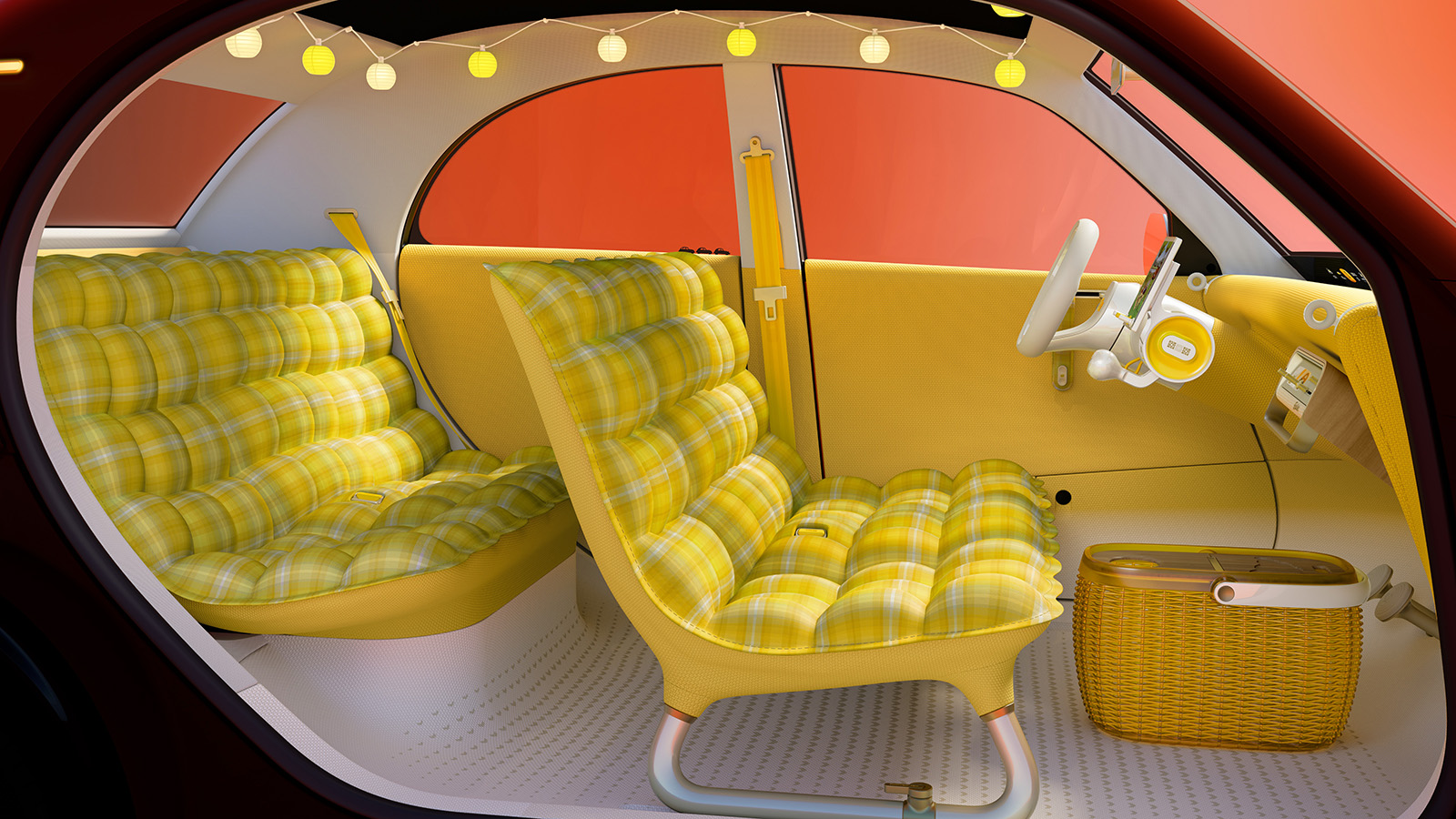
Look at that! The 2CV’s lawn chair-style seats inspired these much more padded looking seats, and the tartan plaid pattern was absolutely an original 2CV affectation. There’s the flat floor of the original car, and looking at that floor reveals a little latch on the driver’s bench support, which makes me wonder if this seat is designed to be as easy to remove as the orginal car’s seats.
And look at the string of lights! Is that standard?
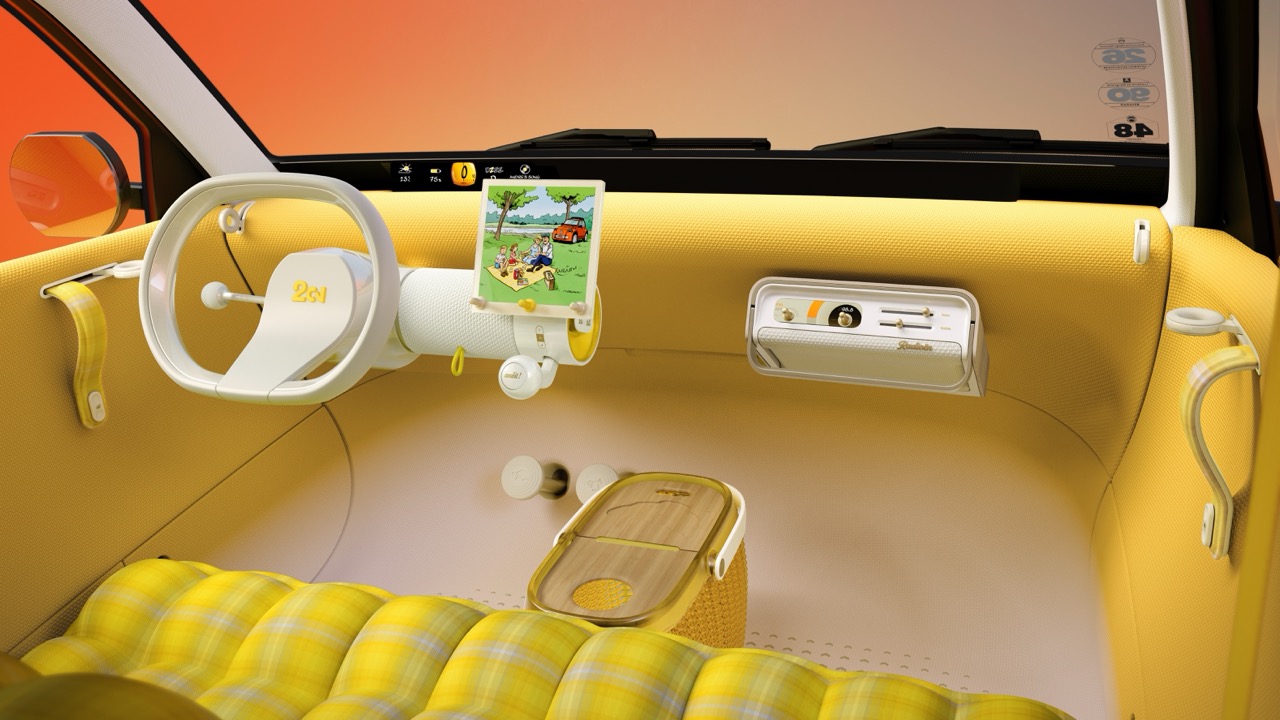
The dash captures the unrelenting simplicity of the old car, but makes it all a lot cheerier. The strange umbrella handle shifter is still there, the steering wheel has one spoke, just like Citroën likes, and that radio unit is removable and can be used outside of the car. The center console there – something that was absent in most 2CVs – is made to look like a charming picnic basket.
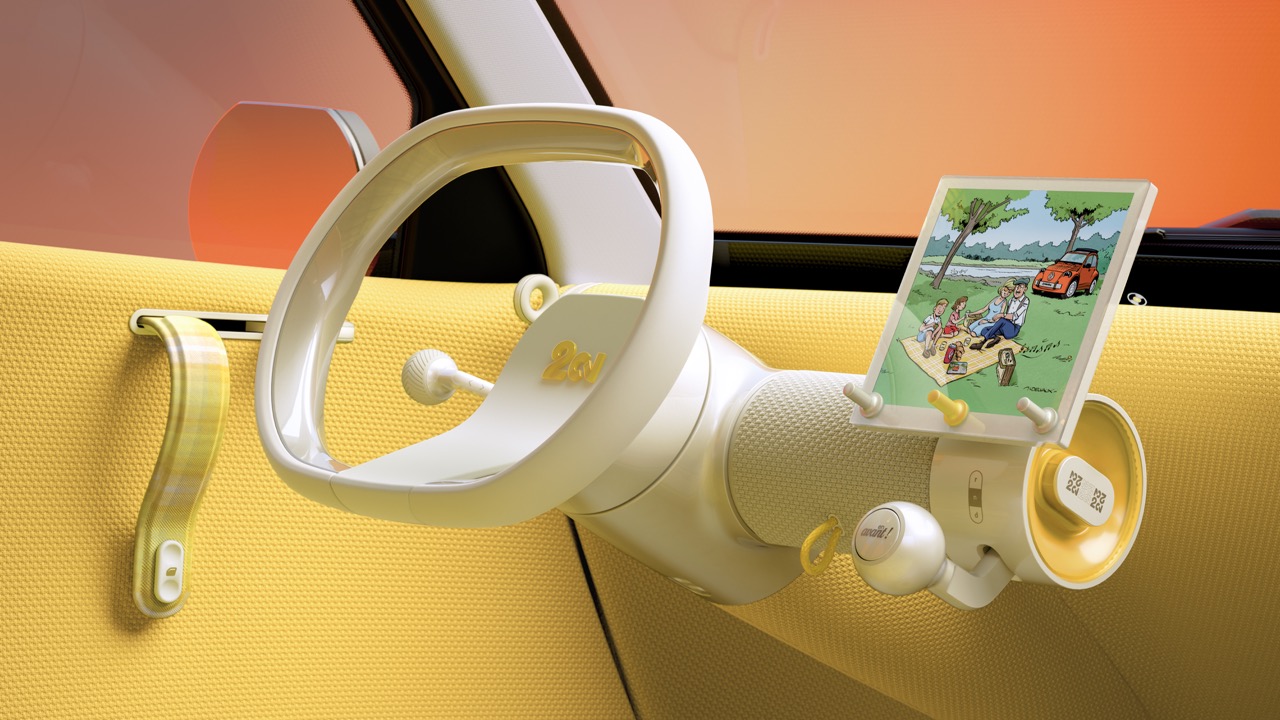
There’s a strip right under the windshield that has most of the instruments displayed on it, and a center-stack screen, which seems to have a nearly square aspect ratio, is where the rest of your controls are, and it seems to have three knobs that can be re-configured by software. The UX shown on the concept car seems inspired by Hergé’s Tintin comics, which do have a 2CV tie-in.
The roll-back fabric roof of the OG 2CV has been retained, too, to my delight, and also delighting me are the facts that the press release claims efforts will be taken to keep the car light, and, more importantly, cheap: the target price is 15,000 Euros, which comes to about $16,800 American Freedom Eagle All-Beef dollars. That’s fantastic.
There’s no specs given yet on horsepower or range, though I can make some guesses? I wouldn’t be surprised if there was a front-mounted motor driving the front wheels and making about 115 hp, and a range of, oh, let’s say 225 to 250. I’m just speculating, of course, but I would not be shocked if the production car, planned to come out in 2028, has specs close to those.
I’m very excited about this car. Other than the lack of a skirted rear wheel, I think Citroën has done a fabulous job dragging the 2CV into this modern Electric Age, and I appreciate how much they seem to be trying to keep to the original car’s goals of being cheap and charming, rugged and useful, acceptable and classless transportation for everyone.
Will the production version live up to these lofty yet humble goals? Will it really be able to be sold that cheaply? I sure hope so. I guess we’ll just have to see.



OK, hear me out: the US Dealers selling individual brands Dodge and Chrysler become “Stellantis” shops, selling Dodge and Chrysler PLUS whatever other Stellantis products they can easily get into the US; which, being EVs mostly, should be at least somewhat easy. This 2CV? sold. I want both the sedan and the Fourginette (spelling). And yes I understand these are just the concepts.
Yeah, no emissions issues with EVs, but you’ve still gotta do crash testing. I think e-cars are going to be frozen in time for crash standards, but still have to meet the current ones, which I believe are similar enough between Europe and the US to not be a problem?
If it looks remotely like that when it comes out, I can’t wait to be envious of europeans for having that option, just like I am with the Renault 5
I think it looks like a Luce was artificially inseminated with a clay model of a cartoon car. Not for me.
Sadly the interior has zero chance of looking like that, but hopefully they can approach its awesomeness. Jolly good job, Citroen.
As a big fan of friend-shaped cars, I love this concept so much. Channeling my inner Marie Kondo, we need more cars that spark joy like this. I’m still not a fan of spartan interiors (granted that’s pretty apropos of the OG 2CV), but everything else about this concept speaks to me. Even the orange they chose reminds me of my 500e(s, I have a problem). Between this, the new Renault 5, and the Honda e, I don’t think I’ve been more bummed out seeing a car that we won’t get in North America until 25 years after the fact.
Europe is getting all the good EVs, for real.
I absolutely love this concept, and wish like hell VW would do something similar to revive the Beetle nameplate as a simple, charming, cheap, and modern ev commuter.
To quote Wayne White, “it’s so beautiful, it hurts my feelings”
Well done, Citroën!
> wish like hell VW would do something similar to revive the Beetle nameplate as a simple, charming, cheap, and modern ev commuter.
VW: “We’ve listened to our customers and present the New Beetle II, our newest diesel-electric crossover, starting at $48K plus destination”
I’m smitten. Just when I thought I didn’t like any modern vehicles, and also that EV had no personality.
The bumpers and the ease of panel repair should be lauded as industry leading and celebrated all over the world. Keep cars going and let them be repaired.
Perf.
I hope they have the guts to make it, and export it. To sell it in France it has to pass European crash standards so it’s only a few tweaks and an NACS charging port away from US compliance and this gives Stellantis something for Fiat dealers to sell
Or, hear me out, a new Neon.
I hope someone will make an aftermarket skirt for the rear wheel. This is so cool though. I love how happy it is. Cars are all so aggressive and mean now. This is an antidote to that.
Great cute car, and I see a body made from composites rather than metal. Maybe that’s the color choice creating that illusion?
If/When this makes it into production, I’m so curious how many of the fun design choices here get into the hands of a customer.
I love this, but also it looks like it came straight out of one of those Chevron claymation commercials.
My current 2022 electric Mini Cooper S gets about 115 miles of range. Anything above that is great for just city driving. Got a Tacoma for the rest of my needs.
But the alleged price point is great, too! I paid a good $20,000 American Freedom Eagle All-Beef dollars for the used Mini with about 24k miles on it.
I hope you’re right on the specs but I think you’re being wildly optimisitc. I think we’re going to see 80hp and 150 miles of range. This will compete with the Twingo.
Hard to say where the power numbers will end up, but I agree that Torch’s 225-250mi estimate seems optimistic. Except that he didn’t specify miles… Perhaps he was thinking WLTP range numbers in appropriately Gallic kilomètres.
While this isn’t the sort of car I would buy, I wish more automakers would make more cars like these.
The exterior looks like a clown car…but the interior is to die for!
Two design details make me wonder whether this concept car could pass EU type approval in its current form, namely pedestrian safety, when put into the production.
The headlamp housing looks perfect for shearing the arm off the pedestrian who doesn’t look at the traffic before crossing the street. Same with wipers where the pedestrian’s face could sieve through.
The solution is to make housing pivot into the body when pressed like those Mercedes-Benz three-point star hood ornaments. The wipers could tuck into the A-Pillar when not used like 2005–2012 SEAT León and Altea (Ferrari, SEAT has best solution to the obnoxious wipers on Luce).
Brilliant idea. I can see exactly what they’re doing and I wish more manufacturers would tap into this.
Kind of gives me PT cruiser vibes, and that’s fine, I liked the PT! I love this car, and yes, it needs the rear fender skirts. That plaid interior is awesome!
I put my hand over the front end and you’re absolutely right. Son of PT Cruiser.
I like it and love what this new e car / M1E class stands for. Peoples cars that are inexpensive to buy and cheap to operate. If they can really deliver for €15k with at least 150 miles of range I think they have something.
The happiest new car I’ve ever seen. Build it.