

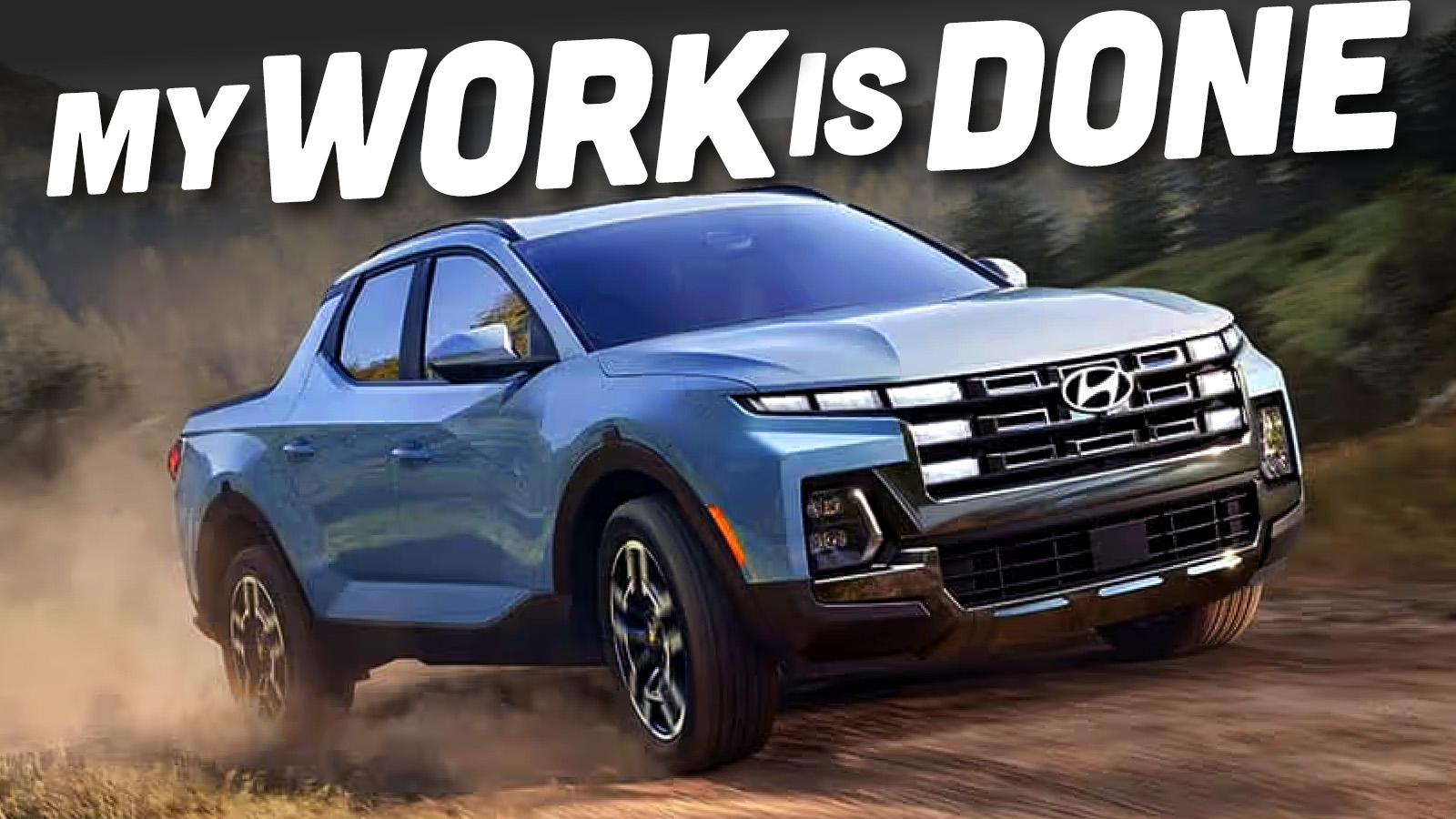
The Hyundai Santa Cruz is a charming little compact pickup truck that blasted onto the scene in 2021 with much fanfare. It was the first such-sized pickup to appear in the American market for some time, and Hyundai’s first attempt at breaking into a utilitarian segment.
Though it’s only been around for a few years, Automotive News, citing unnamed sources, reports that Hyundai is planning to cut and eventually end production of the Santa Cruz, with no direct replacement planned.


While Hyundai declined to comment on whether the Santa Cruz is actually on its way out, a spokesperson told The Autopian the pickup “has helped Hyundai gain valuable experience and visibility in the open-bed market.” Here’s what we know.
Allegedly Cut Short Due To Slow Sales
Automotive News spoke with several sources on Hyundai’s move to reportedly kill off its compact pickup ahead of schedule, citing low demand. From the article:
Originally slated to continue through the second quarter of 2027, Santa Cruz production now is expected to end sooner, a person briefed on the plan said.

Another source confirmed the phaseout, driven by weak sales and elevated inventory. The truck’s only like-sized competitor, the Ford Maverick, outsold it 6-to-1 in 2025, leaving Hyundai dealerships with nearly five months’ worth in stock at year end.
Hyundai has told suppliers it is cutting Santa Cruz production by roughly half this quarter, one source said.
As Autonews points out, discontinuing the lagging Santa Cruz would free up space at the company’s Montgomery, Alabama assembly plant, where it also builds the Tucson. The Tucson, coincidentally, is Hyundai’s most popular car—the Korean automaker sold over 200,000 of them last year, an increase of 14% over the year prior. Going by a pure demand perspective, shifting resources to the car that people want more of isn’t a bad move.
If It’s True, I’m Not Terribly Surprised
Since the Ford Maverick’s debut, the Santa Cruz has been playing second fiddle in the small (but very competitive) compact pickup segment. The Ford is both more efficient (38 mpg combined versus 25 mpg for the Hyundai) and has a more spacious bed (4.5 feet long versus 4 feet for the Hyundai). The Maverick is also cheaper, starting at $29,840 including destination, compared to $31,350 for the Santa Cruz.
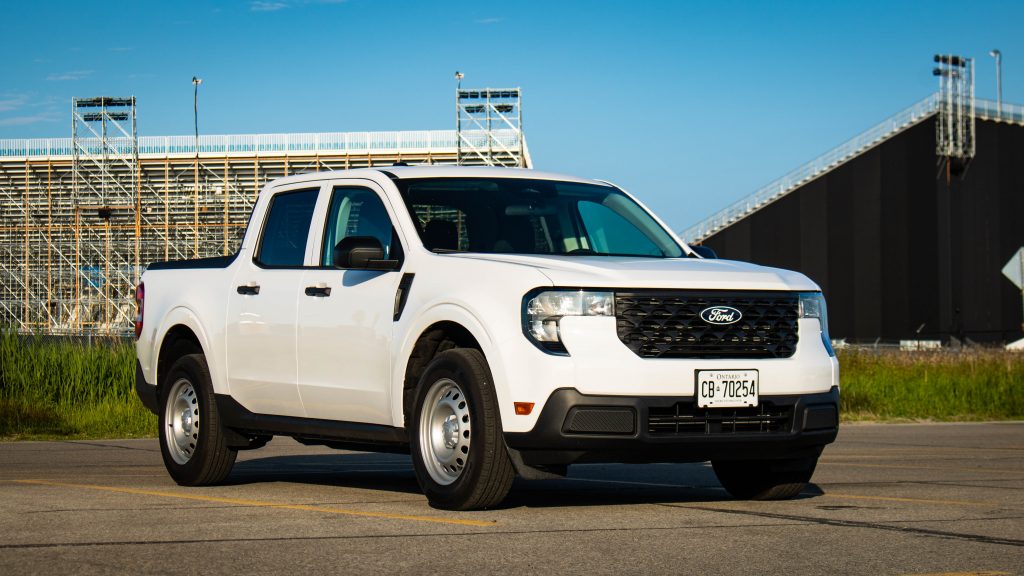
Buyers overwhelmingly prefer the Maverick. Ford sold 155,051 of the little pickup in 2025, while Hyundai sold just 25,499 Santa Cruzes.
Even if the Santa Cruz could match the Maverick’s specs and price, I suspect the sales numbers would remain similar. Ford is as well-established in the pickup truck game as a brand could be, while Hyundai has never sold any sort of pickup truck in America before this one. Which brings me to why Hyundai says it’s happy with how the Santa Cruz has shaken out in the American market so far.
Hyundai Is Looking At More Than Just Sales Numbers
A Hyundai spokesperson I reached out to wouldn’t comment when asked to confirm whether Automotive News’s reporting was accurate, but they did provide some interesting insight into how the company is measuring the Santa Cruz’s impact on the U.S. market. Here’s the full statement:
“The Santa Cruz Sport Adventure Vehicle continues to be a valued ongoing member of the Hyundai product portfolio. As with all Hyundai vehicles, long range product portfolio planning is guided by many factors including consumer demand and overall market trends. We don’t comment on future product speculation.

Since its launch in 2021, our Santa Cruz sport adventure vehicle has successfully introduced Hyundai to a new type of U.S. consumer who values the capability, versatility, and rugged image of open-bed vehicles.
Not only does Santa Cruz continue to be a valued ongoing member of our product portfolio from a sales perspective, the model has helped Hyundai gain valuable experience and visibility in the open-bed market. These developments contributed directly to the announcement of a new midsize body-on-frame truck that we confirmed during our 2025 CEO Investor Day last September. That vehicle is due in the U.S. market before 2030.”
That last paragraph is the important part. In essence, it suggests that Hyundai is using the learnings it’s gained from developing and selling the Santa Cruz to U.S. buyers as a stepping stone for the bigger, body-on-frame truck it plans to launch in the near future (2029, per Automotive News).
All things considered, that makes a lot of sense—while the Santa Cruz isn’t (wasn’t?) a gigantic, runaway success, Hyundai surely learned a whole bunch about how to market a pickup truck in America, and now knows far more about their buyers and their preferences. That intel alone is extremely valuable.
This new truck will likely look and drive far differently than the Santa Cruz, a unibody truck that shared much of its design with the Tucson crossover. This one should also be bigger, and compete with the likes of the Ford Ranger, the Chevrolet Colorado, the Toyota Tacoma, and the Honda Ridgeline, rather than the Maverick. Whether it’s any more successful, well, we’ll just have to wait a few years and see.
Top graphic image: Hyundai




I wish that instead of giving up, they instead worked to make it more competitive with the Maverick… like figure out ways to make it cheaper and also give it an affordable hybrid option
This is just terrible—Hyundai fails the logic test. Yes, the Santa Cruz has too bad fuel economy and too small a bed, and the Maverick proves there’s great demand for a compact truck, but Hyundai’s takeaway is it needs to build another conventional, oversized truck. And, sadly, it’ll probably meet with great success!
I’d hardly call a midsized oversized but yes, it might sell better. Unless they follow Kia’s design cues.
680901-6720e0d365705.jpg (1920×1080)
The Tucson, non plugin hybrid starts at 30K, you would think removing trim, glass and part of the roof would be a cost reduction.
But Maverick was played well from a sales/loss leader perspective. it also has the benefit of being a ford in the fleet game and they are, or at least were doing everything they could to try to fit real truck stuff onto these little fellers to try to get the then 22-25k hybrid work truck to work out for light duty fleet customers. doing that made the demand go up as the people wanting any form of the truck ran into supply hurdles, real or not it resulted in demand.
Outside of the things catching fire when the oil leaked from them due to a machining error(which was fixed by drilling holes in the belly pan) and the Ford wide 12V Battery lawsuit, ford has done fairly well keeping the numerous other recalls kind of low on the media radar, so it has not affected sales demand as much as it probably should considering starting price is now where it probably would have been initially if not for the loss leader sales tactic.
The Santa Cruz was always the Mercury Capri to the Ford’s Mazda Miata in the compact truck segment.
Deep cut, but you’re not wrong.
My son has a Mercury Capri as a daily. It’s… fine. Where the Miata was/is delightful.
Likewise, I am delighted by my Maverick. But everything I read about the Santa Cruz is… fine, I guess.
I appreciate you getting the reference.
I live in an area where Hyundai’s are surprisingly popular, and Crosstreks and Outbacks are everywhere. I expected to see tons of these, but I rarely do. In this case, Ford indeed had the better idea.
In a US market that wants trucks more for their image than for their utility, Ford’s looks like a truck and Hyundai’s looks like a car (especially before the refresh).
I suppose they could put a bed on the Sante Fe to get a square nose version, but truck types don’t see a truck in either of these, the maverick was pretty low priced for something that claimed almost 40mpg and it was car enough in overall size to avoid the basic person just looking for a Focus replacement to not be scared off.
I have to admit that I really don’t like the styling of the latest Santa Fe. It reminds me of a Geo Metro for some reason. Especially the tail lights.
Some Might say it is a Temu Ford Flex https://www.reddit.com/media?url=https%3A%2F%2Fi.redd.it%2Fi8coavte5k2f1.png
Welp, I can’t unsee that now. But that said, I liked the Santa Fe before (not sure I’d have one, but I’m glad it exists), and I liked the Flex, so…
You are so right!
Agreed. The people buying a truck for the image aren’t looking at compacts at all, and even midsizers are lucky to get more than a glance (though, for better or worse, the overland crowd have done a lot for the image of midsize pickups).
Don’t get me wrong, I like the soft-yet-trucky styling of the Maverick, but the more car-like styling of the Santa Cruz is hardly a deal breaker, and I think it looks more proportional. But in this market segment, who is spending more money on a bulkier vehicle that gets worse fuel economy and holds less stuff?
the tricky part is the prices are getting very close. the options less so. so the maverick gets the win here. I will say the Tucson and Santa Cruz front end treatment is probably more polarizing as well, i get it. But I do think the Santa Cruz might have done better had they responded faster in 22-23 and sold some Tucson Hybridized Santa Cruz’s as loss leaders for around 25K
I’ve always liked the Santa Cruz.
People talk about the price compared to the Maverick, but honestly, the actual sale price of most of the Santa Cruz’ are at or lower than the Maverick. My local Ford dealer doesn’t have a single Maverick for under 32k. And that Maverick is an XL with basically no equipment, and steelies (though I do like the steelies).
Yes, Hyundai should have given this a hybrid. Yes, it should probably look better. But otherwise, it seems like a nicer vehicle, and the value isn’t as bad as it seems. I think a lot of people just think the Maverick is super cheap because at one point it was, and then Ford basically pulled a bait and switch and shot the price up to the moon.
I’ll add, my local Hyundai dealer has A LOT of Santa Cruz’ sitting on the lot, so I guess I’m not surprised by the potential cancellation. Still a bummer though.
they never made a Hybris Santa Cruz that ever sold (at least on paper) for under 30K, in fact they never sold the hybrid version at all.
the first year Maverick looked like this on paper.
The 2022 Ford Maverick Hybrid base MSRP of $19,995 for the XL trim, excluding the $1,495 destination charge. Total starting price with destination was $21,490. Fuel Economy: 42 MPG city / 33 MPG highway
However, the tricky part was those were limited in build volume and mostly only available to fleets. So each subsequent year they claimed failure to meet demand, though it was on purpose, and due to the related demand the dealers were marking them up a lot anyway.
Kia had hybrid and even full BEV options in 2022, but even if they had swapped the gas motor to a hybrid, they could not have dropped the price to the same price without taking a big loss on each sale. Ford Gambled and it seems to have paid off a bit for now.
I don’t think there was really any prioritization of XLs to fleet (vs retail customers) and the intended build mix being only 15% XL was known fairly early. Many fleets ended up just switching to FWD/AWD EcoBoost XLT which at that time weren’t that much more expensive (<$2k).
I base this upon the hundreds of fleet units sitting in the holding lots around here while the vast majority of people online were complaining about getting one.
I think this is also the reason why we will never see another Subaru Baja based off the Outback. The market again proved it’s not worth the cut in production of the Outback.
If Hyundai had a hybrid powertrain from the start at about the same price as the 2.5T I think it would have been much more competitive. The upper trims were pretty comparably (arguably better) equipped than the XLT/Lariat + luxury package for about similar price, although the mandatory roll-up tonneau on those SC trims ate up even more of the limited bed space. But by the second model year Hyundai blinked first on really raising the pricing and that did in those cross-shopping with the EcoBoost Maverick.
Ford using the hybrid as the base powertrain in the Maverick was a brilliant maneuver. It’s faster and far more efficient than the base Hyundai engine.
I don’t mind the looks of the Santa Cruz, its interior is far nicer, the optional turbo engine looks roughly equal to the Maverick’s optional turbo, and if there’s one dealership worse than our local Hyundai it’s our awful hillbilly haven Ford dealership.
But base powertrain to base powertrain the Ford is so much more appealing.
I love the way the Santa Cruz looks. They always get a head turn from me when I see one out in the wild. And they look way better than the Maverick. That said, I could never come up with a use-case to justify buying one. I need a covered cargo area way more than I need a flatbed (my dog is in the rear of my car at least four or five days per week, and I’d rather my groceries be covered, or not smashed under a tonneau cover). And if I did need a truck, I imagine I’d want at least a slightly bigger flatbed. Still though, they’re pretty sharp looking and I wish I could justify getting one.
I was very seriously looking at these a few months back, I’ve always really liked them as well. I talked myself out of it for most of the same reasons you did… I need a truck to do truck stuff for about two hours about twice a year, and then I just rent from Home Depot.
You two are the reason why it failed. If Hyundai couldn’t get you guys to jump, then who was their buying market?
They didn’t buy them because they are Autopians. Round here dont buy new. We buy ten years old and high milage
True dat!
Doesn’t seem to matter what I do
I’m always number two
No one knows how hard I tried, oh-oh, I
I have feelings that I can’t explain
Drivin’ me insane
All my life, been so polite
But I’ll sleep alone tonight
Cuz I’m just
KenSanta CruzIts because it looks like they took a car and carved out a bed in the back. It doesn’t remotely resemble a truck and its not very useful- as a truck- either
Just like every ute ever made. It’s useful enough as a truck to make me want one for a while. I’m not hauling 4×8 plywood or construction material. I just needed something to haul a small load of junk to the dump or some gardening stuff from Home Depot without getting the interior of my SUV all dirty and stinky.
The Santa Cruz does have one thing on the Maverick, and that’s its towing capacity. It’s capable of hauling my little British sports car on a U-Haul trailer, where the Mav can’t. It would have been perfect for me, if I could have convinced my wife to drive a pickup.
In theory the Santa Cruz had better towing capacity, but in practice the DCT really didn’t like getting worked hard by that sort of thing as well as stop/go or off-road.
That’s good to know, thanks!
I should also note that what I said was true at the time I was cross-shopping. It looks like the Mav has since made available a towing package that bumps the tow rating from 2000 to 4000. Still not as good as the SC’s 5000, but it does put it in contention for my example use case.
The Maverick always had the 4k towing option for the EcoBoost AWD. MY25 added it for the Hybrid w/ AWD.
Well, regardless, I still had the wife problem, so it was a no-go either way.
I delivered one to a customer when I was gigging as a transport driver for our local multi-brand dealer. Drove it for about an hour and basically other than being a little stiffer than the SUV it’s based on, I basically forgot about the bed part until I looked behind me.
The woman buying it was late 50s I would say and when I asked why she picked it she said it was so she could take her lawn mower to the shop without having to pack it into an SUV.
So 1 use case, and it wouldn’t be hard to argue there are easier ways to do that one task, but a $40k trucklet was her answer.
A retired family member has a Santa Cruz, and for the life of me I couldn’t identify why they went for it over the Maverick except that they sold a Palisade to buy the Santa Cruz. It is a nice vehicle, but for the utility and efficiency the Maverick is better. For the interior usability, the Ridgeline is better. It just exists in a price point where everything it does or might be cross-shopped against does things better.
Brand Loyalty is a hell of a thing.
In another light, is being able to produce niche cars like this going to be a victim of the tariffs?
If exports from the US are tariffed in response to what the US has been doing, then it forces you to re-organize a bit and can’t pick up on these.
Bed was too small, price was too high. We all know it, we all said it.
If this thing looked like a Slate, businesses everywhere would have one, maybe a fleet.
Seeing it is based on the Tuscon, which has a hybrid and PHEV model, did they ever explain why they didn’t at least offer the hybrid?
I’m interested in a Maverick…hybrid. If I want a truck that gets low 20’s mpg, I’ll go get a Ridgeline.
Volume. The Tucson is a car that sells at probably 10 times the rate of the Santa Cruz or more. Battery resources are finite, so Hyundai decided they’d rather make a midsized SUV hybrid than a weird truck-thing hybrid. I assume their market research also told them truck owners don’t give a rat’s ass about fuel economy…which is largely true, although if they thought they were going to woo Tacoma buyers they were delusional.
What they didn’t get is that the people that are interested in this or a Maverick aren’t the usual truck crowd, and care about fuel economy.
Bingo. It just got crowded out of the hybrid platform, and its turn never came. And that was it. And that was always going to be it, once Ford nailed the Maverick and started it at 23, originally. When I almost bought a Maverick, an XLT with the lux package, or whatever it was back then,
retailedMSRP’ed for 28.The Tucsons built in Alabama do not have the hybrid power train available, only the naturally aspirated 2.5L four cylinder. The engine and transmission are installed in the Santa Fe Hybrid, but the battery pack is different from the Tucson. All Tucson HEV and PHEV are assembled in Korea, and none of the Santa Cruz are assembled outside of Montgomery Alabama. So therefore they can’t LEGO the pieces together at HMMA to assemble a Santa Cruz hybrid. They probably didn’t even package it though which is a shame. However the 1.6L turbo hybrid is still far less efficient than the 2.5L Atkinson Cycle in the Maverick/ Escape especially in PHEV form. 28 ish mpg highway sucks compared with upper 30s low 40s out of the Escape PHEV though that is only fwd vs the mechanical AWD of the Tucson PHEV
Took em too long to ditch the DCT and the bad mpg/no hybrid didnt help either. Overall I think they’re pretty neat, hopefully the mid-size will be a solid contender.
I’m guessing a quiet part of the production capacity angle is that amid the tariff situation, this could free up room to make more hybrid Santa Fes/maybe add hybrid Tucson production.
If it weren’t for that I think Hyundai would have considered producing it for a long time with updates here and there along the way, like Honda has with the Ridgeline.
I think Hyundai sold exactly the amount of SC’s they intended to sell. It didn’t have the volume aspirations that Ford had with the Maverick and for Ford part of that is necessity, it was always going to be the higher volume model just by virtue of its positioning. Ford has a fleet market to serve, it’s the entry point for the brand and started less than its platformmates. Hyundai has a fuller lineup and 4 models that start at a lower price than the SC.
Very Mazda 5 vibes with this whole thing.
The Maverick has succeeded because the US is truck-centric. Even while some folks argue that the Maverick isn’t a “real truck” (whatever that means) it looks like a truck.
Meanwhile, the Santa Cruz is neither fish nor fowl. It doesn’t look like a truck, it looks like a CUV with a roof-ectomy. Same thing happened with the Subaru Baja.
Honestly, 25mpg is insulting. A freaking F-150 can best it in certain configurations.
Shoot, I got 26 mpg while cruising at 70 mph in the F-150 FP700, and that thing was a supercharged V8 that wanted to do nothing but burnouts.
I rest my case, your honor.
Once that truck is up to speed it takes very little power to keep it moving at that speed, whether the engine makes 700hp or 190.
To be fair, my lifted AWD Ecoboost Maverick only does 23. Decent for a Truck, not amazing for a Maverick.
Given all the underbody nooks and crannies that you exposed to the wind by lifting the truck I think you’re doing pretty well mileage wise.
You’re comparing combined estimates with highway estimates – this is crowdsourced data and usage/configurations naturally vary but on Fuelly the F-150 2.7T sits around 18-19 MPG (17 for the gas 3.5) and the Santa Cruz around 23-24 MPG.
Pretty standard numbers for a mid-to-full-size BOF truck/SUV and the Santa Cruz is pretty standard for a compact-to-midsize Hyun/Kia crossover. Still, it’s a 5 MPG so maybe just under 30% improvement.
It’s not appealing, but I don’t know about “insulting”. This is a 4,000 pound vehicle with no electric assistance to help that mass accelerate. 25mpg is about what you can expect there.
An F150 at a slow steady cruise can of course get the same mpg as a Santa Cruz that is repeatedly slowing down and speeding up in combined driving. I’m not sure why we comparing the combined mpg figure of one to the best case scenario of the other and then acting like that means something.
Sir, this is the internet. Get out of here with that sort of reasonable thinking.
Yup. Phil needs to learn how internet arguing works. Send him to reddit fir a while, get him up to speed.
The biggest difference I see between Maverick and Santa Cruz is that Maverick was truck that happened to be compact while Santa Cruz was a compact that happened to be a truck.
Two VERY different buyers.
I, for one, have a Maverick. It continues to be an incredibly handy little trucklet. It does most of what I need it to (I’ve only been let down by its bed size once). I would describe it like a multitool: Is it the best screwdriver/knife/bottle opener in the world? No. Is is incredibly handy in a pinch? Yup!
I have a Maverick hybrid, and I agree that it is very useful and outperforms it’s price point. (I ordered mine when it was announced and paid a lot less than it retails for today.) Both the Hyundai and the Ford are unibody vehicles, so in my mind they’re equal on that. I actually like the looks of the Hyundai better, but it just doesn’t compete on fuel economy or price.
I wouldn’t describe the Maverick as a multitool; if the F150 is a full size screwdriver, the Maverick is a stubby screwdriver.
Maverick was built for folks who wanted a smaller truck. Santa Cruz was built as a lifestyle vehicle that happened to have a bed. Similar concepts with vastly different outcomes.
If a XLT Maverick Hybrid with a moonroof and maybe one other option had been available for MSRP at launch, I’d probably be driving one now. Do I need one? No. But anyways, that moment has passed. They could still probably sell quite a lot with just a non-turbo non-hybrid 2.5 Duratec if that were available.
Like a multitool that you carry on your belt, my Maverick is handy because it’s always with me. “Didn’t know I’d need a truck today, but here we go…”
And because it’s fuel efficient, compact, and pleasant to drive I’m not penalized for that. Again, multitool – where daily’ing a full size truck is like walking around with a carpenter’s belt loaded with full size hammer, screwdrivers, and pliers all the time.
Pretty much…
That being said, unlike a full size pickup truck, it doesn’t hold a lot, doesn’t tow a lot, and doesn’t have a ton of room. But in a pinch, it can hold 40 bags of mulch, a pallet of whatever, and tow a small trailer. Always handy.
It probably would’ve sold if they put a hybrid powertrain in it.
Yeah I was going to say I think Hyundai really screwed the pooch on this one by not having a hybrid option.
The sad part being that the Tucson had the hybrid option, but it’s truck version didn’t — and it needed it more. I’m sure there was either a tecnical reason why that wouldn’t work or, more likely, they knew it was going to just die on the vine.
They could have had the only PHEV truck on the market.
From a competitive standpoint, the Tucson needed it more. The two biggest players in that segment have had a heavy mix of hybrids. Just the RAV4 hybrid alone has run something like ~75% of of all Tucson sales the last few years and that’s of course changing now that the 2026 RAV is only hybrid.
“There he goes. One of God’s own prototypes. A high-powered mutant of some kind never even considered for mass production. Too weird to live, and too rare to die”-HST
I blame its demise on the lack of an N model
Username checks out.
Ron Swanson voice: I know what I’m about, son
Lets hope Hyundai makes a pickup with a 6 ft bed.
One can hope, but I wouldn’t count on it. If they’re competing in the mid-size segment, my guess will be 5 or 5.5 foot. And I think they’ll get their clocks cleaned in that segment, too.
Imagine a smaller than mid sized actual truck shaped with a 6ft box and aimed at the work truck market. (cool but probably still a fail)
Nissan and Toyota still offer a 6-foot bed as an option so maybe?
I still see them a couple times a day and think they’re fantastic cars especially for the retiree set (I say this because the back seat is tight, and the bed is just enough to get 10 gallons of knockout roses home from the nursery.)
I drove one of these with the 2.5t and it was…scary quick. The chassis wasn’t prepared for the power, but it was still admirable. I just hate that it was sized like a Tuscon, but priced like a Santa Fe.
You’re not wrong about them being great for the retiree set. I see loads of them in Florida.
I haven’t been in a 2nd Gen Ridgeline, but I assumed it was in the same class as this and the Maverick. The last sentence of the article implies otherwise.
I’m not exactly disappointed in the Santa Cruz departing. The Maverick simply does the same task better.
The Evolutionary Chart of Modern El Caminos is basically, left to right, Santa Cruz, Maverick, Ridgeline.
The one thing where I will ding the Maverick is the lack of style. It’s pure function, no pretense (which I appreciate), but I’m also shocked it sells so well in the current era of aggressive styling and “fake capability” — not just trucks, it’s most cars.
You ding it for that, but I praise it for it’s function-over-form approach. And don’t worry, they still make a “fake capability” version in the tremor trim.
I like the looks of the Hyundai a lot, but I bought the Maverick because better fuel economy and price.
A Ridgeline is quite a lot larger in every dimension than a Maverick and Santa Cruz.
Example Dimensions: Hyundai Santa Cruz 2021-present vs. Honda Ridgeline 2016-present
The Ridgeline is firmly in the midsize category in footprint. Maybe a couple inches shorter in length than it’s competitors?
It used to be above-average in width like the other Honda mid-sizers at 78.5″ – just 1.5″ narrower than a full-size 80″ sans mirrors – but the others have since caught up.
The Maverick and SC are ~10 and ~14 inches shorter respectively.
The Ridgeline is bigger in exterior dimensions.